















![Economic Growth. Facts, Theories and Policies [ENG]](https://i.ytimg.com/vi/eV-_pTodFO0/sddefault.jpg?v=6381cfbc)


![[노벨경제학상 심층분석] 꼰대 천국 한국 성장도 없습니다 (명지대학교 경제학과 김두얼 교수)](https://i.ytimg.com/vi_webp/-fvfK6AbZcw/maxresdefault.webp)

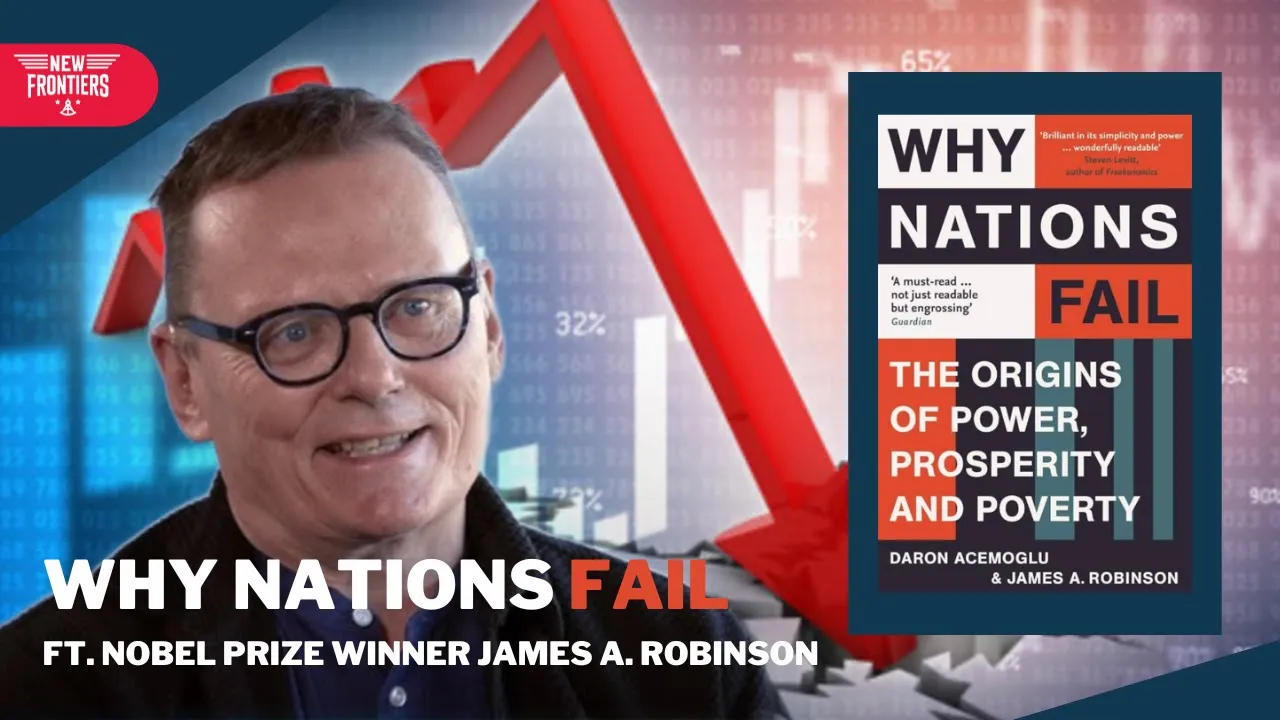












Nations become prosperous when they establish inclusive political institutions that provide broad political and property rights, encourage innovation and investment, and create a level playing field for citizens to develop their talents; conversely, nations remain poor when extractive political systems concentrate power among elites who exploit resources rather than fostering broad-based economic growth.
Why Nations Fail: Daron Acemoglu on Inclusive vs Extractive Institutions
Added:The definition of 'institutions' in economic terms, specifically how formal and informal rules shape human interaction and economic exchanges.
Basic macroeconomic concepts of economic growth, prosperity, and the historical divergence in wealth between nations.
Alternative theories of economic development, such as geographical determinism and cultural explanations of national wealth.
The fundamental role of secure property rights and the rule of law in encouraging individual investment and market participation.
The concept of 'Creative Destruction' (Schumpeterian growth) and how inclusive political systems allow technological innovation to disrupt established economic elites.
Critical evaluations of the theory, such as the debate over China's rapid economic growth under politically authoritarian and economically semi-inclusive systems.
In-depth historical case studies used to support the theory, including the post-WWII division of Korea and the dual city of Nogales (USA/Mexico).
The policy implications of institutional economics, specifically the challenges of 'institutional engineering' and state-building by international organizations.
128.1K views1.7Klikes4:56Original Release: 2012-03-23
The main idea of the book is that if we want to think about the prosperity or poverty of nations, we have to think about the politics of it—in particular, we have to think about institutions that provide incentives for innovation and investment, or a level playing field. But, sadly, those institutions are rather rare in history. What we see much more are what we call in the book 'extractive institutions,' which have been designed by a few people—the elite in society— to extract resources from the rest of society, and they don't generally encourage investment or innovation, and they certainly don't provide a level playing field for people to use their talents.
I think the best way to understand why this theory, rather than those that have been proposed over the centuries, emphasizing the importance of geography, culture, or enlightened leadership, is the right way for thinking about the prosperity of nations, we can consider an example.
Consider how what we view as the extractive institutions in South America have formed over the last past centuries, versus the more inclusive institutions in North America.
If you look at the way that the Spanish conquistadors conquered Latin America, the main things they were interested in were gold, silver, and people to enslave, and to capture and put to work to produce goods and food for them. And when they found places which were empty or sparsely settled, they had no interest in those places, they moved away. And places such as Buenos Aires, for example, with a great climate and fertile land around it, was not what the Spaniards were interested in. When the English colonialists went to North America, they had a remarkably similar strategy for colonization as the Spaniards in the South.
They first tried to capture the Indians; that didn't work because they were too sparsely settled and they didn't have the Aztec or the Inca empires to turn to, so as a second strategy, they tried to bring in indentured servants, to become the enslaved people to produce food and goods for the elite. That didn't work either, and people ran away, and wanted their freedom, and it was finally upon the realization that those strategies would not work in North America, that they started to introduce the first bits of inclusive institutions. They introduced the head rights system, giving incentives, and land to settlers; and then also a general assembly so that the settlers could govern themselves. And I think what's remarkable about this story is that it emphasizes that it wasn't some English culture, or some different vision of leadership that led to the outcomes that were so divergent between North and South America; it was certainly not geography because at the time the Europeans arrived it was actually the South that was more developed and the North that was less developed.
It was the politics of it, and in particular that the Spanish conquistadors could take over existing hierarchies and use force to enslave people in the South, but they couldn't do the same in the North because there were not enough people to enslave, and when they brought their own lower strata of the society, those people rose up and didn't give them the same opportunities. And those beginnings of institutions have persisted and led to a more inclusive system in the North and a more extractive system in the South, and when we see today more innovation, more investment, and a more level playing field in places such as the United States or Canada, than in Mexico, Peru or Bolivia, those are the continuations of these trends that had started in an institutional and political way with the discovery of the new world in the 15th century and 16th century.
You know, when we started working on this, the sort of topics that we cover in this book were not popular among economists, who focused on such things as unemployment, monetary policy, business cycles, but big picture questions about long-run development weren't popular, and when they were posed, they were posed in entirely non-political contexts. And both James and I realized that you could really not divorce the economic trajectory of a nation from its political dynamics, and we brought a political aspect, a political viewpoint to this problem, and we started writing academic papers, both on the theory and empirical and historical analysis of these problems, and about four years ago we finally decided it was time to sort of push this agenda and try to write a book that was both more comprehensive, so forced us to be more holistic and recognize different aspects of the problem, and also perhaps reach a broader audience.
Up Next

71:10
Development Economics: Global Income Inequality & Poverty (MIT Lecture)
@mitocw
389.1K views•2023-04-05

5:07
Impact of Yuan in Indo-Russian Trade Amid Sanctions
@WION
261.9K views•2022-07-01
48:22
Market Failures II: Informational Asymmetry | MIT 14.01
@mitocw
59.2K views•2020-07-16

113:18
The Age of Easy Money: Fed & Inflation | Full Documentary
@frontline
21.2M views•2023-03-15
Related Study Plans & Knowledge Roadmaps
Structured learning paths in Economics
economics
Sovereign Debt: Defaults, IMF & Restructuring
01Introduction to Sovereign Debt & Government Bonds
02Debt Sustainability & Credit Ratings
03Anatomy and History of Debt Crises
+ 2 more learning modules
12h5 modules
Explore Roadmap
economics
Market Design: Matching Theory & Gale-Shapley
01Introduction to Market Design and Price-Free Markets
02Two-Sided Matching & The Gale-Shapley Algorithm
03School Choice Systems and Mechanism Design
+ 2 more learning modules
10h5 modules
Explore Roadmap
economics
Impossible Trinity: Forex, Capital & Policy
01Introduction to Monetary Policy and Central Banking
02Exchange Rates and International Capital Flows
03The Mundell-Fleming Model
+ 2 more learning modules
8h5 modules
Explore Roadmap
economics
Healthcare Economics: Market Failures & Systems
01Introduction to Healthcare Markets and Market Failure
02Asymmetric Information and Adverse Selection
03Moral Hazard and Insurance Design
+ 2 more learning modules
12h5 modules
Explore Roadmap