A syntactic tree diagram is a visual representation of sentence structure that breaks down phrases into their constituent parts according to grammatical rules, with the root node representing the main clause and branches showing hierarchical relationships between words and phrases.
How to Draw a Syntactic Tree Diagram: Simple Steps
Added:Deep Dive
Familiarity with basic parts of speech (lexical categories) such as nouns, verbs, adjectives, prepositions, and determiners.
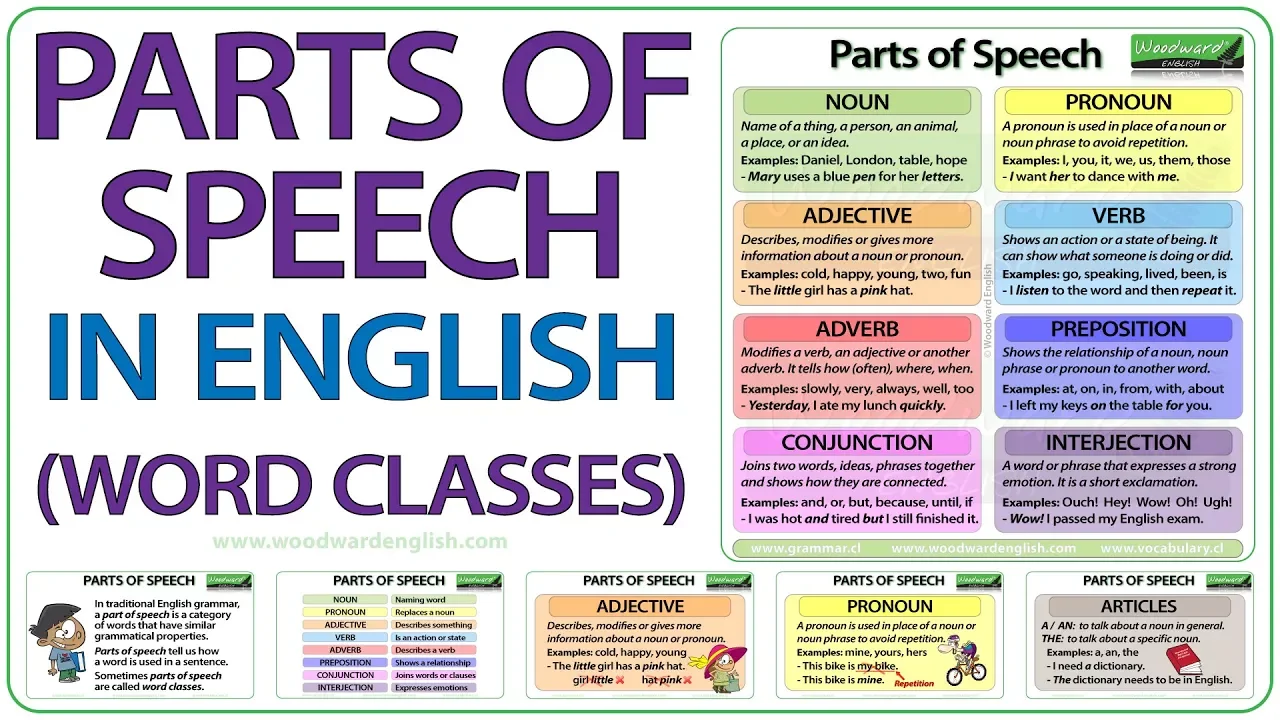
Parts of Speech in English | English Word Classes | Learn English Grammar
1.5M
In traditional English grammar, there are eight main parts of speech: nouns (name things, people, animals, places, or ideas), pronouns (replace nouns to avoid repetition), adjectives (describe or modify nouns), verbs (show actions or states of being), adverbs (modify verbs, adjectives, or other adverbs to indicate manner, frequency, place, time, or degree), prepositions (show relationships between words), conjunctions (join words, phrases, or clauses), and interjections (express strong feelings or emotions). Some teachers also include articles (a, an, the) as a ninth part of speech, which function as determiners to specify whether nouns are general or specific.
Click to watch →

Short Class Basic English | MySkill
1.7K
This comprehensive section covers all major parts of speech in English grammar. Nouns name people, places, things, ideas, or concepts—not just physical objects but everything in the universe including abstract concepts like happiness and democracy. Pronouns substitute for nouns to avoid repetition. Verbs express actions, occurrences, or states of being, including action verbs (sit, teach, eat) and the verb 'to be' (is, are, was, were). Adjectives describe or modify nouns, providing qualities like big, small, or beautiful. Adverbs modify verbs, adjectives, or other adverbs, often answering 'how?' (beautifully, quickly) or 'when?' (always, usually). Prepositions show relationships between words, indicating location, direction, time, or manner (in, on, at, with, by). Conjunctions connect words, phrases, or clauses: coordinate conjunctions (FANBOYS: For, And, Nor, But, Or, Yet, So) require commas before them when joining independent clauses; correlative conjunctions (because, while, if) don't require commas; transitional phrases (therefore, moreover) connect ideas between sentences. Interjections express strong emotion (wow, oh, no). Determiners specify or limit nouns, including articles (the, a, an), demonstratives (this, that), and possessives (my, your).
Click to watch →
![[Introduction to Linguistics] Word Order, Grammaticality, Word Classes](https://i.ytimg.com/vi_webp/E3eTNgPXkG4/maxresdefault.webp)
[Introduction to Linguistics] Word Order, Grammaticality, Word Classes
78.3K
English words belong to lexical categories (nouns, verbs, adjectives, prepositions, adverbs) and functional categories. Nouns name people, places, things, or concepts and can take determiners like 'his' or 'the.' Verbs express actions or states. Adjectives describe nouns. Prepositions show location or relationships. Adverbs modify verbs, adjectives, or other adverbs. Functional categories include determiners (pair with nouns), qualifiers (modify adverbs/adjectives), auxiliaries (support main verbs), and conjunctions (join clauses). Understanding these categories helps analyze sentence structure.
Click to watch →

Syntax (Part 1)
928.1K
Lexical categories are the fundamental parts of speech used in linguistic analysis. Nouns represent persons, places, or things and typically serve as subjects. Adjectives modify or describe nouns (e.g., 'red', 'big'). Verbs denote actions or events (e.g., 'swim', 'live'). Adverbs describe verbs (e.g., 'quickly', 'slowly'), with many ending in '-ly' though exceptions exist. Pronouns function similarly to nouns but point to specific entities (e.g., 'you', 'he', 'she'). Determiners include articles ('a', 'an', 'the'), possessive pronouns ('his', 'her'), demonstratives ('this', 'that'), and quantifiers ('one', 'some'). Adpositions encompass prepositions (which precede objects, like 'to', 'near', 'from') and postpositions (used in languages like Japanese, Turkish, or Quechua where the object follows).
Click to watch →

Parts of Speech Identification এর জন্য এই একটা ক্লাসই যথেষ্ট
15.1K
A determiner is one or more words that typically come before a noun and specify or limit that noun. Determiners include: numbers and quantifiers (one, two, three, a lot of, much, many, few, a few), articles (a, an, the), possessive determiners (my, our, your, his, her, its, their), demonstrative determiners (this, that, these, those), distributive determiners (each, every, either, neither, all, both), and fractions (half, one-third, two-thirds). To identify parts of speech, ask specific questions: for nouns, ask 'who' or 'what'; for adjectives, ask 'how' or 'what kind'; for adverbs, ask 'how' (modifying verbs); for determiners, ask 'how many' or 'which'. When a determiner and a preposition are separated by a word, that word is typically a noun. For example, in 'the doctor took the round in the hospital', 'round' is a noun because it appears between 'the' (determiner) and 'in' (preposition). When a determiner and a preposition are separated by a word, that word is typically a noun. For example, in 'no right to scold you', 'right' is a noun because it appears between 'no' (determiner) and 'to' (preposition).
Click to watch →
Deep Dive
Understanding the concept of constituency, or how words naturally group together to form structural units (phrases) within a sentence.
09: A bridge between words and sentences - Intro syntax, constituent, trees, fun linguistics lecture
1.6K
Constituency is the linguistic concept that language is composed of hierarchical units where smaller pieces combine into larger pieces. It addresses how individual words and sounds combine to form meaningful language structures. The classic example 'time flies like an arrow' demonstrates structural ambiguity: it can mean either 'time (which flies) like an arrow' or 'time flies (the insect) like an arrow.' The phrase 'fruit flies like a banana' means 'fruit flies (the insect) like a banana.' The ambiguity arises because the same words can be grouped into different constituent structures. Sentences can be understood through two structural analogies: the bracelet model (words as beads on a single string) and the mobile model (words hanging from other words in hierarchical layers). A cooking metaphor further explains constituency: when making a cake, you prepare separate bowls of ingredients before combining them, just as words must be grouped into constituents before being combined in sentences.
Click to watch →
![[Syntax] Constituents](https://i.ytimg.com/vi_webp/Ia7d4slVL6s/maxresdefault.webp)
[Syntax] Constituents
144K
A constituent is defined as a group of words that function together as a unit within a sentence. In syntactic trees, constituents are identified by selecting nodes and seeing what words come with them. For example, in the sentence 'The man ate his broccoli,' 'the man' forms a noun phrase (NP) constituent, while 'ate his broccoli' forms a verb phrase (VP) constituent. Each individual word is also considered its own constituent. The key characteristic is that constituents can be replaced by a single word from the same grammatical category without changing the sentence structure.
Click to watch →

Phrase structure Grammar Eng455 Lecture in Hindi Urdu 14
2.7K
Constituency defines how words grow together to form phrases. For example, in the noun phrase 'three parties from Brooklyn,' the words group together to form a constituent. The constituent elements are the actual elements that combine together to make a phrase, such as words that seem to belong together like 'crazy man' in 'the crazy man is jumping off the bridge.'
Click to watch →

Word classes and syntactic constituency
19.7K
Syntactic constituency refers to how words group together hierarchically in sentences. Different interpretations of ambiguous sentences arise from different constituency structures, as seen in 'old men and women like sports cars' (where 'men and women' may or may not form a constituent). The basic sentence structure rule states that sentences combine noun phrases (NPs) and verb phrases (VPs). English questions are formed through subject-auxiliary inversion, exchanging NP and auxiliary positions rather than moving words. This demonstrates that syntactic rules operate on constituents, not word positions.
Click to watch →
Syntactic Constituency
1.9K
A syntactic constituent is a logical chunk of a sentence—words or phrases that naturally group together. The smallest constituents are individual words, each functioning as its own constituent. Larger constituents include noun phrases (like 'the yellow dog') and verb phrases (like 'ate the chocolate cake'). The entire sentence is always a constituent. However, constituent status is context-dependent; a phrase that works in one sentence may not work in another. This foundational concept enables systematic analysis of sentence structure.
Click to watch →
Deep Dive
Basic recognition of core phrase types, specifically Noun Phrases (NP), Verb Phrases (VP), and Prepositional Phrases (PP).

TRANSITIVE VERBS, PHRASES, AND PHRASE STRUCTURE RULES
183
This section explains three major phrase types. A noun phrase (NP) has a noun as its head/core (e.g., 'a talented singer'). A verb phrase (VP) has a verb as its head and may include auxiliaries, modifiers, and complements (e.g., 'heals the wound' where 'the wound' completes the verb's meaning). A prepositional phrase (PP) consists of a preposition followed by a noun object (e.g., 'at the school'). Each phrase type serves a distinct grammatical function in sentence construction.
Click to watch →
Categories and Constituents (ENG)
1.9K
Identifying phrase types requires specific tests: Noun phrases pass pronoun tests (replace with 'she,' 'they') and include pronouns, proper names, or mass nouns; Prepositional phrases differ from NPs—they cannot be replaced by pronouns alone (test: 'I sat on it' vs. 'I sat it'); Verb phrases typically begin with verbs, though adverbs precede them; Adjective phrases modify nouns but never contain the head noun. Correct identification requires understanding hierarchical structure and applying multiple tests simultaneously.
Click to watch →

Tipos y análisis de frases (sintagmas)
2.3K
Phrases are groups of words structured around a core word. The six main types are: (1) Nominal phrase - determiner + noun as core; (2) Sustantiva phrase - noun or pronoun as core, no determiner; (3) Adjetiva phrase - adjective as core; (4) Adverbial phrase - adverb as core; (5) Verbal phrase - verb or verbal periphrasis as core; (6) Propositional phrase - preposition initiates the phrase. Each phrase type has specific syntactic functions: nominal phrases have determiner and nominal; sustantiva, adjetiva, and adverbial phrases have core plus optional modifiers; verbal phrases have only core; propositional phrases have enlace (preposition) and término.
Click to watch →

(IELTS Reading & Writing) Essential Grammar — Phrase Types
72.4K
Noun phrases center on a head noun determining verb agreement, with modifiers including articles, prepositional phrases, and adjective clauses. Examples: 'The head of the research department decided' (head = department); 'The car I bought last week is red' (head = car with adjective clause). Prepositional phrases begin with prepositions (on, at, by, with, among, between) showing time, location, or material relationships. They require objects and add specificity to sentences. Both phrase types are essential for academic writing and reading comprehension, enabling writers to construct varied, informative sentences.
Click to watch →

Clase 20 de abril presentación Frase Nominal
524
A noun phrase (sintagma nominal) is a sentence constituent whose core is a noun or proper noun. The core includes articles, determiners, quantifiers, adjectives, and complements. When multiple nouns appear, the last noun is always the core. Pre-modifiers appear before the core, while post-modifiers appear after it. To identify the core, use word formation guides to recognize habitual noun endings. Read phrases from right to left (mirror image), starting with the core. Noun phrases can have various combinations: core alone, determiner before core, determiner plus pre-modifiers, or pre-modifier plus core plus post-modifier. When reading or translating, always start with the core noun. If a determiner exists, read it first, then pre-modifiers from right to left, and finally post-modifiers. Examples include 'clinical problems' (core: problems), 'the history of nursing' (core: history), and 'reversal strategies for diabetes' (core: strategies).
Click to watch →
Prerequisite Knowledge
- Concept 01Familiarity with basic parts of speech (lexical categories) such as nouns, verbs, adjectives, prepositions, and determiners.
- Concept 02Understanding the concept of constituency, or how words naturally group together to form structural units (phrases) within a sentence.
- Concept 03Basic recognition of core phrase types, specifically Noun Phrases (NP), Verb Phrases (VP), and Prepositional Phrases (PP).
Subsequent Learning
- Step 01Introduction to X-bar Theory, which standardizes phrase structure across different grammatical categories.
- Step 02Analyzing structural ambiguity, where a single sentence can generate multiple syntactic trees representing different meanings.
- Step 03Understanding syntactic movement and transformations, such as how declarative sentences transform into questions (CP and IP levels).
- Step 04Application of syntactic parsing in Computational Linguistics and Natural Language Processing (NLP) for machine translation and syntax-aware algorithms.
Intro
Core
Detail
Impact
Close
Intro
0:42Playing Section
- 1
Speaker opens with a greeting.
- 2
Sets the stage for the main discussion.
Dependency Grammar and Word-Based Syntactic Representation
While traditional constituent tree diagrams are based on phrase structure grammar—which groups words into nested hierarchical phrases (like NP and VP)—a major alternative perspective is Dependency Grammar. Pioneered by Lucien Tesnière, Dependency Grammar rejects abstract phrasal nodes entirely. Instead, it posits that syntactic structure consists of direct, binary relations between individual words (heads and their dependents). This results in a flat, word-based network rather than a nested constituency tree. Dependency grammar is highly favored in computational linguistics and is often considered far better suited for analyzing morphologically rich, free-word-order languages where rigid phrase-structure hierarchies fail to capture the fluid relationships between words.
Deep Dive
Introduction to X-bar Theory, which standardizes phrase structure across different grammatical categories.

CURSO DE TEORIA X-BARRA | SINTAXE GERATIVA | AULA 1 | INTRODUÇÃO À TEORIA X-BARRA, VP
8.6K
X-Bar Theory is a fundamental framework in generative syntax that represents sentence structures hierarchically using XP notation, where X represents the category (N, V, A, P) and P stands for Phrase; the theory posits that every syntagma contains a nucleus (X0) that projects two positions: specifier (Spec) and complement (Comp), with the intermediate projection containing only the nucleus and complement, and the maximum projection (XP) including all three components; this universal structure applies to all natural languages, with the specifier and complement positions being structural requirements that may or may not be filled depending on the language and specific syntactic context.
Click to watch →
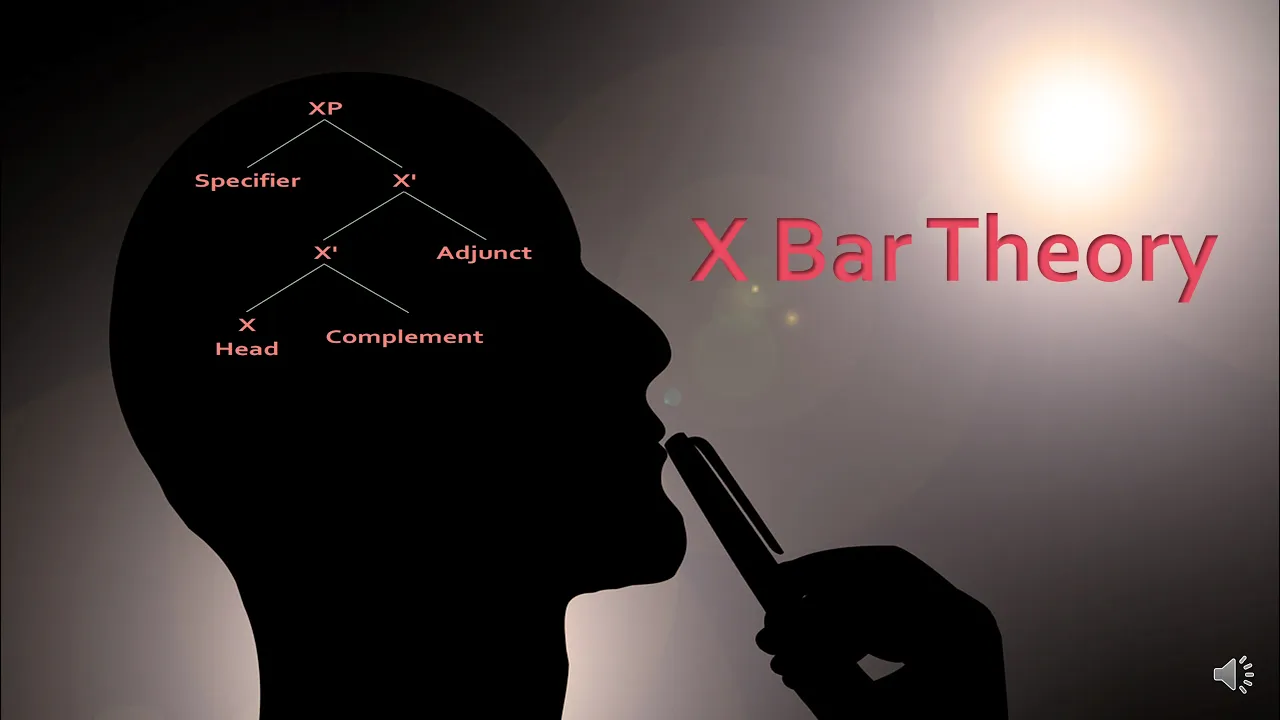
X Bar Theory
19.8K
X-bar theory is a syntactic framework that represents phrases using a hierarchical structure with three functional positions: specifier (which modifies the head), complement (which is essential to the head), and adjunct (which provides optional modification); this theory applies universally to all phrase types (noun phrases, verb phrases, adjective phrases, preposition phrases) by using X as a variable representing any lexical category, allowing for unlimited adjuncts but only one complement per phrase.
Click to watch →
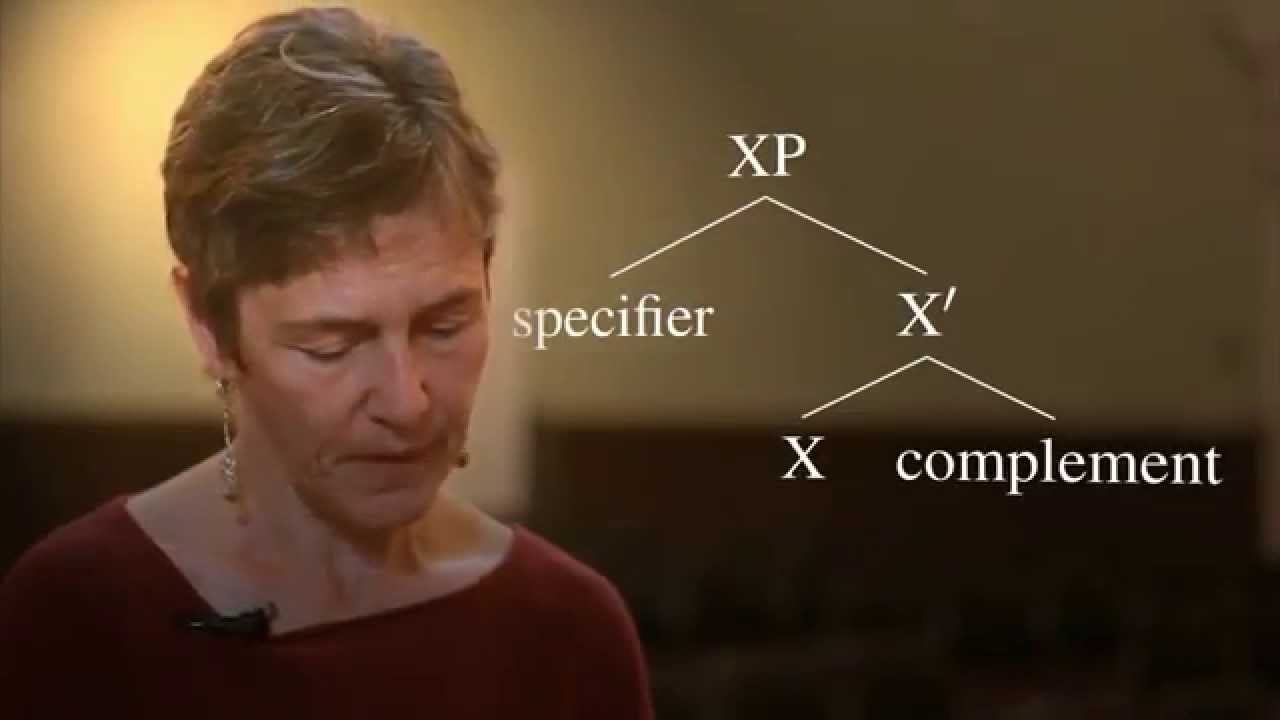
Generative Syntax 4.1: The X-bar Schema
151.8K
The X-bar schema is a general framework for representing phrase structure in generative grammar, where any phrase consists of a head (X) that projects to an intermediate level (X-bar, containing the head and its complement) and then to a full phrase (XP, containing the specifier). This schema applies universally to phrases of different categories such as verb phrases (VP), adjective phrases (AP), and noun phrases (NP), with the complement being the sister to the head and the specifier being the sister to X-bar. The schema allows for optional elements depending on the specific properties of the head, though it may need extensions to account for complex cases like ditransitive verbs with three arguments or unlimited modifiers.
Click to watch →

Introducing X-bar theory (1): Evidence for N-bar
1.5K
X-bar theory introduces an intermediate level (N-bar) between the noun phrase (NP) and the head noun (N), which explains why certain verbs like 'appoint' select noun phrases minus determiners, coordination requires parallel structure at the N-bar level, and pronouns can replace N-bar constituents; this three-level architecture (NP/N-double-bar, N-bar, N-zero) provides a unified framework for analyzing all phrase types in syntax.
Click to watch →
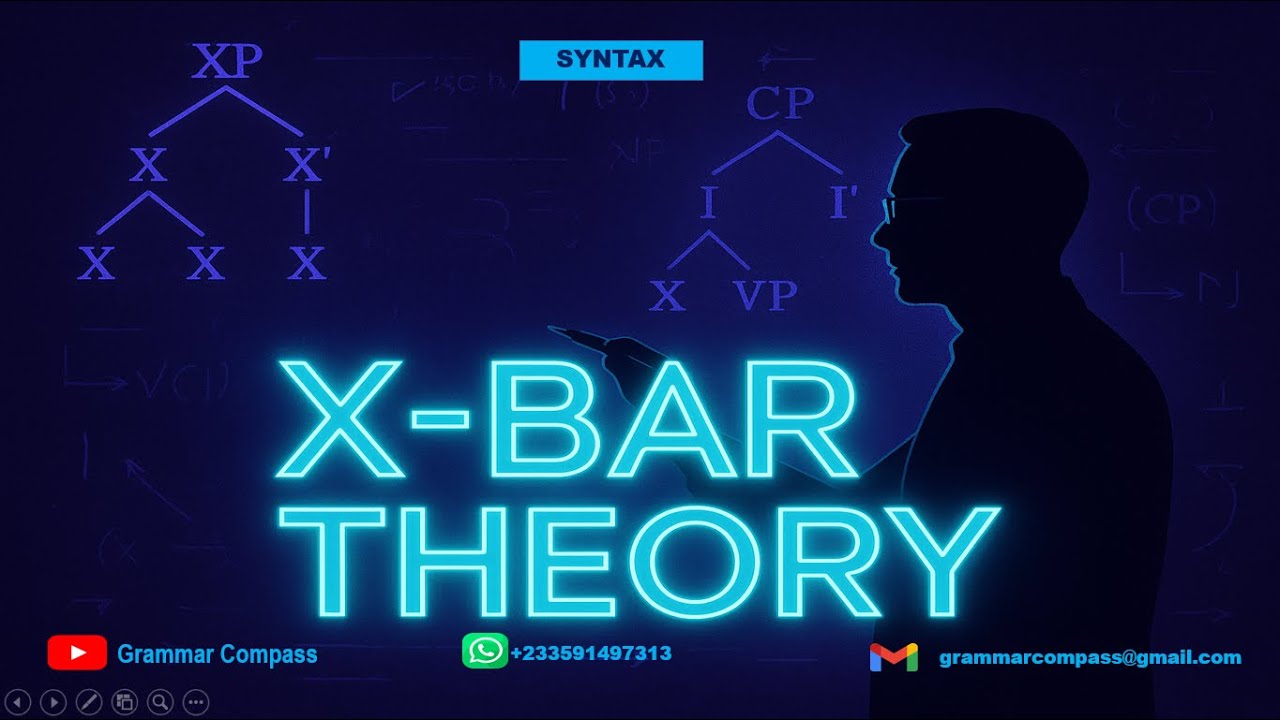
X-BAR SYNTAX MADE SIMPLE | PART 1| UNDERSTANDING STRUCTURES, RULES, AND MODIFIERS
1.4K
X-Bar theory distinguishes three types of modifiers: (1) Specifiers are daughters of phrases and sisters to X-bars (only found in NPs as determiners); (2) Adjuncts are daughters of X-bars and sisters to X-bars, appearing before or after the X-bar and always optional; (3) Complements are daughters of X-bars and sisters to heads, always closest to the head, non-iterative, non-reorderable, and marked by specific prepositions (typically 'of' in NPs). Three major generalizations apply to all phrase types: (1) Every phrase follows three rules: specifier rule, adjunct rule, and complement rule; (2) Headedness: the head is the only obligatory element in every phrase; (3) Non-head material must be both phrasal and optional. These generalizations allow prediction of tree structures across different phrase types.
Click to watch →
Deep Dive
Analyzing structural ambiguity, where a single sentence can generate multiple syntactic trees representing different meanings.
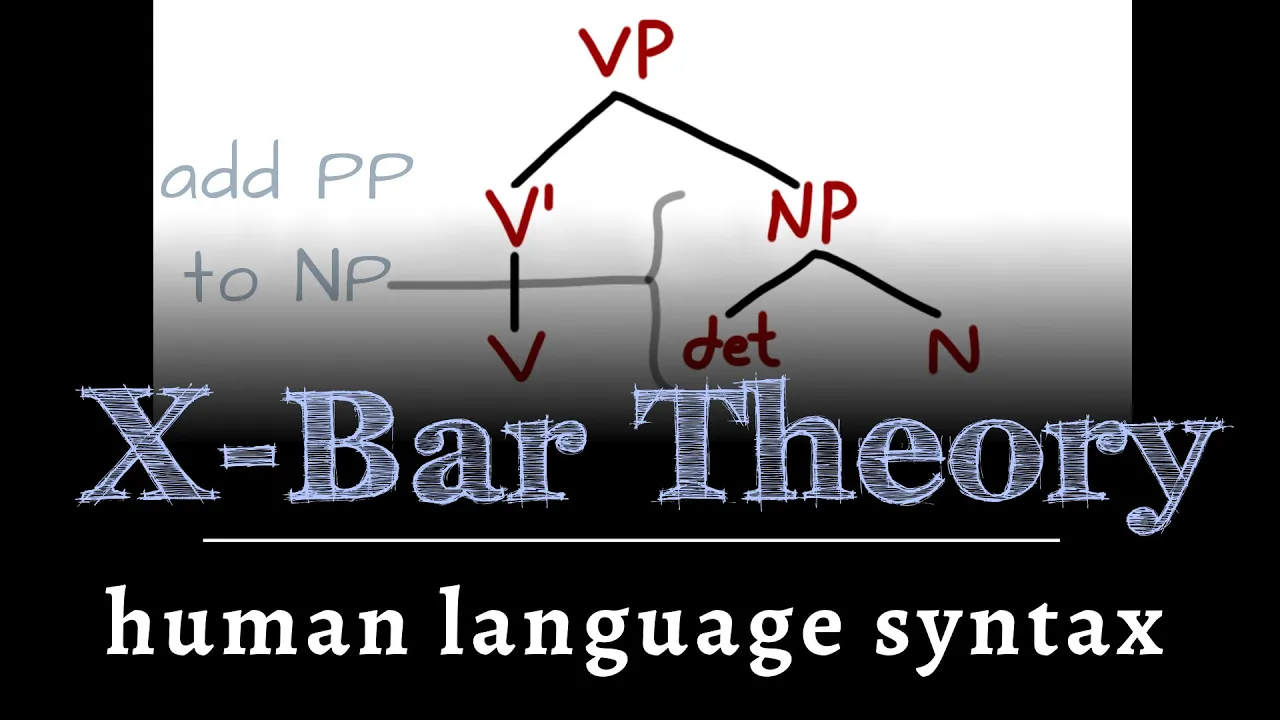
Human Language Sentences - Basic Parse Trees, X-Bar Theory & Ambiguity -- Linguistics 101
220.2K
Structural ambiguity occurs when more than one parse tree can represent a sentence, yielding different grammatical structures and interpretations. The canonical example is 'Time flies like an arrow,' which can be parsed with time as verb, flies as verb, or like as verb, producing different meanings.
Click to watch →

Syntax (Part 2)
616.4K
Structural ambiguity occurs when a single sentence can yield at least two distinct meanings based on how its components are grouped. The same string of words can be parsed differently, resulting in different interpretations of what is being described.
Click to watch →
![Ambiguity: Intro to Linguistics [Video 9]](https://i.ytimg.com/vi/u4t1LSNTQ2Q/hqdefault.jpg?v=5f715d91)
Ambiguity: Intro to Linguistics [Video 9]
19.4K
Structural ambiguity occurs when a sentence can have multiple different syntax trees (grammatical structures) even though the surface string of words appears the same. A classic example is Groucho Marx's line 'I once shot an elephant in my pajamas.' This sentence can be parsed two ways: either the prepositional phrase 'in my pajamas' modifies the verb (meaning I was wearing pajamas when I shot the elephant), or it modifies the noun (meaning I shot an elephant that was in my pajamas). The ambiguity exists because the syntax tree structure isn't pronounced when speaking—we just assume listeners will figure out the most likely interpretation using extra-linguistic knowledge (like knowing elephants can't fit into pajamas).
Click to watch →

UGC NET English 2026 | UGC NET English Language and Linguistics: Sementic | UGC NET English Classes
156
Structural ambiguity occurs when a sentence can be parsed in multiple ways, leading to different meanings. For example, 'I saw the man with the telescope' can mean either 'I used the telescope to see the man' or 'I saw a man who had a telescope.' Different hierarchical structures can represent the same words but different meanings.
Click to watch →

Teoria X Barra 2
19.6K
Sentences can have structural ambiguity, meaning they can be interpreted in multiple ways with different syntactic structures. For example, 'João disse que Maria comprou a boneca bonita com alegria' can be interpreted as either 'Maria bought the beautiful doll with joy' (PP as adjunct to VP) or 'João said with joy that Maria bought the beautiful doll' (PP as adjunct to VP containing 'disse'). Each interpretation corresponds to a distinct tree structure.
Click to watch →
Deep Dive
Understanding syntactic movement and transformations, such as how declarative sentences transform into questions (CP and IP levels).

Intro Syntax: A'-Movement Continued and Building Grammatical Model
126
WH movement (A'-movement) transforms declarative sentences into questions through specific syntactic operations. In declaratives, the subject raises to T-position checking EPP and receiving nominative case. For yes/no questions, the Q-feature of C attracts T, causing do-support where the auxiliary raises to satisfy Q. For content questions, a +WH feature in C attracts the +WH wh-element, which then moves to the specifier of C. These operations demonstrate how different movement types build upon each other in syntactic derivations.
Click to watch →

#33 Movement of Constituents in Interrogative Sentences | Basics of Language Science
249
This section develops the theoretical framework for understanding question formation through syntactic movement. The IP structure alone cannot account for questions because both tense markers and questioned NPs must move. The complementizer phrase (CP) provides the necessary structure, with heads moving to head positions and NPs moving to specifier positions. Movement leaves traces—empty categories marking original positions—which are visible in underlying structure but not articulated in speech. This explains why sentences like 'What did you buy?' have grammatical constraints on word order and why movement accounts for abundant data in principled ways.
Click to watch →

Movement in the X bar Theory
1.7K
Movement is a syntactic process necessary for forming morphologically and syntactically acceptable sentences. Two types of reasons drive movement: morphological (bound morphemes like tense inflections must attach to verbs) and syntactic (every sentence requires a subject before the predicate, and questions require inversion). In declarative sentences like 'Jenny bought a necklace,' the subject moves from specifier of V to specifier of T, and the verb moves from V to T because T is defective. In questions like 'Can you answer the question,' the subject moves to specifier of T, and the auxiliary moves from T to C for inversion. In WH-questions like 'What will we eat for dinner,' three movements occur: subject movement, auxiliary inversion, and WH-phrase movement to specifier of C. The specifier of C is always empty and serves as the landing site for inverted auxiliaries and WH-phrases.
Click to watch →
Transformation Rule: Move Aux
25.6K
To create interrogative sentences from declarative ones, the auxiliary verb moves to the beginning of the sentence. This process is called 'auxiliary movement' or 'move aux.' The transformation rule applies to deep structure to render surface structure, specifically moving the auxiliary from its original position to the front of the subject NP under the sentence node.
Click to watch →
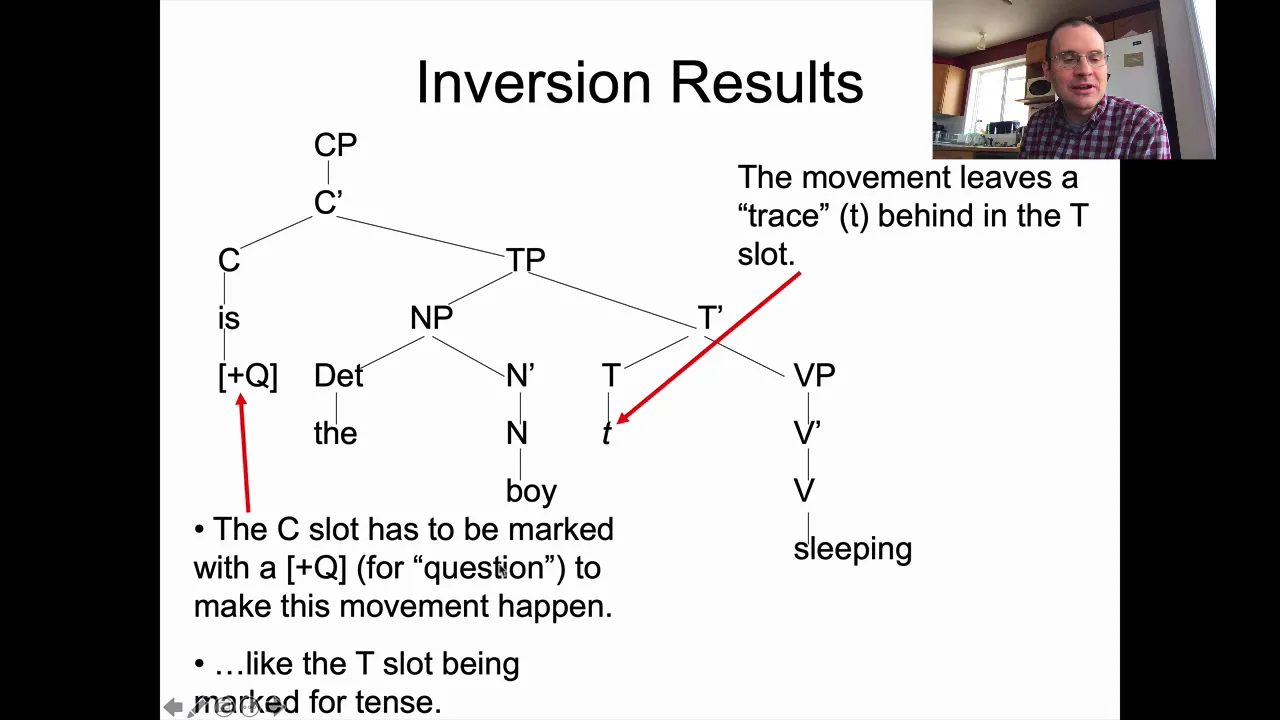
Ling 201 - Intro Linguistics - Syntax 5, Part 2
532
This section introduces transformational rules that generate sentence variations from existing structures. It explains how yes/no questions form through auxiliary verb movement from the T slot to the C slot, creating a complementizer phrase (CP) with [+Q] marking. The trace theory is introduced, explaining how moved elements leave placeholders at their original positions. This foundational framework enables understanding of how declarative sentences transform into interrogative structures through systematic syntactic operations.
Click to watch →
Deep Dive
Application of syntactic parsing in Computational Linguistics and Natural Language Processing (NLP) for machine translation and syntax-aware algorithms.

SYNTACTIC PARSING
111
Syntactic parsing is an NLP technique that analyzes the grammatical structure of sentences to understand how words relate to each other, enabling machines to interpret meaning by identifying relationships between words and phrases through processes like tokenization, part-of-speech tagging, and hierarchical representation construction using either rule-based methods (context-free grammars, hidden Markov models) or statistical approaches (probabilistic models, machine learning), with applications in machine translation, text summarization, question answering, and speech recognition.
Click to watch →

Syntactic Parsing
1.2K
Syntactic parsing is a fundamental task in computational linguistics that involves analyzing sentence structure to identify grammatical constituents (such as noun phrases, verb phrases, and clauses) and their hierarchical relationships, using formal grammatical rules to transform raw text into structured representations called treebanks, which serve as essential resources for various NLP applications including machine translation, information retrieval, question answering, and text summarization.
Click to watch →

Parsing in NLP | Types of Parsing | Syntactic & Dependency Parsing Explained with Examples
193
Parsing in NLP is the process of analyzing a sentence's grammatical structure according to formal grammar rules, breaking it down into constituent parts and identifying relationships between words; there are two main types: syntactic parsing (which generates constituency trees showing hierarchical phrase structure) and dependency parsing (which represents sentences as directed graphs showing word relationships), both serving applications in machine translation, chatbots, and question answering systems.
Click to watch →

Syntactic Parsing for NLP
770
Natural Language Processing (NLP) enables computers to read, understand, and generate human-like text, powering chatbots, voice assistants, and grammar checkers. Syntactic parsing is the core technique that allows AI to understand language structure by breaking sentences into meaningful parts. Syntax defines how words are arranged to convey meaning, distinguishing correct sentences from jumbled words. AI applies syntactic parsing for word prediction, understanding word relationships, and processing sentence structure in search engines. This foundational knowledge explains how Google Translate and similar tools understand and translate language.
Click to watch →

Forest-based Search Algorithms in Parsing and Machine Translation
19.6K
Syntax-based machine translation uses synchronous context-free grammars to generate aligned sentence pairs, projecting grammars to source and target languages with rules specifying syntactic transformations. Language models are integrated by splitting hypergraph nodes into instantiations based on boundary words, enabling proper scoring of generated hypotheses. Efficient k-best algorithms applied to this framework achieve orders-of-magnitude speedups over conventional beam search while maintaining translation quality. This demonstrates the general applicability of hypergraph parsing techniques to machine translation decoding, with applications including phrase-based and syntax-based systems achieving competitive performance on benchmark datasets like FLE.
Click to watch →
Intro
Core
Detail
Impact
Close
Intro
0:42- 1
Speaker opens with a greeting.
- 2
Sets the stage for the main discussion.
Dependency Grammar and Word-Based Syntactic Representation
While traditional constituent tree diagrams are based on phrase structure grammar—which groups words into nested hierarchical phrases (like NP and VP)—a major alternative perspective is Dependency Grammar. Pioneered by Lucien Tesnière, Dependency Grammar rejects abstract phrasal nodes entirely. Instead, it posits that syntactic structure consists of direct, binary relations between individual words (heads and their dependents). This results in a flat, word-based network rather than a nested constituency tree. Dependency grammar is highly favored in computational linguistics and is often considered far better suited for analyzing morphologically rich, free-word-order languages where rigid phrase-structure hierarchies fail to capture the fluid relationships between words.
Familiarity with basic parts of speech (lexical categories) such as nouns, verbs, adjectives, prepositions, and determiners.
Understanding the concept of constituency, or how words naturally group together to form structural units (phrases) within a sentence.
Basic recognition of core phrase types, specifically Noun Phrases (NP), Verb Phrases (VP), and Prepositional Phrases (PP).
Introduction to X-bar Theory, which standardizes phrase structure across different grammatical categories.
Analyzing structural ambiguity, where a single sentence can generate multiple syntactic trees representing different meanings.
Understanding syntactic movement and transformations, such as how declarative sentences transform into questions (CP and IP levels).
Application of syntactic parsing in Computational Linguistics and Natural Language Processing (NLP) for machine translation and syntax-aware algorithms.
128.2K views1.3Klikes3:02@GracerodVOriginal Release: 2020-09-20
[Music] so [Music] my [Music] [Applause] so [Music] so [Music] so [Music] so [Music] my you
Up Next

10:42
Syntax Tree Diagrams Explained | Grammar Rules & Structure
@crashcourse
306.6K views•2020-10-02
36:52
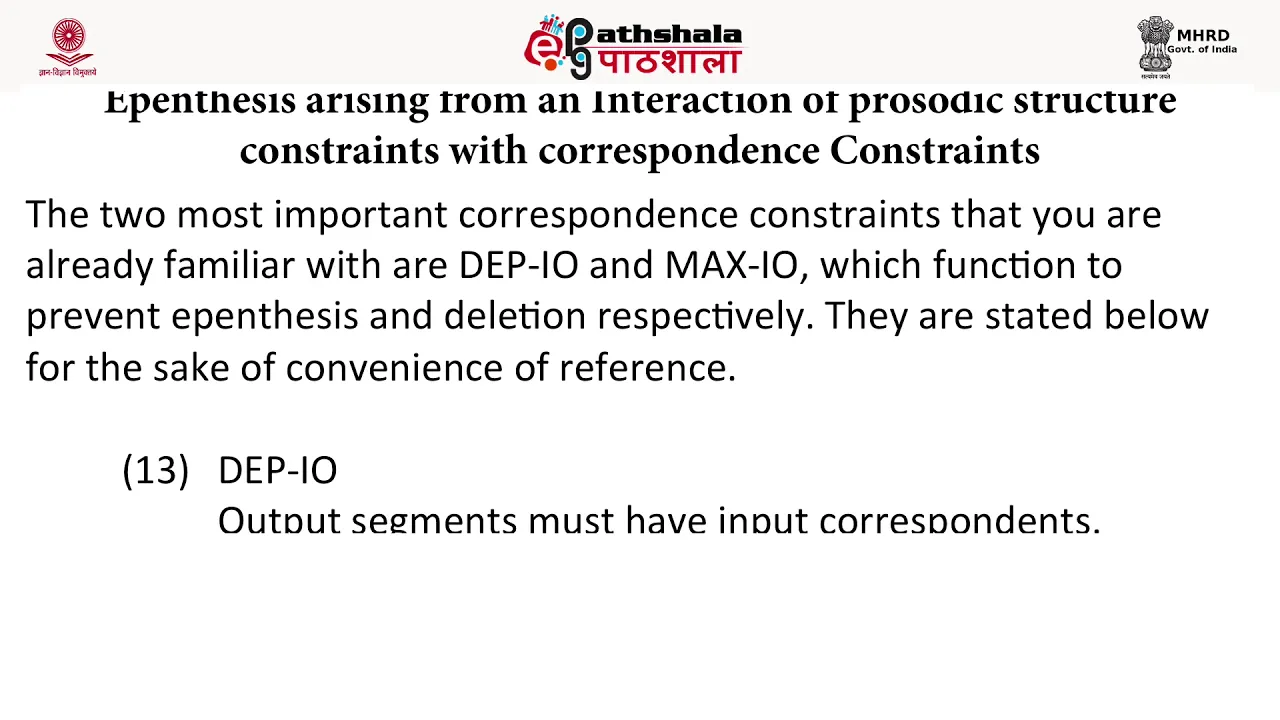
Constraint Interaction in Optimality Theory: Epenthesis & Deletion
@Vidyamitra
180 views•2018-08-20

8:59
Forensic Linguistics: How Language Solves Crimes | PBS
@pbsstoried
1M views•2024-01-25

21:32
Accent Expert Explains U.S. Regional Dialects | Part 1
@WIRED
9.3M views•2021-01-21
Related Study Plans & Knowledge Roadmaps
Structured learning paths in Linguistics
linguistics
Optimality Theory: Tableaux & Constraints
01Phonological Basics: Sounds, Syllables & Rules
02Foundations of Optimality Theory: GEN, CON, and EVAL
03The Constraint Inventory: Markedness vs. Faithfulness
+ 2 more learning modules
15h5 modules
Explore Roadmap
linguistics
Morphosyntactic Alignment: S, A & P Systems
01Foundations of Syntax: Transitivity and Arguments
02The Linguistic Variables: Mapping S, A, and P
03Nominative-Accusative Alignment
+ 3 more learning modules
12h6 modules
Explore Roadmap
linguistics
Analyzing Sign Language: Phonology & Syntax
01Foundations of Sign Language Linguistics
02Phonology: The Five Parameters of a Sign
03Morphology: Word Formation and Classifiers
+ 2 more learning modules
14h5 modules
Explore Roadmap
linguistics
Pragmatics: Speech Acts, Grice & Politeness
01Introduction to Pragmatics: Meaning in Context
02Grice’s Cooperative Principle & Implicature
03Speech Act Theory
+ 2 more learning modules
14h5 modules
Explore Roadmap