















Bertrand Russell's 1919 theory of descriptions proposes that definite descriptions (phrases beginning with 'the') do not function as referring expressions but instead express complex logical claims consisting of three components: existence (at least one thing satisfies the description), uniqueness (no more than one thing satisfies it), and predication (the described thing has a certain property). For example, 'The author of Waverly was Scotch' is analyzed as 'There exists an author of Waverly, there is at most one author of Waverly, and whoever authored Waverly was Scotch.' This theory resolves puzzles about meaningful sentences containing non-existent objects (like 'The golden mountain is tall') by showing they are false because the existence claim fails, while remaining meaningful because they express coherent logical propositions.
Bertrand Russell's Theory of Descriptions Explained
Added:In 1905, Bertrand Russell published a paper called on denoting. And if we're not talking about books, but just academic papers, then this has got to be in the top five all-time most famous, most esteemed philosophy papers ever written. In this paper, Russell gives an account of definite descriptions, which are phrases like [clears throat] the greatest shooter of all time. That phrase almost certainly refers to Steph Curry and it's called a definite description because it begins with the word 'the', which is called the definite article.
I'm in my office editing this video and I have to interrupt. The human capacity for language is both the most important thing that we have and the thing that we do every day that we understand the least. What makes this paper of Russells so unsettling is that it unears the fact that our words and thoughts appear to us to be structured a certain way but really they aren't structured that way in a very real sense. We don't understand our own thoughts. So this paper is not just about these things called definite descriptions which are just phrases that start with the word 'the'. Really this paper is about the fundamental nature of all human thought.
But to understand that we do need to start with the word 'the'. What I mean by all this will be clear in like 7 minutes. The word definite here refers to the fact that these phrases refer to just one and only one thing, the greatest shooter of all time. And these are contrasted with indefinite descriptions like a basketball player, which can describe one of many, many things. What Russell does in this 1905 paper is give an analysis of these phrases that is weird and interesting and and maybe brilliant. But the paper is very difficult and confusing and we're going to get to it in the next lecture. But right now we're going to talk about a different paper that he wrote 14 years later where he summarizes the view from that earlier paper. To understand Russell's theory though, let's look at a sentence that does not include a definite description. Mount Everest is tall. This sentence starts with a proper name, Mount Everest. This is what we would call a referring expression. The job of this name in the sentence, the the role that it plays is it refers to an object. It refers to this big thing in the Himalayas. And then there's this other bit, the predicate is tall. The job of this part of the sentence is not to refer to some object in the world. It's instead to say something about this first thing. So, we immediately have a contrast between referring expressions and what we'll call non-referring expressions. The referring expressions like Mount Everest, their job is to pick out things in the world so that we know what we're talking about. And then the non-referring expressions like is tall, they do all sorts of different things, but in this case, they don't pick out an object. They say something about the object that was already picked out.
Russell says that these non-referring expressions, they contribute a concept.
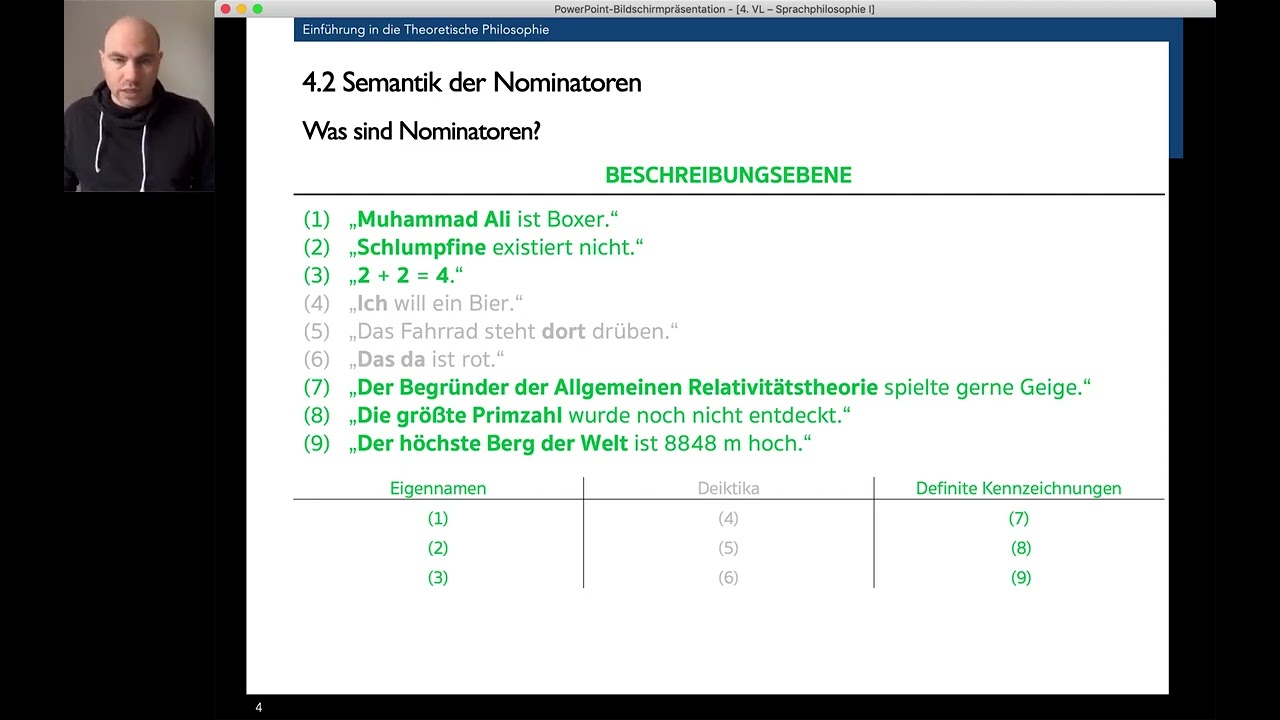
What does that mean exactly? Nobody knows. Don't worry about that. Then there are sentences like two here. The golden mountain is tall. Now, what we've done is we've replaced Mount Everest with a definite description. The Golden Mountain. It starts with the word 'the'.
That's the definite article. This is a definite description. It looks on the surface like these two sentences have the same structure. They start with a referring expression that picks out an object, Mount Everest or the Golden Mountain, and then they say something about that object. [sighs] Look, the thing to understand here is that these sentences have to work this way.
We say sentences like this, and when we say them, we know what we're saying.
We're using the name Mount Everest to point, like with our words, to a thing in the world. We point to it. And then we use the other words is tall to say something about the thing that we just pointed to. That's what each part of the sentence does. And they work together to give us the whole sentence or the whole thought. And the other sentence, surely it works the same way, right?
This phrase, the golden mountain, it points to something. And then just like in the previous sentence, these words say something about that thing. They say that it's a tall thing. We write in sentences like this and we think in sentences like this and we know how they work. This is how they work. But there's a problem. And lots of philosophers see this problem and they scramble to solve it. But Russell realizes that their solutions are crazy. And the solution that he gets to is also kind of crazy, but in a different way. cuz his solution basically says that our brains are running an automatic language program, but it's a different program than the one that we think we're running. We'll get there, but for now it's like surely these two sentences work the same way.
The view that these two sentences are similar was held, for example, by Alexius Minong, an Austrian philosopher who lived from 1853 to 1920. Minong was interested in sentences like two. Now, here's the thing about a sentence like two. Uh there is no golden mountain.
Like there's no mountain made of gold.
Mountains are all made of rocks or dirt and trees, I guess, and and magma sometimes maybe. But they're definitely not made of gold. Okay. But even though the golden mountain doesn't exist, this sentence is still meaningful. This sentence is not like the sentence bing bang boo, right? That's just some nonsense that I made up. That's not a sentence that doesn't have a meaning.
This has a very clear meaning. The golden mountain is tall. It's just not true because there is no golden mountain. Not only that, there are sentences like this. There are sentences that include the definite description the golden mountain that are not only meaningful but true. Like the sentence the golden mountain does not exist. That sentence is both meaningful and true.
Minong is trying to figure out how this can be so. How these sentences can be meaningful. Right? Sentence number one is meaningful because Mount Everest picks out an object in the world. But this definite description, the golden mountain, it doesn't pick out anything in the world. So, so what's the meaning of this first part of the sentence?
Minong is wrestling with three facts.
One, this thing at the beginning of the sentence, the definite description, this is a referring expression. Its meaning or its contribution to the meaning of the sentence in which it appears is it refers to some object. And in this case, it does contribute some meaning because the whole sentence that comes out is meaningful. But then also the golden mountain doesn't exist. How can he handle all of these things? Minong concludes that the golden mountain, even though it doesn't exist in the world, it must sort of exist in some other world or in some other way. It's got to be out there in order to be the reference of this description of this definite description. Sometimes we summarize Mong's view as the idea that the golden mountain does not exist, but it does subsist. And that just means that the golden mountain isn't a real thing, but it's sort of there anyway somehow. In some sense, it's there. This is how Russell summarizes it in this 1919 paper descriptions. It is argued for example by Minong that we can speak about the golden mountain, the round square and so on. We can make true propositions of which these are the subjects. Hence, they must have some kind of logical being since otherwise the propositions in which they occur would be meaningless. Right? So on Minong's view, the golden mountain doesn't exist, but it still has logical being, and it needs to have this kind of quasi existence in order for sentences like this to be meaningful. Russell thinks this is utterly bonkers. Logic, I should maintain, must no more admit a unicorn than zoology can, for logic is concerned with the real world just as truly as zoology, though with its more abstract and general features. Okay. So if the biologists and zoologologists say that unicorns do not exist, then the logicians also have to say that unicorns do not exist. To say that unicorns have an existence in heraldry or in literature or in imagination is a most pitiful and poultry evasion. What exists in heraldry is not an animal made of flesh and blood moving and breathing of its own initiative. What exists is a picture or a description in words. And you notice that he immediately considers a possible response. You might say that the golden mountain or that unicorns or whatever, they exist in heraldry.
Heraldry is the art of like making crests or coats of arms or whatever.
It's like drawings, you know, special pictures or carvings or whatever. And Russell just says accurately that unicorns don't exist on these coats of arms. Drawings of unicorns exist on these coats of arms.
Here's a drawing of a unicorn. This is some ink, like some pink ink. on a piece of glass. That's very different from like a unicorn. A unicorn, you know, has a horn and hooves and it farts rainbows or whatever unicorns do. This is just a drawing of a unicorn. These exist.
Unicorns don't. Similarly, to maintain that Hamlet, for example, exists in his own world, namely in the world of Shakespeare's imagination just as truly as say Napoleon existed in the ordinary world, is to say something deliberately confusing or else confused to a degree which is scarcely credible. There is only one world, the real world.
Shakespeare's imagination is part of it and the thoughts that he had in writing Hamlet are real. So are the thoughts that we have in reading the play. But it is of the very essence of fiction that only the thoughts, feelings, etc. in Shakespeare and his readers are real and that there is not in addition to them an objective Hamlet. Russell admits that we might talk about the world of Shakespeare's imagination, but that's not another world. That's not an actual other reality. That's just a metaphor that refers to what is really the stuff that Shakespeare has written and thought about. And that stuff that he's written and thought about, that's just as real as anything else, like my hands or my watch or whatever, except for those things are just thoughts and words. And so, it's just wrong to say that the fictional character Hamlet or a unicorn or the Golden Mountain, it's just wrong to say that those things exist in any sense. They don't exist. Although drawings of them and thoughts and words about them do exist. If no one had thought about Hamlet, there would be nothing left of him. If no one had thought about Napoleon, he would have soon seen to it that someone did. That's like a joke, but it's correct as well.
If everyone stopped thinking about Hamlet, there's nothing left to Hamlet other than the thoughts about him. But Napoleon was an actual human being. And so if no one was thinking about Napoleon, he would still be there. And because he was sort of desperate for attention and whatever, he would have stabbed you, I guess, and gotten your attention.
So Russell has rejected Minong's view.
But how is he going to handle sentences like two? His answer is to give an analysis of sentences like this where the golden mountain is no longer a referring expression. Even though sentence one and sentence two look like they have the same structure on the surface, Russell thinks that their underlying logical structure is very different. And what happens is this sentence turns into a new sentence that doesn't have a referring expression.
Like there's no part of the meaning of this sentence he thinks at the end of the day that refers or attempts to refer to any object in the world.
However, before giving his analysis of definite descriptions like the golden mountain, he gives an analysis of indefinite descriptions like a mountain.
Right? It starts with the word a. That's the indefinite article instead of the word 'the', which is the definite article. He thinks that a sentence like three is really under the surface making two claims. One, it's making the claim there exists a mountain. And two, it is tall. Now, you might immediately wonder, wait a minute, the phrase a mountain just appears in the analysis. And that's right. This is not really the right way to write it. You're supposed to write it in the logical language and it would look like this. But I'm trying to avoid assuming that you've taken introduction to logic. So, I'm just writing it like this. You could rephrase this if you want as there exists something and that thing is mountainish. However you want to phrase it, the point is this. We're no longer picking out an object in the world and then saying something about it. Instead, we're just saying something exists and then saying a bunch of stuff about that thing, whatever it is. By doing this, the referring expression disappears. There's no longer a need to refer to something in the world in order for the sentence to be meaningful.
Here's another example. A unicorn is tall. Russell analyzes this as the conjunction of two claims. There exists a unicorn and it is tall. On Russell's analysis, this sentence is no longer picking out a unicorn in the world and then saying something about it. Instead, it is asserting that there exists something with the characteristic of unicornhood and then saying that that thing is tall. The result is that this sentence comes out false because this claim is false. It's false to say that there exists a unicorn. And so on Russell's analysis for a unicorn is tall is false as well. Here's the example that Russell gives in the paper.
I met a man. On the sort of surface reading of this sentence, I this pronoun is a referring expression. It refers to the speaker. A man is a referring expression. It refers to some guy or whatever. And then the word met just says that these two objects in the world are related to each other in a certain way where the speaker met this other guy.
But on Russell's analysis, this sentence is really making two claims or it's sort of composed of these two claims. There is a man and I met him. So now the contribution to the meaning of the sentence that this indefinite description a man is making is no longer to pick out some guy in the world.
Instead, it's to assert that there exists someone with the characteristic of manhood and also that I met that guy.
So now that Russell has given his account of indefinite descriptions like a man or a mountain or whatever, he goes on to give his account of definite descriptions like the golden mountain or the greatest shooter of all time. We are now in a position to define propositions in which a definite description occurs.
The only thing that distinguishes the soandso from a so andso is the implication of uniqueness.
The point that Russell is making here is that the only difference between an indefinite description like a sandwich and a definite description like the sandwich is that this definite description suggests that there's only one. It's unique. Suppose that I say to my wife, "Did you eat the sandwich in the refrigerator?" That suggests that there was only one sandwich in the refrigerator. But if instead I say, "Did you eat a sandwich in the refrigerator?"
That just asks if she ate a sandwich that was in the refrigerator. It might have been that there were eight sandwiches in there and I'm just asking if she ate one of them. We cannot speak of the inhabitant of London because inhabiting London is an attribute which is not unique. This is a little bit confusing. In some sense, you can't talk about the inhabitant of London because there's lots of people that live in London. There isn't just one. There isn't just one unique one. But actually, there are lots of cases where we can talk about the inhabitant of London when there is one unique one. Suppose we were at like a party in Paris, you know, and I said to you, "The inhabitant of London has had too much to drink." That might be perfectly meaningful and even true if there was like one person at that party who was from London, like they lived in London and they came to Paris for this party and then they had too much to drink. The point is just that the word 'the' suggests that there's only one thing of this kind, but it suggests it within a domain, right? So sometimes the domain about which we're talking is the whole world or the whole universe. But sometimes we're just talking about one area like you know the party or whatever. And so when I say the inhabitant of London, I'm talking about the one person who lives in London who's at this one party. And it's the same way with sandwich, right? I could say did you eat the sandwich? Now, I say that knowing that there's way more than one sandwich in the universe. But maybe in our domain of discourse, you know, there's sort of an unspoken understanding. We're just talking about the sandwiches or objects in our house.
Well, in that case, there might just be one sandwich in the house, and I can ask, "Did you eat the sandwich?" Thus, propositions about the so- and so always imply the corresponding propositions about a soando with the addendum that there is not more than one soando.
So here is how he would analyze the unicorn is tall. There exists a unicorn and there exists only one unicorn or no more than one unicorn and it is tall. So the only thing that changes when we go from a sentence with an indefinite article like a a unicorn is tall to one with a definite article the the unicorn is tall. The only thing that changes on Russell's analysis is we get this additional uniqueness clause. There exists only one or no more than one unicorn. No more than one thing of this kind. The example sentence that Russell uses to illustrate this is the author of Waverly was Scotch. So there was this guy Sir Walter Scott and he was like a Scottish author or poet or writer or whatever and he wrote a book, a novel called Waverly. He's the author of Waverly, Sir Walter Scott. And he was from Scotland and so we would say that he's Scottish. Or if it was the year 1919, we might say that he was Scotch.
Russell analyzes this sentence as consisting of three claims. At least one person wrote Waverly. At most one person wrote Waverly. Whoever wrote Waverly was Scotch. The second claim is the uniqueness claim that gets added because this sentence starts with a definite description and not an indefinite description. That was a lot, but here's what I want you to take away. On Russell's analysis, the sentence, the author of Waverly was Scotch, comes out true. And it's true because all three of these claims that make it up are themselves true. But a sentence like the golden mountain is tall. This sentence comes out false because the first claim that makes up this sentence according to Russell's analysis is there exists a golden mountain. But there doesn't exist a golden mountain. So that claim is false. And so this whole claim is false.
Okay. So here is what really happened here. Language is not a human invention like the light bulb or the spoon.
Language is a biological phenomenon that is built into us by evolution like digestion and language in its natural state in our brains comes in sentences.
Bertrand Russell was one of the first people to suggest that written sentences and even thoughts, they have like a surface structure, how they look to be arranged and functioning on the surface and they have a hidden true structure, how they are really arranged, how they really function. He analyzes sentences with the word 'the' in them in such a way that those sentences don't have a referring expression. They don't have a part in them like a name that points to something in the world. When we think this thought, despite what it feels like, we are not thinking about an object in the world and then thinking something about that object. Instead, we are making weird broad claims about what exists in the universe. Okay, so that's sort of the short version of Russell's theory of descriptions as he presents it in this 1919 paper, descriptions. Next, in the next lecture, we're going to get to the big one, the big paper, the 1905 paper on denoting, which is way more confusing, and there's a lot more going on, but that's the that's the real seinal paper, the great paper, you know, and so, uh, we're going to do it. Of course, Strawson will show that this is all a mistake in 1950, but that's like two lectures from now. Hi, it's me in my office. If you have a long enough attention span to make it this far in the video, then you might be interested in the book that I'm writing. If you click the link in the description below and put in your email address. I will email you when the book is ready. I promise I will not send you a million emails. I will not sell your email address to spammers. All you will get is an email from me when the book is for sale. And I will pick a bunch of those emails and those people will get free copies of the book.
Up Next

Russell's Theory of Definite Descriptions Explained (Philosophy of Language)
@CarneadesOfCyrene
52.5K views•2015-03-21

John of Damascus on Holy Images: A Theological Defense
@BannedBooks
139 views•2026-04-25
Frank Jackson's Mary's Room Thought Experiment Explained
@profjeffreykaplan
285.3K views•2020-09-04
The Myth of Sisyphus: A Greek Legend of Eternal Punishment
@TEDEd
8.6M views•2018-11-13
Related Study Plans & Knowledge Roadmaps
Structured learning paths in Philosophy