










![[코너별 다시보기] 3부 - 말장난으로 정치하지마라!](https://i.ytimg.com/vi/6i_b1S34MtQ/maxresdefault.jpg)



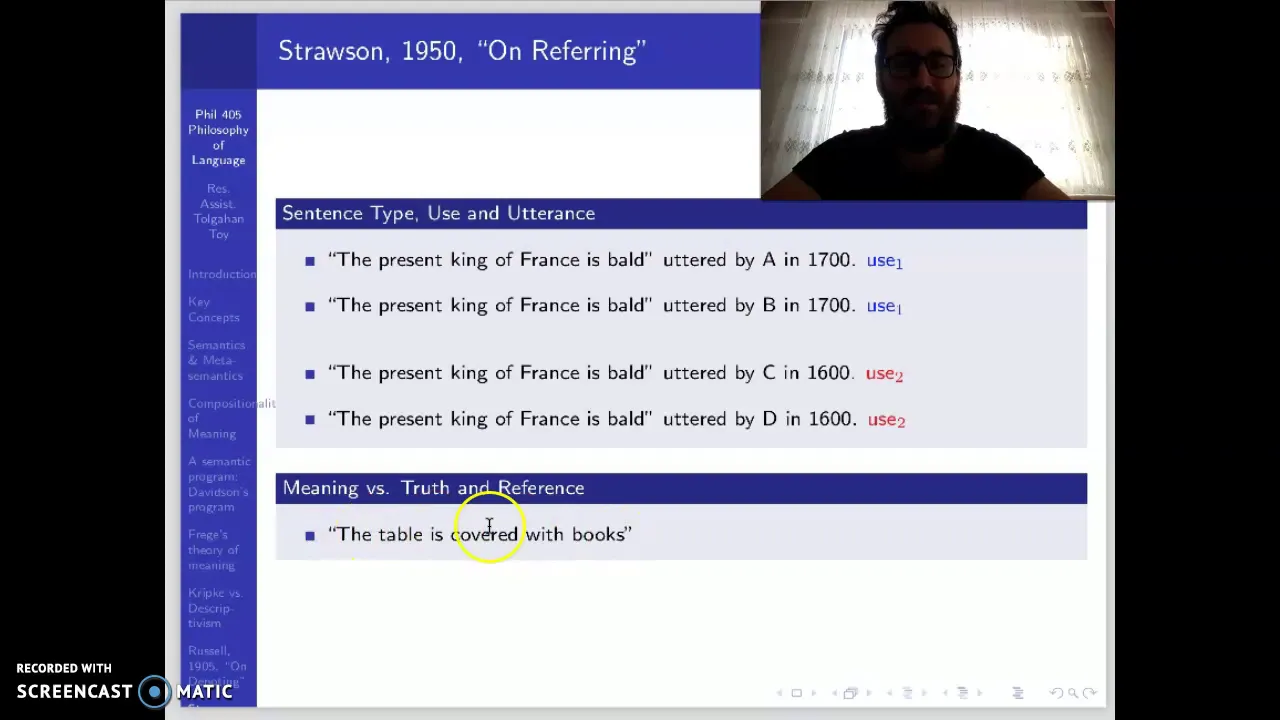










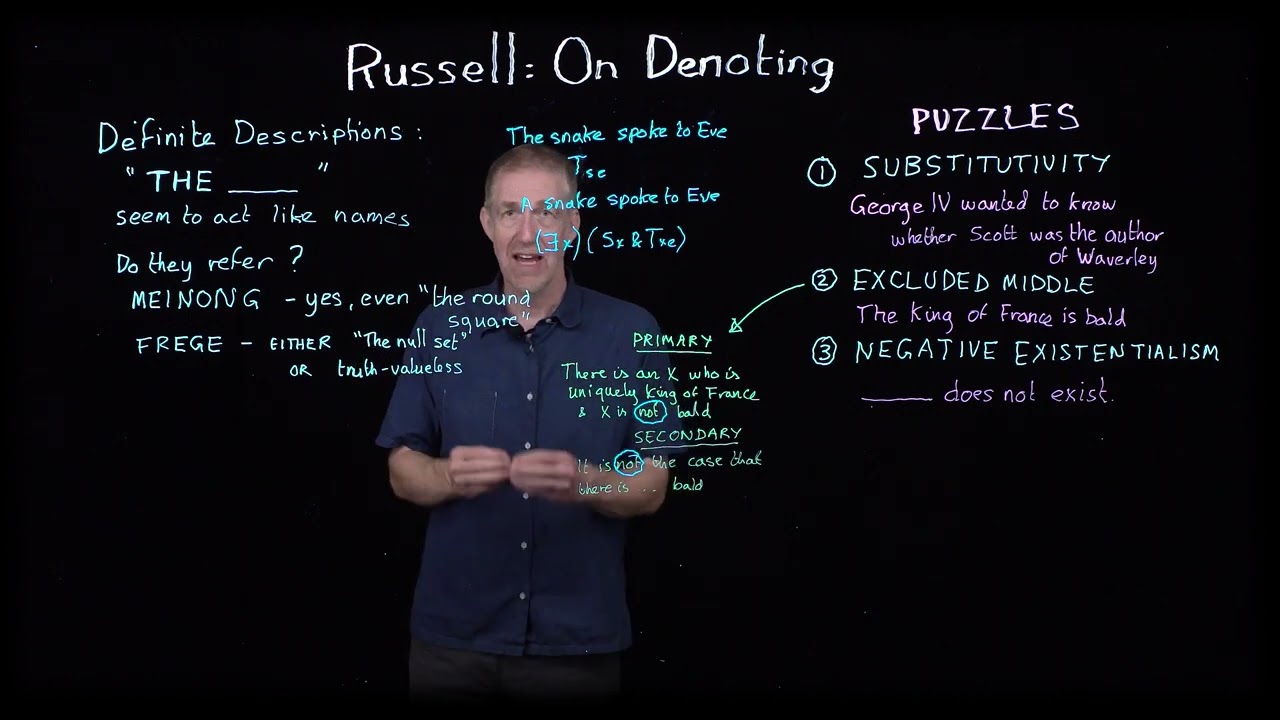
Bertrand Russell proposed that definite descriptions (like 'the present King of France') are not names but complex logical expressions meaning 'there exists exactly one X such that X satisfies the description and X has the property.' This theory resolves puzzles about non-existent objects by showing that statements involving them are false (not merely unknown), as demonstrated by representing 'The present King of France is bald' as 'There exists exactly one X who is the King of France and X is bald,' which is false because no such X exists.
Russell's Theory of Definite Descriptions Explained (Philosophy of Language)
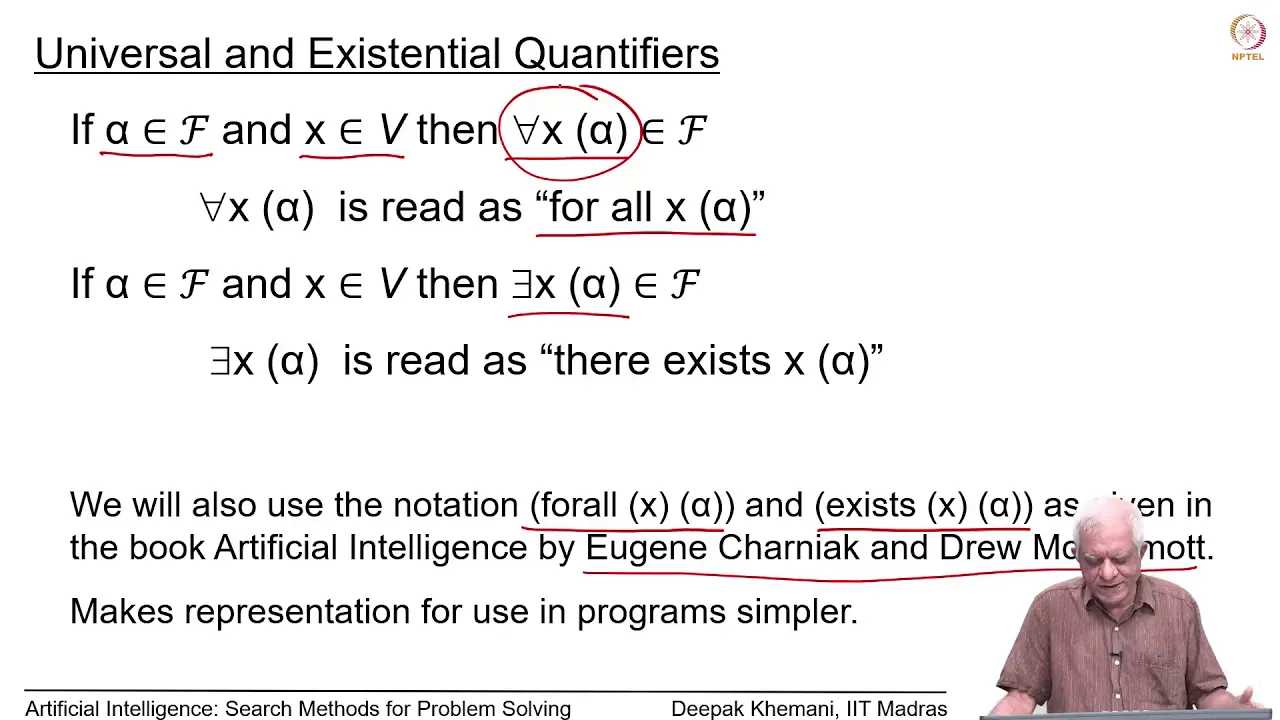
Added:Introduction to First-Order Logic: Understanding quantifiers (existential and universal), variables, and logical connectives.
Frege's Distinction between Sense and Reference: Familiarity with how Gottlob Frege addressed the meaning of names and expressions.
The Problem of Non-Referring Terms: Basic awareness of the philosophical puzzle regarding sentences about entities that do not exist (e.g., Pegasus).
Basic Philosophy of Language: Distinguishing between grammatical form (syntax) and logical form (semantics).
P.F. Strawson's Critique of Russell: Exploring Strawson's 'On Referring' and the concept of presupposition vs. assertion.
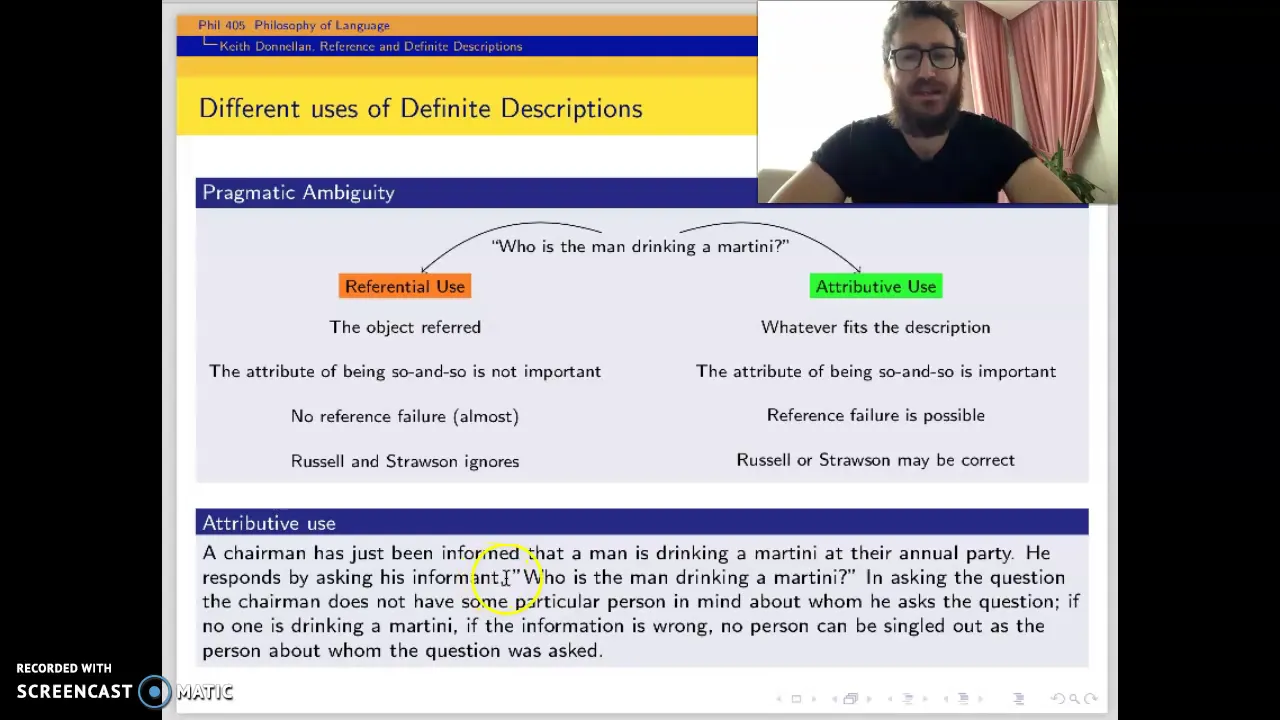
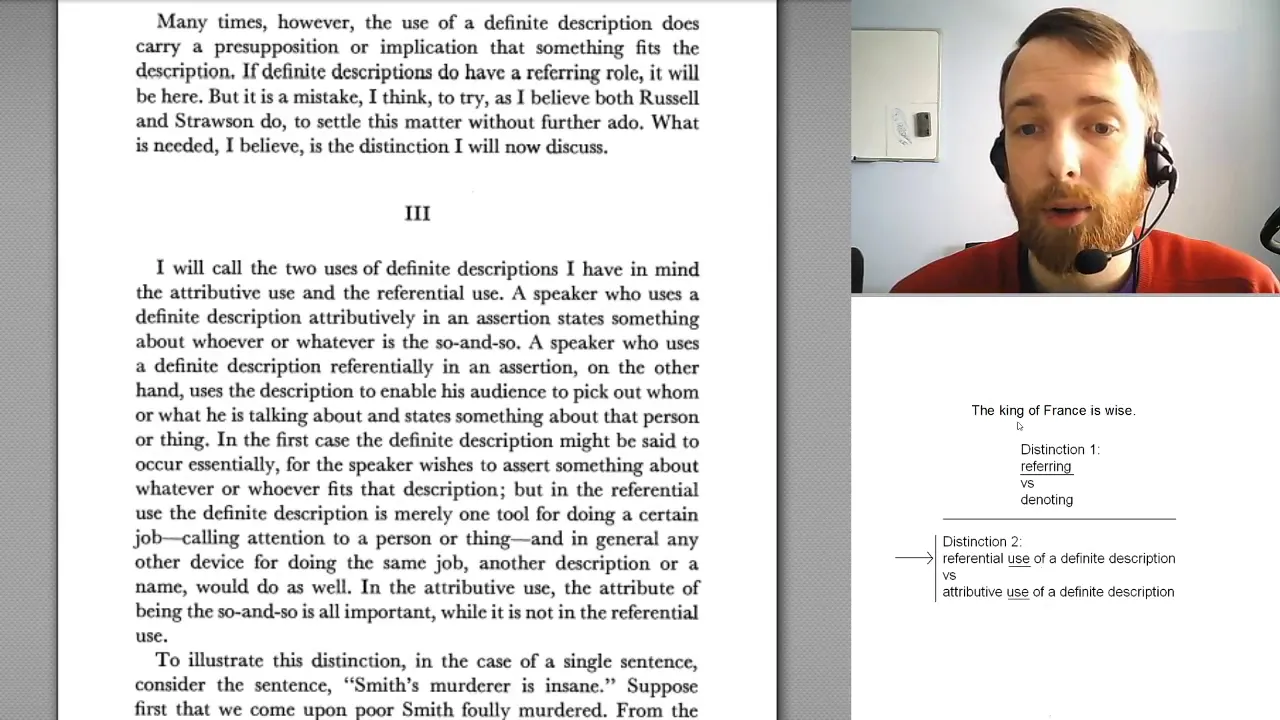
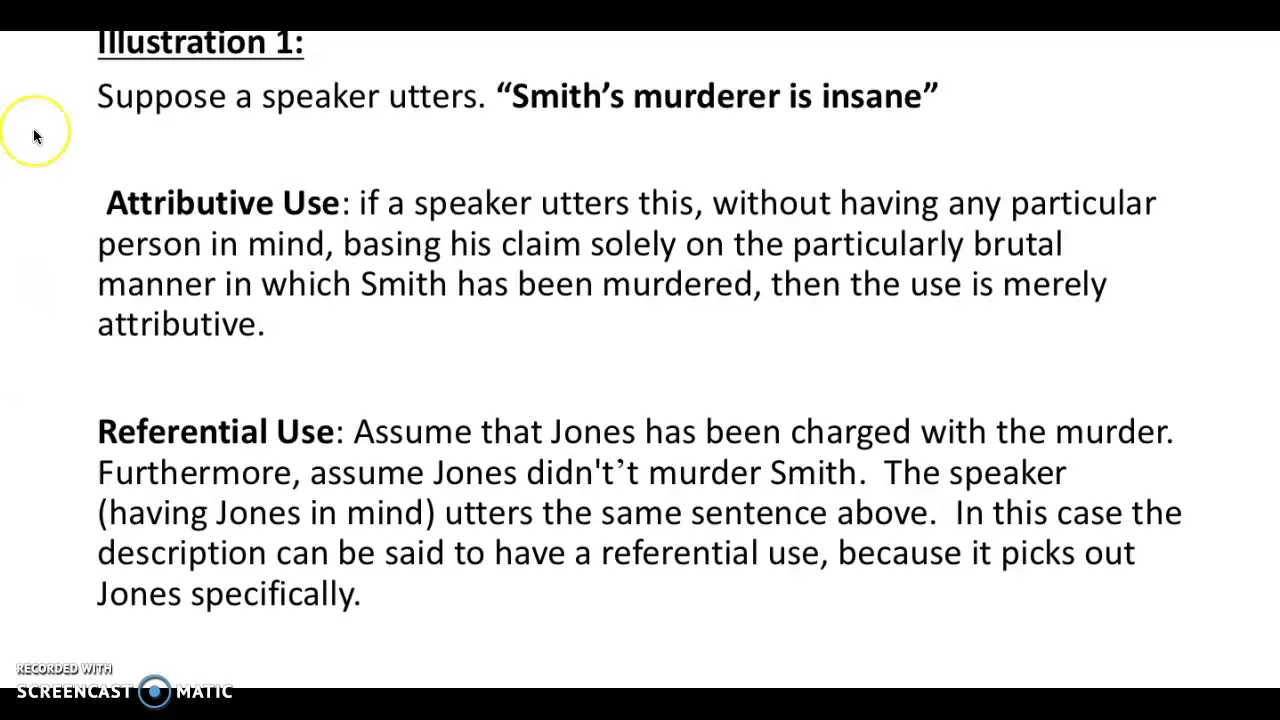
Keith Donnellan's Referential vs. Attributive Distinction: Examining how speakers use definite descriptions in different contexts.
Saul Kripke's Naming and Necessity: Studying the critique of descriptivism and the introduction of 'rigid designators' for proper names.
The Semantics of Empty Names in Free Logic: Investigating how modern formal logics handle terms that fail to refer without assigning them false truth values.
52.5K views618likes4:58Original Release: 2015-03-21
welcome back to cares.org today we're going to be finishing up our series for famous puzzles in the philosophy of language with burand Russell and ger Fraga in this video we're going to be looking at Russell's solutions to the last two puzzles we offered and Russell's theory of definite descriptions in a very basic form so for Russell the statement the present King of France is very different in kind from names like Scott or Bill the present King of France is something Russell is going to call a definite description what does that mean instead of calling someone by a name it describes something so the present King of France is something of an attribute or a property well being Scott or being bill is just to have that name so definite descriptions cannot have meaning on their own we can only represent them if they're placed into a proposition so we can see this very clearly if we take J to be John DX to be X's bald and KX to be X's the present King of France we can't represent on its own the present King of France as we noted because definite descriptions don't work like that we can see the difference using these titles between the statement John is bald and the present King of France is bald he we would represent JN is bald simply as BJ of J J is bald however we would represent the present king of France's Bal with there exists some X such that X is k x is the king of France and for all y if Y is K if Y is the king of France that implies that x equals y and x is bald it seems like a really complicated way to say this but we're basically saying that there exists exactly one thing that is the king of France and that one thing is in fact bald if you want more information on kind of the way that we use logic to State numbers of things you should check out my video on identity where we actually deal with some of these puzzles from the philosophy of language so when it's framed this way it should be clear that this whole statement is in fact false it's not unknown or unclear so the L the law of the excluded middle is going to hold it is not in fact the case that there exists one individual that is the of France and is bald as there's not an individual that is in fact the king of France a similar strategy is going to assist us in denying the existence of the king of France instead of representing the proposition as it's not the case there exists some X such that x equals K and being forced to assume that K exists and therefore showing the falsehood of our own proposition we should represent it as it's not the case there exists some X such that X is K representing K as as a property instead of an object that X is identical to allows it to be an empty set we could have some property like being around Square such that there doesn't exist anything that is around square of course people like Mong are going to disagree with this assessment of everything check out manong's jungle if you're curious but for most of us that don't believe in non-existent objects this is going to be sufficient now an extra credit problem for those of you who are interested in the philosophy of language how can Fraga or Russell's systems deal with the following problem take the following statements dionisis is the son of Zeus all unicorns have one horn Darth Vader is Anakin Skywalker these seem to express true propositions yet all of the terms fail to refer dionis Zeus unicorns Darth Vader and Anakin Skywalker Don't actually exist at the very least even if you think those propositions are false they seem to express propositions whose truth values are importantly different from statements like dionis is the son of Poseidon all unicorns have two horns and Darth Vader is Yoda it seems of these latter three statements we would say they're definitely false well the first three we would say that at least they're partially true or in some way true but with frag and Russell's systems the question for you is are are we committed to claiming that all of the above statements are false or can we allow for some or any of them to be true and explain how in the comments below so that was the end of our series for famous puzzles in the philosophy of language those were Russell's Solutions and the theory of definite descriptions watch this video and more here at carneades.org and stay skeptical everybody
Up Next

50:15
Russell's Theory of Descriptions Explained | Analytic Philosophy Lecture
@PhiloofAlexandria
36.4K views•2017-02-03

164:01
John of Damascus on Holy Images: A Theological Defense
@BannedBooks
139 views•2026-04-25
6:07
Gottlob Frege: Founder of Analytic Philosophy and Modern Logic
@CarneadesOfCyrene
15.3K views•2016-12-08
4:57
The Myth of Sisyphus: A Greek Legend of Eternal Punishment
@TEDEd
8.6M views•2018-11-13
Related Study Plans & Knowledge Roadmaps
Structured learning paths in Philosophy
philosophy
Frankfurt School: Critical Theory & Culture
01Foundations of the Frankfurt School and Critical Theory
02Horkheimer & Adorno: The Critique of Instrumental Reason
03The Culture Industry and Mass Deception
+ 2 more learning modules
12h5 modules
Explore Roadmap
philosophy
Philosophy of Language: From Frege to Austin
01The Linguistic Turn: An Introduction to Language in Philosophy
02Gottlob Frege: Sense and Reference
03Early Wittgenstein: The Picture Theory of Meaning
+ 3 more learning modules
15h6 modules
Explore Roadmap
philosophy
Feminist Epistemology: Standpoint & Injustice
01Introduction to Epistemology and Feminist Critiques
02Sandra Harding and Standpoint Theory
03Donna Haraway and Situated Knowledges
+ 2 more learning modules
12h5 modules
Explore Roadmap
philosophy
Environmental Philosophy: Ethics & Deep Ecology
01Foundations of Environmental Ethics & Anthropocentrism
02Biocentric Individualism and Animal Liberation
03Ecocentric Holism and Deep Ecology
+ 1 more learning modules
10h4 modules
Explore Roadmap