![[Logic] Predicate Logic](https://i.ytimg.com/vi_webp/h5UTvdcgFHw/maxresdefault.webp)


![Lógica de primeira ordem [13] - Formalização de primeira ordem (1/3)](https://i.ytimg.com/vi_webp/--mHO8AzXBo/maxresdefault.webp)









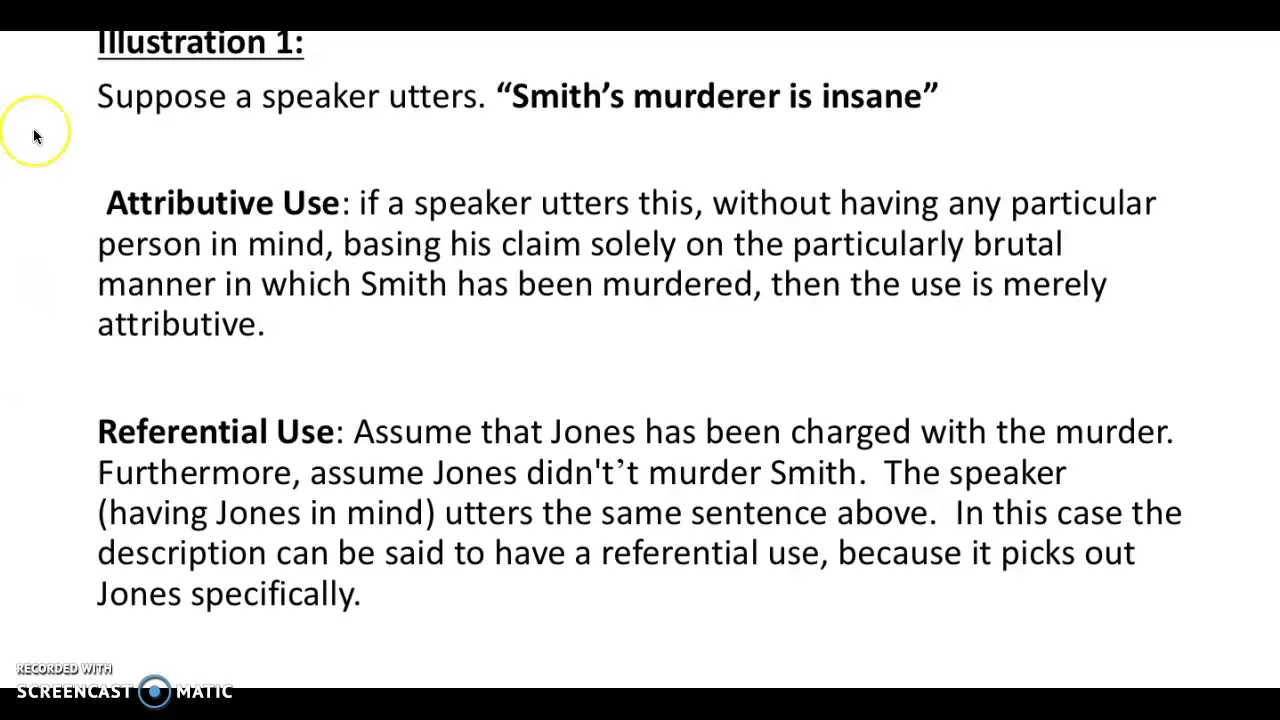






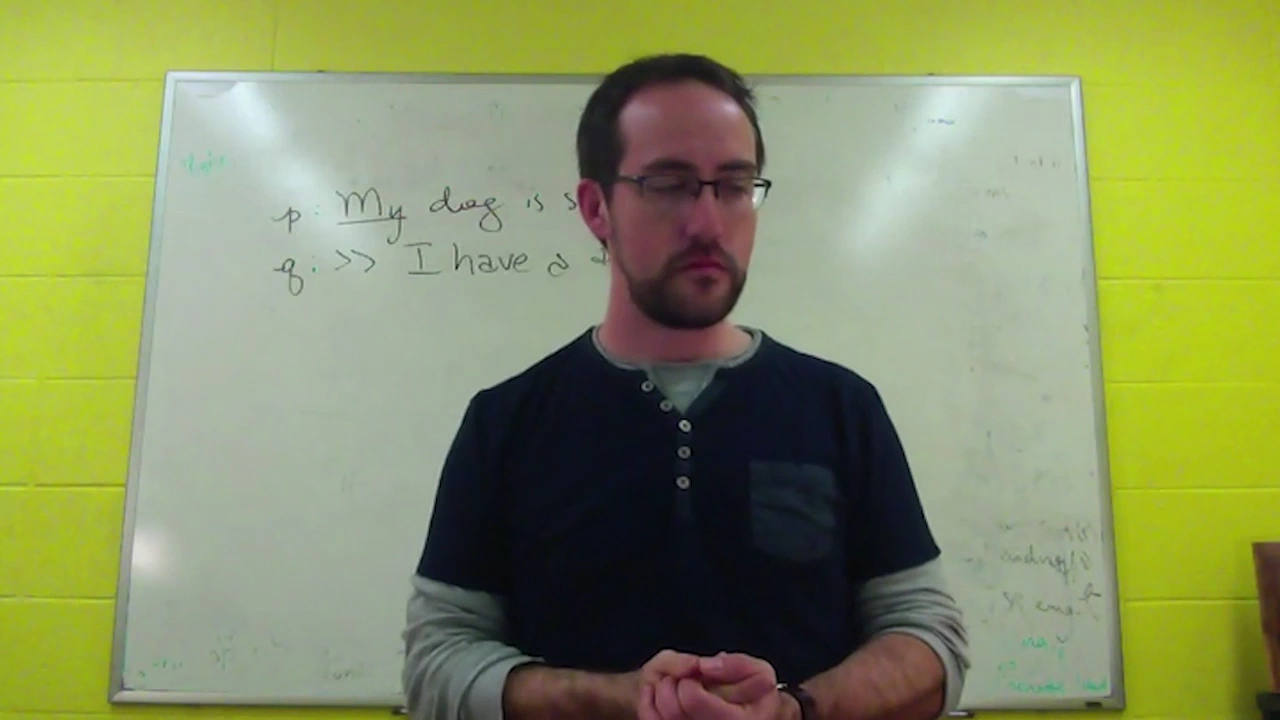
Bertrand Russell's 1905 essay 'On Denoting' argues that denoting phrases (such as 'a man,' 'the present King of France,' or 'the center of mass of the solar system') do not directly refer to objects but instead function logically within sentences through quantification. Russell distinguishes between knowledge by acquaintance (direct perception of objects) and knowledge by description (indirect understanding through properties and relations). His theory of descriptions analyzes definite descriptions like 'the F is G' as asserting three components: existence (there is an F), uniqueness (there is at most one F), and predication (that F has property G). This revolutionary approach resolved puzzles about non-existent objects and demonstrated how language connects to the world through logical structure rather than direct reference.
Russell's Theory of Descriptions Explained | Analytic Philosophy Lecture
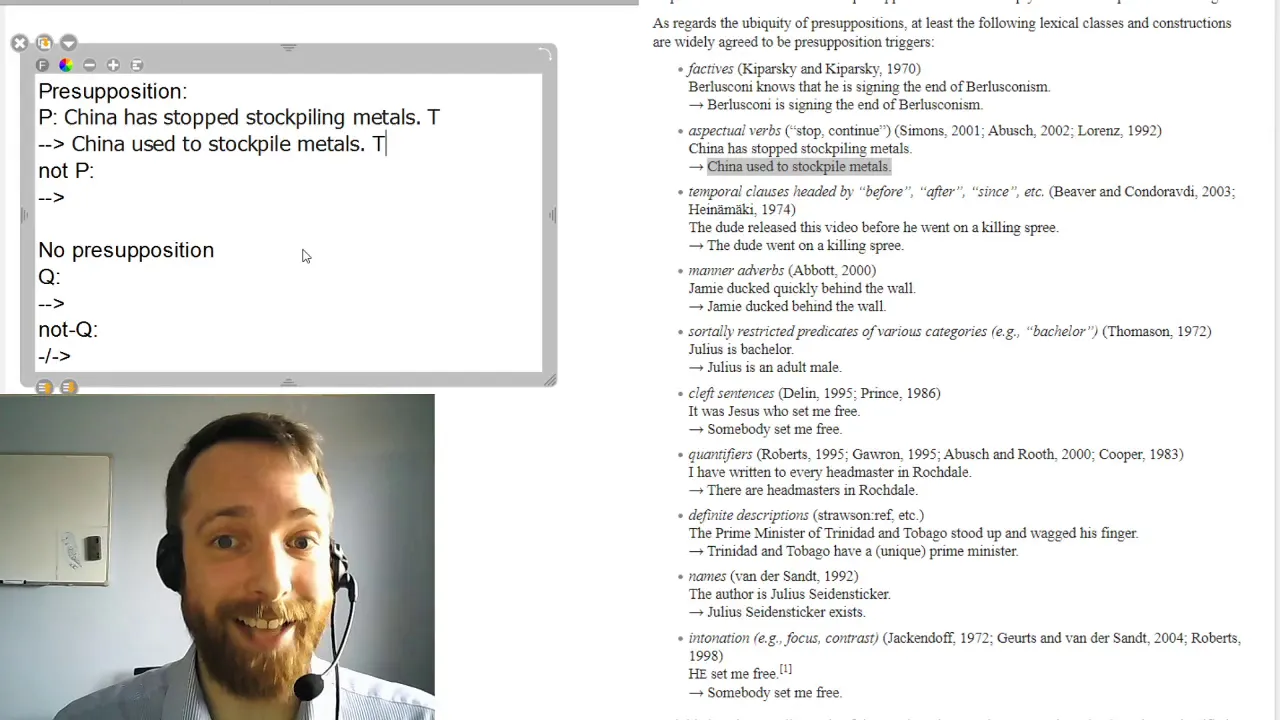
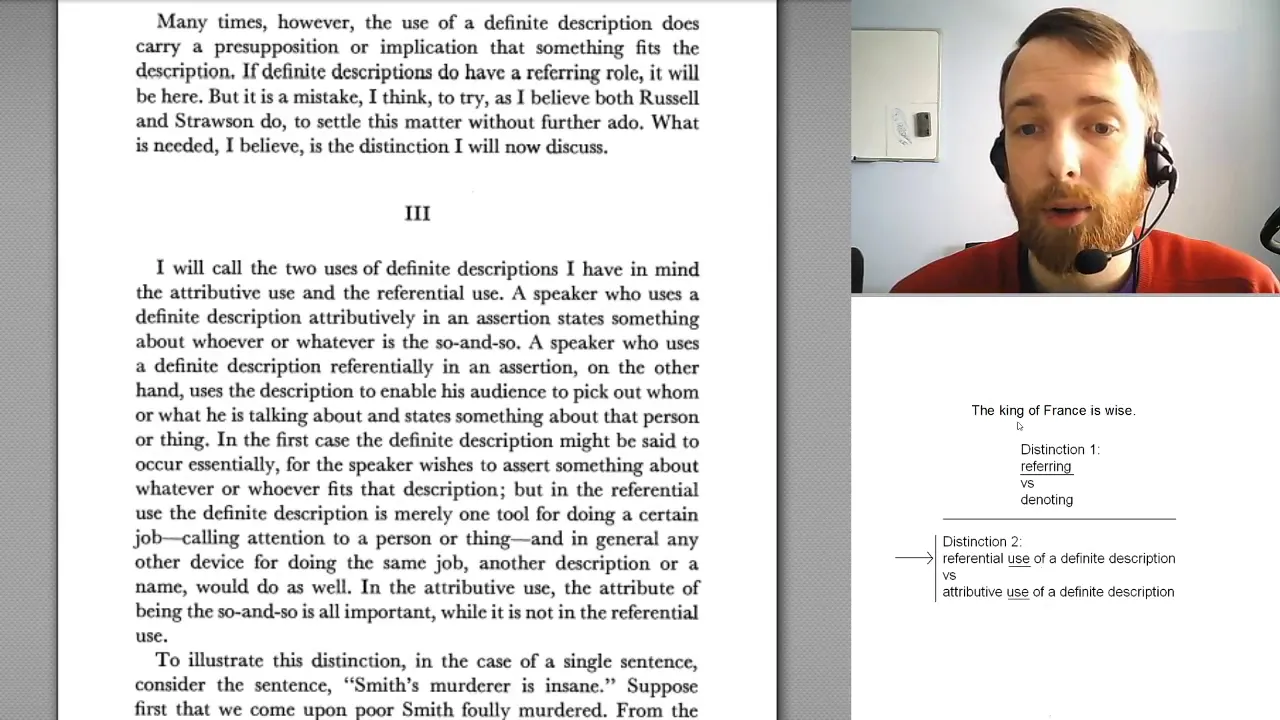
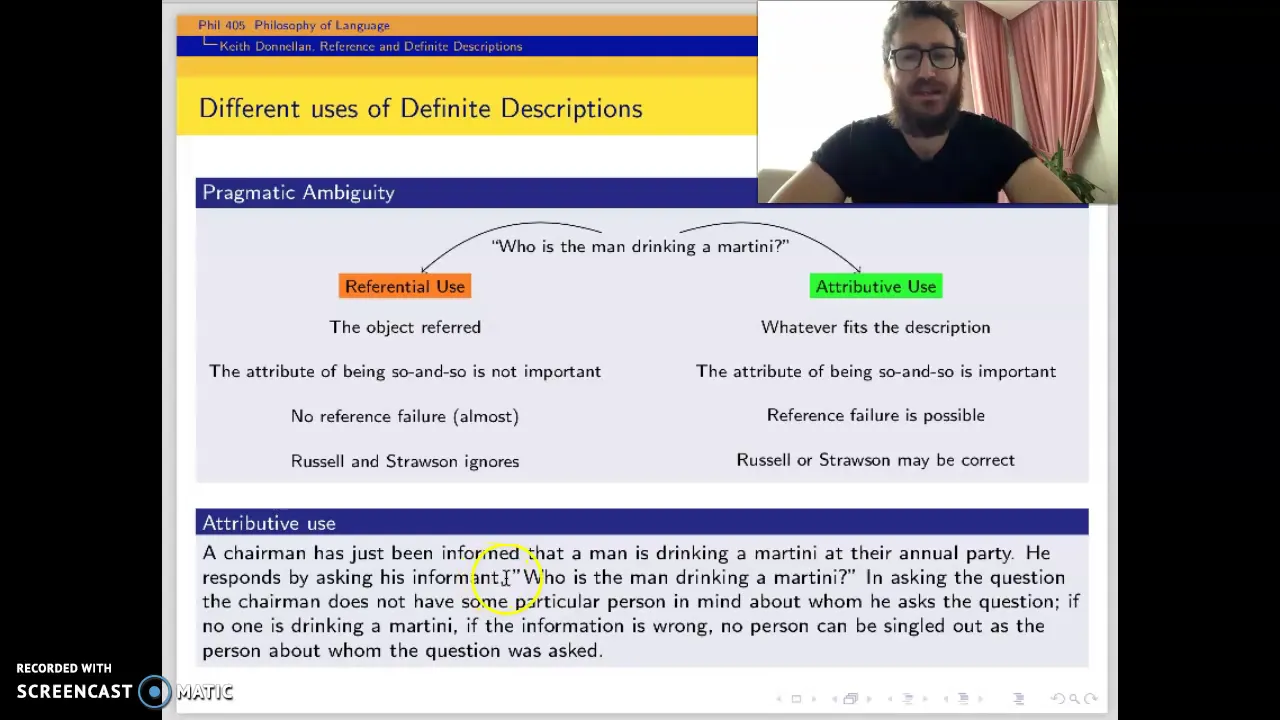
Added:the paper we're going to be talking about today on denoting is one of the most important essays in 20th century philosophy and at first glance it's really a puzzling essay you might think why on Earth is this an important essay it appeared in a 1905 issue of mind which is the most prominent philosophical journal in Great Britain uh was then still is today and it's surrounded by other pieces on the nature of Truth a fight between the pragmatists and the absolute idealists um none of the papers appearing in that Year's Journal look anything like this so it must have struck people as quite bizarre when this first appeared um nevertheless there is something really important about it it can be hard to read at first because when you encounter this for the first time you think what what's going on why is this even philosophy so I want to take us through parts of it quite carefully to try to understand what what's going on Berard Russell ends up being one of the great philosophers of the 20th century in general one of the great public intellectuals he's somebody who wrote book after book on all sorts of topics um his views also changed he was one of those people who was constantly changing his ideas changing his views depending upon arguments other people put forward that he himself had developed so this reflects his views as of 1905 and he never really does change the theory of description significantly but we're going to next next week look at his uh philosophy of logical atom atomism and there are a number of differences that appeared there and really every few months during this period he's changing his ideas about mathematical logic about the nature of s about all sorts of philosophical topics and he continues doing that throughout his mon so really in the end we can't talk about what is Russell's view on this it's really what is Russell 1905 view on this what is Russell the spring of 1908 Russell 1910 Russell 19113 Etc and those are all a little bit different well let's take a look at the beginning of this essay by denoting phrase I mean a phrase such as any one of the following a man some man any man every man all man the present King of England the present King of France the center of mass of the solar system at the first instant of the 20th century the revolution of the Earth around the Sun the revolution of the sun around the earth thus a phras is denoting solely in virtue its form now first of all let's talk about those examples of phrases what are they a man some man any man every man all men the president King of England the president King of France the center of mass blah blah blah blah blah what are votes grammatically speaking yeah good they're nouns specifically noun phrases right or sometimes these days in linguistics called denoting phrases um or uh determiner phrases really um they are things that are well there is noticed some determiner like a every all the ETC and then some now typically here just man uh men but then we get some phrases as well noun phrases King of England King of France Center of mass Etc and so these are things that most linguists would consider noun phrases or determiner phrases well he says notice he's concluding from this a phrase is denoting solely in virtue of itself for in other words it's not a question of whether there really is such an object notice some of these correspond to something that exists at the time he's writing the king of England there was a king of England at the time but then King of France there was no king of France in 1905 so one of those denoted when he wrote this and one of them didn't today neither one denotes but then the revolution of the Earth around the Sun okay that denotes something but the revolution of the sun around the earth that doesn't denote anything however being a denoting phrase isn't a question of they really being an object in other words it's just a matter of the grammatical form now he says we can distinguish three cases a phrase may be denoting yet not denote anything so it can be a denoting phrase without actually denoting an object for example the present King of France there is no present King of France a phrase May denote one definite object the present King of England denotes a certain man uh well did in 1905 a phrase May denote Ambiguously a man does not denote many men but an ambiguous man now notice the way he's dividing the okay you might not pick out anything at all so there might be nothing corresponding to this noun phrase there might be one that thing but then what's the other possibility notice he says it denotes huous there's actually a very old idea that Russell here is kind of leaving alone it's a it's not in the end I think his official view but he's referring to something like a man as a denoted praise but what does it denote well gosh suppose somebody says a man walked in what does the phrase a man denote yeah almost nothing ah okay what do you mean almost nothing good well I mean I guess like if it was the man there would be more description attached to it or we would have a better idea of who walked in but a man could be literally any man ah good good good could be any man so that's why he says it denotes Ambiguously because a man could stand for any man right and so it sort of denotes well what now there is a sort of medieval view that a man denotes a man but then as soon as you say that you can say well like which man right could say Well in that sentence the man who walked in maybe but that's going to be weird because who it denotes depends on the sentence um really in the end Russell's going to think that it doesn't it's wrong to think of it denoting really it's doing something else so we'll come back to that it's it plays only a background role throughout this essay but it's worth reflecting on General yeah so usually when like is the saying like independ like that is in isolation has no meaning or because when you say like a man walked in it usually follows up with more details as to who that man is ah good yes so it's going to turn out that um a man is really to be understood as something like introducing a quantifier in logical terms and so it'll be something well he gives a very odd paraphrase of it because he wants to take every as the basic idea and so it's going to be um a man walked in will be something like it's not true Pro that X walked in is always false and that's going to be well I I didn't put the man in there so it's not true that X is a man and X walked in is always false it's going to be his way of understanding um but really that's going to be saying there is some object X for example such that X is a man and X walked in and so to say a man there won't have any significance independently and you're right to identify this is one of the main themes he says look if you try to take these phrases in isolation and say what's the denotation of that phrase or even what's its meaning you're not going to be able to give give a good answer but you can give a good answer to the question of what the meaning of the sentence containing it is so he'll end up saying really these things have meanings and denotations only in the context of a sentence um later linguists will say actually I can tell you what the meaning of that is but they introduce a Lambda phrase in order to do do that and Russell does something very much like that by 1913 um so that he has a way of talking about this that's a little bit more specific but anyway I don't want to get into the Lambda calculus now so we'll just sort of forget about that yeah sorry so what about what about a man An Evening Star the man the evening star like yeah what's the difference okay a man and the Man what's the difference between just saying a man walked in and the man walked or or that man or or oh or that man that's very closely related right or a or am man and Bruce Wayne or am Man and Batman oh yes we could specify a man namely Bruce Wayne right so all of those are slightly different how do they differ yeah you want to get um I would think it's definit or uniqueness ah all right good one thing you could say is definiteness the man implies a certain definit whereas a man doesn't right a man walked in speaking who right the man walked in um there's more this presupposition the sense that you're already supposed to know who we're talking about and so there's a notion of definit here and also notice you said uh yeah definit plus what else uniqueness yeah and so Russell thinks one of the things that's really important is that if I say a man walked in that's fully compatible with lots of people walking in but if I say the man that implies that there is one and only one man that we're talking about that that we could sort of fill in there um so he thinks it's not only a question of definit but of uniqueness and you might identify those two things as he seems to in a sense in this article but you might also keep them separate and say one is a question of having somebody specific in mind as opposed to a very general statement the other is a matter of a unique characterization and that may or may not be the same thing as definiteness other things that would be different there well let's continue and see what his view ends up being uh he says the subject of denoting is of very great importance not only in logic and Mathematics but also in the theory of knowledge and now we get the account of why he thinks this paper is important later he ends up saying I think the theory of the word the is so important that I would insist on giving it even if I were dead from the ne town so he's basically saying I'm dying I am you know I I'm paralyzed but I can still speak and what are my last words to tell you what the means you think whoa okay that's really weird but why why because he thinks it's a key to a fundamental philosophical question the theory of knowledge namely how does the mind how does language connect to the world we've talked about that word world connection that mind world connection he says this is V to it because when I say the present King of France or the present King of England or the center of mass of the solar system or the man or whatever we've got a phrase that looks like it's connecting to the world in some way and he wants to understand the nature of those connections to the world and he thinks this is key to understanding those connections so really this paper is about how thought and how language link up to the world do they link directly or indirectly and if directly where and how so that's the background question that's why he cares about this that's why he sees it as fundamental that's presumably why mind printed it because otherwise it could look like a paper in logic or Linguistics but why did it have philosophical importance because it has to do with that connection between mind and world so he'll tell you here what the connection is he says for example we know the center of mass of the solar system at a definite instant is some definite point and we can affirm a number of propositions about it but we have no immediate acquaintance with this point which is only known to us by description so the idea is this I going to draw this picture not in the sense of really a very specific mind though you can think of it that way if you like but in very general terms think of this as the Mind here we've got the world and now the question is how do they connect well his idea is that there are certain points of immediate connection direct connection okay and he calls that acquaintance so at certain times I've got something going on here and will'll be also true in language I say something and whatever I say here blah blah blah is going to have some kind of direct connection with the world so there will be some object here who knows what it is um and whatever that object is I've been talking about triangles but triangles are getting boring so let's introduce a new object what should well gosh this paper is all about Kings right so let's talk about Kings here we've got yes I draw King Royal robes crown that looks like an angel doesn't it something I don't know what that looks like gosh that's terrible okay but whatever okay came and now you might think my thought is directly about that object or my statement is directly about that object and so let's call this kind of direct actually later in the tradition this will be known as some sort of direct reference or you might consider it here in terms of the thought our acquaintance with the object so in those cases he wants to say we've got a direct link to the world thought language is connecting directly but in other cases it's really indirect the center of mass of the solar system um there's no direct connection to a point there and so sometimes we we've got this direct reference but much more often we've got a kind of indirect reference and so one of the things he's all about here and we really won't get the full story until his 198 lectures next week is to try to understand where these points of direct connection so the thought is really we have some points where there is sort of a direct link to the world and then we've got built on top of that all of these indirect links and how do we link up to the world indirectly well maybe there are various ways but one of the key ones is by way of description and so in fact he thinks that's the most fundamental way so we're going to have knowledge by acquaintance and knowledge by description and that indeed is one of the titles of a paper that ends up following this by a few knowledge by equence and knowledge by description the thought is we have this direct acquaintance with certain things in experience and then then by way of descriptions we know other things and so descriptions are fundamental because they're how we get from these direct connections the world to anything else yeah so in the case of like in my for me I never met a king so would every single thing be exactly it's all indirect and in fact where would you have direct connections by que if we're talking about the table right there yeah good um if we if now if we say the table I I might be looking at this and I might not right but I'll give you a preview it's really with phrases like this and that okay where I have got something directly before my mind and perception so I say this and maybe this table that will give me something like a direct link to the world so this and that pointed seeing directly those he takes to be acquaintances but everything else built on top of that is built by description and so is really indirect so even talking about the table in the room um that's going to be a description um that's perfectly intelligible whether you're here acquainted with the object or not but to say that that's something that I can only understand if you're there in the presence of the table and your acquaint now if you say that table that man it's sort of an interesting combination of those two and so one of the things to think about is what is that doing and is it something that really counts as sort of a direct plus an indirect reference um but we'll come back to that question next week uh for now it'll be enough to try to understand the sort of simple cases of description okay so that's really what this is all about this is why he cares so much he thinks look the whole way we have of getting from this direct acquaintance by way of perception with things that are immediately present to us to the rest of our knowledge is all by way of description we're acquainted with a few things but only the things right in front of us at a given time and so everything else has to be indect now there's a philosophical view that you can see underlying all of this what is it does this remind does this ring any bells from the STP there are certain things that sort of are directly there in front of me and I have you know experience of them directly then I build everything else on top of those yeah Jak cart cart well okay um yeah I had in mind lock and Hume as aist but you're right dayart with respect to perceptual knowledge actually has very much the same account I mean dayart then has his innate ideas and his I think as well but you're right dayart really gives you in the new way of ideas the same basic account so it's probably fairer historically to say it's really dayart who gives you that theory of perception and then lock and Hume take it over and say oh that's all and they cart has these other things in addition but you're right the idea that perception can be broken down into these symbols that are sort of direct experiences of the world that's something that deart Lo and hum all share and so Russell is in that tradition very much yes are you talking sort of about like the relations of ideas versus what yeah good relations of ideas versus matters of fact so really here we're thinking of matters of fact and thinking of them as ucing ultimately to these simple connections as in you you know there these the there are these simple Impressions um that give rise to simple ideas and then we put all those ideas together in complex combinations but in the end it comes down to these simple Impressions and that's sort of the kind of thing he's talking about is a direct connection here um not necessarily simple of course A lot of these are going to be kind of complex way but but nevertheless um yeah these are like The Impressions and the are like the ideas why when Why Try to like reduce this to a calculus like when when you see day uh not dayart who do we Russell like when you see him use X or or very y or like these you know why use logic for this right ah well because of that idea that we're not really going to explain the meaning of these in isolation uh because there are puzzles that arise it it's many decades later when Peter gich directly addresses that medieval theory that a man refers to a man and basically says look that doesn't make any sense and goes through in detail to show you why it doesn't make any sense but Russell I think has in the back of his mind yeah when he it doesn't really make any sense um and so in the end we have to explain what's going on here in a different way and he thinks he has a new tool for understanding that there's a much broader point in way um philosophy goes through Cycles there are times when philosophers get very excited and there's lots of movement in philosophy um sometimes that happens as a result of a philosophical idea sometimes it happens as a result of a scientific Advance sometimes it results from a mathematical or a logical Advance where all of a sudden people have new tools and new ways of thinking about things and part of what's going on at the beginning of analytic philosophy is that people have new tools they have first order logic um developed really by mathematicians initially um and logicians were thinking about mathematics is the best case and so there here I could I won't but I could go into an Excursion about what was going on in 19th century mathematics basically people had developed the calculus liit Newton the calculus really didn't make any sense in the sense that it seemed as if there was this underlying view of infinitesimal quantities and people really didn't understand what that was like think about what it is to compute a derivative um you are taking a limit as things get smaller and smaller but people had no theory of limits and they really didn't have a theory of infinite sequences that would allow them to understand limits and so there was this sort of understanding that went like this and then it was kind of like okay now imagine you've got it at a point so that really you know the difference between F of Y and F ofx and then between y and X is just zero and somehow 0 over 0 was supposed to be the derivative and they realized yeah that doesn't make any sense I don't know what to do with zero or zero and so the 19th century saw the development of the real numbers in a kind of rigorous detail of the calculus in rigorous detail um developing a theory of limits developing theories of infinite sequences and so on that could make sense of all with that um at the beginning of the 19th century there were all sorts of paradoxes in mathematics uh and then that happens early in the 20th century too but a lot of the logic that we see here was developed to get around those problems in mathematics in order to formalize mathematical proof and mathematical theories and so Russell suddenly finds himself with this wonderful New Logic developed by Fraga and by purse um that has all sorts of applicability in mathematics and he sees wait I can use this in philosophy too something similar is going to happen some 60 years later when uh new advances in logic enable all kryp key for example to say I can make sense of all these ideas that couldn't be made sense of in the earlier logic and so all of a sudden you have new tools and that generates a huge amount of excitement but then after people have used the tools on the big problems they start using the tools on smaller and smaller problems and you might say philosophy gets feeling tired and like gosh philosophers are just worried about all this nonsense and who cares anyway and then somebody comes up with a new tool and you realize oh there are those problems we forgot about that we now have ways of addressing and the excitement builds again so I would say by the 1950s things are getting kind of tied this Paradigm introduced by Russell uh and so on it gets exhausted but then new life gets breathed into it biological advances where are we now I think we're in one of those tired stages again longing for the next advance that will enable philosophy to sort of see things in a new light but that's what Russell's do in short he realizes this this old way of thinking about phrases like a man doesn't make much sense but the 19th century developed first Boolean algebras and then this sort of logical calculus that you can now use that's what all the x's and y's are about um and in the end if you write if you understand logic and can write down the symbols you can say a lot of what he says here so much more elegantly and so much more briefly that he's trying to do that without the symbols to scare you away but that means he says a lot of stuff in English that doesn't make much sense it seems really unattractive anyway yeah um so if you were to see like the portrait of the 1905 King of England would that be a direct reference ah okay so oh the portrait yeah oh that's a really good question yeah what happens if we are looking at a portrait of the king of England the time is writing I think that's George IV so we see this painting of George ivth and you say there he is the king of England actually here we we've got something I don't know this guy is the king of England who is he I don't know the comedian okay so I point to him and I say ah there's the comedian well shoot um am I pointing at the comedian is that direct knowledge of the comedian no right the portrait or the in this case the photograph is an indirect way of getting access to the man himself however it I do have direct access to something in this case you're AB it's interesting because it's it's a sort of representation of It's A Portrait of or a photograph of it's an image of that person and we often talk as if that's the person you say who you know who is going to be uh doing that thing at the theater that guy well i't actually pointed at a guy I've pointed at a photograph of a guy so I've directly referred to the photograph but indirectly referred to the person and I think would say the same thing about the king you see the portrait of the King you would say there's the king you're directly acquainted with the portrait the image of the king but then there is a connection in this case close causal connection between the comedian or the king and then the image of the comedian or the image of the king much more direct in the case of the photograph since there is a causal process we can explain in some detail whereas who knows what goes through the vine of the art yeah of the mind of the Artist as he's painting somebody's portrait yeah so only when we're actually able to see something and be near it can we actually be acquainted with it that's his you got to be right there with a thing yeah and that and that if that's the case then what's the direct reference for the center like of mass of the UN or the Sol stem you'd have to be there at the point so there are lots of things we know only indirectly and the center of B of the solar system is one of those things I just thought everything was built off of direct reference well everything is ultimately built off of direct reference but it can be very very indirect and it's not like we have direct reference of that particular point so suppose I say ah the first baby to have been born in the 21st century um presumably that picks out a particular baby but I don't know who it was I I think at the time there were articles actually saying you know so which baby was the first born of the new century um and maybe people know but probably not after all they most know in the United States or something and so you might say in this case I only have this indirect knowledge now what do I have direct knowledge of well think about that first baby born in 21st century is our knowledge of babies well I've used the term baby right that's a sort of description and so it's built ultimately on Direct references to babies look at that baby look at this baby um but in the end it sort of so everything ultimately traces down to these bits of direct reference however many of the things we discuss we never have direct reference um or never have direct equain with we don't have it with that point in the solar system um gosh probably most things we know about read death death that's a good question you have well you have direct acquaintance with death you can watch someone die yes or I guess you have direct acquaintance with the person dying of course you'll have direct acquaintance with your own death but can't tell anybody right I saw an article the other day saying hey your whole life does Flash before you your eyes as you die how do you know I mean are you talking to the guy as he dies saying goodbye dear well all flashing by see what I was too I mean I thought this how could you not anyway yeah um so death is the kind of thing you might think look in a certain sense uh the direct knowledge of it is when you die um so how does the rest of us gave anything from that um somebody can be there and watching you die so there is a kind of direct connection as opposed to that particular experience but a lot of things like what we think of babies what we think about death and so on is builds out of these sort of direct acquaintances uh by way of then generalization inductive inferences um further descriptions that's why I said although he talks about knowledge by acquaintances by description um it seems to me description is only one of the paths here um for example the connection between the portrait of the king and the actual king um doesn't sound to me like description exactly it's a different kind of representation um the same thing with photographs and so forth so um I'm inclined to think that although we put them into language in terms of descriptions epistemically speaking there are different paths for getting from the direct but lots of things like the center of mass of solar system will never have direct knowledge of its own indirect yeah what about more conceptual things like cause is there how does that fit all right good question what about causation do we ever have direct acquaintance with a causal link can we just use um inductive reasoning for causation yeah yeah exactly and so I think his view in the end is rather humean um we have acquaintance with certain facts um and then we infer through inductive reasoning and things like that that there are causal connections but we never have direct acquaintance with the causal connection human or human humi following D okay uh yeah well Russell's theories are also human because Russell was a human but that's rather uninteresting to remark um but yeah I mean humi and the underlying pattern is very much simples uh being built up into complexes uh direct acquaintance being built up through indirect means to knowledge of the world um not really direct acquaintance with um causal links or necessity or anything like that and so many of the things that you might think of are as problems for Hume well what on Earth is causation what is necessity it's own those become problems for Russell too and both because of this picture of the world that is in some ways following Hume and also because in the logic that he has as a tool now he will have a way of talking about facts but not a way of talking about necessity not a way of talking about um causal connections Etc so only certain things can really be captured in this logical system well we haven't even seen yet his theory of descriptions but let's press on okay he says it often happens we know that a certain phrase denotes unambiguously that we have no acquaintance with what it denotes like the center of mass of the solar system um in perception we have acquaintance with the objects of perception and thought we have acquaintance with the objects of a more abstract logical character so I can have direct acquaint with a number for example things I'm thinking about that but we don't necessarily have acquaintance with the objects denoted by phrases composed of words whose with whose meanings we are acquainted um for example other people's minds I can talk about what your thinking let's say and yet I have no direct acquaintance with that I'm am not acquainted with what's going on in your mind I can only infer it from other things that I see I might see you looking at me like this and think you're surprised or puzzled um but I don't have any direct acquaintance with your mind that lets me be acquainted with the surprise or the puzzle okay so he says all thinking has to start from acquaintance but it succeeds in thinking about many things with which we have no acquaintance now he's going to give us his theory so he says my theory briefly is as follows I take the notion of a variable as fundamental I use C ofx to mean a proposition really footnote propositional function in which X is a constituent where X the variable is essentially andly un determined so he introduces two Notions C of X is always true and CX is sometimes true then everything and nothing and something mean c of everything C is always true C of nothing C is C of X is false is always true C of something it's false that c ofx is false is always true now if you it's tempting to sort of write these out but I don't really want to do it why because we now have logical notation that says exactly this right and so he's thinking about this he's thinking yeah um C of everything so the C here is just some print so gosh think of a sentence about everything back when I was a kid there was this song Everything is Beautiful Everything Is Beautiful in its own way W that was a terrible uh or what's the what's the one from the Lego Movie Everything is Awesome that's sort of the much better uh more recent version of this well supposed we want to say everything is awesome how do we say that well he says that's saying X is awesome is always true okay so everything is awesome is okay uh X is awesome is always true which we'd write today in logic as just for all x x is awesome for example or you know the the other way to do it which Russell actually uses in his own work is to put a parenthesis around the X this upside down a is one way of saying for all this is another way of saying for all and you could write out X is awesome or you could write it out in this form awesome X um but that's what you'd be more likely to see in an intro logic class for example um if you know logic and these are old friends yay if you don't um you're going to see some in the things we read later so you might as well become acquainted with them yeah okay let's look at the next one um that do it um see of nothing so what is an example of a sentence that's about nothing nothing what is not awesome is not awesome is not awesome we could do that um that would be equivalent to this what the heck sure nothing is not awesome that should end up being equivalent so what's that going to mean well he says in the end that's really just CX is false is always true so in this case C is is not awesome so that's a way of saying X is not awesome actually I shouldn't say that yeah is false wait a minute I'm getting myself thoroughly confused because of the thoughts I knew this would I mean you'd think after all these years of teaching logic double negations would not bother me but they still bother me right like nothing is not awesome my first reaction to that is to go what and it even after all these years it's still like what so anyway by the way it's not just me it turns out psychologically speaking when you put more than one negation in a sentence people just freak out more than two and they totally freak out nobody can understand what it means but even two people's cognitive skills decline just radically psychologists have looked at this and they've realized oh people are pretty good with and they're pretty good with or they're so so with if then um with one knot they're pretty good two knots they become idiots well isn't it unnecessary unnecessary to it's not unnecessary right that's part of the problem and part of it is that you know people so often uh use double negations in correctly where they really mean one negation and so part of what I think happens is you think wait are you serious about that I mean do you really mean now if it's not unnecessary we can kind of get okay that's like saying it's necessary more or less um but if it's a question of some other kind of thing like it's not true that it's not awesome uh that's it does feel like a perverse way of saying it's awesome yeah and so so yeah so all this is way of saying look I'm up at the board and I'm confused Russell's way of putting but all right C of nothing means CX false oh yeah so CX awesome CX is not awesome okay X is not awesome uh is false is always true so does that make sense can you just put is always false yeah so in other words that right is always false so in short uh yeah we've got it's always false so for all X is not the case and that is a common logical symbol for not um that X is not awesome so to write this out a different way you could put it like this it's not the case that it's not awesome so for any X it's not the case that it's not the case that X is awesome and double negations cancel out so that's just saying everything is awesome but okay I really regret having done that now see of something okay so something give me a sentence involving something something is awesome something is awesome awesome oh great yes something is awesome what is that going to mean it's going to mean it is false that CX is false is always true okay I'm going to skip writing that out because it's even more confusing it is false that CX is false well CX is just X is awesome CX is false it's more or less it's false that X is awesome so X is not awesome but that's false so something is awesome it's really just saying something like not um not nothing always true that it's not the case that X is awesome and in logic that's not the case that everything is not that's just equivalent to its spe is the way of defining there is an X such that blah blah blah in this case X is awesome so here he's really just giving you some Elementary theory of the quantifiers but doing everything with for all as the basic which he puts in terms of always being true it's a bit weird because notice he's giving you this semantic Ascent every time we quote the sentence and say it's true or it's false it's always true always false that's not the way we do it in contemporary logic we wouldn't want these quotation marks floating around and even in Russell's logic it's not that way so he puts it in a certain way here in the paper trying to stay away from any of these symbols trying to not presuppose any knowledge of logic however it makes it rather hard I think to understand and even he admits look it's going to sound incredible what my theory is and it's partly incredible because he's talking to people who have no idea what this logic is all about and he has to be think start yeah so how developed was this logic like was his I couldn't tell if his like propositional functions were the same as predicates uh in logic and a a propositional function is what Quin later calls an open sentence in other words it's a a formula or a sentence or a proposition but with some variables in it so he thinks of it as a propositional function in that if you fill in the value of the variable you get a proposition so Tom is tall would be an example of let's say a sentence and there you might refer to the proposition that Tom is tall but then if you say x is tall that's the propositional function or the open sentence really inine the quote X is tall that's the open sentence and it denotes something like a propositional function a function from values of X like Tom let X be Tom then it becomes the proposition that Tom is tall there I once sat in on a seminar taught by another faculty member who's now retired but uh there was a guy named Tom in that seminar who always he was coming all the way from the law school and so he always got to class class and he had to sit right next to the professor and so every example was about that poor guy so it was always and and the guy was kind of chubby and so the example was always okay let's take a sentence like Tom is fat really awful I mean it sort of today I think you know this would lead to Serious complaints and so forth but the time for was oh well anyway yeah it was kind of amazing now so here's what happens if we think about now something nothing everything his immediate point is look there is no one thing that corresponds to that in our logical representation okay if you say what does everything denote well we've got X is awesome is always true and in the end we have something like for all x x is awesome but there isn't any one component there that we can say ah that is what represents everything and the same thing with nothing or something um the we come close here because we have that Universal quantifier for all X or here there is an X that looks like something that corresponds to that one word something or everything um in the case of nothing we don't have any one thing that even looks like it corresponds to that and indeed maybe part of the reason that Russell does it in terms of the quotation and so forth here is that he wants to stress that there's nothing in that way of writing it out that looks like what everybody knows um one time go ahead can you say what you just said one more time yeah there's no one thing in this that looks like it's the meaning of everything right what would it be um and that's why he says everything has a meaning but we can only show its meaning in the context of the whole sentence it contributes to sentence meanings in such a way that the sentence containing it has a meaning but there's no one component where we say ah everything it means that yeah quite differently from Thomas tall where you might represent that as just tall of T let's say that represents Tom now you say whoa what repres represents Tom the meaning of Tom or the you know like oh that t right is the constant standing for Tom um here there's no one thing you can point to and say Ah that's the everything uh and it would be even worse if we had every man or every woman or no uh cow or something like that uh then immediately you see oh gosh there's just no one thing corresponding that well all of this is a way of getting us finally and he goes through those every man no man some man and so on but now we get to the theory of the so all of this is really a way of getting us to an understanding of what a phrase like the f is doing the present King of France the center of the solar system or in this case the father of Charles II well the father of Charles II was executed he says this asserts that there was an ex who was the father of Charles II and was executed now the' when it is strictly used involves uniqueness we do it's true I love this it's like Hume saying look everything comes from experience and then he says well you know if you got two shades of blue and there's this in between shade you've never experienced do you think you could figure out what that was yeah bet you could well then almost everything comes from experience right okay you gave us the counter example but in way it's bold right instead of saying I could wait for you to give the counter example of my theory but I'm going to give it there it is so what I'm about to say is almost obvious true and that's what Russell does here we talk about the son of so and so even though so and so has several Sons he says we really should say a son of so and so we're sloppy and that is a move that I'm highlighting just because we'll see Russell vidin and a variety of other thinkers make it again and again they'll say here's my theory it doesn't exactly fit the way we use natural language but yeah we're sloppy you know yeah we're dumb I that's too cruel but it's kind of like yeah look we when we use natural languages like English and so on we're just messy and so the theory doesn't fit natural language exactly but so much the worst for natural language we're we're just pigs we use language in bad ways um an ideal language wouldn't be like that we've already seen something like that in fra we see it here in Russell we're going to see it again and again and in fact Richard Ry refers to Russell and wienstein and frga and so on as ideal language philosophers for just this reason they will admit at certain point their theories do not match natural languages like English and they'll say that's because natural language is sloppy and ambiguous and bad and vague and so on a really proper language wouldn't be like that so they're giving you this ideal language this is the way it ought to be okay so all of that is background now when we say x was the father of Charles II we not only assert that X had a certain relation to Charles II but that nothing else had that relation so the father of Charles II was executed becomes it is not always false of X that X begat Charles II and that X was executed and that if x if and if y be got TR second Y is identical with X is always TR and now you think I don't know why any of you had problems with homework Ser right there but now let's go through that a bit more carefully actually he does it in a much more Illuminating form later in the paper where he is talking about a different case um and he does it nicely with I believe Scott being the author of wavering but here's what comes down to we end up saying all right the F we can't say what that means in isolation we have to describe its contribution to a sentence so really let's think not just about the F but something like the f is G or the fgs or something like that okay the president King of France is bald for example um or the father of Charles II was executed now what does that say well first of all try to isolate the contribution of VF he does think that implies first of all that there is such an object right so one part of the contribution here is there is an F but there's this uniqueness idea okay otherwise we could just say and F is G we want to say something stronger we want to say that there is at most one [Music] of I'll put this way there is only one F that's the uniqueness part so this is really useful in mathematics this is the existence claim this is the uniqueness claim and when you introduce a mathematical description or a mathematical function for example you often have to do that those two parts of the proof you have to say all right here's the existence proof here's the uniqueness proof and so it's valuable to separate those sections out and when you're thinking about descriptions in mathematics which is his underlying motivation here then it's very natural to do this whether or not you want the uniqueness for natural languages like English you sure want it in mathematics because if I talk about the value of the function there I really do mean to say there's one and only one Val and then what else is being said well this part that connects it to the G so it's going to be something that let's see most my page um yeah as he puts it later one and only one term has the property F and that one has the property F or G to use this loc this thing so one and only one thing is an f and that one is G so some sometimes he says so every f is G but of course he can also say some f is G since there's only one you can say that f is G because after all if there's one and only one F these
Up Next
Wittgenstein's Tractatus: A Beginner's Guide | Key Ideas Explained
@AtticPhilosophy
44.5K views•2023-06-17

John of Damascus on Holy Images: A Theological Defense
@BannedBooks
139 views•2026-04-25

Wittgenstein's Tractatus Logico-Philosophicus | Analytic Tradition Lecture
@PhiloofAlexandria
103K views•2017-02-11
The Myth of Sisyphus: A Greek Legend of Eternal Punishment
@TEDEd
8.6M views•2018-11-13
Related Study Plans & Knowledge Roadmaps
Structured learning paths in Philosophy