Philosophy of Death (Metaphysics, Harm & Grief)
Learning Goal: Analyze the metaphysical and ethical dimensions of death, evaluating the deprivation account of death's harm, Lucretius's symmetry puzzle, Bernard Williams's arguments on the undesirability of immortality, and the rationality of grief.
- Prerequisites: None. An open mind and a basic familiarity with introductory philosophical vocabulary are helpful but not required.
- Estimated Total Study Time: 15 Hours
Module 1: Introduction to the Metaphysics of Death
This module establishes the foundational definitions of death, distinguishing between biological cessation and metaphysical definitions of personal identity. You will explore what it means philosophically for a conscious self to cease to exist, contrasting physicalist and dualist views on mortality.

Why this video: This fast-paced, highly accessible video introduces the core philosophical attitudes toward mortality. It covers historical figures such as Socrates and Epicurus, outlining the primary positions on whether death is something to be feared. This serves as an excellent gateway to conceptualizing death as the permanent cessation of consciousness and the metaphysical questions that emerge from this loss.
- Knowledge Checkpoint:
- Understand the difference between death as an active state of "being dead" versus the process of dying.
- Distinguish between dualist views (the separation of soul and body) and physicalist views of death.
- Explain Socrates' view that death is either a dreamless sleep or a transition to another realm of consciousness.

Why this video: Professor Shelly Kagan, author of the renowned Yale course on Death, details the rigorous metaphysical framework of mortality. He defines death as the irreversible loss of consciousness and personhood, showing how our physicalist assumptions about personal identity dictate our view of what happens when we die.
- Knowledge Checkpoint:
- Articulate the "personality-based" definition of a person versus a purely biological definition of human life.
- Explain why the irreversible loss of cognitive functioning, rather than bodily decay, defines philosophical death.
- Evaluate how physicalism rules out the possibility of surviving bodily death.
Module 2: Is Death Bad? Epicureanism vs. The Deprivation Account
In this module, you will confront the classical Epicurean puzzle: if you do not exist when you are dead, how can death harm you? You will then analyze Thomas Nagel’s modern resolution—the Deprivation Account—which argues that death is harmful because it deprives us of the ongoing goods of life.
Why this video: This deep-dive lecture unpacks Epicurus's Letter to Menoeceus, detailing the argument that death cannot harm the deceased because there is no subject remaining to experience the harm. It provides the analytical groundwork for understanding Epicurean hedonism and the classic "existence requirement" for harm.
- Knowledge Checkpoint:
- Reconstruct Epicurus’s core argument: "When we exist, death is not; and when death exists, we are not."
- Define the "existence requirement" for harm and explain how it challenges the claim that death is bad.
- Describe the Epicurean view of ataraxia (tranquility) and how eliminating the fear of death is necessary to achieve it.

Why this video: In this classic Yale Lecture, Shelly Kagan systematically analyzes Thomas Nagel’s Deprivation Account of death's badness. The lecture explains how death can be a "comparative" bad—harming us not because nonexistence is painful, but because it deprives us of the positive experiences we would have had if we had lived longer.
- Knowledge Checkpoint:
- Define "comparative harm" versus "intrinsic harm" in the context of the deprivation account.
- Address the "timing puzzle": When does death harm the person who dies? (Evaluating eternalism, priorism, and subsequentism).
- Critique the deprivation account using the concept of organic limits to human life.

Why this video: A brief but highly focused summary of Thomas Nagel's deprivation account. It acts as a clear conceptual anchor, reinforcing how Nagel counters Epicureanism by shifting the evaluation of harm from sensory experiences to lost opportunities.
- Knowledge Checkpoint:
- State Nagel's core thesis: life is intrinsically good, meaning death is a deprivation of that good.
- Distinguish Nagel’s view from Epicurus's insistence that all harm requires conscious sensation.
Module 3: Lucretius's Symmetry Puzzle
This module tackles the symmetry argument proposed by the Roman Epicurean philosopher Lucretius. If we do not grieve or fear the infinite abyss of time before our birth (pre-natal non-existence), why do we fear the identical infinite abyss after our death (post-mortem non-existence)? You will evaluate whether our asymmetrical attitude is rational or a cognitive bias.
Why this video: This academic presentation directly analyzes Book III of Lucretius's De Rerum Natura. It walks you through his analogical argument, demonstrating how Lucretius uses the mirror of pre-natal time to show that our anxieties about post-mortem non-existence are completely unfounded.
- Knowledge Checkpoint:
- Reconstruct Lucretius’s symmetry argument as an argument from analogy.
- Identify the similarities and differences Lucretius points out between pre-natal and post-mortem nonexistence.
- Explain how Lucretius relies on Epicurean physics (atomism) to ground his claim that no consciousness survives.

Why this video: This concise, analytical video unpacks the symmetry argument and evaluates modern philosophical responses to it. Specifically, it reviews how contemporary thinkers attempt to defend the asymmetry of our attitudes by appealing to our bias toward the future (parfitian temporal bias).
- Knowledge Checkpoint:
- Explain Derek Parfit's "future-biased" thought experiments (e.g., the surgery example) and how they apply to the symmetry puzzle.
- Discuss Fred Feldman's response that birth and death are not symmetrical because dying early deprives us of life we could have had, whereas being born later does not have the same deprivation structure.
- Formulate your own defense or critique of the rationality of caring more about your future than your past.
Why this video: This short excerpt isolates the exact logical structure of the symmetry problem, making it perfect for quick review and focus before engaging with the complexities of the deprivation/asymmetry interface.
- Knowledge Checkpoint:
- Contrast our emotional reactions to the past ("I wasn't alive in the 1800s") with our reactions to the future ("I will die in the 2000s").
- Define the core puzzle: does the asymmetry of our concern reveal an asymmetry of harm?
Module 4: Bernard Williams and the Undesirability of Immortality
If death is bad because it deprives us of life, does it follow that an immortal life would be infinitely good? This module explores Bernard Williams’s influential paper, "The Makropulos Case: Reflections on the Tedium of Immortality." You will evaluate whether eternal life must inevitably lead to terminal boredom, the exhaustion of our "categorical desires," and a loss of personal identity.
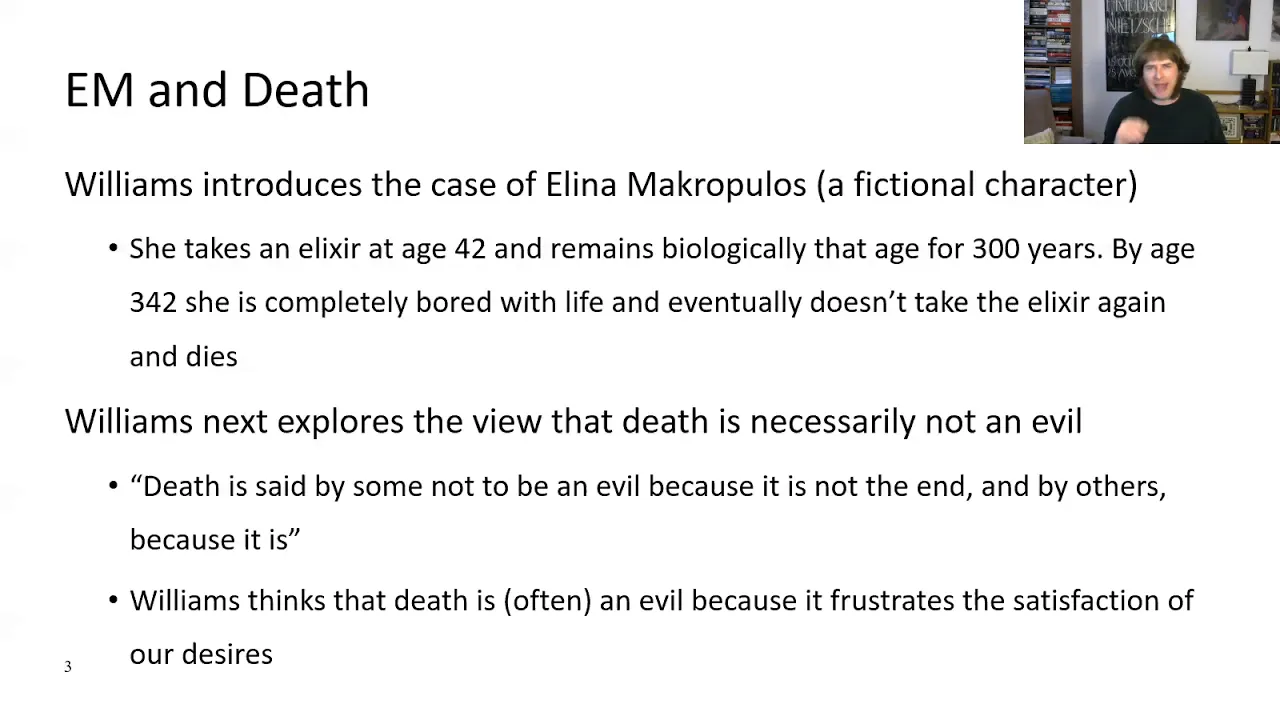
Why this video: This complete academic lecture offers a thorough walkthrough of Bernard Williams's argument. It details the fictional case of Elina Makropulos (who drank an elixir of life and chose to die after 300 years of cold boredom) and outlines Williams's distinction between conditional and categorical desires.
- Knowledge Checkpoint:
- Distinguish between conditional desires (desires we have given that we are alive, like buying groceries) and categorical desires (desires that give us a reason to stay alive, like completing a life's project).
- Explain why Williams claims an immortal life must either end in paralyzing boredom or require us to change so fundamentally that we lose our original identity.
- Define the "double bind" of immortality according to Williams: to remain ourselves, we will get bored; to avoid boredom, we must change so much that we cease to be ourselves.

Why this video: In this public lecture, prominent philosopher Martha Nussbaum counters Bernard Williams. She explores how extreme longevity can be structured to avoid paralyzing boredom, emphasizing that the value of life is determined by its quality and activities rather than mere temporal duration.
- Knowledge Checkpoint:
- Explain Nussbaum's critique of the assumption that eternal life must be monotonous.
- Discuss how social, creative, and intellectual pursuits can generate infinite categorical desires.
- Contrast Nussbaum's Aristotelian view of human flourishing with Williams's view of personal identity.
Module 5: The Rationality and Ethics of Grief
This module analyzes our emotional and cognitive response to death: grief. You will evaluate whether mourning is a rational response to the deprivation of death, explore the adaptive value of sadness, and study the ethical duties of memory and legacy that we owe to the deceased.
Independent Study Note (Addressing Video Gaps): The video pool contains fewer comprehensive, academic lectures on contemporary philosophers of grief like Dan Moller or Michael Cholbi. To supplement this module, you are strongly encouraged to independently search for and read:
- Dan Moller’s paper "Love and Death" (examining the "supervenience of grief" and resilience).
- Michael Cholbi’s book Grief: A Philosophical Guide (evaluating grief as a source of self-knowledge and ethical obligation). Use the search queries: "philosophy of grief michael cholbi" and "dan moller supervenience of grief philosophy".

Why this video: A short introduction to the political, ethical, and clinical research surrounding the philosophy of grief. It introduces the idea that grief is not merely a passive psychological symptom to be cured, but carries deep philosophical and ethical weight.
- Knowledge Checkpoint:
- Contrast the medicalized/clinical model of grief as a pathology with the philosophical view of grief as an active, evaluative process.
- Explain how characterizing grief as an ethical or human right changes clinical and social duties to the bereaved.
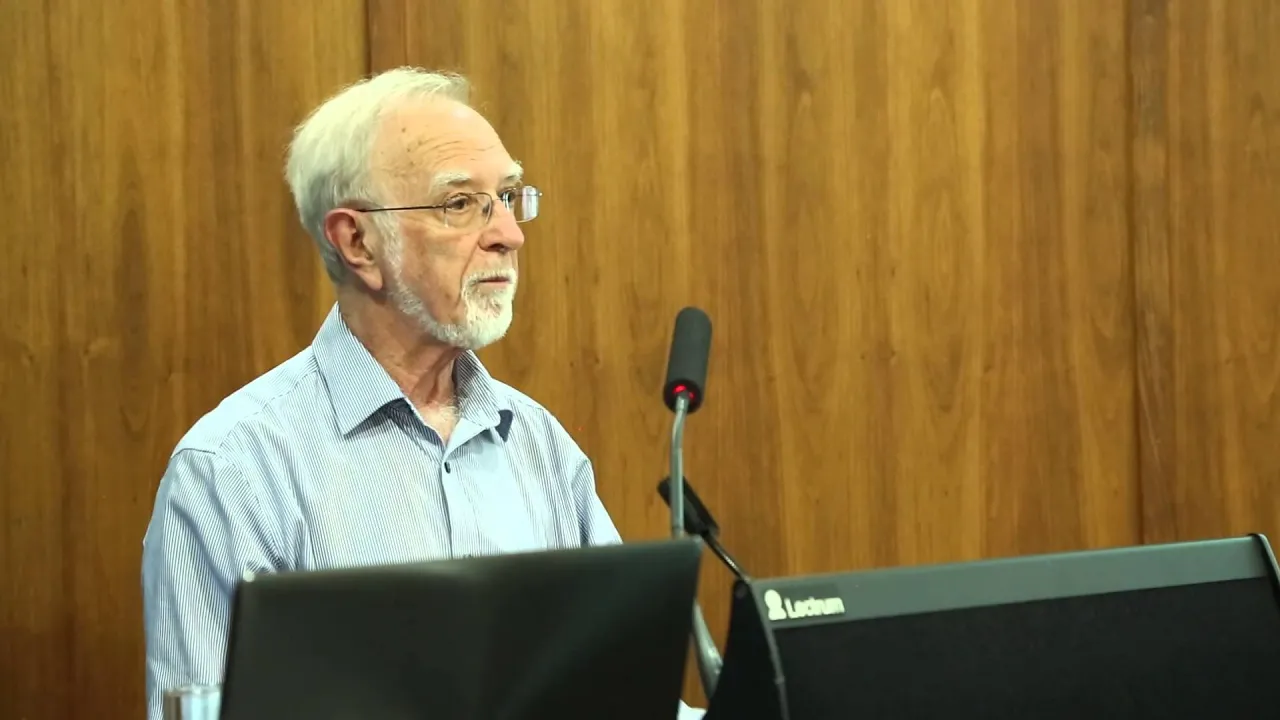
Why this video: Professor Tony Coady addresses the rationality of emotions, using grief as a key test case. He demonstrates that while grief is deeply painful and seemingly "inefficient," it is a rational and fitting response because it tracks the real value of the relationship that was lost.
- Knowledge Checkpoint:
- Explain how an emotion like grief can be "rational" even if it feels destructive.
- Critique the idea of eliminating grief through cognitive enhancement: why would it be irrational not to grieve a lost beloved?

Why this video: This raw, personal account offers a concrete case study of the "Grief Continuum," illustrating how grief is not a linear, self-limiting biological stage to be "passed through." Instead, it highlights how grief is integrated into a person's life, showing that we maintain ongoing ethical relationships with the dead.
- Knowledge Checkpoint:
- Contrast the classic "Five Stages of Grief" model with the non-linear "Grief Continuum."
- Describe how continuing bonds with the deceased can be maintained in a rational and meaningful way.

Why this video: This clip from a collegiate debate outlines the ethical duties we owe to the dead, focusing on three dimensions: carrying out their legacies, respecting their final wishes, and honoring their life's work. It provides an excellent transition from the personal psychology of grief to the objective ethical obligations we have toward people who no longer exist.
- Knowledge Checkpoint:
- List the three factors that constitute our duty to the dead according to this presentation.
- Evaluate how a person who no longer exists can still be said to have interests or rights that can be violated (posthumous harm).
Course Map
Below is the recommended learning progression for this course. Notice how understanding the metaphysics of death and its badness serves as a prerequisite for tackling the symmetry puzzle, the challenge of immortality, and the rationality of grief.
Key People Index
- Socrates (470–399 BC): Classical Greek philosopher who argued that death should not be feared, framing it either as a state of peaceful unconsciousness or an opportunity for the soul to gain true wisdom.
- Epicurus (341–270 BC): Ancient Greek philosopher who founded Epicureanism. He formulated the challenge that death is "nothing to us" because we do not exist to experience it.
- Lucretius (c. 99–c. 55 BC): Roman poet and Epicurean philosopher who formulated the Symmetry Argument comparing pre-natal non-existence to post-mortem non-existence.
- Thomas Nagel (1937–Present): Contemporary American philosopher whose landmark paper "Death" established the Deprivation Account, arguing that death's harm lies in what it takes away from us.
- Bernard Williams (1929–2003): British moral philosopher who argued that immortality is undesirable because it inevitably exhausts our categorical desires, leading to terminal boredom or loss of self.
- Martha Nussbaum (1947–Present): Renowned American philosopher who defended the desirability of highly extended life, critiquing Williams's assumptions about boredom and identity.
Final Self-Assessment
To successfully complete this course, verify that you can explain and critique the following concepts:
- Explain the metaphysical distinction between physicalist and dualist views on the survival of consciousness after death.
- Articulate Epicurus's argument for why death cannot harm the person who dies.
- Detail Thomas Nagel's Deprivation Account and how it utilizes "comparative harm" to counter Epicureanism.
- Reconstruct Lucretius's Symmetry Puzzle and the analogy between pre-natal and post-mortem non-existence.
- Explain Derek Parfit's "bias toward the future" and how it is used to defend our asymmetrical attitudes toward birth and death.
- Distinguish between conditional and categorical desires in Bernard Williams's essay on the Makropulos Case.
- Critique Williams's view on immortality using Martha Nussbaum's arguments regarding the variety and renewability of human activities.
- Argue for or against the claim that grief is a rational emotional response, incorporating the concept of tracking objective relationship values.
- Discuss the ethical duties we owe to the dead (e.g., carrying out wills, preserving legacies) and how they relate to the concept of posthumous harm.