











This lecture argues that reason and emotion are not separate or opposing faculties but are deeply interconnected in human moral cognition, challenging both traditional philosophical views that portray them as warring elements and contemporary neuroscience studies that oversimplify their relationship; the speaker demonstrates this through historical analysis of philosophical traditions (Plato, Stoics, Christianity), neuroscience case studies (Phineas Gage), and critical examination of psychological experiments on moral dilemmas, ultimately concluding that effective moral reasoning requires understanding the complex interplay between cognitive and emotional processes rather than treating them as independent domains.
Ethics of Human Enhancement: Reason, Emotion, and Morality
Added:Basic definitions and categories of human enhancement (such as cognitive, physical, and genetic modifications) versus therapeutic medical treatments.
The traditional philosophical divide between rationalism (reason-based ethics, e.g., Kantianism) and sentimentalism (emotion-based ethics, e.g., Humeanism).
The concept of the 'wisdom of repugnance' (or the 'yuck factor'), which argues that deep-seated emotional reactions like disgust can serve as valid moral guides.
Core principles of bioethics, specifically autonomy, beneficence, and the philosophical debates surrounding 'human nature'.
The ethics of 'Moral Enhancement', exploring the controversy of using pharmacological or genetic means to influence human moral behavior.
Empirical moral psychology and neuroethics, specifically studying dual-process theory (Joshua Greene) and the social intuitionist model (Jonathan Haidt).
Transhumanist perspectives on enhancement, analyzing arguments from philosophers like Nick Bostrom and Julian Savulescu who champion morphological freedom.
The practical translation of bioethical theory into policy, studying how public emotional consensus and rational discourse shape biotechnology regulations (e.g., CRISPR guidelines).
652 views8likes46:54Original Release: 2015-07-28
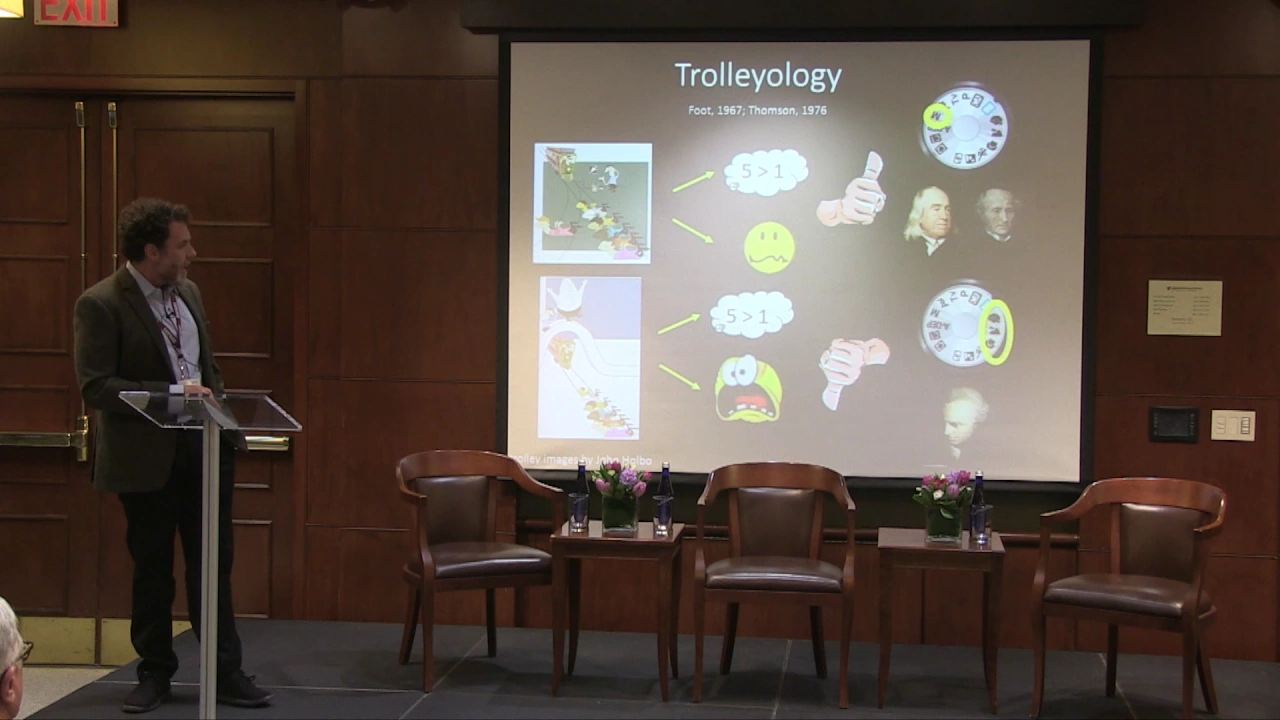
Tony's about recent emotional morality some portions for the enhancement projects good thank your dad he said coming out okay don't leave you're just master I'm just going to basically read this I've got a slight display this isn't really a problem I think pologize an adventure but there's just some help in it it's a standard approach in both popular speech and academic contexts alike to admonish someone is being emotional or using a motive speech there's an implied and often explicit contrast with the speaker's own reliance upon reason or rationality the speaker is cool and collected where you the accused are heated the contrast and it's evaluatee emphasises distract me him examining the human enhancement debate since it's sometimes claimed that one of the divergences between so-called liberal proponents of human enhancement as the conservative opponents of the project is that the conservatives or at least that group of them of his objections are roughly speaking inherent rather than potential rely upon emotion whereas their opponents rely upon reason this claim often explicitly or implicitly takes them to the to human faculties of emotion and reason as strongly opposed and that the appeal to emotion is somehow it listen the role of emotion is often equated with gut feeling and disparaged as a best kind of shorthand reaction produced by some evolutionary processes to allow quick responses when reason has some time to do the real work this is common in the writings of neuroscientists who address themselves to ethics and is most prominent in the work of Joshua Greene and his colleagues it's then taken up by philosophers who want to inject a conservative views in a range of areas and notably in the enhancement debate what I want to do here is discuss the relation between emotion and reason thereby summarizing and joining a debate amongst philosophers that's had too little impact upon the neuroscientists and their philosophical admirers I argue that the common derogatory opposition is oversimplified and dubiously helpful I hope this will contribute to an understanding of of reasons and reasoning since a person's success in seeking truth is as much guided for the positive aspects of their emotional makeup as by the positive aspects of what we think of as their intellect in life sketching the tradition the tradition in Western thought and elsewhere - to the effect of reason and emotion are two distinct and even warring elements in our conscious makeup his ancient and system reason is pictured as pure cool higher authority and ideally regularly where as emotion is seen as tainted - even lower and in need of control some of this opposition arises from philosophical traditions some of the religious traditions on the philosophical side one might say plato's image in the Phaedrus of the charioteer agrees and reason ruling the two galloping horses of the passions admittedly Plato has one of the horses the white one interestingly enough represent good emotions even though they must still be under the control of emotionless reason nor is this image irrelevant to Plato's developed theory of moral fulfillment as rational contemplation of the eternal bloodless form of the good nor is his picture of healthy civil society as the domination of unruly passionate claims by the philosophically rational guardians certain aspects of stoic thought also contribute to the picture since they describe most of what we would call emotions plus some other affective states as involving inherently false judgments that must be corrected by reason the Stoics did somewhat somewhat grudgingly recognize that there are a few good feelings as they call them but their description of these is decidedly cool dispassionate and remote from human experience for Diogenes condemnation of pleasure fear and desire are supposedly mitigated by an endorsement of joy as a well reasoned elation or watchfulness or portion as well reasoned shrinking and wishing as a well reasoned wishing on the religious side the strand of Christianity that opposes the flesh to the spirit sometimes includes rather a lot of even emotional real tations within the category of the flesh that need to be subdued by the spirit Paul's letter to the Galatians with its dictum that the desires of the flesh are against the spirit and the desires of the spirit against the flesh has been influential here as as much as else that I'll admit for now we might for convenience but with awareness of the looseness involved call this reason traditional rationalism and it's been criticized recently not only for gender bias as in Genevieve Lloyd's the man of reason but for various failures to recognize the valuable and irreducible role that emotion complain human reasoning and moral thinking Martha Nussbaum has stressed positive and negative importance of emotions for reason and this is connected with recent advocacy of an ethics of caring as a counterweight to rationalistic ethics of course the history of both philosophy and theology you've seen some similar emphases one notable reaction against excessive rationalism was that of John Stuart Mill who records movingly and sometimes painfully in his autobiography the revolution in his outlook brought about by his recognition of the crucial place of emotion and poetry nature and the arts in a fulfilling human life as Mill puts it that's not Mill that's what I meant to put up at the start of the whole thing so look at that for a minute okay they'll give you a mill that's that's more a couple of items from literature to give the feel of the stress that I'm trying to put forward your time's up almost I still see some eyes moving I'm gonna run out of time and I want to too late this is mill I'll let you absorb the while I rush on and more recently there have been even further significant moves in philosophy too towards more sympathetic and nuanced picture of the role of emotions in a morally fulfilling life typically this has produced a great deal of focus distinction Laden and often technical disputation but the general tendency is clearly more than the rationale was tradition sketched above altar I won't turn now to the turn to neuroscience and I don't think I'll put anything more up there I did have some stuff about the difference between teh honor de ontology and utilitarianism which figures in some of this stuff but I think I'll put that up later if there're some people gave her a fortunately innocent of this phenomenon a new development beyond philosophy has cast a different sort of light on the reason emotion divided this is the development within the discipline of cognitive science or neuroscience of an account of the brain's functions that shows or purpose purports to show various things about the relations of emotion and reason in thinking and especially in moral thinking and deciding a significant moment in this development was Antonio Damasio his book Descartes Sara emotion reason of the human brain which began in the introduction by stating I had been advised early in life that sound decisions come from a cool head that emotions and reasons did not mix any more than oil and water I have grown up accustomed to thinking that the mechanisms of reason existed in a separate province of the mind where emotion should not be allowed to intrude and when I thought the brain behind that mind I envisioned separate neural systems for reason and emotion but this picture was destroyed for DiMarzio when he studied the history of Phineas P gage his life had been transformed in 1848 by a horrible accident when an explosion drove an iron rod 43 inches long and one and a quarter inches thick through weighing over 13 pounds straight through his brain and out again landing a good 100 feet away covered in blood and brains continued every expectation Gage was not killed indeed shortly after the accident he was capable of describing the accidents and it's aftermath calmly in great detail to a doctor who attended him and found him quote perfectly rational unquote but gages subsequent history showed that although his capacity for logical reasoning was unimpaired his character and the emotional resources that made him a highly respected and capable human being were largely destroyed he's reading about what to do how to respond to others and how to shape his life was dramatically impaired he could not sustain work became dissolute and unreliable exhibited himself in a freak circus and died at the age of 38 DiMaggio and his colleagues managed to find out a surprising amount about the type of damage to gages brain and the likely source of the impediments that dogged the rest of his life taking hints from that DiMaggio conducted numerous contemporary investigations of brain damage that confirmed his dawning conviction that quote reason may not be as pure as most of us think it is or wish it were and that emotions and feelings may not intrude us in the bastion of reason at all they may be in masking internet works for worse or for better this is not the place for a full resume of DiMaggio's empirical studies and conclusions impressive and stimulating if they are ascites work Milly to illustrate an interesting shift in the traditional separation of reason and emotion that I began by outlining this shift has come from empirical investigation into behavior and its connection with brain activity and indeed many subsequent studies have endorsed DiMaggio's conclusions but in recent years there's been an absurd in neuro scientific studies that rely upon fMRI imaging and purport the show that changes in discrete areas of the brain said to be concerned respectively with emotion and reason cognition influence our thinking and deciding about moral and practical matters this represents a return to some extent to the rationalist tradition described earlier since the decisions arising from the reason zone are taken be clearly superior to the mistaken responses arising from the emotion zone I think that most of these studies have failed to learn properly from DiMaggio and rely upon a picture of separate and conflicting brain areas for emotion and cognition that merely mirrors the philosophical tradition outlined earlier there is such good reason to challenge the model of neuroscience at work here on its own ground well I won't make that central here some this works being done by other people many of these studies proceed by showing the strong influence that emotions allegedly have on reactions to descriptions of challenging moral scenarios often fantasy ones invented by philosophers and then they contrast these with rational reactions quite often the assumption is that the rational and morally right reaction is a utilitarian one indeed as I proposed to show a somewhat narrow version of utilitarian thinking button and retails for example state that quote decisions made on the basis of de ontological or non-utilitarian principles usually lead to results that are not as good as the best that could be achieved it's clear from the context this is not merely a restatement of the difference between de ontological utilitarian theories but often but sorry but and often an argue preference for the latter other theorists such as Joshua Greene and his colleagues declare outright that all non-utilitarian judgments in moral matters are simply errors caused by emotional reactions emanating in a specific emotion center in the brain sometimes this line of thought is linked to a somewhat confusing contrast of the personal and impersonal in ways that I can't discuss fully or tall here I have a section talking about Colonel Minh and firstly in their connection with his story I believe that one recent study however by bartels and Pizarro counters this trend simply by pointing out its prevalence this utilitarian trend simply by pointing out its prevalence and questioning nature and then by seeking to show that psychopathic personalities who are commonly regarded as largely lacking a concern for morality and as being defective in certain emotional capacities such as empathy are conspicuously more comfortable with utilitarian reasoning than with de ontological since it's also commonly held that Psychopaths are plenty of rationality in the rationalistic sense and since it seems to many theorists and non theorists that morality is an activity much concerned with good and bad reasons for acting then the fact that Psychopaths are examples of moral agents means that the rationalists approach and perhaps utilitarianism more generally is not a good one for understanding morality or what is smaller rational about it in the way of reason given so Bart Ellison Pizarro their study arrived at its conclusions by testing subjects against the scale for psychopathy and then testing them for answers to a battery of moral dilemmas mostly drawn or adapted from philosophers examples it also checked the responses against scale for what it calls Machiavellianism and no meaning to life attitudes and these also showed greater tendency to support what they call the utilitarian solutions to the dilemmas gratifying as these conclusions are to those of us who are neither psychopaths nor utilitarians there are reasons unfortunately to be skeptical about the ambitious extent of the conclusions of this experiment even if it's not as crude conceptually as the studies it criticizes I shall leave aside for the moment problems about the nature of psychopathy on which there is considerable debate within psychiatry and psychology and mentioned several other conceptual conclude her duties in the analysis which Bartels and Pizarro have inherited from those they disagree with first there is the understanding of utilitarianism which is construed in narrower utilitarian terms without any appreciation of the more complex versions of the theory such as rule or other indirect forms of utilitarianism nor is there any attempt to explore or mention a distinction between utilitarianism as of theoretical justification for morality by contrast with the decision procedure for particular actions to be fair many of the studies of these people criticized do equate moral rationality with primitive act utilitarianism this simplification is important because more complex utilitarian theories might well yield the same result as the day ontological or non utilitarian reaction as they theorist categorize Stephen Nathanson for instance has argued for an absolute moral rejection of terrorist acts on utilitarian grounds even though it's usually thought that utilitarians dismiss all absolute model tourist prohibitions and they work therefore allow that some terrorists act saying ticking bomb situations may be morally right second if there is no appreciation of the fact that some of the moral puzzles provided as such that many non-utilitarian theorists would give the very same answers of the so-called utilitarians give this is a feature not only of our tellers bizarro but of all the neuroscience studies of the so-called moral dilemmas that I've seen one of the bartels bizarro dilemmas is taken without attribution straight from Bernard Williams Jim and the Indian story I've got a thing to show that even the Indian story for those who don't know it I'll put that up later on because I'm kind of push on this is about it briefly this is about human being given the opportunity in a South American jungle by a notorious police chief he's got ten captive Indians to shoot one of them and thereby the other nine will go free and if he doesn't do that the the police chief and shoot all ten and Williams though a fierce opponent of utilitarianism gives the same answer of the problem as those the study treats as utilitarians William says it would be the right thing for Jim to do even though he's not a utilitarian and he grounds that on non-utilitarian consideration like Moulton Michael Walters famous category of dirty hands in politics this suggests that psychologists studying moral thinking often fall into the vulgar error of mistakenly construing any concern for consequences in morality as utilitarian whereas Dyan colleges and other non utilitarians are certainly free to consider consequences in a range of cases even in the moral dilemma examples some day oncologists would allow as we saw with Williams that the so called so-called utilitarian response is morally acceptable and dirty hence theorists would allow that extreme emergency situations sometimes permit great negative consequences to account in a certain way against normal normally deeply moral even absolutely constraints similar things can be said of the soldiers example that's one of leaving an injured soldier to be captured and killed when saving would mean that all of the troop including him would be killed and the bystander Driver example which is part of the trolley ology as they call it the famous trolley example which again I've got something I can show on the screen later the driver of example which is where someone driving a trolley comes to a fork in the road and even the rails and if it can't stop the trolley and there's one person tied to the left hand rail and five the right hand rail should exercise his power to turn the thing one way or the other and the supposed utilitarian solution is that he turns in to the left to kill the line in order to save the other five but on that example non utilitarians like Francis cam is a fierce non-utilitarian if she agrees to return to the left she gives the ontological reasons for supporting the supposedly utilitarian solution and gives extremely complex down for logical reasons for rejecting the utilitarian response in another version of the place called the footbridge example where the thing is going on a single rail but there are five people may need to be run over and you're on a breeze looking down you think my gosh and along comes an obliging stranger and you have even toss him over and that stops the thing and utilitarian solution is supposed to be yes you do and the de ontological no you don't camp says no you don't for that one though she doesn't put the other one it's hard to see Cam's extremely complex reasons for this as the result of an erroneous reliance on emotions certainly if you know Francis whatever her brain States are doing similar points can be made about data logical theorists who discuss difficult cases short of dirty hands who judge permissibly when there are small numbers of deaths caused disabled maps larger number of lives but impermissibly when a large number of lives are to be sacrificed from each an even larger number saved now here are not defending such biological theories and theorists but merely pointing out the complexities that are consistently ignored or just not understood by the neuroscientists a further point is that utilitarians unlike most non utilitarians have no room for a ground floor distinction between the permissible of the obligatory so response as to what is permissible or non domicile which most of the experiments call for they say can you do this can you do that is it permissible inevitably we leave it open whether the permissible response is a sloppy shorthand for obligatory or parries and on utilitarian message one might also note that the loose vocabulary of moral dilemma used by all the psychological studies of decision make moral decision-making obscures the issues in another way namely that philosophers tend to use the term to denote those situations in which there is no right or wrong answer for the decision problem of the agent faces in the examples considered by Bartels in Pesaro different agents give different answers to the puzzling cases but each things that their answer is unequivocally right without moral remainder or if they don't actually think that the experimental scenario forces them to act as if they do for dirty hands theorists the story they tell whether coherent or not is that the action is morally wrong but nonetheless the right thing to do for moral dilemma theorists either choice of actions not is neither right nor wrong morality drops out at that point it may be thought this prime is too technical to insist upon but I think the points worth making because it not only highlights the apparent philosophical ignorance of many neuroscientists but also because it shows the extreme artificiality of the demand for a binary response yes/no permitted not limited in the use of the deliberate sameness Joshua Greene for instance who has a philosophy background and should not be ignorant such Alexa T's cheerfully treats various extreme philosophers examples broadly characterized as trolley ology as being moral dilemmas that reveal the structure of moral cognition they are he says moral delusions revealing for the manner in which they mislead us that's a quote from the misleading is invariably done by what he calls a moral gizmo in the brain that produces emotional reactions as alarm bells that warn us off various acts such as pushing an innocent bystander under a trolley well though Greene's ruling picture of such businesses of moral illusions comparable to such visual illusions is the mullah liable blinds that must be subjected to the corrective power of utilitarian rationality he occasionally admits that they can do some good and maintains only that they are not infinitely wise but then neither is cool reason nor any other faculty or brain function as such brutal Paragons of unemotional cool rationality as Victor Hugo's dedicated policeman Javed in Misurata forcefully Illustrated defects in the laboratory study about moral brains extend beyond the considerations I produced so far the likely relevance of such studies to the realities of moral thinking and emotion in the world where they actually matter not only are the binary respondent adequate reflections of the philosophical theories they purport to reflect but as philosophers such as happy a burger and lemon have recently pointed out the scenarios considered in laboratory conditions are very unlikely to elicit the thinking and feeling that actual real-life encounters with difficult moral decisions will involve moral being asked to imagine how you would respond and white or described an emergency scenario is not the same as being in that scenario and it's a big assumption to think that I the reasoning and feeling that occurs in the formal will be the same as that in the latter and be that the brain states involved in both will be the same there are many reasons to doubt any such identities one is that the real-life scenario were probably different myriad detail from its imagined twin thus giving rise to options deliberately from the twin another is that my engagement with the real cut case confronts me with actual people and circumstances and not descriptions are even visual presentations in Albury there's little reason to think my responses and guesses about the ladder will match my responses and thought about the former it does however further highlight the lack of philosophical sophistication and depth involved in the way many neuroscientists often resort philosophical examples and theories returning to bartels and bizarro I think that in spite of some of their work involving some of the confusions discussed above a number of their points survive no doubt they've drawn upon philosophical positions crudely I didn't accurately have been ignorant of much of the complexity and philosophical debates but at least they've shown that a narrow version of utilitarianism or consequentialism that is at least a widespread tendency of thought influential upon many in the wider community as well as intellectuals should not be uncritically assumed by experimenters properly to characterize genuine moral thinking and deciding more over-the-air experiments those sharing some of the problematic difficulty complained of do strongly suggest that the casting of all emotions involved in moral thinking and deciding as error inducing by contrast with a certain model of rationality is ill-considered the authors also are clear that they do not mean to imply that all people who have thought their way through to an endorsement of utilitarianism as a philosophical theory of morality are thereby exhibiting more prone to psychopathy furthermore when their research is perd of misleading assumptions it suggests ways that the concentration on an emotionally detached model of reason may itself produce errors since it can obscure or even omit altogether the possibly benign role of emotion in thinking and reasoning about moral questions and they have I failed to acknowledge the dangers adherence to that model poses from fulfilling life I want to turn now to the nature of emotions and again I may not be able to get through all this some philosophers in the revival of interesting emotions have treated them as heavily cognitive virtual equating them to beliefs the cognitivists as they call following Solomon Bob Solomon being one here they have recognized that emotions are not brought up surges but over a reason and structure in several ways they have however failed to give sufficient weight to the usual feeling element in emotion and it's common connection with bodily sensations as in the feet that can go with anger or the trembling with fear and they have assimilated the world directedness of emotion too closely to believe where it seems I think more akin to perception they would like to see that not just any subjective upsurge can count as fear or anger or compassion since these emotions must have a characteristic rational structure so fear must typically be governed by the thought of an object under the aspect of being dangerous to the perceiver or agent there are no doubt nameless fears or a general fear of the world but at core fear is governed by a fairly specific thought but concerns danger to the agent and those she's closely identified with where the thought of danger is totally misplaced it's right to call it irrational even though in terms of its associated feelings and bodily effects it is still a sort of fear similarly anger is typically two gear towards slights or injuries related to the agent's concerns or well-being it makes no sense to describe someone as angry or being well-treated at the successes of a close friend unless the agent thinks the good treatment is a bit of a bit of condescension towards her or that the friends accessor have somehow been achieved at some resented the cost of the agent itself a grain gratitude cannot coherently be felt in something that can in no way be understood as a gift it's no accident or me as social prejudice that nameless fear object loss anger a pathological a lot of points important because there's directness of emotions or their intentionality is more akin to that of perception so that passeth perception it's possible for an emotion to represent a state of affairs that the agent believes does not obtain so just as an agent can see an object it's elliptical but correctly believe it's round so she can be afraid of a spider thus emotionally representing it as dangerous when she may believe on good evidence that it's harmless but quite apart from the agents thought or judgment about an object or the way it appears in a motion to him there remains the question whether the emotion really fits it's object the person who is afraid of something that is not really fearful or dangerous as someone who is afraid of a realistic toy spider has been led astray by the emotion just as someone who miss perceives in dim light of their own and fled in a mirror for another person has been led astray by their senses similarly someone is indignant about a wrong that isn't really wrong has an emotion that fails to match its object even if the emotion is triggered by a relevant thought namely that are the wrong there is even a sense in which people can still be led astray by their fear indignation even when they know the Spyders of Toei was as opposed to front not or wrong emotions are also related to the way the world is in a forward-looking fashion in that they prompt a typical range of object related reactions such as flight from the danger feared or more positive ways of eliminating it admiration prompts emulation indignation prompts attempted attempts to remedy the wrong and jealousy prompts the sort of actions that lead to italo's a disastrous decline a further thing about emotions that invokes a cognitive or intellectual dimension is the way that they can be discordant or harmonious with each other and with the agent's quest for a fulfilling life one doesn't have to have a rigid conception of what such a life must be like but there are limits to what it can be emotions like envy jealousy spitefulness' and with some qualifications hatred carry with them disturbances of emotional balance and interfere with such emotional dispositions as kindness love admiration and gratitude any attempt to live a good life must at least involve a modicum of attention to having good reasons what we do and how we plan our lives if we gear ratio allottee to living rather than as well as theorizing we may pay particular attention to the rational dimensions so we must pay particular attention to the rational dimensions of emotion and not fewer notions of mere or distorting turbulences indeed there's good reason to think of trusting our emotions in the same sort of way that we trust our other resources for dealing with the world we live in what we usually consider our strictly cognitive resources for recognizing and exploring the world for example sensory perception memory introspection inferential capacities and testimony and all lead us astray as can our emotions but we need to have a general trust in those cognitive resources not only to survive but to have any prospect of living well epistemologists increasingly realized that attempts to somehow prove the reliability of such cognitive resource without circularity are doomed to failure this is of course of crucial move in skeptical arguments but assuming that skepticism has little - tell us about how to live and hereby sidestep certain ways in which ancient scriptures did indeed think they provided a lesson for living what the circularity problem helps to show is that there is a certain trust in our cognitive faculties that is central to coping with ourselves in the environment whatever the logical of the ontological state is the levy environment our thought ultimately has I would argue is that by doing the full version of this paper and an agreement with lenders access key in the Book of Enoch Authority at the same point applies caters perilous to her emotional capacities both capacities are central to trust himself that we need for intellectual and moral flourishing the basic question to which trust in emotions is addressed is whether they genuinely fit their objects but there are other questions about them up for adjudication such as whether some emotions are oriented to the wrong reactions to their objects this concerns the issue of what patterns of action and emotion of prompts as I put it earlier put it earlier emotions can be cognitively apt for certain objects but produce a distorted picture of the place of those objects in the world we inhabit consider Envy your prep you'd object for Envy is very roughly the successes or achievements of another except for unusual circumstances we cannot envy failure in another nor can we Envy a rock that we might envy a neighbor who has secured a particularly fine looking stone for a centerpiece of her garden but of course the success of another person is also the proper object of the emotion of admiration comparing the achievements or high qualities of another person with our own is integral to the generation of both envy and admiration but the reactions of both of motions go in opposite directions admiration leads naturally to emulation in some degree or at least dissatisfaction that a fellow human being colleague Co national co-religionist etc can achieve so well and this affords a certain encouragement to oneself Envy on the other hand leads to disparagement of the other's achievements and often it stimulates thoughts that the others success or honor is undeserved when we say to someone you're just envious of Smith we mean to highlight the fact that emotion of envy has distorted the agents perception and understanding of the achievements of the envied person typically this is what Emily does it misrepresents aspects of the world of the agent not of course of the facts of the others achievements but of the way they were achieved or are their true significance if one's disparaging thoughts were actually true that is for example if the person successes were not due to their personal excellences or relevant hard work but to toadying or bribery or something similar then one's reactions should not be envied but rather a healthy emotions such as indignation or something of that sort well I've hoped to chance some of the pitfalls in the tendency to think about emotional life as detached from largely hostile to or in need of rigorous control by an attenuated reason and to suggest that too much of the neuropsychological investigations of the role of reason and emotion in ethics attends to little to the subtleties and complexities of both philosophical ethics and psychological reality there are two lessons for the enhancement project in this first is the findings of those psychological come neurological investigations that often go under the label of neuroscience should be scrutinized carefully and used with caution the second is that various proposals to enhance either our reasonings or our emotions need to attend to the often intimate connections between reason and emotion since enhancing what we imagined to be one separate and superior category or subcategory is very likely to have serious implications for the other thank you could you perhaps a bit more about how Williams justifies the fact that Jim can shoot the once in its game with my understanding of that case was that you say it's Jim shouldn't do that or we shouldn't require Jim to shoot them because that causes him to go against some of his commitments and that nearly makes them sort of a calculator with its various utilities are playing the next years now well it's it must be 30 years since I've read that also I don't claim to be able to recall the details that's what my memory was that Vernon puts forward the the sort of integrity oriented reasons that he has for that thing but allows them in the end of maybe that some of the caveat that he gives on this condition on the situation may be overridden by the fact that if you're absolutely sir I'm in for one thing you he raises the question which is perfectly reasonable in the context what how can you trust this police chief even brutal fog that's giving you this option and so on at all like that but supposing that that could be overcome and it's definitely so will kill the whole team he doesn't as I recall that no circumstances he's okay to go you can do this but this is not because of standard utilitarian reason I mean one reason that's in the mix is of course the fella the fella you killed if you don't act like this that's how it's going to be killed anyway which is a significant consideration in cases like the parallel ones like shooting down the you having the 911 situation shooting down the plane full of people there game they'd be anyway you might have an absolute prohibition on killing innocent people but be confronted by situation in which they're going to be killed by someone else they gotta be killed anyway and you to get in to prevent that when you kill all these people there because they yeah I think he says different things in different places you know I mean but in the moral tribes he does explicitly say what I quote even saying about a moral illusion and it's not an illusion if you take me it was what he called the utilitarian line as I said I don't think it's fair to utilitarianism entirely but but it's understandable with me think of that as a utilitarian just just in fact a very incomplete account of what he's done easily utilitarian position but if he's saying that the taking the other view on this which is supposed to be a ontological he's a moral illusion he's he's making a very strong claim about what's rational and what's not and it's nothing to do with political whatnots of any sort at that stage well that sounds like your position yes yeah yeah well I mean oh I'm just just going by what he says in the various parts but where he talks about the experiments you state um this is just a partial defense of social psychology so I mean oftentimes they do lose the experiments that you point out sequential yeah but social psychologists and neuroscientists are in the business of trying to get results so what they will say is that we have to operationalize these things in order to get data at all so there are often times it just sort of recognized that book it's really difficult to get pulled data and we have to simplify things too so I mean there is benefit of worrying where the people who interpreting this doctor in doing so with an awareness but that's gone on so I agree with you that that sort of has someone downstream when someone is reading the present but the actual experiments experiments I'm usually not even be aware of what yeah I don't know if that means Green's not interpreting downstream he does the experiments until pain each team anyway and when they write up their experiments not very far downstream this is saying what they've done they move very quickly from you know well here's an interesting fact or set of facts you know these people say this those people say this you know on and there's so many of them and these and they said oh they didn't say that they go on and say these people are doing YouTube in response and these people are doing a day on the logical one and these people are getting it wrong because they're not doing the or at least wrong if you think rationale is a good thing to believe because these irrational things and those are not what my experience is when you talk to you the experiment is that these sort of things story well if the track the trouble is that if they have to do these dodgy and amazingly truncated things to earn a crust I feel you know well that's one way to earn a living but should be taken to every see reason I mean I'm not I'm not against all the people I mean I think some of them that I've read are more careful about what they're doing inside though I think there's a there's a powerful tendency and I'm sure they should be right that this is about trying to scare things down to manage ability to draw to deal with highly artificial situations and then say well let's let's go from these to the real world I mean the whole of Milgram thing for instance I don't want to say that it's of no value whatever but my easing series of misinterpretations of them as of the famous Princeton thing of the people running running their the Stanford sorry yeah I mean they're consistently reporting that they don't they don't mention the quite high proportion given the emergency it did stop to help the guy it's not very well for max inside he actually came up earlier incitements big sky probably with your are attractive but the idea that you could buy some sort of enhancement techniques in same open relationship take away the kind of painful emotions that might come into the oven relation like so if your partner dies or something like that you would expect to be devastated you expect to feel incredible grief but certainly it's an irrational partner but it could be perfectly rational to regret the emotion of grief the feeling of grief that you'll have could be perfectly rational to regret the devastation that you'll feel but it would seem to be irrational to regret that your relationship was of the type that it would devastate you fill you with grief something like that happened so like I mean I'm just trying to you think of that as an example between I think I think grief is is an interesting case because it does seem to me that if I remember I read a blog for the you where I say the people on a proposal to appeals and some American Sanders to come up with that would enable people to lose plank painful memories and one of my objections and they just thought this was obviously a good thing and it seemed to me that one of my addictions this was precisely off about breathing and it doesn't if someone had really lost someone they deeply loved and they and they felt this very disturbing emotion of grief and and someone's hit he's a pill you know you you won't have those feelings anymore about that departed person thing the person took this would be doing something that was a bad be unreasonable I don't like rational irrational all that much because I think that's been preempted for various things but I would think person had a lot of reason in their relationship and its cessation to have these debilitating sensitive feelings and emotions and someone now that because they can go on too long they go to acute you you know you might be able to sleep there are various things I don't want to give up everything on this but if someone said it's just this memory let's get rid of them it's something deeply wrong with that and I think it shows the disparagement of its connected with something Simon was saying before about in the first talk I would think that if you if you treated the grief as just some imperfection to be got rid of so you could get on with various other things and so on you'd actually be betraying the relationship that you'd had with the loved person which might be extended over many many years and so on and denying something really important about yourself now those things are not that I wouldn't put those things in terms of some what the other author was saying was infinite value I don't understand the concept of infinite value I have no idea really what that means but I think that it's a powerful consideration now it may be that you've got tremendously important you know you're the president the country that's a war or something and you can't afford to be debilitated for too long the suit there might be considerations like that that come into play but just talking about one important consideration coming in too much from the nature and structure of that emotion which itself seems to me to have a rationality available to those intimate relationships
Up Next
57:42
Princeton IV 2024 Finals | Debate on Duties to the Dead
@PrincetonDebatePanel
4.4K views•2024-09-29

131:21
The Arcades of Paris: Walter Benjamin on Urban Politics & Philosophy
@internationalcentreforcont7204
2.3K views•2013-06-19

68:32
Should We Destroy the Machines? Big Tech Surveillance Critique
@TheStoriesWeTell303
167.9K views•2025-11-30
4:57
The Myth of Sisyphus: A Greek Legend of Eternal Punishment
@TEDEd
8.6M views•2018-11-13
Related Study Plans & Knowledge Roadmaps
Structured learning paths in Philosophy
philosophy
Philosophy of Death (Metaphysics, Harm & Grief)
01Introduction to the Metaphysics of Death
02Is Death Bad? Epicureanism vs. The Deprivation Account
03Lucretius's Symmetry Puzzle
+ 2 more learning modules
15h5 modules
Explore Roadmap
philosophy
Frankfurt School: Critical Theory & Culture
01Foundations of the Frankfurt School and Critical Theory
02Horkheimer & Adorno: The Critique of Instrumental Reason
03The Culture Industry and Mass Deception
+ 2 more learning modules
12h5 modules
Explore Roadmap
philosophy
Philosophy of Language: From Frege to Austin
01The Linguistic Turn: An Introduction to Language in Philosophy
02Gottlob Frege: Sense and Reference
03Early Wittgenstein: The Picture Theory of Meaning
+ 3 more learning modules
15h6 modules
Explore Roadmap
philosophy
Feminist Epistemology: Standpoint & Injustice
01Introduction to Epistemology and Feminist Critiques
02Sandra Harding and Standpoint Theory
03Donna Haraway and Situated Knowledges
+ 2 more learning modules
12h5 modules
Explore Roadmap