












While Epicurus argued that death is nothing to us because when we exist death does not, and when death exists we do not, this argument fails to account for how death interrupts valuable human projects with temporal structures—unfinished works, unfulfilled plans, and relationships that unfold over time. Similarly, Bernard Williams's argument that immortality would lead to boredom overlooks the possibility of continued growth and exploration. However, Lucretius's insight that indefinite prolongation threatens Earth's carrying capacity and eliminates the intergenerational relationships that give human life its distinctive character provides a compelling reason to accept finite lifespans. Mortality, rather than being merely an obstacle to be overcome, may be constitutive of what makes human life meaningful and valuable.
Martha Nussbaum on Immortality, Death, and the Good Life
Added:So um today people are living longer and longer lives. It's becoming increasingly possible to extend the human lifespan with reasonable functionality and good health above a 100. Who knows how far that can go? Increasingly, people in medicine are beginning to talk about aging as not an inevitable condition, but rather a series of diseases which we may actually be able to cure. And even though nobody thinks that actual immortality within this life is within our grasp, uh an indefinite extension of the lifespan seems more and more possible. Now the question is, is that something we should be putting resources into? Should we be striving for that?
And should individuals who are are getting closer and closer to that problem uh should they be wanting that?
Professor Levmore and I are writing a book about aging and it's a series of essays on different topics where one of us says something and the other one responds. And so they're paired essays on different themes like friendship, compulsory retirement, but one of them is the length of the the human lifespan.
uh we are reacting in part to a very influential article by Zeke Emanuel the bioethicists who's the older brother of Rahm Emanuel but that has nothing to do with his career uh he wrote an article recently in the Atlantic saying that people should not want to live longer than 75 and he said he himself I think he's about 70 now would be he'd be very happy to go at 75 and and this of course seemed seemed repugnant to many many people but uh of course it started a discussion now it happens to be one of the many areas of human life in which the ancient Greeks and Romans have had very interesting things to say and I would say that there's probably no argument from the ancient Greek philosophers that's more discussed by modern philosophers by the best modern philosophers people like Tom Nagel Bernard Williams than Epicurus's argument about death there's a little dialogue alog that's ascribed to Plato, but it's really written by EP Epicuran pupils that describes a an old man who's on the verge of death and he's very unhappy. And Socrates says, "What's wrong, Excus? You used to be a happy guy and now you're weeping and moaning." And Excus says, "You got it right. Now that I'm right up against the fearful thing, meaning death, all my fine and clever arguments sneak away and breathe their last. But of course, since this is a philosophical dialogue, that's not the end of the story. And sure enough, a better argument arrives on the scene, which is Epicurus's argument to the effect that death is not bad for you.
And that comforts poor old Axia. So, philosophers like to think that argument can address our deepest fears and our deepest longings. Maybe that's true and maybe it isn't, but let's at least see how far we can go. So what I want to do first is to look at this argument. So here are these two people. Epicurus a Greek philosopher born overlapping with Aristotle but living later. And then his pupil there was a long tradition really quite a lot of agilation of Epicurus a lot of deference. So it's a pretty orthodox tradition and Lucriccius the Roman poetic philosopher is the other one that I'll talk about but it's basically one in the same view. Now uh I'm going to assume for the purposes of this discussion that what we're talking about is extending a reasonably healthy and active life not a life of increasing decrepitude. Like if you know Goliver's travels, Guliver goes to this one land called the Strolled Bugs who are people who are just increasingly shrunken and decrepit and demented and now of course that immortality we don't want. But uh but a reasonably healthy immortality.
I'm also going to just ignore questions about a religious afterlife because whether that exists or not, I think we're all interested in the question of how far we should prolong life within this life. So, is death bad? Would immortality be good if we could have it?
Well, it it kind of seems obvious that immortality would be good and that that we would like to have it. Uh it looks pretty lovely and and it's a tantalizing thought. Even people who have no interest in religion over the years have said that there are reasons to long for immortality. John Stewart Mill, one of the most militant atheists in the history of philosophy, wrote about a hundred pages about why religion is no use to anyone. But then he said the promise of immortality because we might see our loved ones again then it really is meaningful and he was thinking about his wife Harriet Taylor who had just died. So people really are drawn to this and um it's not obvious that it's a good thing. So lots of people have been persuaded by Epicurus's argument and even who those who are not persuaded find it difficult to say what's wrong with it. So, first I'm going to look at this argument and then I'm going to look at two other ways of comforting people about death.
They're sort of like Job's false comforters. And one is is me at a younger age and the other one is my teacher Bernard Williams who is actually dead by now. So uh the first the argument now Epicurus famously says death is nothing to us because when we are there death is not and when death is there we are not. So the picture is here's this person journeying along and then comes death and then there's no person. And so Epicurus's claim is that an event can be good or bad for that person only if at the time when that event occurs the person is there for those predicates good and bad to be attached to. But the time after death is not such a time. There's no you there.
And then he goes on to say that often people do falsely imagine that there is.
So they're kind of imagining a little them who's watching their own funeral and grieving for the loss of good things, but of course that's not real.
There is no person there, so it can't be good or bad. And then the condition of being dead is not bad. And then he goes on to say, well, if it's not going to be bad when it happens, it's irrational to fear it. So it's irrational to fear death.
Now, modern philosophers have thought there's got to be something wrong with that because we can imagine cases where something clearly is good or bad for you even though you're not aware of it and maybe you couldn't even become aware of it. So Tom Nagel imagines a case where the person was betrayed by a best friend but things are set up in such a way that that person could never not only doesn't learn of the betrayal but could never learn of the betrayal and yet we want to say that betrayal is bad for that person even though that person can never come to know of it.
Another case that Nagel then goes to is the case of somebody who has irreversible brain damage. Now that person it's bad that the person has that damage but as we're setting up the case the person can't become aware of the damage because it's irreversible.
So what about those cases? It it's not clear that he's right that we we agree that these things are are bad for the person. But the problem with both of them is that they imagine cases where there's a person who goes on existing after the bad event. So there's a little person, either the one who's betrayed or the one who has brain damage. And so it's easy to see what the predicate attaches to that it's bad for that person, and that person is still there.
So it looks like that doesn't really help us to rebut Epicurus's argument. It looks pretty good so far, but there are other problems. The So here's the one that I wrote a book in 1994 that that talked about the argument. So, here's the one that I found persuasive in trying to find a problem with the argument.
Death doesn't just strike a life that's already winding down if the person is healthy and active. Death is an interruption and it interrupts activities that are underway that are in the planning phases and so it casts a retrospective light back on the life by harming interests and projects that that person had in life. Think of somebody who's building a house and maybe they spend years getting ready to build the house, getting the designs in place and then death strikes before the house can be built. We want to say, well, a lot of that person's life was a waste then because they just didn't get to do what they were planning to do. What about somebody who invests in preparatory activities like going to law school? So, you go to law school and you do so not because it's intrinsically good, although it is, but you do it because you think that in the end it's going to lead to something that will be valuable.
But of course if death strikes in the middle then kind of want to say well maybe I should have used those three years doing something different. I should have spent time with my friends.
I should have listened to music.
Whatever. So that's the argument that I think is quite interesting that death when it comes is an interruption of valuable pursuits. And so we should say that even though there's no you there anymore, nonetheless, there's something bad about it because it it kind of cuts off things back in life. And there are a lot of things like that. There are things like law school, but there are also things like writing a book. And even if you've written a book before, somehow the one you're writing now, you would quite like to bring that to completion. Friendship and love are like that. They have a kind of temporal structure that's unfolding. You have plans together. You have a a life that you're planning to live together. You might have children together. So all of these human pursuits that we think of as particularly valuable have this temporal structure so that death when it comes can be an interruption and therefore kind of cast a stain on the value of the pursuits the person was engaged in. Now obviously that would be least the case if the person is at the end of the normal human lifespan and has taken that into account in planning. My grandmother died at the age of 104. She had a very healthy life up till that time rather like Ronald Coast I would say. And um she wasn't an academic at all but she did the things she liked to do collecting antiques and talking to her family and so on. And she did those things happily, but of course she was aware because she had other relatives who lived to be 102, 103. You know, she had passed that. So she she was pretty near the end. So it wasn't likely that she'd start some big thing that took time to complete. Nonetheless, even in such a case, I guess I want to say that's not bad to the same degree as the death of our wonderful law students two years ago who were at the beginning of a long and wonderful career. And uh so and yet there's still something bad about it because it cut off things that she was invested in that she valued talking to her grandchildren and her great grandchildren and seeing her great granddaughter grow up and all the things she didn't get to do. So um that seems like a a pretty good way of saying Epicurus's argument leaves a lot out.
But once we see that we see something else that I think is quite interesting and has interesting implications for law and that is that this idea of interruption softens the barrier between life and death in the following way. that when people are alive, they not only have projects that death will cancel or anull, but they also have projects relating to the time after their death that interests that project out into this space. Even if they know they're going to die soon, they make a will, they leave their money to certain causes, and they have a variety of other interests. And and then the question is what what should we think about that if the person is no longer there? Can we recognize that there are interests of that person that still exist after death? And my argument suggests that we should because human projects do have this temporal structure. And even though death might be one kind of interruption, there's something else that could happen. Namely, we might find that that the will would be be disregarded. So, here's an interesting case of that.
Steven Gerard, who was a a wealthy man in the late 18th century, a wealthy banker, left much of his estate to establish a boarding school, which was called Gerard College. It still exists, but it's really a prep school in Philadelphia for poor white male orphans. Now by the 1950s the racial limitation was felt as repugnant and so his will was challenged and in the end in 1968 Gerard's will was broken by the courts and it became a landmark case in post-mortem desegregation.
Today in fact all races and both genders are represented in the school and it's actually 96% enrollment of students of color. But in any case we we should ask about that. So Gerard, we we might think that it's hard to say whether it's good or bad because Gerard's purposes were frustrated, but in a way that makes his life better, we might think that it would have been otherwise. So one question is, is it good or bad? But the other question, the one that raised is raised by Epicurus's argument is does it matter at all? Gerard is not there anymore. So what difference does it make that his will was broken? And uh we have many many cases of that kind of course and the way our system currently works is except in such egregious cases we respect the sanctity of wills and uh there are other cases which are quite interesting involving attorney client privilege. You may not be aware that Vince Foster after his suicide uh Kenneth Star was trying to get notes taken by his lawyer before Fosters's suicide and the court stopped that saying that a person's interest in privacy and in the attorney client privilege survives death. So there are many interesting legal conundrums that this argument suggests and the court explicitly said that the rationale for this protection was that it furthers the client's intent.
Now those cases still say that Epicurus is right to this extent. The good and bad are predicated so to speak only of the living person.
But they're saying that the living person has interests that go beyond their life. There are lots of cases too about literary works. If any of you go to see the remarkable production of Eugene O'Neal's Long Day's Journey into Tonight at the Court Theater, one of the best things they've they've done in recent years, you'll find that that's a play that you O'Neal explicitly asked to be destroyed at his death. And then they didn't do it. And well, was that bad for O'Neal? Was it good for you? It's hard to say, but it seems to have some relation to O'Neal's interests. His interests were frustrated. So, those are the things that I would want to say about Epicurus's argument that it's fascinating, but it's flawed because it hasn't sufficiently understood the way in which our lives and our interests extend over time. And what that means is that death can be a harm to the person who was living. But it can also things happen after death can also be a harm to the person who is living. Well, there are other things however that we might say to console us for accepting a pretty short and finite lifespan. And one of them in the book therapy of desire when I was about what 20 years younger than I am now, I said that there was a different kind of consolation that we should offer for death. I wrote as follows. Our finitude and in particular our mortality which is a particularly central case of our finitude and which conditions all our awareness of other limits is a constitutive factor in all valuable things having the value for us that in fact they have. Now that that rather tortuous pros I think is a sign that I was already struggling with the problem. But what I had in mind, uh, I then turned to the gods in Homer's Iliad and said, "If you think about the Greek gods who are immortal, and they know they're immortal, there's a limit to what they can actually achieve by way of virtue and value. They can't even run a race because there's no limit. There's no struggle. They just sort of whisk themselves away to the finish line. And so then that's not running a race." So there's no sense of athletic competition. But also if you think about the recognized human virtues, it's hard for them to have them. How can they have courage if there's no death to face? How can they have even love which seems at least the kind of love that mortal people have involves a kind of loyalty in the face of obstacles and often a willingness to take risks involving risk of life. And so I then um quoted Wallace Stevens's poem Sunday morning where he says death is the mother of beauty that there's a way in which having a limit constitutes the value of human pursuits.
And I said when Adysius in the Odyssey declines the offer of immortality and says I want to go back to my own life and my own home. that there was something reasonable in that because there was a kind of love that he couldn't have on Calypso's happy flowery island and that he could only have an immortal life. Now, I think it's not as though there's nothing in this argument and I think it's right that the homeriic gods who not only have no death, but they also have no struggle, no limit at all. So you take away all the limits, I think then that does remove certain kinds of human value. But as I was I've had this long exchange with a philosopher in California who writes about death a lot named John Fischer.
Some of you might have read some of his things. John Fiser pointed out you can have a lot of struggle and limit without having death. We get this even in Greek mythology where Prometheus has pain and struggle and so on. But you know in a way it gets to be all the worse because he can't die. So one can imagine an immortal being struggling against all kinds of limits, pain, weakness, the bad conduct of other people, their betrayals of him, poverty, injustice and physical injury and so on. And I think those are enough to give virtues like courage, moderation, friendship and so on uh their point. And we we'd probably like to include in a good life the possibility of struggle, the possibility of regeneration and recovery from debilitating diseases. And so that would all give the life an interesting narrative shape that we can care about.
And I think the same is true of love and friendship. Most of what we value doesn't actually require death, although it probably does require the possibility of facing adversity, overcoming difficulties, illness, recovery, and so on. So, we'd have to say more about what those things are. But I guess I think I was much too quick in saying we need depth to make sense of the virtues. I think there might possibly be a kind of intense devotion that's manifested by willingness not just to risk pain and difficulty for someone or for a cause but to risk death itself. But it's a continuum. I I think you can get a lot of what we want in the life that's not finite. So I guess I think I was it's easy to say these things when you're young and say, "Oh, who wants immortality?" Right? But but as um as time goes on it looks better and better.
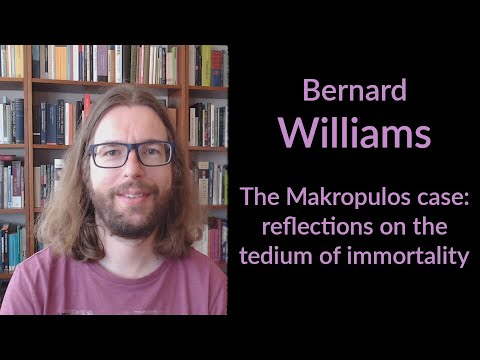
So then we get my dead teacher Bernard Williams and I think this is pertinent because he wrote the relevant article when he was 42 when he thought he even said he thought that was great age to be. He died what I would call quite prematurely at the age of 74 of a form of cancer that had been incorrectly diagnosed. And so anyway, it was very sad and and premature death in the middle of extreme philosophical output and activity. So what did he say when he was 42? What he did was to look at an opera. He was great opera fan like me and he actually wrote a lot of the reading list of the opera course that I'm teaching right now. And um he there's this opera by Laosanichek a Czech composer of the late 19th century called the macropolis case ref and then Williams entitled his article the macropolis case reflections on the tedium of immortality. Now the metropolis case it's actually based on a play but he was talking about the opera version is the story of a woman who was 42. So that's why he points out that his own age is exactly that and it's a good age and so on. And her name was Elina Mccropolis. She was a talented opera singer. And she finds a potion that confers immortality. But she has to keep taking it once every so and so many years in order to renew the effect. And she's lived for 342 years at the time that the opera is set.
And then she decides this time I'm not going to take it anymore because she's just burned out and she's really um tired. And and what she says is she's in a state of boredom, indifference, and coldness. In the end, it is all the same. She says, "Sing and silence."
Quite odd because I guess in an opera you have to have the singing, but but she really wanted the silence. So she refuses to drink the potion again. Now what does Williams want to do with that?
What he says is there are really two possibilities when we think about an immortal life.
One possibility is that the life becomes very abstract because it has so many changes that we can't really think of it as the life for you. And he thinks the life of contemplation would be like that because you just imagine an abstract contemplator and there's no personal identity. So, so that it seems to him that doesn't rescue immortality because it's at the price of there being a particular you that goes on living. But then the other possibility is there is a particular you with characteristic tastes, pursuits and so on. And his claim is that this person is going to get bored because there are only so many times that you can do your characteristic pursuits. And he thinks that's what went wrong with Alina Mropolis, that she just did the things she did, singing and so on too often.
And and she she just got bored. And and he says there's there's really just um the desires will go away in those versions in which I am recognizably myself. I would eventually, he concludes, have had altogether too much of myself.
Now, why should one believe that though?
I think surely one should not believe it just because one's teacher says so or even because there's an opera to that effect. If you look at the opera, there are reasons for doubt because in fact the reason that Alina Mropolis is tired of life is that she wants love, but the men that she encounters because she's a glamorous and talented woman repeatedly objectify her, treat her as a thing, and offer her not love, but some kind of parasitic relationship where their egos are gratified. So, of course, she gets bored with that. So that does seem like a problem. But the problem I think Yanichek who is definitely a great and obsessive feminist in the 19th century world. Yanichek really meant to say relations between the sexes need to change. He was not trying to say that life itself always has to get boring.
And I think if if she had found real love and somebody who was curious about her, who valued her, well, it would be an altogether different story. So the most general conclusion that we can draw here is that if human life is unsatisfactory in these specific ways, then people might get tired of living that life. But what about trying to imagine what immortal life would be like if that was not the case? I guess what I think is that it's easy to imagine that you could go on as the same person and have a wonderful life because there's so many things that there's no time to do. And I think we're all afflicted by the America, particularly American disease of having too many things we want to do and not enough time. So, think about the stressed out lives that we live that don't allow as many things as we want to do, but they especially don't allow relaxation, frivolous things that make all of life more fun if people weren't always racing against the clock. They would probably find, I think, more meaning in each thing rather than less.
And they would get more sleep and in general just feel better about each thing that they would do. Now, some immortal lives could go on in one in the same profession, but I think you could also imagine compatibly with it being you that you might explore different professions.
That's already happening with second careers increasingly. So, at one point in my my temple, both the rabbi and the caner were second career women. One had been a travel agent, one had been a businesswoman. And now they're exploring this career in religion, which was much more meaningful to them. So there are lots of things like that and and I could easily imagine different careers that I might have if I of course the career I do have is already many. I can teach on opera and I can talk about philosophy. I can do so many things that I want to do.
But I could also imagine being a novelist, a psychoanalyst, a caner, all kinds of things that would be really fun and interesting. And if you think that that would all give out after a while, there's always the interest in producing justice in the world, which would never leave out so long as human life is anything like the life that we know.
There's always more to do. And I think even there it's not purely abstract.
there are characteristic ways of pursuing justice and pursuing a more just world that would be the that own person's way of doing that. So I guess I think that Bernard Williams's conclusion, it's a sad um conclusion that betrays a particular temperament, a temperament that got got bored with one's own self after a while. And some people do have temperaments like that. And I think those people certainly there would need to be new forms of psychotherapy in the life of immortality to deal with boredom or you know let those people die if what what they want to do is die. But but that hasn't shown that for all of us immortal life has problems.
So finally now we have to go back now to Lucriccius and it's in Lucriccius but not in Epicurus as so far as we know. So I say Lucriccius but probably it was in Epicurus. Epicurus' writings survive only in a few short summaries but also in papyrus fragments that are increasingly being decoded from the Egyptian desert. But so far we haven't found this particular one but this is what Lucriccius says. There is need of matter so that future generations may grow. They too having lived out their lives will follow you. generations before this perish just like you and will perish again. Thus, one thing will never stop arising from another. Life is nobody's private property but is everyone's to use. So, in other words, we have to ask about the effects of our immortality on the whole world. So, there are three possibilities. only one person is immortal, a relatively small group of people are immortal or everyone becomes immortal. So let's talk about each of those. So if only me, if it's only me, then I think that's really unpleasant and unhappy. Just the sense of being unfairly singled out for a huge windfall. And even if you didn't do anything to get that windfall, it's just um the feeling of guilt for having had that good luck when everyone else is dying off would be very unpleasant. And uh you know if one had to endure also the deaths of all your friends and your grandchildren, your great-grandchildren.
My grandmother even by the time she died had lost most of her children. In fact, my mother who was her daughter predesceased her and she'd lost quite a lot of her grandchildren uh also. But so so that's a problem and I think you know you have new forms of human relationship but it might not be enough to make somebody have a happy life if they just stood there while everyone else dies.
Even worse would be the world in which a certain class of people get to be immortal and everyone else dies. How many people have either read or seen Kazwell Ishiguro's Never Let Me Go?
It's a movie and a novel. It was a wonderful novel and a wonderful movie.
The movie is 2005 or no, the the novel is 2005 and the movie is 2010.
What he imagines is that a dominant group, the wealthy elites, have managed to subordinate a certain class of the population and they want to use them as sources for organ donations because there of course there's scarcity of organs. So we we can solve that if we just breed organ donors. And this subordinate class are brought up to just think it's inevitable that you make four donations is the way the scheme goes.
You make the first donation is something superficial like hair or so on. Then you get something that's a little more disfiguring like your cornea and then eventually by the fourth one you're you're dead. And the novel is told from the point of view of the people in that class. What kind of lives do they have?
What kind of love and friendship do they have? And of course, what you see in the end is that they are us because they are the ones who face limit and disability.
Whereas the dominant group just don't look like us very much. They don't face those limits. They they're not actually immortal, but we just don't see anyone dying. They live so long that there are very few deaths. Well, of course that seems pretty awful. Uh, and and it would be still more horrible, I think, if the superior class would be totally immortal.
But let's imagine that everyone gets to be immortal. Well, then, so Lucriccius's argument really comes into focus here because we either have a world that gets more and more populated and therefore the life the standard of living goes down. You can imagine it going gradually down. And I mean the green revolution can't solve all the problems of overpopulation and eventually we get a pretty terrible world at some point and a world in which um people are living a very miserable life or on the other hand people decide to stop having children and then we have a different world but is that a good world? Well then we have to point out that it would change so much of what we value. So going back to what I said before about how human love and friendship have a temporal structure in the world with no children, we lose the sense that intergenerational relations are possible and good. There would be no children, there would be no grandchildren. And so a lot would change. And I think it's possible certainly not certain but but very possible that we wouldn't want to opt into a world sort of like the world of the homeriic gods where there would be certain pains and struggles but but but there wouldn't be a kind of love that's characteristic of the world with children. So that does give us a a version of an argument from Epicurus that seems genuinely important and worth thinking about especially as our planet is increasingly taxed. The Epicurans already were on to that fact that the carrying capacity of the Earth is finite. They actually believed that there were other planets that were habitable and that they in the end their solution was well we just find out about those planets and we'll colonize those.
And of course science fiction has done that for generations. But if that is not a possibility, and it probably isn't in the near future, then I think that's a pretty good argument for resigning ourselves to a form of mortality, though not certainly to a lifespan that's the current one. So we could go on trying to extend it but not to the extent that we make it difficult to have children or difficult to have lives that that are somehow rich in intergenerational values. So I I'll stop there and and discuss this because it's one of the most fun things to discuss in the whole history of philosophy. So thanks [Applause] Yeah, there's so many. So I know that there are because and uh so we could talk about why Zeke Emanuel thought 75 was the age. We could talk about any of the aspects of the Yeah. So I think your definition of immortal would be in a sense like natural that would be the scientific possible that's our definition of immortal in the sense of natural wondering if you have any thoughts of what the effect that type of immortality would have conflicts between Oh that's a great question yeah I think that's fascinating because of Of course, you're quite right that we we might not we might take natural death off the table and not take murder off the table. No, actually, I'll tell you what Lucriccius thinks. He thinks that the reason that people go to war, kill each other has a lot to do with their fear of death. that people try in various ways to kind of heap up riches, conquest, and they do this irrationally believing that this is going to be a kind of bull work between them and death. So his guess is that if we took away the fear of death, either by his argument or in some other way, people wouldn't have the same motives to do that to other people. I'm not sure that that's correct. I mean, it's probably correct for some cases, but if you think about horrible family love and hatred and dysfunctional families, uh, long day's journey into tonight is very much on my mind. I think that would still be quite possible that people would hate somebody and want them to die even though they they were not worried about their own death. So, yeah, I mean, that that's something we have to think about. And of course it would change the we can imagine two scenarios. One would be one where there was some miracle that made the body impervious to assault and that's really what the homeic gods have.
So they can Prometheus can get his liver eaten by the eagle uh but he never dies.
He just feels a lot of pain. So that would be one one scenario. The other scenario would be yours where we just take natural death off the table, but we still have possibility of homicide or suicide. And and I think then we would still have a lot of problems to deal with even though maybe some reasons for human conflict would be removed.
Yeah. As a followup question on that, how if we're living in the world where people live under normal circumstances, how do you think that mightffect the value?
more valable.
Well, I guess I think it ought to make it maybe even more valuable because we've discovered now that it's not just 70 years of useful activity, but there's a lot more that's valuable that we could have. So, if you imagine the murder of somebody who's 70 years old today, we might think, well, you know, that person was going to die pretty soon anyway. But if we now think that's cheated them of maybe not immortal life, but let's say even a life of 250 years, that seems that makes it seem a lot worse. And we already get this, right? Because we have lives that are much longer on average.
Now, actually, the the Greeks and Romans live pretty long lives once you get through childhood. A lot of them lived into their 80s and 90s. So, it it looks like the so-called natural human lifespan hasn't changed all that much because they had a good diet and they didn't have tobacco. They had a good climate. And so, it's pretty common to think that 80s and 90s is what you would expect. But in any case, that's not what we've really had in human history since then. And so, we find that all of a sudden we're facing lives that are much longer than we've had before. And I think that has already altered the way we think about homicide. And certainly suicide, I mean, the suicide of somebody who's 80 probably 50 years ago would have seemed no big deal because it would just we wouldn't bother to treat that person's depression because we know they're old, they're about to die anyway. And today, especially under pressure of my generation who are saying, "Hey, being that age is not doesn't mean that you have no interest in life or it doesn't mean you don't have any valuable activities." We're learning that certain things that were thought to be inevitable kind of suicidal depression in old age are actually treatable.
They're treatable medical conditions. So as we learn to value the lives that people live in their upper years more then I think you know it changes our impression of when somebody says I want to commit suicide. No, you get treated for depression and homicide similarly.
Yeah.
One of the things I've always found off about reading the curious especially the stoics you've written about a lot is not only a lot of times they seem to be sort of you know saying that you shouldn't worry or shouldn't fear death but almost that you should be glad there many of the say it shouldn't even matter to you whether you die young middleage kind of all the perspective of the universe and I like you always found myself unconvinced by this terrified ideient they have more of a cyclical view of things or is it just you know universal as long as there's that some people are afraid of it some people I guess I think there what's changed is philosophy that philosophy used to be seen as not an unmarked study of truth whatever the human truth might happen to be but as a form of therapy for the fears and the the struggles of human beings and so people went in for philosophy not just because it was a course that everyone took and it was an undergraduate liberal arts education but rather because they were afraid and they were tormented or they had grief that they couldn't deal with and philosophy promised them some kind of an escape and so that's why I wrote this book the therapy of desire to try to show that philosophers described their mission differently it was like just as we have medical doctors for the diseases of our body so we have philosophers for the diseases diseases of our minds. So if that's the picture and the diseases are the usual ones, fear and grief and unhappy love and anger and so then of course that means philosophers are likely to be sort of on one side of this picture and as time I it's not all of them. I think Aristotle is is a bit different but um it's usually the people who are not philosophers who criticize in your way the philosophical argument.
So for example, Plutarch, the biographer, he criticizes Epicurus's argument saying, "What about the terror of nothingness? That's the thing that we're really afraid of, right? And you have left that out." Uh but uh so he's he's not really a philosopher. He's just a sort of lay um biographer. And then there's Cicero himself, the Roman statesman who knew all the philosophy and he writes philosophy, but he also was a human being. And we happen to have a lot of his letters. when his daughter, his beloved daughter Tulia died, we have letters where he says, "I know that the Stoics tell me that I shouldn't be very upset. I should just accept it and I should go about my business, but then he says to his best friend, you know, I can't behave that way. And furthermore, I don't even think I ought to." And so he mourns in this outsiz way that's extremely moving and extremely poignant.
Um so I think it's really a change in philosophy that as time went on and of course you get a long period of human history in the west where the philosophers were all Christian priests of I mean mostly Catholic priests and so that view also influenced what they would say philosophically. So it's only more recently that philosophers are of every possible walk of life and every possible kind of relation to human life.
And and so then the Stoic view still looks appealing in some ways. And I here's what I think is important that the Stoics do think that to be a person of dignity and to lead a life that's worthy of human dignity, you can't be cowering and grveling all the time. So you have to have a certain kind of ability to stand tall in the face of fortune. And I think people do find that still very valuable about the Stoics.
Vice Admiral Stockdale wrote a whole book about how stoic philosophy helped his men get through prisoner of war camp in Vietnam.
And President, former President Clinton said that he read the meditations of Marcus Aurelius every week or something, which particularly the part that talks about how you deal with hostility and your enemies trying to tear you down.
And so so stoicism still appeals because you still want to have a kind of what Marcus called the inner citadel, the the kind of part of you that's not vulnerable to the attacks of the world.
But most people do not take it all the way to complete impassivity. There's a wonderful book that a student of mine named Nancy Sherman who teaches at Georgetown wrote about the American military and the extent to which they've embied stoic doctrines. It's called Stoic Warriors. And what she says is basically they they do accept quite a lot from the stoics about how a dignified person would behave under fire and in the the turmoil of of combat, but they still hold on to compassion for death and other kinds of things that the stoics wouldn't fully approve of. So, so in short, you know, the stoic view is is has got a lot going for it. In a world where there's so many things that try to tear apart the inner core of a person, they give you a sense of integrity under fire. But the sto the real stoics took it much too far and said nothing the world can do should ever make you upset. Yeah. You made a really interesting remark about justice.
We're discussing the kinds of things that might give meaning to a moral life that justice is always going to be there as a goal to strive towards in a variety of different personal ways.
Now regarding the u the way limits mortality and other limits give meaning to our uh lives. I think if anything this uh should encourage us to should not be an argument to say we shouldn't be immoral because that will take away our limits and thus take away our meaning. If anything is the like uh justice like injustice death like injustice immortality like justice is the one limit that we can always be assured we can push against as a way of generating meaning for ourselves. So I would question entirely the premise that because uh we need limits to have meaning therefore we should not seek immortality. We're not anywhere close to mortality we're getting like a year at a time years at a time. So um You know, if limits are something that we derive meaning from by pushing back against, then we should be grateful for injustice in the same way.
I see. Whoa. Yeah, that's an interesting thing that you you say. I guess yeah, which limits do we want to remove is the question. And I've I I wrote this early book called The Fragility of Goodness where I did talk about how vulnerability to various kinds of catastrophes makes life rich and human and so that wasn't the end of the story because there are certain limits that I think we would quite like to remove for good. We wouldn't want any child to be hungry. We wouldn't want any child to suffer from let's say sexual abuse or violence. So, um I guess I think that we would probably we can predict that we're never going to get all the way there, but I don't know that I agree with you that we should be happy about that. Um, in thinking about what a good society is like, I say all people should have certain opportunities or capabilities that include certain kinds of freedom, certain kinds of health opportunities, food opportunities, and so on. Now, would we really say that the fact that some children are dying of hunger and other children are dying of parasitic illnesses that that's something that's constitutive of value? I I don't like that. I I guess I think I'd rather say that justice is always a little bit over the hill and out of sight just because we know ahead of time that people are defective and it's it's not something that we approve of but we just know from human history that people always go wrong in certain ways. Maybe immortality would remove some of the wars. I mean, so back to the first question. Um, but I think it wouldn't remove human greed and human corruption.
So I guess I don't take your line. I'd rather just say we can predict on the basis of human beings being the way they are that we're never going to get all the way there, but that that's not a good thing. I I I understand what you're saying. and the world of perfect justice.
When we think about writers who've tried to imagine a perfectly just world like Dante and the Paradiso, sometimes people find that a little bit static and uninteresting. And it's a common reaction to Dante where the inferno, the purgatorio, and the paradiso that the most appealing and the most easy to identify with is purgatory because there's struggle and progress.
Because in Inferno, you're damned forever and you got to do the same thing. But in Paradise, you also are saved forever and you got to do the same thing. And so, so I think your position is that of people who say, well, you know, can't imagine paradise. It just doesn't work. We need this kind of constant struggle.
But I guess I don't believe it. I think the human imagination is not easy easily on top of such fantasies. And that's why the paradiso is a little bit boring, but it would be better if we we got closer and closer.
Yeah. In the back.
market.
Oh, that's interesting.
So I don't know whether you think or that you know we live forever.
Yeah.
Well, I like that example. Thank you. I think I'll I'll have to put it in and get the references. Um it's part of what I was saying that we're overworked. We don't have enough leisure time. We don't have enough time with our friends. And I mean, just think about how law firms work. Law firms work to extract the maximum productivity out of young people, but not in a way that's necessarily maximally conducive to flourishing lives for those people and their families. So, I guess I think if we had more time, well, we wouldn't shoot first for maximal productivity.
We'd first even out the stress and the tension and we'd create more spaces for relaxation, for sleep, for family, for friendship. And who knows how far that would take us. I doubt that it would take us to the total collapse of increase in productivity because we would be healthier and that itself might make us more productive. So you're dealing with only a very limited spectrum of productivity in in your data. But uh but I do think we have a long way to go in making human life better without shooting always for greater productivity. I mean productivity or we could think of productivity in a different way as productivity of flourishing lives and then that would be something quite different. It' be interesting to know that whether people have more flourishing lives when they're allegedly less productive. It's part of what in my own work in development economics, we focus on not measuring well-being in a nation by GDP per capita, but rather by looking at how human beings live and what opportunities they have, including opportunities for leisure activities, opportunities for friendship. And so the so-called capabilities approach is an attempt to craft a different account of productivity precisely because it appears to us that is the group of us who work on this that that just measuring by economic productivity is too narrow to take the measure of what human beings really want. Yeah.
talks about experiences being good or bad, but he doesn't seem to consider that the ability to experience has any value.
Perhaps it's implicit in your response to Williams, but do you think the ability to have experiences, the ability to exist has any either meta value or maybe an optionality value, the ability to I do. I think one of the big I mean I left this out of the talk, but it was it's in the paper. The big problems with Epicurus's argument is the failure to distinguish between actual experience and the possibility of experience. I think his argument works only if he's really talking about the possibility of experience because otherwise it's all too easy to to find f fault with it because there are lots of things that can be good or bad for you that are not registered directly in experience.
And I actually think that he's got to believe in order for the argument to be a good one that what he's really talking about is the the person existing as a subject of at least possible experience.
And that's what he thinks is the the basis the necessary condition of all good and bad. I think that's right. And that's why I don't think that Tom Nagel's counterexamples work very much because they deal with the absence of actual experience but they don't really deal with the absence of possible experience. Then there's a whole literature where John Fischer and other people have tried to change Nagel's examples so that it becomes physically impossible for the person to learn of the bad thing because of something science fictional about the way the world is set up. But I want to say to Fischer that's not the real point. The real point is that it's not just physical impossibility, but it's the the kind of the total absence, the conceptual impossibility of experience that comes with there being no subject there at all. So, yeah, I think absolutely.
Yes.
Excuse me. There's an implicit ass Our plans are good. They said elsewhere that people are flawed and they want to do bad things. So if we allow death is a blessing because sure we lose the good plants. We also lose a lot of bad or worthless.
Well, I was speaking from the point of view of the person. Now, of course, we then have the question, what do we do about people who from their subjective point of view, what they do has value, but it's bad for other people. Well, look, in a in a prolonged life, and immortal life, we're still going to need um penal institutions. We're going to need to think about how you deter crime.
Now, as I've said, Lucriccius thinks that once you prolong the lifespan, that removes a lot of sources of anxiety, greed, competition. Maybe he's right, maybe he's wrong. We have to wait and see. Uh but certainly the current prolongation of lifespan doesn't give much support to that because people who are elderly, they may not commit as many violent crimes, but they commit an awful lot of other types of financial crimes and other crimes. So I guess I would say we still have the same this is still the human beings we know and it's still the human world we know. And given that there are some projects that harm other people, we have to think what to do about that. We have to educate people not to form projects like that. But if that doesn't I think that's that's where I would start is to think about education nutrition because when we just think about punishment all the time we just leave the problem in place but maybe we could actually reduce the problem if we started Xanti with education, nutrition, love and so on. Uh and then we see what crimes are left and then we figure out what we want to do about those. And then that's the old familiar debate. Now, of course, one thing that happens is you have to think about what kind of prison sentences might possibly make sense. It's already the case that life in prison is getting to be extraordinarily expensive. It's expensive anyway, but as people are living longer and they have more diseases, that's costing government quite a lot. So I think we would we probably should rethink a lot of our policies of imprisonment anyway, but that would be a further reason to do that.
Yes.
They killed the coach of the winning team. What?
And they believe firmly that that person would be immortal.
I guess I mean I'm just ask. Yeah. Well, I guess I mean look there martyrdom has always been attractive to some people and that's true in every society pretty much the Christian martyrs were also seeking a kind of glorious death and today we we have um criminal types who commit acts of violent terrorism seeking a glorious death and under the delusion that that is going to be a good future for them. I guess I think well when people have a a false belief about what's going to happen to them that is a problem that we should remove but suppose it was really the case that people were living much longer I don't think they would want such exercises because actually of course if you if you don't if you think that the the the life that's long and the life that's really good is the life you have you're not going to be so easily bewitched.
by the idea that you get over to some other life. I think martyrdom appeals often to people who are downtrodden who think that they are frail and that they'll probably die pretty soon anyway and then they think, "Oh, this other life is very glorious." John Stewart Mill said that people would actually if if the world were more just and everyone had enough to eat and so on, then people wouldn't need the other world very much.
and he thought that the only reason you would want it is to see your loved ones again, which he himself felt. But so I guess I predict the same thing that people wouldn't have that longing for this fantasy of another world for which they're going to commit this act of martyrdom if they had prospects in this world that were good.
Yeah. I was just wondering, so we talked about the individual level how our quality of lives and of livre.
I was just wondering how do you think that affects the level the longer that we're living in our lives?
Do you think that's pushing us to push through?
Yes. Exploration means making Yeah, that's a great suggestion. Now, fir first of all, I think we have been familiar with the Malthusian argument that everything is going to get terrible as people overpop populate. And we know by now that Mouthus was wrong and that the earth can carry a lot more than we thought it could. And so, um, yeah, in the 18th century when those arguments were new, uh, people were were firmly committed to them. And even more recently with Paul Erlick's the population bomb uh people have re repeated those but the green revolution has shown us that we really don't know much about how many people there could be however yes absolutely if right now people like David Weissbach who are writing about global warming the thought experiment he offers is to think about your grandchildren and so he says look if you don't care about your own interests think about the interests of your grandchildren.
And that will give you strong reason to do something about global warming. Well, of course, if the lifespan is extended, then it doesn't even have to be the grandchildren. It can be the you and the children and so on. So, I think it absolutely does give people I think they should have sufficient incentive to do something about the problem anyway, but it gives them gives them much stronger, more egocentric reasons to to do something about global warming now before it even gets out of your own lifespan.
for today.
Well, thank you very much. Thank you.
Up Next

Understanding the Philosophy of Grief with Michael Cholbi
@edinburghphilosophy
100 views•2024-07-18

The Arcades of Paris: Walter Benjamin on Urban Politics & Philosophy
@internationalcentreforcont7204
2.3K views•2013-06-19

Should We Destroy the Machines? Big Tech Surveillance Critique
@TheStoriesWeTell303
167.9K views•2025-11-30
The Myth of Sisyphus: A Greek Legend of Eternal Punishment
@TEDEd
8.6M views•2018-11-13
Related Study Plans & Knowledge Roadmaps
Structured learning paths in Philosophy