






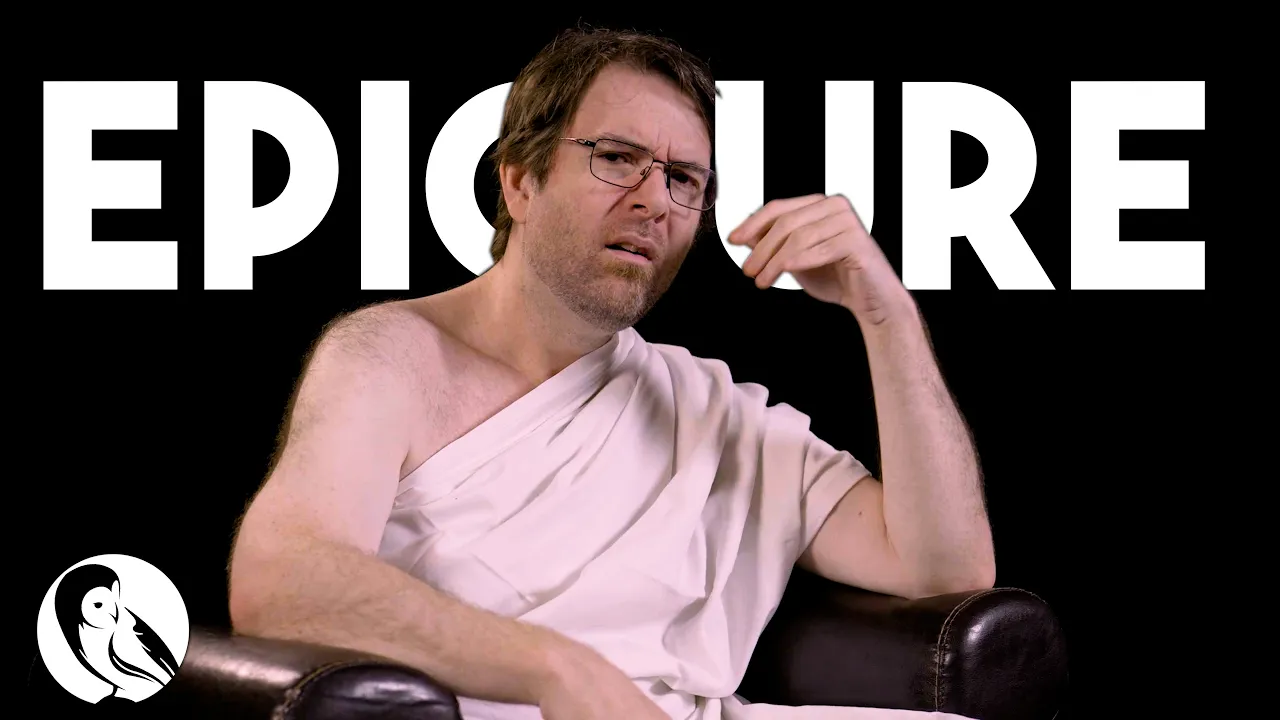




Epicurus argues that death is not bad because it is the permanent end of sensory experience for the person who dies; since we exist when death is not present and do not exist when death is present, death cannot harm us or deprive us of anything, making it neither relevant to the living nor the dead.
Epicurus on Death: Is Death Bad? Philosophy of Mortality
Added:Introduction to Epicurean Hedonism: The philosophical framework holding that pleasure (specifically the absence of pain or 'aponia', and mental tranquility or 'ataraxia') is the highest good.
Epicurean Materialism (Atomism): The ancient physical theory that the universe consists of indivisible atoms and void, meaning the human soul is material and ceases to exist at bodily death.
The Concept of Harm in Philosophy: An understanding of how philosophers define harm, particularly the distinction between experiencing a state of pain and suffering a loss.
Thomas Nagel's Deprivation Account: A modern philosophical critique asserting that death is bad for the deceased because it deprives them of the positive goods of life, regardless of their lack of consciousness.
Lucretius' Symmetry Argument: The exploration of Epicurus' disciple who argued that the infinite time after our death is symmetrical to the infinite time before our birth, and thus equally unfeared.
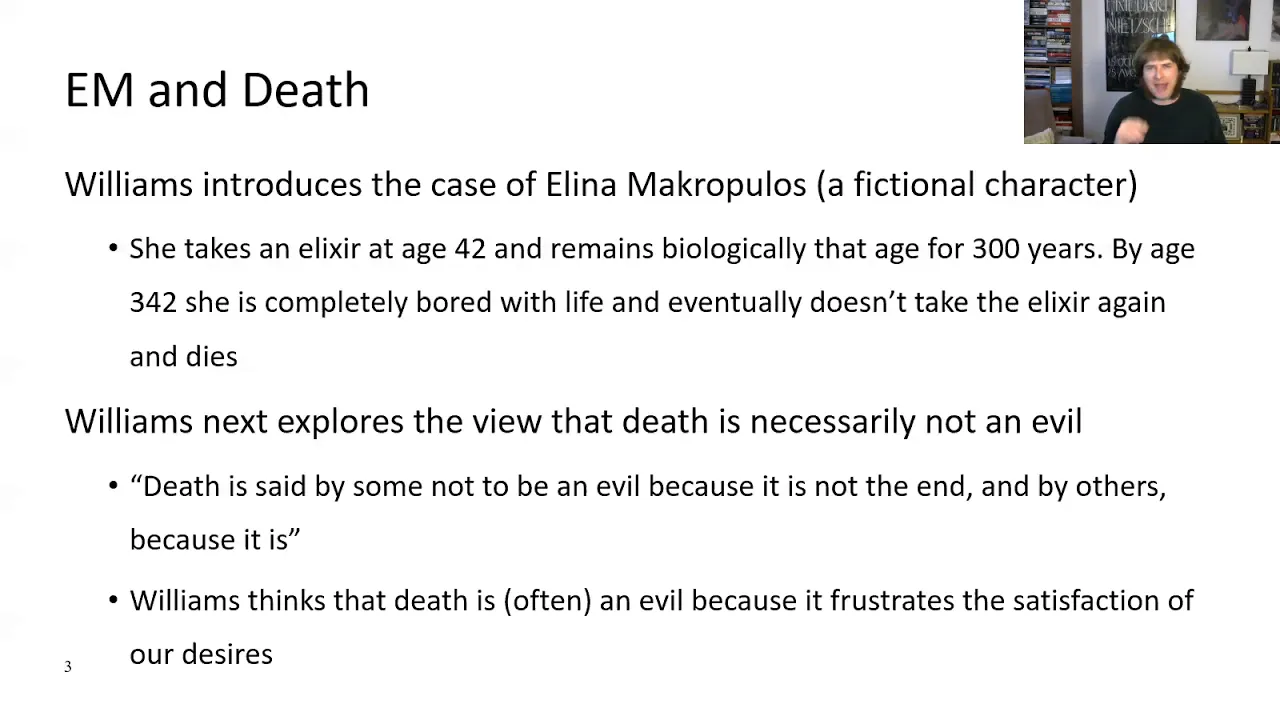
Bernard Williams and the Tedium of Immortality: An investigation into whether living forever is actually desirable, or if mortality is necessary for life to have meaning and structure.
Practical Existential Therapy: How modern cognitive behavioral therapy and existential psychology utilize Epicurean arguments to alleviate thanatophobia (death anxiety).
5.6K views107likes39:08Original Release: 2016-04-06
welcome to the lecture on Epicurus --is letter to many seus I'm Andrew Chapman and in this lecture will be discussing the issue of death specifically we'll be discussing whether death is bad we'll be coming at this question of whether death is bad from two different although intertwined directions the first is the factual question of whether death is actually bad if it is how is it bad the second way will be coming at this question is from an emotional or psychological perspective asking should we be afraid of death should we be concerned does death matter in the sort of way that it should affect our lives our life projects the way we live before death get used to believing that death is nothing to us for all good and bad consists in Sense experience and death is the privation of sense experience hence a correct knowledge of the fact that death is nothing to us makes the mortality of life a matter for contentment not by adding a limitless time to life but by removing the longing for immortality for there is nothing fearful in life for one who has grasped that there is nothing fearful in the absence of life thus he is a fool who says that he fears death not because it will be painful when present but because it is painful when it is still to come for that which while present causes no distress causes unnecessary pain when merely anticipated so death the most frightening of bad things is nothing to us since when we exist death is not yet present and when death is present then we do not exist therefore it is relevant neither to the living nor to the dead since it does not affect the former and the latter do not exist we can sum up much of what Epicurus is saying here in a famous and more pithy statement of this quotation when we are death is not when death is we are not Epicurus was an ancient Greek philosopher who lived from 341 to 270 BCE he was an atomic materialist this is a notion of what the ultimate constituents of reality are their atoms which are things that can't be broken down any further and they are essentially material in nature he was a religious skeptic he was a questioner of religious claims and he was a founder of the doctrine that takes his name epicureanism Epicureanism is a complicated doctrine that sometimes misunderstood as a form of base hedonism that says pleasure is the only thing that matters Epicurus did say that sense experience gave us the only things that could possibly matter but pleasure in his account isn't mere bodily pleasure it's much more complicated than this since what we're doing in this discussion is talking about a practical ethical matter one that deals with a specific component of our lived experience we should look at the sub discipline of philosophy known as practical ethics practical ethics which is sometimes also called applied ethics as the sub-discipline of philosophical ethics that concerns itself with the moral properties and moral reasons surrounding specific types of actions events and states of affairs so the practical ethicist is primarily concerned with the moral properties possessed by specific types of actions events and states of affairs but isn't primarily concerned with general theories of ethics that determine right or wrong or good or bad or better or worse so notice that this term practical means exactly what it seems to me in practice practical ethics deals with the things that we actually confront in our daily lives some of the questions asked by the practical ethicist are what's the moral status of specific sorts of sexual activity what's the moral status of abortion how should we treat non-human animals what are the right and wrong ways for a nation to conduct a war what is the moral status of specifically race related questions what is the moral status of specifically gender related questions and what makes our specific sorts of lives go well or badly this final question is the question that will be concerned with mostly in this lecture since death is part of our specific sorts of lives we want to know whether death makes our lives worse it's important in understanding practical ethics to recognize how practical ethics is related to but nonetheless distinct from a philosophical sub-discipline known as existentialism existentialism is a philosophical and literary movement that began mainly in Germany and France in the late 19th century thinkers such as Kierkegaard meetcha Heidegger and Sartre are among existentialism most prominent figures even though some of these thinkers rejected the name existentialism existentialism requires a radically individualistic although not generally self-centered or egotistical or egoistic methodology that's known as phenomenology existentialism is in many ways a philosophy of living we're living refers to the specific sort of thing that self-conscious rational creatures like you and I do while practical ethics generally gives us guidelines for how to live in terms of being good human people and thus could be considered some sort of a philosophy of living it nearly always ignores a phenomenological or first personal or subjective methodology and is more concerned with moral principles than with individual experience so while we could have a practical ethics that's a form of existentialism usually the way that practical ethics is investigated studied researched in the anglo-american world is in terms of an objective Universal general methodology rather than the subjective individualistic phenomenological methodology found in existentialism since what we're concerned with here is death we should get clear on what we mean here by death here we aren't concerned with metaphysical or religious questions concerning whether persons are more than their mere bodies or whether there's some part of a person that could persist beyond bodily death these are very interesting questions in their own right but we shouldn't confuse them with our central topic death as we'll use the term here refers to permanent annihilation of the subject if I die then I'm gone now note that this is a stipulative definition I'm saying this is how we'll use the term death in this lecture no metaphysical questions turn on using the term in this specific way I won't make any arguments about religious or metaphysical theses from this stipulative definition of death now if someone thinks that after bodily death we still exist in some way then person thinks that bodily death isn't real death isn't death in our sense of the word if somebody thinks that some part of us is immortal then that person thinks that we never actually die in the sense that we're using the term death in this lecture thus when we talk about death what we're referring to is one and only one very specific thing permanent annihilation of the subject the subject being no more we can take a humorous look at this notion of death in a very famous sketch from Monty Python ooh I wish to register a complete it is miss what you may miss I'm sorry I have a cold I wish to make it complete sorry we're closing forever man that man late I wish to complete about this pellet what I purchased not Alfred her ago from this very boutique oh yes the Norwegian blue what's wrong with it I'll tell you what's wrong with you it's dude look look I know a dead parrot when I see one and I'm looking at one right now it's not that it's resting visiting yeah remarkable bird the Norwegian blue beautiful plumage in it the plumage didn't enter into it it's still resting all right then if it's wrists you know wake it up hey do you believe my god nice cuttlefish for you when you wake up buddy better they move you know this you did buddy poorni Felipe Lord wake up Bali now that's what I call it did put it stunned look man I've had just about enough of this that parrot is definitely deceased and when I bought it not half an hour ago you assured me that its lack of movement was due to it being tired and shagged out after lunch on him for the fields painting for the fields what kind of talk is that look man did it fall flat me expect Amir but I got it home but no region blue prefers keeping on his back I took the liberty of examining that header and I discovered that the only reason that it had been sitting on its perch in the first place was they did have been nailed there cause it was nailed there otherwise it muscled up to those bars and boom look mating this parrot wouldn't do if I put four thousand bolts three leading demise there's noise it's pointed it's not pain and it's passed on this parrot is no more it has ceased to be it's expired and gone to meet its makeup this is elite pennant it's a stiff the restive knife it rests in peace if you hadn't nailed it the perch you could be pushing up the daisies join the crowd invisible this is an ex well better replace it then it'll help to get clear on this notion of death if we contrast three different concepts with one another these are the concepts of being dead death and dying the concepts that we use that surround the issue of death can be used in precisely or equivocally so it's very important when we start talking about the notion of death if we want to do good philosophical work and arrive at correct or justified conclusions about death that we're using words very precisely here's how we'll use these words here being dead is the state one is in after one has died after ones death one is no longer around when they're dead death on the other hand is the instant when one dies when one passes from being alive to being dead however death is also used oftentimes to refer to the state of being dead it's generally used in this second sense in fact context generally makes clear how the concept of death is being used whether it's being used in terms of the instant when we pass from being alive to being dead or whether it's being used in the same way as the concept of being dead dying in contrast is the process undergone by the living that is a lead-up to death no dying person is dead now of course in a poetic sort of way we're all dying since we are all growing closer to death usually however the concept of dying is used to refer to the final bits of a living person's death so a dying person is alive then death happens and they become dead many people think that death is a bad thing when we're talking about the badness of death we can break that notion of badness into two different issues a philosophical issue and an emotional or psychological issue let's first talk about this philosophical issue many people think that there's something bad about death and it's not just that death makes survivors sad in fact it's the badness of death that makes people sad not the other way around but if death is actually bad then we should be able to find some reason why death is bad if death is bad it's bad because of something call this the philosophical question of the badness of death what is it that makes death bad one way to examine this question and the way that's been most influential in the practical philosophical study of death has been to look at the sorts of things that make other human endeavors bad and then to see whether death possesses those things or at least things that are relevant ly similar to those things human endeavors are bad or go badly for a number of reasons chief among these reasons are some one is or some people are harmed or there's a lack of some good thing that should otherwise be present and someone is or some people are deprived of something that would be better for them not to be deprived of this is the philosophical issue of the badness of death contrast this with the emotional or psychological issue of the badness of death in addition to and perhaps largely independent of the philosophical question concerning the badness of death there's also this emotional question many perhaps most people have negative emotions about death especially about their own death death these emotions are generally related to fear and anxiety the emotional question concerning the badness of death is whether our negative emotions concerning death are apt or whether those emotions are misplaced now of course emotion is less susceptible to reason and argumentation than is belief however we shouldn't think that good reasons can't offer us comfort concerning something that we thought was bad or even show us the way to feel much less bad or even good about something that we previously had negative emotions with respect to so for example imagine that you're afraid of something and somebody shows you a number of good reasons why you shouldn't be afraid of that thing that might not automatically make your emotions a fear go away but it would surely provide you with some comfort and might eventually if you focused on those reasons make your fear of that thing go away is death a harm this is a first way that we might ask the philosophical question of the badness of death and a way into asking the emotional question of the badness of death harm is usually considered in both consequential istic and sensory terms such that a person is harmed when the consequences of some action or inaction result in negative sensory states generally pain but also lack of pleasure on the part of that person now dying can be very painful and since death is the end state of the process of dying this gives us good reason to think that there's some relationship between death and further when a person is dead they can no longer experience pleasure that gives us even more reason to think that there is some relationship between death and harm however we need to be very careful here as we've already noted dying and death are not the same thing neither are dying and being dead so the fact that dying can be painful doesn't by itself entail that death is painful or that death is a harm recall that it's very important to distinguish being dead the instant of death and dying when talking about the purported badness of death even further since death is the end of the suffering of dying even though dying might generally be painful or unpleasant to the person who is dying death and subsequently being dead puts an end to that suffering isn't that perhaps some reason to think that the harm of dying doesn't transfer over into a harm in death well what about this thought that death is a privation that death is a lack of something could this make sense of why we think that death is bad privation is the lack of something something's being missing and death is a lack of all sort of things chief among the things is life thus we might formulate what we can call a privation account of the badness of death as follows one life is good to death is the privation of or lack of life three death is the privation of something good which just follows from one and two for anything that's the privation of something good is itself bad therefore death is bad now a clarification on this first premise that life is good that first premise isn't claiming that all lives are good or that life is always good ones merely claiming that lives are generally on balance positive however we actually need to evaluate each particular life individually before applying this argument to that particular life now the central premise of this argument is for that anything that is the privation of something good is itself bad but is for true there are all sorts of things that are good but the privation of those things is also good so it doesn't seem to be the case that if you've got a good thing and that good thing isn't present that therefore bad stuff is occurring consider an example riding a horse that's great but not riding a horse can also be great eating a hamburger that might be great but not eating a hamburger if instead you're eating a hotdog that might also be great so the fact that something good is missing doesn't entail that something bad is occurring we need much more to give the privation account some sort of purchase some sort of good strength some some reason behind it to believe that death is a bad thing well what about a more specific version of a privation account that we can call the deprivation account the deprivation account of the badness of death is currently very popular in practical ethical discussions about the badness death the deprivation account is distinct from the privation account in that the privation account claims that some good thing is missing from the world in general while the deprivation account says that some particular person doesn't have some good thing the deprivation account claims that death deprives a person of life but specifically the good things that happen in life experiences successes relationships etc to be deprived of these things is a bad thing thus death is a bad thing however consider when you or I are deprived of something someone namely you or I still exists to be deprived of that thing when I don't give you a candy bar for example you're still around after I don't give you the candy bar but you're now candy bar deprived however when a person dies it's not as though there's still someone around who's being deprived of the good things in life how would it be that a person could be deprived of the good things in life when they don't even exist anymore this criticism of the deprivation account gets us to something very similar to Epicurus --is argument Epicurus --is main claim is that death is not bad now we'll need to see what he means by this and why he thinks this here's a formalized version of Epicurus his argument premise 1 for any particular person call that person s s is death is the permanent end of sensory experience for that person s this just seems true given how we've defined death as permanent annihilation premise two if something is the permanent end of sensory experience for some person s then s has no sensory experience at that time or after that time this just seems to follow thus for any person s s has no sensory experience at or after her death that's a conclusion of 1 & 2 but for any person s some event call it E can only be good or bad for that person s if s has sensory experience of E thus for any person s at or after s is death s is death is not bad for s and for any person s if at or after as his death as his death is not bad for us then death is not bad therefore our conclusion that follows from 1 through 6 is that death is not bad one of the main things doing the work in this argument is premise for for a person some event can only be good or bad if the person can have sensory experiences of that event and since we know that there are no sensory experiences at or after death death can't be bad this is a compelling argument death can't harm you it can't deprive you of things it can't be bad for you according to Epicurus --is picture of what badness is because when you are around you're not dead and when death is around you're not around anymore here's an initial worry with what Epicurus is claiming here Epicurus relativize --is badness notice that a kill according to Epicurus bad things are bad things for specific individuals thus nothing is just bad bad period bad. or in philosophical language bad simpliciter but while we can admit that some perhaps many of the bad things that happen are bad for specific people is it the case we should ask that all bad things are bad for specific people that is is it the case that all badness can be reduced to badness for specific individuals or specific sets of individuals if there's such a thing as badness that's not bad Ness for a specific individual then we might say that even though death is not bad for the person who dies death is still bad not bad for anyone but just bad period consider would it be bad for a person to burn down a forest for no reason even if doing that wasn't bad for some sentient creatures now most people would say yes but if it would be bad to do that even though it's not bad for anyone then it looks like we have a notion of bad period bad simply Qader that doesn't rely on someone's actually experiencing badness or consider would it be bad to cheat on an exam even if it wasn't bad for any specific person or people most people would say yes but if it can be bad to do something even though it's not bad for any specific individuals then we've got a notion of badness period or consider would it be bad to steal from a large company even if there were no negative effects for any specific individuals or groups many people would say yes but if it's bad to do it without it being bad for any specific person then it seems like we have a notion of badness that isn't relativized to specific individuals thus couldn't we agree with Epicurus that death isn't bad for the person who dies however it's nonetheless bad here's a second worry Epicurus makes badness and goodness entirely dependent on sensory states states of hearing or seeing or smelling touching tasting etc Epicurus is overarching moral theory is a version of albeit a complex and entirely non-standard version of hedonism hedonism is a position that pleasure is the primary moral good and that pain or a lack of pleasure is the primary moral bad and what that means is that there are no good or bad things that aren't experienced by something that can experience good or bad now certainly it's plausible that many of the good things are things that are experienced and many of the bad things are things that are experienced however doesn't it also seem plausible that there are some good or bad things that aren't experienced that are bad just because of the sort of thing that they are and not bad because of how they make somebody feel so consider most people think that it's good for me to respect you and not because of how respect makes you feel or how it makes me feel but instead because respect is a good way of treating another person but if respect can be good independent of how it makes anybody feel then there are such things as goodness and badness that are not dependent on sensory states further most people think that it would be bad for you to break a promise or for you to be unfaithful commit infidelity perhaps not because of how it would make somebody feel but because promise breaking or Park excuse me promise keeping fidelity those are good things in themselves but if we've got an ocean of good things in themselves and bad things in themselves then there are good and bad things that don't rely on sensory state so thus couldn't we agree with Epicurus that there's no sensation of badness that comes from death of course but death is nonetheless a bad thing not bad because it's an experience but just bad period these two problems that of the sensory nature of badness and that of the relativity of badness in Epicurus account should make us suspicious of Epicurus --is general claim that death is not bad ever period we can agree with Epicurus about a lot of what he says but we should be worried about the general overarching claim that he's making now that we've looked at this oesophagus notion of the badness of death let's return to the emotional question of the badness of death since we haven't paid very much attention to that yet recall that the emotional question of the badness of death is the question of whether being worried about or fearing death is apt for us a contemporary and sophisticated defender of Epicurus argument against the badness of death might say something like the following look I agree that things can be bad apart from being experienced I agree that things can be bad in themselves what I want to claim is that death is never bad as an experience for the person who is dead and that is not a trivial thesis why is it that it's not trivial that death is never bad as an experience for the person who's dead well recall that people are generally terrified and anxious about their own death is there a good reason to feel this way about our own death this is what we're calling the emotional problem now perhaps even though Epicurus argument isn't bulletproof with respect to the philosophical question it is very strong with respect to the emotional question perhaps Epicurus --is argument is instead intended to solve the emotional problem and not the purely philosophical problem Epicurus does say this recall but the many sometimes flee death as the greatest of bad things and sometimes choose it as a relief from the bad things in life but the wise man neither rejects life nor fears death for living does not offend him nor does he believe not living to be something bad and just as he does not unconditionally choose the largest amount of food but the most pleasant food so he savors not the longest time but the most pleasant perhaps what Epicurus is telling us here is that in order to live a good life we should recognize that fearing death in life makes our lives worse and that we have no good reason to feel that way to make our lives worse by fearing death in this lecture we've taken a look at Epic Orissa's famous argument against the badness of death in his letter to manesis Epicurus his argument can be summed up as follows when death is I am NOT when I am death is not now we saw that this might not be a solution to the philosophical problem of the badness of death because it might be that there are things that are bad independent of whether somebody experiences them it might be that badness is not always relativized to individuals as badness for some specific person there might be a non relativized non experiential version of badness and in that way death might nonetheless be bad however it does seem that if we are fearing things because we think we have good reason to fear those things then we may have made a mistake with respect to fearing death and if fearing death while we're alive makes our lives worse that's plenty good reason to try as hard as we can not to fear yes thank you
Up Next

51:36
Understanding Death's Badness: The Deprivation Account (Philosophy Lecture)
@YaleCourses
72.4K views•2008-09-30

131:21
The Arcades of Paris: Walter Benjamin on Urban Politics & Philosophy
@internationalcentreforcont7204
2.3K views•2013-06-19
31:02
The Symmetry Argument: Lucretius on Death's Harm
@autodidactstoolkit
2.5K views•2016-04-14
4:57
The Myth of Sisyphus: A Greek Legend of Eternal Punishment
@TEDEd
8.6M views•2018-11-13
Related Study Plans & Knowledge Roadmaps
Structured learning paths in Philosophy
philosophy
Philosophy of Death (Metaphysics, Harm & Grief)
01Introduction to the Metaphysics of Death
02Is Death Bad? Epicureanism vs. The Deprivation Account
03Lucretius's Symmetry Puzzle
+ 2 more learning modules
15h5 modules
Explore Roadmap
philosophy
Frankfurt School: Critical Theory & Culture
01Foundations of the Frankfurt School and Critical Theory
02Horkheimer & Adorno: The Critique of Instrumental Reason
03The Culture Industry and Mass Deception
+ 2 more learning modules
12h5 modules
Explore Roadmap
philosophy
Philosophy of Language: From Frege to Austin
01The Linguistic Turn: An Introduction to Language in Philosophy
02Gottlob Frege: Sense and Reference
03Early Wittgenstein: The Picture Theory of Meaning
+ 3 more learning modules
15h6 modules
Explore Roadmap
philosophy
Feminist Epistemology: Standpoint & Injustice
01Introduction to Epistemology and Feminist Critiques
02Sandra Harding and Standpoint Theory
03Donna Haraway and Situated Knowledges
+ 2 more learning modules
12h5 modules
Explore Roadmap