


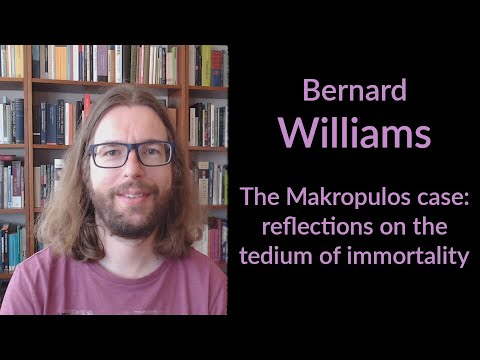











Bernard Williams argues that personal immortality is antithetical to a meaningful human life because an immortal existence would eventually exhaust our categorical desires (those that give us reasons to live beyond mere survival), leading to boredom and loss of purpose; for life to be meaningful, it must have an endpoint that prevents this exhaustion, making death potentially welcome rather than always evil.
Bernard Williams on Immortality: The Makropulos Case | Philosophy Lecture 9
Added:The philosophical distinction between categorical desires (which give us reasons to go on living) and conditional desires (which assume we are already alive).
Basic theories of personal identity over time, specifically the role of memory, character, and psychological continuity in defining the self.
Traditional philosophical perspectives on the badness of death, such as Epicurean deprivation theory and Lucretius's symmetry argument.
Familiarity with thought experiments in ethics and metaphysics, and how literature (like Karel Čapek's play 'The Makropulos Affair') is used to explore philosophical ideas.
John Martin Fischer's counterarguments to Williams, specifically his classification of 'repeatable' versus 'self-exhausting' pleasures in an infinite life.
The bioethics of radical life extension, analyzing the social, economic, and ethical implications of transhumanism and life-prolonging technologies.
Existentialist views on mortality and meaning, particularly Martin Heidegger's assertion that death is necessary to give life urgency and structure ('being-towards-death').
The distinction between secular/biological immortality and theological/metaphysical conceptions of eternal existence (e.g., heaven, reincarnation, or timelessness).
1.1K views30likes57:47Original Release: 2020-05-20
hello everyone welcome back to another lecture today we're going to be taking a look at our first in a pair of pieces examining the desirability of immortality so we've already looked at some pieces type of the afterlife and death but if you recall in those pieces those terms were defined in such a way that we weren't really talking about personal immortality that is living forever as a single individual or you know even with others but your own existence carrying on but rather we're taking a look at the afterlife before we were thinking about that in terms of really people living after we're gone so the continued exists continue the existence of the human species and presumably people we care about or at least people we could potentially care about and we're looking at death the way Nagel defined that was really as a permanent end to one's existence so not death as some kind of transition dude some other form of life but rather is just the terminus as the very end of one's own existence so what we're going to start taking a look at here today and we'll carry on with tomorrow and lecture on Fisher is really the question of personal immortality and really it's not going to be a question of whether or not we have good reason to believe that we are personally immortal that's just something we're not really going to deal with moons course rather it's gonna be a question about whether or not personal immortality is something that is actually desirable and if it is desirable what if anything it would seem to add to a meaningful human life so the piece we're going to take a look at today is by Bernard Williams 20th century British philosopher well known for number of books and various essays himself considers a lot in this piece I'm really not going to be able to eat them just sort of touching on and explained a number of interesting things he says movements and thinkers he even mentions in here what I'm gonna do instead is try to draw attention to and clearly explain really the the core parts of the argument concerning immortality that Williams puts together so this piece we've got here in Acropolis case reflections of the teeming with immortality this comes from a book called the problems itself that he published in 1973 and so in the piece what are we gonna see Williams do well he introduces us to this necropolis case just what it is consider some views on undeath about whether or not death is a good thing or a bad thing in fact in talks at least a little bit about Nagle's peace uh he distinguishes conditional desires from categorical desires so this is an important distinction he makes between two different kinds of desires he thinks we can separate and sort of tease apart these desires and those desires they have a different kind of relationship to our reasons for living which might also factor into reasons we might not want to live then he introduces two conditions and immortal life has to meet for it to be appealing and meaningful and he ultimately concludes that no life no human life can actually meet those two conditions and so he concludes he really is a joint conclusion that you can never be desirable or meaningful to live forever so in fact personal immortality is antithetical to a meaningful life and this is very much contrary to Quinn Tolstoy Craig might think of so many people want to stick in here but he thinks immortality is actually antithetical to a meaningful life that is you can't really have a meaningful life you live forever and even though that's the case death can still be an evil that can still be something worth avoiding at least for some time one other conclusion that we can say he draws for his reflections here is that for life to have meaning it has to be a life that ends that is death is in some sense what gives life its meaning okay so let's just jump right into it so first we get this macropolis case so he introduces this character Lina macropolis who goes by a number of other names as well ultimately M our initials and all her various identities and so on have these initials GM she's a fictional character this comes from clay so it's not like Williams was trying to report some fact here but the interesting part about am I'm just gonna furnish eeehm really from Acropolis is that she takes an elixir at the age of 42 so and this is supposed to be back him I think he says it's the 16th century so her father is a doctor or researcher or magician whatever uh but he develops this elixir of immortality he gives it to him and she takes it and so she stays at but biologically at age 42 for 300 years and the play that this comes from the historian was trying to do play a curse 300 years later so she's really aged 342 but in body and in effect in mind you know her mental capacity she's still 42 of course she has those 300 years of extra experiences but really she herself hasn't changed her body hasn't aged in any discernable format her mental powers have declined in any way so the age of 342 Ryan for all intents and purposes she's still aged 42 if you ran into her you think oh he was a fruity rural woman huh at this point she is just completely bored with life just just exhausted by it it's just not interesting to where anymore so she has no reason to live now the way the elixir works is that she has to keep retaking it to stay alive and so eventually she just decides at age three 42 she just doesn't want to take she just she dies and so what Williams really wants to do in this piece is as he puts it pursue the idea that four facts about human desire and happiness and what a human life is it follows both that immortality would be we're conceivable at all intolerable and that other things being equal death is reasonably regarded as an evil so EMS case Williams thinks shows us that death isn't necessarily an evil precisely because in her case it appears that death is at some point well change it lives long enough that life just doesn't seem worth living anymore so she wants to die right and if you want to die and then you do die it's not really clear how dying can be regarded as something that really isn't evil because at least one way to look at what it is for something evil is that it runs contrary to what we desire right it's not the thing we want it's it doesn't satisfy your preferences so Williams wants to take a look at this right so after talking with propolis a little bit of yem thinking about this okay so it seems like immortality is really intolerable right that's yams Casey to show us this and it also seems to show us that death per can at least be regarded as an evil all other things considered right candy isn't necessarily so as he mentions death is said by some not to be an evil because it is not the end no biology because it is and here discusses some different religions and philosophies that look at death and he says there's two different ways to look at it looking at death not really being evil one way to look at it is that death isn't an evil precisely because it's not the end of us it's really this kind of transition to something else we die here but that's really just our earthly body dying and then either depending on details of the particular music question I disembody part of us continues to live on a soul or spirit or consciousness or there's going to be some kind of bodily resurrection where you get your your physical body back and then will continue your life at some later point and of course you can have variations of this as well where perhaps the your your soul or consciousness continues existing without a body and then it some future time there will be another body created for it soul or consciousness and with it so one way to look at death not being an evil is precisely by rejecting the fact that it's really the end of your gist's on the other hand there are views that look at death and say it's not really an evil precisely because it is them this is what angle was thinking about this is where Williams also talks about Lucretia's ancient Roman epicurean philosopher and really the view there is for something to be an evil it has to be something bad in your experience it's something that you don't want painful or something like but by being dead you no longer exist which means you can't have anymore experiences which means nothing bad can happen to you because you're not there to experience bad things so there are these two different ways of looking at death and looking at it very differently right saying it's not the end of us where it is the end of us but no matter which way you go on that still coming to the same conclusion that death isn't really a bad thing after all so Williams talks about that and thinks about that a little bit but one other view he wants to take a look at is that death can in fact being evil because it frustrates the satisfaction of our desires and Nagle approached it in this kind of fashion as well there's there's a little bit of a difference there Williams and Nagel agree and disagree in some ways but we'll come back to that a little bit later Williams remarks that he's not really interested in cases of extreme suffering so he's not looking in cases where people by staying alive are really doomed to be stuck suffering and pain all the time and still want to die because of that so he just wants to set that aside rather he wants to look it just other other sorts of cases you know what assuming we weren't going to be him perpetual pain or something like that would death be a bad thing or not well minimally it seems like it could be a a problem or a bad thing precisely because it doesn't allow us to satisfy some of our desires it doesn't let us the keeps projects we want to engage with accomplish the things we want to accomplish and so on okay so let's write that that's some reason to think maybe death really can be and here again no part of what's going on in Williams here was also going on Nagel Nozik there's something that just goes on in philosophy quite generally is that we I'm going to use this we've philosophers in general well we're interested in trying to figure out what's true or what the best reasons support we're not always just engaged in industries coming in and just saying oh believe this and leave this in here this is true here's what I believe we explore well look around and think about things and take some time really say look you know there's reasons to think this way think that way how should we weigh those reasons they intersect with each other what other sorts of reasons engage with those reasons how else might we get to the same conclusion or how might the same reason take us to different conclusions right so part of what Williams is doing here is exploring right he's not just coming out and saying okay I believe these six things I want you to believe them too that can be nice nice and clear in fact my often what I'm hoping to get you to do in your own writing is to try to be nice and clear because I think that's that's a valuable skill to have but in going through the reading you have to be sensitive to the fact that just because they say something were or raise an argument doesn't mean they necessarily endorse it okay so moving ahead here so we've got some this exploration of whether or not death is necessarily right or you know can it maybe not being evil can be not so bad we've got some reasons to think maybe death isn't so bad we also have at least one reason here to think that death can be me at least candy all right so moving on to this distinction Williams draws between two different kinds of desires conditional desires and categorical desires now a conditional desire is a kind of desire that we handle in condition that were alive right think for instance wanting to eat right or drink in fact first they take a little drink of water now the fact that I desire to have drink of water is really conditional in fact I'm alive the kind of creature requires water stay alive right I get thirsty but if i were confronted with the prospect of immortality and so he said what reason do you have to live forever I certainly wouldn't say so that I can be around to take drink when I'm thirsty because of course my dad I'm never going to be thirsty so my having the desired take a drink of water is conditional on the fact that I'm alive and it's only by being alive that I become thirsty and it's only because I'm thirsty that I have a drink of water that's good occasionally I might give you very small bits of life advice I don't think I'm very qualified to give you very much drink water it's a good thing okay so the other kind of desires are categorical desires now categorical desires or desires that really give us a reason to live rather than only having those desires on the condition or because we're alive rather categorical desires of sorts of desires that really give us a reason to want to be a lot right and then the sorts of desires that we want satisfied irrespective of our own staying alive so these are our desires just to give some examples wanting to see one's offspring flourish like wanting one's children to live well and be healthy and so on wanting some some cause that one considers larger than themself to come to fruition say fighting in a war where you think your side really needs to win and so you're willing to sacrifice your life for that say trying to cure a disease right you're trying to cure cancer now it's not just because you think it's fun or or someone gives you a project but rather you think curing cancer something really really important right and that itself can give you a reason to live pursuing that and in fact it could be something that you want to see or use something you want to happen even if it's after your own death so you're not around to experience pleasure and satisfaction of seeing and actually conclusion just a note on the language so we've got these two different kinds of desires the conditional way I think is pretty clear right it's a desire in the condition that your life categorical desire what does it mean to be categorical really exceptional Asst right so the conditional desire has a kind of exception but you don't have that desire if you're dead but a categorical desire is the kind of desire you have that really cuts across those sorts of exceptions right whether or not I'm alive or dead I want to see or I want cancer be cured I want my offspring to do well I want the earth to be a place in heaven Bolin and desirable to beyond for humans for future generations so this is the distinctions William draws here thinks this is going to be pretty important in terms of our thinking for immortality whether or not immortal life would really be desired all right now Williams thinks that really it's our fulfilling our categorical desires that gives us some kind of reason to live and it's really having some kind of reason to live that makes for a meaningful life now death is in fact typically an evil precisely because it interferes with our ability to fulfill our categorical desires right death is the thing that really gets in the way of being able to work towards fulfilling these things now Williams himself claims that in his words the reasons which a man would have for voiding death are grounded in desires categorical designers which he has so unwilling you the reason we have to avoid death is really in our desires right so it's still something in our desires in our own mental states and attitudes that makes our death something potentially bad we're good now Williams talks about Nagle's views um so just to bring that back up here um welcome to too much detail it's something interesting you might want to engage Lydon foreign post or critical response maybe but without you know Williams or Nicolas the better view here deal hafting that's just an idea Williams and Nagel agree in in some sense that death can be an evil doesn't necessarily have to be an evil but they differ in the way they come about so Nagle's view really rests on objective values things that can be independent of the desires of an individual but Williams view as he puts it is closer to each old Terry anism a very popular ethical theory of the 19th 20th centuries ultimately locates good in pleasure and bad in pain looks at it from an overall perspective it's really freeing to latarian what's good maximizing aggregate utility as they put it or overall happiness try to make overall happiness increase that's really what makes for good good actions things that make overall happiness decrease those are bad so utilitarianism is really a version of hedonism which I was repeating as last time Hegel hedonism is really this view that really what's good and what's bad or evil really comes down the questions of pleasure desirable experiences are undesirable so William says that his own view is a little closer to utilitarianism and he visited the angles because ultimately Williams wants to ground his views on on death and whether or not an immortal life is meaningful on our desires like Nagel is willing to step outside of our desires and say that there can be things that are good bad or good and evil that actually go beyond the desires or experiences of any particular people this is really what Nagel is getting at when he said you know some goods can be relational or some goods or evils can be the sort of thing that we can't space you temporarily assigned to some particular agent it's not that on Tuesday at 3 p.m.
you know I found out some terrible fact and that's what makes it bad right things can be good or bad independent about our finding out about them are experiencing them are having a particular attitude toward them and soul okay so now given Williams view here right that fulfilling our categorical desires really because this agrees to live that that dying can get in the way of doing the sort of thing it at least seems like staying alive might always be better to die and this is really the point left off with two niggle gauges in in these think about death you know we can at least see death as a potential evil insofar as it cuts off certain possibilities for people if they'd stayed alive they could have worked on their categorical desires more or so on but of course Nagel says well he sort of leaves a little open-ended really leaves off on this question is it always a bad thing to die or can it actually be a good thing to die at least sometimes this is really where Williams is at this point right it almost seems like staying alive forever is really the preferable option over dying at some point because it's only by living forever that we can continually try to fulfill our categorical desires so this is where Williams really wants to take us now now Williams rejects the suggestion that staying alive so is better to death Nagel is just really non-committal the end of Nagle's peace we don't get an answer but Williams ultimately his conclusion is that immortality staying staying alive least as a human the way we know it is ultimately something not desirable why is this well there is the issue of deteriorating quality of life as we age our bodies decline right they they sort of lose vitality lose energy and so on become more susceptible disease and pain and so on there's also the question of deteriorating mental capacity issues concerning dementia and cognitive decline and so on but Williams let's actually just bracket those issues races okay we could look at those as parts of our experiences that would make our lives ultimately not worth living perhaps depending on the kind of condition our bodies our minds we're in places ok if we take a look at the en case though and we say what if what if somebody were in of their life right say there were 42 and which there's sort of a couple of funny things about the number realize this is an aside I'll come back to the point uh when from my understanding when Williams first gave the the remarks that make up this piece he himself was 42 so he thought you know being alive for at the age of 42 would be quite flying quite welcome also you probably noticed on the Turnitin account the password for our site was 42 though that comes from Hitchhiker's Guide galaxy feel free to look it up if that doesn't immediately ring any bells okay so coming back to the point I was originally making here so Williams thinks given the en case we can bracket these questions of deteriorating you know a bottle bodily and mental integrity and instead just look at this question of would it be worth living or would it be desirable to keep on living if we could avoid those sorts of issues right winding up in chronic pain and suffering losing your mental capacity losing your you know bodily capacity to do different sorts of things imagine we could keep all that right so imagine you could just sort of freeze frame yourself but write whatever you want to pick 20 25 30 15 I'm you know 60 whatever might be what if you could just keep your your body and your minds are in that state not this isn't sort of cutting off any ability to grow you know make yourself more fit or learn more things or something like that but rather just these questions but underlying capacities now Williams thinks that even by bracketing some of those issues like the way the encase lets us do Kirk he still shows us that ultimately your quality of life will deteriorate over time not because of changes to our body or or mind like art or mental or physical capacities but because of the repetitive nature of our experiences because our relationship to the world around us would change now Williams claims that an endless life would be meaningless one and we could have no reason for living eternally the human life he continues and I says there's no desirable or significant property which life would had more of or have more unqualifiedly if we lasted forever oh so although it might seem like it would be a good thing to live forever because we could always be working on fulfilling our categorical desires in fact Williams thinks that's that's not the case and he thinks ultimately the lesson he wants to draw for an e/m case which he thinks is is appropriate is that eventually we would really cease to have categorical desires which would give us a reason to live okay so Williams gives us two conditions that he thinks in a mortal human life has to meet to be appealing and just one thing I want to remark here he is talking about an immortal human life in part and he does consider him will come around to this in a moment he considers a few different models of immortality but ultimately he's interested in immortality that really while hast meat was first condition which is really an identity condition and should be clearly be it should clearly be me who lives forever that is it has to be a kind of immortality in which who we are now as the humans we are are the things that go on living forever so some other kind of immortality it really isn't us carrying on but is some other sort of thing doesn't really meet the conditions so William says you know first it has to really for immortality to be desirable for Williams anything's really verbally it has to be you know him who lives forever has to be ourselves and secondly the state in which I survive this is Williams should be one which to needle and forward will be adequately related you know life presents to those games which I now have in wanting to survive at all what does this mean in effect well it means that Williams categorical desires have to remain essentially the same over time that if he's looking ahead thousand two thousand five thousand fifty thousand fifty million years done don't forget we're talking about immortality we're talking about living forever William says write it as I look forward no matter how far in time it really has to be me who's still there otherwise it's not in a mortal life it's not my life that's continuing a lot some other life that started at some point and the life that's going on has to be the kind of life that is connected to the reasons I now have to live but those carry on into the future otherwise at some point it's not really going to be desirable to live forever to me now because if my desires change significantly enough in the future that might not be the sort of thing that I now can actually desire so I think rather than saying more above these two conditions right now I'm just going to take a look at the different forms of immortality Williams himself looks at because I think they're a good way of trying to talk about these two conditions and make sense of them so these four kinds of immortality Williams considers and he one thing I will note I think of the reading he could have done a better job of flagging these by just sort of saying okay first kind second kind third I think that probably would have been helpful but this is ultimately what he's doing he's considering sort of moving down list and sort of saying okay well what are the different sorts of models of immortality and can they meet these conditions or not so the first kind of mortal life would be a continuous life right such as EMS and this is a pretty easy one to think about just think about your current life but it just goes on forever right it just it never adds it's just perpetually moving into the future in exactly the same way it does right now day to day year to year and so on now this kind of more life Williams thinks ultimately results in an exhaustion of our categorical desires right and ultimately leads to boredom and that boredom really comes from not having categorical desires anymore when we live our lives so to speak we pursue our projects there are things that we're trying to do we've reasons we can point to for living but Williams thinks eventually we would come to really exhaust these we become bored with right why not no matter how engrossing we find something to be ultimately we will come to find it boring not we're doing eventually Williams things so ultimately a continuous life would meet the first condition write the identity condition it would still be the same person living through time but eventually we would just run out of categorical desires and so that immortal life wouldn't really be desirable to us based on what we now consider to be our reasons to live and now of course there's there's a possibility and Williams considers this but rejects it and come back to it a little bit at the end what if our categorical desires change over time and he wants to reject that view because he says well if if we have entirely different categorical desires at some point in the future then in some sense that future life becomes disconnected from our present life either in terms of the identity condition right who we are is in part defined about by what things we think are worth doing or the desirability condition right if if right now I think my reasons to live include let's just say doing philosophy and charitable work right and a thousand years of the future if I could forever thousand years of the future I'm gonna think philosophies stupid and I don't care about helping people anymore instead you know my categorical desires are producing paintings of I don't know snails and actually taking candy from children and just kind of being a jerk those are the things that just make my life worth living at that point well the fact that now those aren't my categorical desires means that right now that future life where those are my reasons to live at present I'm not going to think that's a life worth living so my future life no longer is desirable by me here now and given that Williams less the ground whether or not lives are worth living or whether or not death is an evil in our desires our pursuit of those desires in some sense even if it stretches beyond our present life he thinks that anything that's any kind of view that's trying to step inside our desires in judging whether or not immortal life is worth living is going to be a kind of mistaken view all right so the continuous life meets the identity condition but not the desirability condition rate meets condition one but not condition two and so Williams thinks really is it going to be a desirable form of immortality the second form of immortality he thinks about is a set of serial lies it's really a series of disconnected lives and he says you know that we can think about those in some different ways maybe you now know what your future but ultimately you can't know what what went on in the past so you're not going to be able to have memory of those previous lives back so this kind of immortality might meet that second condition the desirability condition because in each life you might have different categorical desires or different reasons to live but because in each of those lives you can have different desires right and ultimately you don't have continuous memory through them you don't realize that you read this person and then this person this person going to thing all the identity condition and you can hear think of the forms of reincarnation right soul and and I'm just going to talk about this is a very general way of course you could pick particular religions or philosophies that have a particular version of reincarnation in them let's set aside all all the particular details but just in very broad strokes outline some version of reincarnation where your soul or spirit or whatever we want to call it carries on and lives through different bodily manifestations right so Who I am now in the past I was something else what it was another human right say I've had several human lines before or perhaps animal lines or whatever might be right who I really am some kind of spirit or something that animates me but of course we thinking unconscious turned I don't have any memory of previous lives of of living as a different person or just a different animal or something like that so in effect calling like who I really am that spirit seems to disregard by my consciousness um Williams doesn't quite say this but we might as well say that you're me and I'm you right for all intents and purposes I don't have your conscious experience I don't have your memories and so on I don't have the conscious experience or memories of people who've lived in the past so even if there is some kind of connection right spiritual practice material that's a pretty easy way to think of it to write articles we're now made up of used to be particles other things presumably other living things 1.0 but that doesn't mean just because I've got some particles that used to be in dinosaurs or plants or insects or whatever doesn't mean I know a dinosaur or plant or an insect so this dispersion of immortality Williams really doesn't think so work higher just going back to the first kind of continuous life we can think there as well Williams is really primarily interested in exploring an eternal human life right just what if what if we kept living right immortally now as we are but we can also insert versions of heaven and an afterlife in that theistic sense of life that carries on after death presumably on some other claim existence right that would be another version of continuous life so wait wait form the question in terms of the continues life Canton get bored in heaven all right third disjointed lives this is the the third and fourth cases are in some sense trickier than the first two so the first two I think are pretty easy to think about right the continuous life is really just your present life is carrying on the future indefinitely you can think about that in terms of your going to heaven or something we're just staying around on earth right with no no expiry date so to speak you just go on living Williams thinks that's not desirable right we're gonna exhaust a categorical desires initially you're bored right whether it's here on earth or or up in heaven eventually you're gonna be second second the serialize as some version of reincarnation right William says look that might avoid the boredom issue but now you've run into the identity issue it's not really you in those various lives it's just so many different various lives being lived by effectively different individuals the disjointed lives one is a situation where we can meet the memory or the identity condition so William says okay I realize that with the the second one with the reincarnation idea of the serialize we're failing the identity condition but of course what it isn't makes somebody the same person through times can be fairly tested so let's just assume that we somehow set up the identity conditions for what it is to be the same person through time in such a way that somebody can be the same person although they have disjointed states of consciousness right so what I'm saying you know say what really makes me me is my spirit whatever we want to call it which itself has lived through numerous other lives but I have no conscious memory I've no there's no continuity of consciousness between those previous lie and my current life is Carl Leonard so Williams is basically saying look for the sake of argument let's just assume we can come up with certain identity conditions which make you the same person through time but have disjointed states of consciousness so one way to do this and make a pretty sensible eye thing would be just take Who I am now Carl laterally and let's assume at some point in during course of my bodily life you know I suffer some kind of brain injury or you know fill in the details ever you want but I lose all my memories I lose my categorical desires and so on I become somebody else so let's say I you know take on a different name I also have different categorical desires rather than wanting to be a philosopher and whatever else it is that I live for right I come to have very different sorts of desires during this particular bodily life I'm experienced like so think about wanting to paint snails and I don't know steal candy from children's reasons to live where I imagine that's that's what I'm like in five years right and I don't remember being Curl latter route I go by a different name and have the same kinds of memories I don't have so we got one bodily life carrying on and let's just say for the sake of argument that we identify Who I am with the existence of my body rather than my consciousness my memories my personal characteristics desires and so on William says okay if if that's the situation all right for the sake of argument then we've met the identity condition because for the sake of argument we're just saying that we're meeting the identity condition somehow rather in a way that's that allows for disjoint states of consciousness you can also think of like a dr. Jekyll you know mr. Jekyll wait yeah dr. Jekyll mr. Hyde kind of situation or anything else like that involves some sort of issues look consciousness so sure we can meet the identity condition this way but ultimately Williams things we're still going to fail the desirability condition right we're not going to want that that's just not the kind of thing that our current categorical desires would allow for so and and one other thing to note there he is also really allowing here for in some sense some kind of perhaps not reincarnation under this the disjointed lives version but just sort of different lives occurring with some kind of continuity that we can trace through them okay lastly the Tracy's model so this one to really understand this one it's useful to know a little bit of mythology so Therese is sort of Greek mythological character who really lives through a whole series of different lives but then all of those lives culminate a single person's memory so that this would be really having all kinds of separate lives which themselves are separated on frame so there's Carl a dude and there's each each of you but in the trickiest model Teresa is in some sense takes on someone else so well you know I could be Teresa or really Tracy's as me live my life and then once my life is done reverts back to tree seus takes on some other life lives that life with no memory of being Carl and so on but ultimately through living all those lives there's still a point which Teresa is Teresa's but Teresa is really the culmination of all of these individuals and their their ideas and all these things together now William says this one just really doesn't make for a person as he puts a tree sheis is not eventually a person but a phenomenon Teresa is really kind of thing and occurrence but not a person right because really what it is is is this imagination of trying to mash together all sorts of different different people into one person but ultimately William says it doesn't really make sense where you don't really get a person out of that you get sort of a mash together of different things ok so these are really the four models of immortality that Williams thinks are in some sense plausible we can think about them and he says you know ultimately none of these really meet the conditions for a meaningful and a desirable immortal human life right so really to get that what you would have to have is a life that makes boredom unthinkable so really Williams thinks the because boredom is this perpetual possibility that we can run out of our categorical desires at some point what we really need is is something right some kind of life that would make bored and just utterly unthinkable because as long as it's thinkable as long as it's possible eventually it's going to strike us eventually we're going to get sick and tired of engaging sorts of projects and activities that we do right we're gonna come to see them as purposeless or not worth doing more right you can probably describe it some other ways and really Williams thinks this goes for any kind of moral life whether it's here on earth or or up in heaven or wherever it might be it has to be something that just excludes the possibility of boredom so any kind of normal activity he thinks really isn't going to to meet this condition precisely because our relationship to our environment is going to change if we become a world right our concept time our concept of the world around us how how we feel connected or not connected to those things is going to take on a very different character and it's it's we're just not gonna have the same kind of experiences we did so if we're if we want a kind of existence kind of a moral life where boredom is just impossible um is either normal activities right but an impoverishment of our consciousness or reducing our conscious awareness of ourselves that eliminates the boredom we would experience in them so really in a sense making ourselves less aware of our own condition here we only think about Nagle you know going to the contented infant or in some sense making us not fully human anymore right you think of an animal who's engaged in some sort of normal activity you know sunning themselves or chasing bugs through the grass or something where you think of like cats and dogs here maybe they could be happy doing that forever precisely because they don't have the kind of consciousness we have that would allow them to recognize what they're doing get bored with so one option is that we lose that kind of conscious awareness we become sort of less sorry for repetition less aware of what it is we're doing and less susceptible to boredom that would be one way right we just keep doing whatever it is we do and we just sort of turn off that part of our minds that allows us to recognize that hey I've been doing this for a million years now so that'd be one way to go about it which williams himself doesn't think it is really good one um the other way is to be totally absorbed what we're doing all the time and now really this is my way putting it here but I really think this is what Williams is getting at if we sort of make our consciousness less sophisticated so we lose the ability to get bored with normal activities ultimately I think that's that's going to be equivalent to the situation where we're totally absorbed in what we're doing all the time oh maybe they are a little bit different but I think they boil down to basically the same thing so this possibility being constantly engaged in activities that are totally absorbing being gay and something that we are just unable to find boring right making being bored impossible as Williams demands now Williams rejects this - why it seems like we finally struck on the thing that would make an immortal life desire wouldn't it we're constantly absorbed what we're doing we don't have time to think about how long we've been doing it or get bored or realize how repetitive it is doesn't would that be the best thing Williams doesn't think so why well if we're totally Jordan what we're doing right if we're constantly you know forever eternally engaged in this kind of project in some sense this phrase this terminology of losing ourselves comes in right when you're totally absorbed in what you're doing you lose yourself in it that is you lose your conscious awareness of really who you are so it seems like what happens is that we actually fail to meet the identity condition remember when Williams laid out those two conditions he says look it really needs to be me who lives forever and my my desires in the future have to be suitably related I think maybe the language is slightly different to my desires now my categorical categorical desires need to carry on a fairly static manner from now into the future please look if you're constantly absorbed in what you're doing you don't really have any time to think about who you are and have that kind of conscious awareness of the fact that you are you and that you exist and engaged in these sorts of projects so it seems like in some sense you could really lose who you are and near the end when you talking about Spinoza and sort of life of contemplation and so on this is really what he's talking about you imagine a kind of afterlife where you lose your your sense of distinctness and who you are right you just sort of get absorbed into the great infinite of whatever the afterlife is right or or maybe you continue being you but you're so constantly absorbed in doing philosophy or some kind of you know mental activity all right it could be any kind of activity one occupies you or conscious attention that you never recognize who you are step back and say oh yeah and me and Here I am doing these sorts of things so it seems like at least the first condition of a desirable immortality isn't met right if we're always completely absorbing what we're doing the second condition might not be as well depending on what sorts of categorical desires we write if our current categorical desires are just to say I just do something like philosophy forever which blends of self points to and says you know many people have found doing philosophy or other sorts better like intellectual activity to in fact be a categorical desire it's very desirable in certain senses it's something you do for a very long time seems we're wording in itself something you get lost in but depending on what sorts of categorical desires you have doing something like that forever might in fact not meet your current categorical desires either because maybe you've got multiple categorical desires and being perpetually lost in one thing just isn't sort of existence you want so ultimately in the end Williams concludes that no mortal life can meet both of these conditions the identity condition and the desirability condition right no immortal life that seems suitably human can make it so that it's us that lasts forever and avoids boredom exerts exhausting our categorical desires without just introducing new ones that in fact wouldn't be suitably related to our current ones so really when it gets right down to it at the end thinks really living for ever having an immortal existence just is not ultimately a good thing right for life to be meaningful it has to end in death at some point to to be immortal forever in fact would be antithetical to leading a meaningful existence but Williams also wants to hold the death can still be a bad thing precisely because if our lives are cut short right before we've lived long enough to fulfill our categorical desires at least enough until look till we particularly get bored of them death can still be a bad thing precisely because it cuts off our ability to experience these things so the very last paragraph I'm just gonna read the very last paragraph of because I think it sort of sums up nicely what Williams wants to conclude so suppose then the categorical desire just does sustain the desire to live so long as it remain so I shall want not to die yet I also know if what has gone before is right that an eternal life would be unlivable in part as Ian's case originally suggested that is because categorical desire will go away from it in those versions such as hers in which I am recognizably myself I would eventually have had altogether too much of myself there are good reasons surely for dying before that happens but equally at times earlier than that moment there's reason for not die necessarily it tends to be either too early or too late EEM reminds us that it can be too late and many is against Lucretia's need no reminding that it can be too early if that is any sort of dilemma it can as things still are and if one is exceptionally lucky be resolved not by doing anything but just by dying shortly before the horrors of not doing so become evident technological progress may in more than one direction make that piece of luck rarer by making us blue longer and live past what would be our most desirable time to die I think it's what waiting to say but as things are he continues it is possible to be in contrast eeehm velux opportunities mortis as it can be appropriately mistranslated lucky and having the chance to die so thinking back to Nagel who lenses piece really saying you know because it always the case that living longer would be good right would immortality really be a good things death always an evil given that we can see it as an evil at least in some sense williams answers quite clearly no death isn't always an evil in fact at some point it becomes a good at some point it becomes quite welcome because if you go on living forever you're gonna really become sick of yourself you're gonna become sick of life right um if you go on living as you at some point it's not going to be desirable to continue on that way more not because of certain frame it is external circumstances like a deteriorating body your mind or being suffering or something like that but rather just because your reasons for live will eventually exhaust themselves right and so to go on living would just be sort of insufferably boring right you just have no reason to go on you wouldn't have the right kind of connection to the world around you now dying too early can certainly be bad as well and william to admit this precisely because we want to go on we've got these categoricals letters give us a reason to live and we are frustrated and upset and angry when we can't fulfill those sorts of desires so the categorical desires our desires we have that can stretch me on their own lives they themselves give us a reason for living but given too much time eventually we will exhaust or lose those categorical desires and hence our lives will cease to be worth living so ultimately a meaningful life has to be one that ends has to be one that ends in the kind of death Nagle is talking about some sort of infinite correctives is the cessation of existence entirely the only alternative William says would be somehow to be you know eliminate the possibility of boredom just just eliminate that from our existence but that would involve changing us and what we're like so much that we would still fail one of those two conditions we wouldn't really be who we were anymore or you know if we were somehow still us we would have changed the you know what we're doing what we're able to do in such a way that it really doesn't connect to our categorical desires in the right way so that now our judgment about whether or not be worth living in that condition of the future we would Altima Li have to conclude no it really wouldn't be worth living like that at all all right so that takes me to the end of my remarks on Williams hopefully it helps clear things up a little bit and gives you a better idea what he's going after because there's a lot in that piece there's still quite a bit I haven't even touched on and tried to clear up here by all means if there's parts of it you're interested in and want to hear more about feel free to try to look it up them internet or shoot me you know come chat to me during my office hours or something I'm happy to give you some more information about it but I think that should be enough information to really get you a fairly clear picture of the essential points and the arguments he's making about the relationship between immortality and meaningful life now in tomorrow's video I'm going to be taking a look at younger Fisher's piece on immortality and if you think Williams made some missteps and that some of his claims were justified here Fisher's gonna offer criticism of Williams view and propose an alternative view so just stay tuned for that until tomorrow I hope you're doing well bye for now
Up Next

64:33
Martha Nussbaum on Immortality, Death, and the Good Life
@UChicagoLawSchool
5.5K views•2016-05-13

131:21
The Arcades of Paris: Walter Benjamin on Urban Politics & Philosophy
@internationalcentreforcont7204
2.3K views•2013-06-19

68:32
Should We Destroy the Machines? Big Tech Surveillance Critique
@TheStoriesWeTell303
167.9K views•2025-11-30
4:57
The Myth of Sisyphus: A Greek Legend of Eternal Punishment
@TEDEd
8.6M views•2018-11-13
Related Study Plans & Knowledge Roadmaps
Structured learning paths in Philosophy
philosophy
Philosophy of Death (Metaphysics, Harm & Grief)
01Introduction to the Metaphysics of Death
02Is Death Bad? Epicureanism vs. The Deprivation Account
03Lucretius's Symmetry Puzzle
+ 2 more learning modules
15h5 modules
Explore Roadmap
philosophy
Frankfurt School: Critical Theory & Culture
01Foundations of the Frankfurt School and Critical Theory
02Horkheimer & Adorno: The Critique of Instrumental Reason
03The Culture Industry and Mass Deception
+ 2 more learning modules
12h5 modules
Explore Roadmap
philosophy
Philosophy of Language: From Frege to Austin
01The Linguistic Turn: An Introduction to Language in Philosophy
02Gottlob Frege: Sense and Reference
03Early Wittgenstein: The Picture Theory of Meaning
+ 3 more learning modules
15h6 modules
Explore Roadmap
philosophy
Feminist Epistemology: Standpoint & Injustice
01Introduction to Epistemology and Feminist Critiques
02Sandra Harding and Standpoint Theory
03Donna Haraway and Situated Knowledges
+ 2 more learning modules
12h5 modules
Explore Roadmap