





![Me Salva! [AO VIVO] Revisão de Física (Cinemática) para o Ensino Superior](https://i.ytimg.com/vi_webp/bdj0wk3t4Lg/maxresdefault.webp)












![[미적분학1] 3.4절 (2/2) - 지수적 증가와 감소 / Sec. 3.4b. Exponential Growth and Decay - (2/2)](https://i.ytimg.com/vi/rSObaEPiNNE/maxresdefault.jpg)







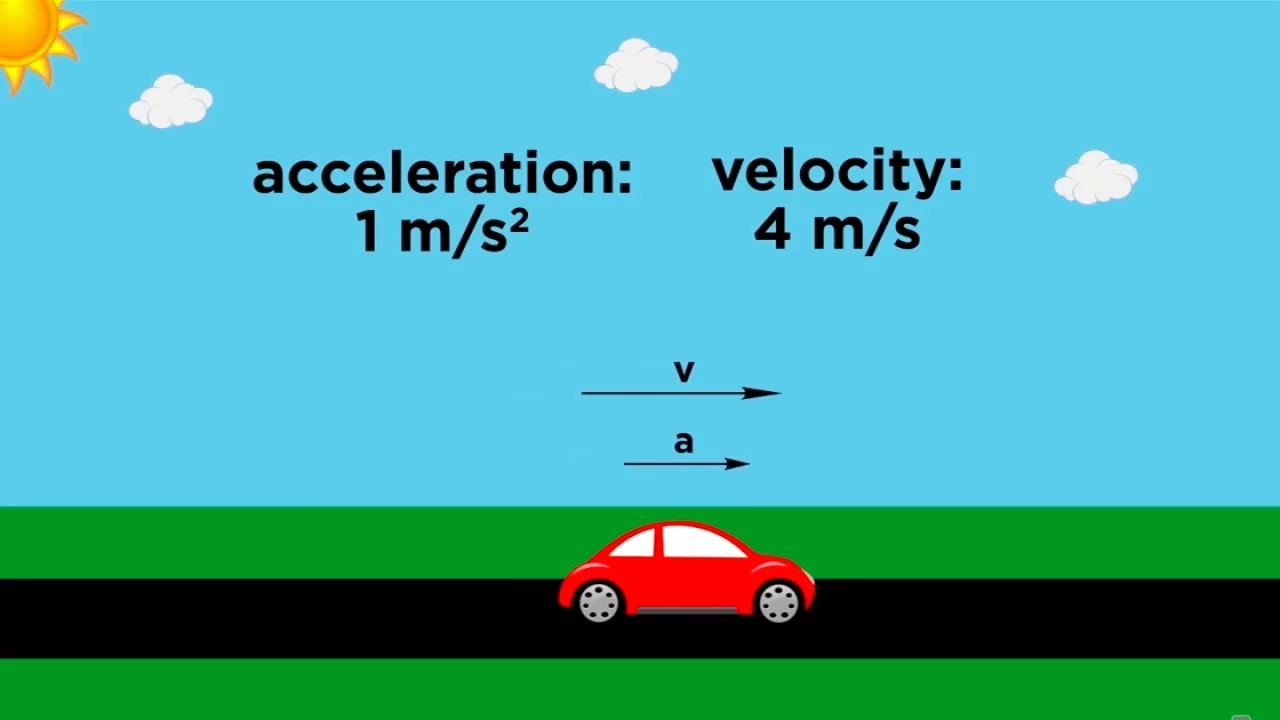
Differential equations are mathematical equations that describe how quantities change over time, where velocity is the first derivative of position (dx/dt) and acceleration is the second derivative of position (d²x/dt²); these equations often require initial conditions to solve, such as starting velocity and constant acceleration, which allow us to predict future states like final velocity and acceleration rates.
Introduction to Differential Equations | Calculus-Free Basics
Added:Basic algebraic skills, including solving linear equations and working with variables.
A conceptual understanding of 'rate of change' (how one variable changes with respect to another, like speed).
Elementary physics concepts of motion, specifically the definitions of position, velocity, and acceleration.
Ability to read and interpret Cartesian graphs, particularly understanding the slope of a line.
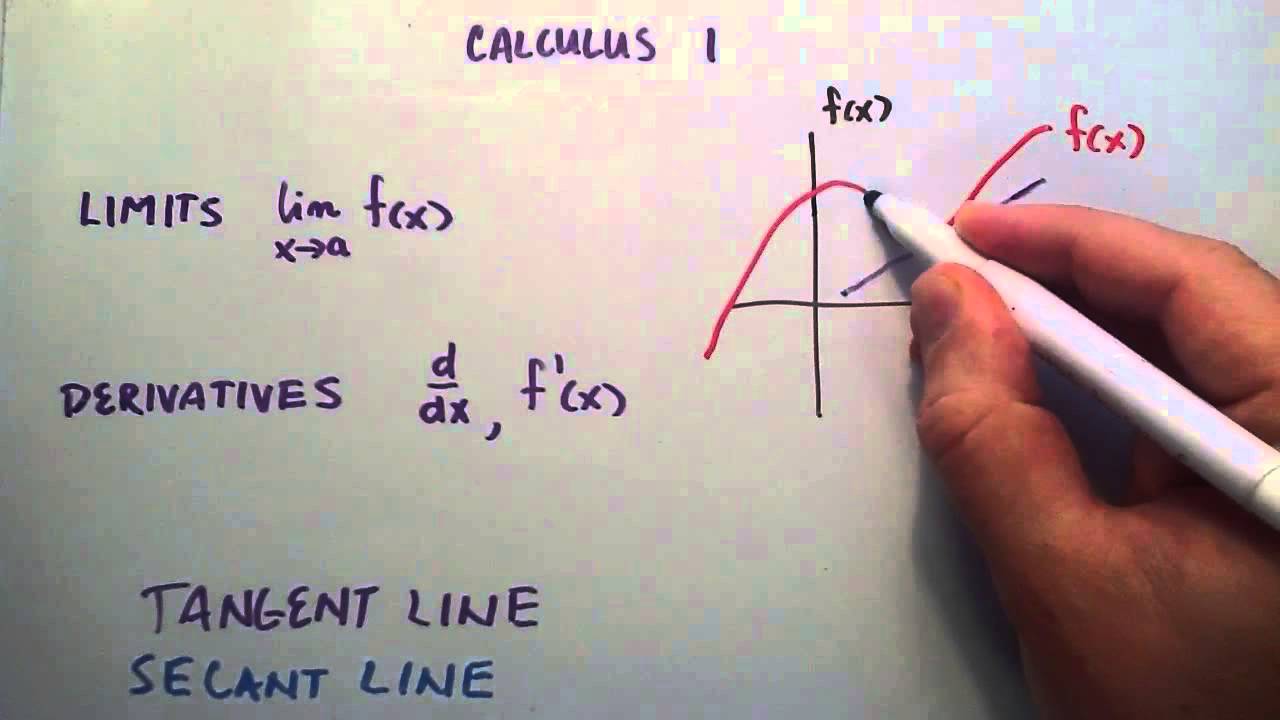
The mathematical definition of a limit and derivative (transitioning into basic calculus).
Solving first-order ordinary differential equations (ODEs) using calculus techniques like separation of variables.
Applying differential equations to model population growth (exponential growth and decay) and cooling processes.
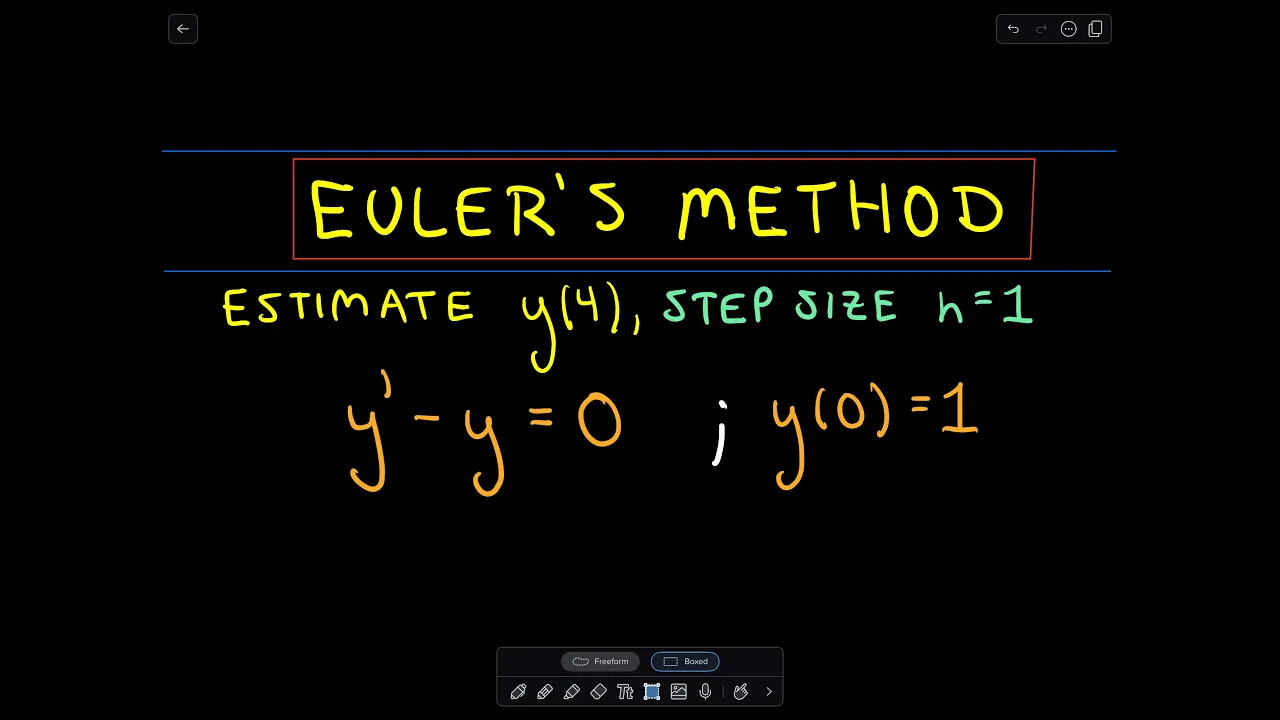
Introduction to Euler's Method, a numerical approach to approximating solutions to differential equations.
625.5K views3.7Klikes11:24Original Release: 2009-01-11
my name is Philip broam and I'm going to introduce you to differential equations the best part is you don't have to know any calculus in order to follow along I like to think of them as difference equations we are going to use the example of a car traveling down a road the x-axis will represent the position of the car here we are at the three mile marker after 10 minutes 5 minutes later we are at the seven mile marker the change in position DX or the difference in X is 4 miles the change in time DT or the difference in T is 5 minutes dxdt is 4 fths don't forget that this actually stands for something it literally means that we are traveling 4 mil per 5 minutes it's a speed it's an unusual speed though so it makes sense to multiply it by 12 which gives us 48 m per 60 Minutes or 48 M hour this is the velocity of the car velocity is the first derivative of position it is written as X do or dxdt acceleration is a bit more complicated here we are at the 3M marker after 10 minutes at the 7mile marker after 15 minutes and at the 15 mile marker after 20 minutes the average velocity of the initial leg of our journey the orange arrow is 48 milph as we just calculated the average velocity of the second leg of our journey the Green Arrow is 96 miles per hour I know this because in the first leg we went four miles in 5 minutes and in the second leg we went 8 mil in 5 minutes so we're going twice as fast the change in velocity DV or the difference in V is 96 minus 48 which is 48 mph that means we accelerated 48 mil hour since the first leg of the journey this does not mean that our acceleration is 48 mph you cannot accelerate at 48 miles hour you need an extra unit of time it's very comp very confusing so I'm going to try to explain it with a more familiar concept Gravity the acceleration of gravity is 9.8 m/s squared what does the squared mean it means that the acceleration of gravity is 9.8 m/s per second mathematicians just like to write the two s's as s s pretend I'm dropping a ball at Time Zero the instant I let go the velocity of the ball is zero it hasn't started falling yet 1 second later the velocity of the ball is 9.8 m/s down why because gravity adds 9.8 m/s per second it's been 1 second so it's falling at 9.8 m/ second at time two after another second we are going an additional 9.8 m/s down for a total of 19.6 m/s down and at time three we add yet again another 9.8 m/s so our total velocity is now 29.4 m/s this is why when you drop things they start falling faster and faster and faster acceleration is the second derivative of position it is written as X double dot or d^2 x dt2 d^2 x dt^ 2 where did that come from I will briefly explain where this notation come from D over DT is the change over time dxdt is the change in X over time if we replace the X with the expression itself dxdt the velocity we get the change over time of the change over time of the position there are two derivatives there this is why it's called the second derivative again it is the change in time of the change in time of the position or the change in time of the Velocity if we rewrite this horizontally we get D over DT * DX over DT remove the parentheses regroup and we have D * D over DT * DT which becomes d^2 X over DT ^2 going back to our acceleration example if the acceleration is not 48 mph what is it well the acceleration is 48 mph per something we can't actually figure out what the acceleration is and it almost doesn't make sense when you're driving down the road you probably aren't going the same speed all the time and you probably aren't accelerating the same way all the time you're probably weaving in and out of traffic you're probably hitting the brakes you're hitting the gas so to say that there's an exact number for the acceleration might not make sense but more importantly from a mathematical perspective is that differential equations such as these are often difficult or impossible to solve without something we call Initial conditions these are assumptions or measurements made at the beginning of an experiment that are necessary in order to uh answer the question so in our example we're going to make it simpler by removing the middle Dot and just going from A to B One initial condition is going to be that our velocity at time 10 when we start is 0 miles hour we are going to start standing still at the three mile marker another initial condition is that our acceleration is constant we are not hitting the gas or hitting the brakes we're going to be nicely steadily accelerating at a constant rate the question then is what is our final velocity at time 20 how fast are we going when we hit the 15 mile marker one thing we know is that the total distance we have gone is 15 - 3 which is 12 mil the total time we spent is 20 - 10 which is 10 minutes and the average velocity of our entire trip is 12 / 10 or 1.2 mil per minute multiply that by 60 and we get 72 mil per hour now if we know the beginning velocity zero and we know the average velocity 72 can we find the end velocity yes we can the end velocity must be 144 milph because 144 and Zer average out to be 72 if you don't believe me look at this graph this is a graph of constant acceleration between the three and the 15 mile markers we start at zero velocity we end at 144 velocity and you can see that the average velocity is 72 if you remember any two points will uniquely Define the line so if we know two points and we do we can find the third one point we know is that we start at zero velocity another point we know is that the average is 72 we can then extrapolate and figure out that the final velocity must be 144 so so the answer to our problem is that the final velocity after 20 minutes is 144 mph let's go back to our initial conditions example and we even have one more um I guess you would call this a final condition we know that the end velocity at time 20 is 144 milph so let's ask another question what is the acceleration in Miles hour per per hour now remember one of our initial conditions is that the acceleration is constant so we will be able to get an exact number for this acceleration we were unable to do that before because as I was mentioning the acceleration would probably be changing as you drive along and move between lanes now we're assuming the acceleration is constant and we can actually figure it out velocity equals acceleration time time why well imagine you're accelerating at 5 mph per hour after 10 hours you're going 50 m hour so this is the equation velocity equals acceleration time time we know the velocity it's 144 mil hour we also know the time that it took 10 minutes because we went from tal 10 to tal 20 so 144 = 10 a divide by 10 and we get 4 14.4 equal a answers aren't that useful without units what does the 14.4 mean well velocity is in Miles hour and time is in minutes so our units are 14.4 miles hour per minute is the acceleration that means that every minute you drive along you're going 14.4 miles per hour faster than you were 1 minute ago let's multiply this by 60 and the acceleration is 864 mph per hour that is our final answer anyway I hope you enjoyed this video and I hope you walk away with at least a rudimentary understanding of what differential equations are and what they're used for feel free to watch my other videos on YouTube
Up Next

39:56
Limit Cycles in Nonlinear Dynamics: Hopf Bifurcations Explained
@iit
30.6K views•2014-07-28

4:43
Elliptic Curve Cryptography Explained: ECC, ECDSA, ECDH
@PracticalNetworking
28.5K views•2024-10-21
10:44
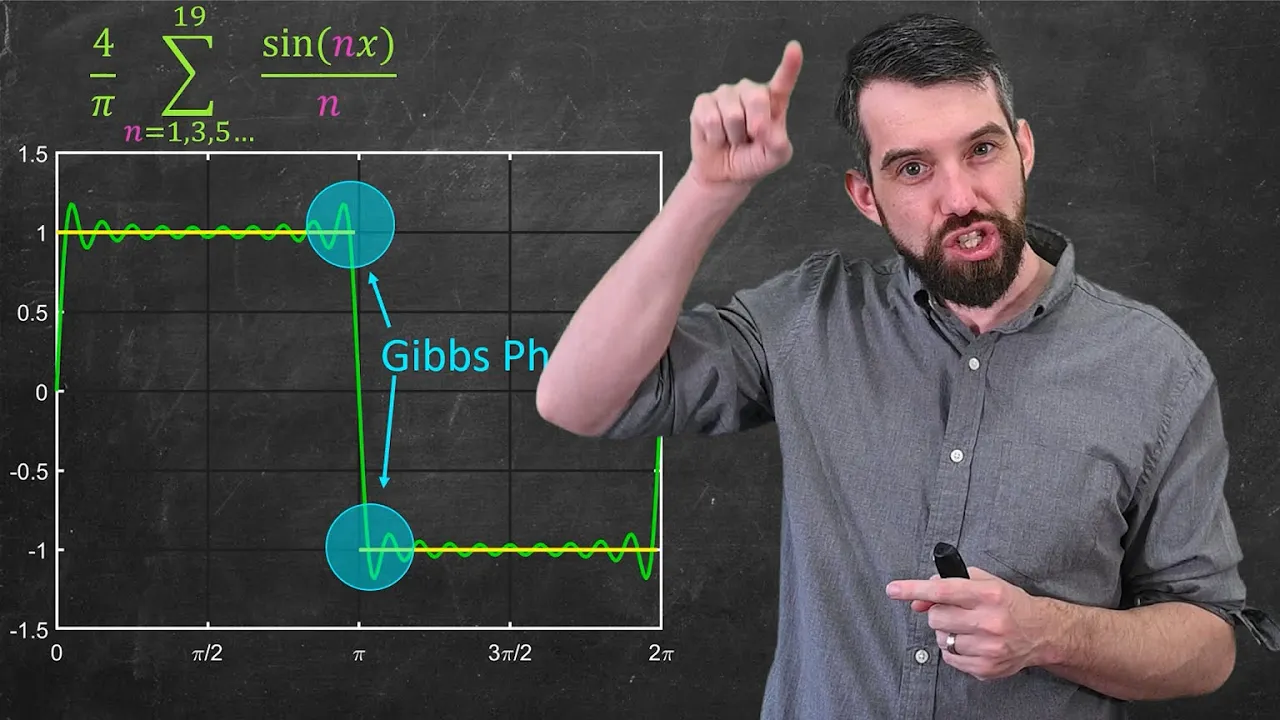
Fourier Series Introduction: The Big Idea Explained
@DrTrefor
387K views•2021-05-03

6:00
The Mathematical Impossibility of Accurate World Maps
@Vox
23.3M views•2016-12-02
Related Study Plans & Knowledge Roadmaps
Structured learning paths in Mathematics
mathematics
Tensor Calculus: Vectors to Riemann Curvature
01Mathematical Foundations: Linear Algebra & Calculus
02Covectors, Dual Spaces, and Tensor Basics
03The Metric Tensor and Index Gymnastics
+ 2 more learning modules
40h5 modules
Explore Roadmap
mathematics
Gödel's Incompleteness: Logic, Proofs & Limits
01Introduction to Formal Systems & Hilbert's Dream
02Set Theory, Cardinality, and Cantor's Diagonal Argument
03Arithmetization and Gödel Numbering
+ 2 more learning modules
14h5 modules
Explore Roadmap
mathematics
Galois Theory: Fields, Groups & Solvability
01Foundations of Abstract Algebra: Groups & Fields
02Polynomials & Field Extensions
03Splitting Fields & Symmetries
+ 2 more learning modules
24h5 modules
Explore Roadmap
mathematics
Non-Euclidean Geometry: Models & Geodesics
01Euclid's Fifth Postulate and the Birth of New Geometries
02Hyperbolic Space and the Poincaré Disk Model
03Geodesics: Defining Straight Lines in Curved Spaces
+ 2 more learning modules
15h5 modules
Explore Roadmap