













![[기본강의 122] 제21장 무역정책론 - 관세와 비관세장벽+수출보조금 효과 (P. 659-615)](https://i.ytimg.com/vi/TLPyK1Lzsq0/maxresdefault.jpg)


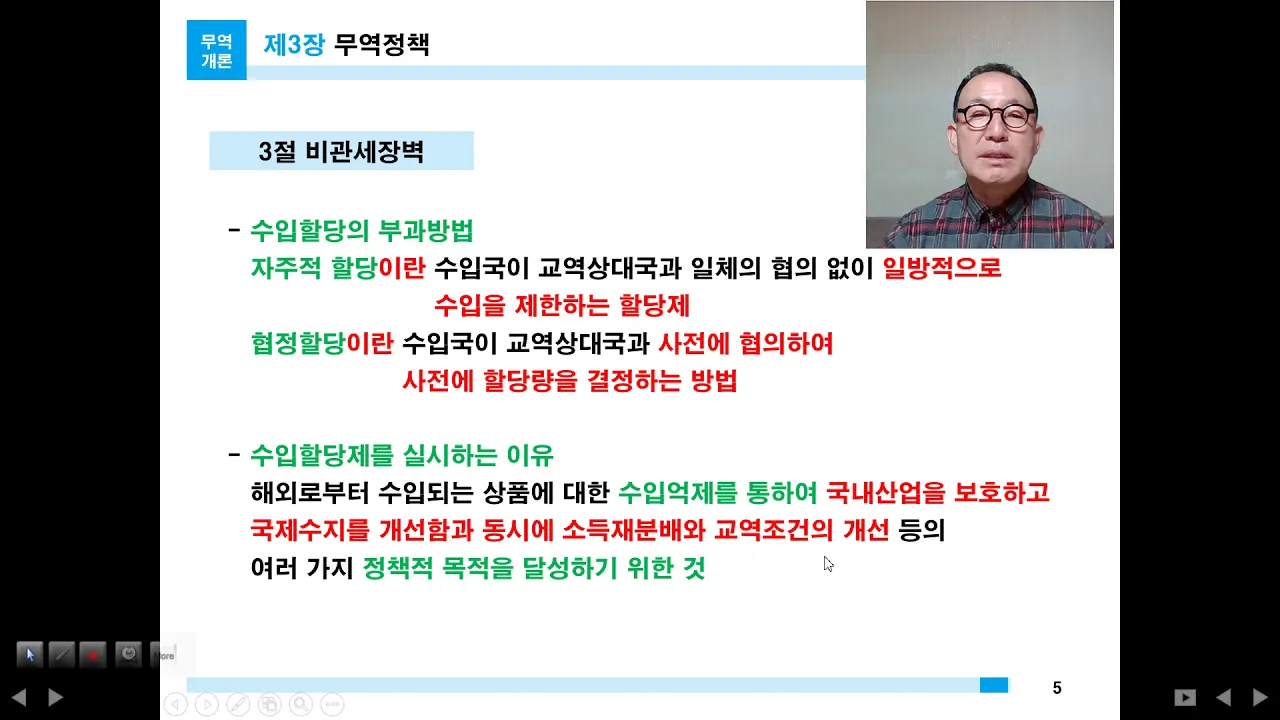





When a government imposes a tariff (a per-unit tax on imported goods), it raises the domestic price above the world price, which reduces total economic surplus compared to free trade; while some of the lost surplus becomes government revenue, other portions become deadweight loss, meaning society loses potential gains that cannot be recovered.
Effects of Tariffs on Economic Surplus | AP Microeconomics
Added:Understanding of basic Demand and Supply curves and how market equilibrium is established in a closed economy.
The concepts of Consumer Surplus (CS) and Producer Surplus (PS), including how to calculate and represent them graphically.
The concept of Allocative Efficiency and how government interventions like taxes create Deadweight Loss (DWL).
The basic model of International Trade, specifically the distinction between domestic equilibrium price and the world price (Pw).
Comparing the economic effects of Tariffs versus Import Quotas, particularly regarding who captures the quota rents.
Analyzing other protectionist trade policies, such as export subsidies and voluntary export restraints (VERs).
Exploring the political economy arguments for and against protectionism (e.g., protecting infant industries, national security, and preventing dumping).
Applying these microeconomic trade models to real-world trade agreements (like the USMCA) and the broader macroeconomic consequences of trade wars.
267.4K views3.8Klikes7:05Original Release: 2018-12-07
- [Instructor] In this video, we're gonna think about how trade affects the total economic surplus in a market, and we're also gonna think about tariffs, which are a per unit charge that a government will often put on some type of good that is being imported, usually to protect a domestic industry, but sometimes it's also to raise revenue.
So, right over here, we have a simple model for the sugar market in some country.
And we're originally initially going to assume that this country is operating in isolation.
So, this is the supply curve for the suppliers of sugar in that country, and then this is the demand curve for the people who would want to use sugar in that country.
And you can see the equilibrium price and quantity in that country.
Now, in this world, we've reviewed this in many videos, what's the total economic surplus?
Well, the total economic surplus would be defined by this triangle right over here.
It's the area above the supply curve and below the demand curve.
And we know that the part above this horizontal line at the price of three, this would be the consumer surplus; and then down here, this would be the producer surplus.
Now, let's say that this market opens up to the world, to the world price.
And let's say when it does so, it does not affect the world price itself, the world market is so large, and let's say this country's market is relatively small.
And so, the world market, let's say that sugar is trading at $1.50 per pound.
So, this right over here is the world price, $1.50 per pound, let me write it right over there.
So, this is our world, our world price.
Now, if we assume that it's opened up to this world price, what will happen?
Well, at the world price, the consumers in this market, the people who are using the sugar, well, they're going to use a lot more.
At $1.50, the place where that intersects the demand curve is out here.
So, now, what is the consumer surplus in this country, in this market?
Well, the consumer surplus in this country is now much larger.
It contains the triangle that it contained before, and then all of this area that I am now shading in.
And that has come at the cost of the producer surplus.
The producers in this country, or in this market, they are now only getting that producer of surplus right over there.
But if you look at the total economic surplus, it has definitely grown.
The total economic surplus, instead of just being that original triangle, it has now extended to include this entire area that goes all the way out there.
And you could see that that completely contains the previous total economic surplus, which we had right over here.
So, theoretically, when a market opens up to the world price like this, it's going to increase your total economic surplus.
And if that world price is below the equilibrium price in your isolated economy, then it's probably going to be to the benefit of the consumers, but the producers are going to lose out on some of their surplus.
Now, let's say that a government comes into power in this market, and says, hey, I've been elected by the sugar producers of this country.
I don't like this thing going on.
Our sugar producers in our country are getting hurt a lot, and they're a big voting block, so I am going to enact a tariff.
And once again, a tariff is a per unit charge, or it's oftentimes a per unit charge.
And let's say the tariff is 50 cents per pound, per pound on imported sugar.
Well, then what is the world price going to look like to the market that we're talking about?
Well then, for the consumers in this market, instead of being able to get the world price at $1.50, they would have to pay 50 cents per pound higher than that.
So, the tariff would make the price go over here.
So, in that situation, what has just happened?
Well, now, where we intersect the demand curve is a lower quantity than when we used the world price.
At the world price, we were consuming a lot of sugar in this market, and now we're going to consume a little bit less sugar.
But since, even with the tariff, our price is still lower than our previous equilibrium price, when we were operating in isolation, we're still consuming more sugar, using more sugar, demanding more sugar in this market than we were when we did not have it opened up to trade.
Now, what did this tariff do to the surpluses?
Well, the consumer surplus has now gone down relative to the free trade scenario.
We've lost this area down here.
So, now, the consumer surplus, I will shade it in this blue color.
And we have increased the domestic producer surplus.
It has increased to this, right over here.
But what about this region that we seem, that seems to no longer be there, either in the consumer or the producer surplus?
Well, some of it is the government revenue.
What's the government revenue going to be?
Well, it's going to be the amount of the tariff times the quantity.
So, the amount of the tariff is going to be that 50 cents, so that's that height right over there.
And then what's the quantity that they're getting that tariff on?
Well, this whole section right over here is the imported quantity.
This section right over here is the domestic production, and this is the imported quantity, so the imported quantity times the tariff, so this area right over here, that is going to be government revenue.
But you do have some of that total economic surplus that is just, becomes deadweight loss now.
You have this region right over here that is now deadweight loss, and this region right over here that is deadweight loss.
So, I'll leave you there.
As you can see here, that when you open up to trade, theoretically, it increases the total economic surplus.
But that could have consequences on the producers.
And actually, there's cases where it can have consequences on the users of whatever, or the people who are the buyers in this market.
And many times, a government will enact a tariff.
Now, you can see that that tariff will reduce the total economic surplus.
Some of that will go towards revenue, while other parts of it will just be deadweight loss.
Another idea that a government might sometimes do is an idea of a quota, where they're saying, hey, we just don't like the total amount of imports that are happening, so they might just put a cap on it.
I'll let you think about how you might deal with a quota and how that might also affect the economic surplus.
Up Next

7:15
Free Trade vs Autarky | Intermediate Microeconomics, No Calculus
@MattBirch
7.5K views•2019-05-02
5:07
Impact of Yuan in Indo-Russian Trade Amid Sanctions
@WION
261.9K views•2022-07-01

10:27
Keynesian Cross & Multiplier: Fiscal Policy Effects
@khanacademy
218.5K views•2012-04-05

113:18
The Age of Easy Money: Fed & Inflation | Full Documentary
@frontline
21.2M views•2023-03-15
Related Study Plans & Knowledge Roadmaps
Structured learning paths in Economics
economics
Sovereign Debt: Defaults, IMF & Restructuring
01Introduction to Sovereign Debt & Government Bonds
02Debt Sustainability & Credit Ratings
03Anatomy and History of Debt Crises
+ 2 more learning modules
12h5 modules
Explore Roadmap
economics
Market Design: Matching Theory & Gale-Shapley
01Introduction to Market Design and Price-Free Markets
02Two-Sided Matching & The Gale-Shapley Algorithm
03School Choice Systems and Mechanism Design
+ 2 more learning modules
10h5 modules
Explore Roadmap
economics
Impossible Trinity: Forex, Capital & Policy
01Introduction to Monetary Policy and Central Banking
02Exchange Rates and International Capital Flows
03The Mundell-Fleming Model
+ 2 more learning modules
8h5 modules
Explore Roadmap
economics
Healthcare Economics: Market Failures & Systems
01Introduction to Healthcare Markets and Market Failure
02Asymmetric Information and Adverse Selection
03Moral Hazard and Insurance Design
+ 2 more learning modules
12h5 modules
Explore Roadmap