


![[오디오] 이기적 유전자! 12,13장! 리처드 도킨스! 유전자와 진화에 대한 모든 것!](https://i.ytimg.com/vi/B49GcuVjJfE/maxresdefault.jpg)









![[Mikroekonomika 2] Lecture 4: Game Theory Repeated Games (Bagian 2)](https://i.ytimg.com/vi/nzm1XHlkMHE/maxresdefault.jpg)

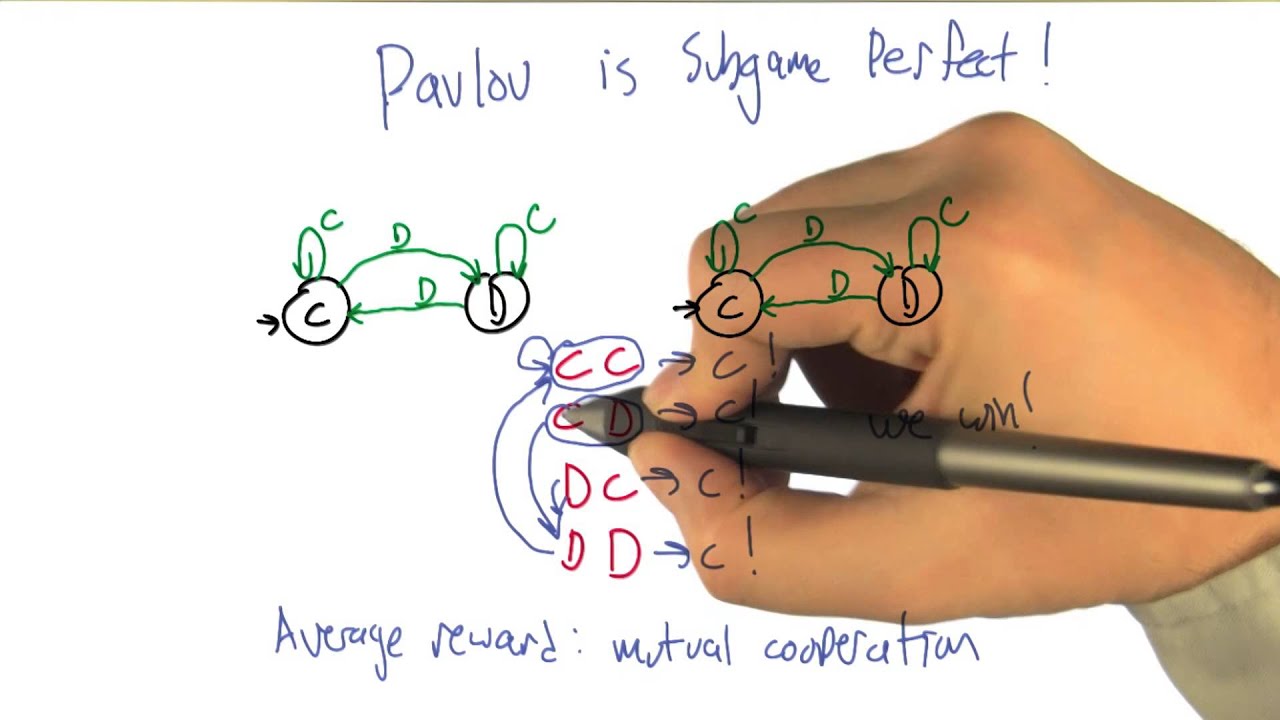



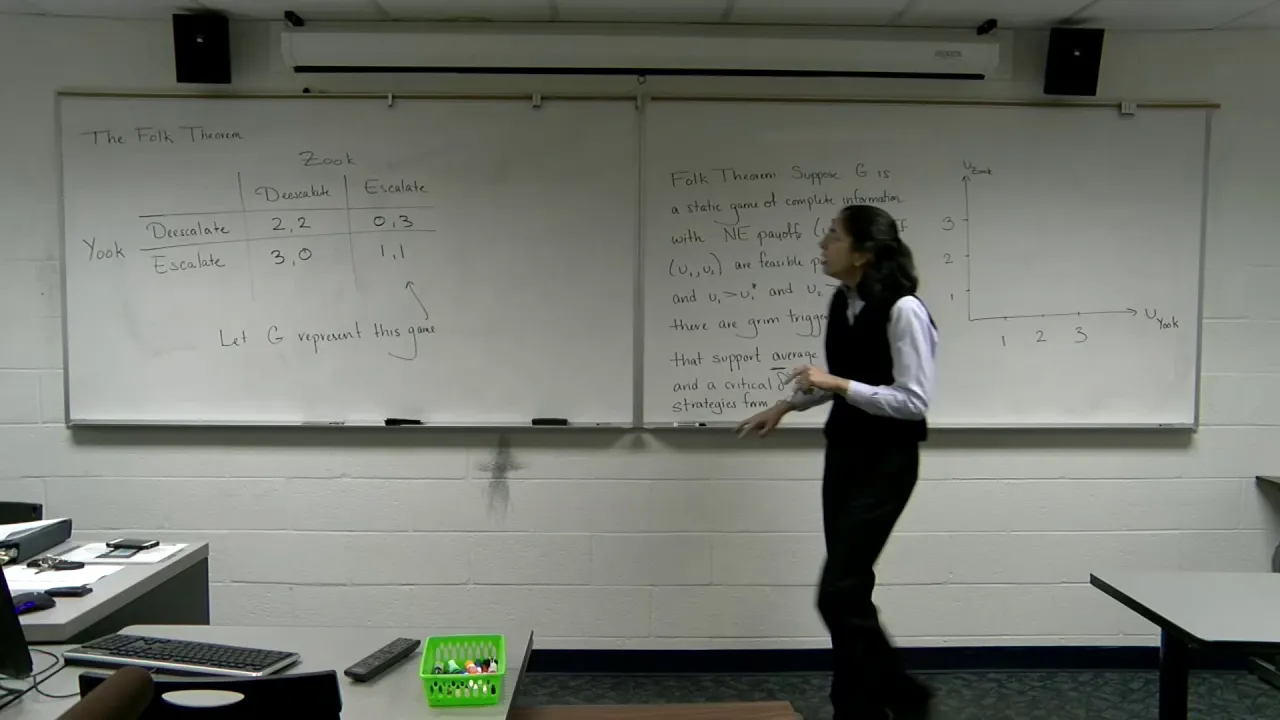











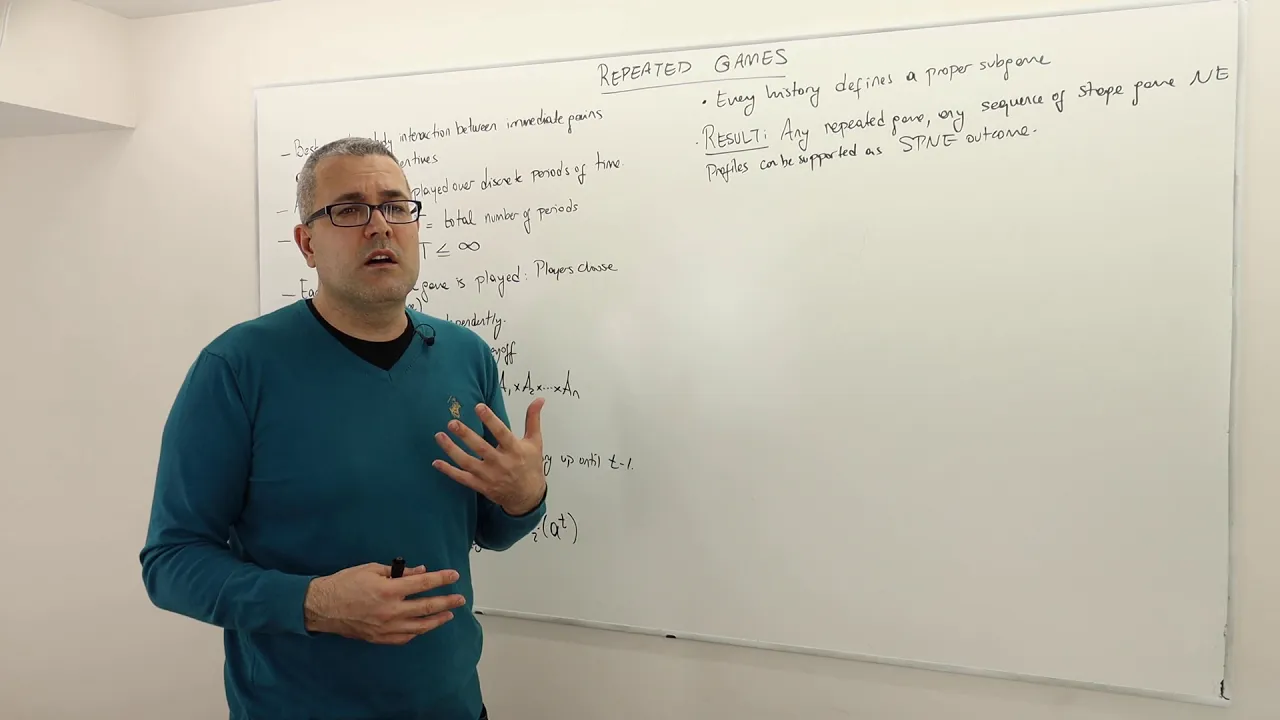
In a repeated prisoner's dilemma with uncertain termination, cooperation can be sustained through a grim trigger strategy where states begin by cooperating and continue doing so as long as all parties cooperate; however, if any state defects, all states defect permanently thereafter. This strategy works because the threat of eternal punishment creates sufficient incentive for cooperation when the probability of future interaction (p) exceeds 0.5, meaning cooperation is possible without requiring an external enforcer or knowing when the interaction will end.
Repeated Prisoner's Dilemma: How Grim Trigger Strategy Sustains Cooperation in IR
Added:The classic, one-shot Prisoner's Dilemma game, including its payoff structure and why dominant strategies lead to mutual defection.
The concept of Nash Equilibrium and how players determine optimal strategies based on the anticipated actions of others.
Fundamental concepts of International Relations (IR) theory, particularly the state of anarchy and the Security Dilemma in Realist theory.
The mathematical concept of discounting future payoffs (the discount factor), which dictates how players value future interactions versus immediate gains.
Alternative repeated game strategies, such as Tit-for-Tat and Pavlov (Win-Stay, Lose-Shift), and their comparative robustness and capacity for forgiveness.
The Folk Theorem of repeated games, which mathematically defines the conditions under which cooperative equilibria can exist in infinitely repeated interactions.
Real-world case studies of international cooperation under anarchy, such as nuclear arms control treaties, international trade agreements (WTO), and climate accords.
Evolutionary Game Theory, exploring how cooperative strategies evolve, adapt, and compete in populations over time through agent-based modeling.
43.2K views425likes11:27Original Release: 2012-07-19
hi I'm William spaniel let's learn about international relations today's topic is a grim trigger type of strategy in a repeated prisoners Lim and we'll learn all about it in this video so again we're still stuck on this big question of can future interaction Inspire cooperation today and when we talked about this in the framework of a prisoners dilemma we saw that the shadow of the future was unable to inspire cooperation if this repeated prisoners dilemma had a definite end and the stes knew about this end ahead of time what would happen is at the very end they would defect against one another and they knew that this outcome was guaranteed there was nothing else that was rational for them to do at the end of the game and because of that if you work your way back upward this defection at the end fails to allow for cooperation at the beginning it sabotages cooperation at the beginning but interactions in the real world seem to be unlikely to end in this manner so for example when the United States is trading with Mexico it doesn't appear that at some point maybe in like I don't know 2030 that trade relations with the United States and Mexico are just simply going to vanish out of thin air it seems like trade relations with Mexico and the United States are likely to continue indefinitely we don't really know when it's going to end and so the question here now becomes can States maintain cooperation when they don't know when the end of the game is and so to modelist we're going to play the prisoners zumma repeatedly again two states are going to do this but after every period another period is going to be played with probability p and then with probability 1us P the game just magically ends for example because a meteor smashes into the Earth and destroys the world and so they're unable to uh continue playing so with probability P you continue with probability one minus P the game ends and this happens every single period throughout time and we're going to imagine P to be fairly large here because the probability that just something magical happens out of nowhere and kills off the game is going to be fairly low because like the the probability a meteor crashing into the Earth is Tiny so we got to make this probability of continuation great so p is going to be fairly large in our heads a grim trigger strategy is what we would think of as a tough love strategy so the states are going to begin by cooperating they at the first period cooperate and then if at any point in the game a player has defected previously then they defect for the rest of the time so you start off by being nice to the other guy and as long as the other guy is nice to you you continue to be nice but at the moment someone stops being nice to one another then you just have defection forever so that's pretty tough love but we think that maybe just maybe that this sort of tough love is going to incentivize continued cooperation because they're going to be afraid of defection in the future so they're going to try to to continue cooperating so we're going to see whether two Grim trigger uh two Grim trigger players ever have incentive to defect on one another so to do that let's start calculating some payoffs so this is the prisoners dilemma again you're your payoffs and if we cooperate then we get a payoff of one in every period so that's just these payoffs right here cuz remember we're starting off by both cooperating in this Grim trigger strategy you start off by cooperating and then you defect if anyone is ever defected so these ones are going to be paying better than these zeros so there's at least some benefit obviously to cooperating and to calculate this payoff well if we're playing this game repeatedly then at the beginning of the game today's payoff is going to be one then what about tomorrow's payoff well you're going to continue cooperating because this is the payoff for cooperating forever well the payoff for tomorrow is the same one for the the payoff that you get for both cooperating but you only get that payoff of one with probability P because with probability one minus p a meteor smashes into the Earth and the game ends so you only get this payoff with with probability P so the actual payoff for tomorrow from the perspective of today is just P * 1 and you can go down the line like this so the day after tomorrow's payoff is still the same one for cooperation but you get that with P squ because with probability P the game ends between today and tomorrow and with probability P the game ends between tomorrow and the day after tomorrow and so if you multiply those two probabilities together then you get p^ squ and so that's what's this payoff is an expectation from today's perspective The Day After Tomorrow will only pay you p^ 2 Time 1 and again you can continue down that line the fourth day payoff is going to be P cubed Time 1 the fifth day payoff is p to the 4th Time 1 and so forth and again this is just going to keep continuing on and on and on and on so it's it's going to look like that except it's going to go on forever so we've gone all the way up to I think 20 different stages right here where you have P to the 19th Time 1 but then it keeps going on and on and on and on and on and on now you might think it well that's just a really large number and it might even be infinite so we're kind of screwed here there's nothing we can do about this mathematically this is just too large of a number for us to handle and if you think that then I have some news you're wrong and that's very nice that you're wrong because this is going to be really really helpful because there's a neat math trick that shows that this is a finite number this is just what we call an infinite geometric series I'm not going to go over the proof for an infinite geometric series if I am smart enough I will put in an annotation to the video so you can click on The annotation and learn about that if you wish but the neat math trick is that this is just equal to 1 over 1 minus P we get this one because that's the payoff for cooperation at the beginning this payoff of one right here and this one minus p that you're dividing the one by comes from the the probability of the Game ending so that's just one minus P right because p is the probability continuing 1 minus p is the probability of ending and so as long as this p is some number between zero and one which it is because the probability has to be between zero and one this thing comes out to being finite and you can just do it like that so if P were equal to 1/2 then this would just collapse into being equal to two if P were equal to.9 then this collapses to being worth 10 if this P were to be99 then this collapses to being worth 100 and so forth the larger you make p the more that this is becomes valuable and that should be intuitive because the higher the value of P the more likely you are to continue which means you should be making more an expectation so we know what the the payoff is for cooperating forever it's just one over one minus P now we need to talk about the payoff for betrayal if I defect against a grim trigger player what do I earn well I'm going to start out by doing slightly better in the first period right because the other guy is going to be naive he's going to start out by cooperating thinking that we're playing this cooperate cooperate outcome forever but instead of doing that I'm going to betray his trust and instead of earning one for the period I'm going to earn two instead so this is going to be a gain right because instead of getting this one I'm getting two this is the just general sort of tension in the prisoners dilemma where individual incentives mean that you want to defect regardless of what the other guy does and if that's a one- shot period then that's that's what happens but remember that there is some some backfire for doing this you you get a blowback I guess I should say for for defecting like this so while you do get two instead of one in the first period you're going to do worse for the rest of the time and you can see that because if I defect in the first period Then the way that my opponent responds by playing a grim trigger strategy is instead of cooperating now he's going to defect for the rest of time and so my response or my best response to him defecting for the rest of time is to defect as well and so that gives me a payoff of zero in every future period instead of a payoff of one in every future period so that's going to hurt me right I mean that should be obvious because I'm getting less every period after if I defect at the beginning than if I were to have cooperated and so if I'm just getting zero in every single other period for the rest of time we know that the payoff for everything else after that first period is just going to be zero and so the most I can earn from betrayal is therefore just going to be two it's going to be the two I get in the first period plus the zero I get from every other period for the rest of the time if you add that together you just get two and if we compare these two choices we can find out when it is beneficial for me to stick to my Grim trigger strategy given that my opponent is also playing a grim trigger strategy remember I get a payoff of one over one minus P if I play Grim trigger if I tried to betray my opponent I get two and you just need to do a little bit of math to see when cooperating is better for you uh playing the Grim trigger strategy is better for you and so you just set that being equal greater than or equal to two and you do a little bit of simplification here and you eventually get down to P is greater than or equal to2 so the important result here is that as long as this probability of continuing is high then you have incentive to cooperate and basically as long as we are going to be interacting in the future cooperation is possible so we don't end up in this situation where we're always doing the worst thing for one another and we can actually be happy with one another and moreover we can do this without the threat of a World Police so it's just the threat of future punishment that's keeping the states in line here it has nothing to do with an outside enforcer that's keeping everyone in line it's just the other two the other guy in the model each state is basically enforcing the agreement with the other state with this threat of future punishment by defecting for the rest of time and that's enough to incentivize cooperation throughout remember the critical distinction here from last video is that states must not know when the interaction will end ahead of time or this result breaks up nevertheless it's a really important result if is a classic in the literature on conflict and cooperation there's a book called The Evolution of cooperation which I will link to in the video description that talks all about this it's a great book if you have some time to spend a day reading it I would highly suggest it but in general this is a a very important result and something that you should definitely be aware of however in terms of talking specifically about international relations and where to go from here we're done with this chapter now but in the next chapter we want to talk about conflict so when we began this chapter we talked about how the repeated play assumption was not so sensible when we were talking about war mobilization where War mobilization was a Now or Never sort of thing and there is no continued game if one guy attacks the other one unsuspectedly however just observing the real world we see that Most states most of the time are not at war with another one another and we need to ask ourselves why is that the case why are we not getting that result in the model because in a prisoner's dilemma if it's just one shot everyone defects and you're at war with one another if we're talking about preventative war or sorry preemptive War as we were in the context of the cult of the offensive in World War I so what's wrong with this model why are we not getting a a result that matches the real world when we're talking about conflict and one answer or one possible reason that we're not getting that result is because these cooperate and defect strategies are extremely restrictive they're binary in their nature there is no room in between and so what we're going to eventually be doing starting in the next video is to allow states to bargain with one another and see how that affects the results and the literature that we'll be talking about in that series of videos really started in in 1995 and sort of took over the international relations literature uh ever since then in the last couple of decades so it's a really important literature and I think the next series or the next chapter is going to be the most interesting of all the chapters we're going to be doing so I hope you join me then I hope you've enjoyed this chapter and I will see you next time take care bye
Up Next

74:09
UPSC Current Affairs Analysis: The Hindu Newspaper 25 June 2023
@BYJUSIAS
45.5K views•2023-06-25

24:30
BRICS Pay and de-dollarization: A New Financial Order Emerges? | 55 chars
@DannyHaiphongYT
164.6K views•2024-10-22

7:33
Government Surveillance Methods: 10 Ways You May Be Watched
@BeAmazed
1.6M views•2017-04-09
10:19
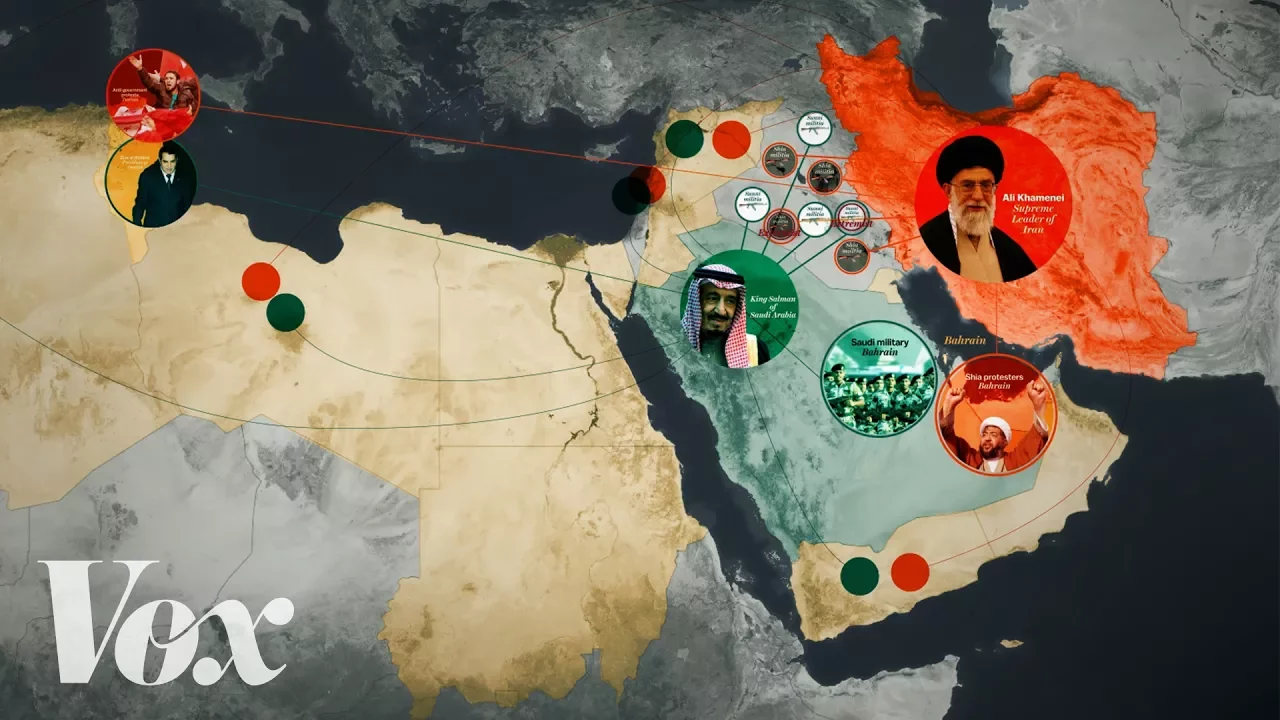
Explaining the Saudi-Iranian Proxy Conflict in the Middle East
@Vox
18.2M views•2017-07-17
Related Study Plans & Knowledge Roadmaps
Structured learning paths in Political Science
political-science
Economic Statecraft: Sanctions & Chokepoints
01Foundations of Geoeconomics and Economic Statecraft
02The Mechanics of Weaponized Interdependence
03International Sanctions: Types, Implementation, and Efficacy
+ 2 more learning modules
12h5 modules
Explore Roadmap
political-science
Central Bank Independence: Politics & Policy
01Foundations of Central Banking and Monetary Policy
02The Time Inconsistency Problem & Inflation Bias
03The Delegation Model and Designing Independence
+ 2 more learning modules
12h5 modules
Explore Roadmap
political-science
Consociationalism: Power-Sharing & Stability
01Democratic Dilemmas in Divided Societies
02Introduction to Consociational Democracy
03The Four Pillars of Consociational Design
+ 2 more learning modules
12h5 modules
Explore Roadmap
political-science
Rebel Governance: Legitimacy, Economy & State
01Foundations of Rebel Governance and Statehood
02Establishing Political Legitimacy and the Rebel Social Contract
03Wartime Economies and Rebel Resource Management
+ 2 more learning modules
14h5 modules
Explore Roadmap