
















Tokenizing securities involves converting traditional financial assets like stocks into digital tokens on blockchain networks, enabling 24/7 trading, instant settlement, and broader access to previously illiquid or restricted investments; this technology can democratize participation in high-growth sectors like AI and space exploration by allowing retail investors to gain exposure to private companies through tokenized shares, though regulatory frameworks and accreditation standards currently limit widespread adoption.
Tokenizing Stocks and Private Shares: Robinhood's Fintech Future
Added:The basics of blockchain technology, smart contracts, and how digital assets are minted and transferred.
The distinction between public equity markets (such as those traded on the NYSE or NASDAQ) and private equity/venture capital markets.
The current mechanics of clearing, settlement (e.g., T+1 settlement cycles), and custody in traditional brokerage systems.
The concept of financial democratization and fractional share trading pioneered by modern fintech platforms.
The regulatory frameworks governing security tokens, including SEC compliance, KYC/AML requirements, and the Howey Test.
The tokenization of other Real-World Assets (RWAs) such as real estate, debt, commodities, and fine art.
The integration of traditional finance (TradFi) assets into Decentralized Finance (DeFi) protocols as collateral or liquidity.
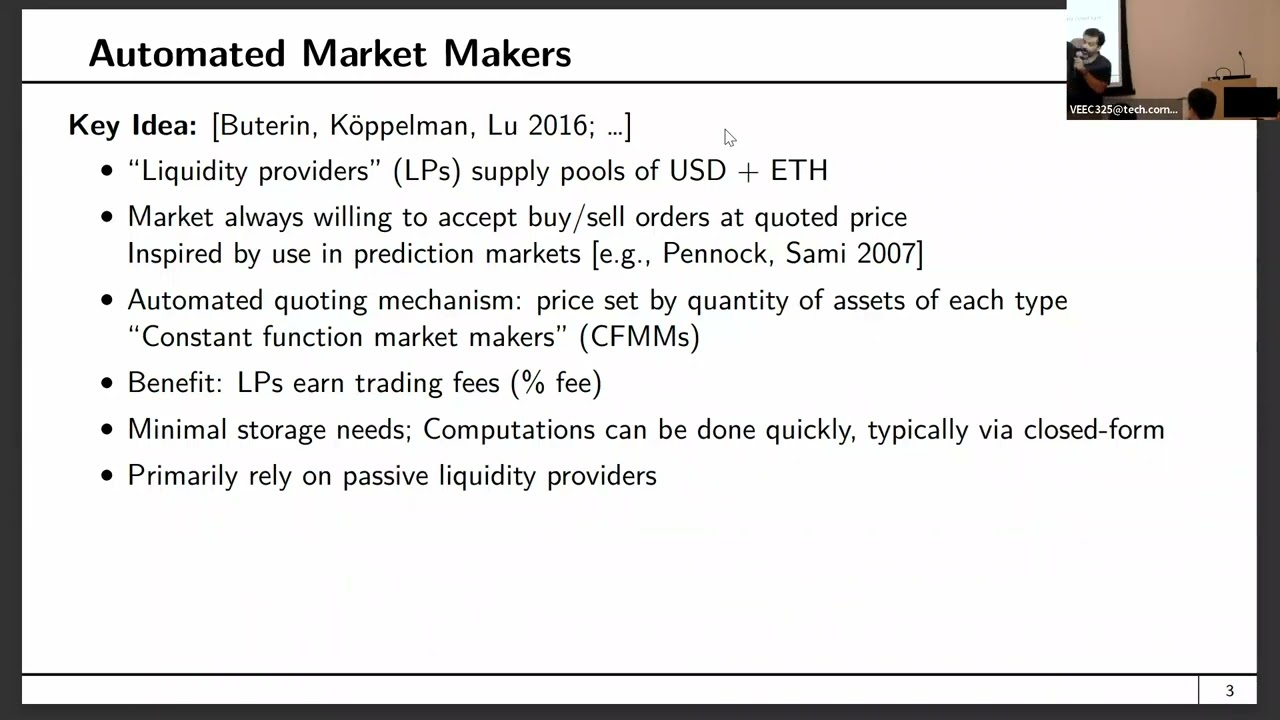
The technical and economic design of secondary markets and automated market makers (AMMs) for historically illiquid private assets.
166.6K views2.6Klikes26:09Original Release: 2025-09-15
I am Vlad Tennv, the founder of Robin Hood.
We're talking about Robin Hood. The stock's more than doubled since its last report.
>> It stock surged 180% this year after nearly doubling in 2024. The >> shares of the trading platform now up more than 400% in the last year.
>> Glad your presence there speaks volumes.
Robin Hood Gold, which hit a record 3.5 million subscribers. Most financial services get worse the more money you have, but we wanted to kind of invert that.
>> Ladies and gentlemen, please welcome Robin Hood CEO Vlad Tenner, [Music] >> my guy.
>> Good to see you, brother.
>> Good to see you.
>> You're the reason Jake Health's here. I mean >> I mean it is a great story.
>> It's so true. Jake Cal bumbles into eight shares of Robin Hood. Lad builds a hundred billion dollar companies. It's unbelievable.
>> I mean people know me for the Uber investment which four or $5 million valuation. But there's >> When do I flip that?
>> Well, yeah, it's going to take a little more. I think you got 20x left to go.
But >> wait, was JL the third or fourth investor in Robin Hood? It was $20 million valuation, but it's a good story, I think, because you hadn't launched. And we're at Antonio's Nutouse. I went for a drink with my friend Ado. He brought his college roommate, Elon. We're hanging out at Antonio's Nut House in Palo Alto. Rest in peace, Antonio.
>> Keep dropping these names. One second.
>> So Vlad comes over. We we Vlad and I knew each other a little bit. And Vlad pitches me on this idea and he says, "Um, I'm a quant." I said, "What's a quant?" He said, "Quant analysis." I said, "Yeah, I heard of it. Um, hit me with the idea." And then he goes, "Is that Elon Musk?" I said, "Yeah, just hit me with the idea. I know you got a startup." He says, "Well, I I want to get uh this generation, these millennials, these Gen Z's. I want to get them to trade stocks." I said, "Love it. They don't care about like getting a driver's license. They they don't they're still on their mom and dad's Netflix. You're going to try to get people who don't care about the future to trade stocks?"
He says, "Yeah." I said, "What's the business model?" I said, "This is the best part. We're going to let him trade for free." So I said, "Okay, let me repeat this back to you, kid. You want to get a group of people who don't have any interest in the future to trade stocks and then >> we have 30 seconds.
>> You're going to make money. You're going to make money.
>> Thank you, Vlad."
>> I said, "I'm in. I'm in."
>> Not only that, but he said, "This is probably the best idea you'll ever have."
>> I did say that to him, too. I was like, "This is the best idea. What if it works?" And here we are 10 years later.
what's worked.
>> And last week you were added to the S&P 500.
>> I was >> last week or yesterday? Two days ago.
>> It was Friday.
>> I mean, what a huge accomplishment.
>> Thank you.
>> I mean, I think I think it was cuz I rejected you for a job, right?
>> It you heard about that.
>> This is a series.
>> Thank you guys for upgrading me, by the way. I guess that that's been the best part of being added to the S&P going from just a Jason interview to to the whole squad.
>> We were doing the rehearsal yesterday and everyone wanted to do the the interview, so we said, "Let's all do it together."
>> Why don't we all get in here? Can I uh let's let's maybe start. So look, you've built an incredible business. Um there's a part of it that looks like the you know what comes after the Erades of the world etc. But there's an enormous other part of your business and there's all these emergent paths. I want to just start by double clicking in something that you announced a few months ago in France and maybe you want to talk us through it what the goal was. You got a lot of support but you got a lot of blowback as well. There was a lot of people that were like, "Wow, this is a little too disruptive tokenizing these stocks, putting them on the blockchain."
Maybe talk us through the business and then just double click on that narrow thing so we can understand what you're up to.
>> Yeah. So, we had an event in in the south of France that we called to catch a token. And the idea behind that event was we wanted to show what Robin Hood, the app, the platform would look like if it was built from the ground up on crypto technology. So what that looked like was stocks on blockchains. Uh obviously we added a bunch of cryptonnative features like pers. Um we launched in now 31 countries. And then uh we also wanted to demonstrate to the US what the power of putting traditional financial services on blockchains was.
And to me, I think a lot of people talk about 24/7 stock trading, instant settlement, these things that do have real value, but I think the most powerful thing is taking inaccessible, illlquid assets and making them available. And and so we we were actually, I think, the first to tokenize OpenAI and SpaceX and we made that available to our retail customers in Europe in the form of a giveaway. and and that was very very exciting, you know, not not without its controversy, but I felt like it was such a powerful thing.
>> How do you do it? How did you enable that?
>> It's actually very similar to uh stablecoin in a way. So, if you're a stable coin issuer, and this it's a little bit oversimplifying, but you can think of it as we keep some dollars or treasuries in a bucket over here. uh we mint and burn tokens against that bucket but back at one to one and the tokens can actually trade publicly on a variety of of blockchains. So it's just extending that token that that tokenization concept from stable coins to uh public and and private.
>> So you had to go and secure your own block of SpaceX and OpenAI stock and >> and then put it somewhere. Were the companies okay with it? Um, it depends.
Uh, I think I think that, uh, I'll say a couple of things. Um, I think a lot of people are okay with it in principle, but if you're a company and you're focused on your mission like OpenAI is, and you hear about some new thing, uh, it's kind of a distraction. So, I I don't really blame them for tokeniz tokenization or private access not being their their top priority, but I did want to be the first to tokenize open AI. So, uh >> did Sam give you a call?
>> Uh I have had a couple conversations with with Sam before and after.
>> Um cuz yeah, he's a spicy individual.
What was his take? Did he tell you to stop?
>> Um I think that actually uh I I'd like to think we get along quite well. I think he understood why we were doing it. Again, the distraction aspect when they have so much going on uh is is a real thing. But at the end of the day, >> where do you take it from here? Are you going to go and get 50, 100 of these well-known private companies? Is that the goal? Is it every private company?
How like what do you do from here to build on top of it?
>> Yeah. So, we we've been hard at work trying to figure out how to do it in the US. I think that's that's uh everyone's interested in that since the France announcement. obviously expanding what we do in Europe as well and there will probably be different mechanisms in the US and and in Europe at least for some time but uh yeah you you should expect that we go bigger and deeper into the space and have plenty of things to do in the future.
>> I'm curious what the relationship has been with the new administration. the last administration, you know, was not very pro- innovation, crypto, and now you got David uh running that specifically. How has the change in the administration changed how you look at innovation at Robin Hood? And then Sax, I'm sure you have some follow-up questions here.
>> Yeah, it's been very positive. I mean, just uh by nature of how many times I've been to Washington, uh the last administration didn't invite me to the White House once. Uh, I asked for meetings and they wouldn't even meet in person. They were all working remotely uh until I think 2023, early 2024. Um, >> it was funny how remote work kind of broke down along political lines. It's sort of like the the Republicans wanted to get back into the office.
>> I think you're referring to remote work as not working.
>> I mean, that is uh I wasn't going to say it, but uh yeah. Um, yeah, it was funny how that works out, but it's it's been very positive. I mean, last administration, we were playing a lot of defense. It was just sort of like one enforcement action and we had a wells notice and all aspects of our business were sort of under assault. So I think the most direct thing was when that went away, we had to think, okay, well there the administration now wants to work with us rather than just trying to attack us from all these angles. And for a while we didn't even know how to operate in that environment because we were just completely not used to it.
>> Yeah, you were on your >> Have you met with Elizabeth Warren?
>> Uh I have not. No, I just receive letters from time to time. But >> she really But she hates you. Well, I told me personally, she really can't take it.
>> No, the reason the reason I asked is what is the core motivation of the idea of we need to enforce, we need to kind of restrict, we need to prohibit. Is it consumer protection that the belief is that systems like yours that are more open, more accessible, more usable, more consumers will trade more and potentially lose money and therefore they have to try and play a role in restricting consumer access to these markets and these marketplaces. and that's what they're mo ultimately kind of driving towards or do you think that there's something more vested interestwise that's motivating?
>> I mean I think I think there's probably both. Certainly consumer protection is the stated reason but obviously these folks have funders and backers and lots of interests. I mean there's powerful there's powerful financial services companies in the state of Massachusetts.
So, I don't know what's happening behind the scenes, but you know, I do think the consumer protection angle is what they're kind of >> pulling out. How do you Yeah. How do you look at this type of innovation and your role at the White House to support it and to foster it while still, you know, having some rules on the field?
>> Well, I think Vlad's uh vision around tokenization is very exciting. I like you wrote a oped I think it's in the Washington Post that I thought was very good on this this topic. We now have a regulatory framework in place the Genius Act which the president signed in July that creates um the the the the set of rules for stable coins which are just tokenized dollars. And like Vlad's saying if you can tokenize a dollar you can tokenize anything. You just basically create a reserve of that asset in a secure account at a bank somewhere or a broker and then you mint tokens on a onetoone basis. So I think it's very exciting is there's no reason why we can't tokenize. Let's start with public securities. I think that's the easy case because with public companies there's already disclosure requirements. There's an abundance of information and anybody can buy a public security, right?
Because of those disclosure requirements. Um and the companies don't really care who their stockholders are, right? I mean because they know that the public owns these securities. So what we could get right away with tokenized securities, public securities is like you were saying a 24/7 global marketplace uh with instantaneous blockchain based settlement and that could be really exciting. There's no reason why trading has to be on this like 9-to-F5 exchange with all this, you know, we could enable stocks to trade as easily as you, you know, transfer a a stable coin. Now the private security part is interesting that that is I think more complicated because first of all the companies like you're saying they do care who their shareholders are and they do generally restrict those things and that's why you probably got the phone call from Sam and then the regulators care also because there's not as much public disclosure. So they there's more uh of an impetus to protect the public.
By the way I'm not saying we can't get there on private securities. Um about a decade ago a ago I founded a startup to tokenize uh real estate called Harbor and we were just way too far ahead of the curve but that that was basically to to um tokenize uh private real estate securities. So I think we can get there but I think the place to start that would be really exciting would just be like let's do the public securities first because it's easy or easier from a regulatory standpoint and then we can work our way into private.
>> Yeah, it's certainly easier technologically. I mean, we we've we've made both uh available to some extent in the EU. Um I think private could be more meaningful long term and I I'll I'll tell you why I think so. If you look at the technologies that are transforming society right now and that we feel so optimistic about over the next 5 years, it's AI and to some extent, you know, space exploration. And I think with AI in particular, there's a lot of fear right now. I mean, you talk to a random person on the street, more than half the time, they're a little bit nervous about what AI is going to do to them. Now, imagine the scenario if you know 20 to 30% of someone's net worth is in AI companies. Now, suddenly they're not fighting against this thing. They want it to succeed because if AI succeeds >> entrepreneurship as a way to let more people participate in the boom.
>> Yeah. Because I worry about the status quo. I mean these AI companies in particular are getting into valuations of hundreds and hundreds of billions with zero retail ownership. And that technology could completely disrupt you know how normal people live their lives.
And we actually expect it to drive that sort of disruption because if if you look at Cathy's presentation, you know, you're talking about negative inflation, high GDP growth rates, giant productivity improvements. I don't think you're going to get there without some significant labor force disruption.
>> Okay. So what do you need from let's say the US government broadly whether it's the SEC or whether it's maybe new legislation on Capitol Hill what what exactly do you need to bring about this revolution?
>> I think I think uh relaxation of accreditation uh standards towards more self-certification. you you mentioned uh a test. Um I think a test I consider to be one form of self-certification, but the simplest form is just someone saying, "I understand the risks. I understand I could lose 100% of what I put in this investment." You could even put like a skull and crossbones.
>> No crying in the casino.
>> Yeah, exactly.
>> You could put somebody crying in the casino. Yes.
>> Yeah.
>> Literally in the app.
>> No crying in the casino. I think >> I guess I mean the point you're making is you can't on the one hand cry for access and on the other hand cry in the casino.
>> Exactly.
>> Can't do that.
>> But the executive order on 401k access I think was a step in the right direction.
So we could also ease into it by extending that to individual retirement accounts which are great short-term vehicles and then give it to >> you need a secured interest. Why can't you just create a synthetic or like a fast contract saying if and when open AI goes public cuz you can see how many shares there are. You know what the legal registration of the corporation is. Can't you create like a synthetic contract that just trades the value of the stock and ultimately needs to settle at some point after the company goes public?
>> We can't do that currently. Uh and and OpenAI in particular is a tricky one because yeah, pick any other LLC or C or something, right? Um but yeah, we're we're continuing to look at all angles, but I I think some clarity would be helpful >> because this is the whole value of of like sorry Chimat, but like futures markets and prediction markets is you can effectively create a synthetic on some underlying without actually having ownership or a secured interest in the underlying or delivery of the commodity.
You could basically just say when this thing goes public, it's above 20 bucks a share, below 20 bucks a share on some number of days after something like that. But I mean I guess one one question for you is is that where prediction markets can take us?
>> So um the the difference within with prediction markets is you can create a prediction market but it has to have an expiry date for the contract. So for example we have a prediction market live on the platform now about which companies are going to IPO. You could do something like that. There have been prediction markets uh in the past, not on our platform, but some other platforms that make a market around the IPO price, but if you just want exposure to underlying equity in a private, I I don't think we can do that.
>> How do you think about, you know, the one criticism people have had, which is, hey, we have got a young generation.
They're frisky. They want to take all this risk. They want to bet. and your responsibility as a platform that is giving that access if you're the on-ramp the education you give and and I remember with the options and people being able to short you you came up with an incredibly elegant solution when you try to short something you give people a test you give them education in that moment before they do it so so how do you think broadly about young people getting into wagering they're playing cards you know they're they're betting on fantasy football and doing sports betting, but they also want to, you know, have their hand in crypto and in puts and calls and and and pretty sophisticated stuff. So, what's your responsibility as a platform then in introducing them to those sophisticated >> um ways of betting and investing?
>> I have a lot of thoughts actually when uh you interviewed me for a job in uh 2008, which by the way was the only it was one of two like final job interviews that I got. Most people just rejected me. I never even got a call from from uh from Google or any of the others, but uh it was either Weather Bill, later Climate Corp, uh or Optiver, where I interviewed to be an options trader. Um so I got very very close.
>> We had a math team.
>> Yeah, I got very close.
>> Was he like in the interview?
>> He you probably don't even remember.
>> You remember Alex Machulka? Yeah, I think he was uh he >> um >> I forget my recruiter's name, but that guy was great. Anyway, um and then I became an entrepreneur. So uh it might not surprise you to know that me personally uh I'm I'm sort of like adverse to control on the level of risk that I would take because my entire career path was sort of like maximally levered bet on one company which is the one that I started.
>> Um so I would be reluctant to discourage people from being entrepreneurs to doing what they want to do with their money or time. Of course, I'm I'm in favor of like reasonable things like you should it should be clear to you what you're investing in. Um but yeah, generally speaking, I think if it's available to wealthy people, high netw worth individuals, it should be made available to retail as well.
>> Let me broaden the conversation. Um it used to be historically we would have banks, we would have brokerages, we'd have payment processors, we'd have merchant acquirers. They were all disagregated. They could all be public.
they could all build thriving companies.
Now with stable coins and everything else, there's this creeping convergence.
You're issuing a credit card. Coinbase has a credit card. SoFi has a federal banking license. Stripe just launched a new L1 called Tempo.
Everybody's competing with everybody.
Tell us the scope of where you think Robin Hood goes in the next four or five years and what the financial landscape and infrastructure looks like. The Visas, the Mastercards, the JP Morgans, what roles do these companies play as you guys just become more and more ambitious and girthy and big and you know market cap and all that stuff.
>> Yeah, I think the industry goes through periods of consolidation and then divergence. I think Robin Hood has a unique advantage which is that our customers put an increasing amount of their dollars into Robin Hood. So what we're thinking about and and it became pretty clear to us as soon as we rolled out our second product. We kind of saw what happened. Customers spent more time on Robin Hood. The two products help each other. So for example with retirement we noticed you know the big question was well if we launch retirement is it going to cannibalize the core brokerage business but what we saw was the opposite. If someone opens up a retirement account they they tend to actually increase the amount they put in their individual account and we saw that again with the credit card. If they're a credit card primary user top of wallet they actually put more money into into Robin Hood. So then that gets us to a future where we ask ourselves, can we be your comprehensive financial platform? Can you put your direct deposit into Robin Hood? Can you put all of your money into Robin Hood? Can you get to gold subscriber premium status as soon as possible? And then can we get all of your family members onto Robin Hood as well and your kids? So yeah, I don't think anyone's really thinking about it from that angle, but I think that there's going to be over 130 trillion that changes hands from silent generation and baby boomers to younger people. And and I think Robin Hood's actually very well positioned to be one of the, if not the number one primary institution that benefits from that transfer. We've got over a quarter trillion assets on the platform already, which seems like a a big number, but it's actually just a drop in the bucket compared to what's going to happen.
>> Where do you see the JP Morgans and the V Mastercards and Visas? How do they compete with an elegant product with hundreds of millions of users that just, you know, the product velocity that you have, the risk you're willing to take?
>> Yeah. I mean, I think that uh if if you think about an incumbent, they have certain benefits. They're like very muscular from a regulatory standpoint.
Like they know how to deal with regulators. They've got global scale.
They've got, you know, tens, hundreds of millions of customers, lots of assets.
But the disadvantage is that they're sometimes slow to adopt new technologies. They don't have the best engineering teams. They can't move very fast. Um, and they they can't hire the best talent. And and so I think that we don't have those downsides. We have great talent. We move really quickly. We use the best technology. We haven't been super acquisitive historically, even though we're doing more. And that prevents us from being bogged down by these like massive integration things that take multiple years. Um, and so it's a question of can we get the benefits of scale while also maintaining the nimleness of a technology startup.
Do you want to give the audience before we run out of time, maybe last question, but tell them about the LLM you guys are building? This is a different project for you.
>> Oh yeah.
>> Um and the goal of that and why you decided to fund that sort of outside the scope of Robin Hood.
>> Yeah. So uh he's talking about Harmonic, which is a company that I started two years ago and I'm chairman of and uh completely separate from Robin Hood. and and basically the goal there is to build what we call mathematical super intell intelligence. So this is um mathematical reasoning that is uh exceeding the capability of any individual human researcher. And we we had a pretty cool result a couple weeks ago where we announced gold medal level performance at the international math olympiad which is the biggest uh mathematics competition in the world. And and I think to my knowledge we were the only formal model.
>> You're the only formal one that got IMO gold. Yeah.
>> Yeah. So open eye and Gemini. Open eye Gemini >> uh did it with informal >> uh Gemini's in formal model got a silver last year.
>> Explain why it's going to be so critical to have a a mathematical super intelligence model.
>> Yeah. So two reasons. Um one that has to do with how these models are trained and the other which is more of a consumer painoint. The thing that we've figured out with formal is how to verify that a statement is true very precisely. And when you're doing reinforcement learning of these models, having a strong reward signal is very helpful because you can just discard all the data that's not helpful and train on the high quality like correct data. And when you're a user of these AI models, sometimes they hallucinate. Uh and and this is actually not just a consumer problem, but also an enterprise problem because basically if you're a software engineer using a coding model, your job has has become over the past couple of years, it it's turned from writing a whole bunch of high-quality code to reviewing LLM generated code and making sure that that's correct. So in a world where you've got, you know, LLMs producing thousands and thousands of pages of code, human verification just doesn't scale, particularly for backend. So we want to solve that problem.
>> Okay, give it up for David Sax's second favorite.
[Music] >> Good to see you guys.
>> Thank you. Thanks, brother.
I'll see you in Vegas.
Up Next

16:35
Asset Tokenization Studio Tutorial on Hedera for Digital Securities
@HederaHashgraph
485 views•2025-11-19

12:54
Triumph of Orthodoxy Icon: Byzantine Art & History Explained
@BenCallan
2.1K views•2024-08-06

9:49
FastAPI vs Flask vs Django: Choosing the Right Python Web Framework
@TechWithTim
302.5K views•2024-05-26

1:42
Game of Thrones Opening Credits: A Cinematic Analysis
@gameofthrones
46.3M views•2011-04-18
Related Study Plans & Knowledge Roadmaps
Structured learning paths in General & Interdisciplinary Studies
general-studies
Elevator Engineering: History, Physics & Cities
01From Hoists to Safety Brakes: The Dawn of Vertical Lift
02Hydraulic vs. Traction: The Engineering Physics of Elevators
03Modern Speed, Safety, and Algorithms
+ 2 more learning modules
12h5 modules
Explore Roadmap
general-studies
Rubber: Material Science, History & Geopolitics
01Origins of Natural Rubber & Mesoamerican History
02The Chemistry of Natural Rubber & Vulcanization
03The Geopolitics of the Rubber Boom & Colonization
+ 2 more learning modules
12h5 modules
Explore Roadmap
general-studies
Containerization: Evolution, Logistics & Trade
01Ancient Trade & Bulk Cargo: Amphorae to Barrels
02The Industrial Revolution & Cardboard Packaging
03The Containerization Revolution: Malcom McLean
+ 2 more learning modules
12h5 modules
Explore Roadmap
general-studies
Textile Tech: Evolution, Labor & Global Impact
01Pre-Industrial Textiles: Handloom & Cottage Industry
02Mechanization: The Spinning Jenny to the Power Loom
03The Factory System & Global Labor Transformation
+ 2 more learning modules
10h5 modules
Explore Roadmap