


























The Planck length (approximately 10^-35 meters) is a fundamental scale derived from three universal constants—Planck's constant, the speed of light, and Newton's gravitational constant—that represents the boundary where quantum mechanics, general relativity, and thermodynamics converge; this scale is crucial because it determines the maximum information capacity of black holes (equal to their event horizon area in square Planck units) and sets a fundamental limit on observation, as attempting to probe smaller scales creates black holes that obscure rather than reveal structure, while also determining stellar stability through quantum mechanical effects like the Chandrasekhar limit.
Brian Cox Explains the Planck Length and Cosmic Limits
Added:The Fundamentals of Quantum Mechanics: Understanding the behavior of matter and energy at atomic scales, particularly the wave-particle duality and the Heisenberg Uncertainty Principle.
Einstein's General Theory of Relativity: Grasping how mass and energy curve spacetime, which governs gravity on cosmic scales.
Fundamental Constants of Nature: Familiarity with the speed of light (c), the gravitational constant (G), and Planck's constant (h) as the fundamental limits of physical measurement.
Subatomic Scales and Orders of Magnitude: Conceptualizing the hierarchy of scale, from the macroscopic world down to atoms, protons, quarks, and eventually the Planck length.
Quantum Gravity Unification: Exploring advanced theoretical frameworks like String Theory and Loop Quantum Gravity that seek to reconcile general relativity with quantum mechanics.
The Planck Epoch of the Early Universe: Investigating the first fraction of a second after the Big Bang (Planck time) where quantum gravitational effects dominated cosmology.
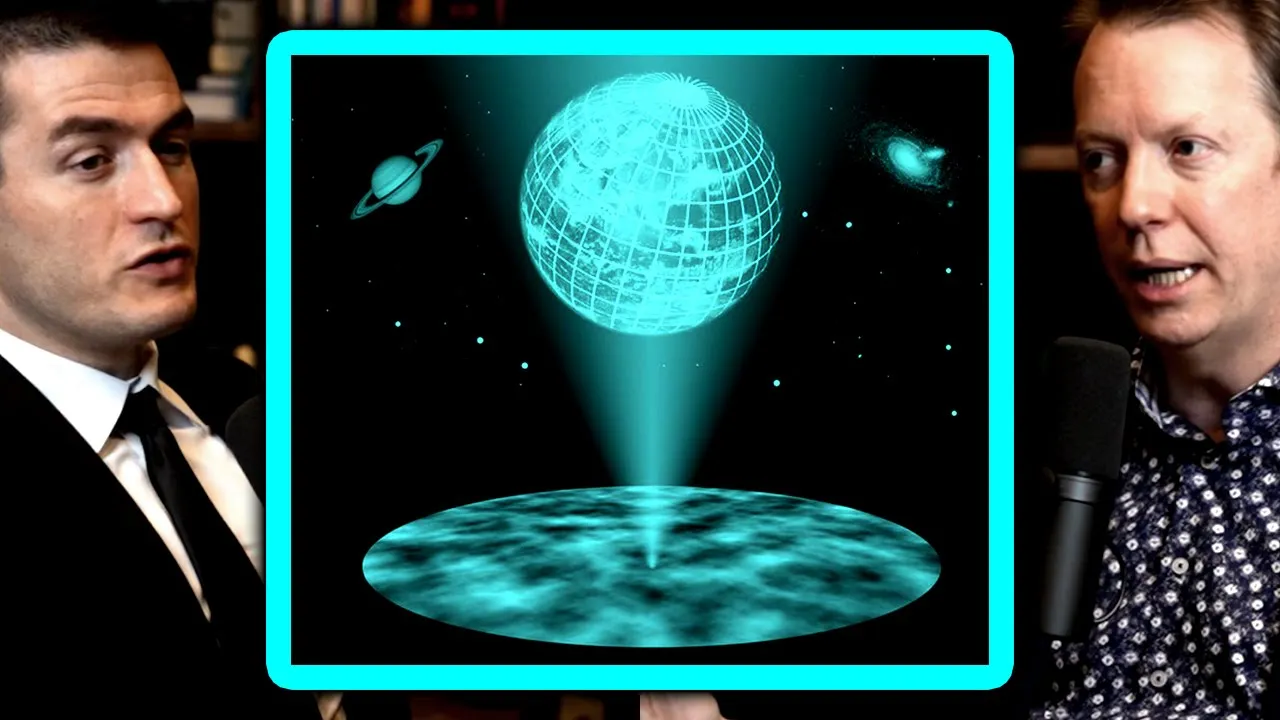
The Holographic Principle: Analyzing the theoretical proposal that our three-dimensional universe is a projection of information encoded on a distant two-dimensional boundary at the Planck scale.
Quantum Foam and Spacetime Topology: Examining the turbulent, chaotic nature of spacetime at the Planck scale, where traditional geometry is hypothesized to break down.
1.3M views25.3Klikes19:26Original Release: 2025-07-03
- I think it is legitimate to make the argument that given what we know about the universe, given the measurement we make at the strength of gravity, the measurement we make of Planck's constant and the measurement we make at the speed of light, then there is something fundamental about this very tiny length, 10 to minus 35 meters.
Just one caveat though, one caveat.
The Planck length itself does seem to be a fundamental property of the universe, but actually what it is, is a measurement.
And at the moment our measurement is given what we measure, then it's 10 to the minus 35 meters.
But you could imagine configurations of the universe where it's rather bigger than that.
- [Interviewer] What kind of insights does the Planck scale reveal?
- When we think about the size of things, of course we tend to think of the size of things with reference to ourselves.
I mean even the units of measurement that we are familiar with.
So, you know, the foot or the meter or those things, or the inch or the centimeter.
What are those things?
Ultimately, historically, they're based on properties of the human body.
So they're based on biology really.
So a meter might be the length of this kinda length and a foot is kind of that kind of length.
And that's what we did historically 'cause why would you do anything else?
But of course the history of physics tells us as we go into the 17th century, 18th century, the 19th century, 20th century, we then begin to understand that there are things that are much bigger than us and much smaller than us.
And so is the meter, for example, which is based on a property of the length of my arm or the length of my foots or whatever it is.
Is that really, is that fundamental?
Is that something that tells us something deep about the structure of nature?
Well, the answer is no.
It tells us about something.
It tells us about biology on earth and how we've evolved on this planet and how big cells are ultimately, I suppose, and how many cells you need to make an intelligent multicellular being like a human based on the fact that we live on this planet with this particular gravitational force and all those things.
So it tells you about all that stuff, but it doesn't tell you anything profound or deep about the deep structure of the universe.
And so Max Planck of Planck's constant fame and quantum mechanics fame came up with a system of units, right?
So a way of saying, well, what are the fundamental quantities as far as we can tell that really tell us something about the structure of nature?
We are looking, I suppose, for units of measurement that you could imagine if we met some aliens from some different civilization that they might be, they might not even have arms, right, or feet, but they might be very different in size and scale from us.
So what would the common language be?
Is there some units of measurement that we could all agree on?
And so Planck thought about that.
So what are the fundamental constants of nature as we understand them?
So things that really tell us about the underlying structure of the universe.
So one would be the speed of light.
So the speed of light, that would be, although we can talk about what it is in meters per second or miles per hour or whatever it is, it is a property of the universe.
Everything that is massless travels at the speed of life, this speed, whatever it is.
And if you have any mass at all, you cannot travel, you cannot accelerate to this speed, a universal speed limit.
So it's something, it's something deep about the property of the universe.
It's to do with perhaps the geometry of space time or we don't know where it comes from the particular number, but there it is the speed of light.
Another one would be the strength of the gravitational force.
So what is the force between two objects of a particular mass or in Einstein's theory, a deeper description.
How does a particular amount of matter or energy that distort the fabric of the universe?
The number that tells you about that is Newton's gravitational constant, which was first measured back in the 1780s, 1790s.
So it's the strength of gravity.
That's another one.
And then there's Planck's constant itself.
So you can say, well this is associated with quantum theory.
What is it?
So can you read many different textbooks, you'll find many different ways in.
You could say for example, that there's a fundamental limit on how accurately we can know the position of a particle and the momentum of a particle.
You can't know them both with absolute precision.
There's a fundamental limit and it's around about Planck's constant.
So the uncertainty on the measurement of the position of something multiplied by the uncertainty on the measurement of the momentum of something is always has to be greater than Planck's constant.
So it's a fundamental property of the universe.
And there are different ways of thinking about it.
Planck first introduced it in the context of the frequency or the wavelength of light emitted from hot objects, photons, what's the energy of a photon?
A packet of light.
It's Planck's constant multiplied by the frequency.
So it's a deep property of nature.
Those three numbers, those three things, speed of light, strength of gravity and Planck's constant allow you to define some distances, a particular distance called the Planck length.
I want to do it by reading it off something because I don't carry all these numbers around in my head.
It would be pointless to do that 'cause you can look them up.
So I could take Planck's constant, multiply it by the strength of gravity and divide it by the cube of the speed of light, and then take the square root of the whole thing.
So it's hG divided by c3, square root.
You'll find that that has, if you put those things in in terms of meters and kilograms and things, you'll find that has, it's a length has the dimensions of meters and it's a tiny length.
It's about 10 to the minus 35 meters point naught, naught, naught naught, naught, naught with 35 naughts one of a meter.
But that is a length that we've calculated by measuring the strength of gravity, the speed of light and Planck's constant.
So it would seem that that should be, it should have something to do with the deep structure of the universe, and indeed it does.
How important is it?
Well, lemme give you some examples of the Planck length.
So it turns out that if you ask a question, how much information in bits is stored inside a black hole, right?
What's that gotta do with all this, right?
How much?
It turns out in a calculation that was done by Jacob Bekenstein in the 1970s, it turns out that the entropy of a black hole, which is the amount of information hidden within it, is equal to the surface area of the event horizon of the black hole in square Planck lengths.
That's astonishing result.
But just think about that for a moment.
It's telling us that the amounts of information stored in a region of space, in this case a black hole, is equal to the surface area surrounding that region in square Planck lengths.
That's a bizarre result.
So it does seem that the Planck length is fundamentally important.
And here's another property of the Planck length.
So let's say we want to make an observation of some very small thing.
So how do you observe something that's very small?
Well, one way to do it is shine a light on it to see where it is, right?
That's the way that we observe things with our eyes.
So you might say, well it's tiny, so I have to shine light with a very small wavelength onto this thing to see the tiny thing.
The wavelength can't be bigger than the tiny thing, otherwise you won't see it.
So the smaller this thing is the smaller the wavelength of the light that I've gotta shine on it.
But remember quantum mechanics tells us that the smaller the wavelength of the light, the higher the energy of the photons.
So I have to start bombarding this thing with higher energy photons to see it.
What happens if you try to approach something that's a Planck length, you get so much energy in there, what you do is you form a black hole and then you put more energy in, you try to see what's going on, and the black hole grows.
And so you get to a point which is around the Planck length in size where you can't in principle try to resolve the structure of this thing, it starts to go bigger again because you make a bigger and bigger black hole and it grow.
So the Planck length does seem to be, I would say is a fundamental property of the universe.
And now the nature of that thing.
So if we talk in terms of black holes, then you have these kind of Planck size pixels in some sense, tiling the event horizon.
Does that mean that these are building blocks of space that size, it would seem so, but this is where we're at the edge of our current understanding.
I think it is legitimate to make the argument that given what we know about the universe, given the measurement we make of the strength of gravity, the measurement we make of Planck's constant and the measurement we make at the speed of light, then there is something fundamental about this very tiny length, 10 to minus 35 meters.
Just one caveat though, one caveat.
Is it important that number, ten to minus 35 meters?
There are theories and we test these theories at places like the Large Hadron Collider for example.
There are theories where, as an example, there are extra dimensions in the universe.
So not only the four dimensional space time of Einstein's theory, but more dimensions.
And the dimensions can be curled up at little places in points, or they can be the extended sheets and there are all different configurations.
If there are extra dimensions in the universe, then you find that you can, let's say that that you could see those extra dimensions, energies just around the energies that we collide particles at Large Hadron Collider.
Then the explanation for why gravity is so weak, so our measurement of Newton's gravitational constant would change at those higher energies.
It might mean that this Planck scale would drop and so the Planck length would expand and we'd see this kind of physics, much lower energies than we might otherwise have anticipated.
So I think it's worth a caveat that the Planck length itself does seem to be a fundamental property of the universe.
But actually what it is, is a measurement.
And at the moment our measurement is given what we measure, then it's 10 to minus 35 meters.
But you could imagine configurations of the universe where it's rather bigger than that.
Now the Planck length, this unimaginably small number in meters.
You might say, well how does that affect our everyday lives?
Does it come into any calculation of a thing that we can conceive of?
And there is a beautiful calculation, it's one of my favorite calculations in all of physics that was initially done by the great mathematical physicist Chandrasekhar back in the 1930s.
And it's a stunning calculation.
It's about the mass of white dwarf stars.
So let's think about a white dwarf star.
What is that?
So what is a star, first of all?
So a star is some material, it's mainly hydrogen and helium collapsing under its own gravity.
So gravity is trying to squash this thing down.
What holds it up?
Well, as the star contracts, as it forms, our sun formed around 4.5 billion years ago through this process, the gravitational collapse, that means the core heats up and it heats up, which means that the hydrogen and the helium is trickling around very fast.
And ultimately you switch on nuclear fusion reactions in the core and the fusion reactions in the case of our sun, hydrogen is fused into helium that releases energy, which creates a pressure which holds the star up.
So the stars a balancing act.
Gravity is trying to squash it, heats the core up, fusion reactions, release energy, creates a pressure, holds it up.
But of course that doesn't exist.
It can't carry on forever because the star doesn't have an infinite amount of fuel in its core.
And so ultimately we're run outta fuel and it will begin to collapse again and then stars will start to fuse heavy elements and so on.
But ultimately you could ask the question, well, when there's no more nuclear fusion can occur in the core, what happens to the star?
Does it just collapse without limit, which would be a black hole as we now understand it?
Or is there something else that can hold it up some other property of matter?
This wonderful calculation is a calculation about what happens to electrons in a collapsing star.
So it's a genuine quantum mechanical calculation.
So what happens, one of the properties of the universe, one of the fundamental ideas in quantum mechanics is called the uncertainty principle.
Heisenberg's uncertainty principle.
So it says that if you try to confine an electron into a smaller and smaller box, which means you're trying to measure its position, but you're trying to confine it and squash it down, then the product of the size of the box, the uncertainty in the position multiplied by the uncertainty and the momentum of this thing has to be greater than Planck's constant.
Fundamental property of the universe.
So as you try to, this stars collapsing and all the electrons are getting pushed together and closer and closer together.
They try to avoid each other, which is another fundamental property of quantum mechanics called the exclusion principle, which roughly speaking says they don't like to be in the same place roughly.
And so you start to squash 'em, they try to get away from each other.
They go into little boxes in the star and the boxes are shrinking and so the electrons are getting confined and so they jiggle faster.
The uncertainty on their momentum is faster and faster.
And so they start to jiggle around 'cause they're getting squashed into each other and trying to stay away from each other.
So this is pure quantum mechanics.
The uncertainty principle, the Pauli exclusion principle jiggling around.
That jiggling is like a temperature in the sense it creates a pressure which can hold the star up.
So you could ask, you could do the calculation, but what happens is I squash this down and the electrons start to jiggle more.
They make the pressure, they hold the star up.
What happens if that jiggling starts to bump into relativity?
What happens if it starts to go towards the speed of light?
They can't jiggle any faster.
And so ultimately there must be a limit on the pressure that these electrons in this quantum mechanical process can exert to hold this thing up.
So you can do the calculation and it's done, I did it in a book called the "Quantum Universe."
There's a gratuitous bit of advertising.
It's in the appendix, so you can do it.
It's not a hard calculation.
Some details are difficult.
And Chandrasekhar did this magnificent calculation.
If you do that calculation, you find that the maximum mass of a star, which is just a lump of matter held up by this process is 1.4 times the mass of our sun.
So it is astonishing calculation.
How does that relate to the fundamental properties of the universe?
'Cause all we've used there, we've used quantum mechanics and we've used the strength of gravity.
Those are the things, these are the things Planck's constant, the speed of light, Newton's gravitational constant.
Those are the things we used when we looked at the Planck units like the Planck length.
So you can use those things, strength of gravity, speed of light, Planck's constant to construct a mass.
It's called a Planck mass.
And it's rather big actually.
So whereas the Planck length is very, very tiny, the Planck mass is about the mass of a grain of dust, a mote of dust.
It's quite a large thing, but you can calculate it.
Fundamental property of the universe using Newton's gravitational constant, speed of light, Planck's constant comes into that calculation.
Turns out when you do the calculation, that roughly speaking that number, the Chandrasekhar limit is the Planck mass cubed divided by the proton mass squared.
That's what it is.
You do that calculation, put the numbers in, it's about 1.4 times the mass of the sun.
But I find it profoundly important.
It's a beautiful, beautiful result because what we're saying is that you can calculate the maximum mass of a load of stuff that can hold itself up through this quantum mechanical process.
And it just depends on these fundamental properties of the universe, strength of gravity, Planck's constant, speed of light.
That's it.
So it's a very, very beautiful calculation, but it's the best example I know of the relationship between these rather abstract quantities perhaps and something that you can look at in a telescope.
It's a beautiful piece of physics.
- [Narrator] Wanna support the channel?
Join the big think members community where you get access to videos early, ad free.
Up Next

30:58
Neutron Star Physics: Limits of Neutron Accumulation and Stellar Collapse
@PhysicsExplainedVideos
1.4M views•2025-07-05

12:53
21cm Hyperfine Transition in Neutral Hydrogen: Radio Astronomy Basics
@AaronRobertParsons
12.4K views•2011-10-13

32:32
NMR Spin Physics I: Zeeman Effect, Resonance Condition & Larmor Frequency
@nptel-indianinstituteofsci8064
2.3K views•2024-01-17

27:14
Entropy and the Second Law of Thermodynamics Explained
@veritasium
27.5M views•2023-07-01
Related Study Plans & Knowledge Roadmaps
Structured learning paths in Physics
physics
Nuclear Physics (Decay, Fission & Reactors)
01Atomic Structure and the Binding Force
02Radioactive Decay and Half-Life
03Nuclear Fission Mechanics and Chain Reactions
+ 2 more learning modules
12h5 modules
Explore Roadmap
physics
Soft Matter (Polymers, Colloids & Rheology)
01Foundations of Soft Matter & Thermal Forces
02Polymer Physics and Macromolecules
03Colloids, Surfactants, and Self-Assembly
+ 2 more learning modules
38h5 modules
Explore Roadmap
physics
Analytical Mechanics: Lagrangian & Hamiltonian
01Mathematical Foundations: Calculus of Variations
02From Newtonian Mechanics to Constraint Dynamics
03The Principle of Least Action & Lagrangian Mechanics
+ 3 more learning modules
28h6 modules
Explore Roadmap
physics
General Relativity (Spacetime & Cosmology)
01Foundations of Relativity: Special Relativity
02The Geometry of Spacetime: Equivalence Principle & Curvature
03Einstein's Field Equations: The Mathematics of Gravity
+ 2 more learning modules
55h5 modules
Explore Roadmap