














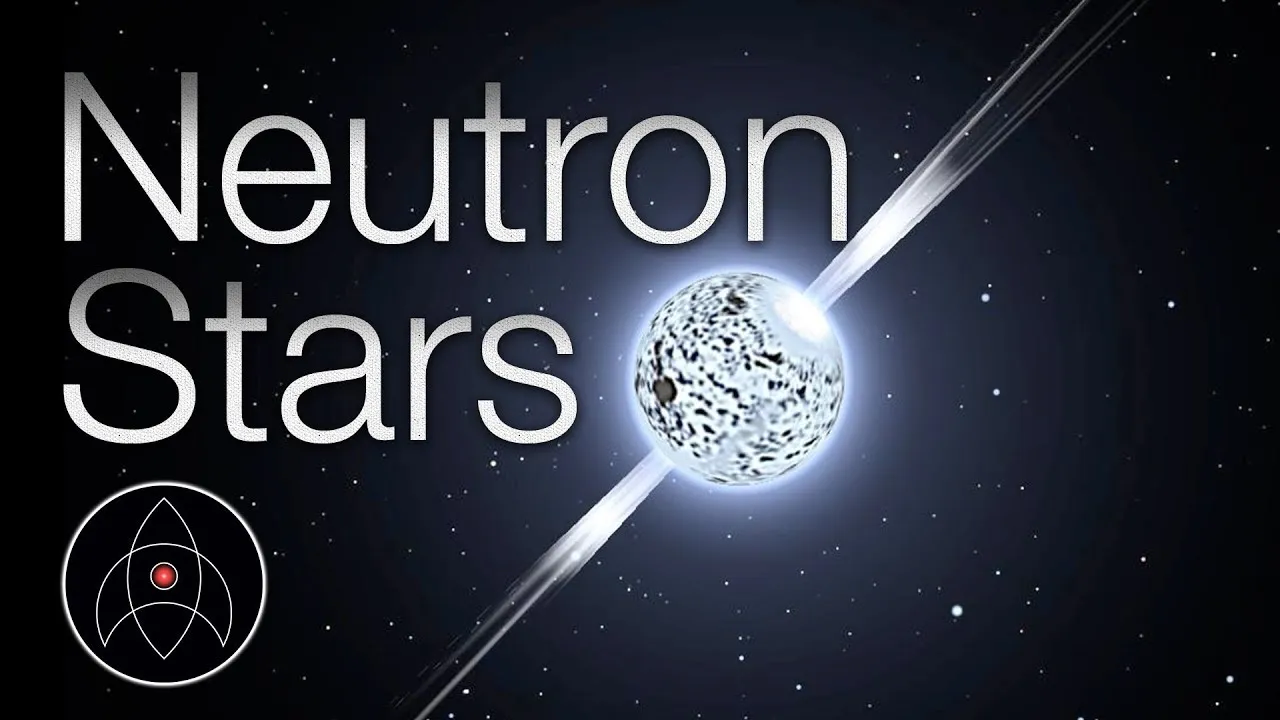






Neutron stars represent the extreme boundary where quantum mechanics and gravity reach equilibrium; they form when sufficient neutrons are packed together at nuclear densities to create gravitational binding energy exceeding nuclear binding energy (estimated minimum mass ~0.1 solar masses), but cannot exceed the Tolman-Oppenheimer-Volkoff limit (~2.2-2.9 solar masses) where neutron degeneracy pressure fails against gravity, causing collapse into black holes; this narrow window enables core-collapse supernovae that disperse heavy elements essential for planetary and life formation.
Neutron Star Physics: Limits of Neutron Accumulation and Stellar Collapse
Added:The lifecycle of massive stars, including stellar nucleosynthesis and the mechanics of core-collapse supernovae.
The Pauli Exclusion Principle and quantum degeneracy pressure, particularly how it supports white dwarfs against gravity.
Fundamental nuclear physics, including beta decay, electron capture, and the role of the strong nuclear force.
Basic principles of gravitation, including escape velocity and the qualitative effects of General Relativity on massive objects.
The Tolman-Oppenheimer-Volkoff (TOV) limit and the threshold at which a neutron star collapses into a stellar-mass black hole.
The astrophysics of Pulsars and Magnetars, focusing on extreme magnetic fields and electromagnetic radiation beams.
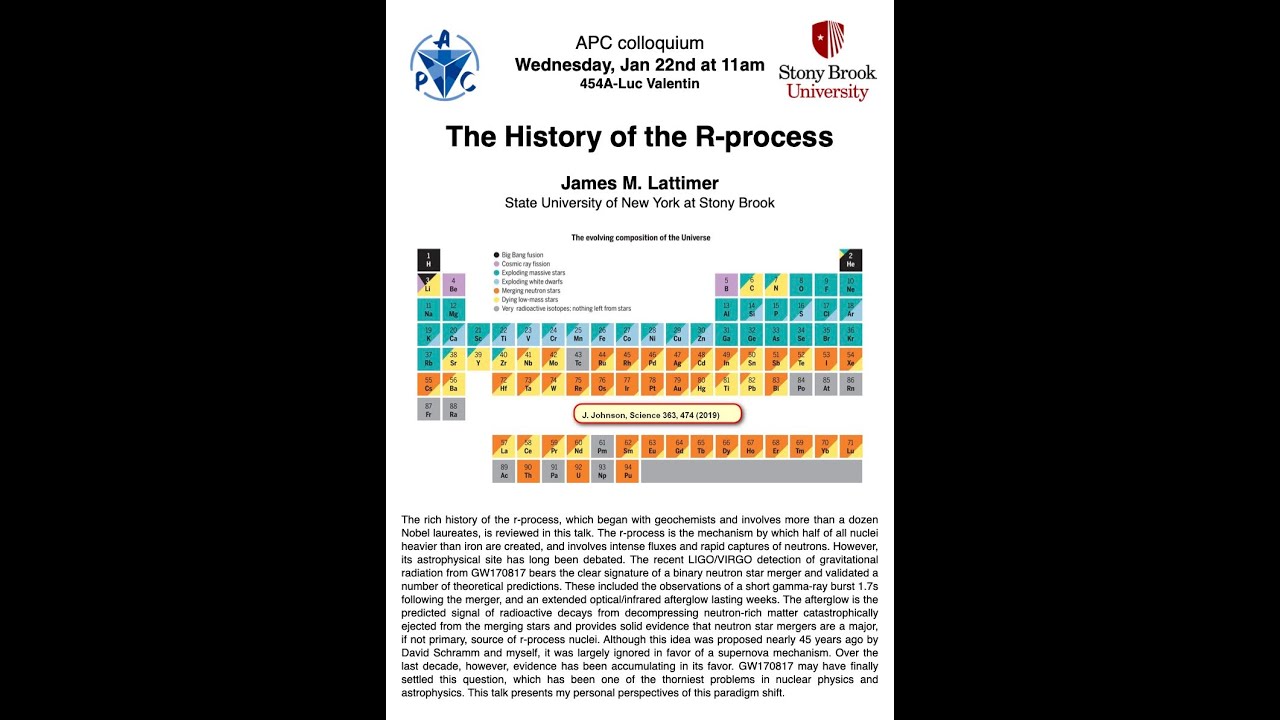
The r-process (rapid neutron capture) nucleosynthesis occurring during binary neutron star mergers (kilonovae).
The Equation of State (EoS) for ultra-dense matter and the hypothetical existence of quark matter or strange stars.
1.4M views39.7Klikes30:58Original Release: 2025-07-05
Have you ever wondered what would happen if you built an object made entirely of neutrons? Those tiny neutral particles tucked inside atomic nuclei.
For example, could you build a neutron tennis ball, a neutron football, or a mountain made of nothing but neutrons?
And could you keep going making ever larger objects? Or is there a limit?
Well, as is often the case in physics, it turns out that the answer is equal parts subtle and marvelous.
And understanding why takes us deep into the heart of quantum mechanics, nuclear forces, and gravity.
This is a story where imagination and reality collide. Where spaceime bends and the familiar laws of physics are stretched to their limits. Where quantum principles clash with gravity on a cosmic scale and something extraordinary emerges from the wreckage. So, if you're ready, buckle up and enjoy the ride.
Our story begins with a simple question.
What exactly is a neutron? Well, as you probably know, at the center of an atom lies the atomic nucleus. Neutrons are tiny neutrally charged particles that are found inside the nucleus, right alongside positively charged protons.
And because neutrons carry no electric charge, they don't electrically repel or attract one another. They don't even electrically push or pull on the protons that they sit next to.
But if neutrons don't electrically push or pull on anything, then what's their purpose? What do they actually do? Well, it turns out they play a vital role in holding the nucleus together. And this will be crucial to our story. To understand why, we need to first consider what's happening with the protons inside the nucleus. And unlike neutrons, protons are positively charged, which means they repel each other constantly.
Imagine two protons sitting one phento meter apart. That's a typical separation inside a nucleus equal to about 1 * 10 -15 m. We can calculate the repulsive force between these two protons using Kulum's law which states that the force between two charges Q1 and Q2 is proportional to the product of the charges and inversely proportional to the square of the distance between them R 2. Here epsilon not is the permitivity of free space. In the case of the two protons both q1 and q2 are equal to e which is the fundamental unit of charge.
And therefore our force equation takes the following form. And if we then plug in the numbers for the charge and distance we find a force of roughly 230 ntons.
Now this might not sound like a very large force but remember that this force is acting at a scale of 1 phtometer between two tiny little protons. It's immense. 230 ntons is equivalent to the weight of a 23 kg object on Earth. For example, imagine holding a fully loaded large suitcase ready for international travel at arms length. So when two protons are just one phento meter apart, they're pushing on each other with the same force it takes to hold up that suitcase with one arm. That is a colossal repulsive force. So given the strength of repulsion between protons, why don't atomic nuclei just fly apart?
There must be something holding them together. Maybe it's gravity. After all, gravity is an attractive force that acts between any objects with mass and protons and neutrons both have mass. So, let's check whether this is possible.
If we again consider our two protons separated by a distance of one phentometer, then we can use Newton's famous universal law of gravitation to estimate the gravitational attraction between the two protons. In this equation, m1 and m2 refer to the masses of our two objects. R represents the separation and G is Newton's gravitational constant. In the case of two protons, both have a mass of approximately 1.67 * 10 -27 kg. And so if we plug in the numbers, we find a gravitational force of roughly 1.87 * 10 - 34 newtons. Now that's not just small, it's utterly negligible.
If we compare with the electrical repulsive force between the two protons that we calculated earlier and calculate the ratio of electrostatic to gravitational force, we see that the electrostatic repulsive force is greater than the gravitational force by a factor of more than 10 ^ of 36. If that doesn't immediately whack you in the face, then try writing out the number by hand. So, it's clearly not gravity holding the nucleus together. is just far far too weak. And this brings us back to the neutrons because there is a force strong enough to overcome all that repulsion. A force that acts between all nucleons, protons and protons, protons and neutrons, neutrons and neutrons. And it's called the strong nuclear force.
And it's around 100 times stronger than the electromagnetic force, but only at extremely short distances. Unlike gravity or electromagnetism which act over long ranges, the strong force is strictly local. It only operates between immediate neighbors. And this limitation has important consequences.
Let's consider a large nucleus where the red spheres represent protons and the blue spheres represent neutrons. If we then focus in on one of the protons, then due to the short range nature of the strong nuclear force, this proton will only be significantly affected by protons and neutrons that are neighboring it. And this can be seen clearly in the diagram where those nucleons surrounding the proton have been highlighted and the proton is only tightly bound by these nucleons.
Likewise, if we focus on a different proton, it too will only be tightly held by its neighboring protons and neutrons.
And the same is true for any proton that we zoom in on. It only experiences a significant binding from the strong force due to its immediate neighbors.
Contrast that with the electrostatic repulsive force, which is a long range force, meaning that two protons on the opposite side of the nucleus can still exert a repulsive influence on each other. And this is a crucial point because if we consider a single proton, then this proton will only be bound by the strong nuclear force due to the surrounding nucleons.
Whereas that same proton will experience a repulsive force from all the other protons within the nucleus and that repulsive force scales with the number of protons while the binding from the strong nuclear force stays limited or even diminishes due to geometric crowding. Eventually the repulsion becomes too strong and the nucleus tips into instability. That's why large elements like uranium are radioactive.
They're right on the edge of falling apart.
And this is where neutrons play a remarkable role. Because neutrons are electrically neutral, they don't contribute to the repulsion at all, no matter how many you add. But they do contribute to the strong nuclear force.
They help glue the nucleus together without increasing the internal stress.
In that sense, neutrons are incredibly efficient. They add to the binding energy without adding to the electrostatic cost. As nuclei grow larger, more and more neutrons are needed to counterbalance the growing proton repulsion. Without them, the nuclei would simply tear itself apart.
Neutrons quietly and invisibly are what make large atoms possible.
So, it would seem that these magical neutrons are the perfect building blocks. You can just keep adding them and they strengthen the nucleus via the strong nuclear force without contributing any repulsive push back. No charge, no conflict, just pure binding.
It starts to look like there's no limit to how large an object you could build just from neutrons alone. They seem perfect for the job. But this is where quantum mechanics slams the door shut.
You see, neutrons are firmians, particles named after the Italian physicist Enrio Fermy. And the thing about firmians is that no two firmians can occupy the same quantum state at the same time. This rule is known as the ply exclusion principle.
Now when we apply this to a nucleus, it means neutrons are forced to occupy distinct energy levels. They can't all just pile into the lowest one. In fact, you can fit two neutrons into that lowest level. One with spin up and one with spin down. but the next pair must move to the next highest level and so on and so forth. It's a bit like hotel guests filling the lowest floors first, then moving up as rooms run out. As you keep adding neutrons, the lower levels fill up and new arrivals are pushed into higher and higher energy states. Their average energy increases and eventually it becomes too much. Once that energy exceeds the binding energy holding them in place, the strong force can no longer contain them and neutrons start to escape. So in a very real sense, it appears as if quantum mechanics builds in a limit to how many neutrons you can keep piling together.
To summarize, when dealing with a nucleus, too many protons and electrostatic repulsion dominates, but too many neutrons and power's exclusion principle drives up the energy too high.
But here's the twist. What if we didn't rely on the strong force to hold neutrons together? What if we packed so many of them into a single object at nuclear densities that gravity itself finally got strong enough to take over?
That might sound implausible given that we've already seen how weak gravity is compared to other fundamental forces.
But if we could gather enough neutrons together, then perhaps their combined mass could begin to make gravity matter.
So the key question becomes, how massive would a collection of neutrons need to be at nuclear density for gravity alone to keep them bound together?
To get an initial estimate, we'll use a beautifully simple back of the envelope argument due to Bernard Schutz from his book, Gravity from the Ground Up, that only requires high school mathematics.
It's a remarkably effective way to cut through the complexity and arrive at an answer that's strikingly close to what general relativity predicts.
Let's begin with something that is experimentally very well established. In a typical atomic nucleus, it takes about eight mega electron volts of energy to remove a nucleon, whether a proton or a neutron. This is the average binding energy per nucleon. Now, here's the clever step. We can convert that escape energy into an escape velocity. To do this, we assume that a neutron would need this much kinetic energy to escape.
And we then apply the classical kinetic energy equation/ mv^ 2. And if we then rearrange this for velocity, we find that the escape velocity will be equal to the square<unk> of 2 e / m.
Now an energy of 8 mega electron volt is equivalent to about 1.28 * 10 -12 jw.
And the mass of a neutron is roughly equal to 1.67 * 10 -27 kg. If we plug those values into our escape velocity equation, the equation gives a value of 3.92 * 10 7 m/s. That's over 10% the speed of light. Okay, so now we have an estimate for the escape velocity required. So that leads to a natural question.
How massive would an object made entirely of neutrons packed at nuclear density need to be so that its gravitational escape velocity is this high?
Or to put it another way, what mass would create such strong gravitational binding so that even a neutron with 8 mega electron volts of kinetic energy, enough to escape a typical nucleus, would still be trapped. If such an object exists, it would no longer rely on the strong nuclear force to stay together. It would now be bound together by gravity.
And that fundamentally is what defines a neutron star. A stellar corpse so dense, so massive that even individual neutrons are locked in place by gravity alone. An object made almost entirely of neutrons, held together not by the strong force, but by the crushing grip of its own gravitational field.
And here's the astonishing part. We can estimate the minimum mass needed to create such an object using nothing more than Newtonian physics.
And the strategy is simple. As we've already established, such an object must be massive enough at nuclear density such that its escape velocity is greater than about 3.9 * 10 7 m/s. The velocity a neutron would need to escape if it had 8 mega electron volts of kinetic energy.
Now for a spherical object of mass m and radius r, the escape velocity from the surface is equal to the square roo<unk> of 2 gm / r, where g is Newton's gravitational constant. Because we're imagining the object is made entirely of neutrons packed at nuclear density, we can use the equation for density, which is simply equal to the mass divided by the volume. And assuming a sphere of radius r, the volume of the sphere is equal to 4/3 p<unk> r cubed. And so our density equation takes the following form. If we then rearrange this expression for the radius, we find the following result.
The next step is to substitute this expression for r back into the escape velocity equation and we find the following result. Then after a bit of simplifying and combining of terms, we end up with the following simplified expression. Now this is a powerful result. It tells us how the escape velocity of a neutron star depends on its mass and its density. And we're assuming that density is constant and equal to the typical nuclear value. And it makes sense for a constant density object. We see that the escape velocity scales with the third power of mass. The more massive an object, the higher the escape velocity, which makes sense since higher mass means higher gravitational attraction at the surface.
Okay, so we now want to use this equation to find out the mass that would give an escape velocity of at least 3.92 * 10 7 m/s. That's the speed we said a neutron would need in order to escape.
To do this, we rearrange our equation for m. And if we then plug in the value for the escape velocity along with the typical density of a nucleus and Newton's gravitational constant, we find an estimate for the minimum mass of 3.9 * 10 28 kg.
And if we compare this with the mass of our sun, we see that this calculated minimum mass is approximately 0.02 * the mass of the sun. And this gives us a first estimate for the minimum mass of a neutron star. the mass needed so that gravity can prevent even the highest energy surface neutrons from escaping.
If it's any lighter, neutrons with 8 mega electron volts of kinetic energy could escape the gravitational pole. But notice what this estimate is based on.
It asks whether a single neutron at the very edge has enough energy to escape.
In that sense, it's a surface-based criterion, a local condition. It tells us the mass required to keep just the outermost particles gravitationally bound. That's useful and surprisingly effective, but it doesn't tell the full story. A neutron star isn't held together just by clinging to its surface. It's stable because every neutron throughout the entire star is bound by the collective pull of gravity.
So to refine our estimate, we need to ask a deeper, more global question. how much gravitational energy is binding the entire object together. This leads us to a second Newtonian approach, still a back of the envelope estimate, but now one that considers the total gravitational binding energy. If that energy exceeds the total binding energy the strong force would provide for the same mass of neutrons, then gravity has truly taken over the job. So we're still working within Newtonian physics, but improving our estimate by shifting from a surface escape argument to a whole object energy balance. So let's see where this takes us. First, we need to understand the idea of gravitational binding energy. This is the total energy you'd have to supply to completely pull apart an object that's held together by gravity. Not just a single particle, but the entire system.
For a spherical object of mass m and radius r, assuming uniform density, the total gravitational binding energy is given by 35ths * g m^2 / r. This tells us how much energy it takes to tear apart a self-gravitating object layer by layer. And it can be calculated using simple integral calculus. The factor of 3 over5 isn't arbitrary or a guess. It comes from integrating the gravitational potential energy over all the concentric shells that make up the object.
Now, just like before, we're assuming that the object is made of neutrons packed at nuclear density. So, we can relate the mass and radius via the density equation. And if we write this in terms of the radius of the sphere and then rearrange, we find the same expression that we derived earlier.
Next, we can substitute this expression for r back into our equation for the gravitational binding energy. And when we do that and simplify a bit, we find the following beautiful equation. This gives us the total energy from gravity that holds the object together. Assuming constant density, now let's compare this to the total nuclear binding energy of the same amount of matter. We know that in a typical atomic nucleus, each nucleon, proton or neutron, is bound by around 8 mega electron volts. That's the energy you'd need to pull a nucleon out of the nucleus. So given that we're assuming our object is made entirely of neutrons to estimate the total binding energy, we simply need to multiply the average binding energy by the total number of neutrons. So how many neutrons do we have?
Well, if we assume our object has mass m and is made entirely of neutrons and if the mass of a single neutron is labeled m subscript n, then the number of neutrons will be given by the following equation. And if we label the binding energy per neutron as e subscript bind, then the total nuclear binding energy can be estimated as the number of neutrons multiplied by the binding energy per neutron. And if we sub in our expression for n, we find the following relation.
The next step is to set the gravitational binding energy that we calculated earlier equal to the nuclear binding energy. And if we do that, we find the following result.
If we then rearrange and solve for m, then after a bit of work and simplification, we find the following remarkably simple result as our new estimate for the minimum mass of our gravitationally bound neutron sphere.
And if we then plug in the numbers, we find an estimated minimum mass value of 8.5 * 10 28 kg.
And this now corresponds to approximately 0.0 043 solar masses, which is over twice our previous estimate. And that makes sense. This approach considers the total energy needed to unbind the entire object, not just whether one neutron at the surface can escape. It's a more global and arguably more complete calculation.
Still, it's a Newtonian estimate. And while our back of the envelope method brings us surprisingly close, it's not the full story. This is where general relativity becomes essential. Inside a neutron star, gravity is so intense that even pressure contributes to the gravitational field. Spacetime itself curves inward, amplifying gravity's pull.
These effects are captured by the Tolman Oppenheimer Vulov equations, which describe the relativistic version of hydrostatic balance. At their core, they express how pressure, mass, and density change with radius inside a spherically symmetric star. These coupled differential equations encode the curved geometry of spacetime and the role of pressure as a source of gravity. Solving them for a given equation of state, that is a relationship between pressure and density, reveals the internal structure of a relativistic star like a neutron star.
And theoretical physicists have shown that by solving these equations, we find that the true minimum mass for a stable neutron star is closer to about 0.1 solar masses. Slightly higher than our estimate, but still remarkably close given the simplicity of our assumptions and our total neglect of relativistic effects.
And considering we use such a crude back of the envelope Newtonian approach stretching from the mass of a single neutron around 10 - 27 kg all the way up to the mass of a neutron star about 10 28 kg that's a range of more than 55 orders of magnitude to land within a factor of 2 is pretty incredible. It shows just how powerful physical intuition can be and how with nothing more than simple mathematical tools, we can begin to explore some of the most extreme objects in the universe. Okay, so we've now estimated the minimum mass required to gravitationally bind a collection of neutrons together.
But what about the other end of the scale? What's the maximum mass a neutron star can have?
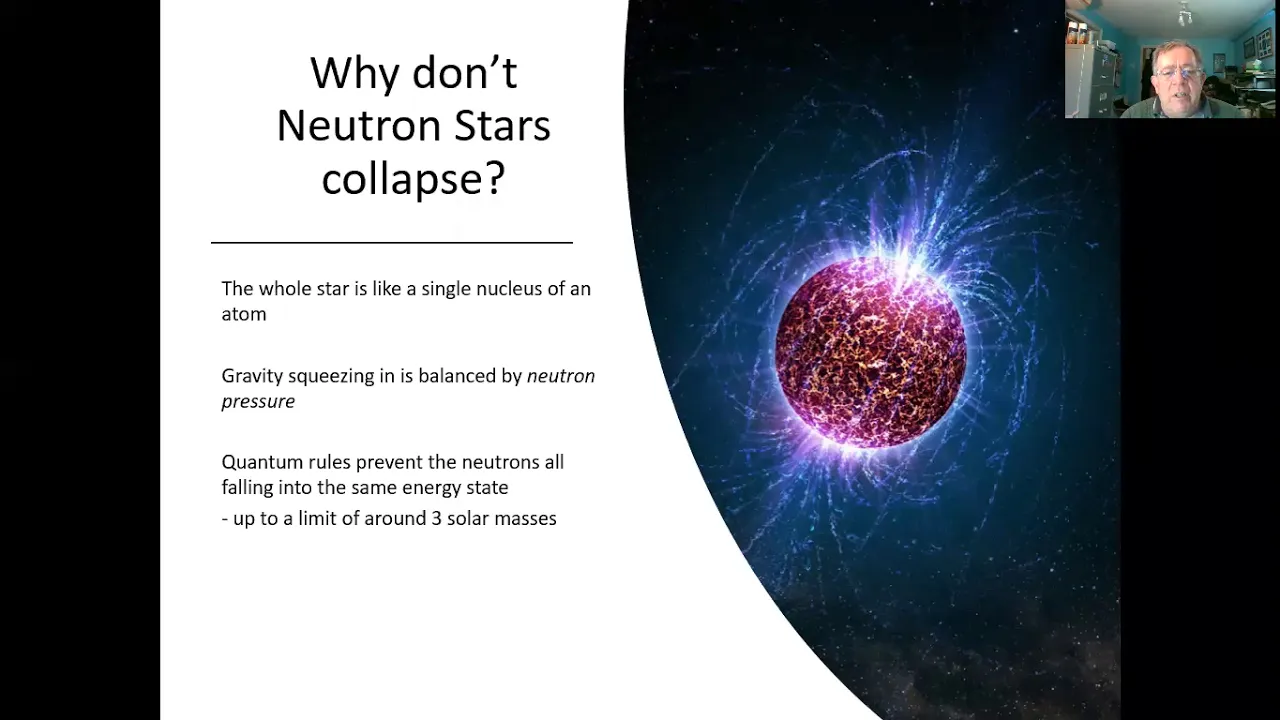
Well, that limit comes from a different kind of balance. Gravity pulling inwards versus neutron degeneracy pressure pushing outwards. Neutrons like electrons are firmians. And as we've already noted, the ply exclusion principle forbids them from occupying the same quantum state. When squeezed together, this generates an immense outward pressure. But it has a limit. As the mass increases, gravity grows stronger and eventually it overpowers even this neutron degeneracy pressure.
At this point, no stable configuration is possible. The star can no longer support itself and it will collapse into a black hole.
When general relativity is taken into account, this tipping point known as the Tolman Oppenheimer Vulv limit is estimated to lie somewhere between 2.2 2 and 2.9 solar masses depending on the exact equation of state. In other words, that's the absolute upper mass limit a neutron star can have before collapsing under its own gravity.
But what do we see in reality? After all, neutron stars aren't just theoretical constructs. They're actually out there, and we've observed plenty of them. It turns out that the majority have masses between about 1.2 2 and 2.1 solar masses with the average clustering around 1.4 solar masses. That's largely a consequence of how they form.
Something we'll explore in a moment. But for now, let's focus on this typical 1.4 solar mass neutron star.
What would such a neutron star with an average mass of 1.4 solar masses actually look like?
Well, if we assume it's made of neutrons packed at constant density somewhere between 2 and 3 * 107 kg per cub m, then we can estimate its radius using the equation we derived earlier. For a typical neutron star with a mass around 1.4 * that of the sun, this gives a radius in the range of about 13 to 15 km. In reality, neutron stars aren't constant density spheres. Their cores are far denser than their outer layers.
And when we account for that using full general relativistic models, the predicted radius comes down slightly to between 11 and 13 km. Even so, our simple estimate gets surprisingly close.
An entire star more massive than the sun squeezed into a sphere no wider than a city. That's truly mindblowing.
To emphasize this point, that's comparable to the width of Manhattan in New York. An object more massive than 450,000 Earths crushed into a space no wider than Manhattan.
But to truly grasp how small this is, you have to zoom out. Manhattan is just a dot on the map of the US. The US is just a patch on the surface of the Earth, and the Earth is a speck compared to the Sun. Yet this tiny neutron star, no wider than a city, outweighs the entire sun.
And just a teaspoon of this matter would have a mass of about 1.4 trillion kg.
And assuming a typical radius of around 13 km, the escape velocity from the surface would be roughly 1.67* 10 8 m/s, more than half the speed of light. A satellite orbiting just above the surface would travel at around 1.18 * 10 8 m/s completing a full orbit in just 0.71 milliseconds.
And these numbers have consequences.
They set physical limits on how fast the star can spin, for example, because if it rotates any faster, then material at the equator would be flung off into space. So in theory, a neutron star could spin up to around a thousand times per second without flying apart.
And indeed, we've observed such objects.
They're called pulsars, neutron stars spinning hundreds of times per second, sweeping beams of high energy radiation across the cosmos like cosmic lighouses.
Their signals reach us with astonishing precision, ticking away like celestial clocks that we can detect right here on Earth.
And everything we've described, the mass limits, the size, the escape velocity, the spin rate, all emerges from the remarkable interplay between quantum mechanics, nuclear physics, and general relativity. And here's the real twist.
Neutron stars don't form by gradually piling up neutrons.
Rather, they are born in the catastrophic deaths of massive stars in cosmic supernova explosions.
You see, at the end of their lives, stars that are more massive than about eight solar masses exhaust their nuclear fuel and develop inert iron cores.
And if the mass of the collapsing core exceeds the Chandraar limit, which is about 1.4 four solar masses, then electron degeneracy pressure is no longer sufficient to support it.
Electrons are forced into protons, creating neutrons and releasing a flood of neutrinos. This sudden stiffening halts the collapse briefly due to neutron degeneracy pressure forming a proton neutron star.
That brief resistance is critical. It triggers a bounce in the inner core and launches a shock wave outwards. Although this shock wave stalls, the vast number of escaping nutrinos deposit energy into the outer layers, reviving the shock and leading to a core collapse supernova.
This explosion is what disperses elements like carbon, oxygen, and iron into the galaxy, the ingredients of planets and life.
But this only happens because the equations of state allows neutron stars to exist with masses greater than the Chandra Secar limit. If the maximum mass of a neutron star were lower, then collapsing cores above 1.4 solar masses would continue directly into black holes. There would be no neutron star to create the bounce, no explosion, and no scattering of heavy elements.
In short, there would be no neutron stars, no core collapse supernova.
And no supernova means no dispersal of heavy elements.
And no dispersal means no planets, no chemistry, and ultimately no life.
Neutron stars are more than just exotic remnants of stellar collapse. They are essential actors in the cosmic story that led to us. Our very existence is bound to the most extreme and violent processes in the universe. And somehow that's beautiful.
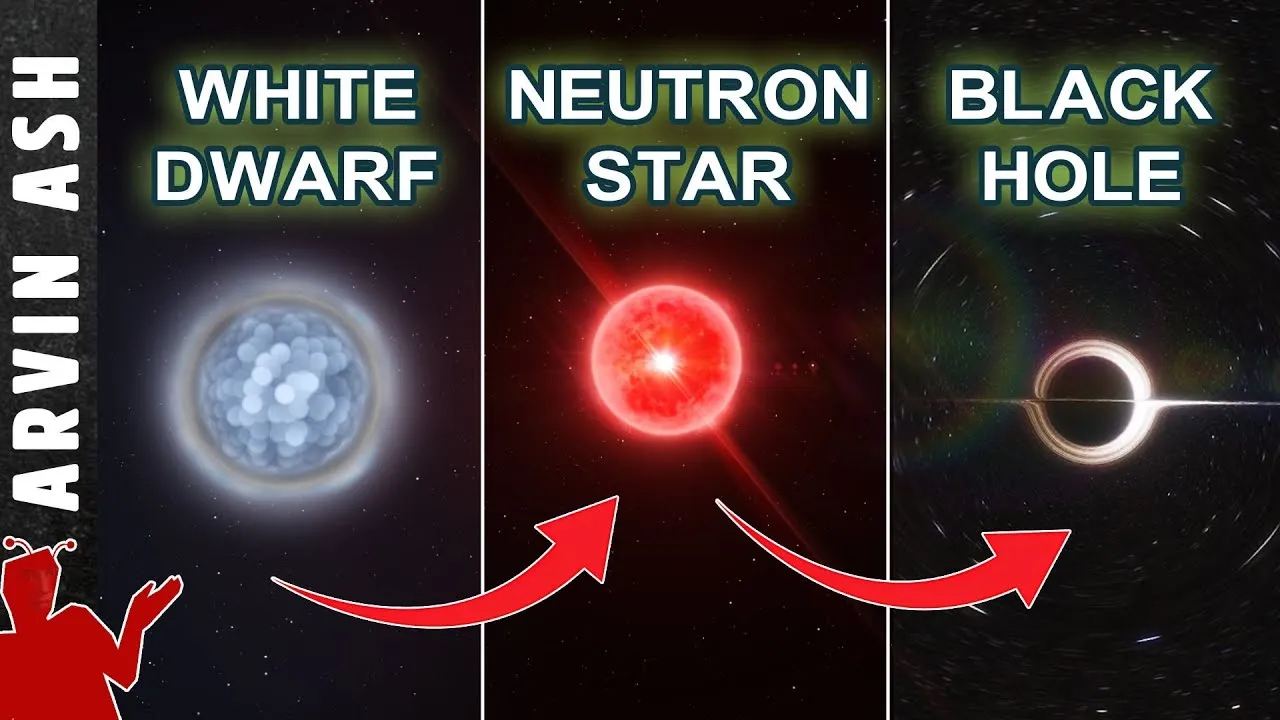
So what happens if you keep adding neutrons? Well, stack enough and gravity takes over and you get a neutron star.
Stack too many and not even neutron degeneracy pressure can resist the crushing pull of gravity and a black hole forms. But the incredible thing about our universe is that in the narrow window between too little and too much, something remarkable happens. Stars explode, elements scatter, and planets and people can form. So, thank you for watching, and until next time, goodbye.
And as always, a massive thank you to all my patrons, and a special shout out to the following who have been incredibly generous with their support.
Thank you so much. I couldn't do it without
Up Next
110:33
Neutron Star Interiors: Physics Beyond the Event Horizon
@Interplanetaryscience
1.3K views•2025-11-11

12:53
21cm Hyperfine Transition in Neutral Hydrogen: Radio Astronomy Basics
@AaronRobertParsons
12.4K views•2011-10-13

43:02
Wave Particle Duality & de Broglie Waves | Quantum Physics Guide
@PhysicsExplainedVideos
551K views•2020-08-11

27:14
Entropy and the Second Law of Thermodynamics Explained
@veritasium
27.5M views•2023-07-01
Related Study Plans & Knowledge Roadmaps
Structured learning paths in Physics
physics
Nuclear Physics (Decay, Fission & Reactors)
01Atomic Structure and the Binding Force
02Radioactive Decay and Half-Life
03Nuclear Fission Mechanics and Chain Reactions
+ 2 more learning modules
12h5 modules
Explore Roadmap
physics
Soft Matter (Polymers, Colloids & Rheology)
01Foundations of Soft Matter & Thermal Forces
02Polymer Physics and Macromolecules
03Colloids, Surfactants, and Self-Assembly
+ 2 more learning modules
38h5 modules
Explore Roadmap
physics
Analytical Mechanics: Lagrangian & Hamiltonian
01Mathematical Foundations: Calculus of Variations
02From Newtonian Mechanics to Constraint Dynamics
03The Principle of Least Action & Lagrangian Mechanics
+ 3 more learning modules
28h6 modules
Explore Roadmap
physics
General Relativity (Spacetime & Cosmology)
01Foundations of Relativity: Special Relativity
02The Geometry of Spacetime: Equivalence Principle & Curvature
03Einstein's Field Equations: The Mathematics of Gravity
+ 2 more learning modules
55h5 modules
Explore Roadmap