Under the Administrative Procedure Act, administrative agencies use two primary rulemaking processes: formal rulemaking, which involves holding hearings where parties present their cases like before a judge and is typically required by Congress for specific regulations, and informal notice-and-comment rulemaking, which requires agencies to publish a regulatory proposal in the Federal Register, solicit public comments (typically for 30-60 days, sometimes up to 120 days), evaluate feedback, and issue a final regulation that becomes effective 30 days after publication; both processes allow for judicial review where courts may remand regulations entirely or partially for reconsideration.
Formal vs. Informal Agency Rulemaking | Administrative Law
Added:Deep Dive
The separation of powers doctrine and how administrative agencies fit within the constitutional framework of the United States government.
![Where Do Administrative Agencies Fit in the Separation of Powers? [No. 86]](https://i.ytimg.com/vi/bEfnz2lUvPA/maxresdefault.jpg)
Where Do Administrative Agencies Fit in the Separation of Powers? [No. 86]
18.9K
Administrative agencies have evolved to combine legislative (rulemaking), judicial (adjudication), and executive functions in one body, creating separation of powers concerns as they increasingly operate independently from presidential control while exercising lawmaking authority that traditionally belongs to Congress.
Click to watch →

The MADNESS of Tyrannical Judges
19.4K
The separation of powers doctrine requires that each branch of government remain independent and accountable only to the people. Congress cannot restrict the president's removal authority over agencies exercising substantial executive power. When administrative agencies are accountable to the president, they do not disrupt the constitutional design. However, if an agency by design does not answer to either elected branch, it undermines the separation of powers and individual liberty protections. The framers insisted upon accountability for the exercise of executive power by lodging full responsibility in a president elected by and accountable to the people.
Click to watch →

Regulation and Rule of Law Conference, lunch presentation
1.6K
The extraordinary growth of federal administrative agencies threatens democracy, the Constitution's separation of powers, and liberty. The legitimacy of government derives from the belief that Americans participate in making laws through voting for Congress. As more rules are made by unelected officials, this legitimacy becomes questioned. The Constitution creates separated powers: Congress makes laws, the executive enforces them, and the judiciary interprets them. Neither the president nor agencies can act without congressional authority, and Congress cannot delegate lawmaking power to the executive branch. The framers created checks and balances so each branch could interfere with others' actions. In Federalist 78, Hamilton called the judiciary the guardians of the Constitution, requiring uncommon fortitude to guard against legislative invasions. The non-delegation doctrine holds that courts should invalidate laws that delegate legislative authority to the executive branch. For its first 150 years, the framers' system functioned as designed with Congress jealously guarding legislative authority. The Great Depression and New Deal changed this—Congress gave extraordinary regulatory powers to the presidency and executive branch, creating new agencies with broad authority. In 1935, the Supreme Court nullified two laws as unconstitutional delegations, but FDR's court-packing plan caused the Court to never again declare such laws unconstitutional. Beginning in 1937, FDR appointed seven new justices supporting his regulatory agenda. In 1984, Chevron v. NRDC directed courts to defer to agencies' reasonable interpretations of statutory authority, giving major boost to administrative state growth. With agencies assuming more powers, Congress enacted very general laws directing agencies to achieve goals without making difficult decisions about costs and burdens. Administrative agencies have supplant Congress as lawgivers, headed by unelected officials without inherent power to make major decisions. The failure of courts to define the line between legislation and administration has enabled agencies to become lawmakers. The judiciary's role is limited—it has no constitutional authority to intervene in national policy but preserving the Constitution's structure is its special responsibility. The Supreme Court must restore the non-delegation doctrine, invalidating laws that delegate legislative authority to the executive branch. The separation of powers is meaningless without courts defining the difference between legislative and administrative actions. Five Supreme Court justices now call themselves constitutionalists believing in separation of powers, including Justice Roberts who stated the judiciary's obligation is not only to confine itself to its proper role but to ensure other branches do so as well. The argument should be framed as democracy—the people governing versus government by an unofficial group peopling administrative agencies. The line-drawing problem between legislation and administration is severe with no current answer, but the Court must eventually develop jurisprudence about what constitutes legislation versus administration.
Click to watch →
Administrative law | Practice with MCQs | Part 1 | UGC NET 2025 | By Ishita Ma’am
1.3K
The separation of powers doctrine, systematically propounded by Montesquieu in 'The Spirit of Laws,' is considered the doctrinal barrier to administrative law development in the USA. The doctrine means one organ of government should not exercise another's functions, and no person should serve in more than one organ. The principle of check and balance and separation of powers work together through harmonious construction - if not followed, legislature and executive will interfere with each other's functions. Executive functions are classified into delegated legislation, judicial functions, and discretionary functions. This framework ensures proper governance while preventing arbitrary exercise of power.
Click to watch →
![Are Administrative Agencies a Part of Constitutional Government? [No. 86 LECTURE]](https://i.ytimg.com/vi/iTGcX3LFlps/maxresdefault.jpg)
Are Administrative Agencies a Part of Constitutional Government? [No. 86 LECTURE]
3K
Administrative agencies derive their authority entirely from statutes enacted by Congress, not from the Constitution itself; while they were originally intended as subordinates to implement presidential policies, modern agencies have evolved to actively create policies through rulemaking (which produces rules with the force of law) and adjudication (which produces decisions with the function of court judgments), raising fundamental constitutional questions about whether this expansion of agency power conflicts with the separation of powers envisioned by the Framers.
Click to watch →
Deep Dive
The purpose and origin of the Administrative Procedure Act (APA) of 1946 as the primary statutory framework governing federal agencies.
Trump WINS BIG! Supreme Court STOPS the Money Flow For DEI SCAM!
23.7K
The Administrative Procedure Act (APA) was created in 1946, right after World War II, during the Roosevelt era when many government agencies were created and were running wild, issuing rule after rule. The legislative intent behind the APA was to limit the ability of bureaucrats to cause havoc on American society. It is an anti-bureaucratic law designed to provide procedural requirements for government agencies when making rules.
Click to watch →

Policy without Process?
704
The Administrative Procedure Act (APA) of 1946 emerged from a constitutional compromise between those opposing unelected agencies' regulatory power and those supporting expert delegation. The APA constrains agencies through three mechanisms: statutory limits on authority, mandatory notice-and-comment procedures for proposed rules, and requirement that final regulations be based on the rulemaking record. Section 553 establishes baseline requirements including public notice, opportunity for comment, response to comments, and a pre-effective date delay. The APA serves as a safeguard ensuring political accountability in the administrative state while maintaining constitutional separation of powers principles.
Click to watch →

Administrative Procedure Act - Introduction and Summary
549
The Administrative Procedure Act (APA), enacted in 1946, serves as the foundational framework governing federal agency actions and judicial review. It establishes two primary procedural categories: rulemaking (divided into formal and informal processes) and adjudication (including formal hearings and informal proceedings). The APA mandates that courts review agency actions for compliance with procedural requirements, arbitrary and capricious decisions, and statutory authority. Key judicial review standards include the arbitrary and capricious test requiring agencies to examine relevant data and articulate satisfactory explanations, and the substantial evidence standard for formal rulemakings. In June 2024, the Supreme Court overruled the Chevron deference doctrine, eliminating judicial deference to agency interpretations of ambiguous statutes and returning primary responsibility to courts for statutory interpretation under Section 706 of the APA.
Click to watch →

Intro to Admin Law
39.3K
The Administrative Procedure Act of 1946 established the legal framework governing administrative agencies. It creates concepts of rulemaking, adjudication, and judicial review, outlines procedures for agency action, and dictates how administrative processes should operate. This statute formalized the relationship between administrative agencies and the three branches of government.
Click to watch →
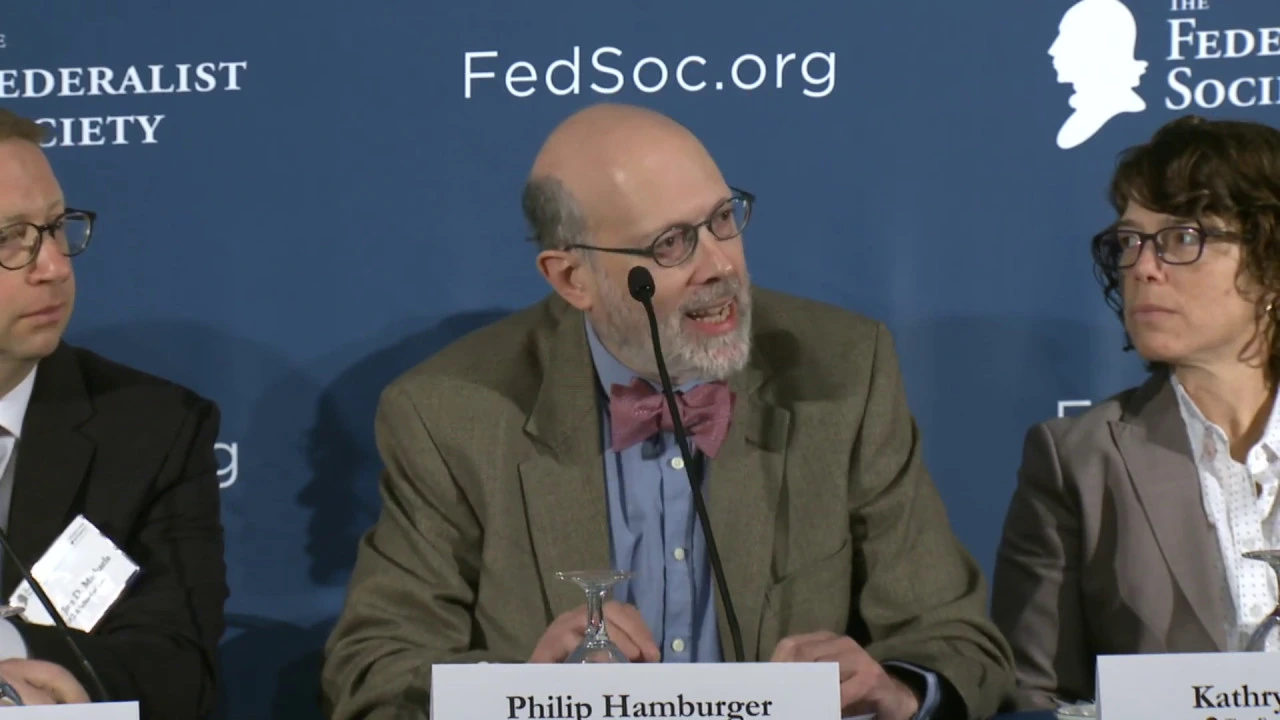
Philip Hamburger, What is Regulation For? Panel sponsored by The Federalist Society
366
The Administrative Procedure Act of 1946 emerged as a compromise between liberals and conservatives to constrain federal administrative agencies following the New Deal. It treated the New Deal as a done deal and created a framework balancing regulatory programs with private interests. The APA was designed as a peace treaty accepting the administrative state's legitimacy while preventing abuses, with key provisions applying the same standard of review to all agencies and leaving rulemaking discretion to encourage timely policy responses. However, the APA's implementation has failed—courts never fully implemented it as written, leading to systemic imbalance where Congress abdicates and the executive fills the void. When rulemaking becomes too difficult, presidents increasingly make policy themselves, lacking transparency, public participation, and expertise compared to agency rulemaking. The APA was designed to avoid totalitarianism, but its failure has entrenching administrative abuse.
Click to watch →
Deep Dive
The concept of statutory delegation of authority, specifically how Congress passes 'enabling legislation' to empower agencies to act.

Delegation in Administrative Law
1.6K
Congress creates agencies through enabling legislation that defines mandates, structure, leadership appointment methods, and authority scope. Most agency authority is executive in nature, involving law execution and program administration. Congress also delegates quasi-legislative authority (creating rules/regulations) and quasi-judicial authority (hearing disputes). Delegation occurs because agencies possess specialized expertise, administrative processes are more efficient, and administrative law judges provide subject matter expertise. However, constitutional limits exist: Congress cannot delegate too much authority, cannot delegate essential legislative or judicial functions, and cannot give one branch control over another branch's functions.
Click to watch →
Intro to the Administrative State pt 1 The Legal Backdrop
9K
Enabling statutes, also called organic or governing statutes, are laws enacted by Congress or state legislatures that create regulatory agencies and delegate authority to them. These statutes empower agencies to regulate, enforce, and run various programs while simultaneously setting the boundaries and parameters of their authority. Examples include the Endangered Species Act, Clean Air Act, National Labor Relations Act, and Federal Trade Commission Act. These statutes provide the legal mandate that gives agencies the authority to act and establishes the limits of their power.
Click to watch →

Supreme Court Overrules Chevron, Strips Administrative Agencies of Discretion
864
Congress delegates authority to administrative agencies through enabling acts, which establish the scope, mandates, and authorities of these agencies. Since Congress cannot be detailed in every aspect of legislation, it delegates rule-making power to agencies like the FDA, EPA, and IRS. This delegation allows agencies to create rules with the force of federal law, such as TSA's liquid carry-on restrictions or FDA prescription requirements.
Click to watch →
Michael Uhlmann: Agency Rule v. Congress
6.6K
Congress has delegated its legislative authority to administrative agencies by passing laws of very general nature and then delegating the task of implementing politically controversial decisions to these agencies. This creates a situation where Congress passes broad legislation while agencies handle the politically difficult aspects, which has been occurring for approximately 50 years.
Click to watch →
Administrative Law: Overview and Introductory Concepts
2.9K
Congress delegates authority to executive agencies through express or permissive language in statutes, creating a 'box' of authorized action within which agencies must operate. This delegation represents the actual authority granted versus what Congress could potentially delegate. Constitutional limitations define the outer boundaries of congressional power—the Bill of Rights restricts government action against citizens. Agencies act within statutory confines but cannot exceed these boundaries without violating constitutional protections. The EPA's authority to regulate carbon under the Clean Air Act exemplifies how agencies may push the boundaries of statutory interpretation, raising questions about whether such actions remain within delegated authority or constitute impermissible expansion.
Click to watch →
Deep Dive
The distinction between quasi-legislative functions (rulemaking) and quasi-judicial functions (adjudication) performed by agencies.

Legal Battle in Tennis & FTC Firings | Bloomberg Law
2.3K
The Supreme Court in Humphrey's Executor distinguished between purely executive functions and those requiring independence. Quasi-legislative functions involve rule-making authority, while quasi-judicial functions involve adjudication and enforcement actions. Agencies performing either type of function may warrant statutory insulation from presidential removal, whereas purely executive functions remain subject to presidential control. This distinction forms the basis for determining which agency heads require independent appointment protections.
Click to watch →

Lecture on CA Regulatory Process and Advocacy
442
State administrative entities engage in both quasi-judicial and quasi-legislative efforts. Quasi-judicial means acting like the judiciary by interpreting and enforcing laws. Quasi-legislative refers to rulemaking under the state administrative procedure act (APA), which is patterned after the federal APA and similar across all 50 states. In California, the APA is divided between the Office of Administrative Law (OAL) overseeing quasi-legislative rulemaking and the Office of Administrative Hearings (OAH) overseeing quasi-judicial administrative hearings.
Click to watch →
Administrative Law: Overview and Introductory Concepts
2.9K
Administrative agencies possess extraordinary combined powers operating across three domains: quasi-legislative (creating regulations), quasi-executive (enforcing regulations), and quasi-judicial (adjudicating disputes). This tripartite authority enables agencies to make rules, investigate violations, hold hearings, and impose penalties—all within statutory boundaries. The alcohol beverage commission example illustrates this power spectrum: investigators gather evidence, prosecutors present cases, and commissioners sit as judges determining outcomes. This concentration of authority within agencies creates both efficiency and potential for abuse, requiring careful statutory definition of agency powers and robust judicial oversight to prevent exceeding delegated authority.
Click to watch →
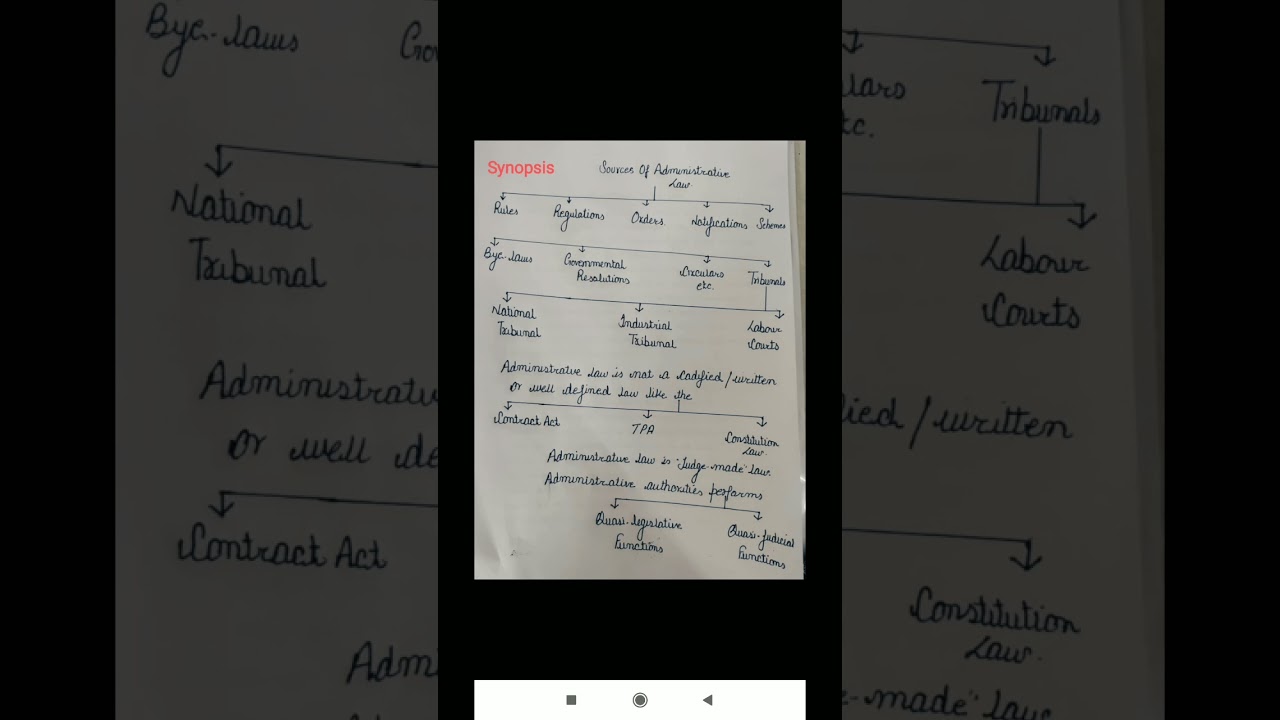
#sourcesoflaw@lawforall9129
142
Administrative authorities perform two key functions: quasi-legislative and quasi-judicial functions. Quasi-legislative functions involve rule-making and policy formulation, while quasi-judicial functions involve adjudicating disputes. This dual nature means administrative authorities operate with characteristics of both legislative and judicial bodies.
Click to watch →
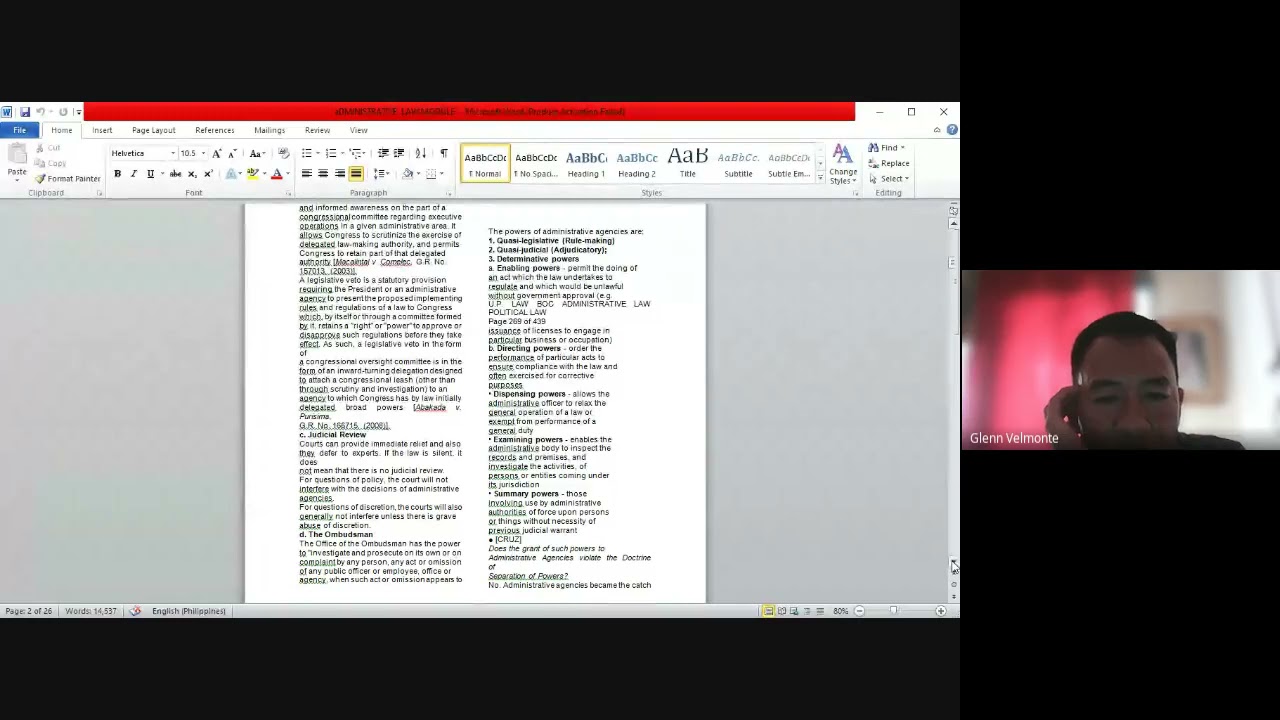
Administrative law lecture
2.4K
Administrative agencies possess quasi-legislative, quasi-judicial, enabling, dispensing, examining, and summary powers. Quasi-legislative power allows rule-making to implement laws. Quasi-judicial powers enable determinative decisions. Enabling powers permit acts that would otherwise be unlawful. Dispensing powers allow relaxation of general law operation. Examining powers enable inspection and investigation. Summary powers allow force without judicial warrant, but only within agency premises. Granting such powers may violate separation of powers by making agencies a catch basin for residual powers.
Click to watch →
Prerequisite Knowledge
- Concept 01The separation of powers doctrine and how administrative agencies fit within the constitutional framework of the United States government.
- Concept 02The purpose and origin of the Administrative Procedure Act (APA) of 1946 as the primary statutory framework governing federal agencies.
- Concept 03The concept of statutory delegation of authority, specifically how Congress passes 'enabling legislation' to empower agencies to act.
- Concept 04The distinction between quasi-legislative functions (rulemaking) and quasi-judicial functions (adjudication) performed by agencies.
Subsequent Learning
- Step 01A deep dive into the specific mechanics of 'Notice-and-Comment' rulemaking under APA Section 553, including the 'logical outgrowth' doctrine.
- Step 02The standards of judicial review for agency actions, including 'arbitrary and capricious' review under State Farm and statutory interpretation in the post-Chevron deference era.
- Step 03The role of presidential oversight in rulemaking, specifically the regulatory review process led by the Office of Information and Regulatory Affairs (OIRA).
- Step 04Alternative rulemaking methods, such as hybrid rulemaking, negotiated rulemaking ('reg-neg'), and guidance documents/interpretive rules.
- Step 05The application of the 'Major Questions Doctrine' and how courts evaluate whether an agency has exceeded its statutory rulemaking authority.
Rule-making
Implementation
Rule-making
0:09Playing Section
- 1
Covers formal adjudicatory hearings for narrow cases.
- 2
Details informal notice-and-comment process.
- 3
Explains final rule publication and effective dates.
The Neo-Formalist Defense of Formal Rulemaking
Standard administrative law scholarship views formal rulemaking as an obsolete, overly burdensome relic, celebrating informal notice-and-comment as the flexible, modern standard. However, a "neo-formalist" counterpoint argues that abandoning formal rulemaking was a mistake. Proponents of this view contend that trial-like procedures—such as cross-examination and strict evidentiary standards—are actually superior for resolving complex, highly technical factual disputes and limiting agency bias or regulatory capture. Furthermore, critics of the modern informal process argue it has become "ossified" by intensive judicial "hard look" review and executive oversight. Consequently, agencies increasingly bypass notice-and-comment altogether in favor of non-binding "guidance documents" (or "regulatory dark matter") that completely evade public participation and democratic accountability. Therefore, this counterpoint suggests that informal rulemaking is neither as efficient nor as democratic as traditionally claimed, and that formal rulemaking procedures deserve a reassessment.
Deep Dive
A deep dive into the specific mechanics of 'Notice-and-Comment' rulemaking under APA Section 553, including the 'logical outgrowth' doctrine.
APA §553(b) Notice-and-Comment Rulemaking
4.6K
Under the Administrative Procedure Act §553(b), federal agencies must generally publish notice of proposed rules in the Federal Register and provide opportunities for public comment, but this requirement does not apply to interpretive rules, general statements of policy, or rules of agency organization, procedure, or practice, nor when an agency finds good cause that notice and public procedure would be impracticable, unnecessary, or contrary to the public interest; agencies sometimes strategically characterize new policies as interpretive rules to avoid the notice-and-comment process, which also affects judicial deference standards and review availability.
Click to watch →

Pistol Brace Rule Unconstitutional Nationwide Injunction. Mock v. Garland 5th Circuit
35.9K
The Administrative Procedure Act requires agency rules to provide fair notice and avoid arbitrary enforcement. The vagueness doctrine mandates criminal laws give ordinary people adequate guidance about prohibited conduct. ATF's shift from a concrete worksheet to a discretionary six-factor test creates ambiguity. The logical outgrowth doctrine requires rules to follow naturally from proposed notices and address commenter concerns; ATF's final rule may exceed permissible interpretation given 270,000 comments criticizing the worksheet approach. The rule of lenity applies when statutory language is genuinely ambiguous, requiring courts to interpret in favor of defendants and ensuring citizens can understand and comply with laws they cannot reasonably interpret.
Click to watch →
BREAKING! Pistol Brace Decision! 5th Circuit Rules in MOCK V GARLAND
314.3K
The Administrative Procedure Act governs administrative agency rulemaking, distinguishing between interpretive rules (explanations of existing law) and legislative rules (new binding obligations). Legislative rules require notice-and-comment procedures and must satisfy the logical outgrowth test—final rules must be reasonably foreseeable from proposed rules. The Fifth Circuit ruled that the ATF's pistol brace rule was legislative in nature, violating APA requirements because the final rule bore no resemblance to the proposed Worksheet 49.99 system. The court issued a preliminary injunction requiring the district court to rule within 60 days, demonstrating how judicial review checks bureaucratic power through procedural compliance requirements.
Click to watch →

BREAKING!!! Immediate Nationwide Block of ATF Short Barreled Rifle & Pistol Brace Rule! Now What?
265.5K
The ATF argued that the proposed rulemaking provided sufficient notice to permit interested parties to comment. The ATF claimed that the Notice of Proposed Rulemaking previewed the rule's reliance on objective evidence of intent and the specific probative evidence identified in the rule. The ATF argued that the proposed rule's report card system and themes remained in the final rule, and since they were similar enough with common themes and threads, there was no violation of the APA's logical outgrowth test.
Click to watch →

Project 2025 Private Training Video: Federal Regulatory Process
4.6K
Final rules must contain: summary, statutory authority, explanation of rule and reasons, discussion of public comments and why accepted or rejected, final regulatory flexibility analysis, final paperwork reduction analysis, OMB Circular A-4 compliant cost-benefit analysis, final CFR amendment, and effective date. Courts apply the 'logical outgrowth test' - final rules must logically flow from proposed rules, or courts will find inadequate notice and strike them down. Advanced Notice of Proposed Rulemaking (ANPRM) or Requests for Information (RFI) may precede proposed rules when entering new fields or when empirical data is needed. A major rule is defined as one likely to result in an annual economic effect of $100 million or more, or significantly increase costs for consumers, industries, or government agencies. The APA defines a rule broadly as any agency statement of general or particular applicability designed to implement, interpret, or prescribe law or policy. Under Section 553, interpretive rules and general statements of policy are exempt from notice and comment requirements, though courts use inconsistent standards to determine what constitutes an interpretive rule.
Click to watch →
Deep Dive
The standards of judicial review for agency actions, including 'arbitrary and capricious' review under State Farm and statutory interpretation in the post-Chevron deference era.

16. Chevron Doctrine I
3.6K
This comprehensive section traces the evolution of judicial review standards for agency actions. It begins with APA Section 706, which establishes standards including arbitrary and capricious review (examining rational connection between agency action and its explanation), in excess of statutory jurisdiction, and short of statutory right. The section explains that unlike arbitrary review, courts are not called upon to oversee agency reasoning in highly specialized technical tasks. Chief Justice Marshall's principle from Marbury v. Madison—that it is the province of the judicial branch to say what the law is—underlies this framework. Pre-Chevron cases like NLRB v. Hearst Publications established that where agencies must initially determine specific applications of broad statutory terms, courts limit their review to whether the agency's determination has warrant in the record and a reasonable basis in law. The 1984 Chevron v. NRDC case then established the landmark two-step framework: Step One asks if Congress has spoken clearly; Step Two asks if the agency's reading of ambiguous language is reasonable. The court found the EPA's bubble rule interpretation reasonable because it struck a balance between clean air and economic growth, establishing that agency interpretations are not instantly carved in stone.
Click to watch →
Administrative Procedure Act - Introduction and Summary
549
The APA makes most final agency action judicially reviewable, with limitations including actions made unreviewable by statute or committed to agency discretion. The arbitrary and capricious standard is the default requirement requiring agencies to examine relevant data and articulate satisfactory explanations for decisions. Factors affecting review strength include agency credibility, political context, and whether agencies are changing policy. The leading case State Farm v. NLRB established that agency rules are arbitrary if they rely on unintended factors, fail to consider important aspects, offer explanations counter to evidence, or make implausible choices. Courts vary in applying this standard—some are more rigorous while others are lenient. The Chevron Doctrine (overturned in 2024) previously required courts to defer to agency interpretations of ambiguous statutes, but the Supreme Court ruled this defied the APA's command that courts decide all relevant questions of law.
Click to watch →

Trump's Military Trans Ban Is In Trouble - Here's Why It Might LOSE
430
The 1983 State Farm case established that administrative agencies cannot issue arbitrary and capricious rules. Agencies must examine relevant data and articulate a satisfactory explanation for their actions, including a rational connection between facts found and choices made. When agencies change their course by rescinding rules, they must supply reasoned analysis. Justice Rehnquist's 'elections have consequences' doctrine holds that changes in administration provide reasonable basis for agencies to reappraise program costs and benefits. Courts grant military significant discretion in policy matters, which may influence how policy changes are evaluated.
Click to watch →
Motor Vehicle Mfrs. Ass’n v. State Farm Mut. Auto. Ins. Co.
6K
In Motor Vehicle Mfrs. Ass’n v. State Farm Mut. Auto. Ins. Co. (1983), the U.S. Supreme Court established the 'hard look review' standard, requiring courts to rigorously scrutinize agency decisions under the Administrative Procedure Act's arbitrary and capricious standard. The Court unanimously held that an agency action is arbitrary and capricious if it fails to examine relevant data, entirely ignores important aspects of the problem, fails to consider important alternatives, or offers explanations contradicting the evidence. The Court specifically criticized the Department of Transportation for rescinding a passive restraint safety rule without adequately justifying why it didn't consider the obvious alternative of requiring only airbags, demonstrating that agencies must provide satisfactory explanations connecting facts to their choices.
Click to watch →

Supreme Myths: Episode 125 (feat. Professor Jennifer Mascott)
277
Administrative agency decisions fall into three categories: (1) Factual determinations - courts apply a close to jury standard; (2) Questions of law - courts interpret statutory terms and determine the scope of agency power; (3) Policy decisions - courts defer to agencies as long as they haven't acted arbitrarily or capriciously. The Supreme Court has loosened the arbitrary and capricious standard in recent years, potentially giving agencies more deference in policy decisions. The Loper Bright decision (2024) left open the question of whether Congress could amend the Administrative Procedure Act to restore the pre-Chevron system where courts defer to all reasonable interpretations of statutory language.
Click to watch →
Deep Dive
The role of presidential oversight in rulemaking, specifically the regulatory review process led by the Office of Information and Regulatory Affairs (OIRA).

What is the Office on Information and Regulatory Affairs?
20.7K
The Office of Information and Regulatory Affairs (OIRA), established during the Bush administration, is a White House agency that reviews federal regulations to assess their economic justification, having altered approximately 84% of EPA rule submissions; the review process involves extensive stakeholder meetings, with industry representatives and lobbyists participating in approximately 1,764 meetings compared to only 116 for public interest groups, raising concerns about regulatory bias toward business interests over public welfare.
Click to watch →

Rachel Augustine Potter of the University of Virginia - Reforming Congress
224
The Office of Information and Regulatory Affairs (OIRA) within the Office of Management and Budget reviews agency regulations at two stages: proposed rule and final rule. Starting with Reagan, OIRA gained authority to ensure regulations meet executive branch standards, including proper cost-benefit analysis and alignment with presidential priorities. The public comment process allows anyone to submit feedback, but most comments come from interest groups rather than individual citizens due to technical complexity. Business-oriented comments tend to be more sophisticated and influential. Career civil servants respond to comments and justify decisions in final rule preambles before OMB review.
Click to watch →

Weighing Regulations: The Metrics of White House Review
189
OIRA (Office of Information and Regulatory Affairs) serves multiple functions in regulatory review: providing a dispassionate analytical second opinion on agency actions, coordinating across agencies to provide external input on regulation impacts and alternatives, and ensuring presidential accountability. OIRA consists of approximately 50 career professionals who work closely with White House policy officials. Historically, OIRA has enforced EO 12866 requirements regarding benefit-cost analysis, though there are concerns about whether it can effectively enforce requirements when presidential priorities conflict. The effectiveness of benefit-cost analysis depends on agencies believing the president and White House leadership value it, making OIRA's position critical. Without presidential support, regulatory review becomes mere box-checking rather than genuine decision-informing.
Click to watch →

Agency Independence and Accountability to the Executive
6.9K
President Trump's February 18, 2021 Executive Order directing independent regulatory agencies to submit all proposed and final significant regulatory actions to the Office of Information and Regulatory Affairs (OIRA) within the Executive Office of the President represents a significant expansion of presidential oversight over independent agencies. This order amends Executive Order 12866 (Clinton era) to bring independent agencies under OIRA review, which previously only applied to executive branch agencies. The implications include increased presidential accountability for agency rulemaking, potential changes in how independent agencies operate, and ongoing constitutional questions about agency independence versus executive control, particularly regarding removal powers and the separation of powers doctrine.
Click to watch →
![What is OIRA Review? [No. 86]](https://i.ytimg.com/vi_webp/qC4LI6U4maY/maxresdefault.webp)
What is OIRA Review? [No. 86]
68.5K
The Office of Information and Regulatory Affairs (OIRA) conducts a three-part review of executive branch regulations: inter-agency coordination to prevent duplicative or conflicting rules, technical review of regulatory impact analysis by experts in statistics, economics, law, and policy, and alignment with presidential priorities; this review applies to cabinet departments and independent executive agencies but not to independent regulatory agencies like the SEC, which conduct less robust regulatory analyses due to lack of external accountability.
Click to watch →
Deep Dive
Alternative rulemaking methods, such as hybrid rulemaking, negotiated rulemaking ('reg-neg'), and guidance documents/interpretive rules.
Project 2025 Private Training Video: Federal Regulatory Process
4.6K
Under Section 553 of the APA, interpretive rules, general statements of policy, and rules of agency organization are exempt from notice and comment requirements. Courts use inconsistent standards to determine what constitutes an interpretive rule - some ask if rules create new rights and duties, others use four-part legal effect tests, and others distinguish between interpretive versus substantive changes. If statements are deemed non-binding, courts typically won't impose notice and comment requirements. Strategic recommendation: if proposed rules matter significantly, don't try to circumvent notice and comment by deeming rules interpretive - this gives opponents additional angles of attack in court and makes reversal by future administrations harder. Guidance documents are easier to withdraw than rules and should be systematically identified and withdrawn by incoming conservative administrations.
Click to watch →

Administrative Rulemaking: Module 3 of 5
4.5K
Congress provided another rulemaking track called negotiated rulemaking, where agencies invite interested parties to work together with agency representatives to devise new rules. This approach is suitable when there are limited identifiable interests impacted by the rule and the agency can convene a representative committee. Negotiated rulemaking increases rule acceptability and shortens finalization time. The process requires publishing notice in the Federal Register with committee details, agenda, and timetable, followed by a 30-day public comment period on the negotiation process. If the committee reaches agreement, the proposed rule proceeds through the usual notice and comment process, though agencies are not bound to adopt the negotiated proposal.
Click to watch →
Agency Rulemaking Intro
3.1K
Administrative agency rulemaking involves agencies creating regulations within their congressionally-granted authority, following procedures outlined in the Administrative Procedure Act (particularly Section 553), which distinguishes between formal rulemaking (rare and cumbersome) and informal rulemaking; courts may apply the 'hard look doctrine' to review the substantive reasonableness of regulations, while also examining whether agencies properly followed procedural requirements, and agencies may attempt to circumvent these requirements by classifying actions as guidance memos or interpretive rules rather than formal regulations.
Click to watch →

Parents of the Field: Lawrence Susskind
485
Negotiated rule making emerged when EPA conducted 20 experiments with mediated processes for creating regulations. The process uses stakeholder assessments with neutral assistance to identify participants, then facilitates agreement on regulatory approaches. The Federal Advisory Committee Act formalizes participant selection. Legislation later made negotiated rule making permanent as an option alongside normal rule-making procedures.
Click to watch →

TSCA Reform — Nine Years Later: Risk Management Session
184
A negotiated rulemaking model where stakeholders discuss and reach compromise could make more sense and enable agencies to accomplish more with limited resources. This would help narrow legal issues and focus on practical concerns rather than ideological standpoints. While this wouldn't work for every risk management rule, it might help reduce litigation and get stakeholders focused on what really matters in the workplace and to companies, moving away from purely ideological positions.
Click to watch →
Deep Dive
The application of the 'Major Questions Doctrine' and how courts evaluate whether an agency has exceeded its statutory rulemaking authority.

Justice Stephen Breyer — Reading the Constitution - with Neal Katyal
3.4K
The major questions doctrine holds that when agencies interpret statutes, courts should defer to agency interpretations only if Congress would reasonably have intended to grant such authority. Courts examine whether the issue is so significant that Congress likely intended to keep it for itself rather than delegate to an agency. This doctrine considers whether the agency possesses relevant expertise and whether the interpretation affects major policy questions.
Click to watch →
How Supreme Court Justice Amy Coney Barrett Does Her Job
171K
The major questions doctrine holds that when an administrative agency seeks to exercise power of vast economic and political significance, the Court looks for a clear congressional statement granting such authority. The absence of such a statement is reason to doubt Congress empowered the agency to settle such major questions rather than retaining authority for itself. This applies primarily to statutory interpretation rather than constitutional interpretation.
Click to watch →

What the heck is up with the current Supreme Court?
133.3K
The major questions doctrine is a legal principle that applies when administrative agencies assert authority over matters of extraordinary economic and political significance. Under this doctrine, courts are more likely to require clear congressional authorization before allowing agencies to exercise such broad powers. The Court stated that when the history and breadth of an agency's asserted authority and the economic and political significance of that assertion provide reason to hesitate, the agency must point to clear congressional authorization. This doctrine limits agency power in cases of major national importance.
Click to watch →
Project 2025 Private Training Video: Federal Regulatory Process
4.6K
Under current Supreme Court cases, notably Chevron v. NRDC (1984), courts lean over backwards to permit agencies to get their way on statutory interpretation. However, the 2022 West Virginia v. EPA case established the Major Question Doctrine, requiring clear statutory statements for courts to conclude Congress intended to delegate regulatory authority on major questions. The upcoming Loper Bright Enterprises v. Rondo case may reverse or modify Chevron itself. Any rule must fall within statutory authority granted by Congress, requiring familiarity with relevant statutory language. This creates significant opportunities for conservative policy victories but also risks if rules exceed delegated authority.
Click to watch →
![West Virginia v. EPA [Oral Argument]](https://i.ytimg.com/vi/ey8_hf-UWjo/maxresdefault.jpg)
West Virginia v. EPA [Oral Argument]
1.2K
The major questions doctrine is a textual tool of statutory construction requiring clear congressional authorization for agencies to exercise transformative power over major economic and political questions. It operates alongside the clear statement canon and is grounded in separation of powers principles. Courts examine whether Congress would have clearly spoken to delegate such authority, using common sense presumptions about legislative intent. The doctrine applies when agency action has sweeping consequences based on costs, number of people affected, or the type of authority claimed. This framework prevents agencies from claiming unprecedented power through interpretations of long-dormant statutes without clear congressional authorization.
Click to watch →
Rule-making
Implementation
Rule-making
0:09- 1
Covers formal adjudicatory hearings for narrow cases.
- 2
Details informal notice-and-comment process.
- 3
Explains final rule publication and effective dates.
The Neo-Formalist Defense of Formal Rulemaking
Standard administrative law scholarship views formal rulemaking as an obsolete, overly burdensome relic, celebrating informal notice-and-comment as the flexible, modern standard. However, a "neo-formalist" counterpoint argues that abandoning formal rulemaking was a mistake. Proponents of this view contend that trial-like procedures—such as cross-examination and strict evidentiary standards—are actually superior for resolving complex, highly technical factual disputes and limiting agency bias or regulatory capture. Furthermore, critics of the modern informal process argue it has become "ossified" by intensive judicial "hard look" review and executive oversight. Consequently, agencies increasingly bypass notice-and-comment altogether in favor of non-binding "guidance documents" (or "regulatory dark matter") that completely evade public participation and democratic accountability. Therefore, this counterpoint suggests that informal rulemaking is neither as efficient nor as democratic as traditionally claimed, and that formal rulemaking procedures deserve a reassessment.
The separation of powers doctrine and how administrative agencies fit within the constitutional framework of the United States government.
The purpose and origin of the Administrative Procedure Act (APA) of 1946 as the primary statutory framework governing federal agencies.
The concept of statutory delegation of authority, specifically how Congress passes 'enabling legislation' to empower agencies to act.
The distinction between quasi-legislative functions (rulemaking) and quasi-judicial functions (adjudication) performed by agencies.
A deep dive into the specific mechanics of 'Notice-and-Comment' rulemaking under APA Section 553, including the 'logical outgrowth' doctrine.
The standards of judicial review for agency actions, including 'arbitrary and capricious' review under State Farm and statutory interpretation in the post-Chevron deference era.
The role of presidential oversight in rulemaking, specifically the regulatory review process led by the Office of Information and Regulatory Affairs (OIRA).
Alternative rulemaking methods, such as hybrid rulemaking, negotiated rulemaking ('reg-neg'), and guidance documents/interpretive rules.
The application of the 'Major Questions Doctrine' and how courts evaluate whether an agency has exceeded its statutory rulemaking authority.
72.9K views61likes3:41@TheFederalistSocietyOriginal Release: 2021-06-29
Regulatory agencies have several tools at their disposal.
Under the Administrative Procedure Act that defines formal and informal rule-making.
Let me start with what the formal rule-making process is.
That is a more adjudicatory approach where agencies go through.
They'll actually hold hearings and the formal hearings are where different parties will come in and present their case almost as if before a judge.
That tends to be used on a narrow set of regulations usually only when Congress prescribes that regulations shall be done through formal rule-making procedures.
It's most valuable for things where there actually are two distinct sides that can present their best case before the regulatory agency, as opposed to the more typical type of regulation that will have many different groups that might be interested in it.
Setting aside the formal rule-making, the main way agencies issue regulations is through notice and comment rule-making, also called informal.
That requires them to develop a regulatory base, a docket that explains what their problem is, the analysis they have, how they propose to go forward to address it.
They publish that in the federal register and seek comment.
That comment period is usually open for at least 30 days but for bigger rules 60 days.
Sometimes more.
Sometimes agencies will extend that comment period.
I think the longest comment period I've ever seen on a regulation was 120 days.
At the end of that public comment period the agency will evaluate all those comments, evaluate how that affects that record that they've developed, and then issue a final regulation.
This is all pursuant, these are all procedures required by the APA.
That final regulation when it's finished again, it'll go into the federal register and 30 days or more after it's published in the federal register as a rule it can become effective.
Some regulations will be published in the federal register and the compliance date is years in the future.
For example, automobile safety or emissions standards.
They're issued years in advance because the auto companies need time to develop that model year car to comply with the standards so they tend to be done three, four years out.
Others will be in effect soon after the regulation is issued.
Also after a regulation is issued in final form, parties may sue and so the courts may get involved.
The executive branch agencies go through all these steps to develop the regulation but once its finished both Congress and the judiciary have an opportunity to overturn that regulation and send it back to the agency.
Through the court review, courts will sometimes just send it back in its entirety and not allow the agency to enforce against it while the agency is reconsidering it.
Other times they will remand certain parts and allow the agency to continue operating under the regulation while they reconsider it.
Up Next
21:49
Administrative Procedure Act: Overview of Rulemaking and Adjudication
@professorstevenson
14.1K views•2020-04-09

4:27
US Secondary Sanctions Impact on EU Businesses and Blocking Legislation
@Bureauvandijk
1.6K views•2019-03-20

115:43
Judicial Review vs Community Values | Federalist Society Symposium
@TheFederalistSociety
815 views•2011-04-19

24:42
Police Interrogation Tactics: False Confessions & Legal Reform
@LastWeekTonight
7M views•2022-04-18
Related Study Plans & Knowledge Roadmaps
Structured learning paths in Law
law
Self-Defense Law: Imminence & Castle Doctrine
01Foundations of Self-Defense Law
02Imminent Threat & Reasonable Belief
03The Principle of Proportionality
+ 3 more learning modules
12h6 modules
Explore Roadmap
law
Defamation Law: First Amendment & Actual Malice
01Introduction to civil torts and the First Amendment
02Elements of Defamation: Libel and Slander
03Public Figures vs. Private Individuals
+ 2 more learning modules
8h5 modules
Explore Roadmap
law
Hearsay Rule: Trial Evidence & Exceptions
01Introduction to Trial Evidence & Courtroom Basics
02Demystifying Hearsay: The Core Definition
03Non-Hearsay: Exclusions Under FRE 801(d)
+ 3 more learning modules
14h6 modules
Explore Roadmap
law
Medical Malpractice: Law, Liability & Care
01Foundations of Tort Law and Civil Liability
02The Four Elements of Medical Malpractice
03Defining and Proving the Standard of Care
+ 2 more learning modules
12h5 modules
Explore Roadmap