![Where Do Administrative Agencies Fit in the Separation of Powers? [No. 86]](https://i.ytimg.com/vi/bEfnz2lUvPA/maxresdefault.jpg)




















![Does Agency Regulatory Power Extend Beyond its Formal Power? [2018 National Lawyers Convention]](https://i.ytimg.com/vi/56xFkimt_mI/maxresdefault.jpg)


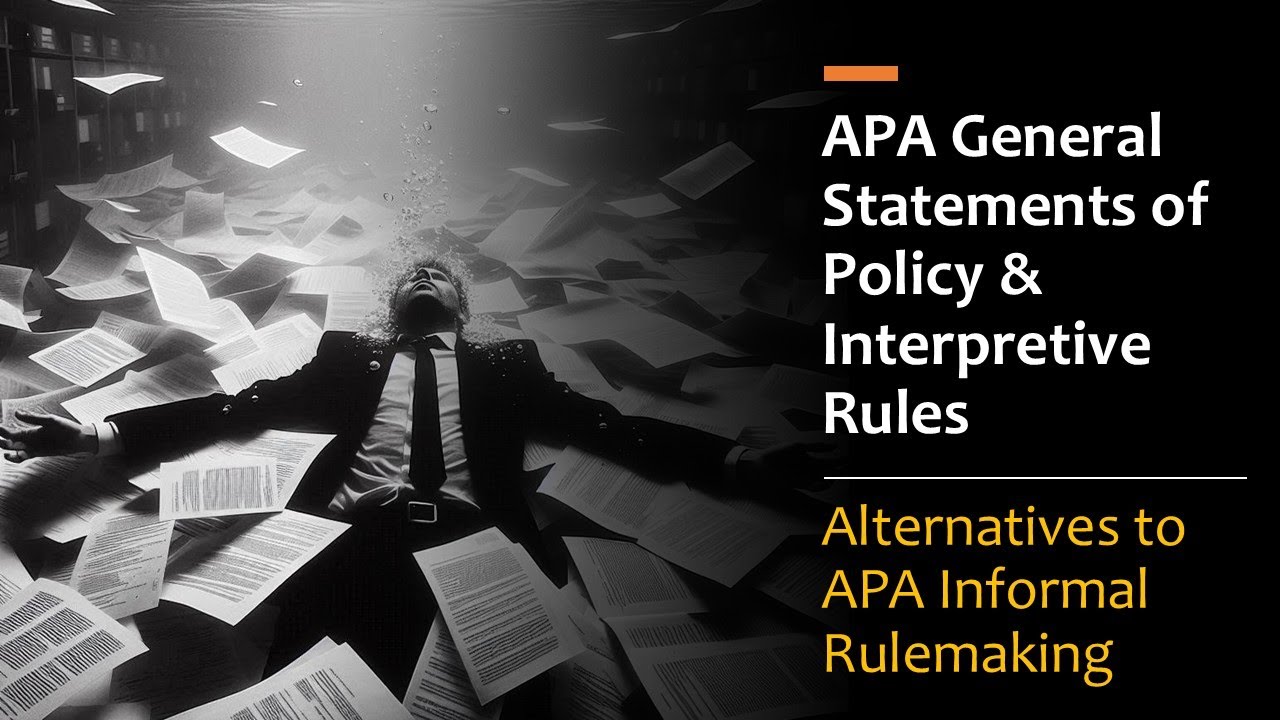
The Administrative Procedure Act (APA), enacted in the late 1940s as a response to the expansion of regulatory agencies during the New Deal era, is a procedural statute that establishes the framework for how federal agencies create regulations and conduct proceedings. The APA divides agency activities into four categories: informal rulemaking (notice and comment rulemaking requiring publication of proposed rules, public comment periods of at least 30 days, and responses to serious comments), formal rulemaking (rare trial-like proceedings), informal adjudication (no specific APA procedures), and formal adjudication (trial-like proceedings with administrative law judges). The APA creates a right of judicial review under Section 702, allowing courts to review agency actions when proper procedures are not followed, though certain agency activities like policy prioritization generally lack judicial review.
Administrative Procedure Act: Overview of Rulemaking and Adjudication
Added:this is going to be a short lecture introducing chapter 4 about the regulatory process and the rulemaking process so this is for my statutory interpretation course and here we're going to be talking or about or introducing the Administrative Procedure Act and notice and comment rulemaking and talking a little bit about this so the Administrative Procedure Act was passed in the late 1940s after World War 2 and after the New Deal had been implemented and and and in fact where we're moving on at that point from the FDR days into the post-war era and in some ways the APA was a counter-reaction to the explosion of regular new regulatory agencies and rulemaking efforts and regulatory efforts from the New Deal there's a few things to keep in mind and that my students should know about this at this point we're just doing a brief overview of it to enable you to understand the cases and the remainder of the case book the APA is a procedural statute it doesn't have substantive provisions and what that means is you should think of it sort of like and are analogous to the Federal Rules of Civil Procedure except it's procedure for regulatory agencies it's the rules they have to follow the procedures that they have to follow when they make new regulations or bring enforcement actions to some extent and or adjudicate claims with with claimants or sometimes when they're adjudicating claims or enforcement actions at the agency level initially and so there's nothing really in it that says from a policy standpoint what agencies are allowed to do or not do what counts as too much regulation or not enough regulation whether agencies should be more conservative or liberal progressive or libertarian or anything like that there's nothing really substantive or policy based in it it's just procedural rules and the closest we get to anything substantive is in the 700s where it creates a right of judicial review to seek review in the courts and the article three courts for adverse actions from an agency so keep that in mind that the APA you could think of it as something that's analogous to the Federal Rules of Civil Procedure except it's the Federal Rules of Administrative Procedure that apply to the agencies on my exams in my classes I don't ask gotcha questions about sections by number of the APA but sometimes I mention section numbers in a question to kind of give a hint to students about what I'm looking for so it won't be I don't ask questions on my tests like what is section five five three about I'm more likely to ask a substantive question something about the APA and then mention a section of five five three to kind of give a hint to students who remember that having said that there's a handful of sections of the APA the men are more than everything else at least from a law student's perspective and for your your stat reg class or if you're taking an upper-level administrative law course on that all the litigation activity all the quarter references are going to be essentially about five five three four rulemaking and then sections five five four to five five eight of the APA are about formal adjudication and formal rulemaking and then there's a set of sections from 7:01 to 706 that are about judicial review and the standards of review that courts are supposed to use and um the timing of judicial review and so forth and that's what so there's a really only a handful of sections that you would need to keep in mind and then this is the framework we can sort of conceptually divide the structure of what the APA requires into sort of a four grids and think of it as four types of things that agencies do now in real life agencies do all sorts of things they disperse grants they pay Social Security disability benefits and retire benefit retirement benefits they collect information and and and supervise labeling and testing requirements for kit the chemical industry all sorts of things right but from the APA standpoint this is the structure you should be thinking of so it breaks everything down into rulemaking and adjudication rulemaking an adjudication and there are two types of rulemaking informal rulemaking and formal rulemaking and then two types of adjudication in formal adjudication and formal adjudication we're given it starts with what's called informal rulemaking and this is a bit of a misnomer though because there's actually four procedural formalities that an agency has to follow even for informal rulemaking and those are set forth in in section five five three and this is what we call notice and comment rulemaking so when an agency wants to promulgate a regulation and regulations - from a law students perspective are going to have the same sort of format and like template as a statute a lot of times there will be an opening provision and then there's enumerated sections and lettered subsections and then small numbered sub sub sections and then section exceptions to this definition sections and so forth so it's going to look a lot like a statute except it's a regulation and what the agency what five five three requires is that the agency first publish a notice of a proposed rule in the Federal Register and allow a period of public comment and and it doesn't say it doesn't really give a ballpark it has to be at least 30 days but it seems more typical when if you kind of follow these postings to see public comment periods of three months six months nine months and so forth a two-year period is very long very very long and rather rare but a three months comment period or six month comment period it is very common and so then during this time people are filing comments about the proposed rule please note that some this isn't everything that the agency puts in the Federal Register they also have to publish some other things as well that we will talk about in later classes or in an upper-level in later sections or in an upper-level administrative law course like environmental impact statements and and and so on sometimes agencies will also publish a notice of intent to engage in rulemaking just a signal to the regulated industry that they've flagged an issue and they're gearing up to to formulate a regulation and and to sort of allow people to get a head start on thinking about what they're gonna do in response to this so you let but let's talk about the five five three procedures the agency publishes a proposed rule like a draft rule there has to be a statement of fact in a statement and some reference to their enabling statute there their statutory authority they're going to summarize their policy findings and and sort of justify it there's a lot of sort of preamble material or preparatory material that they're going to publish in this proposed rule then they're gonna have the proposal and then they allow the the comment period during the comment period we have comments coming from generally three types of sources you as you would expect the regulated industry has an interest in this and very often the regulated industry is going to be saying the the proposed rule goes too far it's going to be too costly they should scale it back and be more reasonable and so forth these are often very sophisticated comments the regulatory industry the regulated industry sorry is going to hire their own scientific experts to do studies or economists to do projections and things like that and they're going to hire lawyers to draft their official comments that they submit to the agency about proposed rules so the agency is going to get some sort of highbrow comments submitted by the regulated industry either individual companies or the trade associations they're also going to get comments very predictably from sort of the opposite side and this is going to be citizen activists groups or public interest nonprofits that are opposed to the regulated industry so if you think about polluters oil and gas companies and so forth on the other side during the notice and comment period you're going to have the Sierra Club and other environmental groups submitting comments and very often their comments are going to say as you might expect that the proposed rule doesn't go far enough and sometimes these these entities a large entity like the Sierra Club or a civil-rights a large national civil rights organization like the ACLU they these big nonprofits and special interest groups will also submit very sophisticated comments they'll have lawyers draft the comments they will have their own studies from economists or sociologists or people like that scientists that they submit challenging saying that the proposed rule needs is no good it needs to be fixed there's also going to be some comments submitted by just average citizens and these range from thoughtful to the type of stuff that you see posted on social media some of which is going to be crazy conspiracy theories and uninformed slogans and and things like that from people just spouting off and there's probably even more of this now that it's possible for people to submit official comments on proposed regulations online through the agency's website so a certain number of these are just going to be people who really think animals are pretty let's say if it's an environmental regulation so they don't and then other people who would really like to go back to a state of nature where we all hunt are hunters and gatherers and have to fight for survival or whatever it is and so the agency has to sift through this and and then after they close the comment period the agency sorts through it they weigh the comments and then they publish a final rule and the final rule is going to have the force of law by the way I know I've been talking for a while but we're still talking about the upper left-hand corner here which is informal rulemaking now here's the thing to keep in mind about notice and comment rulemaking for the cases we're going to look at up ahead in this course the agency has to in their final rule respond to the serious comments that they received during the notice and comment period during the public comment period and so if the industry if the regulated industries submitted some thoughtful and and well researched critiques the agency doesn't have to give in to them but they have to acknowledge we received a number of comments suggesting that the rule be scaled back because of this and then they can say something like we have our scientists and we did our own studies and they will have to explain why they're not following those comments and going ahead with what they wanted and the same with these citizen activists groups like the Sierra Club if they submit comments on the other side they don't have to respond to every crackpot or nutjob who submits a comment about space aliens or human extinction or or things like that and or that everything somehow relates to their constitutional rights and so forth so but they have to respond to the the serious comments in their final rule if the agency skips some steps here that can be grounds for challenging the rule and so please keep that in mind I want my students to make sure they understand that that the the sort of the teeth of a procedural rule is that we are talking about government organizations and bureaucrats and if they skip a couple steps or cut some corners on the steps here even if the rule is a great rule a court could invalidate the rule and send it back the agency back to start over for not following the procedures so procedure procedures create a grounds for a legal challenge now let's move down to adjudication when it comes to infant before we talk about formal rulemaking and I want to talk about informal adjudication which the APA essentially says is everything that's not one of the other three categories now you may find some commercial study aids or outlines that distinguish informal adjudication from other agency functions but from the standpoint of the APA everything that's not in formal rulemaking formal rulemaking or formal adjudication is in formal adjudication and the APA doesn't give any procedures that the agency has to follow for that at all and so this could cover everything from a welfare hearing where we're talking where a an agency is deciding whether to terminate your benefits to a forest ranger coming on your campsite and telling you to put your fire out right in in according the APA even that could be an informal adjudication now let's talk about formal adjudication and the Florida East Coast Railway partly talks about in some ways refers to this and some of our subsequent cases are going to talk about formal adjudication so formal adjudication is going to look like a full-blown trial especially to the untrained eye so you're going to have an administrative law judge you're gonna have a hearing time that a notice is given ahead of time about when the hearing is at well in advance you may have the party or parties represented by counsel there will be a record of the proceedings the evidence is going to have to be kind of identified sort of as exhibits and the record so things will be taken into evidence there's a lot of ways in which it will look like a trial don't make the mistake though it's not an article 3 judicial branch thing and the Federal Rules of Civil Procedure will not apply and the rules of Criminal Procedure will not apply this means for example that even in formal adjudication before an agency the hearsay rules don't really apply so don't go to an agency hearing and start objecting to things as being hearsay you will get a sort of a condescending lecture from the administrative law judge about that does how that doesn't really apply you can question or try to impeach evidence you don't like saying this is unreliable because it's hearsay and maybe you can convince them it's unreliable but it's not going to be excludable or inadmissible because of that and so sections 5 five four five five five five five six five five seven and five five eight are about formal adjudication the big ones are five five four five five six and five five seven just kind of keep in mind that there's a little group of things that have procedures about the hearings notice of the hearings the ALJ the type of opinion that the ALJ has to put out and so forth now the when it comes to formal rulemaking the APA basically says just follow the same procedures that you would follow for formal adjudication and this is awkward very awkward for the agency it means having a making a regulation through a trial like proceeding so it's one thing to have a formal a trial like proceeding to decide whether you qualify for Social Security disability benefits or whether you're social you should be um kicked off of Social Security for summary before breaking rules that makes that's easy to see it's a little bit harder to say okay we need a new the FDA needs to make a new food safety regulation so let's have a trial to decide what the regulation should be and have an administrative law judge and exhibits and so forth and this is um not only kind of an awkward way to make statute like rules but it's very expensive very time consuming and the way you should remember is an agency is never gonna do this unless they're enabling statute says that they have to write so it's it's very rare and they don't want to do this unless they're enabling stet and sometimes Congress will say you have to do this put it in their enabling statute to know that the agency is going to do formal rulemaking now a lot of enabling statutes would leave this open as an option for agencies but it but informal rulemaking makes the notice and comment rulemaking makes so much more sense so that's our framework for the Administrative Procedure Act and from each one of these if you receive an adverse decision you have you can seek judicial review in the courts subject to certain conditions right things like standing and a filing your seeking judicial review filing within a certain deadline and so forth okay there's a few other procedures spelled out in the APA besides rulemaking in adjudication there is a section about petitioning for rulemaking so you want the agency to regulate something you can file a formal petition asking them to do it and in which case they may have an obligation to tell you why they're not going to and to acknowledge that you asked that we already talked about judicial review of rulemaking and judicial review of a Jude occation you should also be aware if you take an upper-level administrative law course there's a number of things for which there will be no judicial review that agencies do and either because they're so sort of intangible like adopting a particular priority policy agenda or a way of prioritizing cases or or things like that that aren't individualized decisions or even really a rule it's just in an agency's priorities under a certain administration there's not going to be judicial review for something like that and then there are certain types of decisions that will be basically where judicial review will be precluded if you need to document that you watch this lecture our lecture attendance password is doctrinaire and i think what we've given you here will set you the stage or give you that the basics nuts and bolts that you'll need for looking at some of our upcoming cases about agencies and making rules having hearings and so forth
Up Next

Constitutional History and the Administrative State | Stanford Law
@stanfordlawschool
1.1K views•2015-05-04

US Secondary Sanctions Impact on EU Businesses and Blocking Legislation
@Bureauvandijk
1.6K views•2019-03-20

NLRB v. Bell Aerospace: Administrative Law Case Brief
@professorstevenson
1.5K views•2022-04-15

Police Interrogation Tactics: False Confessions & Legal Reform
@LastWeekTonight
7M views•2022-04-18
Related Study Plans & Knowledge Roadmaps
Structured learning paths in Law