












![[나눔복지교육원]청소년상담사3급 발달심리 심화이론](https://i.ytimg.com/vi/xc_IcNUnLR4/maxresdefault.jpg)








Partial reinforcement schedules, discovered by B.F. Skinner, determine how behaviors are maintained through reinforcement; these schedules include fixed ratio (reinforcement after fixed number of responses, producing high response rates), fixed interval (reinforcement after fixed time period, producing slower responding), variable ratio (reinforcement after average number of responses with unpredictable variation, producing high and steady responding), and variable interval (reinforcement after unpredictable time periods, producing regular responding), with each schedule having different effects on controlling and maintaining learned behaviors.
Operant Conditioning: Schedules of Reinforcement Explained
Added:Understanding the core principles of B.F. Skinner's Operant Conditioning and how it differs from Pavlovian Classical Conditioning.
The fundamental distinction between Reinforcement (strengthening a behavior) and Punishment (weakening a behavior), including their positive and negative forms.
The baseline concept of Continuous Reinforcement (reinforcing a behavior every single time it occurs) and its role in early-stage learning.
Basic comprehension of behavioral measurement terms, specifically 'response rate' (how often a behavior occurs) and 'extinction' (the fading of a behavior).
The Partial Reinforcement Extinction Effect (PREE), which explains why behaviors maintained by intermittent schedules are highly resistant to stopping.
Real-world application of reinforcement schedules in industries such as game design (gamification), gambling (slot machines), and workplace incentive structures.
The processes of Shaping and Chaining, which utilize reinforcement to teach complex, multi-step behaviors through successive approximations.
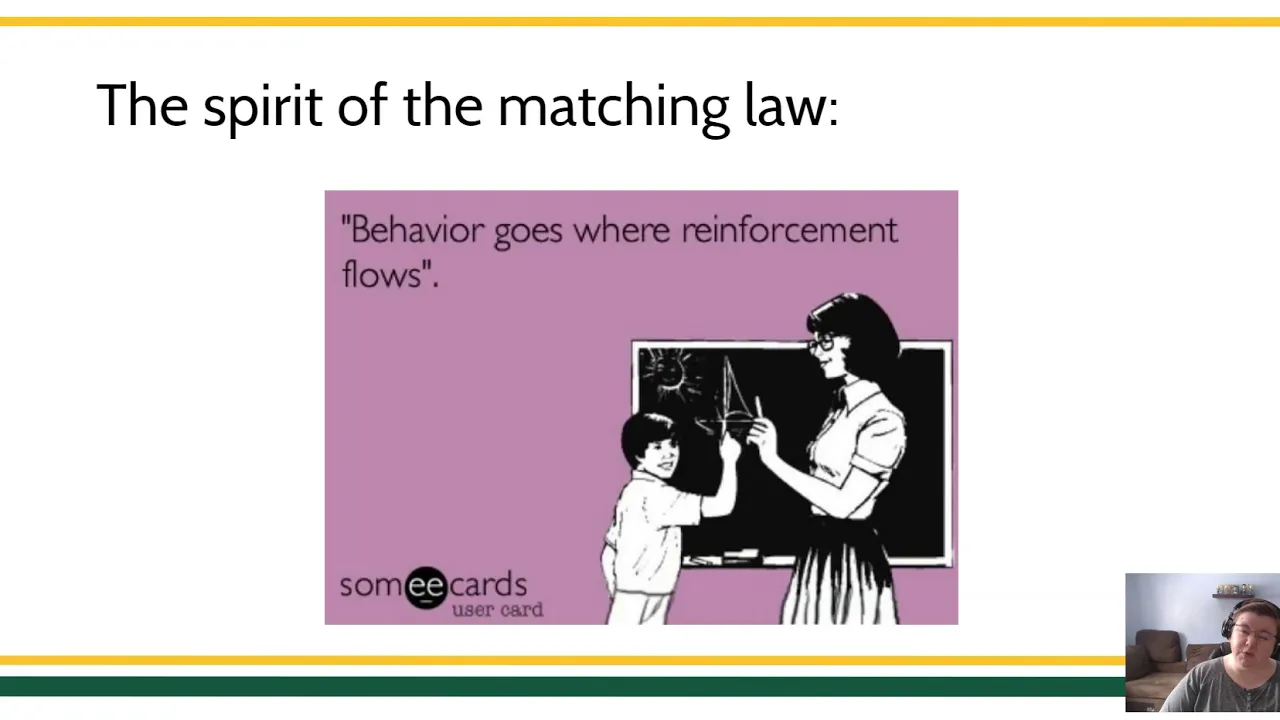
Advanced behavioral theories, such as Herrnstein's Matching Law, which models how organisms choose between concurrent schedules of reinforcement.
566.4K views4.6Klikes7:48Original Release: 2013-10-11
Many of our behaviors are on a partial reinforcement schedule.
Partial reinforcement refers to a situation in which a behavior is reinforced only some of the time.
These partial schedules of reinforcement are important because they are generally more resistant to extinction than continuous reinforcement.
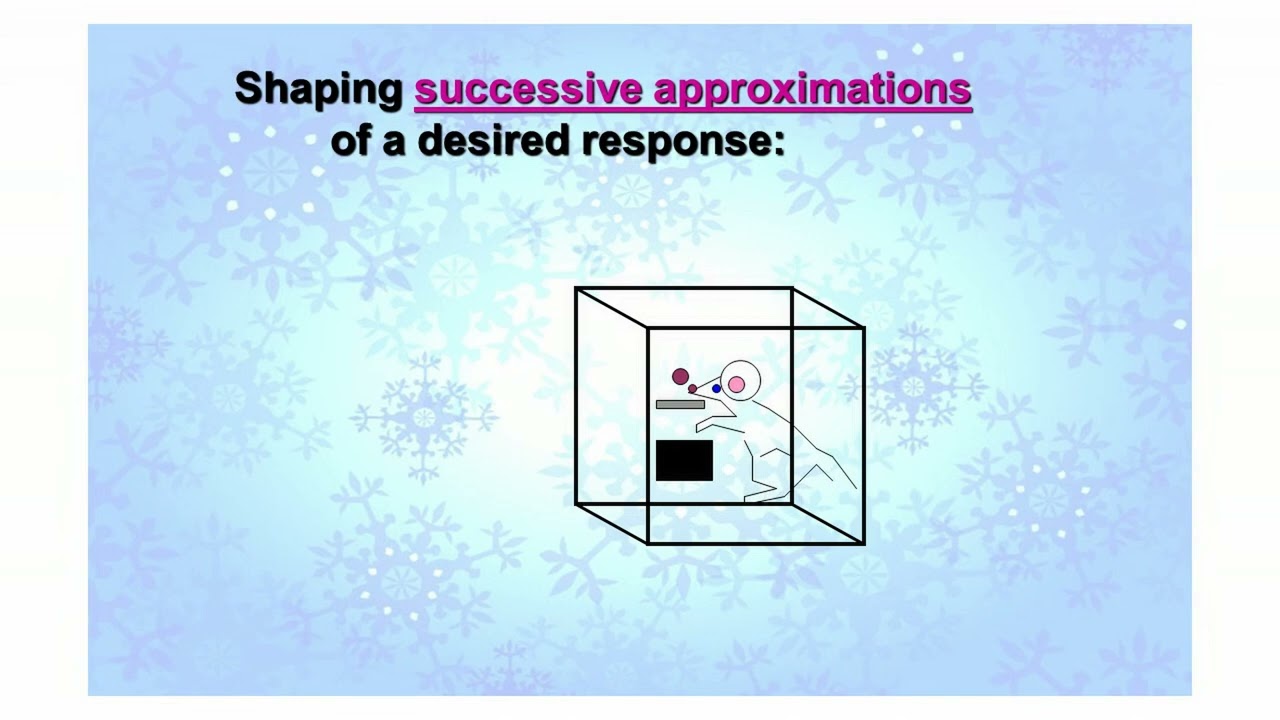
As we discussed, behaviors are shaped through a process of continuous reinforcement of successive approximations of the target behavior.
However, continuous reinforcement eventually becomes less reinforcing.
So there's a need for these partial schedules of reinforcement, which vary in their ability to maintain learned behaviors.
And these were actually discovered by B.F. Skinner through observation of reward schedules with animals.
However, they apply to humans too.
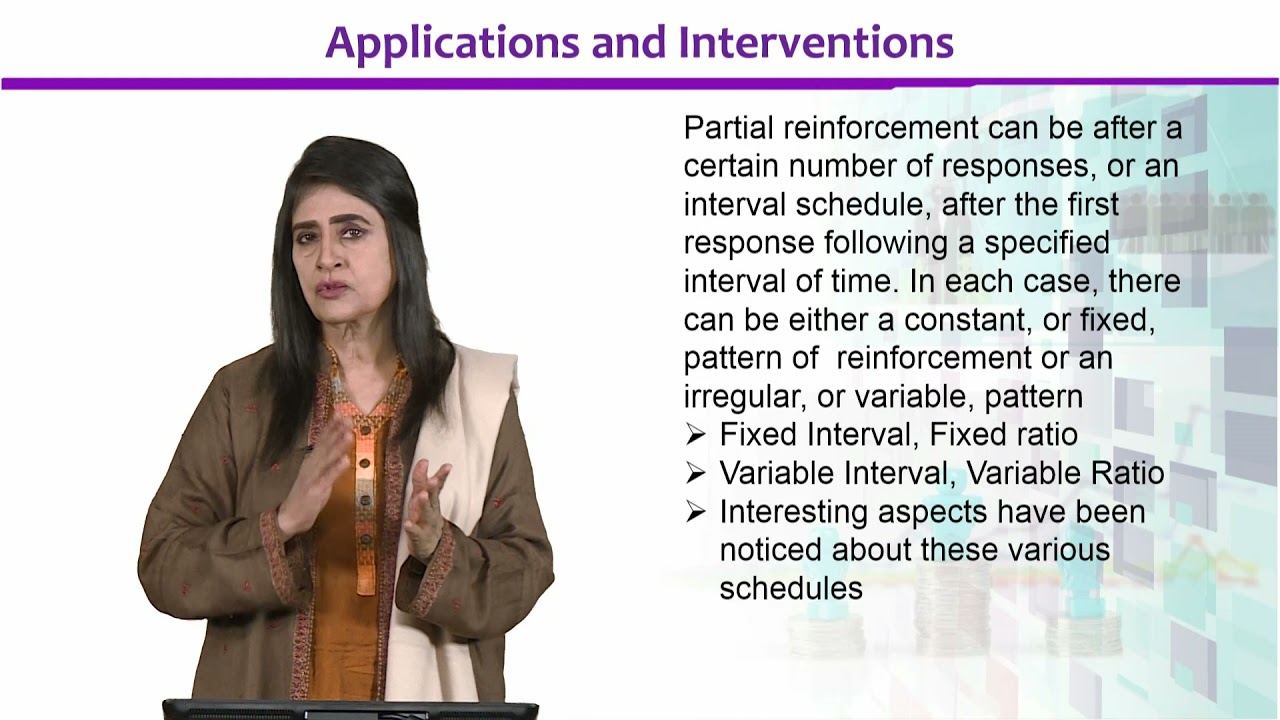
So there are four schedules of partial reinforcement and each one has a different effect on controlling and maintaining behaviors.
As you're watching this video, you'll probably think of situations in your life where your behavior was reinforced on each of these schedules.
And by the end of the video, you'll be able to label those situations with the terminology used in operant conditioning.
So here you can see the four schedules of partial reinforcement.
If these terms are new to you, don't worry.
They'll start to make a lot more sense when you break them apart.
So for our purposes, I want you to associate the word "ratio" with amount of responses.
The word ratio looks similar to ration.
And a ration of food, for example, is a certain amount of food.
So ratio means amount.
And for our purposes, an amount of responses.
Now when you see the word "interval," I want you to associate the word interval with time.
Think of that phrase, an interval of time, like maybe a long interval of time passed, or we were only given a short interval of time to answer the question.
So interval means time.
So here's ratio, which means the amount of responses.
And here's interval, which means time.
Now, each of these categories can either be fixed or variable, meaning that they can be fixed, as in consistent, or variable, as in there is a variation.
And if you combine these words together, you come up with the four schedules of partial reinforcement, fixed ratio, fixed interval, variable ratio, and variable interval.
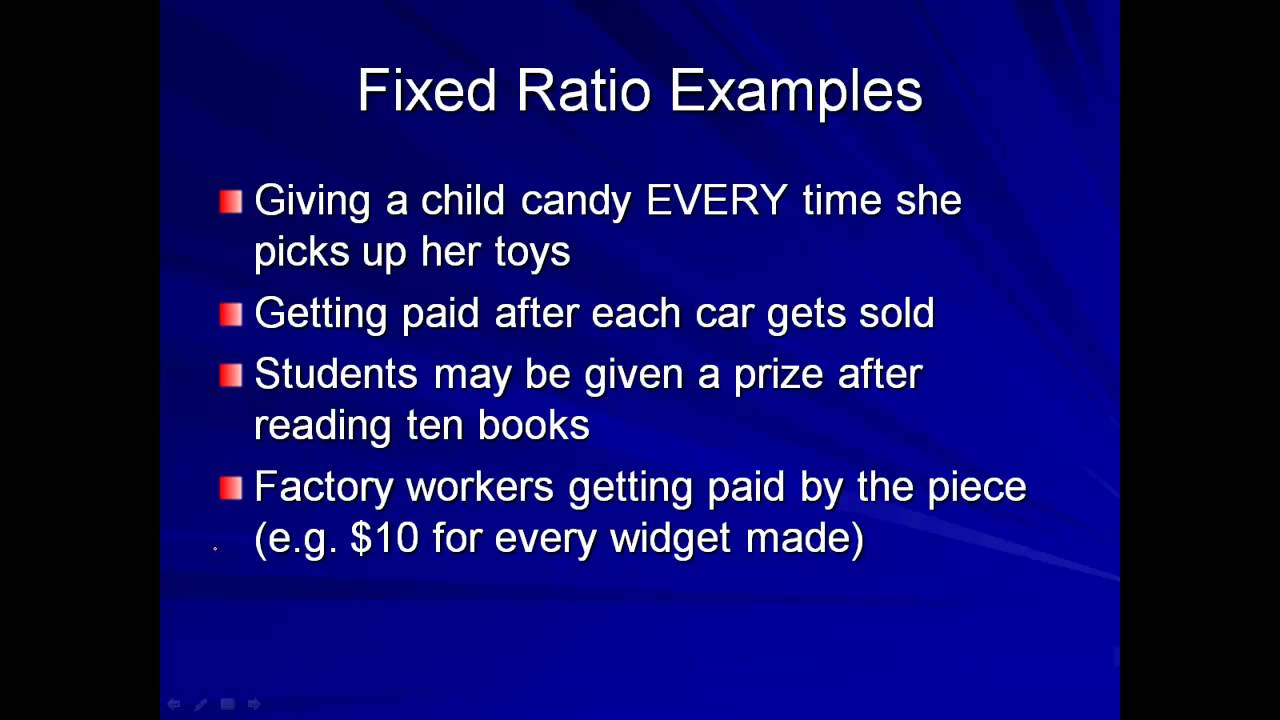
So let's talk about a fixed ratio schedule.
So pretend this car salesmen gets a bonus for every five cars he sells.
That bonus is a reinforcer placed on a fixed ratio schedule.
I a fixed ratio schedule, reinforcement only occurs after a fixed number of responses.
So this car salesman has to sell five cars in order to get a bonus.
And if he sells five cars in a week, he'll get a bonus.
If he sells five cars in a month, he'll get a bonus.
And if he sells five cars in a day, he'll get a bonus.
You get the idea.
What I'm illustrating here is that the reinforcement, in this case the bonus, is contingent on the number of cars he sells, regardless of how long it takes him to do it.
So since the only barrier between the car salesman and his bonus is the number of cars he sells, you might imagine he'll work at a furious pace to earn as many bonuses possible.
Jobs that demand you to work at a fast paced manner like this, they often pay their employees on a fixed ratio schedule.
Think of like factory workers and fruit pickers, for instance.
That's the benefit of a fixed ratio schedule.
It tends to emit a high rate of behavior because the frequency of getting the reward with a reinforcer pretty much depends on the person.
So that's a fixed ratio schedule.
Now, let's talk about a fixed interval schedule.
So pretend this car salesman receives a paycheck every two weeks as long as he sells one car.
The paycheck is on a fixed interval schedule because the reinforcement occurs after a consistent amount of time has passed, in this case two weeks.
So in this case, his paycheck doesn't change if he sells one car or 100 cars during that time interval.
So his paycheck is dependent on the amount of time that passes.
So as you might imagine, he probably doesn't have much of an incentive to sell more than one car if he'll make the same amount of money anyway.
And that's the classic rate of responding for fixed interval schedules.
It's much slower than, say, the fixed ratio schedule like we discussed earlier.
Now, here we have the variable ratio schedule.
A variable ratio schedule means that the reinforcer is delivered after an average number of correct responses has occurred.
So a variable ratio schedule is similar to a fixed ratio schedule except the number of responses needed to receive the reinforcement changes after each reinforcer is presented.
So put simply, a variable ratio schedule is literally a series of fixed ratio schedules that just change.
What matters in the end is the average number of correct responses.
So using an example we used for the fixed ratio schedule, there's a car salesmen receiving a bonus for every five cars he sells.
If the number needed to receive a bonus was always fix at five, then that would be a fixed ratio schedule.
But a variable ratio schedule would vary.
So maybe he must sell like five cars to get the first bonus, and then three cars to get the second bonus, and then seven cars to get the third bonus, and then six cars to get the fourth one, and then four cars to get the fifth bonus.
If you add up all the cars sold and then divide it by the five bonuses he received, you'd find out that the average number of cars sold to receive a bonus is five, which is what the fixed ratio schedule was above, five cars per bonus.
The difference here was that the variable ratio schedule has a lot of uncertainty.
The car salesman cannot predict when he'll receive a bonus in this case.
But with every car sold, he comes closer to getting that bonus.
So the classic example used when it comes on a variable ratio schedule is a slot machine.
If you ever played a slot machine, you understand the power of a variable ratio schedule.
A slot machine is programmed to pay out after an average number of pulls.
But since you never really know when the payout will occur, you keep playing and hoping that you'll win something.
And that's one reason it's so hard to walk away from a slot machine.
You always wonder like what would happen if the next pull is the jackpot.
You don't want to miss that, obviously.
So a slot machine is a variable ratio schedule because the reinforcement is dependent on your behavior.
That is, you have to bet money and pull a lever in order to have a chance to receive anything.
And it doesn't matter how long you wait in between pulling that lever.
It simply matters whether you performed the behavior of pulling a lever.
So that is a variable ratio schedule.
A variable interval schedule means that the responses are reinforced after a variable amount of time has passed.
So to use the car salesman again, imagine a supervisor randomly showing up without notice to give him a bonus.
As long as the supervisor sees him actively talking to a customer, he'll give him that bonus.
Now since a car salesman never knows when a supervisor will drop by, he has to consistently engage with a customer in order to increase the chance that a supervisor will notice.
The difference here is that he could have sold one car or even 100 cars on average that month.
But all that matters in order to receive the bonus is whether or not he's actively engaging in a sale when his supervisor happens to come by.
So a variable interval schedule like this results in a more regular rate of responding than does a fixed interval schedule.
So those are the four types of partial reinforcement schedules.
And as you might imagine, each one has a tendency to emit a different pattern of response.
Up Next
4:09
Operant Conditioning & Skinner Box Explained | VCE Psychology
@Psyccounting
407.5K views•2012-07-20

68:32
Cognitive Skills for Differentiated Instruction | Teacher PD
@BrainWareLearning
631 views•2017-12-17

9:55
Thinking, Fast and Slow: Daniel Kahneman Animated Book Summary
@FightMediocrity
2.3M views•2015-06-05

6:40
The Nocebo Effect: How Beliefs Can Cause Real Harm
@CGPGrey
10.4M views•2013-12-23
Related Study Plans & Knowledge Roadmaps
Structured learning paths in Psychology
psychology
Neuroscience of Creativity: Networks & Training
01Foundations of Creative Cognition
02The Cognitive Neuroscience of Insight & Fixation
03The Triple Network Model of Creativity
+ 1 more learning modules
15h4 modules
Explore Roadmap
psychology
Imposter Syndrome: Etiology & CBT Framework
01Defining the Imposter Phenomenon
02Socio-Developmental Etiologies
03CBT Fundamentals & Thought Distortions
+ 2 more learning modules
15h5 modules
Explore Roadmap
psychology
Adult ADHD: Executive Dysfunction & Scaffolding
01Neurobiology of the ADHD Brain
02The Core Triad of Executive Deficits
03Executive Dysfunction and Emotional Regulation
+ 2 more learning modules
12h5 modules
Explore Roadmap
psychology
Loneliness: Evolution, Neurobiology & CBT
01Evolutionary Origins of Human Connection and Loneliness
02The Neurobiology and Physiology of Chronic Loneliness
03Maladaptive Social Cognition: The Psychological Loop
+ 2 more learning modules
12h5 modules
Explore Roadmap