


























Thermal resistance networks provide an elegant analogy between heat transfer and electrical circuits, where thermal resistance R = L/(kA) for conduction and R = 1/(hA) for convection, allowing complex composite walls to be analyzed by summing resistances in series or parallel; however, this approach assumes steady-state, one-dimensional conduction without heat generation, and contact resistance between materials significantly impacts performance, decreasing as surface smoothness or clamping pressure increases.
Thermal Resistance Networks | Heat Transfer Lecture 09
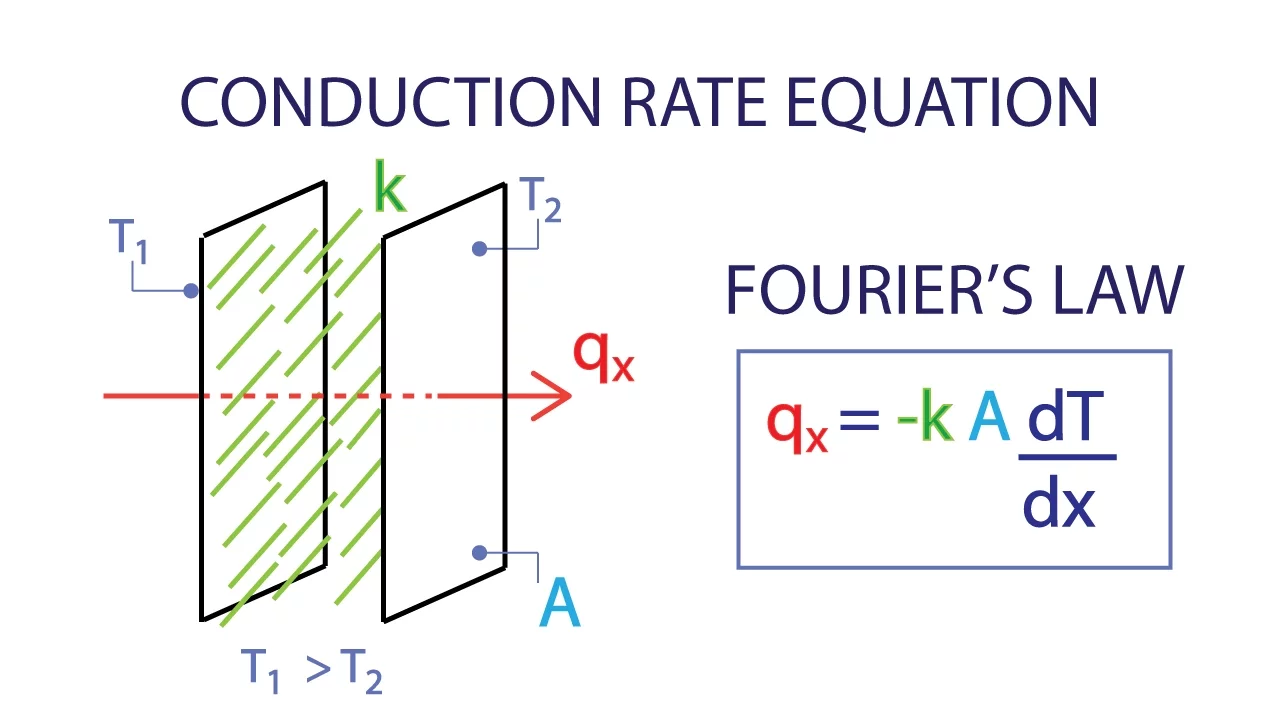
Added:Fourier's Law of Heat Conduction: Understanding the fundamental equation governing conduction heat transfer in solid materials.
Electrical Analogy (Ohm's Law): Familiarity with electrical circuits, current, voltage drop, and resistance, as thermal networks directly parallel these concepts.
Steady-State 1D Heat Conduction: The assumption of heat transferring in a single direction over time without energy storage.
Concepts of Convection and Thermal Conductivity: Basic definitions of conduction (k) and convection (h) heat transfer coefficients.
Transient Heat Conduction and Thermal Capacitance: Moving beyond steady-state to analyze time-dependent systems using thermal RC networks.
Extended Surfaces (Fins): Designing and analyzing heat transfer enhancement devices using resistance concepts for combined conduction-convection.
Critical Radius of Insulation: Calculating the optimal insulation thickness for cylindrical and spherical systems to minimize or maximize heat loss.
Two-Dimensional Steady Conduction: Analyzing complex geometries where heat flows in multiple directions using conduction shape factors or numerical methods.
Heat Exchanger Analysis: Applying thermal resistance principles to evaluate overall heat transfer coefficients (U-factors) in engineering systems.
202 views3likes49:34Original Release: 2018-02-05
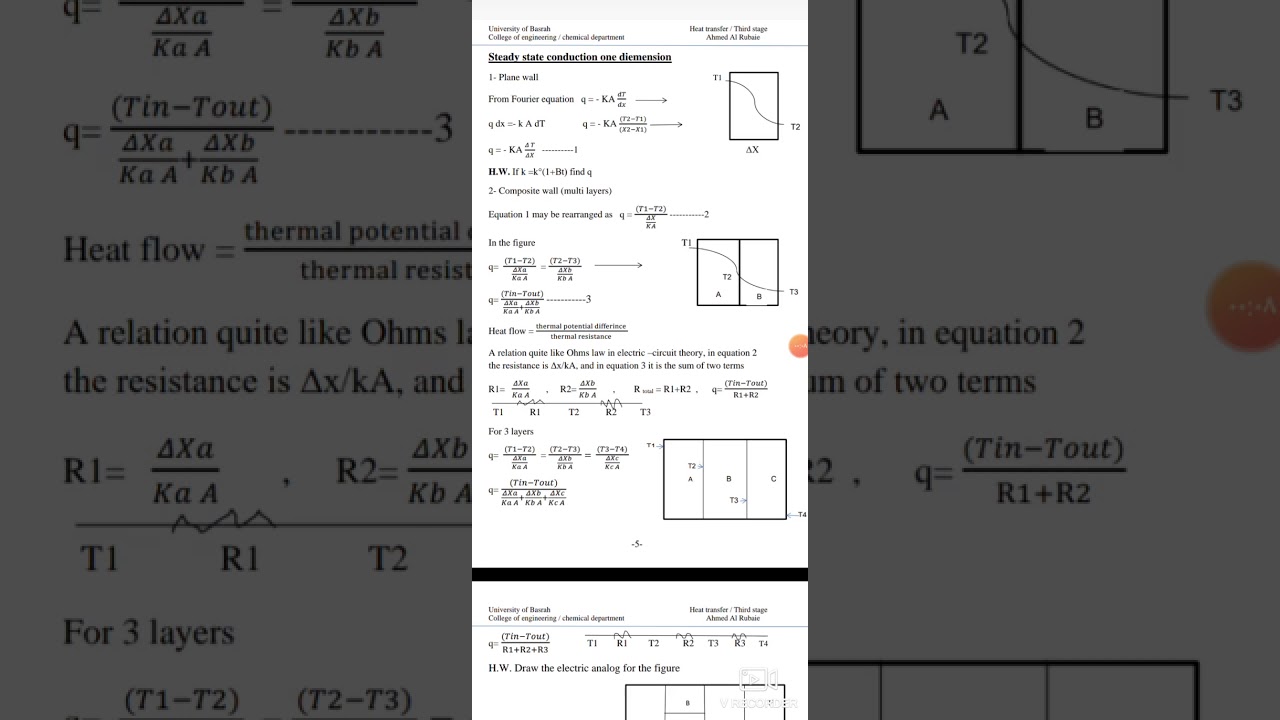
all right so let's uh let's pick back up I'm talking about these things for resistance networks and the thermal resistance analogy for conduction problems we're gonna work a couple examples using this idea of thermal resistance and then we'll segue on into the idea of extended surfaces or fins which we'll try to wrap up Wednesday so just to quickly recap okay what we're talking about when discussing thermal resistance right the idea is that a some object through which conduction is occurring can be treated in a way that's very analogous to an electrical resistor so if we say that we have some temperature one some temperature two and then in between them is some object with a thermal resist or a thermal conductivity k we can instead say that object has some thermal resistance R the idea here is if if T 1 is higher than T 2 we're gonna have heaped flow from left to right in that heat flow will have magnitude of Q equal to t1 minus t2 over that thermal resistance so it's very similar to the way we use Ohm's law right to calculate current in relationship to a voltage potential difference and an electrical resistance almost identical way likewise we have we could we could draw the heat flux or write the heat flux in the X direction here as t1 minus t2 over the flux resistance and the only difference between these would be t1 t2 over R times the area of whatever where so if we consider a plain wall right this is the example we talked about so far let's say it has some thickness l1 it has some thermal conductivity K 1 and it has some surface area a ok we would write that the thermal resistance is 1 over r sy l over K a or that the flux resistance is just L over K and this makes sense right this is essentially for for a if we were to apply this expression right here do you want the T 1 minus T 2 over R that would be T 1 minus T 2 times K over L that essentially works out to 4 eh law right for one-dimensional conduction that's our solution to the 1d heat equation without heat generation so that brings us to the point that thermal resistance this analogy right [Music] is valid for steady 1-dimensional and no heat generation okay if we have that Q dot term in a body then we cannot treat it as a thermal resistor the same way that in an electrical circuit we can't measure the current across some resistor based on just the voltage drop if there's some current source in the middle of that resistor right so composite walls what happens if we stack right another wall onto the side of this one this one with a different thermal conductivity k - maybe a different length L - so if this is t1 this is t2 will say over here is t3 resistance analogy is that just as in electrical circuits we can treat these as thermal resistors in series so we simply stack those on top of each other say t1 t2 t3 this one will have some thermal resistance l1 over k1 a this will have a thermal resistance R to the L to 4k - a and this is assuming that they both have the same surface area and that means that our total resistance is equal to just r1 plus r2 which is going to be equal to t1 minus t3 / q so this is where we have stacks or suppose to deposit walls where we have the heat flowing right the Q remains constant as it travels through the wall so we can simply add up each individual temperature drop and treat it as and so what this allows us to do is to judge that bulk temperature drop in relation to the total heat flow through the wall but it doesn't give us the detailed insight into what exactly the temperature distribution in the wall is so that is the trade-off here okay so at the conclusion of last lecture rate we were talking about this example cooling in a high temperature stage of a gas turbine okay so gas combustion gas flowing across a turbine blade super high temperature in this case we say it's 1700 Kelvin all right nearly 4 over 1,400 degrees Celsius with a convective heat transfer coefficient of a thousand watts per meter squared Kelvin and to avoid melting the blades into a puddle of useless non-german is cooling clear through the inside of the blades at some reduced temperature in this case only 400 Kelvin with a heat transfer coefficient that's only about half and additionally put a layer thermal boundary coating or thermal barrier coating on to the outside of the blade a very thin layer of a ceramic material balsa Konya which has a very low thermal conductivity only about 1.3 watts per meter Kelvin um so here's the question if we take our blade back it's cooling out there convective heating up here we've got a layer of zirconia we have a bonding agent Blair hollow blade if we go ahead and take all this into account are we gonna melt the blade so using the plane wall approximation right we're gonna sort of unwrap this blade and treat it as if it's a straight wall when I can account for curvature so what we did last time was we said here's our sort of our diagram we've got our blade we've got this bonding material and we have our insulating zirconia out here so ahead and label surface temperature one is intermediate temperature t2 and the blade temperature yes three at the inside where it's being cooled by that air that flows through the inside of the blade and so our equivalent resistance Network right was essentially just a matter of drawing in the series resistor analogy he said that to assume we have right our hot gas at tea fit of the outside we have the thermal resistance that is a model of our convection okay here that gets us to TS 1 we have the thermal resistance that is due to conduction in this thermal barrier coating we have an additional resistance that is more clearly we have that additional resistance which is due to this bonding layer right we haven't been told anything about you know the thermal conductivity of the bonding layer or the temperature drop across the bonding layer what we've been told is simply here's what the thermal resistance is per unit area all right so we're just gonna essentially take that number I'll get in here and we're not gonna worry about the details of what goes on in the middle then we have the thermal resistance of the material of the blade okay that gets us to TS three and then finally here's the convective cooling is a sense that gets us to t infinity i or to infinity inside so one of the things to note here is that we are missing a we don't have any knowledge about the area of the blade so instead of using instead of using R right we're gonna be scrapping that in favor of our prime which is T right well T 1 minus T 2 over G prime or Q double prime looks right where heat transfer per unit area context so let's start looking at what is individual existence numbers are gonna be okay so we've got let's say let's call this RC oh let's call this our TBC call this RB r the r b stands for our bond will have our blade we'll have our C I so we've got resistance at the inside so or rather double Prime's on all of these say so the convective resistance at the outside is simply equal to 1 over H at the outside equals 1 over 1,000 watts per meter squared Kelvin or 10 to the negative third meters squared Kelvin per watt our TVC this just works out to the thermal resistance of a plan wall so this will be L TBC over K TBC which works out to right half a millimeter so 0.0005 meters over 1.3 watts per meter Kelvin so this works out to three point eight five times 10 to the negative fourth meter squared Kelvin per watt our double prime B or the bond resistance it's actually given to us as part of the problem in this case what would that if we go back here this bond resistance should have put a double prime on there 10 to the negative fourth in this case 1 over a let's remove that double prime because I include the 1 over a so this means that our double prime of the bond is equal to 10 to the negative fourth meter squared Kelvin per watt so we'll plug that in here 10 to the negative fourth meter squared Kelvin for what I'm going to an underline each of these numbers our double-prime blade again this is just the thermal resistance of playing wall it's time with the K and the thickness of the blade material that inconel right so this turns into L blade over K blade which is 0.005 meters so it's 5 millimeters thick and it has a thermal conductivity of 25 watts per meter Kelvin so this works out to 2 times 10 to the negative 4th meter squared Kelvin per watt and finally our convective the inside so this is the convection resistance for the cooling air this is 1 over H I or 1 over 500 watts per meter squared Kelvin gives us a final value of 2 times 10 to the negative fifth meter squared Kelvin per watt all right so this has just been bookkeeping so far we haven't we haven't done anything crazy we've just been plugging numbers that were given to us into these expressions for thermal resistance and next all we have to do is add these values up right so if we say that right our total then is equal to alright that our or sorry our front double prime total equal to the outside convective resistance plus R Prime the TVC plus R double prime of that bond coating plus R double prime of the blade plus R double prime of the conduct cooling at the inside and we just plug in these values that we have right here this works out to tent negative third plus three point eight five times ten whoops eight five times 10 to the negative fourth plus ten to the negative four plus two times 10 to the negative fourth plus two right this is supposed to be a negative three yep 2 times 10 to the negative 30 and then this is all meters squared Kelvin per watt so this works out to three point six nine times 10 to the negative third meters squared Kelvin per watt okay so we've done is we've taken we had our hot air out here and our cold air over here so we've got T infinity I bet T infinity oh we're assuming that the temperature distribution is going to look something like this right some linear drop across here some drop across that thermal barrier or that that bond and then some drop across the blade and let's go ahead and move this down to infinity I and so rather than solving for heat equation inside these members and using a bunch of boundary conditions to solve for our unknowns we can simply say that the total heat flow from this side right from the hot gas on this side through the blade and everything is equal to Q prime is equal to t infinity outside minus T infinity inside over R double prime total so this is going to work out to 1700 Kelvin - 400 Kelvin all over is three point six nine times ten to the negative third meter squared Kelvin per watt or three point five two times ten to the fifth watts per meter squared so there's our heat flux that's being pushed through the blade right with that or being pushed through the thermal barrier coating that bonding layer and the blade as a result of the convective heating on one side and convective cooling on the other so it's it really is that the analogy between this and the electrical resistance couldn't get any more elegant because it's just like the way that a voltage potential push is carrying through okay this case a temperature difference pushes heat so but the question was right are we gonna melt the blade so this doesn't answer that this just tells us how many watts of a thermal energy per unit area are being shoved through the blade by this temperature difference so to find the surface temperatures right namely we're interested so let me redraw that really quickly yeah rather this is gonna look like this so what we're interested in right are the temperatures in the blade itself so here's our thermal barrier coating and here's the blade obviously the higher temperature in the blade is going to be right at that bonding layer where the heat enters the blade material so if we call this what did we what number did we send that T to okay so if this is TS three this is T 2 in here and this is T infinity I question is how do we find the surface temperatures that we buy T 2 ts 3 we know T infinity sub i right that's given to us it's 400 Kelvin that's the temperature of the cooling air how to find intermediate temps you won't have any ideas we've got Q double prime right we know how much heat is flowing through Q double prime let's write that lik Q double prime the X Direction is equal to that three point five two times ten to the fifth watts per meter squared we know we know H in the air all right we know K in the blade so we can use Newton's law of cooling right which tells us essentially you've got Newton's law of cooling says that Q double prime X is equal to H ts3 minus T infinity I write the surface temperature of the blade ts3 is equal to this case T infinity I plus 1 over H cube double prime X which equals 400 Kelvin plus 1 over 500 watts per meter squared Kelvin times 3.5 2 times 10 to 50 squared sorry it's not a Gildan another way we could have done this is we know Q we could have simply used another resistance analogy drop this convective resistance right and pretended that we could have we could have done something like this here's the convective heating resistance here's the TBC resistance here's that contact resistance here's the blade resistance and then here's ts3 right if we drop here we already know Q double prime and so if we find our total and our total - that conductive and it's very easy to find the temperature drop this point at this point anyway we'll go back to the way we're solving this so here's T s3 all right and then from cs3 you want to find T 2 again we can go ahead and use for yeas law which says that Q double prime for a one-dimensional steady conduction problem with no generation prime X is equal to negative K T 2 minus T say T s3 and so we get that T 2 is equal to t s 3 plus sorry this is going to be over L blade is equal to L blade let's tag this negative k with blade - I'll lay it over gay blade x q 2 prime X which works out to 1174 Kelvin so again I just want to call out attention to the fact that when we were working backwards right in both these cases we were also we could use this as the resistance analogy we've got a 1 over H here which is essentially our double prime of convection and we've got L over K here which is our double prime of the blade so there's there's multiple ways of kind of thinking about this problem handing this problem but what it works down to it works out to is use the thermal resistance concept and kind of a shortcut the total temperature jump from one side to the other or to shortcut figuring out how much total heat flux you have going through this composite wall and then work backwards from there with a known heat flux it becomes very easy to solve for the resulting temperature jumps across different layers so you can use your known rate equations for fauré's law of conduction for Newton's law of cooling or the Kelvin Helmholtz right yeah law of radiation okay or stefan-boltzmann law rather la radiación you can quickly find the intermediate temperatures so it seems a little counterintuitive you find the end solution and you work back for the intermediate steps but it works very well and it's a very easy process to apply alright so a couple other little kickers to the resistance concept okay as I see the idea of contact resistance all right here when you have one of these composite walls right so you join two walls together and say that this has some resistance one this has some resistance to if we were to take a look at the contact point between these walls well we would see oops is that these walls are not right they're not perfect there's this region of sort of surface imperfections and trapped air or trapped fluid and such between them which creates if we were to look at the temperature distribution here which creates a sort of a concentrated resistance because in between these you've got a reduced contact area as well as some convective heat transfer between these two solid objects so it's true that anytime surfaces contacting one another I have imperfect interfaces which results in a very high resistance over a very short distance which is why pseudo jump in temperatures okay linear jump linear and as a rule it's very hard to calculate what this contact resistance is gonna be it's sort of a something you have to look up in a table or use some empirical knowledge of but our contact will go ahead and say generally decreases as surfaces become smoother or the contact pressure increases so you think of a very pure pan frying steaks for example all right what's one of the it's the kind of cheaters method for getting them to cook faster you push down on the steaks on the skillet right to increase that heat transfer it's the same idea here so if you look in your books right if you look at a table three point one one of the things I'll see there is a list of materials with typical sort of surface finishes and then contact resistances for different contact pressures okay as well as if you have different sort of fluids filling the gap you have air there's a vacuum between them versus if it's water in between the two right all of these influence what that contact resistance is but in ways that are really difficult to calculate directly as I said so turn to Table three point one and others like it to look these sort of values up for for example for considering contact between two stainless steel plates if they're being clamped together at a pressure of a hundred kilo Pascal's which is basically one atmosphere we end up with are the prime is equal to something between six and twenty five times 10 to the negative fourth meter squared Kelvin per watt and if you were to multiply that clamping pressure by 100 that is move it up to 10 mega Pascal's or about a hundred atmospheres pressure then our double prime is equal to zero point seven two four times 10 to the negative fourth meter squared / what so Wow this is typical of a pretty moderate clamping force alright the kind of thing you might get using like a mechanical C clamp or something between two these are the metal or is if you were to use nuts and bolts or a more industrial sort of clamping thing like hydraulic press you can easily get up to 100 atmospheres of clamping pressure and in doing so you've reduced just because you've squeezed all these surface imperfections together an increase sort of contact area and minimize the amount of fluid trapped between those services you've decreased the resistance by an order of magnitude yeah eyes ear o point seven two four that's a range yeah so that's zero point seven two four and there are more materials and more clamping pressures and more variations in table 3.1 so write that down and use that as a reference yeah pretty much really told you know if in in in in practice right and in real engineering problems you always need to account for this right anytime you have two things that are joins together in a way that does not make them like a kind of a monolithic structure if you have something welded that's one thing general right your weld two pieces of metal together you've joined them into effectively one piece of material thermally sometimes welding right you introduce metal with a different conductivity so you might need to treat it as a composite material but if you have things like bolted interfaces this is the sort of thing that you need to account for right it's standard practice when coming up with assembly calculations for anything that's bolted together you figure out the bulk tension and the clamping pressure at that interface you can use that information along with knowledge about what materials are being clamped together to come up with this sort of behavior and then you just use that composite wall assumption to figure out what kind of temperature drop or heat transfer you'll get through that interface all right and last thing dealing with thermal resistance right this idea of parallel resistance so what happens in electrical circuits right when you have two resistors that are branched subsets current flows through them together it decreases the overall resistance of that leg of the circuit right same thing happens in heat transfer so if let's say we have some wall here it's got some area a1 and some surface temperature TS one the whole thing as a thermal conductivity of k1 let's say it is attached to another piece of metal here or another piece of material with okay to say this is l1 thick l2 and has surface area a2 and then let's say that there's like an adiabatic or a perfect insulating surface here and the reason I'm putting that perfect insulation there is essentially two behaves as a one-dimensional heat transfer problem we don't have because that screws with our assumption of one-dimensional heat transfer so what we then have is let's say we've got fluid flowing through or flowing past both of these surfaces right so we have convective cooling both at this surface and at the surface so we've got T infinity and some H all right so let's go ahead and draw a equivalent thermal circuit here we've got TS 1 all the heat flows through this first wall 2 if branch where it flows in parallel through the conductive resistance of the second piece of material here and then that convective resistance as it leaves by convective heat transfer out here through area a - at the same time through this wall we have just convection okay and then they both end up at T infinity so let's call this R 1 I'll call this R 2 we call this RC 3 well this RC 4 alright with a subscript C needs a convective resistance we've got R 1 is equal to L 1 over K 1 a 1 right this is just straight from the table our - same thing because it's conductive resistance in a plane wall L 2 over K 2 a 2 RC 3 is equal to 1 over H a 3 or sorry a two rather and our c4 is equal to one over H a3 where this is a3 which is really just equal to 1 over H a1 minus a2 right and so if we were to come up with this whole thing all right the idea is the same as in electrical circuits you say these two are in series add them up then this series so you take the reciprocal of each add them together and then take the reciprocal of that sum and then that whole thing is in series with this guy so you simply add that so it works out to our total is equal to this case our 1 plus 1 over R C 4 plus 1 over r2 plus RC 3 negative 1 so again this is this is exactly the way we deal with electrical resistors if this is a little bit rusty for you come up with equivalent resistances it's something you might want to practice a little bit for your own sanity in this course all right so to kind of wrap up this idea of like summarize okay what we're talking about here we've got say this is not just cylindrical and spherical walls if we could fill in this table here right we've so far discovered that for that for plain walls right the total the resistance is L over K a and the heat flux resistance then is L over k if we were to look in spec ssin see how this works so the heat rate if this is equal to the quantity shown in this cell we can see that here's our temperature jump okay and so if the heat rate is equal to delta T over R right is the reciprocal of our thermal resistance so this works out to Ln R 2 over R 1 over 2 pi L K same thing with a spherical wall we've got our temperature jump here and so we can see by inspection what the equivalent thermal resistance is just 1 over or one minus one over r2 all over 4pi okay and for a convective surface right the heat rate is given by Newton's law of cooling which is Q equals a h delta T basically right so the resistance is 1 over H a alright so the heat flux resistance that is per unit area and we've sort of dropped the direction because we're assuming this is all one-dimensional is always going in this case like in the X direction or in the r direction if we're talking about the radial systems this works out to our times a right hue / a that a just finds its way into the our so for a cylinder right the surface area is gonna be 2 pi times the radius times the length of the cylinder so if we were to put a 2 pi RL up top then what it works out to be for the thermal resistance or the flux resistance is R times the Ln R 2 over R 1 all over K same thing for the spherical wall again here the surface area is going to be 4 PI R squared right so R 2 1 over R 1 minus 1/2 okay and for the convective surface regardless of whether it's a plane wall a cylinder or a sphere whatever the surface area is it's just going in here and so when you're talking about the heat flux per unit surface area v1 over H so make a table like this let this be your resource when forming these resistance networks because it becomes very quick very easy to judge the amount of heat flow through these composite shelves or composite waltz using this sort of approach so we're gonna wrap up with I think we're gonna get to extend the surfaces in the next lecture but we're gonna wrap up quickly with a very fast example of tube insulation okay so here's a radial system say we're looking at like steam radiators write something that's carrying a saturated liquid or a saturated vapor and we're trying to get this to where it's going with a minimum of heat loss through this copper pipe so we've got a copper pipe with a two centimeter inside diameter and a one millimeter wall thickness okay so coppers got a thermal conductivity of 400 watts per meter Kelvin we said that the air around the pipe is at 293 Kelvin or 20 degrees Celsius so the question is what's the heat loss through 10 meter long section of this pi if we say it has yes it has this three meter a three centimeter thick rack of insulation this blue layer or without it and actually lifting at the time I don't think we're gonna have time to solve all this but let's set up the resistance network that we would use so if we're talking about with insulation all right we've got our inside fluid temperature right which because it's boiling this was an example I used before when you have a boiling liquid this is a case where you generally get to say that fixes the that imposes a constant temperature condition on any surface touching it because phase change tends to absorb any extra heat transfer or provide any extra heat transferred necessary to keep something at a constant temperature so here we can simply say that the inside temperature is gonna be TS one of which is equal to that 373 Kelvin so we've got TS one we have the resistance of that first copper pipe layer right then we have the resistance of so we'll say this is the recess of the copper pipe and we have the resistance of the insulation and then we have the convective resistance to reach the outside air temperature and without insulation we've got the inside surface temperature the copper pipe resistance which is the same as the case above and then we have the convective resistance to get it to t infinity no and on the other case we have a much smaller surface area on the copper pipe so what this sets up and will we'll wrap this up on Wednesday is the case that if you don't design your insulation correctly what you can do is sure you you minimize the amount of conductive heat transfer it you increase the conduction resistance but you actually will decrease the convective resistance even more and so you can end up with greater heat transfer by wrapping a pipe in insulation so we'll finish that up on Wednesday the homework three will be posted here in a couple of hours you
Up Next

60:25
Next-Generation Additive Manufacturing: Advanced Materials & Hybrid Processes
@SMEMfg
855 views•2021-08-20

30:32
Ultrasonic Transducers: Resonant Frequency Measurement and Horn Design
@imajeenyus42
229.9K views•2017-02-22
54:16
Polymer Environmental Degradation: Mechanisms & Stabilization
@iit
1.8K views•2012-07-10
33:39
How a Student's Question Saved a NYC Skyscraper from Collapse
@veritasium
22.8M views•2025-04-26
Related Study Plans & Knowledge Roadmaps
Structured learning paths in Engineering
engineering
Building Acoustic Levitators: Physics & Arduino
01The Physics of Sound and Standing Waves
02Piezoelectric Transducers and H-Bridge Drivers
03Arduino Programming: Generating 40 kHz Signals
+ 2 more learning modules
14h5 modules
Explore Roadmap
engineering
Building Peltier Cloud Chambers: Particle Tracks
01Cosmic Rays & Cloud Chamber Physics
02Thermoelectric Cooling (TEC) Fundamentals
03Custom Liquid-Cooling Loop Design
+ 2 more learning modules
18h5 modules
Explore Roadmap
engineering
Yagi-Uda Antennas: Modeling, Build & VNA Test
01Introduction to RF and Antenna Fundamentals
02Yagi-Uda Antenna Design Principles
03Antenna Modeling and Simulation in 4NEC2
+ 2 more learning modules
18h5 modules
Explore Roadmap
engineering
ECG Monitor Design: Op-Amps, Filters & Noise
01Electronics & Breadboard Basics
02Op-Amps and Instrumentation Amplifiers
03Bioelectricity and ECG Fundamentals
+ 2 more learning modules
18h5 modules
Explore Roadmap