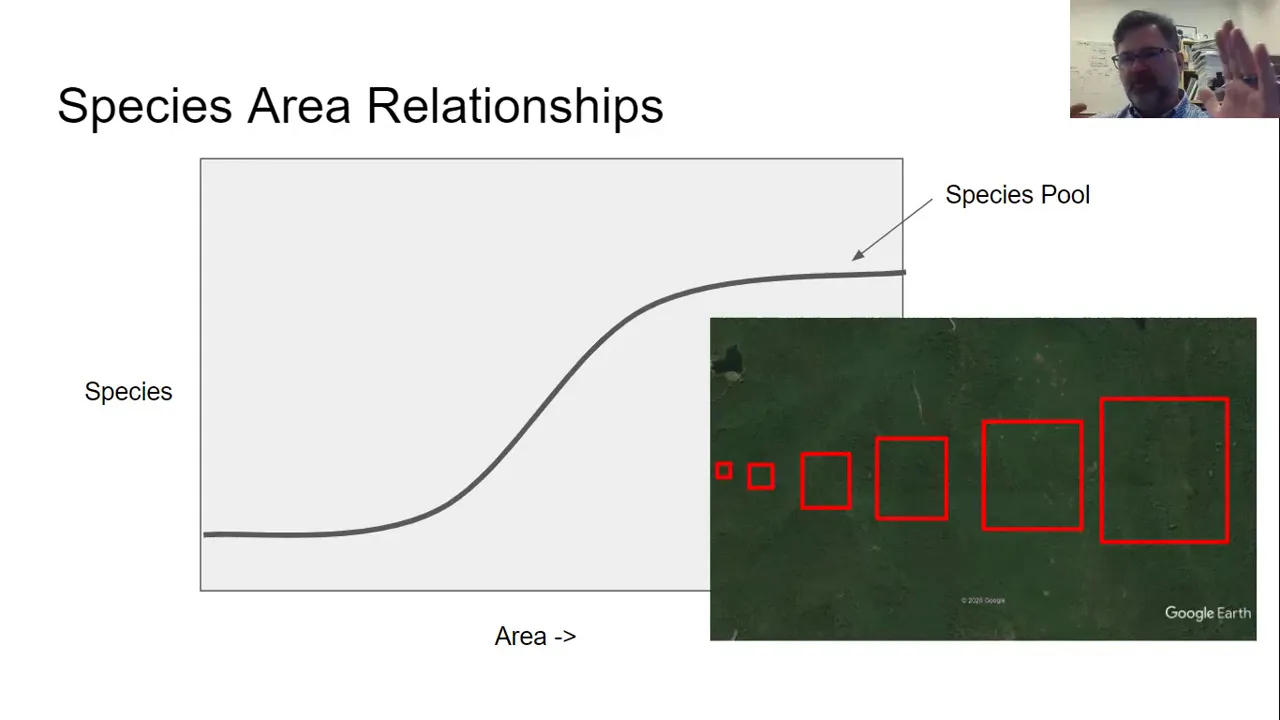

















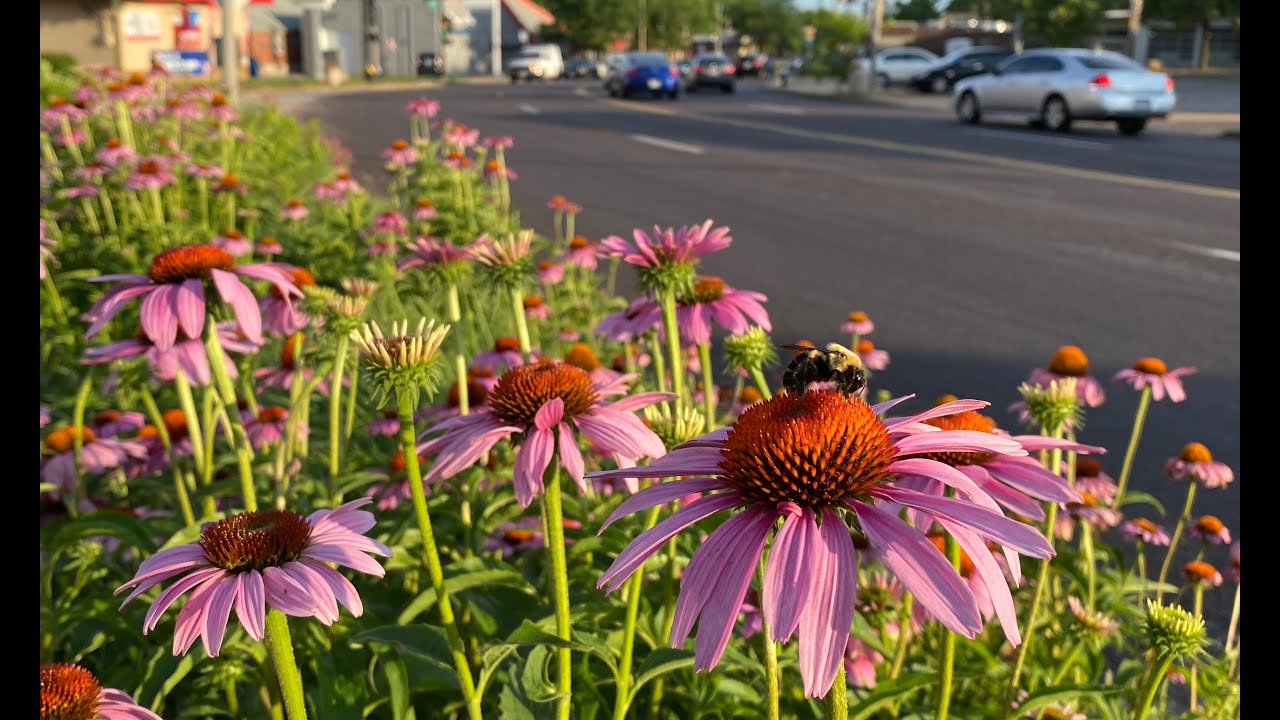


Landscape fragmentation, particularly from roads and urban areas, reduces wildlife population viability through four mechanisms: habitat loss, traffic mortality, road avoidance, and barrier effects. Computer simulations reveal that population viability follows a threshold relationship with road density—populations remain stable initially but suddenly collapse once a critical road density is reached. This threshold effect means that gradual landscape fragmentation may seem harmless until reaching a tipping point where populations go extinct. For most species, the threshold at which populations disappear is unknown, making it difficult to establish safe levels of landscape fragmentation for conservation planning.
Landscape Fragmentation: Wildlife Impact & Measurement (Jochen Jäger, Part 1)
Added:Basic principles of ecology and conservation biology, including the distinction between habitat loss and habitat fragmentation.
The Theory of Island Biogeography and its application to terrestrial habitat patches and 'islands'.
Fundamental concepts of metapopulation dynamics, gene flow, and wildlife migration patterns.
A general understanding of how spatial scale and geographic features influence species distribution.
Advanced landscape metrics for quantification, specifically Jochen Jäger's 'Effective Mesh Size' (UEM) method.
Designing and evaluating mitigation measures, such as wildlife crossings, ecoducts, and green infrastructure.
Threshold response modeling to predict ecological tipping points and extinction debt in fragmented habitats.
Integrating landscape connectivity metrics into urban planning, transportation ecology, and environmental impact assessments (EIAs).
751 views9likes14:18Original Release: 2013-02-28
first I want to present to you some important effects of landscape fragmentation then tackle the question how to measure landscape fragmentation talk a little bit about about mitigation measures and then try to conclude with 10 lessons and uh about this uh drawing here the Striking feature of this drawing is it's not new it was done in 1964 so the problem we're talking about really is an old problem and we are still suffering from it um here's an example from Switzerland you all know where Switzerland is uh and this is a map of Switzerland in 1885 which shows the sizes of the fragments all the barriers in the landscape such as roads and urban areas are shown in Black railway lines for example and then the patches uh have certain sizes and the colors indicate their size so large patches are shown in green or orange patches are pretty small and red patches are pretty tiny here's an example of a black area that's Geneva the cities are shown in Black here and uh to get this map we had to digitize old Maps so this really is the situation more than 100 years ago you got that's true very good thanks that's helpful so here is Zurich here's Basel here's burn and so on so now watch how the land cape has changed this is 1935 this is 1960 this is 1980 this this is 2002 so as you see these patches have shrunken quite a bit and uh of course the landscape is changing at a very rapid pace and it's still ongoing so as a result Wildlife populations are increasingly un meshed by roads and railway lines and urban area as a result we have more frequent encounters with Wildlife so this is an example from Canada so it shows you Canadian street gang of course this also results in a huge loss of wildlife through uh Wildlife mortality and sometimes it becomes difficult to recognize these Critters on the road so that's why there is a field guide out there called flat and FAA if Field Guide to common animals of Roads streets and highways and it shows you certain shapes of animals and you can compare that with the signs on the road uh to identify those Critters it's a written with lots of black humor however the issue of traffic mortality is really important this is an example from Eastern Germany where they did a study about otter being killed and compared that with all types of mortality and I found that it's almost 60% of mortality in ERS caused by traffic so traffic mortality for many Critters is a serious source of um threat however it's not only a threat for Animals it's also a problem for humans this is an example from Germany when you hit a bunch of wild boar with your cars or even larger Critters this is important in the sense that this is an issue that ministries of Transportation are worried about so sometimes you can get money for research when you address traffic traffic safety issues and then you try to sneak in issues of wildlife protection in the same project so what are the mechanisms of roads and traffic how do they affect Wildlife populations well there are four major effects among others the first one here is habitat l Lo and you have the road effect Zone which Richard Foreman has published about a lot because habitat loss is not just the surface of the road but also the effects extending from the road such as noise and light and so on second one is traffic mortality which youve just talked about the third one is Road avoidance or barrier effect so animals may not be able to cross the road for example if it's fenced or animals that would physically be able to cross the road may not want to do so because it's perceived as a risk or as a disturbance so they may avoid the road from some distance or they don't have um protection from predators and so on and the point now is that all these processes are always detrimental for the animals so they will reduce population size and at some point they will reduce the probability of population persistence when you combine these two effects two effects traffic mortality and Road avoidance you get what is also called a population subdivision so you're dividing up the landscape into smaller patches and the problem now becomes when these roads are a barrier that this patch of habitat it cannot be recolonized once it's empty you have small populations in smaller patches so they are fluctuating quite a bit and can easily go extinct and if this H piece of habitat is not accessible anymore because the road is a barrier or it's fenced then even though if it's very nice habitat very high quality it may be useless for the population because they cannot access it anymore so inaccessible habitat is kind of lost habitat and as you know habitat loss is the biggest uh problem biggest issue biggest cause of extinctions of species so as a result fragmented populations have a higher risk of Extinction if you fragment the landscape more and more you will lose more and more animals and the populations will be at higher risk the reasons are several one of which is demographic stochasticity if you have large populations and they fluctuate they will still not go extinct because they are far away from zero Over time however if you have a population it fluctuates and it's closer to zero so it may easily go to zero which means it's extinct and then it's gone um the other problem I mentioned is lack of recolonization of empty habitats once empty habitats once habitats go empty because the population is so small it cannot be recolonized if the barrier is too strong and many animals also need different habitat types to complete their life cycle two or three or four different habitat types for example breathing habitat and overwintering habitat and if they can't get from one habitat type to the other across the barrier then they cannot survive so one question then becomes what happens if we put more and more barriers into the landscape more and more roads for example it will reduce population persistence probability however how does this work so if we have a diagram and put roads on the x-axis Road density and show on the other axis population viability what would you expect the relationship to look like would you expect to see a linear relationship going down like this or would you expect a threshold so that's a real question what do you expect so make your choice you don't have to tell me but make your choice ready so that was one of the questions I looked at during my postto and I did a computer simulation model for it and to study this research questions are there thresholds in the effect of Road density on the viability of wildlife populations and I used a simulation model a spatially explicit individual based stochastic simulation model where the landscape is represented by a grid like this so the road is in the center and four things can happen when animals move around in the landscape so either they move and they don't encounter the road then they are fine maybe they move and they successfully Traverse trans uh Traverse the road or they move and avoid the road so in the model they are just reflected at the Road or they try to cross and they get killed by traffic those are the four things and I won't tell you about all the details about the model I just tell you about the result and it looks like this so that means the more roads you put into your landscape uh the more population viability will be reduced but it follows a threshold so that means at first the population will still survive so you add roads and add roads and then you may think well it survived the previous roads why not add three or four more roads but the problem is if you're close to the threshold suddenly the population may go extinct now this would be nice information to have for planning right um well you can try to look at some empirical data this is an example from Switzerland looking at brown hair so here's row density measured and here is hair abundance and you see a pretty strong relationship in this situation and you can see at some point abundance will go down to zero right here at this road density right so here populations are not only affected by roads it's many other things Agricultural intensification and so on but roads are an important part of the story so what we would like to have is the knowledge how much is too much how much Road density is too much so our wish would be if in an Ideal World we have our degree of fragmentation and we know po population persistence probability and then we would just say well we are still fine with say 90% or 95% or 99% uh persistence probability over so many generations maybe 30 generations and then we would say this is the maximum level of allowed fragmentation then we could plan with this so planners love threshold however we don't know we don't know this answer we have some idea for some species and here's the complete almost complete list of what we know for these species so species like wolves elk black bear bull trout and some others we know those thresholds but of course there are many more species out there so that means for most species we don't know where the threshold is and even for these species we don't know this threshold what we know is when do they disappear so that's this threshold and that's a different threshold when we use this threshold that's far too late because at this point species will go extinct if they are still around at this level of degree of fragmentation that means they are just still declining and will go extinct in a few years or maybe in a few decades so this threshold is too much already so we have to find some different way of dealing with this well there are quite a number of effects of landscape fragmentation uh in particular of roads but other elements as well and you can group them into seven themes land cover local climate emissions water flora and FAA landscape scenery and land use but I don't have enough space to talk about all of these so that's why I'll just show you a summary which looks like this and because you can't read this I will hand out a paper copy if you may just take a sheet and there you can read up on it um so I'm just highlighting a few examples from this one section here flora and FAA and if you want to read more on it I recommend this report to you landscape fragmentation in Europe where you find more information so how are we dealing with these environmental effects in environmental impact assessment well this was one question in this review paper uh by goner at Al biodiversity and environmental assessment current practice and tools for prediction and the main result of this paper is that first biodiversity assessment was confined to local scales only which does not allow the assessment of of the effects of habitat loss and fragmentation second there is a lack of quantifications and methods for impact predictions and third for the development it seems that development and imp implementation of new methods is necessary to tackle this problem so basically the message is in real environmental impact assessments we are doing pretty bad
Up Next
92:51
Road Ecology in the Anthropocene: Lessons from Banff
@BCWildlifeFederation
694 views•2021-06-30

15:54
Life in Biosphere 2: Sustainable Ecosystems & Human Survival
@TED
334.9K views•2009-06-16
14:30
Microplastics Everywhere: How Plastic Impacts Our Lives
@TEDx
100.9K views•2018-05-08
10:28
Ice Stupa Artificial Glaciers: Solving Ladakh's Water Crisis
@SonamWangchuk66
3.2M views•2015-05-03
Related Study Plans & Knowledge Roadmaps
Structured learning paths in Environmental Science
environmental-science
Ocean Noise: Cetacean Impacts & Mitigation
01Fundamentals of Underwater Acoustics
02Marine Mammal Bioacoustics
03Anthropogenic Noise: Shipping & Seismic Surveying
+ 2 more learning modules
16h5 modules
Explore Roadmap
environmental-science
Road Ecology: Corridors, Overpasses & Fencing
01Foundations of Habitat Fragmentation and Carnivore Ecology
02The Road Barrier: Ecological Impacts of Transport Infrastructure
03Principles of Ecological Corridors and Connectivity Mapping
+ 3 more learning modules
14h6 modules
Explore Roadmap
environmental-science
Ocean Acidification: Kelp Buffering & Shellfish
01Fundamentals of Ocean Chemistry & pH
02Chemical Pathways of Coastal Acidification
03Bivalve Physiology & Calcification Under Stress
+ 2 more learning modules
18h5 modules
Explore Roadmap
environmental-science
Ice Stupas: Glacial Retreat & Water Security
01Foundations of Glaciology & Mountain Hydrology
02Climate Change and Glacial Retreat Dynamics
03The Science of Ice Stupas & Artificial Glaciers
+ 2 more learning modules
14h5 modules
Explore Roadmap