





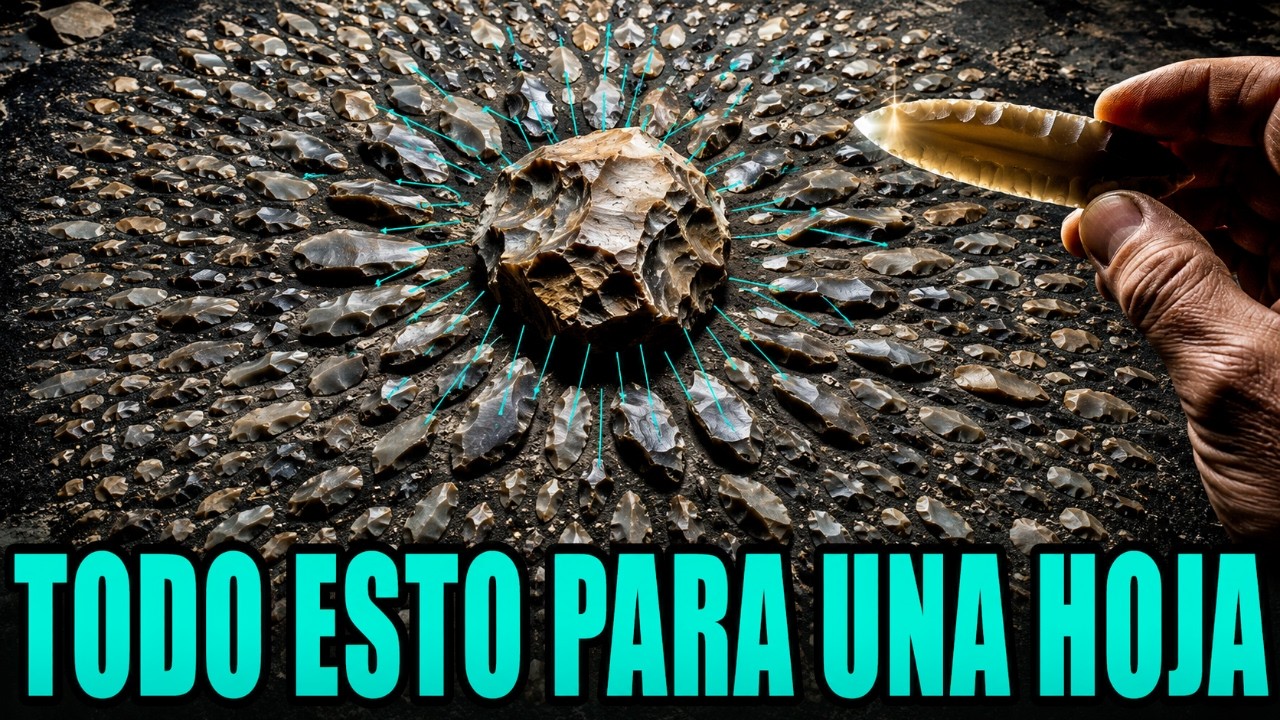


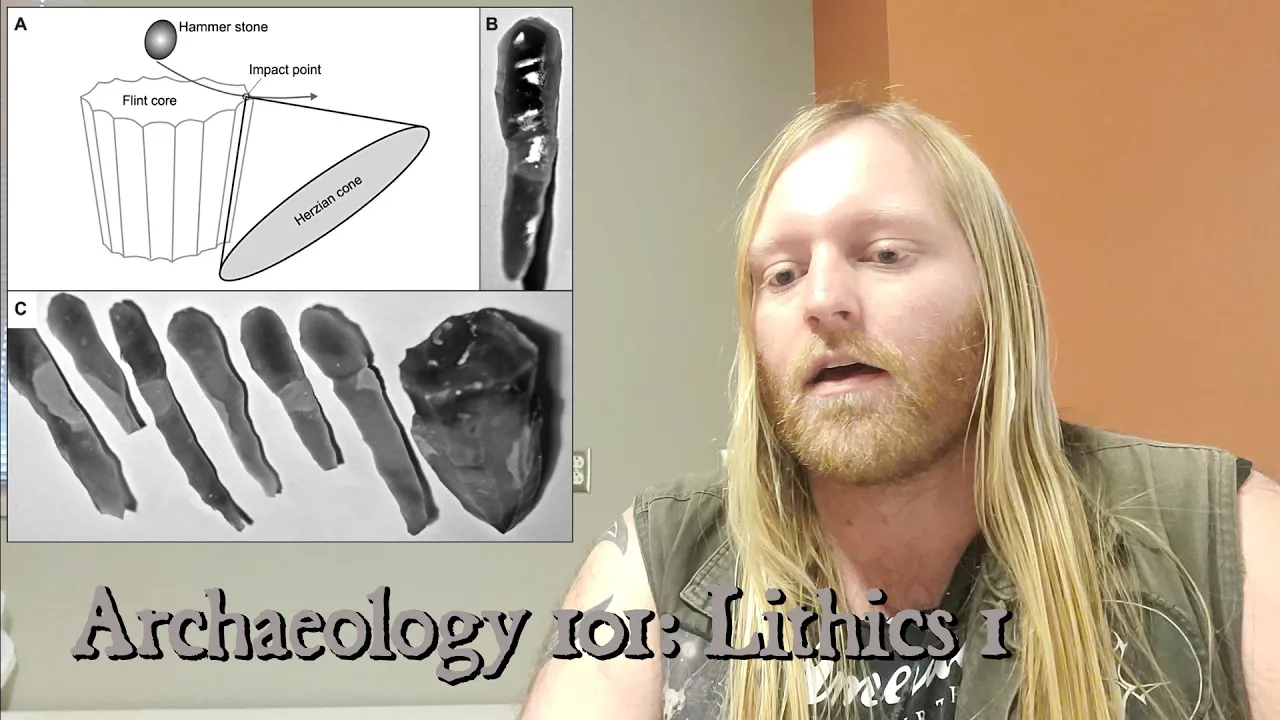























Oldowan stone tools, dating from 2.6 to 1.9 million years ago, represent the earliest known stone tool industry, characterized by direct percussion techniques where early humans held both the core and hammer stone in hand to strike and produce flakes with greater precision than earlier methods; this technology produced various tool types including casual cores, polyhedral cores, discoid cores, flat platform cores, bipolar cores, and choppers, which were used for multiple purposes such as cutting, chopping, and processing materials.
How to Make Oldowan Stone Tools | 2.6-1.9 Million Years Ago
Added:Introduction to early hominin evolution, specifically focusing on Australopithecus and early Homo (such as Homo habilis) during the Pliocene-Pleistocene transition.
Basic rock mechanics and fracture dynamics, particularly 'conchoidal fracture' which allows certain stones like chert, flint, or basalt to flake predictably.
Fundamental archaeological terminology of lithic technology, specifically the distinction between a 'core' (the parent block) and a 'flake' (the detached fragment).
The dietary and ecological shifts of early hominins, emphasizing the transition toward meat-eating, scavenging, and the adaptive need for sharp cutting edges.
The Acheulean tool industry, analyzing how tool-making evolved from simple Oldowan flakes to symmetrical, bifacial handaxes associated with Homo erectus.
The cognitive and neurological implications of tool manufacturing, exploring how stone knapping relates to brain encephalization and the development of language.
Experimental archaeology methodologies, specifically how modern researchers replicate stone tools to study ancient motor skills and raw material selectivity.
Use-wear analysis (traceology), examining microscopic wear patterns on stone tool edges to determine whether they were used for butchery, woodworking, or plant processing.
12.9K views272likes12:02Original Release: 2017-04-08
[Music] hello everybody Jeremy trick here I hope you all doing great today so easy in front of you this is basically what and my real life archeology lab looks like this is just one but there's a couple of other facts stored and a couple of artifacts laying out on the table for the students coming for a practice afternoon and in the drawers we have like a collection of some artifacts and tools for teaching purposes you can see just some of the local arms or South African parts that you get from different cultures from like the last few hundred years and they're also used for the teaching okay guys so today I'm gonna show you the old one which is basically the time period you get after than my Koran which I showed you in the last video so these tools range from about the age of 2.6 million years they're about 1.9 million years where we get a different time period called the shooting which I will probably cover in the next video so you get different types of tools and different types of techniques which are being used now so in the previous video I showed you that they would take a core and then they'd smash it against an anvil to get the flight but with the older one they'd basically have a cobble or a core in hand and then they'd have a hammer stone and they would strike that holding the core in their hand now this gave them a lot more accuracy and a lot more precision so they could refine their tools and get exactly what they want rather than make a mistake that doesn't quite go to plan so you get different types of cause and different types of tools but the main tool they were after with these place of course places you saw in the Ross video is very sharp and they could be used for multitude of purposes now the flex before in this time period is slightly smaller because I guess if you're holding cores in your hands you get slightly smaller place overall but that doesn't really slow down the ability to make you know other tools that are wood or to put your things it gives you a little bit more precision holding a smaller flake as well of course not too small I'm at a fairly decent average size all right so the types of calls we get well first let me talk about the hammer stone so of course because they're using a core or another cobble for a hammer stone you tend to find these stones that have a lot of bashing on a side or a couple of sides and these are called the hammer stones they're basically going to shape the other tools with that stone and here's just another one for example sometimes when they've been used too much they break and then you get some flakes that come on for them okay now you get like the simplest core would be the casual core which is just a cobble with like one flake removed now be remind you find these naturally all the time because in Reverse rocks smash against one another and they dislodge these flakes but if you find this in context with some of the rest of the tools or you find these cobbles like away from any River source or anything where you would naturally find cobbles it's likely they will move there by someone and napped into tools or they just needed to play from that alright so other calls you get a very common one is the polyhedral call it's basically a call for a bunch of different solids and they would take a cobble or a piece of rub and then just take flakes off from every single angle that they can until there's no longer any angles available or until they feel they've had enough flakes and they range in a bunch of different shapes and sizes some of them small some of them pretty big all right so the course would be the discord all right by the name you can see exactly what is called discord it's sort of a centripetal cone way they would flake the one side going around in a circle and the other side going around in a circle as well they could alternate I guess but yeah the overall shape eventually you get this centripetal core and you could still continue for a little bit although the angle and this one's already quite steep this one for example there is still some space today some flakes you can see it's a nice little disc shape all right um let me get the flat platform course which are basically one side is completely flat and then they'd use this sort of angle on an edge and take the brakes off all around the edge this so you can see there is some that's nice place that have been removed before alright here's just another one alright and then we also get something called bipolar call now it's basically a small trouble or something that's more manageable to hold and what they do is they would put this on top of a rock and then smash it with another work so you tend to get the rocks or flaking into these Irish segments slices and if done correctly you get some pretty decent for extreme ladders web alright and then one thing we do find which is quite strange are these spherical pieces not every single although one side has them but some do and at first we thought they might have been used for hammer stones but not all of them show indication of hammer stone usage so we're not 100% sure why they made this or why they collected these they are a bunch of different theories but I suppose no one can prove exactly what they were for so I guess you can speculate for yourself now Chiapas is normally a Kabul we're just the one edge they knock these little flakes off to create sort of like a sharp edge now we call them choppers because they look like you can chop things all right so that's basically it for the old one and I will show you how to make a couple of these hello everyone yes so sorry about this video taking quite a long time to get out but it's because mainly I had a bit of an accident with my finger as I tended to bust it pretty badly and you can't really make some tools with a seriously injured finger so it's taken me a couple of weeks to recover from them but I'm back now and I'm gonna show you how to make some of the older one tools right so with the previous video remember that I mentioned the Lemurian technology the people used rocks against one another to get the flesh but in the older one we see that they would actually hold both the core and the hammer stone in the hand and then flake like that now and that probably gives them a lot more precision to try it on just this little sort of super cobble reflect that was taken from a cobble in a riverbed and just get a couple of flakes off from it right so they would hold the flakes in their hands or the cores in their hands like stone and then just strike along the edge to try and get some nice place to come that's not you can see some nice place like this we find quite commonly in the old one some sharp edges it can be used for all sorts of techniques like I showed in a previous video so that's the basic technique you don't let it home kids could be dangerous yeah funny enough I've broken this finger before and this one I pretty much completely squashed but I've never hurt myself seriously doing stunts or making it so this is basically like a chopper so if you look at the rest of the tool there hasn't been much flaking around and the rest it just one edge you can see it's inflated on both sides creating this sort of nice jagged sharp edge um so I guess we call them choppers because they look like you can actually use them for some sort of chopping action maybe through Bono's on some wood material right so that's the chopper so here's a nicer flat platform over there and so we're going to try and get some flakes off this dude she basically just struggling the edge of their platform small all right now I don't know if the old one people would have done this but a great way of supporting where your ex come off is using your fingers at the back ashes to the Rick laforce it doesn't seem like they're quite mastered ethic you can get old one I'm so just doing it as habit making you lazy types to go no nice like from they're very very sharp I think that is super super sharp all right and that's a pretty decent flick for usage that's basically the flat platform core is you just go on edge or around the edges until you have got enough place but you know me and to just keep the one platform consistent right all right then after this time period we hit the issue in which I'll likely cover in the next episode it might have a little while because I'll have to find the resources to make robots hand axes and I'm pushing I don't really have that much puzzle at the moment so it might take me a while to get the cobbles and everything they are needful that because you do require more specific materials than just little cobbles or flakes and things so left to look around and see what I can find for that and hopefully I'll get a nice enough piece to show you how to make a hand ax because hand axes are pretty cool and most people know about those ones and then after that we'll start to get into the time period where people actually first appeared I call the Middle Stone Age and that's when we start to see things like arrowheads and blades and some very very intricate tools radio so that's it for me today I hope you enjoy the video I hope it's informative and yes thank you for watching Cheers that's a terrible you
Up Next

58:21
Why Homo Sapiens Dominated Earth: The Evolution of Human Tool Use
@HistoryofHumankind
838.8K views•2024-11-27

12:54
Triumph of Orthodoxy Icon: Byzantine Art & History Explained
@BenCallan
2.1K views•2024-08-06

9:49
FastAPI vs Flask vs Django: Choosing the Right Python Web Framework
@TechWithTim
302.5K views•2024-05-26

1:42
Game of Thrones Opening Credits: A Cinematic Analysis
@gameofthrones
46.3M views•2011-04-18
Related Study Plans & Knowledge Roadmaps
Structured learning paths in General & Interdisciplinary Studies
general-studies
Elevator Engineering: History, Physics & Cities
01From Hoists to Safety Brakes: The Dawn of Vertical Lift
02Hydraulic vs. Traction: The Engineering Physics of Elevators
03Modern Speed, Safety, and Algorithms
+ 2 more learning modules
12h5 modules
Explore Roadmap
general-studies
Rubber: Material Science, History & Geopolitics
01Origins of Natural Rubber & Mesoamerican History
02The Chemistry of Natural Rubber & Vulcanization
03The Geopolitics of the Rubber Boom & Colonization
+ 2 more learning modules
12h5 modules
Explore Roadmap
general-studies
Containerization: Evolution, Logistics & Trade
01Ancient Trade & Bulk Cargo: Amphorae to Barrels
02The Industrial Revolution & Cardboard Packaging
03The Containerization Revolution: Malcom McLean
+ 2 more learning modules
12h5 modules
Explore Roadmap
general-studies
Textile Tech: Evolution, Labor & Global Impact
01Pre-Industrial Textiles: Handloom & Cottage Industry
02Mechanization: The Spinning Jenny to the Power Loom
03The Factory System & Global Labor Transformation
+ 2 more learning modules
10h5 modules
Explore Roadmap