










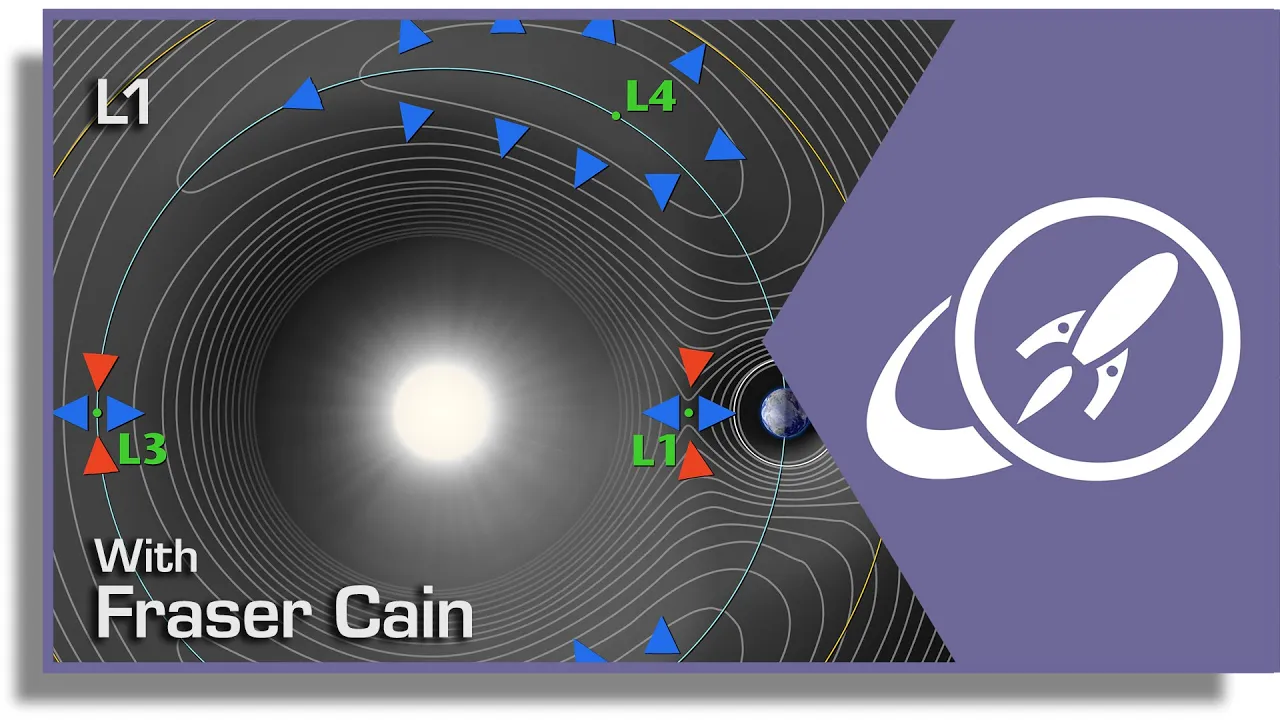




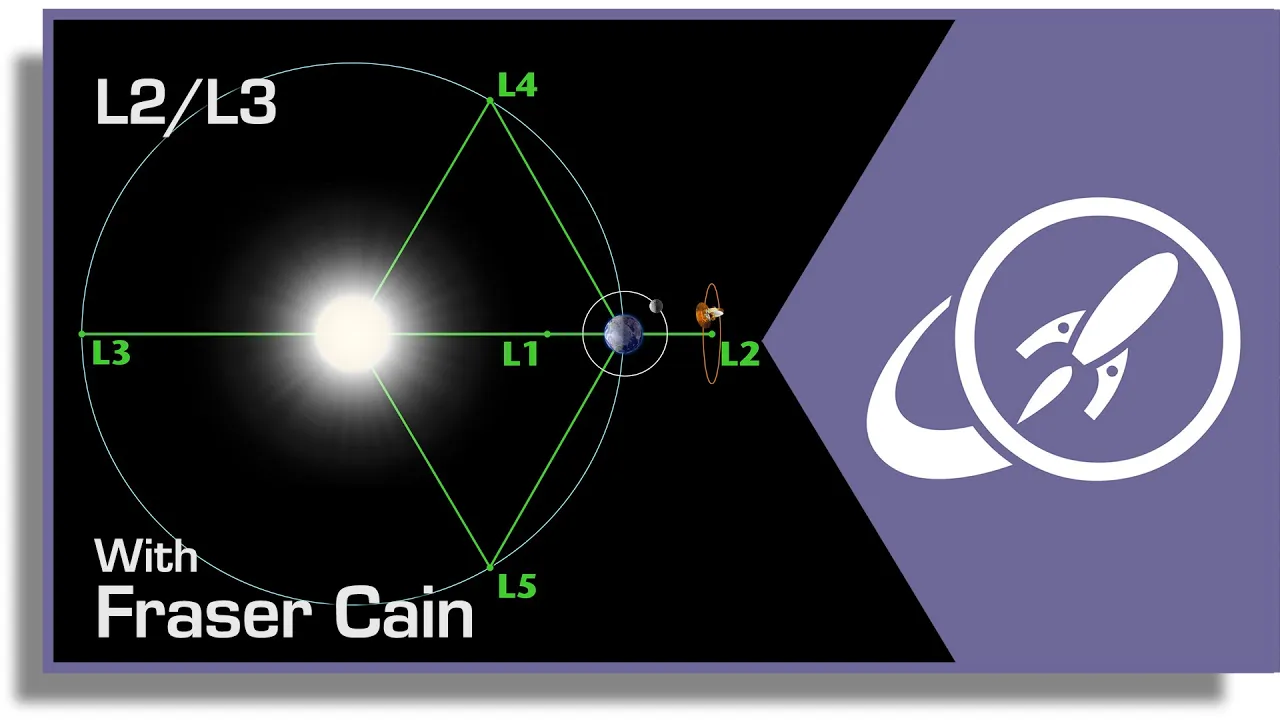

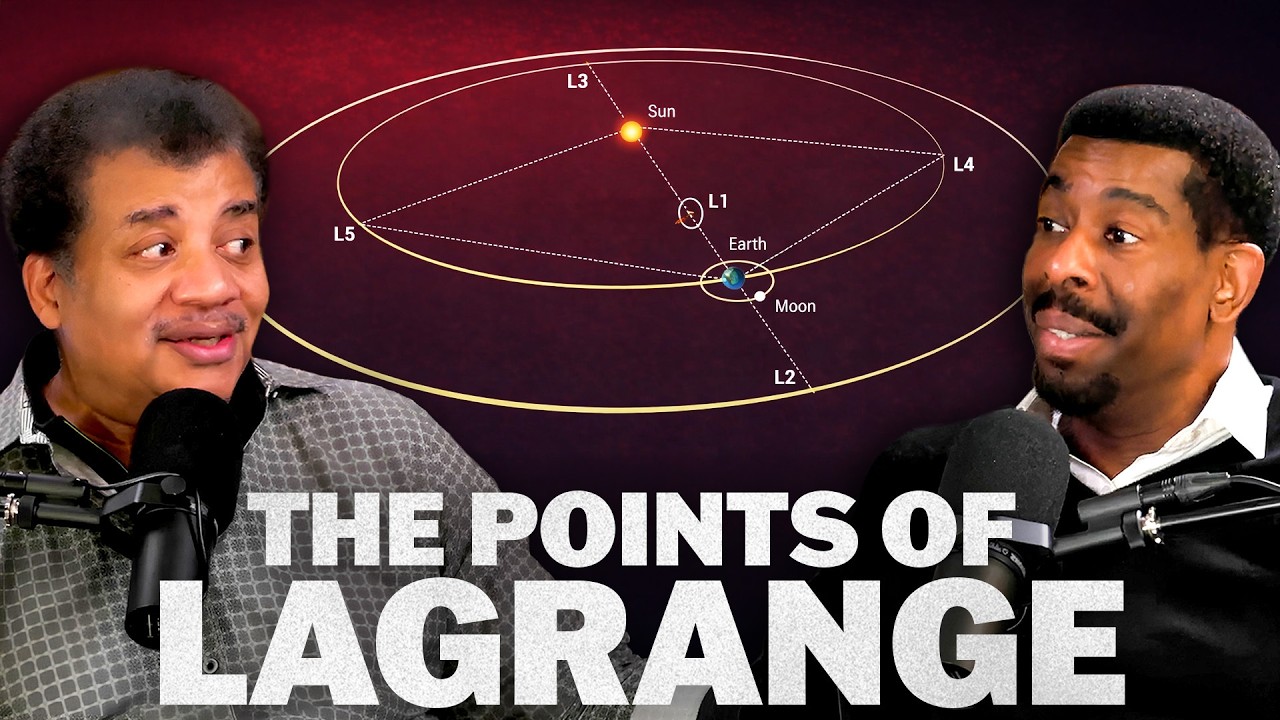




Lagrange points are five special locations in space where gravitational and centrifugal forces from two orbiting bodies cancel out, allowing objects to remain stationary with minimal propulsion; discovered by Euler (L1-L3) and Lagrange (L4-L5) in the 18th century, these points arise from solving the restricted three-body problem, where L4 and L5 form equilateral triangles with the two primary bodies and are stabilized by the Coriolis force when the secondary body's mass is less than about 1/25 of the primary's mass, making them ideal for spacecraft positioning like the James Webb Space Telescope at Earth's L2 point.
What Are Lagrange Points? Their Role in Space Missions Explained
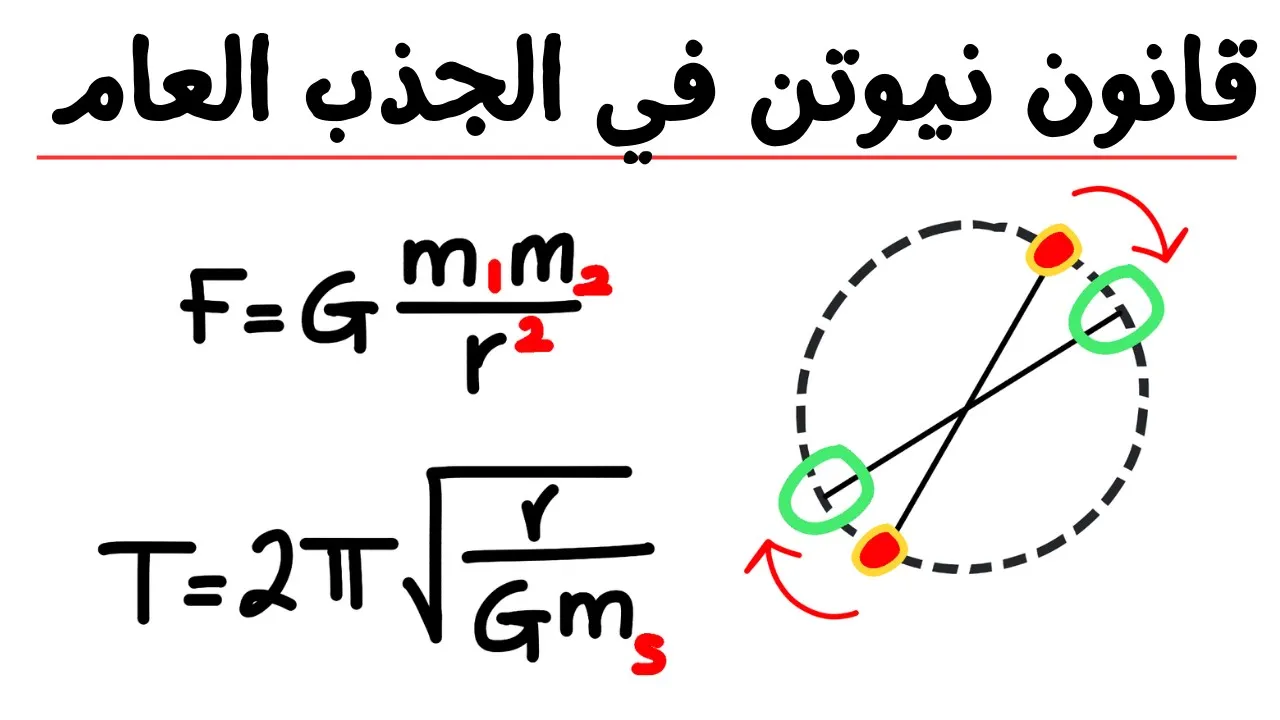
Added:Newton's Law of Universal Gravitation and how gravitational force scales with mass and distance.
Basics of orbital mechanics, specifically how centripetal force keeps an object in orbit.
The concept of net force and dynamic equilibrium in physics.
An introductory understanding of the Three-Body Problem, which describes the movement of three bodies under mutual gravitational attraction.
The mathematical and physical differences between stable (L4, L5) and unstable (L1, L2, L3) Lagrange points.
The dynamics of Halo orbits and Lissajous orbits used by spacecraft to 'orbit' a Lagrange point.
Case studies of key space missions, such as the James Webb Space Telescope at L2 and the SOHO satellite at L1.
The study of Trojan asteroids and other natural celestial bodies captured at planetary L4 and L5 points.
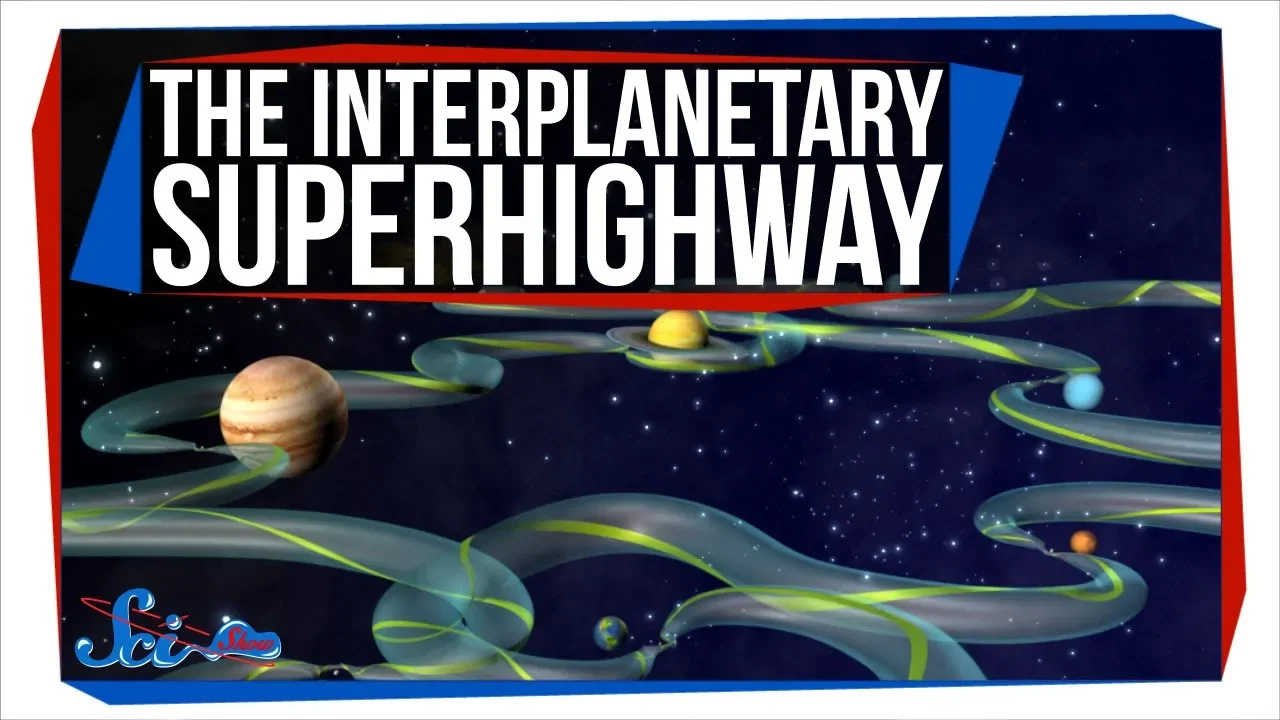
The concept of the Interplanetary Superhighway, which utilizes weak stability boundaries and Lagrange points for fuel-efficient space travel.
1.6M views47.8Klikes13:30Original Release: 2021-10-15
hello it's scott manley here today i want to talk to you about lagrange points lagrange points often come up in orbital mechanics they're places in deep space where you can put a spacecraft and it can kind of chill out there and roughly remain where it is without expending too much propellant to stay there there are points in space that are relative to a central body and another object orbiting it so there are lagrange points that are around the sun and earth system the sun jupiter system or even the earth and moon system you have two massive bodies orbiting each other they're named after joseph louis lagrange a french mathematician who published a work on the three body problem in 1772 but at least three of the points were discovered back in 1722 by leonard euler the three body problem in orbital mechanics is where you have three self-gravitating bodies interacting and moving around and it turns out that the three-body problem generally isn't something that is easily solvable over a century before lagrange's work isaac newton showed that the two body system was perfectly solvable if you had two gravitational bodies orbiting each other and you knew its state you could calculate that state into the future or the past using nothing more than a paper and pencil and maybe some tables for trigonometry and logarithms but adding a third body just leads to chaos there's usually no analytical solutions to three body problems instead you need to integrate the equations of motion stepwise you know stepping them forwards in time slowly until you get to the time period that you're interested in it's a kind of repetitive boring math that is perfect for a computer but not very good to carry out by hand lagrange points are exact solutions to the three-body problem where the forces on the particles are perfectly balanced and the whole system just rotates without changing any of its internal distances so therefore it's stable unchanging and you can calculate the state at any point in the future or the past now to get these lagrange actually started out with an even simpler version of the problem the circular coplanar restricted three-body problem in this version only two of the bodies have mass and they are put in zero eccentricity circular orbits the third particle is massless and its only constraint is that it starts out in the same orbital plane as these two objects so what you've got is a two-dimensional solution so that makes it simpler but also the two heavy particles cannot have their mo their orbits changed therefore you know exactly where they will be for all future and past the big question mark is the third object and there's still plenty enough chaos to go around now this simplified system isn't realistic in real astronomical systems the primary bodies will have orbital eccentricities their orbits won't be perfectly circular the particle that you're following may have mass of its own and it's probably not rotating in the plane but if you look at you know the real earth moon system there are effects from the sun there are effects from jupiter possibly but we still do see lagrange points that are useful so anyway starting with this highly simplified system lagrange identified five locations where if you placed a particle of zero mass with exactly the right velocity it would remain in that location relative to the other objects and therefore you could calculate its position forwards in time forever now of course lagrange did this using paper and pen math and geometry and it all was obvious to smart people but i think it's a lot easier to look at this in terms of forces so we've got a model here where the yellow object is the massive body the blue object is a much smaller one and they're sitting on a flat plane and we're going to use this plane as a stand-in for the forces so the first forces that we can think about are the forces of gravity generated by these objects so here we've curved the surface to represent the gravitational potential and you'll notice it just kind of shrinks down to this funnel like shaped object and the idea is if you place a test particle on this it will want to roll downhill into that big hole just as if we're being attracted by the gravity of that yellow object now the second object also has its own gravity well it's a lot smaller because its body's mass is a lot lower and you can of course combine these two to give you the combined gravitational potential of the system now depending upon where your test particle starts it'll roll downhill and it could go into one gravity well or the other and this is of course true for both these bodies the gravity makes them want to fall towards each other but the formulation says that they are rotating around each other in circular orbits that's this is what it kind of looks like now for lagrange he looked at it in a rotating point of view and you probably know that if you're in an environment that is rotating such as say a rotating room you will feel a force towards the outside this is a fictional centrifugal force so we can treat this fictional force just like we've treated gravity we can turn it into a potential surface and you can imagine that an object placed on this will tend to roll downhill away from the center as if it's feeling a force pushing it away from the center so now let's add up all these forces the gravitational forces and the centrifugal forces and we get this complex surface shape and because this is a video rather than a slideshow let's show you it rotating in three dimensions so you can get an idea of the shape of this surface so remember if you put a marble on the surface it will tend to roll downhill we are looking for places where it won't roll downhill where it could be stable some of you might find it easier to look at this contour plot if you're a map reader you can see the hills and the valleys here but of course lagrange and euler they did this just using good old-fashioned math so the first lagrange point or l1 sits between the two bodies on this saddle point between the two gravity wells this is perfectly balanced between both bodies but if it's pushed even slightly it will fall into one or the other l2 is on the far side of the low mass body and again it's on a saddle point this is also perfectly balanced between being captured by the small body and flying off into a higher orbit and l3 is on the far side of the large body and again this is sort of balanced between being captured by the main body or going on into a higher orbit so l one through three were all actually discovered by leonard euler about 50 years before lagrange's work but lagrange did figure out l4 which is on a peak in the potential and l5 which is on the other side now these two together they both form equilateral triangles with the two bodies and that means that jupiter's lagrange points are as far from jupiter as sun is from jupiter now many of you will have heard that l4 and l5 are stable but if you look at this that doesn't look stable right those things if they're pushed slightly away from those hilltops they'll tend to roll downhill and away from the lagrange point and look here's a really simple demo where i've got the moon and the earth and some objects in the same orbit as the moon and we run time forwards and very quickly a lot of the objects get kicked off into different orbits some fall down some go up but the objects in l4 and l5 remain in the same places and the reason they can remain here is because of the coriolis force you see all these potential surfaces we've been drawing are assuming a rotating environment with a fixed object but as soon as an object starts moving in a rotating environment it experiences the coriolis force so this force is always going to be at 90 degrees to the direction of motion and if you've got a force at 90 degrees to the direction of motion it forces you to move in circles and so that's why l4 and l5 can be stable but wait i hear you say why doesn't the coriolis force stabilize the other lagrange points and the answer is the coriolis force isn't the only thing acting on it it's also got the forces from this you're rolling around on these curved surfaces and if it starts at l one through three then it's on a saddle point if it rolls down away from it comes sideways and it gets pushed back up it's gonna find that it has to go up higher which would mean it need to get energy from somewhere so the saddle points don't really support this kind of rotation now if you start up on the edge of the ridge then there are ways to move around this but they're not stable but the other thing is the coriolis force is only sufficient if the curvature near the point is sufficiently low if things don't go downhill too fast the shape of this potential surface depends upon the mass ratio between the primary and the secondary body and as the secondary body gets larger the peaks at l4 and l5 become sharper and that makes them less and less forgiving to the coriolis force so it turns out that if the mass of the secondary body is more than about 1 25th of the mass of the primary then l4 and l5 are no longer stable so that means that jupiter with a mass of 1000th that of the sun is able to stabilize its l4 and l5 points but out on the edge of the solar system pluto and charon the mass ratio is only 8 to 1 so that shouldn't have stable l4 and l5 points the earth moon mass ratio is about 81 to 1 and that would in theory make the l4 and l5 points in the lunar system stable that's why gerard o'neill said let's put space colonies at l4 and l5 they'll be stable however at this point this is where our model starts to sort of see its limits because the earth and the immune system are orbiting around the sun and also the moon has an eccentric orbit relative to the earth and it turns out that if you start to do long-term integrations and modeling of this the the l4 and l5 points aren't totally stable around the earth and the moon but that's fine they're still very useful while lagrange's idealized model doesn't exist in reality real orbits are close enough that they do get stable regions near these lagrange points and they can be exploited by spacecraft for example which can sit there one fine example is putting a spit satellite at the l2 point on the far side of the moon in a halo orbit so this appears to orbit the lagrange point in space and this is really useful because by taking this halo orbit the earth always has line of sight to the satellite and the satellite always has line of sight to the far side of the moon it's very useful if you want to communicate to a spacecraft on the far side of the moon like changa4 now we know that l2 isn't stable but we can see also that the potential gradients are a lot less in these regions so you can actually sit spacecraft near these and let the local forces kind of push them around orbits are possible but they require constant maintenance it's worth noting that if it gets ahead or behind its point then there is a force actually pushing it back towards the center but also when you look at these halo orbits from an outside observer they don't actually look like circular orbits they just look like sort of orbits that are wobbling up and down relative to the secondary body for the earth's sun system the l1 and l2 points are very important locations for spacecraft so in the l1 point that puts them closer to the sun which is very useful if you're studying the sun because it means the earth doesn't get in the way it also means you get to see plasma and other you know solar wind events before they reach the earth so this is discover which also had a camera looking back at the earth and i plotted its orbit over time so you can see how its viewpoint of earth changes as it liberates around this lagrange point the l2 point is on the far side of earth and that's great if you want to look at the sky and not have the earth ever be in your field of view so it's a great place to put space telescopes such as the james webb space telescope which is planned to go there again this isn't a passively stable orbit it needs regular correction to make sure that it doesn't drift away from this location and either fall back towards the earth or further off into deep space and at this point i would usually be making some joke about jwst's historic delays but actually the spacecraft has just arrived in south america so hopefully we will be seeing this in this orbit in the coming year and all more than a little to a couple of 18th century mathematicians i'm scott manley fly safe [Music] you
Up Next
14:40
James Webb Space Telescope: Orbiting the Sun-Earth L2 Point
@LaunchPadAstronomy
2.3M views•2022-01-28

12:53
21cm Hyperfine Transition in Neutral Hydrogen: Radio Astronomy Basics
@AaronRobertParsons
12.4K views•2011-10-13

32:32
NMR Spin Physics I: Zeeman Effect, Resonance Condition & Larmor Frequency
@nptel-indianinstituteofsci8064
2.3K views•2024-01-17

27:14
Entropy and the Second Law of Thermodynamics Explained
@veritasium
27.5M views•2023-07-01
Related Study Plans & Knowledge Roadmaps
Structured learning paths in Physics
physics
Nuclear Physics (Decay, Fission & Reactors)
01Atomic Structure and the Binding Force
02Radioactive Decay and Half-Life
03Nuclear Fission Mechanics and Chain Reactions
+ 2 more learning modules
12h5 modules
Explore Roadmap
physics
Soft Matter (Polymers, Colloids & Rheology)
01Foundations of Soft Matter & Thermal Forces
02Polymer Physics and Macromolecules
03Colloids, Surfactants, and Self-Assembly
+ 2 more learning modules
38h5 modules
Explore Roadmap
physics
Analytical Mechanics: Lagrangian & Hamiltonian
01Mathematical Foundations: Calculus of Variations
02From Newtonian Mechanics to Constraint Dynamics
03The Principle of Least Action & Lagrangian Mechanics
+ 3 more learning modules
28h6 modules
Explore Roadmap
physics
General Relativity (Spacetime & Cosmology)
01Foundations of Relativity: Special Relativity
02The Geometry of Spacetime: Equivalence Principle & Curvature
03Einstein's Field Equations: The Mathematics of Gravity
+ 2 more learning modules
55h5 modules
Explore Roadmap