









![[Curso de extensão] A Engenharia das Missões Espaciais: Introdução ao Curso e Mecânica Orbital](https://i.ytimg.com/vi/NcoIIqPf4dU/maxresdefault.jpg)

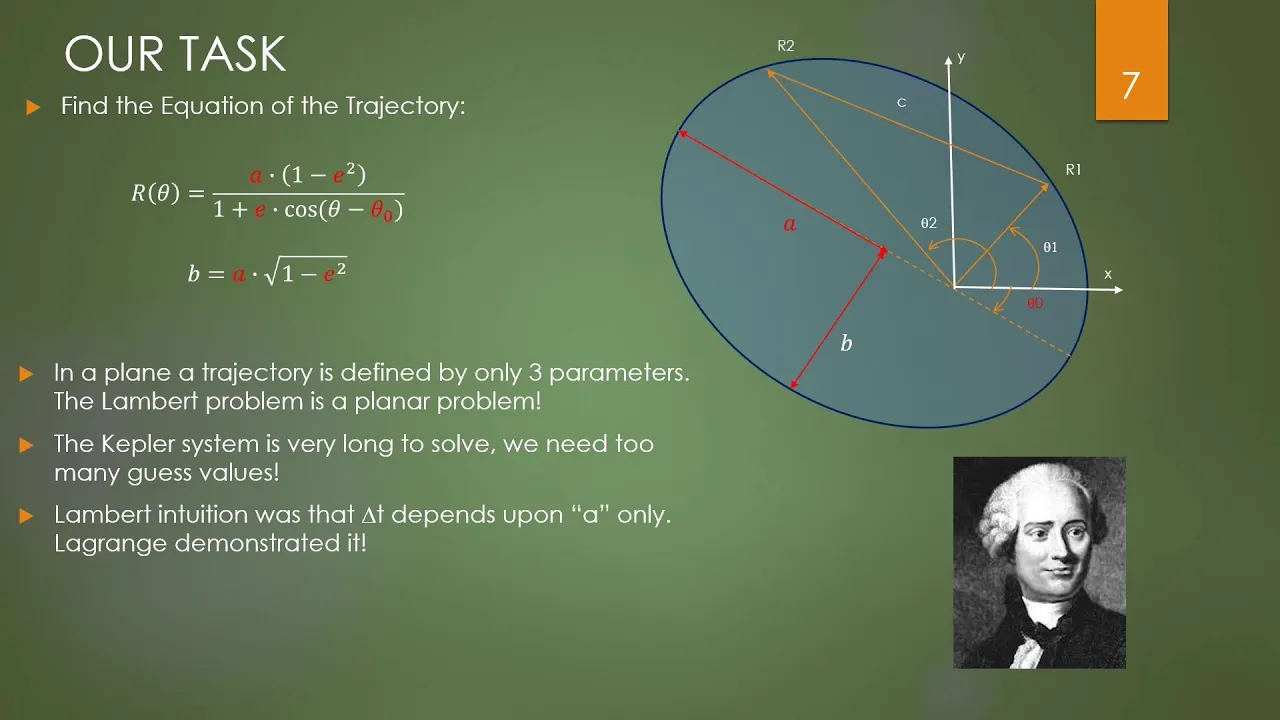

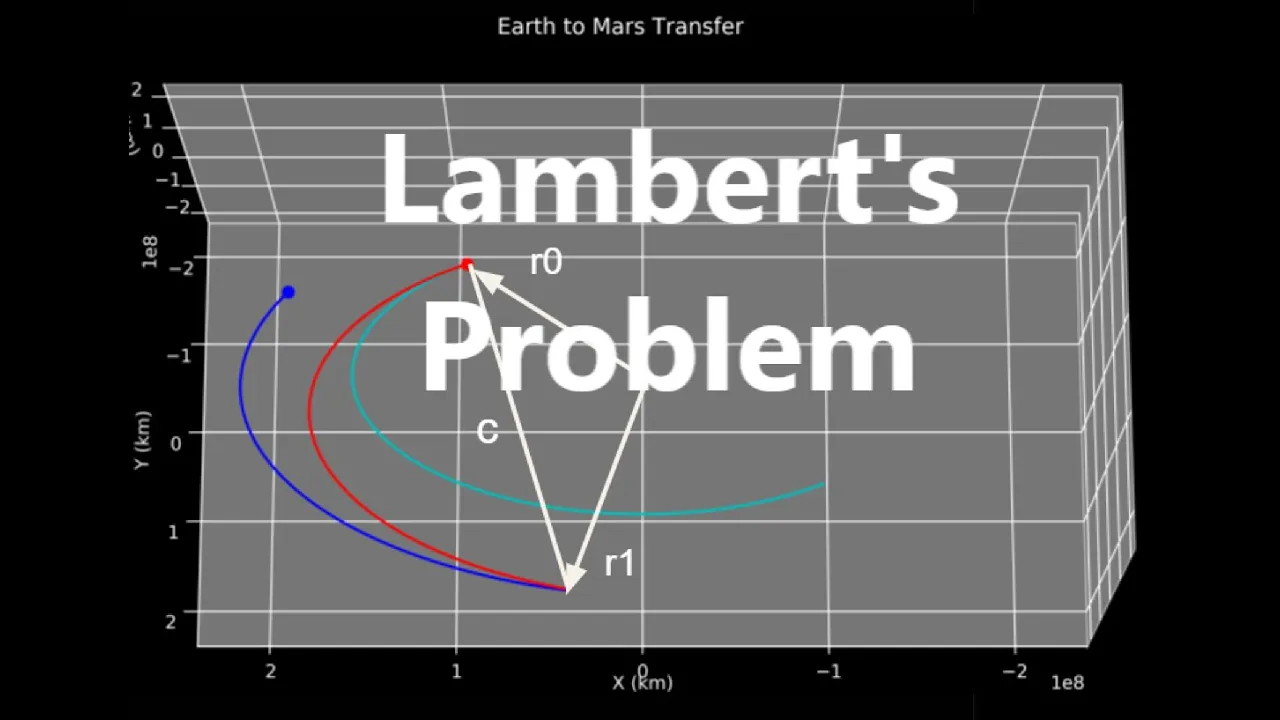












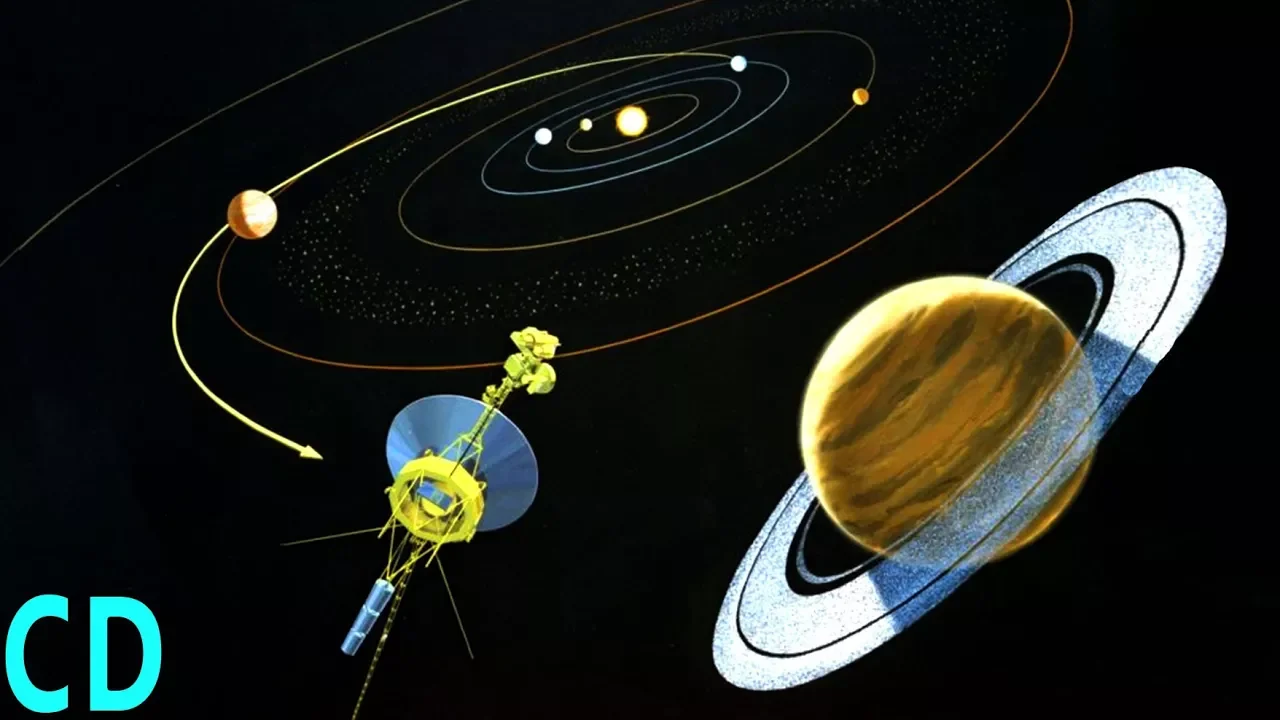
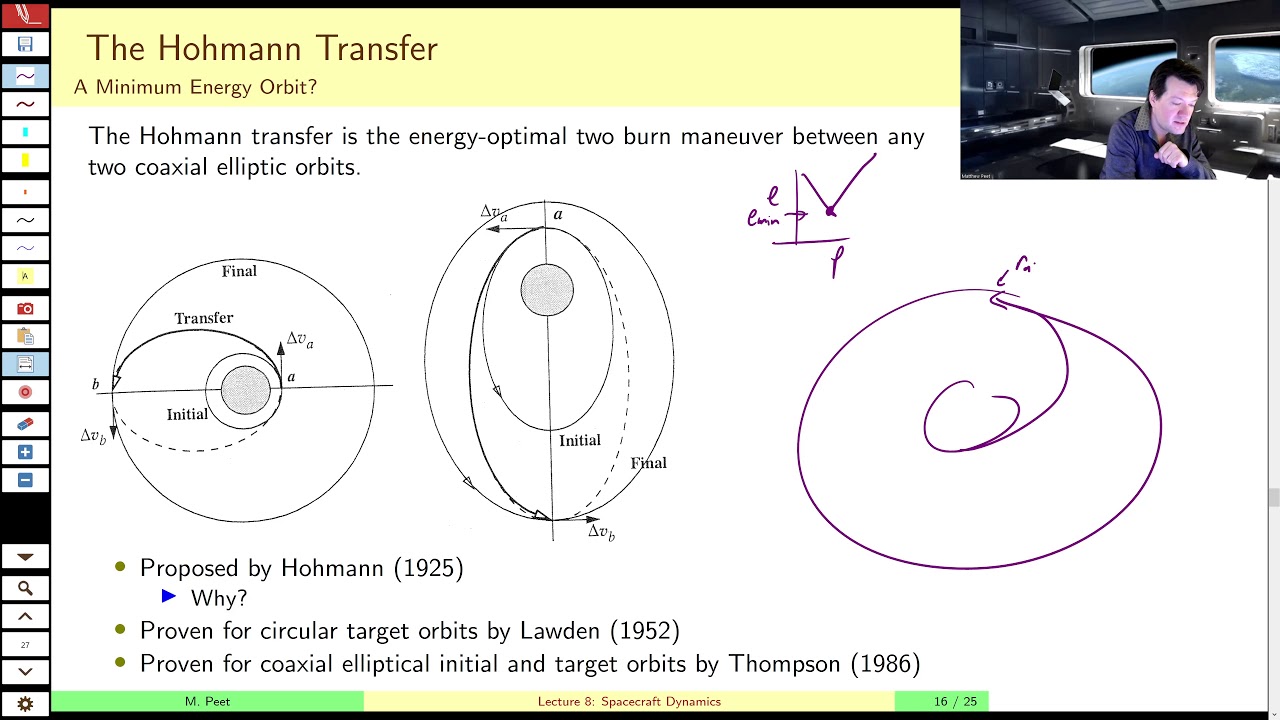
A Hohmann Transfer is the most fuel-efficient orbital maneuver for traveling between two points in space, using an elliptical path that accounts for the gravitational influences of celestial bodies. To calculate the required velocity changes (Delta V), one must determine the orbital velocities of both the departure and destination bodies using Newton's gravitational constant, the mass of the central body (like the Sun), and the distance between them. The total energy of an orbiting body equals half its gravitational potential energy at the average distance, which enables calculation of the velocities needed to enter and exit the elliptical transfer orbit. For example, traveling from Earth to Mars requires approximately 5.7 km/s of Delta V, with entry velocity of 33 km/s and exit velocity of 21 km/s.
Orbital Mechanics of Intercepting the Tesla Roadster
Added:- Look, I told you, it doesn't matter why I want it or how much it costs.
Just get me that space car.
Do it, do it!
Let's just say that for some super villainy reason, you wanted to steal the only sports car currently in space.
How would you do that?
Let's get technical.
(Over the phone) Get it to me now!
(intense rock music) In early 2018, a one Elon Musk, after taking suggestions on Twitter, decided to christen the launch of his Falcon Heavy Rocket with the silliest thing that you could imagine.
That silly thing just happened to be his personal midnight cherry Tesla Roadster.
After launching in February, that road car became the first in the cosmos, carrying a towel and blasting David Bowie.
It was a heck of a spectacle, sure, but the car isn't just lost to the void now.
We know exactly where it is.
All an enterprising super villain would have to do then is get to it, and I'm not saying I'm one of those or that you should do it, I'm just saying this is how you could do it, very very important distinction there.
First, it's not like government agencies or Musk himself is going to help us nab a space car that's already traveled the equivalent of 37 times all of the world's roads put together, no.
So, we're gonna have to take a quick crash course in orbital mechanics and maneuvers.
Probably not the best choice of words there.
And don't you worry about how we're actually going to intercept and then return the Tesla to us.
I so happen to have a Tesla capture device that I cons... that I found at a yard sale.
What we really need is a plan and a pathway through space.
When should we launch?
How long will it take us to get to the Roadster?
What will the trajectory look like?
Oo, it's all coming together, he said innocently (laughs maniacally).
A rendezvous in space isn't as easy as just point and then thrust it and that's because everything in space is moving.
Gravity is everywhere, it affects everything and so, in effect, everything in the universe is always falling around something else, whether that be the earth around the sun or a galaxy around another galaxy, and so any orbital maneuver inside our solar system, for example, has to take into account this omnipresence of gravity.
For example, if you wanted to launch a rocket from Earth to Mars, and you just point and shoot without gargantuan thrust, you're gonna miss.
So instead, bending to gravity's whim, we're gonna want to take some kind of curved path, not a straight one, that will take us, not just to where Mars is, but to where Mars will be when our rocket gets there millions of kilometers later.
This kind of orbital maneuver is one of the simplest and easiest, in terms of fuel and it's called a Hohmann Transfer.
So, we're gonna wanna learn the mechanics of this kind of transfer if we're gonna pull off grand theft strato...sphere.
Stra... So, let's learn by doing and return to the example that we just laid out.
How would we really get a rocket from Earth, where it would launch from, to Mars, where there's definitely not a subterranean base of mine, for sure.
We know we have to take some kind of curved path again, but we have to be exact or else we're going to miss Mars, where something is definitely not being constructed right now, don't even worry about it at all.
So, let's get more technical.
The idea during a Hohmann Transfer is to take some kind of elliptical path to your destination, but when you get there, you have to remember that a celestial body or a planet or what have you, has a lot of velocity on it's own.
So, when you get there, you're gonna have to match that velocity in some way, and so, this kind of maneuver won't just take one burn to launch you off of a planet like Earth, it's actually gonna take two, one to launch you off of your planet and then, a second to match the new orbit of the thing you are trying to intercept.
When performed correctly, this kind of maneuver looks like this.
This is NASA launching their Insight Mission.
It looks relatively straightforward and easy, but it only looks that way.
There's actually a lot of math involved.
So, if we only have really probably one shot of stealing star man, we're gonna learn the math behind this kind of transfer, step by step.
(phone rings) All right, I'm gonna let that go to voicemail.
(Through the phone) Answer me, you coward!
Just how much velocity do you need to add to or subtract from a rocket in order to get it to Mars or even a space car, that's right, it's super... space enthusiast pop quiz time.
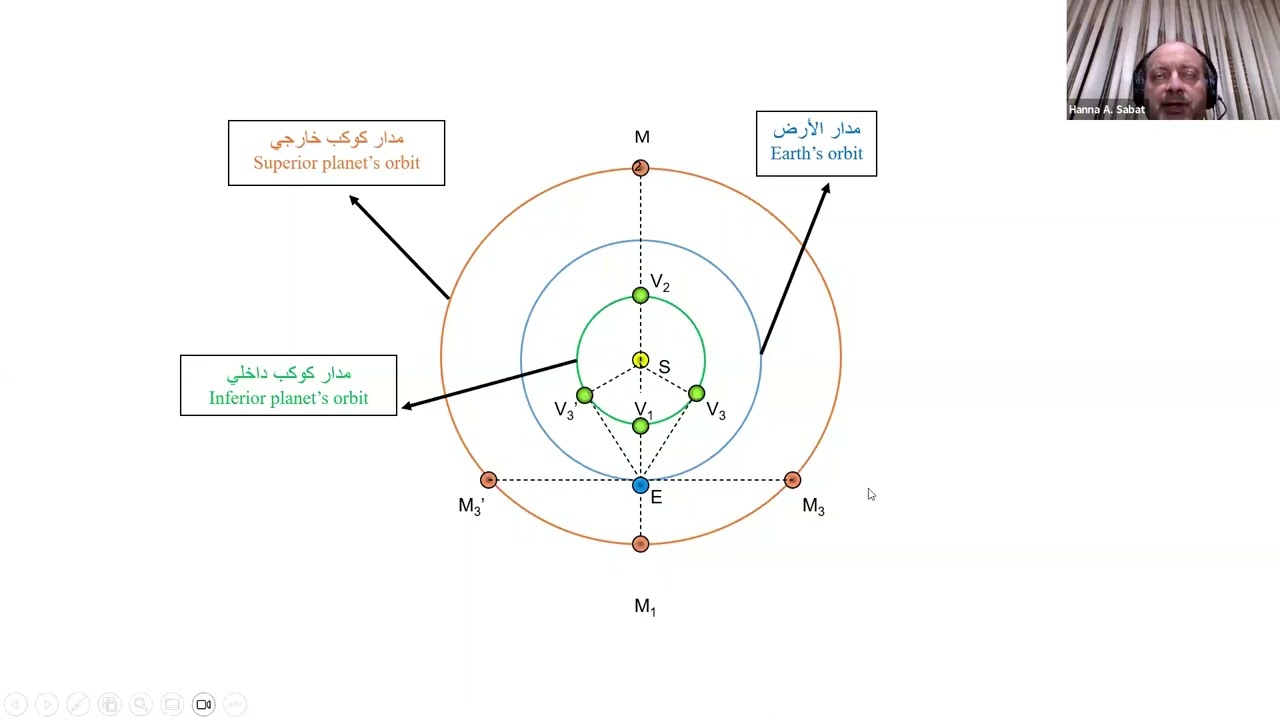
Here is the sun and Earth and Mars in their respective orbits.
I'll lay out all the variables that we want.
To get from the earth to Mars with one of the simplest transfers that there is, we're gonna have to know the orbital velocity of Earth, the orbital velocity of Mars and the velocities that we need to both enter and exit our transfer elliptical orbit.
The force keeping Earth and Mars in orbit around the sun, gravity, can be modeled like the tension in a string, if you tied a rock to the end of a string and was swinging the rock around in a circle, but you could also model it like a simple gravitational interaction.
So, you can use these equivalences to solve for the orbital velocity of both Earth and Mars around the sun.
If we take Newton's Gravitational Constant as G here, the big M as the mass of our sun and R being the distance between the sun and the planet that we're concerned about.
Now, I was not joking about a pop quiz.
What is the orbital velocity of Earth around the sun?
You can look up Newton's Gravitational Constant, the mass of the sun and the distance from the earth to the sun.
Now, don't just look up the orbital velocity of Earth, I want you to really try it.
It's empowering, you can pause the video right now...I'll wait.
(elevator waiting music) The correct answer, if we round, is B, 30 kilometers per second, that's how fast the earth is going in orbit around the sun.
How'd you do?
Using the exact same reasoning, look up the distance between the sun and Mars and solve for the orbital velocity of Mars.
I'll wait.
(elevator waiting music) The correct answer is 24 kilometers per second around the sun, C.
How did you do?
Did ya get it?
Because now, it's time to get a little bit more-- (phone rings) complicated.
Ssh, say I'm not here.
(Over the phone) I know you're there!
If you wanted to find out the total amount of energy of a body orbiting something like a star, you would need it's energy of motion, it's kinetic energy and you'd also need it's gravitational potential energy, which is the same energy as anything has sitting in a gravitational field.
Anyway, the total amount of energy of an orbiting body is also equivalent to half the gravitational potential energy at the average distance between two bodies, and this is really important because this will enable us to calculate how much velocity we will need to both enter and exit an elliptical path between two points.
We can use this relationship to solve for velocity here, too, and we get the velocity that we need to both enter and exit our elliptical transfer orbit based on R being the distance between the sun and Earth and the sun and Mars, and remember, that A here is those distances added together and then divided by two.
Pop quiz!
Using the distance between the earth and the sun as our first, what velocity do we need to initiate our transfer orbit?
(elevator waiting music) The correct answer is A, 33 kilometers per second.
Did ya nail it?
I bet you did, you nerds.
Now, use the distance between Mars and the sun to find our exit velocity, pop quiz!
(elevator waiting music) The correct answer is B, 21 kilometers per second.
Did you get it?
Because if you did, that deserves one gold skull.
We don't give out stars for this kind of mission.
So, now that we know all of our numbers, what is the total amount of velocity that we need to give our rocket to make it from Earth to Mars?
This is a critical calculation in any orbital maneuver called Delta V, pop quiz, what is it?!
We want the absolute distance between all of these velocities.
How much velocity will take us to launch off of Earth to get us into that elliptical orbit and then, how much will it take us to speed up or slow down to exit from that orbit and match Mars' orbit?
Take a shot at it right now.
I'll wait again, ah!
(elevator waiting music) Did you get 6 kilometers per second?
Well, let's check our work.
You can find Delta V maps for real interplanetary travel pretty much anywhere on the internet.
So, if we look at the pathway, you would need to take, in terms of velocity, from Earth to Mars and you add all those up, what do we get?
Well, I got 5.7 kilometers per second.
Look how close we were with six.
We calculated a space mission kinda.
That deserves one gold skull, maybe even two, kinda, yeah!
We did the basic calculations, sure, but to steal a space car, we might need some help.
We already know the Tesla Roadster's exact location in space.
We also know that it's going 40 times faster than a Bugatti Veyron.
Thanks to the laws of physics, we should be able to accurately track the position of this space car for centuries.
Now, while we could do the same kind of Hohmann Transfer calculations that we just did to get to this space car, as you can see, the orbit of this car is not quite as nice and circular and centered on the sun as Mars is.
So, I'm not gonna lie, these calculations we just went through aren't really gonna cut it and the math would be a little bit above our pay grade.
So, instead of going through a bunch of complicated math and then, getting it wrong, why don't we, instead, play around with a very specific and specifically helpful calculator?
(rock music) Sup, nerds?
Welcome back to another Let's Play, of course.
Today, we're checking out Planetary Transfer Calculator, which you can go and check out at http://www.transfercalculator.com.
As you can see here, we have the orbits, the standard orbits that we're looking at here.
We have the earth orbiting around the sun and we have Mars orbiting out around here and what's cool about Transfer Calculator is that you can actually add other minor bodies and we can add star man.
So, let's turn that on right here.
So, now, we see star man's orbit in red.
Now, what this calculator does, is make hundreds of Hohmann-like transfer calculations.
It iterates them down to find the simplest best transfer, the lowest energy transfer from anywhere you wanna go to another place.
So, we can actually now calculate our path using a lot of mathematical help from the people who created this, our path from Earth to, let's say, the Tesla Roadster.
I'ma set the time to when I'm filming this Let's Play, (chuckles) as we always do streaming.
Yeah, am I right?
So, I'ma set the time to now and then, I am going to go ahead and calculate our transfer.
I get, if we launch next February, which is the best time to launch, according to this calculator, it looks like it'll take us just about 16 1/2 months to intercept the Tesla Roadster and then, it would take another 16 1/2 months to get back to Earth, presumably, and with a Delta V of about 4 1/2 kilometers per second.
So, this is a much longer transit time, as you can see here, to the Tesla Roadster than it would be to Mars, but it's a much lower Delta V.
So, with all these numbers, we should be able to set our super villainy plan in motion.
This is all we need.
We can see the ship coming within intercept range of the Tesla Roadster now in just a couple months time.
That's pretty cool.
I like Transfer Calculator quite a bit, all right.
Ah, Bearcat comes in with a five dollar donation.
"Hey, Kyle/discount Thor, you really did "a great job."
(Scoffs) Discount (scoffs again).
(rock music) If we use this specific trajectory, within a few years, we should be able to get our hands on the only road car that has ever existed in space, and when our undisclosed Tesla capture spacecraft lands, we will have an awaiting semi-truck to whisk it away to super villain auction.
Of course, we probably won't be able to make back even one percent of the mission costs from the car sale, but hey, it's the super villain principle of the thing, which I'm not and I'm not saying you should do this and don't tell Elon.
So, if you're a super villain and you have millions of dollars burning a hole in your pocket and staff and infrastructure and rockets and the knowledge of orbital mechanics, there is a relatively simple trajectory towards carjacking the star man and if you do pull something like this off, now that I support or condone it, tell them it was, "Because Science."
(Chuckles) Space car.
(Upbeat electronic music) You know what might actually be more impressive than a super villain stealing a space car, is if Elon Musk did all of this himself.
If he launched it into space and then, with his reusable rocket technology in a couple years, was able to successfully return a space car back down to Earth, and then, he restored it, and then, he was driving it around headquarters in Hawthorne, now that would be impressive, and it would improve his rocket technology, and I guess I just gave him a great idea for some PR.
You're welcome.
(electronic music)
Up Next
Patched Conic Approximation for Mun Trajectories | Orbital Mechanics KSP
@andyl8074
4.5K views•2017-03-12

21cm Hyperfine Transition in Neutral Hydrogen: Radio Astronomy Basics
@AaronRobertParsons
12.4K views•2011-10-13

NMR Spin Physics I: Zeeman Effect, Resonance Condition & Larmor Frequency
@nptel-indianinstituteofsci8064
2.3K views•2024-01-17

Entropy and the Second Law of Thermodynamics Explained
@veritasium
27.5M views•2023-07-01
Related Study Plans & Knowledge Roadmaps
Structured learning paths in Physics