










![에게 문명 [통합본] ─ 미노아 │ 미케네 │ 트로이](https://i.ytimg.com/vi_webp/mCpoPIvNYJY/maxresdefault.webp)











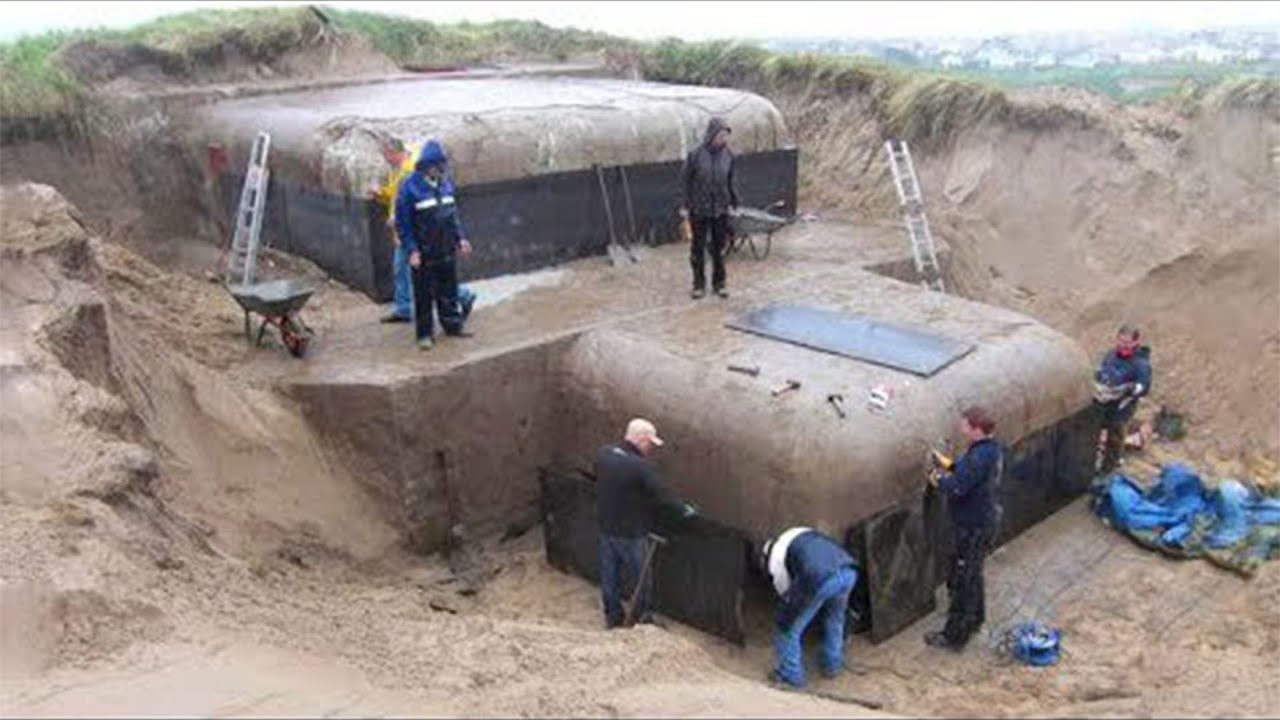

Archaeology cannot prove or disprove the historicity of myths because myth exists as a multiplicity of variant narratives rather than singular propositions, and the concept of truthfulness is fundamentally immaterial to myth's function; instead, archaeological discoveries serve as material media through which communities construct and fashion collective myths, as demonstrated by the case of the Trojan War where multiple archaeological layers and traditions coexist without definitive proof of any single historical account.
Archaeology and Myth: Reflecting on the Trojan War's Historicity
Added:Familiarity with Homeric epic poetry, specifically the narrative of the Trojan War as depicted in the 'Iliad' and the 'Odyssey'.
Understanding the basic definition of 'historicity' and how historians distinguish between myth, legend, and historical fact.
Knowledge of Heinrich Schliemann's 19th-century excavations at Hisarlik (modern-day Turkey) and his claims of finding the historical Troy.
An introductory understanding of the Late Bronze Age in the Aegean, including the rise and fall of Mycenaean civilization.
Analysis of Near Eastern diplomatic records, specifically Hittite clay tablets referencing 'Wilusa' and 'Ahhiyawa', to contextualize Trojan geopolitics.
Investigation into the methodology of 'myth-history'—how modern historians systematically extract historical data from oral traditions.
Exploration of the ideological and political uses of the Trojan myth in Classical Greece and Imperial Rome (e.g., Virgil's 'Aeneid').
Comparative study of other archaeological efforts to verify legendary narratives, such as the search for King Arthur's Camelot or biblical archaeology.
13.9K views285likes52:59Original Release: 2022-11-03
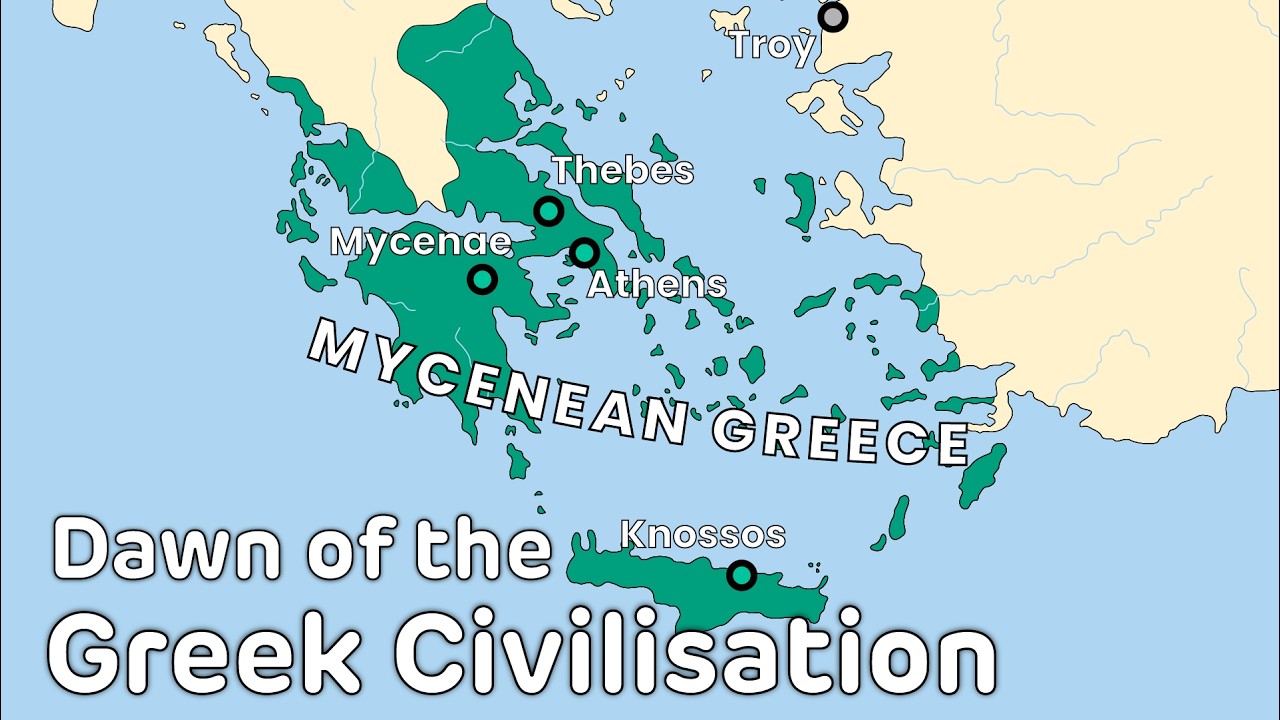
foreign [Music] it's a great honor for me to introduce to you this season's first Speaker Jonathan Hall uh Professor Hall is the Phyllis Faye Horton professor in the Departments of both history and Classics at this University and several years ago there was added to this title uh distinguished service Professor because Johnson Hall has been indeed or has distinguished himself also apart from scholarly also in a let's say managerial sense he has been chair of the classic department for for quite a few years um and okay so that has earned him the the extra title of distinguished service professor Professor Hall has is here at this University since 1996. he came then from uh Cambridge in the UK where he was a research fellow in Classics after receiving his degree there in Cambridge and he got his ba from Oxford University uh Professor Hall has also been awarded several times he received the prestigious teaching award at this University the so-called quantrel award in undergraduate teaching and in 2004 he received the equally prestigious Gordon Lang award from the U Chicago University of Chicago press for their best book at that moment and that was uh Professor Hall's 2002 book hellenicity between ethnicity and culture published obviously by University of Chicago press apart from that book he is the author of a whole range of books and and numerous articles and as a title of that book that I just mentioned uh hellenicity between ethnicity and culture and the book that he published before that ethnic identity in Greek Antiquity already uh indicates uh ethnicity and culture and their construction function and meanings are one of his research interests other research interests that he mentions on his website are not surprising classical archeology historical methodology remember he's a member of the history Department as well but also interestingly modern Greek history tonight however he will speak on aspects of historicity and mythical past and one area where that is relevant is of course the Trojan War and eternally fascinating topic we all know Homer's Iliad and odyssey but what is the truth behind it is there a truth behind it on the ois side of this question uh hittite Scholars now generally agree that the homeric achaeans the akaioi are indeed mentioned in the hittite texts and that there were contexts diplomatic or otherwise between the Anatolian rulers on the one hand and the Greek Kings of the late Bronze Age but does that bring the Trojan War any closer to having been a historical reality we may hear that tonight so I hope you'll join me in welcoming Professor Jonathan Holt thank you very much for that very warm and generous introduction on Valentine's Day 2005 a headline in the Italian newspaper IL Mesa gero triumphantly proclaimed Rome it's all true the event that prompted such jubilation was the discovery in the Roman Forum of a structure that its excavator Andrea karandini formerly of the University of Rome La Sapienza interpreted as the residents of the earliest Kings of Rome figures whose historicity up till then had been widely doubted by Scholars karandini had already created a buzz 20 years earlier when he claimed to have discovered part of the wall that Rome's supposed co-founder Romulus had constructed around the base of the Palatine Hill then in 2007 karandini excavated a grotto seven meters beneath the house of Augustus on the Palatine Hill which he identified as the lupacal the cave in which the twins Romulus and Remus were thoughts to have been suckled by a she-wolf after being washed up on the banks of the Tiber as then minister of culture Francesco routelli put it it is incredible to think that one can finally find a mythological place that today has at last become real now Rome is of course no stranger to spectacular claims about archeology and what it can prove about the richly textured Traditions that have grown up around the city in a Christmas broadcast of 1950 after years of clandestine excavations in the Crypt of Saint Peter's Basilica Pope Pius XII announced that the Tomb of the Apostle Peter had been found and on the eve of the feast day of Saints Peter and Paul on June 29 2009 Pope Benedict XVI reported a radiocarbon analysis of Bones recovered from a sarcophagus beneath the high altar of Saint Paul's outside the walls which he claimed quote seems to confirm the unanimous and Undisputed tradition that they are the Mortal remains of the Apostle Paul unquote Beyond Italy one can think of any number of examples where claims have been made on archaeological grounds for the historicity of what many consider myths in 1993 at tildan in the Golan Heights a fragmentary Steely was discovered which bore an Aramaic inscription perhaps dating to the 9th century BCE and arguably offering evidence for the historical existence of the biblical King David meanwhile recent excavations of female burials with arms in Western Russia and Ukraine have led to confident declarations that the Amazons were not simply the product of the ancient Greeks feverish imagination now it's easy to see why such cases would excite considerable public interest but at the risk of being a Debbie Downer I want to urge some caution as to the viability of what we might term an archeology of myth in particular the contrast that we tend to entertain between history and myth is conditioned by a very modern understanding or rather misunderstanding of what myth is today we tend to use the word myth to describe something that is widely believed but false myth is contrasted with truth and reality look again at what rutelli said about the Lupica and when it comes to the study of the past we often distinguish myth from history a tendency that can be traced back to the Monumental history of Greece written by George groat in the middle of the 19th century which commenced with the first Olympic Games of 776 BCE but actually groat's point was not necessarily that anything described in ancient sources as occurring before 776 was fictitious merely that it was unknowable and in that he was simply echoing ancient authors originally the Greek term muthos connoted authoritative utterances that sought to advance powerful truth claims by the 5th Century BCE however it came to be used for narratives especially oral narratives whose ferocity could not necessarily be demonstrated and by the time of Plato muthoy were regularly contrasted with logoy or demonstrable propositions muthoy could then include lies but they were not primarily defined by their lack of truthfulness now of course we are not compelled to understand myth in the same way as the ancient Greeks indeed Scholars such as Claude Kalam and fritzgraph have argued that myth as an object of intellectual study is an invention of the Enlightenment in thinking about myth I've been greatly influenced by my Chicago colleague Bruce Lincoln professor emeritus in the Divinity School Lincoln has identified a French intellectual tradition pioneered by Emil durkheim and marcelmos and taken up by George dumasil and Claude Levy Strauss whereby myth is viewed as taxonomy in narrative form but appealing to cultural theorists such as gramshi bhart and Bordeaux Lincoln goes on to point out that quote taxonomy is hardly a neutral process since the order established among all that is classified is hierarchic as well as categoric Lincoln therefore concludes that myth can be defined as ideology in narrative form but rather than understanding ideology here in its Marxist sense as a false consciousness imposed upon the unknowledgeable masses by those who control the means of production or even following out of Sir as a self-deception on the part of masses and Elites alike I would prefer to treat it more neutrally as a strategy conscious or unconscious of naturalizing and legitimating what is historically contingent in other words when it comes to myth I would suggest that the concept of truthfulness is a red herring meaning that it makes little sense to claim that it can be either proven or disproven by means of archaeological evidence more than that however myth in its singular form is really a medium or genre when it comes to stories that explain origins or developments what we almost invariably have is not a singular myth but rather a multiplicity of myths to return to Rome there are at least 15 different versions of the foundation of the city some of which are utterly incompatible with each other faced with a complex web of multiple and often mutually contradictory Traditions that have Arisen from different perspectives among different constituencies what sense does it make to expect that archeology will succeed in investing just one of these for instance the foundation of Rome by Romulus on the Palatine Hill with greater legitimacy than the others along similar lines how valid is it to suppose that archeology will confirm the location of Saint Peter's final resting place when our earliest texts cast doubt as to whether the Apostle ever even visited the Eternal City let alone met his end there worse still there are indications that by the 3rd Century CE the Vatican was desperately trying to ward off a rival claim to house the Mortal remains of the Apostle on the part of a complex on the Appian Way and the complex is beneath the current Church of San Sebastiano well with that in mind I want to turn to the case study that will constitute the remainder of my lecture namely the attempt to prove the historicity of the Trojan War on archaeological grounds I suspect there are some people here today who went on the oi visit to Troy and Greece over the summer I apologize if you've already heard anything that I say but you can nod wisely as I as I go along the earliest literary reference to the Trojan War is of course The Iliad attributed to Homer but it's approximately 15 000 lines of hexameter verse later divided into 24 Books Deals Only with about seven weeks during the tenth year of the war recounting how Achilles withdrew from combat in protest at agamemnon's confiscation of his Trojan captive brisays and what you're looking at here is a fresco from the house of the tragic poet in Pompeii which shows patroclos separating Achilles from brazils Achilles only reluctantly returns to the free after the death of his friend petropolis The Iliad ends before the final sack of Troy with Achilles Slaughter of Hector and the ransoming of his body to Hector's father Priam the story of the Trojan Horse is briefly mentioned in the other complete epic poem attributed to Homer The Odyssey but more detailed accounts of the war including episodes such as the Judgment of Paris the capture of Helen the dispatch of the Greek Expedition under Agamemnon the death of Achilles at the hands of Paris the sack of Troy and the troubled returns of various Greek leaders from Troy were taken from a variety of poems that constitute what is often called The Epic cycle and which were probably written one or two centuries after The Iliad and odyssey the historicity of the war and its protagonists was certainly taken for granted by the two great historians of the fifth century Herodotus and fusilities and the sack of Troy occupies a prominent and poignant place in Rome's National epic The Aeneid by Virgil and and here you see a painting with Aeneas carrying off his father ankises from The Burning city of Troy this is by Federico barocci it's currently in the Borghese Gallery in Rome ancient authors had no doubts concerning the location of Troy it was believed to lie on the spot of the later Greek city of Ilion to which both Alexander the Great and Julius Caesar paid pilgrimage there was less agreement as to when Troy had been sacked by agamemnon's Army though the date of 1184 BCE was proposed by the 3rd century chronographer eratosthenes and subsequently became canonical even though it was based on little more than guesswork by the 17th century of our era however the site of Troy seems to have been lost and by the 18th century many scholars regarded the city and the war associated with it as nothing more than the fictional creation of Homer ridiculing those who thought otherwise Grote whom I mentioned earlier argued that the Trojan War was quote essentially a legend and nothing more end of quote Heinrich schliemann was born in the north German region of Mecklenburg in 1822 by his own account his interest with Troy began when at the age of nine his father gave him a book with an illustration of Aeneas fleeing the burning city of Troy schliemann made his fortune through business he served as a middleman in Sacramento during the Californian Gold Rush and he cornered the market in salt peter at the time of the Crimean War and the market in Cotton during the American Civil War in his mid-40s schliemann retired and decided to vote his time and attention to finding Troy and proving the academics wrong in 1868 during a visit to Turkey he befriended Frank Calvert a British expatriate who was then serving as American Vice consul Calvert had bought a mound named his salic which he suggested might be the site of Troy and in 1870 without securing any permission from the ottoman authorities schliemann began Excavating his psalek two years later after digging a huge 45-foot deep trench across the mound schliemann identified a series of superimposed cities he counted six or seven though we now know there were nine with numerous sub phases his attention was particularly drawn to the second level from the bottom Troy 2 which is indicated in green on the screen particularly because it seemed to show evidence of burning his suspicion that this might be Homer's Troy was seemingly corroborated in 1873 when he and his Greek wife Sophia discovered a huge inventory of arms armor cups and jury made from gold silver and electrum colloquially known as priam's treasure which Heinrich and Sophia smuggled out of turkey to their house in Athens and this is a very famous photograph of Sophia schliemann wearing some of this jewelry now I put discovered in scare quotes because although it's now no longer believed that the pieces of forgeries there is sufficient evidence that schliemann found them over a much longer period of time and then re-buried them to Stage a spectacular discovery but the treasure is not priams and Troy 2 is not homeric Troy further excavations in the late 1870s and 1880s revealed that Troy II dated to around 2 300 BCE in other words about 1 000 years too early for any homeric Troy and that a more likely candidate for Homer's City might be Troy 6 or Troy 7.
the problem was that in his Zeal to uncover the earlier City schliemann had removed much of the evidence of the later cities sriman died in 1890 and it was left to his assistant Wilhelm derpfield to continue excavations which focused on the massive fortification wall of Troy six to dirtfield's mind this matched Well the homeric description of Troy's bastions schliemann had also dug at mycenae in the Greek peloponnese in 1876 discovering a wealthy late Bronze Age civilization that we call the Mycenaean civilization that flourished between about 1600 and 1200 BCE seemingly offering support for the existence of a network of powerful Kings such as Agamemnon Menelaus Nestor Ajax and achilles just as Homer describes now as Professor Van Den help mentioned uh the late 19th century also saw the discovery of a contemporary civilization in what is now turkey and these are of course are the Hittites excavations in 1906 at the hittite capital hatusa or modern Burger's koi brought to light a series of tablets written in hittite accordion and luvian on some of these tablets there are references to a place named willusa equated by most though not all Specialists with ilios the originally Greek name for Troy the tablets indicate fluctuating relationships between the inhabitants of wulusa and the Hittites but for much of the time the rulers of wilusa seem to be vassal rulers of the hittite great king one of these rulers is called alaksandu a name that to many is remarkably similar to Alexander which in a number of authors including Homer is another name for Paris one of the texts actually signed by Alex and do in the early 13th century explicitly refers to a war fought at wulusa though it does not mention the aggressor furthermore a number of hittite texts refer to a place named akiyawa and is now widely if not universally accepted that this is the hittite form of the Greek Ikea one of the names that Homer uses to denote Mainland Greece does then archeology and the hittite evidence support the historicity of the homeric account of the Trojan War the matter is Complicated by the so-called homeric question ever since the 18th century there has been some scholarly doubt as to whether the Iliad and the Odyssey were composed by the same person and even whether Homer actually ever existed or was simply a cipher given to a longer intergenerational poetic tradition the Ancients knew very little about the supposed author of the poems and what they did know was frequently contradictory for instance was he born in Smyrna the modern Izmir or did he come from the Greek island of kios Herodotus hazarded the guests that he had lived about 400 years before his own time that would be about 850 BCE in our terms although today most Scholars think that the poems took on a form that is recognizable to us in either the second half of the 8th Century or the first half of the 7th Century BCE but if the Trojan War really occurred it would have to have taken place while my Sinai was still at its height and since the destruction of the Mycenaean palaces is dated to around 1200 BCE by archeology then that opens up a gap of roughly five centuries between the date of composition of the homeric epics and the events they purportedly describe could details of events in the late Bronze Age be preserved over such a long period of time or are the homeric epics pure invention many were skeptical especially since there is absolutely no evidence for the existence of writing in Greece during the period 1200 to 800 BCE but in the 1920s A Gifted linguist from Harvard named Millman Parry suggested that the transmission of memory and poetry over centuries might not have been impossible after all along with Albert Lord he documented performances of thousands of lines of epic poetry by bards in Bosnia who were illiterate these poems could be transmitted orally from generation to generation they would not be exactly the same from performance to Performance but they were close enough and this was accomplished by what Perry termed the oral formulaic Theory put simply this was akin to the techniques that modern Jazz musicians use when they extemporize from a repertoire of riffs in Paris View an oral transmission of the homeric epics was facilitated by its construction from traditional formulas and epithets think about gray-eyed Athena or swift-footed Achilles or when Dawn The Rosy fingered Shone forth etc etc or archaeological investigations seemed to indicate that many of the citadels described in the homeric epics had been abandoned long before the 8th century while certain artifacts such as helmets made out of boars tusks or large Tower shields were only in use during the Bronze Age now obviously anachronistic elements would have crept in during the centuries-long process of oral transmission for example both patroclus and Hector are said to have been cremated on the battlefield but by and large Bronze Age Greeks did not practice cremation it was a funerary right that largely post-dates the destruction of the Mycenaean palaces well this more positive view of the question received something of a setback in the 1950s a series of clay tablets have been discovered at some Mycenaean citadels preserved by the conflagrations that destroyed the palaces around about 1200 BCE and the reason for these destructions is still hotly debuted these tablets were inventories recording the possessions of the royal storerooms the largely syllabic script used to record them was named Linear B and was clearly derived from an earlier script linear a that had been employed in the minoan Palaces of Crete during the middle Bronze Age for decades however the language rendered by the script had been unknown nobody had been able to decipher Linear B Michael Ventress was a British architect and a talented linguist in collaboration with John Chadwick who had served in a code breaking unit of the royal Navy during World War II Ventress set himself the task of deciphering Linear B a task that he accomplished in 1952 when he demonstrated to almost Universal scholarly satisfaction that the script of the Mycenaean palaces recorded an early form of the Greek language but the Mycenaean world that was revealed by ventress's decipherment of linear bore very little resemblance to the world described by Homer be it administratively socially politically or economically furthermore the middle Decades of the 20th century saw a greater archaeological focus on the period of Greek history that was then known as the Dark Ages now more neutrally as the early Iron Age roughly the 12th through 8th centuries BCE and in combination the evidence now appeared to suggest that the world described by Homer was not that of the Bronze Age after all but of the succeeding Iron Age and if that were the case what credibility could be given to Homer's account of the Trojan War let's head back to Troy back in the 1930s Carl blagan of the University of Cincinnati began a new campaign of excavations at hisarlik en disagreed with durpfield's view that Troy six was Homer's Troy because in his opinion it had been destroyed by an earthquake and not by enemy action although there were signs of burning these would be the consequence of incendiary events sparked by an earthquake which was indicated by the collapse of huge towers and walls knocked out of kilter by digging at the edges of the mound blagan was also able to identify eight different subphases of Troy VI which is shown in pink here with no signs of cultural break between the subfaces but he also discovered that there was no marked cultural break between the last of the subphasis of Troy six Troy 6 h and the first of the successive City Troy 7A you can just see little bits in Crimson here in other words Troy 7A was not so much a new city begun after a sharp cultural break but rather a hasty rebuilding of Troy's sixth after the earthquake not only that but the presence of Mycenaean Pottery in the Troy 7A level showed that the inhabitants of Troy remained in contact with the Mycenaean civilization of Greece now Troy 7A did display clear signs of fire damage and blagan also discovered remains of bodies that appeared to be unburied as well as arrowheads of Greek manufacture so was perhaps Troy 7A the Troy that according to Homer was destroyed by agamemnon's coalition two problems the first is that the well-built Troy 6 fits Homer's description of the city much better than the ramshackle shanty town of Troy 7A for the German scholar Fritz shakamaya there was a solution to this problem and it was provided by the story of the Trojan Horse some had supposed that this was merely the distorted memory of some sort of battering ram but shakamaya made two observations first the horse was an animal that was associated with the sea god Poseidon indeed in some places he's actually worshiped under the title Poseidon hippios or Poseidon of the horse second Poseidon was not only god of the sea but also God of earthquakes Homer often attaches the epithet Earth Shaker to him on this reading perhaps the besieging Greeks took advantage of an earthquake that toppled the walls of Troy six thus allowing them to enter and Sack the city the second problem though concerns chronology the most recent dating of the pottery from Troy 7A places it at the start of the 12th century this is exactly the same time that the Mycenaean palaces throughout Greece were destroyed but according to Greek tradition the Mycenaean palaces had survived the sack of Troy by a couple of generations some have therefore suggested that both the Mycenaean palaces and Troy were victims of the mysterious sea peoples who were mentioned in Egyptian inscriptions of pleagan's conclusions first that Troy six have been destroyed by an earthquake and second that Troy 7A have been destroyed by enemy action have subsequently been restated by the late Manfred Kaufman of the University of tubingen who excavated Troy from 1988 to 2005.
relying upon radiocarbon dates and a more refined chronology of Mycenaean Pottery Imports Kaufman dated the destruction of Troy 6h to around 1300 and that of Troy 70 to somewhere between 12 30 and 1180.
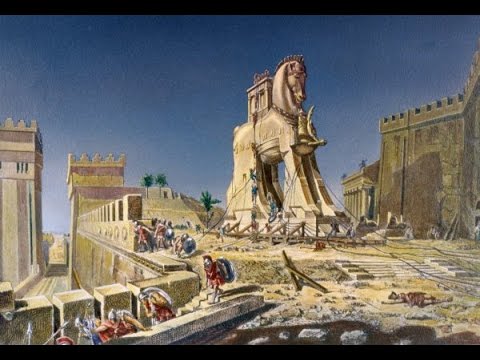
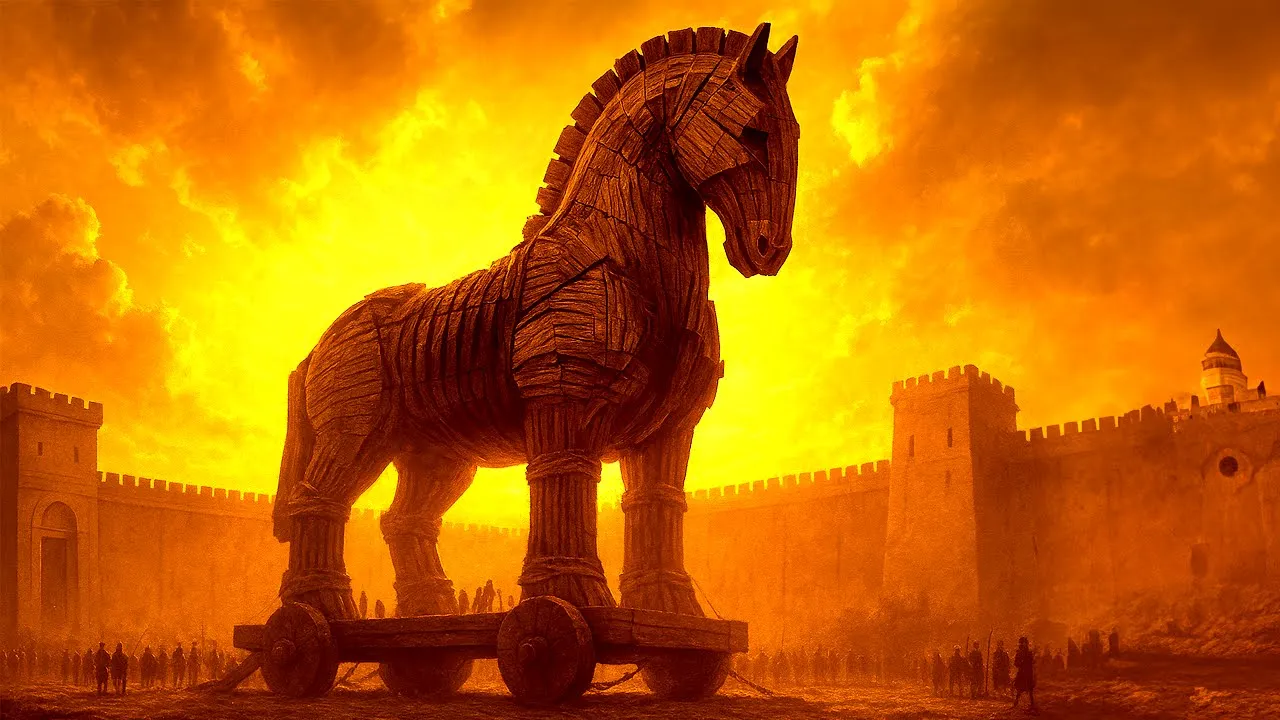
but Kaufman also believed that he had made another discovery that answered what had become a nagging doubt among many scholars although Troy six in many ways resembles Homer's description of the city its dimensions are decidedly modest when compared to the picture one gets from Homer not only of the size of the city but also the number of its inhabitants Kaufman employed magnetometry cultural features such as walls and ditches have a different magnetic field to the environment around them and so can be plotted by magnetic probes without excavation what Kaufman claims to have found was a vast lower City surrounding the mound of hisalic in other words the Mounds that schliemann dirtfeld and blagon had all excavated was not the entire city of Troy but merely served as its Citadel what the Greeks would call an acropolis the complete City would have covered somewhere between 50 and 75 Acres perhaps providing home uh for anywhere between four thousand and ten thousand inhabitants and although his findings came under severe criticism uh especially from one of his own tubigan colleagues Frank korb subsequent excavation seems to have Vindicated the results of the magnetometry so is the Trojan War as described by Homer and the Epic cycle fact or fiction has archeology finally proven what many scholars up till now had considered a myth no less an authority than Barry Strauss professor of history and Classics at Cornell University and an expert on Ancient military history has triumphantly written that spectacular new evidence makes it likely that the Trojan War indeed took place new excavations since 1988 constitute little less than an archaeological Revolution proving that Homer was right about the city and Eric Klein professor of classical and ancient near Eastern studies in anthropology at George Washington University though a little more cautious argues that Homer's descriptions of Troy in The Iliad could be drawn from knowledge of Troy 6h while the description of its destruction could be drawn from awareness of the fires that brought an end to Troy 7A meaning that the basic parameters of the tale of the Trojan War can be confirmed now as you might have guessed um I'm a little more skeptical there existed a city that the Greeks called Troy centuries before The Iliad and the Odyssey were composed cannot seriously be questioned Homer talks about Greek cities such as mycenae tyrins pilos and Thebes and they are all real enough indeed the ruined remains of the great Bronze Age palaces would still have been visible in Homer's day and would undoubtedly have served as cultural magnets attracting cycles of stories and myths around them that hisalic is Troy is likely but is yet still unprovable Homer's descriptions might match the physical aspect of Troy six but might not most late Bronze Age cities be built in a similar way what we can see is that later Greeks and Romans believed that his salik the city they called Ilion was the site of Homer's Troy that Troy was on The Fringe of the hittite Empire and that Mycenaean Greeks had launched hostile action against the Anatolian Coast is certainly possible perhaps even likely if we accept the proposition that hittite wulusa is homeric Ilion and that hittite akiyawa is Greek Akia we can however be certain that the inhabitants of his salic had dealings with Mycenaean Greeks because of the presence of Mycenaean Pottery Imports that his salic was destroyed by enemy action as has been argued for Troy 7e is probably certain but there are several destruction Horizons at the city it was it was destroyed many times in the course of its 5 000 year history and the current dating of the destruction level at Troy 7A makes it difficult to accept that it was the casualty of a Mycenaean civilization that had already collapsed that there really once existed historical individuals named Agamemnon or Menelaus or Achilles or Ajax is certainly a possibility though we cannot I think be certain that they were necessarily contemporaries let alone that they had joined forces in a single Expedition against Troy and of course you're looking at Brian Cox in the role of Agamemnon and Brad Pitt as Achilles in the late Wolf Gang Peterson's 2004 movie Troy it is not perhaps too troubling that with the exception of prime and Paris all of the Trojan Heroes bear names that are Greek rather than Anatolian they could after all be Greek translations or renderings of Anatolian names although more troubling is the fact that Hector seems to have been a figure of cult at the Greek city of Thebes and this actually prompted some Scholars to think that originally there was an earlier epic poem with a lot of the incidents and themes that are familiar to us from The Iliad but associated with Thebes and that it was later transplanted to the other side of the Aegean to Troy but even if we pass over the intervention of divinities such as Zeus Athena Poseidon Apollo and Aphrodite and I would remind you that actually these are Divine actions that are Central to the plot of The Iliad are we really to believe that a coalition of Mycenaean Chieftains embarked on a 10-year punitive Expedition for the sake of a cuckolded husband's reputation are we really to believe that Achilles was killed by an arrow wound to the heel the one part of his body that his Divine mother had not steeped in the medicinal Waters of the river sticks are we really to believe that Odysseus and Ajax argued about who should inherit the armor of Achilles and that Ajax committed suicide when he lost or that the city of Troy finally fell when its inhabitants unwittingly took in a hollow wooden horse Stuffed with Greek soldiers now one could of course argue and many have argued that these are just romantic or poetic embellishments that are built around some sort of historical kernel of Truth regarding a military operation of Mycenaean Greeks against an outpost Outpost of the hittite empire but that seems to me to be setting the critical analytical bar ridiculously low and it also fails to account for the nature and function of myth I'll show you this picture of the Trojan Horse being accompanied into Troy uh by Giovanni Domenico tiopolo this is currently in the National Gallery in London the reverence that has been bestowed on the homeric epics even in Antiquity has blinded us to the fact that it was not the only account that existed regarding episodes of the heroic age they were in reality multiple Traditions including one where Helen never even went to Troy and another where Agamemnon was the king not of my Sinai but of Sparta now in eastcholus is orestaya he's actually the king of Argos but there are distinct historical circumstances that explain them the reason why the homeric version prevailed is due in part to the canonization of the homeric epics but also because this particular version proved especially robust over the centuries in generating what Lincoln calls ideology in narrative form it is this which lends the tradition its durability and longevity not the fact that it preserves the memory of genuine historical events because at least before the invention of chronography in the later 5th Century the Greeks had next to no interest in preserving the memory of the past for its own sake as opposed to its utility for contemporary purposes so for example the tradition of the Trojan War was mobilized at Athens in the wake of the Persian War of 480-79 BCE requiring an orientalization of the hitherto ethnically neutral Trojans and their assimilation to the Contemporary figure of the Persian Barbarian already in the 470s pindar Compares the naval Battle of Salamis to the Trojan War a few decades later Herodotus educes the Trojan War as one of the catalysts for Perpetual enmity between east and west in the 4th Century the tradition of the Trojan War was exploited in order to legitimate the disastrous Expedition against Persia launched by the Spartan King agisales II and to provide justification for the panhellenic campaign of Vengeance against the Latter-Day Trojans I.E the Persians that was proposed by the Athenian orator isocrates and eventually realized by Alexander the Great even at this relatively late date however the myths surrounding the Trojan War were still flexible and labile enough to support new ideological applications at about the time Alexander was Conquering the East the Romans adopted and adapted the Greek myth of Troy by claiming that the Latin cities of Alba and lavinium the precursors to Rome itself were founded by Aeneas Aeneas was of course a Trojan Prince but he was also a figure of Greek myth and cult as such he was the ideal vehicle on the one hand to validate Rome's associations with the Greek world at a time when the city was entering into intensive diplomacy with the Greek cities of southern Italy and Sicily and on the other to distinguish the Romans from the Greeks and to safeguard their distinct identity within the unifying mythical narratives that were largely the creation of Greek authors my talk this evening has of course been essentially negative I've argued that archeology is not an appropriate tool with which to gauge the historicity of a myth in closing however I want very briefly to sketch out a way in which material culture might be implicated in the ideological work that myth performs and to do so I'd like to return to Rome one last time the foundations of the war that karandini discovered at the foot of the Palatine Hill may not prove the tradition of romulus's foundation of Rome but they do bear an uncanny resemblance to the historian tacitus's description of what he thought was the boundary of the romulian city so rather than seeing the wall as the archaeological reflex of what is actually an incoherent Matrix of traditions it makes more sense to view the Traditions as growing up around the physical remains of a past that was no longer remembered with any accuracy in the Vatican on the other hand the emergence of more detailed and specific accounts regarding Peter's execution near the circus of Gaius and Nero post dates the construction in the middle of the second century of a niched structure named the idicular on which Constantine's Basilica would eventually be oriented this is the idicular here and this is the apps of the first Basilica of Constantine which is beneath the current basilica in other words here too it is highly likely that Traditions about the martyrdom and burial of Saint Peter began to crystallize around and become materialized through a monument that may not originally have been constructed to serve the purpose that later authors attributed to it and in the case of the Trojan War as I suggested earlier it could be the continuing existence within the Greek landscape and the Anatolian landscape of these ruined late Bronze Age citadels which served as magnets for traditions and epic Feats and personalities to become attracted to them and if that is the case then archaeological discoveries such as these are not so much the confirmation of an original foundational moment as they are the material media through which communities construct and fashion their Collective myths thank you very much [Applause] for over 100 years the oi has been a leading Research Center for the study of ancient Middle Eastern civilizations join us in uncovering the past and learn about the beginnings of Our Lives as humans together become a member by visiting oi.uchicago.edu member
Up Next

30:20
The Hero's Journey: Joseph Campbell's Story Structure Explained
@StudioBinder
82.3K views•2025-08-04

12:54
Triumph of Orthodoxy Icon: Byzantine Art & History Explained
@BenCallan
2.1K views•2024-08-06

9:49
FastAPI vs Flask vs Django: Choosing the Right Python Web Framework
@TechWithTim
302.5K views•2024-05-26

1:42
Game of Thrones Opening Credits: A Cinematic Analysis
@gameofthrones
46.3M views•2011-04-18
Related Study Plans & Knowledge Roadmaps
Structured learning paths in General & Interdisciplinary Studies
general-studies
Elevator Engineering: History, Physics & Cities
01From Hoists to Safety Brakes: The Dawn of Vertical Lift
02Hydraulic vs. Traction: The Engineering Physics of Elevators
03Modern Speed, Safety, and Algorithms
+ 2 more learning modules
12h5 modules
Explore Roadmap
general-studies
Rubber: Material Science, History & Geopolitics
01Origins of Natural Rubber & Mesoamerican History
02The Chemistry of Natural Rubber & Vulcanization
03The Geopolitics of the Rubber Boom & Colonization
+ 2 more learning modules
12h5 modules
Explore Roadmap
general-studies
Containerization: Evolution, Logistics & Trade
01Ancient Trade & Bulk Cargo: Amphorae to Barrels
02The Industrial Revolution & Cardboard Packaging
03The Containerization Revolution: Malcom McLean
+ 2 more learning modules
12h5 modules
Explore Roadmap
general-studies
Textile Tech: Evolution, Labor & Global Impact
01Pre-Industrial Textiles: Handloom & Cottage Industry
02Mechanization: The Spinning Jenny to the Power Loom
03The Factory System & Global Labor Transformation
+ 2 more learning modules
10h5 modules
Explore Roadmap