



















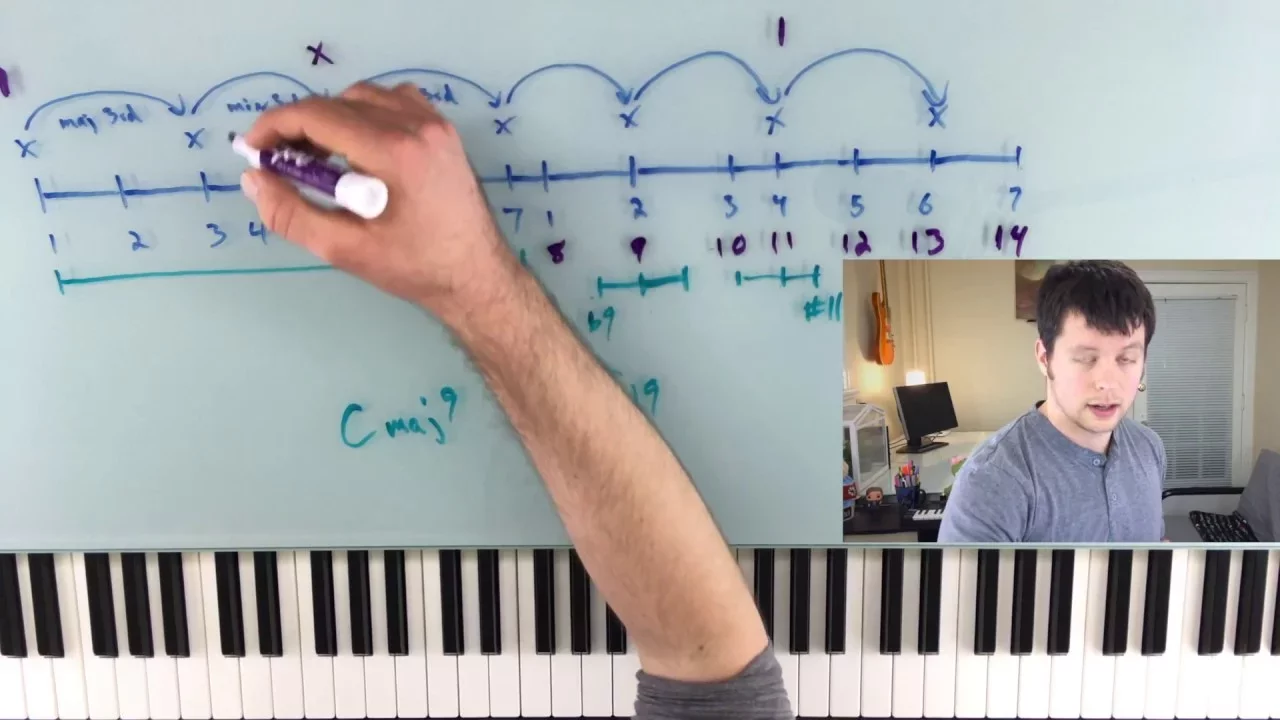

Seventh chords are built by adding the seventh scale degree to triads, with four main types: Major 7th (1 3 5 7), Minor 7th (1 b3 5 b7), Dominant 7th (1 3 5 b7), and Diminished 7th (1 b3 b5 bb7); each type is constructed by first writing out the major scale of the desired root, identifying the scale degree numbers, and selecting the appropriate notes while omitting the others.
How to Build Major, Minor, Dominant, and Diminished 7th Chords
Added:Basic understanding of major and minor scales, including how to identify their key signatures.
Knowledge of musical intervals, specifically major and minor thirds, perfect fifths, and major and minor sevenths.
The ability to construct and identify basic triads (major, minor, and diminished).
Familiarity with scale degree numbering (e.g., 1, 3, 5) and how they represent notes relative to a root.
How to invert 7th chords (root position, first, second, and third inversions) for better voice leading.
Understanding diatonic 7th chords and how to harmonize major and minor scales.
Applying 7th chords to common chord progressions, such as the jazz ii-V-I progression.
Exploring extended chords (9ths, 11ths, and 13ths) which build upon 7th chord structures.
462.2K views8.4Klikes19:56Original Release: 2011-08-16
[Music] okay so today we're looking at uh seventh chord specifically we're looking at how you make major minor dominant or diminished seventh chords now uh before we do this video you're going to need to understand how you make major scales and uh major key signatures and it all builds from there so to start with just like how we worked out all the other chords um write at a C major uh scale or a C major key signature and draw the scale degree numbers underneath really easy so let's do that we've done now is we've written out the c major scale yeah from C all the way up to the the the higher C like an octave higher yeah so now we're just going to write underneath the scale degrees 1 2 3 4 5 6 7 and eight back to the if you've seen my other video on how to create major chords Triad chords with the one three and the five it's exactly the same only this time you want 1 three five and seven okay so start off you want the one you don't want the two you want the three you don't want four you definitely want the five you don't want the six you want the seven and you can take out the eight so that's it so that's how you make a Major Seventh chord it's just that easy you have the one the three the five and then the seven and that's it really simple stuff so let's stack it up vertically to look at it another way so remembering what scale degrees you want you want the one the three the five and the Seven you draw that up 1 3 5 7 and then just as you you know just as we did before you just remember those letter names c e g b easy so looking at it vertically uh in this sort of order can sometimes sort of picture it better in your head uh so you can look at it horizontally or vertically either way way you just have to remember that for a Major Seventh chord that's what you've got you've got the one the three the five and the Seven I'll do I'll do a quick other example in the key of A so we're going to look at an a major 7th chord all right here we go okay so just as we did with C major I've drawn out the a major scale or the a major key signature we want the one the three the five and the Seven easy so get rid of the two get rid of the four get rid of the six and get rid of the eight and all those there are the notes in the a major 7th chord and let's draw it vertically 1 3 5 7 a c sh e gsh easy so in some people's minds it works better looking at it vertically stacking it up that way other people do it horizontally either way I always start off writing out all the notes horizontally and then wiping them out it just works better for me that way great something to think about with major 7th chords is major 7th chords could look like this so they could do this they could do that so instantly you know that's going to be a major 7even but that's not going to be the case sometimes you might see this you might just see C and then the letter is M AJ and J stands for major and seven stands for the seventh but sometimes you even see less than that sometimes you only see C capital M seven sometimes you might just see that if it was a little M it would more indicate that it was like a a minor uh seventh chord as opposed to a capital M but those are the different ways that you you know that in general sort of sheet music you're going to see aaz 7th so the important thing to remember is if you wanted a major chord let's say you wanted a B major chord yeah you'd write out the B major scale you do the scale degree numbers underneath and you take out the ones you don't want so you only want 1 3 5 7 that's it okay so now we're going to look at minus 7th chords okay so exactly as we did the other ones you draw out the c major scale the c major key signature draw out the scale degree numbers 1 2 3 4 5 six 7 and eight now if you remember in um the last video I showed you with creating minor chords that a major chord is 135 A Minor triad chord is 1 flat 35 if you don't remember go back and check out that other video uh but so pressing on so in a minor 7th chord we want the one the three that's then flattened the five and then the seven but the Seven's also flattened so first let's get rid of the scale degree letters uh that we don't want so we don't want the two or the four we want the five we don't want the six or the eight okay so if you're looking at all those letters there 1 3 5 7 that's a C major chord to turn it into a minor chord so e goes down to E flat uh down a fret or a semitone and then um the seventh also goes down so it goes down a semitone or a fret so B becomes B flat and just put a a flat on the seventh so there that's how you work out a C minor 7th chord One Flat 3 5 flat 7 or the letter names are c e flat G B flat done let's stack it vertically cuz some people it it helps to see it in a vertical area so remember one flat 3 5 flat 7 c e flat G B flat done so that's all there is to it that's how you make a minus 7th chord I'm just going to quickly do this exactly the same thing in another key just to show you another example okay let's pick another key let's do D so we're going to do start off writing out a D major key signature or a D major scale and then turn it into a d minus 7th chord here we go 1 3 5 7 and then you flatten the third and flatten the seventh because it's a minus 7th chord you wouldn't flatten those two if it was a major seventh okay so we take out we write down so we write down the scale degree numbers 1 2 3 4 five 6 7 eight let's go backwards take out the eight take out the six take out the four and the two so there you have it that's D major 7th but we flatten the third so put a flat on the three and then instead of f it's going to go down a semitone so instead of f sh it's going to go down a semitone to F and then instead of a normal seven it's going to be a flat seven so the C Shar goes down to C so it just goes from C Shar down a fret or down a c and that's it exactly the same you can draw that up vertically it doesn't matter 1 flat 3 5 flat 7 that's how you work out a minus 7th chord great well done now there's a few different ways uh if you're looking at sheet music or at tabs or whatever that you might see um a minor 7th chord written out so I'll show you okay so you might see C if it's a c chord and then minor next to it if you see minor written out you know it's a minor chord c minor if you see the seventh next to it that's how you might see it you might see C minor 7th but you might see it C and then the word Min now min's just standing for minor so c - 7 again or you could see this C little m s okay and so the little m stands for minor um it comes up every now and again I know it seems a little crazy like it could the M could mean major or minor it's just cuz it's smaller that it's sort of indicating more that it's a minor chord and that's it well done so the important thing to remember is it's just like all the other chords if you wanted um let's say an eus 7th chord you just write out the E major scale you take out the ones you don't want you only want one three five and seven and then you just flatten the three down and then you flatten the seventh and that's it so it works so you can now create any minor 7th chord well done okay so today we're looking at how you work out a dominant 7eventh chord okay so it's just like all the other videos so if you don't know how to make a major scale cuz that's what we're doing it from go back and watch those other videos and watch the key signature videos and then watch building you know Triads if you're not sure how to make Triads okay so first off we've written a C major scale or C major key signature because there's no Sharps of flats it's really easy to see it all the notes okay then draw the scale degree numb Z okay maybe it'll be neater than me uh then once you've done that in a dominant seventh chord you want 1 3 5 flat seven okay so get rid of the other ones you don't want so you don't want the eight you don't want the six you don't want the four or the two it's going to be a C major 7th chord all you do is you flatten the seventh there so little flat on the seventh little flat on the B and now suddenly that's a c dominant seventh chord okay it's not minor because you have a major third there you didn't flatten the third to turn it from a major into a minor you kept that major you've just flattened the seventh so it's gone from a major 7eventh to a dominant seventh chord just by flattening that one note that's all you do I'll give you another example let's choose uh G so I'll do uh G dominant 7eventh chord here we go so first you'd write out the notes in the G Major scale g a b c d e f and g then you write down the scale degree numbers okay and now remember what we want we want 1 3 5 flat 7even get to the other ones the eight the six the four the two flatten the seventh here and then because it's F you just take it back a fret or a semitone from F to F so you're still flattening it so right there GB D and F they're all the notes in the G dominant 7th so you do that with any key so if you wanted a let's say you wanted a b dominant 7eventh chord all you would do is you would write at a B major scale and then do exactly that to it in order to change it really easy stuff now if you're looking at different music different tabs or chord charts or whatever you're going to see dominant 7 written in a few different ways you might see it like this let's say you've got a C chord you might see it written you might see that you might see someone's actually gone to the trouble of writing out dominant 7th you might see that or you could just see this C Dom seven you could see that or more often than not all you're going to see is the chord value so the chord and then a seven next to it that stands for dominant seven okay nine times out of 10 generally that's what you're going to see um so it's the same with you know 9th 11th and 13th chords you're going to see like a c 9 okay something like that it's it's just going to be a dominant that's what it means okay and well done that's it so that's dominant seventh chords basically So today we're looking at diminished seventh chords yeah okay now if you've watched the other video and you understand how diminished chords work where you flatten the third degree and the fifth degree it's just adding a seventh okay and it's flattening the seventh twice but it'll make more sense once we get into it because we're after the C diminished seventh chord you first write out a C major scale if you're after an a diminished seventh chord you'd write out an a major scale and then change it this way but it all comes back to writing out the major scale so you first you put down the scale degree numbers 1 2 3 4 5 6 7 and eight now you want one three 5 and seven but then you alter them okay so get rid of the other ones first so get rid of the two get rid of the four get rid of the six and get rid of the eight so if I kept it that way that's going to be a C major 7th okay if I flatten the third so e goes down a fret or down a semitone E flat that's a minor major 7th chord because it still has a major 7th if I flatten the fifth from here so G goes down a fret or a semitone to g flat then it's going to be a diminished C or C diminished with an added major 7th okay very confusing terminology yeah but as soon as you flatten twice the 7eventh so B goes down to B flat but then it also goes down another one so whenever you go down Two Flats you go down a tone so a tone you can think of as two Frets or two semmit tones okay tone you could think of uh a tone abbreviated to T or t for two yeah that sort of a thing so b double flat is actually a okay so you can think of it as b double flat or you can think it as a the note is exactly the same they're anharmonically equivalent yeah so that's exactly the same so there are the notes in the C diminished 7th there's the first the flat third the flat 5 and the double flat 7 now the only reason some of you are going to say well it doesn't look too nice to have a b double flat like wouldn't it just be easier writing an A and it is easier writing an a the only reason why I'd stick to the B Double flat is if you write out the c major SC again if you have a look uh a is the sixth degree so a is already in the c major scale so to me it just makes a little bit more sense altering the B with a double flat than writing an a because a would sort of suggest that it could be if you just wrote the a it could be a different type of chord could be like a sixth chord or something like that but so I would keep it as looking at the Double flat CU that makes more sense yeah if you have um tab or you have like a lead sheet or sheet music or whatever you might see a diminish seven written like this so you've got C then here's the diminished okay so you might see it like that someone's taken the time to write out properly see diminish s or this is a bit more popular you might just see C dim s dim standing for diminished or you could actually find this C little circle above the C seven okay that means it's a full diminished chord that means everything's going to be diminished the third the fifth and the seventh is going to be double flat yeah um so that's a full diminished seventh we're get into half diminished later but if you see a diminished chord it could be written like that as well great so just a super quick recap um together we're going to go through all of them really really quickly okay so major 7 is 1 35 7 that's it so let's quickly write out the c major scale remember it just goes up the alphabet yeah no sharps or flats okay we want the 1 three the five and the Seven 1 3 five 7 get rid of the rest done so that's all all the notes in the c major 7th c e g b now now let's do minus it so we want 1 flat 3 5 flat 7 so get rid of the other ones done okay so now we have to flatten the three and the seventh so e goes down a fret down a 7 T to E flat then there's G fine and then seventh is flattened so B goes down to B flat that's it easy now let's look at dominant seventh okay again right at the scale okay and dominant seventh you want the 1 three five and the seven but it's flat seventh is fat so get rid of the other ones so all you do one 3 5 7 flat in the seventh so B becomes B flat easy and now we'll do the last one the diminished seven so with diminished seven we're looking at one flat three flat five double flat 7 okay get rid the other ones you don't want so e goes down to E flat G goes down to g flat and B gets Two Flats so it's either B and B gets Two Flats so it's either b double flat or a another look I've gotten rid of the note names yeah so this is just the formulas so for a major 7th chord you want 1 3 5 7 for a minor 7th chord 1 flat 3 5 flat 7 for a dominant 7eventh chord 1 3 5 flat 7 and for a diminished One Flat 3 flat 5 double flat seven and that's it that's all the sort of popular seventh chords you're going to come across but again other seventh chords I'll do in more videos okay well done everyone bye now just a quick sort of side note um what I've been showing is I've been showing you the scale degree numbers and how to use them changing um you know a major scale into you know minor chords diminish chords augmented anything like that there's other ways to do it this is just the easiest way that I can um show you CU it's visually and I think it works really well because you could practice it anywhere you know just need a pen or paper and then start working it out in your head there's few different sort of rules of thumb like although I did rub out you know the eight the octave uh in a lot of chords that you play the octave is still going to be in there that's not to say it's not supposed to be in there I was just showing you the main um scale degree numbers in each of the chords you know some are going to have another octaves and if you notice it if you work out what notes you're playing on the guitar they're not going to be in that particular order a lot of the time a lot of the time it's not going to be played you know 135 7 8 it's not going to be like that maybe it'll be 1 5 8 3 something like that it's it's it's all going to be different the guitar isn't like a piano where it's all the notes you know are set out and you play the chord you know straight exactly how it is you've got almost you've got six different pianos with all the different strings and so you're looking at it from that way looking at it vertically so don't you know don't freak out if you're playing a chord and it's it doesn't seem to be 1 3 57 they're just going to be jumbled up in a different sort of an order but that's all the seventh chords and then a lot more videos to come okay bye guys
Up Next

9:23
Music Theory Fundamentals: 11 Concepts for Beginner Musicians
@TrevorWongMusic
63.5K views•2019-12-28

10:20
Mozart's Musical Dice Game Explained: History, Rules, & Fun
@webpianoacademy
5K views•2023-03-13

47:36
Understanding Diatonic 7th Chords in Major Keys | Music Theory Tutorial
@GracieTerzian
54.7K views•2022-03-02
10:49
Understanding John Coltrane's Giant Steps: A Music Theory Analysis
@Vox
10.4M views•2018-11-12
Related Study Plans & Knowledge Roadmaps
Structured learning paths in Music Theory
music-theory
Composing Galant Music: Partimento & Schemata
01Foundations of Figured Bass and Keyboard Harmony
02The Rule of the Octave (Regola dell'Ottava)
03Galant Schemata: The Building Blocks of Form
+ 2 more learning modules
30h5 modules
Explore Roadmap
music-theory
Decoding Overtone Series: Tuning & Drone Music
01Acoustic Foundations: The Physics of the Overtone Series
02Tuning Systems: Equal Temperament vs. Just Intonation
03Microtonality and Spectralism: Beyond Standard Pitches
+ 2 more learning modules
24h5 modules
Explore Roadmap
music-theory
Impressionist Harmony: Scales, Planing & RPGs
01Foundational Music Theory: Keys, Intervals, and Seventh Chords
02Impressionist Color: Chord Planing and Parallel Harmony
03Whimsical Textures: Pentatonic Cascades and Whole-Tone Scales
+ 1 more learning modules
14h4 modules
Explore Roadmap
music-theory
Negative Harmony: Axis Reflection in Indie Pop
01Music Theory Foundations: Scales, Intervals, and Triads
02Functional Harmony and the Circle of Fifths
03Demystifying the Negative Harmony Axis Reflection
+ 2 more learning modules
16h5 modules
Explore Roadmap