

![Les clés du regard [5] - Jan van Eyck](https://i.ytimg.com/vi/Tkq8LkUyV5o/maxresdefault.jpg)



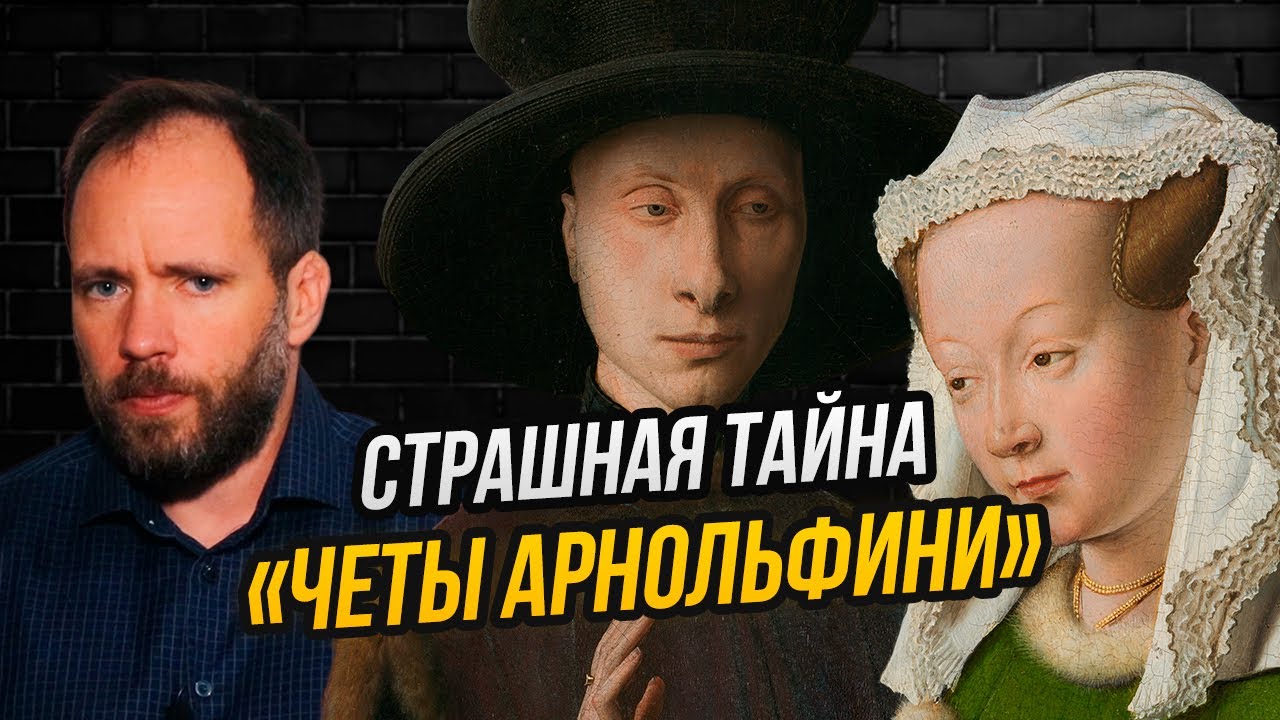





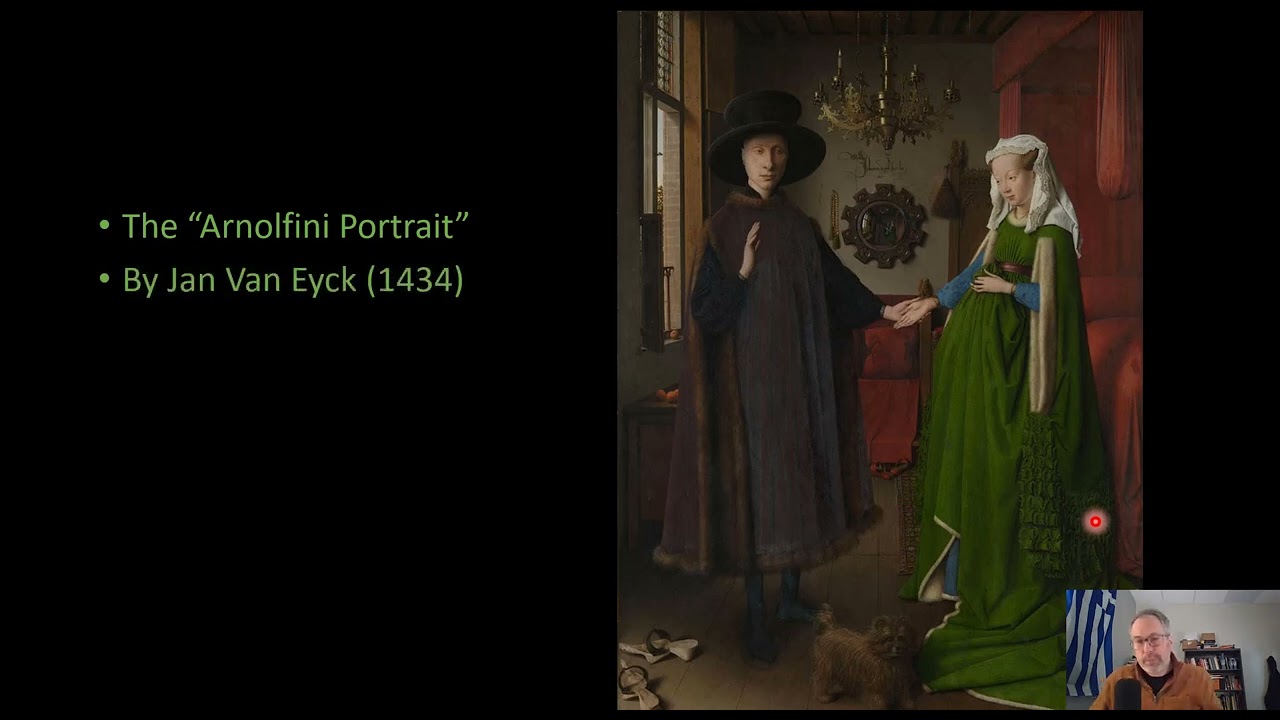
Jan van Eyck's 1434 painting 'The Arnolfini Portrait' remains one of art history's most mysterious works due to its layered symbolism and contested interpretations; while traditionally viewed as a wedding portrait, scholars debate whether it serves as a legal marriage record (as proposed by Erwin Panofsky through the artist's signature and mirror reflections), a memorial to a deceased wife (supported by historical records showing her death in 1433), or simply a celebration of wealth and status, with details like the single candle above the husband symbolizing divine wisdom and the extinguished candle above the wife possibly representing mortality.
The Arnolfini Portrait: Decoding Jan van Eyck’s Masterpiece
Added:The distinction between the Northern Renaissance and the Italian Renaissance, particularly the Northern focus on domestic realism, meticulous detail, and everyday settings.
The development and properties of oil painting as a medium, specifically Jan van Eyck's pioneering use of layering translucent glazes to achieve depth and light.
The definition of iconography and how art historians analyze symbolic language, signs, and allegories within historical artworks.
The socio-economic context of 15th-century Flanders, including the rise of a wealthy merchant class and the importance of trade hubs like Bruges.
The historiographical debate surrounding the portrait, specifically comparing Erwin Panofsky’s 'sacralized marriage contract' theory with Margaret Koster's 'memorial portrait' hypothesis.
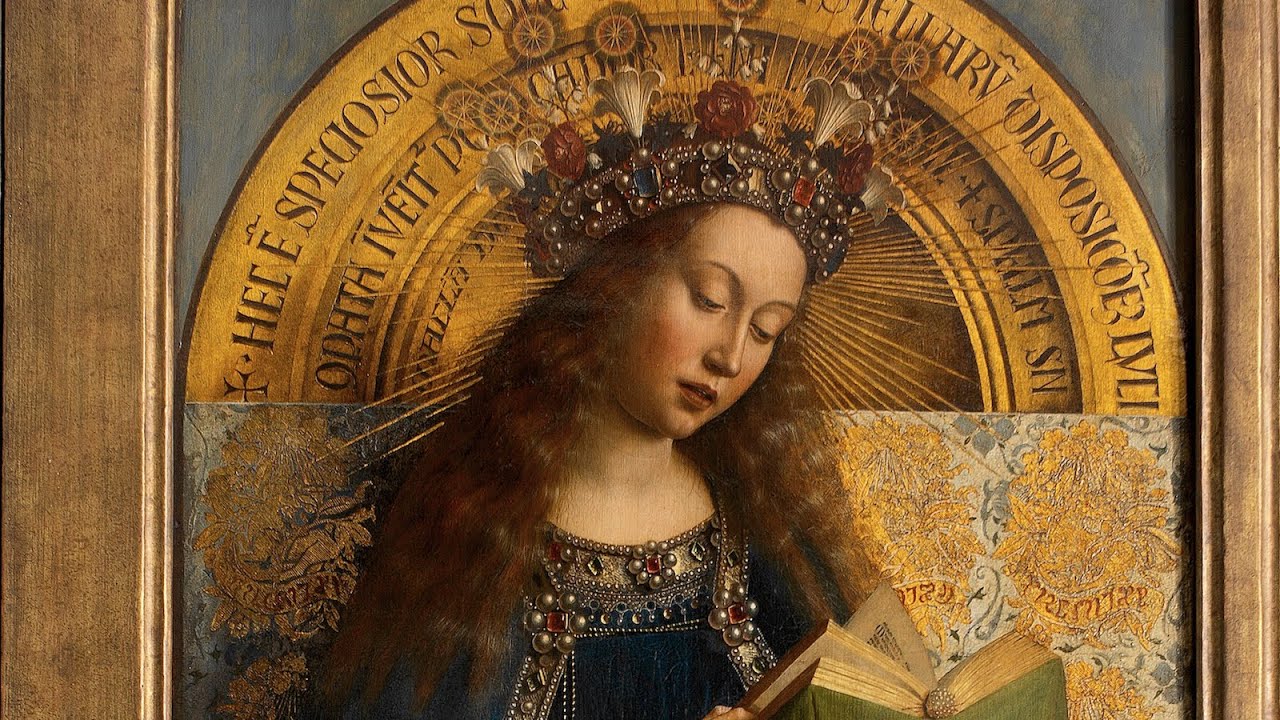
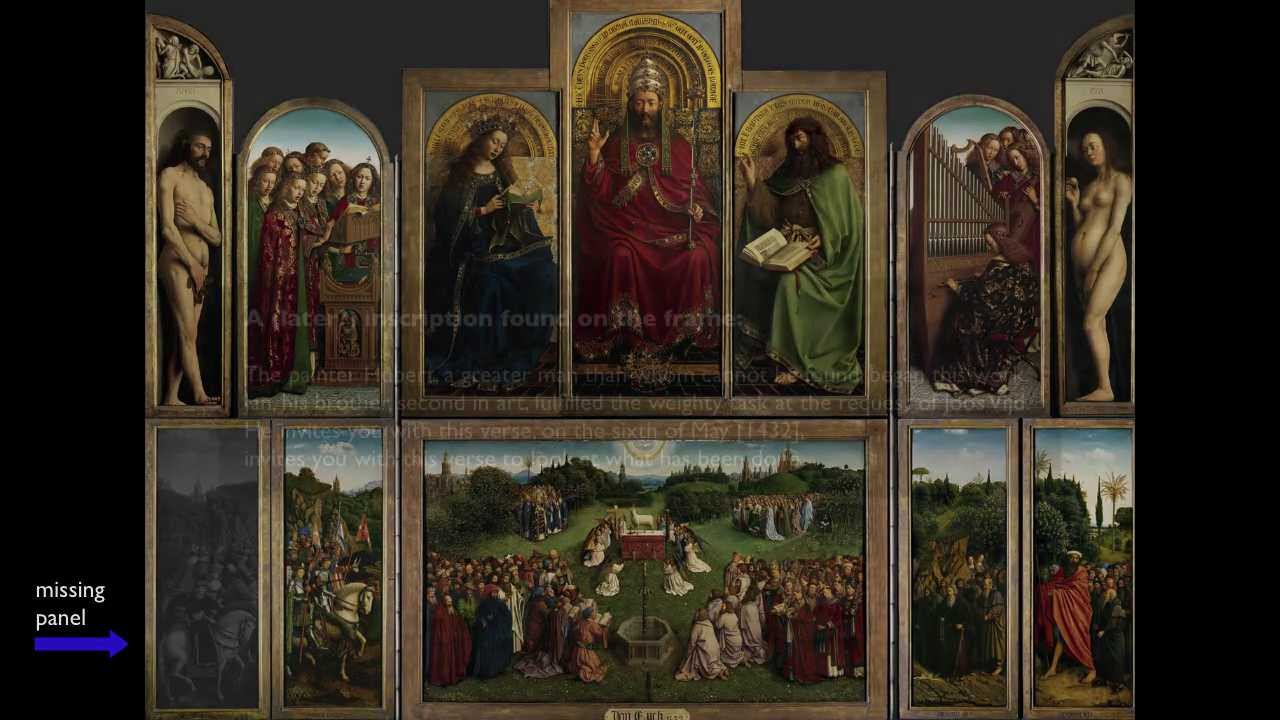
Jan van Eyck's broader oeuvre, notably the Ghent Altarpiece, to analyze his mastery of complex theological programs and monumental scale.
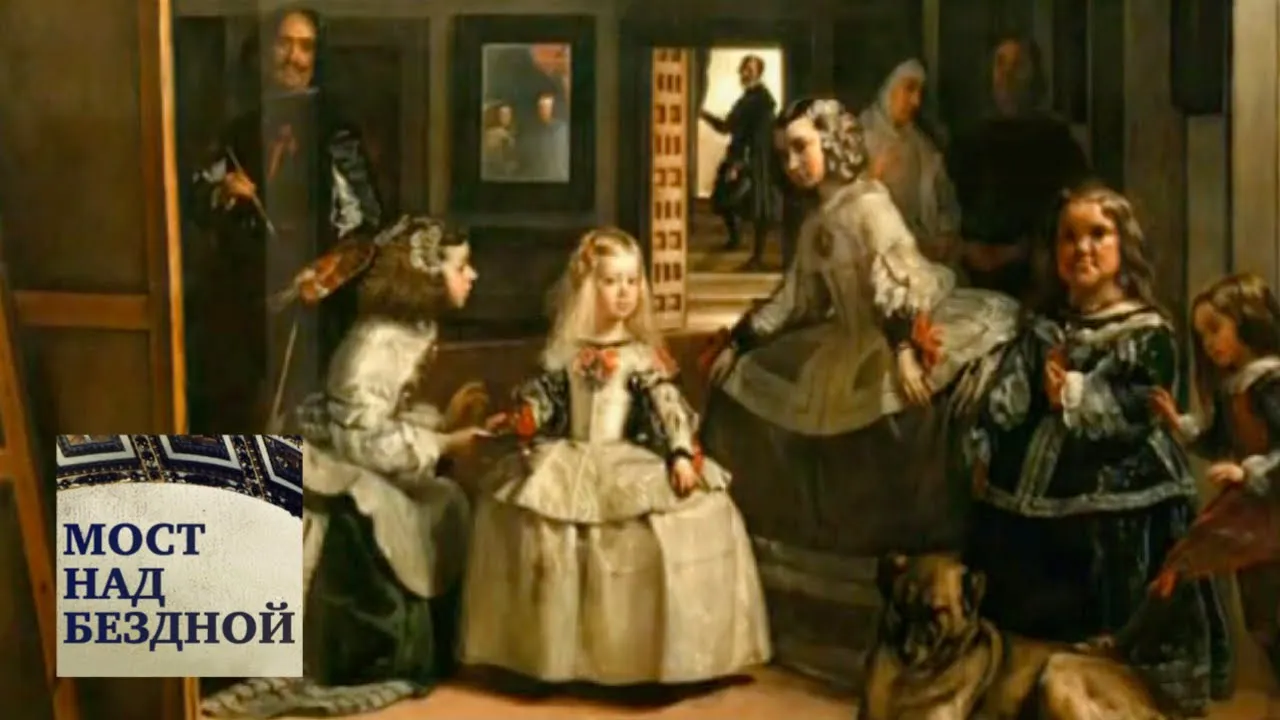
The evolution of the convex mirror and self-referential optical devices in Western art, tracing its influence to masterpieces like Diego Velázquez’s 'Las Meninas'.
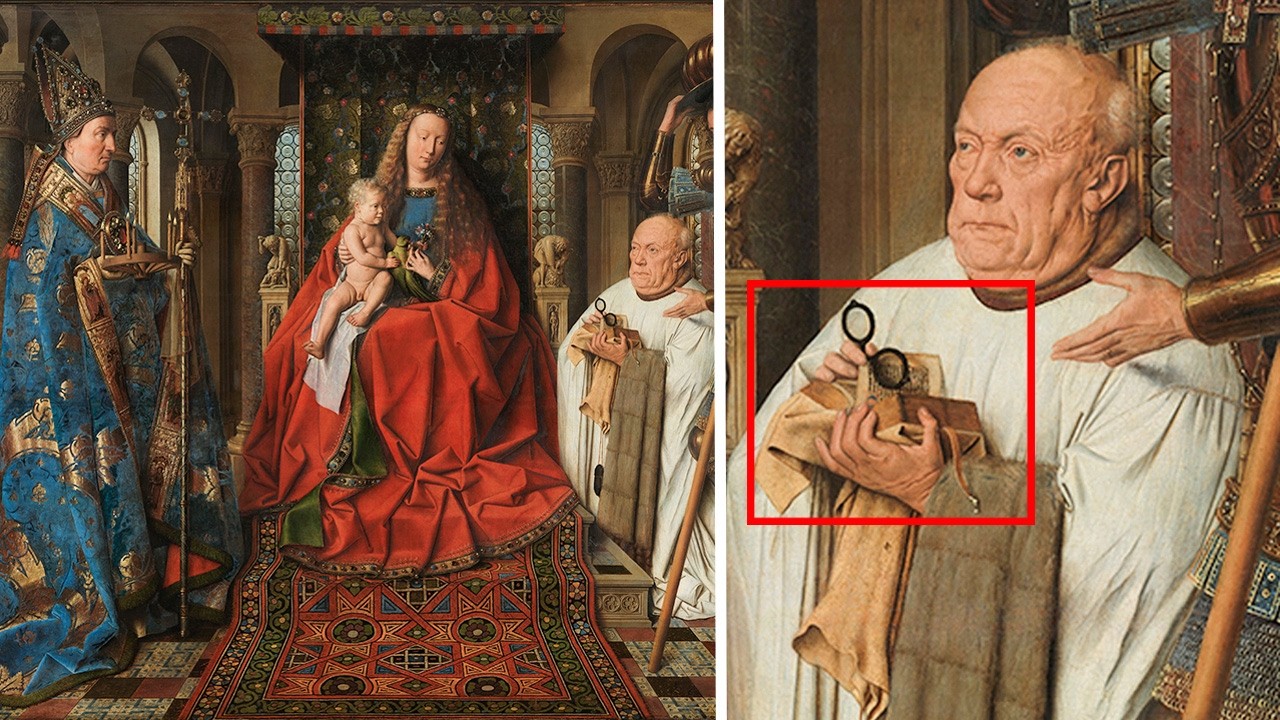
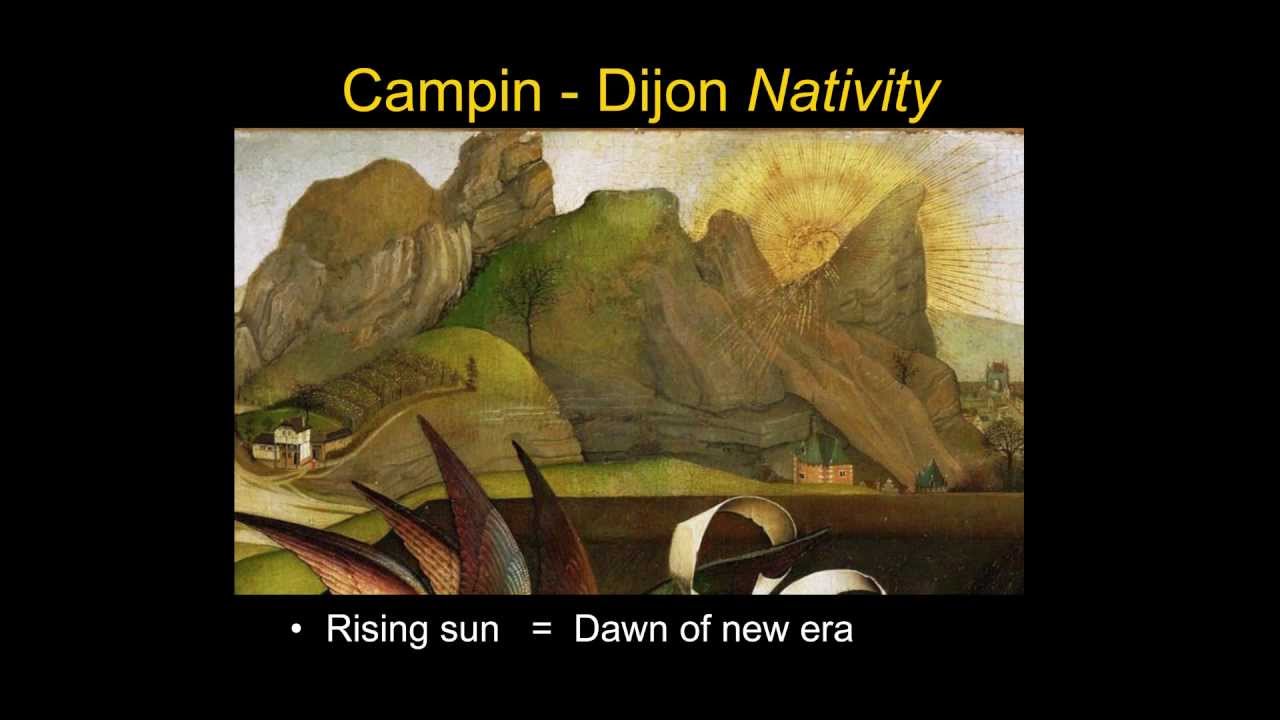
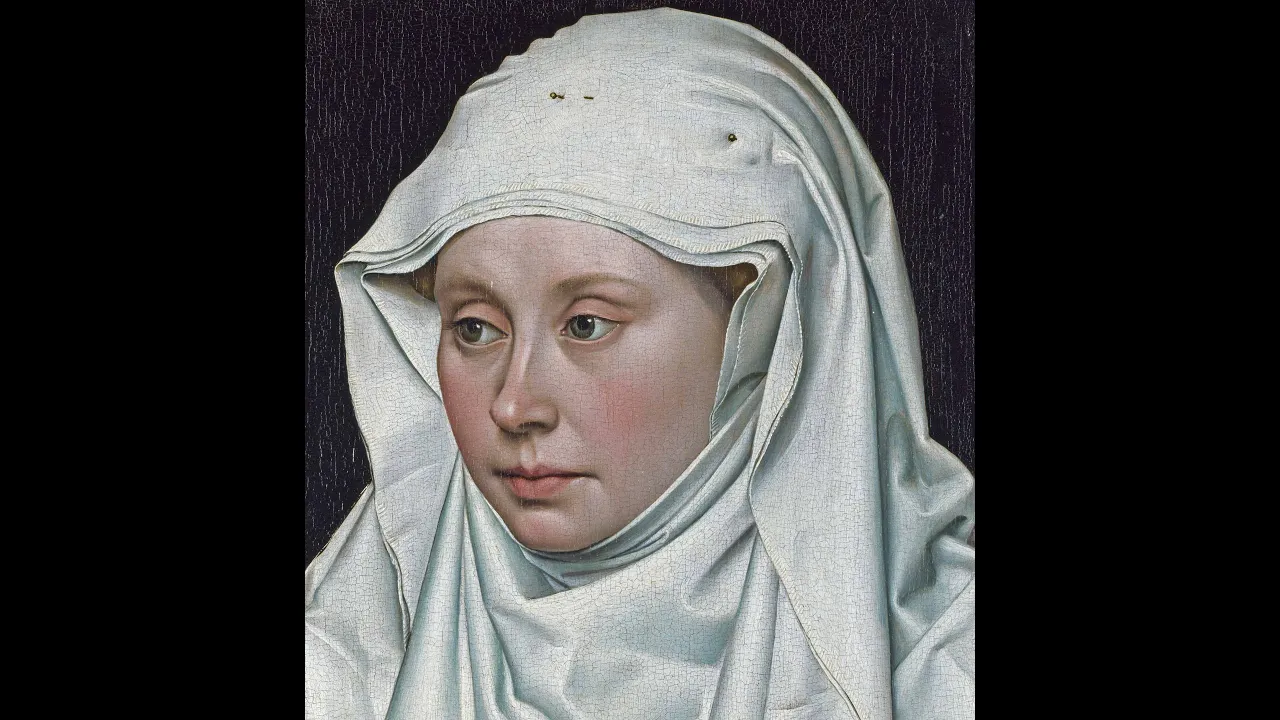
A comparative study of contemporary Early Netherlandish masters, such as Rogier van der Weyden and Robert Campin, to understand the stylistic trajectory of Flemish art.
1.7M views22.1Klikes9:09Original Release: 2025-08-28
Some paintings seem to hide such a deep enigma that they compel us to look at them over and over again.
One of them is the famous Arnolfini Portrait, painted by Jan van Eyck in 1434.
At first glance, it looks like a small and simple work. But the more you study it, the more hidden details begin to emerge. That’s why many consider it the most mysterious painting in the history of art.
For centuries, it was believed to depict a marriage or engagement. However, details such as the woman’s dress, the little dog at the couple’s feet, and the two mysterious figures reflected in the mirror have led experts to question whether we are truly looking at a wedding scene —and to propose fascinating theories that might forever change the way you see this painting.
The first thing we need to understand is that we are in the 15th century, in the city of Bruges, what we know today as Belgium. Before us stand two figures dressed in a display of wealth that leaves no doubt about their social status.
The woman wears a green gown lined with squirrel fur, a garment that, according to scholars, may have required as many as two thousand pelts to create. The man, meanwhile, is dressed in a velvet tabard trimmed with marten fur—another unmistakable marker of wealth and power.
They stand hand in hand. The man raises his other hand in a solemn gesture, as though making a vow of loyalty or marriage. And for centuries, most people believed that this is exactly what we were seeing: a wedding portrait.
But in 1934, the influential art historian Erwin Panofsky proposed a far more intriguing interpretation. According to him, the painting was not only a depiction of a marriage, but also a legal record of the event itself.
The key lies in a detail that can be easy to miss: a carefully painted inscription on the back wall. It reads, “Johannes de Eyck fuit hic. 1434.” In Latin, this means “Jan van Eyck was here. 1434.” Unlike the discreet signatures in some of his other works, here it appears boldly integrated into the scene, as though it truly belonged to the moment being depicted. For Panofsky, this unusual statement meant more than simply claiming authorship: Van Eyck was acting as a witness to the marriage. In this sense, the painting became something unique—a portrait and a legal document at the same time.
If we follow Panofsky’s interpretation, the idea that this painting serves as a legal record is reinforced by one crucial detail: the circular mirror just below the artist’s signature.
It’s a convex mirror, framed by ten tiny medallions depicting the Passion of Christ, from his arrest to the crucifixion. This isn’t just decoration—it’s a showcase of pure virtuosity. Van Eyck not only managed to capture reflections with almost microscopic precision—so fine that he may have used a single-hair brush—but he also filled this detail with rich symbolic meaning.
In the mirror, we see the backs of the couple standing in the room. We can also make out the window, the chandelier, the wooden beams of the ceiling, and even the oranges on the windowsill—luxuries at the time, reserved only for the wealthy.
But the most enigmatic detail appears near the doorway: two additional figures, one dressed in blue and the other in red. According to Panofsky’s logic, they are not just passersby but witnesses to the ceremony. One of them, he suggested, might even be Van Eyck himself, leaving behind evidence of his presence within the scene.
But not all art historians accept Panofsky’s interpretation.
To begin with, he identified the couple as Giovanni di Arrigo Arnolfini and his wife Jeanne Cenami. Yet later research showed that Giovanni di Arrigo did not marry until 1447—six years after Jan van Eyck’s death.
This forced scholars to look elsewhere within the family. The most convincing candidate is Giovanni di Nicolao Arnolfini, a cousin of Giovanni di Arrigo and a wealthy merchant from Lucca, Italy, who spent most of his life in Bruges.
If this is indeed the case, then certain details in the painting take on a very different meaning. Take, for instance, the ornate bronze chandelier hanging from the ceiling. Van Eyck painted it with astonishing precision: each curve seems to catch the light differently, as if every line were a deliberate display of his mastery.
At first glance, it may appear to be just another symbol of luxury. But scholars have long noticed something unsettling. Only one candle is lit—despite it being daytime—and it is placed directly above the man’s head. Panofsky read this as a “wedding candle,” symbolizing the omniscient wisdom of God presiding over the ceremony.
Yet on the other side, above the woman, we see another candle—but this one has burned down and gone out. In the tradition of memento mori, extinguished candles often symbolized the passage of time and the fragility of life.
This has led some scholars to suggest a darker possibility: that the woman may have already died, while the man was still living. Under this interpretation, the painting would not be a wedding portrait at all, but rather a memorial portrait—a solemn tribute to a wife who had passed away too soon.
Art historian Margaret Koster was the one who gave a decisive twist to this interpretation. In 2003, she dismissed Panofsky’s theory as “an improbable scenario” and proposed an alternative much more consistent with the historical record.
But before diving into her theory, let me remind you that this painting is already available in our catalog.
Over the past few months, we’ve built a collection of more than 700 carefully selected artworks—chosen both by me and with your suggestions. I’d love for you to take a look once you finish watching this video. There, you can purchase your favorite painting to hang in your home, with free worldwide shipping. And by doing so, you’ll also be supporting my work and helping me keep creating videos like this one.
Thank you so much for your support—the link is in the description.
Now then, let’s continue… Archival records reveal that Giovanni di Nicolao Arnolfini’s first wife, Costanza Trenta, died in 1433—just a year before the date inscribed in the painting. And all evidence suggests that she died in childbirth.
Suddenly, many details of the painting begin to align with this possibility. Behind the woman, we see a finely carved wooden chair. At the top of its post is a small figure of a woman standing on a dragon. Koster identifies her as Saint Margaret, patron saint of pregnant women, celebrated in legend for being swallowed by a dragon and miraculously emerging unharmed.
This brings us to the central controversy: is the woman in the portrait actually pregnant? Koster insists that she is. Others, however, argue that the bulge of the dress is not a sign of pregnancy but of fashion. Among the wealthy of the time, it was common to wear long gowns with heavy fabric gathered at the front. You can even see the same style in another Van Eyck painting, where the Virgin Mary wears a voluminous blue robe in the exact same way—though of course, she is not meant to be pregnant. And since Arnolfini was a fabric merchant, the extravagant display of textiles on his wife would have doubled as a statement of his profession.
Still, the commemorative hypothesis remains standing. If we accept this reading, then even the little dog at the couple’s feet takes on a different meaning. Panofsky saw it as a symbol of marital fidelity. But in funerary tradition, dogs often appear in female effigies—not only as signs of love, but also as guardians meant to accompany the deceased into the afterlife.
Even the mirror seems to reinforce the idea. The ten medallions that frame it tell the story of Christ’s Passion, and they’re not arranged randomly. On the left are scenes of Christ alive; on the right, scenes of his death. It’s as if the couple reflects the same division: the man on the left standing for life, and the woman on the right, bound to death.
Reaching a definitive conclusion is not easy. And perhaps that is Van Eyck’s true genius: his ability to weave profound symbols into a scene that, at first glance, seems so natural.
Some historians see hidden messages in every object; others prefer caution and argue that no secret meanings exist at all. Either way, nothing diminishes the serene beauty of the painting, nor the technical mastery with which Van Eyck presents a scene that feels almost alive before our eyes.
What is certain is that the mystery lives on—nearly six centuries later.
I’d love to hear your interpretation in the comments. Which of these theories do you think fits the painting best?
See you in the next video.
Up Next

22:15
The Northern Renaissance: Art, Innovation, and Cultural Revolution
@ArtWithUsFamily
142.7K views•2023-03-25

114:18
Christian Iconography: History, Theology, and Meaning | Fr. Panayiotis Papageorgiou
@Trisagionfilms
58.8K views•2020-02-21

8:02
Ophelia by Millais: Symbolism and Pre-Raphaelite Art Explained
@inspiraggio
287.5K views•2025-09-07

16:34
Earliest Depictions of Jesus in Art: 10 Ancient Images Explained
@UsefulCharts
5.9M views•2022-06-03
Related Study Plans & Knowledge Roadmaps
Structured learning paths in Art History
art-history
Gothic Cathedrals: Engineering, Light & Society
01The Birth of the Gothic: Romanesque to Suger's Vision
02The Structural Triad: Pointed Arches, Ribbed Vaults, and Flying Buttresses
03Theology of Light: Lux Nova and Sacred Geometry
+ 2 more learning modules
14h5 modules
Explore Roadmap
art-history
Pre-Raphaelites: Realism, Symbolism & Critique
01The Victorian Art Establishment and Academic Formula
02The Founding of the PRB and Radical Realism
03Medieval Revivalism and Literary Symbolism
+ 1 more learning modules
8h4 modules
Explore Roadmap
art-history
Street Art: From Subways to Art Market
01Subcultural Origins in Philadelphia and New York (1970s)
02The Subway Era and Style Wars (Late 1970s - 1980s)
03The East Village Scene and Early Gallery Crossover
+ 2 more learning modules
10h5 modules
Explore Roadmap
art-history
Classic Maya Art: Iconography, Glyphs & Ritual
01Foundations of Classic Maya Visual Culture
02Deciphering Maya Hieroglyphs & Text-Image Integration
03Sacred Geography and Cosmological Architecture
+ 2 more learning modules
14h5 modules
Explore Roadmap