













![[교양] 사자가 우리말 할 때](https://i.ytimg.com/vi/1TONW9lSuHQ/sddefault.jpg)


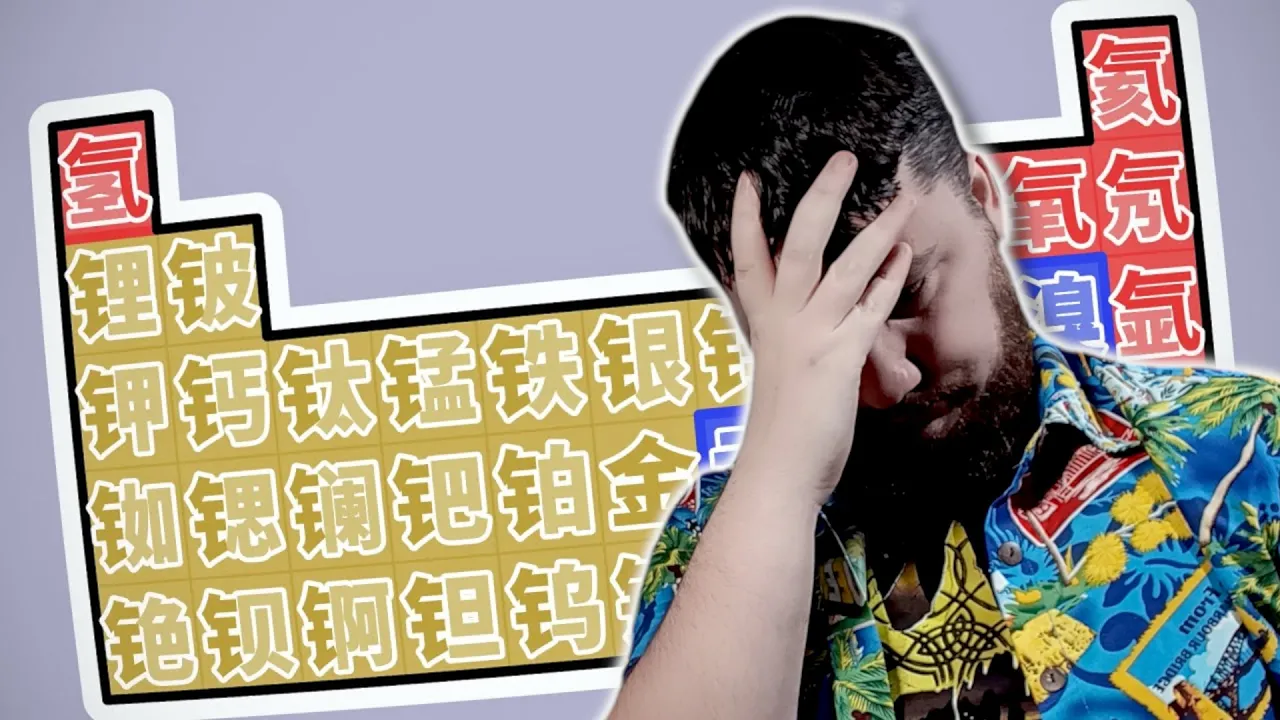




Chinese chemical elements are uniquely named using phono-semantic compound characters, where each element has its own character combining a radical indicating its physical state (metal, stone, air, or water) with a phonetic component derived from its international name, creating a systematic and visually distinctive approach to element naming that differs significantly from Western naming conventions.
Chinese Chemical Element Naming: A Linguistic Analysis
Added:Basic organization and categorization of the Periodic Table of Elements, including the distinctions between metals, non-metals, gases, and liquids.
Fundamental structure of Chinese orthography, specifically the concept of phono-semantic compound characters consisting of a semantic radical and a phonetic component.
The concept of scientific nomenclature and how systematic naming conventions facilitate global scientific communication.
Basic terminology of linguistics, such as phonetics, semantics, morphology, and etymology.
The historical development of modern scientific translation in East Asia, focusing on pioneers like Xu Shou and John Fryer in 19th-century China.
Comparative analysis of chemical nomenclature across East Asian languages, exploring how Japanese (Kanji/Katakana) and Korean (Hanja/Hangul) adapted these terms.
The modern linguistic process and institutional decision-making behind coining Chinese characters for newly discovered synthetic superheavy elements (e.g., Oganesson, Tennessine).
Cognitive studies on how highly systematic, semantically transparent naming systems affect chemical literacy and science education in Chinese-speaking regions.
551.8K views23.6Klikes11:56Original Release: 2025-05-08
Just so we’re clear, I don’t speak any Chinese and I know nothing about chemistry except for opioids so if I make some mistakes in this video, it might have something to do with that.
And while I have never studied Chinese, I have studied Japanese, which has been influenced by Chinese quite a lot, so I expected to find some parallels in how chemical elements are named in both languages.
The Japanese periodic table is not that interesting all things considered, and the naming conventions for the elements are all over the place. The vast majority are phonetic borrowings from German, Dutch or English, there is also about a dozen elements with a suffix meaning ‘element’ most of which are calques from Dutch, and another dozen or so, encompassing some of the most common elements, most of which are borrowings from Chinese with three exceptions which are of native origin.
With this in mind, I figured the Chinese equivalent wouldn’t be much different.
Sure, I know that Chinese avoids phonetic loans like the plague, but one exception is proper nouns especially peoples’ names. I mean, how would you render the word einsteinium other than the transcription of Einstein + some suffix signifying an element, right? Well, as it turns out, no.
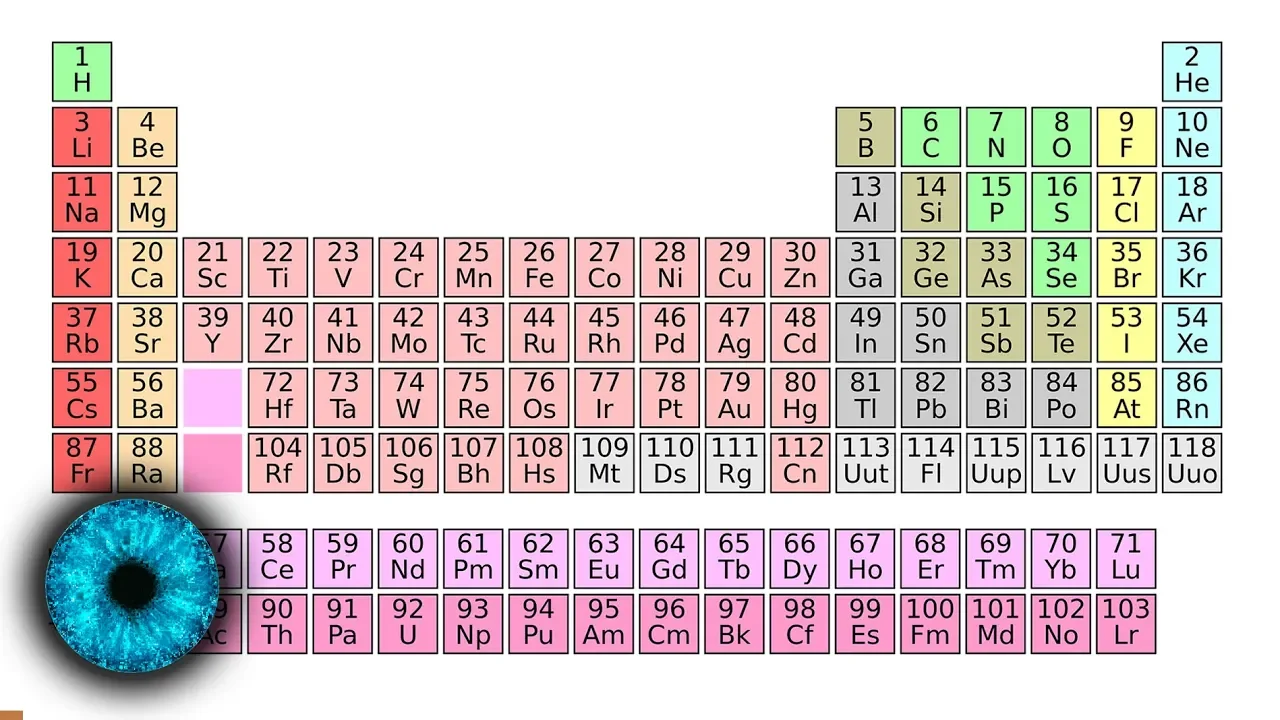
To my surprise, when I looked up the Chinese periodic table, I came across this feast for the eyes.
My god, isn’t she stunning? Well okay, it didn’t look this pretty I made this one, it probably looked something more like this.
And you might be thinking, well, what’s so great about this? Okay, for one thing, the fact that each element has its own character is pretty cool, but also quite unusual in the context of the entire language.
Although the Chinese script features thousands of logographs, the vast majority of words are compounds which combine two or more characters. Generally only relatively basic concepts are expressed with single characters, and you’re not gonna tell me that darmstadtium is one of them.
So these characters are quite unique and as you can imagine, many of them are very rarely used.
It also means discoveries of new elements are some of the only opportunities for new Chinese characters to be coined. How they are exactly coined we’ll talk about later but because of how new they are, some of them aren’t even displayed properly sometimes.
Just look at how this character for livermorium displays on Chinese wikipedia.
I remember a few years ago the character for oganesson wasn’t even digitized, it was just a png.
The other fascinating aspect of these characters is their composition. Before I explain that I need to talk a little bit about how Chinese characters work, and specifically, how they’re categorized.
As you may suspect, they’re not completely random assortments of strokes, and with a few exceptions they’re not pictograms either. The most commonly used categorization of Chinese characters is very old. It dates back to circa 100 AD, when a guy named Xǔ Shèn composed his dictionary titled Shuōwén Jiězì, which was definitely not pronounced like that back then, but I digress. He divided characters into the famous liùshū, or the ‘six writings.’ These categories are as follows. The first two are what people talk about when they say that Chinese writing is easy because the characters just look like what they represent.
So we have pictograms, which are supposed to look like the physical objects they represent although due to thousands of years of evolution, seeing these resemblances in the modern glyphs requires a little bit of imagination; and we also have ideograms which represent not physical objects, but rather abstractions.
Then we have two categories which are a little bit iffy. First off, we have phonetic borrowings.
This category is an example of the so-called rebus principle, which is the usage of pictograms for their sound, as opposed to meaning. The idea is, you have a glyph that’s used to represent something, and then another word comes around which happens to have a similar pronunciation and yoinks this glyph, and so the old word is left with nothing to represent it and you need to come up with a new glyph for it, or use a compound or something like that.
The fourth category is the most controversial, and you can refer to it as ‘derivative cognates’ maybe?
The author suggests that some characters were created through arbitrary changes made to a character with a similar meaning. He offers a single example - 老 lǎo and 考 kǎo which both originally meant ‘old.’ But then he never uses the term in the rest of the dictionary after defining it, so these days this category is usually disregarded.
Now these four categories, we don’t care about them. That’s because all characters on the Chinese periodic table belong to the final two. In fact, these final categories are estimated to constitute over 93% of all characters found in the dictionary. The first works by putting together usually two elements whose separate meanings are supposed to be combined and understood together as a new concept.
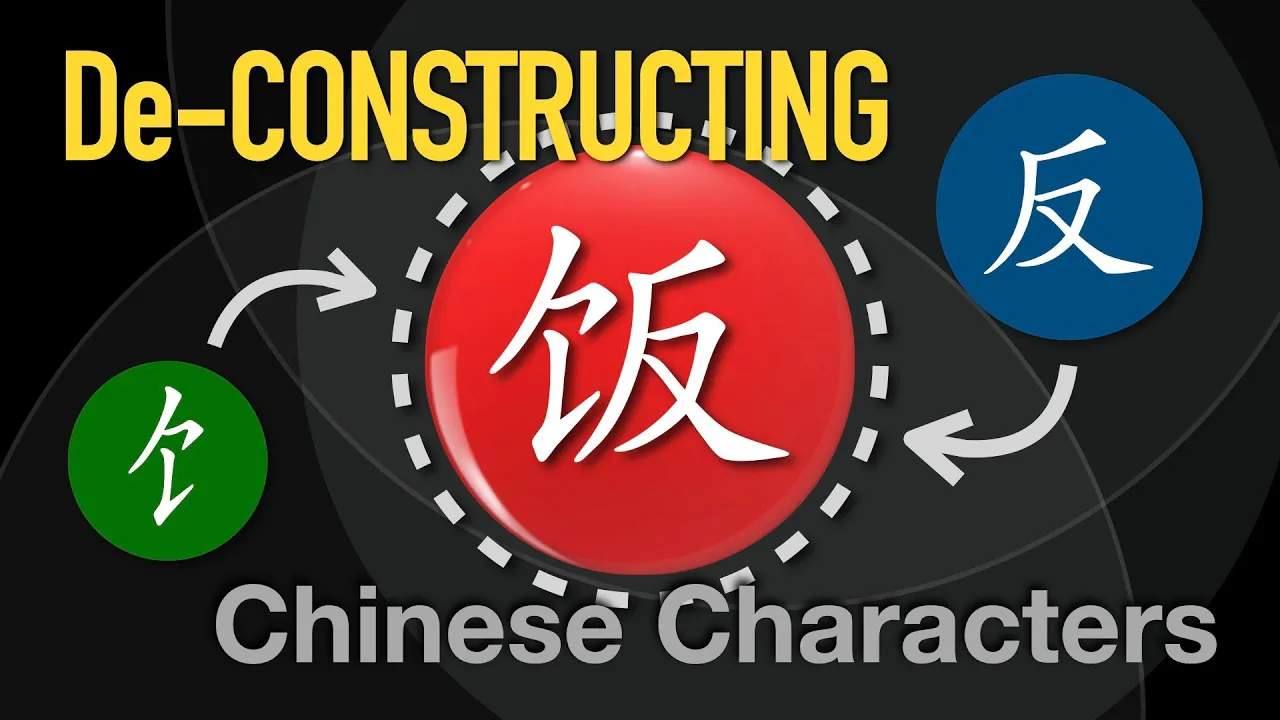
The final category makes up over 81% of all characters featured in Shuōwén Jiězì, so the vast majority of Chinese characters belong to this category. These are phono-semantic compounds and as the name suggests, they feature a phonetic and a semantic element.
The semantic component is called a radical, and it’s what characters are usually ordered by in character dictionaries, like how we use the initial letters of words to order them alphabetically.
The radical is supposed to hint at a general meaning category of the character so under the water radical we can find characters meaning ‘pond,’ ‘drown,’ or ‘river’ but also ‘clean,’ ‘shallow,’ and ‘pale.’ The second half of the character usually has nothing to do semantically with the meaning of the whole character, and is instead supposed to hint at an approximate pronunciation of the character. This means that theoretically, characters that only differ by radical should have similar pronunciations.
In practice, because of sound changes the pronunciations have drifted apart so it’s no longer a very good strategy for determining how a character should be pronounced.
It does work much better in Japanese, and to some degree in Korean.
In fact, every single character on the Chinese periodic table belongs to this category.
In addition, about ten simultaneously belong to the conjoined meaning category.
We’ll take a look at them in a second. Let’s go back to a full view of the table and with our newly gained knowledge we can understand this categorization a little better.
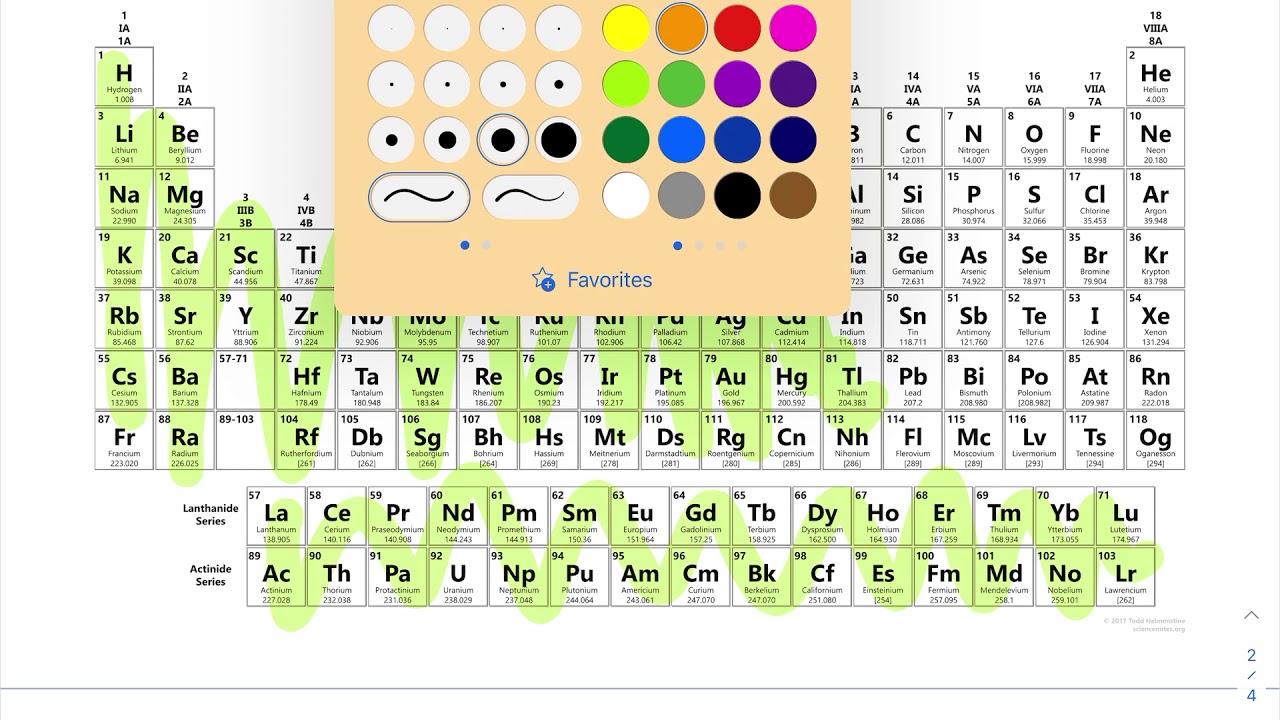
We know that compound characters have a semantic radical and a phonetic element and if we just separate the two, we can see four categories, with a distinct radical representing each.
These categories are based on the element’s state in room temperature.
The metal radical represents solid metals, the stone radical solid non-metals, the air radical gases and the water radical liquids. Just to clarify, some of these radicals have different variants like how the water radical has a simplified form when used on the left side of a character and so does the metal radical, but only in Simplified Chinese.
When used as a full character, it’s not simplified. You can also see it on the table as an element because apart from ‘metal,’ the same character also means ‘gold.’ The phonetic element is usually a simplified transliteration of the character’s name generally in English, Latin or some other European language. I say simplified, because it would be kind of hard to squeeze einsteinium into one Chinese syllable. This is not always the case, and there are some native Chinese names for elements, mostly ones you could expect the ancient Chinese to have found in nature without the need to synthesize them in a high-tech laboratory.
These include gold, silver, iron, copper, tin, mercury and lead.
And then we also have the aforementioned conjoined meaning elements.
These include elements such as oxygen which contains part of the character meaning ‘nourishment’ because most things need oxygen to live, bromine which combines the water radical with the character for ‘bad smell’ mirroring the original Greek etymology platinum which is ‘white gold,’ hydrogen, which, as the lightest element contains part of the character for ‘light,’ and there are also a few others.
At the same time, these characters are also phono-semantic, because the non-radical part dictates the pronunciation.
So if a new element were to be discovered, or more realistically, synthesized, it would be given a radical based on its physical properties and a phonetic element, likely based on its international name.
This is where things get iffy, because for these new elements, their properties are only hypothesized.
Like for this one, apparently only five atoms have been successfully synthesized to date and it’s only predicted that it’s likely to be a solid, even though it’s in the noble gas column, so who knows.
And its neighbor to the left, tennessine, is predicted to be a metal but it was given the non-metal radical, because I don’t know.
Either way, when it comes to naming new elements in Chinese, one thing to look out for are homophones.
You need to make sure that the new element isn’t pronounced like any other of the already existing one hundred-plus elements which is kind of a pain, but that’s what you get when you decide to stick to monosyllables.
This is further complicated by the fact that certain elements have different pronunciations or even entirely different characters in different regional varieties.
What makes things a little easier is that because the majority of these characters are modern inventions, their pronunciation is generally identical to that of their phonetic components even down to the tone, because sound changes haven’t had enough time to kick in.
Compare the newer elements on the left with the older ones on the right.
Thankfully, there are absolutely no homophones among element names whatsoever.
Well, no, I lied, tin and selenium are both pronounced xī, which is why there is an alternative reading for tin with a different tone so that they’re not identical.
Now, just because elements can’t be confused for one another, doesn’t mean that they can’t be confused for other words.
This is what surprised me the most. If there’s one thing Chinese morphology is famous for, it’s its distaste for monosyllabic words. Because so many of them are homophonic the language prefers compounds or generic suffixes, which are helpful for disambiguation.
I would’ve expected chemical elements to be in the same vein, with the character 素 sù used as a suffix signaling to the listener that the preceding syllable refers to an element.
This suffix could be dropped in names of chemical compounds.
In fact, a comment I found online from a Chinese speaker wonders the same thing adding that this is commonly done with names of fish. But this isn’t done, maybe because most chemical elements don’t enjoy a lot of usage in spoken language, where disambiguation would be necessary.
All in all, I really like this system of naming elements. I say this as a complete layman, I don’t know if I was an expert in the field, maybe I would get irrationally angry about these characters breaking some sort of chemistry Geneva Convention, but at the very least it’s not any worse than naming elements after some random guy and sticking -ium at the end.
Up Next
7:54
What Causes Paper to Yellow Over Time? Science Explained
@TodayIFoundOut
148.8K views•2019-08-15

83:56
Biocatalysis and Catalysis in Islatravir Synthesis | Merck Webinar
@SCIwheresciencemeetsbusiness
675 views•2020-10-08
10:06
1H NMR: Determining Number of Peaks from Structure
@MSJChem
59.2K views•2017-04-06

17:31
Edible Water Bottles: A DIY Guide to Sodium Alginate Spherification
@ryan
10.5M views•2019-06-21
Related Study Plans & Knowledge Roadmaps
Structured learning paths in Chemistry
chemistry
Nuclear Chemistry: Decay, Meds & Fuel Cycle
01Introduction to Nuclear Structure and Radioactivity
02Decay Dynamics and Kinetics
03Radiation Interaction and Detection
+ 2 more learning modules
24h5 modules
Explore Roadmap
chemistry
Supramolecular Chemistry: Forces & Machines
01Foundations of Chemical Bonding and Intermolecular Forces
02Introduction to Host-Guest Chemistry
03Thermodynamics and Dynamics of Self-Assembly
+ 2 more learning modules
16h5 modules
Explore Roadmap
chemistry
Photochemistry: Excited States & Reactions
01Foundations of Light-Matter Interactions
02Molecular Orbitals and Electronic States
03Photophysical Processes and Jablonski Diagrams
+ 2 more learning modules
18h5 modules
Explore Roadmap
chemistry
Coordination Chemistry: Bonding & Properties
01Introduction to Transition Metals and Ligands
02Crystal Field Theory (CFT) and Geometry
03Magnetic Behavior and Spin States
+ 2 more learning modules
14h5 modules
Explore Roadmap