






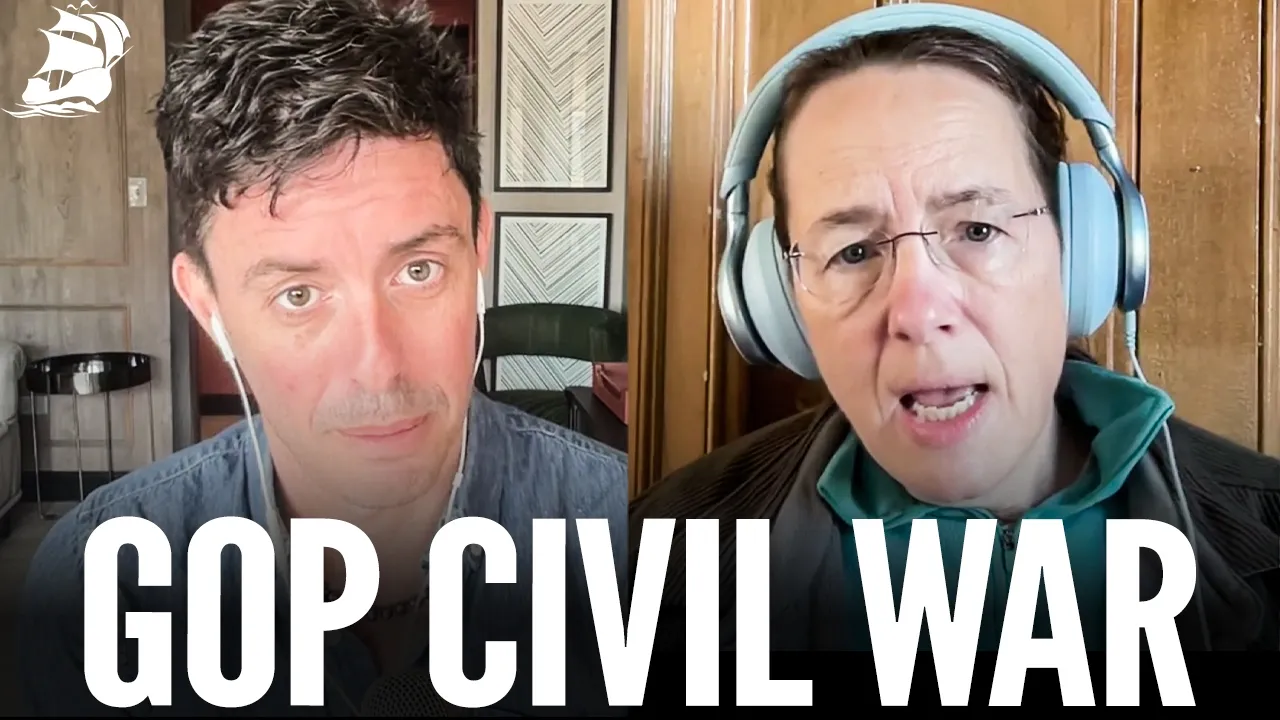















This conversation between historian Heather Cox Richardson and constitutional lawyer Joyce Vance examines how contemporary political rhetoric and intellectual influences threaten American democratic principles. They analyze how the Trump administration's renaming of the Department of Defense to the Department of War reflects a deliberate shift toward authoritarian governance, drawing connections to Nazi philosopher Carl Schmidt's theory that politics is fundamentally about friends and enemies rather than Enlightenment ideals of balance of power. The discussion traces how movement conservatism originated in 1954 with William F. Buckley Jr.'s binary division of Americans into liberals and conservatives, and how Nixon deliberately employed 'positive polarization' to divide the nation. The speakers emphasize that democracy is never finished and requires constant vigilance, urging citizens to engage with history, law, and politics to protect democratic institutions from those who would replace them with authoritarian rule.
America's Democratic Crisis: Lessons from Political History
Added:Hi guys.
>> Well, and I also think partly it took away the um the layer between pundits, if you will, and an audience because, you know, there wasn't the makeup and the perfect studios and sometimes a cat walked across somebody's screen. And you remember that guy who um whose daughter came into the room, the the expert from K, you know, on Korean >> policy or whatever he was. If that had happened two years later, he'd have been like picking her up and saying, "Hey, this is my daughter." And it's just a really big contrast to where we are now where it's like, you know, you kind of do the best you can. And that sort of takes the mystery out of what people like you and I do, I think.
>> And it's not a terrible way um for, you know, people to come together and figure out how to save a democracy. Not to not to be too much hammering that point home, but honestly, I think because it just makes us understand that we're all just people trying to get through this and figure out what we can do to help.
Um, it makes it a lot easier, which is why it's great um that we have so many people joining us tonight. Thank you for being here because I can only see one and I was thinking, you know, the three of us should just go out for a for a chat somewhere, but apparently you can see more than one. So, it's not just the three of see 848 people. I will confess that I debated getting a beer out of the fridge before we started and then I thought, "No, I've never done a Substack live with Heather before and I need to be respectful and and thoughtful." Um, and now there's so many of y'all. I'm sort of sorry I didn't grab a beer.
>> Well, and um and you probably don't know that my thing is I drink Diet Pepsi out of a wine glass all day long. There's a long history. But let me tell you, I was doing something the other day at 10 o'clock in the morning and everybody was like, "Okay, but it was a little odd."
And somebody goes, "It's pretty impressive to be here with somebody who's already drinking wine at 10 o'clock in the morning." I'm like, "No, no, no. It's Diet Pepsi."
>> That's good. Hey, before we talk about serious stuff, can we talk about your socks? Is that okay? Do you?
>> My socks. You're not talking about my socks.
>> And I both That was a Christmas stocking, Joyce. I thought it was a pair of socks.
>> No, no, it was a Christmas stocking.
>> So, we were talking about doing this.
Heather and I are both knitts and um I'm like knitting, in fact, it's here. I'm knitting a very pedestrian sweater right now. It's gorgeous, but it's like nothing difficult. And Heather Heather has this like intricately beautiful feral, you know, Christmas stocking that was just amazing. Do you do stuff like that all the time? I do. Well, I don't have as much time as I used to, but the story was that um when my mother died, she was knitting a Christmas stocking for one of my family members, and I said that I would take it over since I was the only person who knew how to knit.
And it went pretty well. So, I became the go-to person in my family to make these Christmas stockings, but I was I'm very easily bored, in case you hadn't noticed. So, I started designing my own.
And the one that I showed you was uh a bunch of uh sweater patterns that I cut down to to make the the design, which was for for people who aren't sitting there with a picture in front of them, it was pine trees and um an ocean and an island and a rose bush and sheep. Um and it was it it really turned out beautifully. I was really pleased. But let me tell you, it was freaking sheep.
I had to tear them out twice entirely.
>> You never again do any other dogs.
>> I mean, I feel like I'm good at pharaoh.
I could not knit those teeny tiny sheep that are just like one stitch sitting in there.
>> They weren't one stitch. They're actually they were they were five, seven, seven um with a nose uh and then four and then just two little legs.
>> They looked complicated, but they weren't. They were >> It was really great looking. I do. One of the many things I hold against Donald Trump is that he has seriously cut into my knitting time. So, >> amen.
>> Um, there is that. All right, you guys are here for serious talk, not knitting talk. And I have a startoff question because I'm so happy to be with a historian. Um, I I have this question about something that that really may have gotten lost in the crush of all the other crazy this week, but you know, we've just been through this moment where Donald Trump has come out and insisted on renaming the Department of Defense the Department of War. And of course, there's some historical context.
Um, decades ago, it was actually the Department of War before it ultimately became the Department of Defense. I'm sort of struggling here to figure out what the message is and if it's as in your face as I'm taking it for being.
What What do you make of that? A couple of things. First of all, the Department of War did not seamlessly become uh the Department of Defense. What happened is after World War II, the military has expanded dramatically and there's a lot of overlap. There's a lot of competition among the different branches to control different pieces of the military.
Eisenhower is great reading on this if anybody's an Eisenhower fan because he's supposed to be making order of it all and this is when he's still in the military and he's just constantly mad at individuals being like so and so won't give up this and so and so won't give up that but anyway what happens is and I might get the number the dates wrong because I haven't looked at this in a while but what happens is in 1947 as part of that reworking they stop calling uh the military the department of war and they split the department of war into the department of the army and the department of the air force. Now it's not a completely clean split but they split that. They add in the department of the navy and then all of them become uh the national military establishment.
But the problem with calling them the national military establishment, I'm sorry, it's not funny, but it is kind of funny, is that the initials are N M E enemy.
So, I'm I'm not making that up. So, in Amazing, >> in 49, they change it to the Department of Defense. But there's more going on with that in that after World War II, there's this complete reworking of what the mission of a military should be because they're trying to stop another World War. And by they, I mean the United States, but all of the allies in World War II. So they start to talk about the mission of the American military being to uh deter wars and for national security. And that's when they change it to the Department of Defense with the idea that we will have this rules-based international order that will prevent wars um rather than using might makes right all around the world.
So there's that longer history and that matters in this present because in part um what is happening is that the um Trump administration is in fact trying to destroy that rules-based international order. This is why we're siding with Putin. This is why we're, you know, saying we're not going to get involved with anybody else's business unless, you know, only to mean we're not going to spread democracy. Otherwise, we're certainly happy to mess around in Germany, for example, supporting the AFD. So, um the the radical right um political party there. So, >> partly that's what's going on. But here's why I wrote to you today about um the Nazi political political scientist Carl Schmidt. Um because I've been reading pretty deeply in Carl Schmidt because of the fact that um pretty clearly the the Curtis Yarvin, Peter Teal, um JD Vance axis is involved with Curt with um Carl Schmidt who was a political philosopher coming out of World War I who ends up becoming a Nazi.
And the reason that I wrote to you and asked about that actually has to do with the Department of War. Is any of this interesting by the way?
>> Yeah, this is really interesting. Keep going.
>> Okay, cuz it's like, you know, we just went from knitting to Nazi philosophers.
>> This is exactly what I wanted to talk to you about. So, even if nobody else is interested, I'm here for it.
>> So, the issue for um for Schmidt was he didn't believe in liberal democracy.
He's growing uh not growing up, he's coming of age in in under the VHimar Republic and he thinks it's going to fall apart and he has a he writes a lot of books about why things are going to fall apart or a lot of writing about not always books about why it's going to fall apart and and that's sort of interesting but the reason that I'm associating that with the department of war is that he says that fundamentally politics is about friends and enemies.
None of this balance of power crap that the Enlightenment thinkers cared about.
None of this coming up with better ideas to move a country forward. He says it's friends and enemies. And what you need to use the state for is to defend your friends and crush your enemies.
>> A very Trumpian.
>> Well, but but Department of War, crush your enemies, right? And so u and there's more to it than that as well. I mean, he actually believes or writes anyway. You can't ever say what somebody believes, but writes that he rejects liberal democracy because the idea of individual self-determination means that people are going to be at odds with each other. And true and and so the state's never going to be that strong. true democracy, he says, is to um wed the the people directly to the government so that everybody's in agreement with the government and those people who are not in agreement need to be purged. Those those become enemies.
So to go back to why call it the department of war, first of all, it's easy to spell which may be a may be a benefit. Second of all, um it does in fact talked about an earlier era when we get rid of the idea of um a rules-based international order. But third, I kind of wonder if they are not putting in place this idea of friends and enemies all over our government um and using the power of the state to crush their enemies. And the other key piece of that and of Schmidt's belief is that um what's probably is that Um, is that enough on Schmidt?
>> Well, no. I mean, what I'm really interested in here because you mentioned that Yarvin and Theel and and Vance sort of that, you know, that tripartate um group of evil that this is a philosopher that they've picked up on. And I wonder how is there a way of of assessing how pervasive that influence is? Is it singular? Is it just part of just an entire sort of worldview that they're adopting that's very different from what the American paradigm was up until 5 10 years ago? So, you know, it's very hard to see how deeply something goes. A lot of the the writers on the radical right read Schmidt and talk about him. Um, it is not, I think, a commonly he's not, I think, a commonly known political philosopher in the United States in this period. He actually wasn't reprinted in the United States until, I think, 1970.
The um the more the additions that are widely used are from the 1980s. But there is something about how ideas get into the water and a lot of um or the the intellectual water and a lot of what he is arguing um seems to me to be in the water of this administration. So the other piece of him and the reason that I was studying him is not because of the friends and enemies thing which is not at all unique to him. This goes all the way back in the United States to Nixon who very you know did did this deliberately. He called it positive polarization, but because key to the idea of destabilizing uh constitutional government according to Schmidt is to um to control the exceptions. That is when there is uh an emergency for example the a true sovereign you know the the person who can run everything takes control of that situation and uses it to usurp the powers of the democracy and to take them himself. Well look how Trump is governed with emergencies.
So that's why I was looking at it. You know it's just fascinating to me. I have my phone that I'm using to do this on a stack of books that I've been reading through today. And the top book on the stack is Hitler's hund first 100 days, which is just a wonderful book by Peter Frrich. If y'all are interested in that period and sort of obsessed like I am, I spent so much of my um childhood, but even on into college, trying to understand, right, how did Hitler come to power in Germany? I mean, I think that's a question that a lot of people struggle with more intelligently than I do. And of course, we all have more insight into that question now than we did before now because we've watched how Trump has come to power. Not making that comparison, just saying we understand how someone who is more despotic, more autocratic um than the norm has the ability to ascend. And I just wonder how much of a parallel um do you draw there?
I mean, is it just coincidental that they're looking at someone who ultimately became a Nazi and looking at those views or do you think that that's really the essence of this autocratic movement that we're seeing this notion of friends and enemies which I frankly I think is very much at the core of it right we talk about the revenge presidency and Trump going after people legal political figures who who tried to put up roadblocks to him that's very much of the friends and enemies notion but we see it throughout his approach to federal government. We see it with law firms, with universities. I I mean, if you're just looking for a universal theme here, it's Trump trying to accumulate more power by deciding who his friends are and who his enemies are and freshing the wheat.
You know, I think the what I see here, and again, I am I I I'm always suspicious when somebody says, "Oh, here's the key to how somebody thinks."
Because I think a lot more about what I kind of call zeitgeist. you know, there's just stuff in the water and in what people are seeing. And one of the reasons I'm always encouraging people to speak up and say what they care about and to push back is because that really does change the course of the way the country moves and the way people think about things. That is quite literally what I have studied in a number of my books is how does the conversation change and you you think about the way the conversation changes and how some things that are acceptable today wouldn't have become even in the conversation 20 years ago. But it strikes me that a number first of all the rise of autocracy or the rise of a dictatorship is kind of cookie cutter.
You know you there are a number of stages to it and philosophers like Hannah Arent and Eric Hoffer and all these people who probably did read Schmidt by the way we know Arent did um because he was a very well-known political philosopher in his day. Um they kind of do follow a pattern. So when I think about where the Republican party has ended up today, I don't start with Trump and I don't start with Mitch McConnell and I don't start with N.
Gingrich and I I don't even start with Reagan and to some degree I don't start even with um with Nixon because that real idea that we are should be divided in two comes from all the way back in um 1954 with the book McCarthy and his enemies by uh William F. Buckley Jr. and his brother-in-law El Brent Bazelle. And they of course before that were trying to overturn the New Deal. And what they did in the 54 book McCarthy and his Enemies was to say, "Listen, there's two groups of people in the United States.
There's liberals with a capital L to make them sound like they were something like the Chinese Communist Party who believed in the idea of using the government to um regulate business and provide a basic social safety net and promote infrastructure and protect civil rights and have this rules-based international order. And those people are tantamount to communists. They're on this slippery slope. They are socialists. These are bad guys. And by that they meant not just Democrats and independents, they also meant Republicans. And then in contrast to that there was this very small group of capital C conservatives who were actually incredibly radical um who were trying to overturn that. And that's where we get this idea of movement conservatism um all the way back then. And that's that's really in 51 when he starts talking about it. But in 54 when he writes McCarthy and his enemies, that's when he tries to divide the world in two. Now, it's not all clear anybody's going to go that way in 54. It's really Nixon in 1970 who really doubles down on the idea of dividing the American people through what he calls positive polarization because if you could get the middle Americans, as he called them, riled up enough, they would vote for Nixon and not for McGovern in 72. And so, you see this deliberate attempt to polarize the country. In fact, in in 72 before the election, that's when they start talking about abortion as being um you know, this that's before Roie Wade. So, you know, when I think about it, whether or not people are actually right in this moment looking or have been looking at Schmidt through this period, no, I don't think they really were. I think they're following this this logical train of polarizing a society to win political office. The reason I think he's important now is because of this idea this that essentially dresses up a fascist coup that if you govern by emergency you can become a dictator theoretically still under a constitutional system and when Trump said the you know whenever it was um I can do I'm the president I can do whatever it takes to defend the nation that's all legal that's that's a a Trump spin on a schmid idea idea. So, I think the local guys are looking at it.
>> I mean, it is such a Trump thing, right?
I have an article, too. I mean, I just always remember his phrasing when he said that because it's clear that someone told him that there was an article two to the Constitution. How deeply he studied it, I think, is um, you know, something that's up for grabs.
So, >> no, it's not.
>> I was trying to be nice. I mean, I'm a former Justice Department lawyer. We try to never judge anybody until the evidence is all in. So, it's really nice to talk to somebody who just calls it what it is.
>> Well, you know, I try and be nice, too.
And I like I say, I never try to say somebody believes because I don't know what somebody believes. They might just be saying it. But we have zero evidence that that man has ever read anything basically. So, the idea that he's reading a very dense German political political theorist seems maybe an okay thing to say. He probably didn't read it.
>> I don't know. You're talking about a guy who had mine comp on his bookshelf, right? So, you never know. But no. Um, so, so look, this notion of government through emergency, I think is a powerful one, right? Because we know that and particularly in this century, people who have come to power as dictators, Orban is always a convenient example, have really enjoyed cloaking themselves in their constitution or in democracy because it does give them sort of a patina of legitimacy. Putin still holds elections, right? Because they want to be able to make that claim that they're not dictators. And yet we're sort of living in this moment where the president of the United States has threatened to go into Chicago, has used sort of, you know, Vietnam era, right?
Sort of symbolism. Um, you know, he's serious about this, right? That's the first thing. I mean, you're talking about getting the appropriate forms of conversation um in into the nation's bloodstream. I think it's a great moment to say this is serious stuff. Trump isn't joking. He's not teasing. He's not going back and forth. He is serious about using emergencies to expand the power of the presidency.
>> Yeah. I think what really jumps out to me is the degree to which people are trying to normalize this moment. And I actually don't mean people like you and me and I don't mean a lot of the people who listen to us and who talk with us. I am extraordinarily concerned about the Republicans in Congress who seem to think that this is a normal administration and don't seem to be doing anything to protect their own prerogatives. So um so yes, this is an emergency. Yes, there is a deliberate attempt to destroy American democracy.
Um, and we can go at length on at length about that. But I do think there's another important piece of this and that is that I don't think Trump is the one who understands what's going on. I I think Trump is interested in making money and having people pay a lot of attention to him. I don't think he's in good shape mentally at all. I think a lot of the work he's doing on the White House and you know turning it into a mini Mara Lago and all that is in part because he is in trouble mentally and people around him are urging him to spend time doing things he likes and he doesn't know how to knit. Um so so I think that is part of it that basically um the people around him are putting in a system for when he is gone that somebody else can step into. And so it's easy to look at him who is in many ways a uh simply running a reality show.
That's what Susie Wilds is doing as the White House chief of staff. She is running a a TV show every day and and she's doing a great job of it. You know, she's got memes that are making people, you know, get all upset and and you just mentioned Chicago. In fact, there has been an ICE surge into Boston on announced on Sunday and into Chicago announced this afternoon. But all of the buildup was we're sending troops in, we're sending troops in. And if you read a lot of the news stories, they still say they're sending troops in. But as near as I can tell, they're not sending troops in. They are sending ICE in. And ICE is, you know, regardless of how we might feel about it, that's not a grab of power. ICE can go into to Chicago.
Chicago doesn't have to cooperate with ICE by the way the law well you know that nor does Boston but but this idea that he's this strong man and he's going in with the troops so far has not been borne out in this move into Boston and Chicago but a lot of people already think it has. So we don't want to make him seem greater than he is at a time when it actually is very weak and we maybe want to talk about what came out of the Epstein files today. Um, but there is definitely a philosophical, a mechanical, and a personnel attempt to overturn American democracy. And by God, while they're out there talking about Carl Schmidt, I think we should be out there talking about James Madison and Thomas Jefferson and Abraham Lincoln and because those principles have lasted.
this idea that's we have to go back to a Nazi philosopher. Nazism didn't work out so well. You know this, you know, I really I really my big thing is that we really need to push on our values because by God they were proven to work for 250 years. Why we feel the need to turn back to a Nazi is kind of beyond me. Except I know why.
>> Well, yeah. I mean, I spent an inordinate amount of time going back through the federalist papers, which I had studied in law school and probably >> historians are so much we're so much fun.
>> I mean, like, I'm not a historian, though. I think I'm just a wannabe. But so, you know, I just finished writing a book that was sort of about law and democracy. And I wanted to go back and and not just read what people said about what the founding fathers said. I wanted to read, you know, Madison and I wanted to read Hamilton um and read John J and and think about what they meant. And you know, obviously there's so much that you could pull out that's germanine right now. And one of the big themes is, and it was interesting to me that Judge Brier in California said this in in one of his opinions talking about Trump and the way that they were nationalizing the guard and using the military in California. But they make the point that we are living in the context of rejection of a monarchy. Right? These are people who understood what happened when you gave too much power to the dictator or the king or whatever you want to call him. that that didn't really work out all that well for people like you and me and everybody who's with us right now. And so I I'm still astonished when I see judges and even justices who seem to forego that fundamental point and folks who are talking about history and tradition and that's how we interpret the constitution and our laws and then they dump more power into the hands of the executive without confronting this fundamental basis for the development of our government which is rejection of putting too much power into the hands of the king. And so we have this very muscular unitary executive theory that has come into popularity in in conservative or MAGA legal circles. And yet that's antithetical to the origins of the constitution and the writing of the founding fathers. And to your point, right, what what they did, what they thought, what they created has worked pretty damn well. and the notion that we would reject it in service of Donald Trump or or perhaps in service of people that are creating what comes after Donald Trump, you know, the the um presidency of of JD Vance. Uh it seems to me to really be uh just sort of astonishing to be honest with you. I'm I'm constantly astonished that smart people don't start with this baseline of the Constitution and what it clearly intended instead of trying to look, you know, for oh, magical meaning in it. No, the president's supposed to be uber powerful and be able to, you know, dictate to everybody. I just honestly I sometimes have days and this is one of them where I do not understand how we've ended up in this place.
Well, we've ended up in this place probably um largely because of the 1965 Voting Rights Act. That is um you know the the law for people who might not have that one at the at the top of their brains. It's the law that protects black and brown voting. And um the the people who I actually re read the the radical right a lot. I read the intellectual people a lot and it's scary. It's a scary rabbit hole, let me tell you. But what they would argue and have argued is that the idea of liberal democracy, which is what we live in, the idea that individual rights are protected by the state, um that idea of liberal democracy has dramatically weakened the country because it means uh that you're u you're attacking traditional uh social values.
You're attacking uh the idea that men are uh superior to women. You're attacking the idea that white people are superior to black and brown people. And the loss of those societal norms and guard rails has dramatically weakened a country. And you know, we could go even deeper than that and talk about how um people like Bill Barr, who was the attorney general under Trump uh 1.0, actually gave a speech at Notre Dame in which he um talked about um I should I I I should back off that might not have been Bill Bar. It was one of the the uh legal types. Um, it might have been a Supreme Court justice.
Shoot, I should have it on the top of my brain and I don't, but scratch that I said it was bar. It might have been, it might not have been. But what he argues is that the um the nature of of people is so um sinful.
the person who's a radical Catholic is so sinful that the when the founders talked about um the idea of self-determination or self-government, they didn't mean the right to elect people to create laws. They meant governing oneself.
And because oneself is sinful and cannot make good decisions without superior aid, what they were really saying was that we need to have a theocracy. I mean, there's all kinds of ways you can you can bastardize that stuff.
>> I mean, it's, you know, having read through the Federalist Papers um pretty recently and pretty deeply, it's very clear to me that maybe something that we need to do more of in this country is really sort of revitalize our notion of civics's education. So it's not just something that you do in fourth grade and 10th grade and forget about because it's very easy for people to talk about what you know what the founding fathers meant what they intended what they said and to have no fidelity in fact to what they were saying and what they were thinking and and meaning about the future of the country. Um you know I don't know if you saw Amy Coney Barrett Supreme Court Justice did her first television interview since she was appointed. She's she's got a new book out. She's out selling the book. And so she's been sort of drawing this line saying that she doesn't think that the court is more political and well maybe that's what she thinks, right? But in in my view that the question is, is the court more ideological? Because the court is clearly a much more ideological court. You know, you've got Sam Alto quoting people in his opinions, men from the 13th, 14th century who thought that there was no such thing as marital rape and that witches should be burned at the state. And somehow this is the history and the tradition that they want to imbue modern America with, not this, you know, very clear vision of of the founders that gets implemented through decades and decades of expanding the promise of America. Um, a and I'm sorry, I'm just sort of using you for therapy now, Heather, but you know, you talked about the 1965 Voting Rights Act, which protects black and brown voters in its initial passage and then is expanded over time. So that for instance, it protects language minorities, right, immigrants. and and there's this vision of an America that's that's bigger and better and more inclusive and smarter because it brings more people into bear.
And of course, something that we all thought during the first Trump administration was that a lot of it was about racism that this was about people who were deeply threatened by the other um people who didn't want to have to compete in a larger pool of smart, capable people. So, it was easier to say that black and brown people shouldn't be permitted to compete against white men because that made their lives a lot easier. And of course, for me, the poster child for that was Trump's first attorney general, Jeff Sessions, from Mobile, Alabama, who clearly espoused those sorts of views. Increasingly, though, I wonder if that's not just a little bit too easy and too neat and too pat because I think in essence, it's a sort of racism on steroids. um maybe even in the George Orwell 1984 sense that says either you believe like I do, either you accept the fictions that I tell you are truth or you become the other no matter who you are. And so now we live in in this world that I think in some ways could be frightening, except for the fact that you make a point that I believe is a really good one, which is that Donald Trump is not nearly as powerful as he wants to tell people he is. And as his entire movement is trying to convince us that he is. And so when Trump talks about going in with troops, right, and that's something that he may well still do, I think a lot of this is Trump testing the waters and seeing what he can get away with until somebody pushes back. Congress is supine. The Supreme Court has not done the job I would have liked to have seen them do.
But in many ways, I think public intellectuals like you, I think just real people who are going out and who are protesting this enhanced federalism that we have, which maybe is is something we should talk about before we end. You know, this notion, some people have been calling it soft secession. I think of it as really functional federalism where where states um and and mayors, governors and mayors are sort of stepping up and fulfilling the role of the two absent branches of government. I mean the the power still quite frankly belongs to us and I have this sense that we need to believe in ourselves. We need to believe in our ability not just to push conversation, but to push policy to protect the upcoming election, which Trump clearly has an interest now in trying to engage in sort of outsized voter suppression and and efforts to keep the vote count from being accurate.
A and so maybe you'll just talk a little bit about um what you think about soft secession, but also your view of the power we all have and what we should be doing. I'm laughing because that was like all of America. So, you know, like now, now, Heather, answer that in one sentence.
>> You get one minute. Go.
>> Um, what do we literally only have one minute?
>> No, I'm just teasing you. You can have as much time as you want. I will stay and listen.
>> You just said something really interesting because I'm seeing a lot about soft secession, too. I love the idea of functional federalism. That is a far better way to put it because this is not in any way new. So, you know, I know where that term came from and why people are talking about it. And we tend to associate states rights with the negative associations it had before the the US Civil War, but but in many times since then um not only the the um movement against the civil rights uh movement in the 1850s and60s and so on, but also this is I don't think I've ever told anybody this before. I one day got bored and as historians can do, we can do word searches in in old newspapers and I wanted to see when people talked about states rights after the Civil War because you know at the time there must have been something going on in the mo in modern America and people were talking about it and do you know it really kind of falls apart after the Civil War with the exception of two things that I remember. appeared three times in waves which you can check on the online. Um but the two I remember were there there were both cases of quarantine. There was, I believe it was chalera coming into the port of New York and um the government tried to to stop uh the the boats from unloading in in New York and the New Yorkers screamed states rights we have the right to do this and there was a cattle disease going up and down the planes and similarly when the federal government tried to stop that um the the states said we can move our cattle anywhere we want. That's when they talked about states rights after um after the civil war is is on those two and then one third uh occasion as well. It's been forever since I looked at that. But aside from the bad times when people use states rights to impose things like kalera on other people, in fact states have always been experiments of democracy. So the the one that that I always think of when I think of uh the laboratory of democracy idea first is New York when the federal government said it didn't think it had the power to institute internal improvements. So New Yorkers dug a freaking canal across the entire state in the 1820s and that's how we got the Eerie Canal. They said, "Okay, we're not going to do you're not going to do um internal improvements. we are. Hey, George, here's a shovel. And they they preserved the Midwest to the United States because it was it was considering seceding to Canada because of the water routes. Once you had the Erie Canal, you could get from the middle of the country to the Atlantic seabboard and that's what opened up the middle of the country to the United States instead of Canada. But by the the the late 19th century when the federal government was essentially being run by robber barons, states were at that point literally called laboratories of democracy. And we get the Wisconsin idea where in Wisconsin the government brings together the governor brings together scientists and business leaders and lawmakers and officials to figure out what's best for the country. And when the Roosevelt becomes president, he literally writes an introduction to a book called The Wisconsin Idea that says, "We're going to take this Wisconsin idea national." Similarly, in the 20th century in New York City, um at at a time when the the federal the New York is really trying to grapple with influxes of immigrants and uh black Americans and figuring out how in New York, the government that had been run corruptly by Tammy Hall could continue to run non-corruptly. And what they do is they recognize that in order to garner people's votes, they've got to answer their needs. So in the 19s, that early, the New York City government begins to protect the rights of black Americans and women. I mean, we all think about the Democrats as being dominated by the former Confederate wing in that period for a number of reasons.
But in New York City, they were actually doing what was best for the people.
Well, why does that matter? Because guess who comes out of that Tamony Hall gang? That's going to be Francis Perkins who's the secretary of labor under Franklin Delano Roosevelt and who gives us the Social Security Act. Franklin Delano Roosevelt comes out of that. Al Smith comes out of that. And you get this nationalization of a system that began in New York City. So this idea of states being able to push back against uh uh reactionary federal government and find new ways to serve its citizens is old and very American. And you know, you're watching it especially over issues like the COVID vaccine and seeing all these different states come together in in units and think, you know, the the the the the wild card here to me is that the way that Trump's tariffs are hitting, the way his cuts are hitting and so on, it's actually his districts that are getting hit hardest. So, what does that mean when you are in rural Iowa or wherever and you're losing your supermarkets, you're losing your Medicaid, you're losing your your local hospital and so on and you look to a Democratic nearby state and think, "How come they got everything?" And I don't have any idea how that um how that cuts. But I think it's if I were a Republican, I would be extremely concerned about that.
>> So, you know, it's interesting. I happen to live in Alabama and have those conversations with people um a lot of the time and I I think it hits in an interesting way. I mean people people will candidly tell you I voted for Trump but I didn't think it meant I was going to lose you know my job my hospital take your pick. my, you know, Medicaid, Medicare are increasingly becoming concerns for people and whether or not they're going to be able to make that that leap from that single sort of incursion on their life to just overall right the desiraability of democracy over other systems of government. I still don't know, you know, how that ends up playing out. But something I try to talk about a lot and talk um with my kids about a lot is this notion of not taking democracy for granted, which I think is something that we do far too much. It's been too successful for too long for us to understand that it's something that we end up having to really fight for. I've seen so many of y'all in the comments just talking about the need for greater civics's education.
And I'll just say that my view is that this actually is civics's education and this is what we should be doing. Getting together with other people and talking about history, talking about law, talking about politics so that we can form our own views. Right? I don't want my views to be the view that somebody dictates to me. Certainly not Donald Trump and frankly not the Democratic party either. I want to visit the history and the law and think through it for myself in the company of other smart people. So I Heather, I really appreciate the opportunity to talk to you. I read you every single night. Um I don't know, you know, how the fan grilling hits with you, but man, I have to say that there are a lot of days where either you make me think or you maybe you save me from thinking about things that it's not going to be profitable for me to think about. And I am always really deeply grateful that you do what you do. I have no idea how you do it, you know, in the sustained way that you've done it for so long, but it is deeply helpful for those of us who need better civics education these days.
>> Well, back at you and I love your chickens.
>> You know, um the chickens really are helpful. There is actually a national holiday called National Drinking with Chickens Day. This is a real thing. It's on the registry of national.
Okay. When is it?
>> There's like this woman who went to all the work of getting it registered and I think it's in April and a couple of years we actually celebrated it but everybody got way too drunk, right?
Because I mean it just it was bad. But um but I I just will say you know everybody's got to do their thing right now that that keeps them happy. Tim Snyder um gave a talk that my seminar class was lucky enough to hear last semester where somebody said to him, "What should we all be doing?" And he sort of said, "You know, you should hug the people around you more often." Um and my class took it sort of literally as did I. This sense we should find things that make us happy and we should do them and we should do them with other people. So, you know, if you like watching chickens, um I I do try to keep people supplied with pictures, but I think finding joy or happiness or whatever it is is essential right now.
Well, it is in part because uh we know that authoritarians can't take root when people are happy and and joy really does matter. And you know the other thing that that always strikes me about this administration and about what uh is going on in the country is so much of the reason that we are here is because as you say we stopped working for democracy which is really about agency.
You know democracy by definition is never fixed. It's never finished. And to me that's the the exciting part of it.
That's the creative part of it. That's the, you know, in in many ways, you know, yeah, we'd probably rather be knitting or kaying or whatever, but given the opportunity to create something new, there's extraordinary joy in creation. And that, you know, starting talking about that Nazi philosopher and all that, you know, the people who created this nation built a nation and they built the principles for a nation, but they didn't put that nation into operation. And they didn't put those principles into operation. The people who did that were the people who were excluded from it because they could sit there and they could say, "Hey, that Declaration of Independence sounds really ducky, but why am I not part of it?" And that that work on the part of marginalized Americans to recognize the importance of those principles and to put muscle and ideas and comradeship and community behind making those ideals real gradually over time. That is one hell of an act of creation. And it's exciting to be part of this next era of it.
>> I could not agree with that more. This notion that American democracy is always aspirational, never completed, but something that we get to work on. I I mean, I am frankly looking forward to getting through the moment that we're in and getting back to working on expanding democracy. Um, that's really what I hope our last act looks like. I hope we won't be fighting MAGA and Trumpism down to the last couple of minutes.
Well, the um there there is no doubt that this is this is going to be a long fight, but that's not to say there won't be victories along the way. Um but one of the things that jumps out to me is this is the same freaking fight we have had repeatedly now for at least 150 years.
And the problem is every time we think we've won it, we get complacent and the reactionary right rises again. And and that's not to say, like you say, we shouldn't have at least two political parties because our system depends on that. You need to have different ideas and so on. But having two political parties of people who believe in the tenants of democracy and believe in the American dream, the idea of working hard and rising is a very different thing than having a political party that's trying to destroy democracy and institute a system of authoritarianism.
So, yeah, I I don't think we'll ever be done, but boy, it would be nice not to have to dread it every time you pick up your phone. Every time somebody sends me a text and has those two eyes, I think, "Oh, no. What is it? What's it going to be?"
>> It's true. I mean, it is absolutely true, y'all. I promised Heather when I asked her if she would do this 20 minutes, and I can actually see my own child peeking her head around the corner wondering when dinner is going to be.
Um, so we will leave it there. But Heather, can we do this more? Maybe together.
>> My My calendar said an hour. If I known it was 20 minutes, I wouldn't have worked so hard this afternoon.
>> I know, right? So, we both have newsletters to write tonight.
>> Well, you've got a Don't you have a book coming out? Is your book out?
>> I No, my book comes out um October. I should know the date, right? Because it's my book. 21st. Um so, it's all done. I've finished reading it for the audible version and and now I'm just sort of hanging out until it comes out.
>> Oh, good. Well, let's do something around your book. I got to read it first.
>> Good. Let's do that. Do you have good advice for me? Like you've been through this twice now. What was it like when you went out and talked to people about your book?
>> Um, it is it's it's first of all, it's great to talk to people. It's great to hear what they have to say. It's great to meet all your friends that are, you know, you sort of only know in two dimensions. That part is great, >> but you're not going to get enough exercise. Your eating habits, you're in real trouble. And um and you're not going to get enough sleep. And you know, when I was before I started doing this stuff and people would you watch rock stars complain about being on the road and I'd be like, "What's so bad about being out there doing what you love and meeting all these great people?" The problem is not the actual performance.
The problem is going, "I haven't exercised in three days." and and you know it you know you'll go all day and things will get backed up and they're like you have 2 minutes to be on stage and you're like I have not eaten in 15 hours. Could I at least have a granola bar? You know that's that's the part that is not good.
>> You're making it sound really fun. I'm looking forward to the tour now. Thanks a bunch.
>> Well, the people is great and congratulations on the book.
>> Well, thank you and I sure do look forward to meeting everybody. Um y'all, thank you so much for having been with us tonight for our not quite an hour and thanks so much to Heather. This is on Pit Barara's Stay Tune channel. If you guys aren't already subscribing, I hope you will. Pit is my former US attorney colleague and my podcast uh co-host for cafe.com's insider podcast every Tuesday. So, thanks for being here.
>> Thanks everybody.
Up Next
McCulloch v. Maryland: AP Gov Required Supreme Court Case
@heimlershistory
663.7K views•2021-08-25

BRICS Pay and de-dollarization: A New Financial Order Emerges? | 55 chars
@DannyHaiphongYT
164.6K views•2024-10-22

Government Surveillance Methods: 10 Ways You May Be Watched
@BeAmazed
1.6M views•2017-04-09
Explaining the Saudi-Iranian Proxy Conflict in the Middle East
@Vox
18.2M views•2017-07-17
Related Study Plans & Knowledge Roadmaps
Structured learning paths in Political Science