





























ADHD is characterized by impaired response inhibition, where the anterior cingulate cortex (ACC)—the brain region responsible for holding back inappropriate emotional and social responses—fails to activate properly, causing individuals to act on impulses they recognize as wrong; however, this can be improved through five evidence-based strategies: meditation (which physically changes the brain to enhance decision-making and attention), mindfulness (creating awareness between thoughts and reactions), cognitive behavioral therapy (building space between events and responses), medication (helping with focus and self-control), and exercise (particularly aerobic activity and yoga, which improve self-regulation).
ADHD and Anger Management: Building Up Your Impulse Control Brakes
Added:A basic understanding of ADHD as a neurodevelopmental disorder that primarily impairs executive functioning, rather than just a behavioral issue.
The concept of executive dysfunction, specifically how it relates to response inhibition and emotional self-regulation.
The role of the prefrontal cortex as the brain's cognitive control center, often analogized as the brain's 'brakes' or decision-maker.
The developmental distinction between experiencing a primary emotion (such as anger) and the secondary behavioral response or impulse.
The adaptation of specialized therapeutic modalities, such as Dialectical Behavior Therapy (DBT-ADHD), to address chronic emotional dysregulation.
How pharmacological treatments (stimulants and non-stimulants) biochemically assist the prefrontal cortex in improving impulse control.
Analyzing comorbidities, such as Oppositional Defiant Disorder (ODD) or anxiety, which frequently co-occur with ADHD and complicate anger management.
The study of neuroplasticity and how consistent behavioral intervention can structurally and functionally strengthen neural pathways over time.
1.1M views46.8Klikes6:32Original Release: 2016-08-19
Hello Brains!
ADHDers tend to be impulsive and not just when we’re buying office supplies.
[Ding!]
We’re emotionally and socially impulsive too, which can make us a lot of fun, when we’re in a good mood.
The problem is, we’re not always IN a good mood.
[Intro Music] We get angry, we get frustrated.
Angry thoughts lead to angry actions and we do things that end up costing us friendships, relationships, even our jobs.
Afterward, we feel awful.
We regret it. And then?
We do it again!
It’s not that we aren’t smart or capable of making good decisions.
As Dr. Russell Barkley puts it, ADHD is *not* an “information deficit” disorder.
We know we shouldn’t scream in the middle of class or hit another kid on the playground.
We TOTALLY GET that telling off our coworker is “not acceptable behavior.” The problem is we get SO MAD we can’t control it.
You know what I’m talking about.
The kind of feeling that builds in the pit of your stomach and makes your teeth clench and absolutely want to destroy the person who EERRRAAAAAAGGGGGHHHHHHHH Well, actually…I did the research, and it’s not just you.
Everybody gets that upset.
What? How?
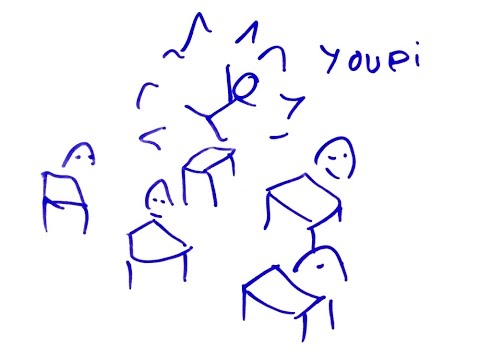
Then WHY AM I THE ONLY ONE IN DETENTION?
[Ice cream truck] [beep beep] [Ice cream truck] [Throws more papers] You weren’t the only one who WANTED to flip a table when your teacher assigned extra homework, you’re just the only one who DID.
Why?
Because YOUR BRAIN is faster than your brakes.
To help me explain, cool science stuff!!
[Music] Turns out, there’s a part of the brain whose JOB it is to HELP us hold back emotions and actions when expressing them might not be the best idea.
It’s called the anterior cingulate cortex or ACC.
In neurotypical brains, it activates anytime they experience an emotional or social conflict.
As in, they might WANT to hang up on their boss but that could have consequences.
Their ACC picks up on the fact that they’re about to do something that could be bad for them and buys them time to think about how to handle the situation.
That way, the part of the brain that knows they NEED that job and have plans to retire someday is able to step in and suppress those impulses.
In a fight, the ACC would be the friend holding you back while your other friends talk some sense into you.
The problem is, in ADHD brains, the ACC doesn’t always work that way.
Or at all.
In fact, according to Dr. Russell Barkley, in adult ADHD brains, the ACC appears to do…nothing.
Which means your other friend, the frontal lobe might have some amazing wisdom to share but with no one to hold you back he won’t have time to share it before YOU get punched in the nose.
Dr. Barkley describes this as “trouble with response inhibition.” Dr. Hallowell calls it having a Ferrari engine brain, with bicycle brakes.
I call it being enthusiastic.
Whatever you call it, it can be a problem for those of us with ADHD.
So what's a Brain to do?
You gotta build up your brakes.
Fortunately, there are plenty of ways to do this!
Here are 5 ways we can help out our ACC: 1. Meditation.
Hear me out!
Meditation doesn't mean sitting still and clearing your mind of thoughts.
It's just an opportunity to practice having thoughts and emotions without reacting to them.
You know, the thing were having trouble with?
Plus, research has shown that meditation actually changes your brain, thickening the parts responsible for decision making, maintaining attention, and taking action in line with our goals.
In other words, the parts affected by our ADHD.
If you haven’t tried meditating yet, don’t worry.
It’s way easier than you think I explain more in THIS video.
2. Mindfulness.
Mindfulness is simply being aware of your thoughts, feelings, and your body’s reactions without judging them.
The great thing about mindfulness is if you only remember to meditate when you’re already about to scream at somebody or eat a box of cookies, it’s not too late to use this technique.
One of the easiest ways to do this is to focus on your breath.
That's it! That's enough to active your ACC.
There’s a link to a cute video on belly breathing in the description below There’s also this video!
3. Cognitive Behavioral Therapy or CBT, is a kind of therapy that focuses on how you process your thoughts and feelings in the present moment.
Are you starting to see a pattern here?
All of these methods are about creating space between an event or an emotion and your reaction to it.
Basically, what most people’s ACC does for them automatically.
CBT is especially great for dealing with depression and automatic negative thoughts, but programs have been developed specifically for dealing with ADHD, emotional self-regulation and impulse control.
4. Medication.
Yeah, I don’t talk about this much because I am clearly NOT A DOCTOR!
but I have to include it because for most people with ADHD, it’s very effective.
It can not only help us focus, it also helps with self-control.
I'll include links to more information in the description below, but if you are considering medication: talk to a doctor (which, I AM NOT).
Finally, 5. Exercise.
Research suggests that physical activity can make a huge difference as well.
Aerobic exercise, like running, swimming or dancing seems to have the most impact on ADHD symptoms overall, while mind-body exercise like yoga seems to have the biggest impact on self-regulation.
So the next time you need to have a difficult discussion, try doing it in downward dog.
ahh!
and 6.
[Ding] If you find yourself judging yourself, remember that the emotions you’re feeling are probably totally normal.
You just have to work on your brakes.
Of course, it also helps to have a backup plan for times when your brakes might fail.
I'll go into that, in another video!
That's it for this week!
Thanks for making it all the way through.
This was a lot of information to cover but really important.
Let me know how your brakes have failed or saved you!
Comment below or on Facebook or Twitter, and leave me a question for question time.
If you like what I do, subscribe.
And if you LOVE what I do, consider donating to our Patreon page so we can make even more videos!
Bye Brains!
Question Time!
How do you approach someone in order to make friends (your crush specifically)?
Love, true love!
I think it’s important to consider the timing.
Probably don’t talk to them when they’re in the middle of something or clearly want to be left alone.
Wait till you think they might be receptive to conversation, and then try to find stuff you have in common.
Ask them questions about themselves to see if you guys have the same taste in music or share a hobby.
For this reason, a great place to meet is in a class or a group thats dedicated to something you’re interested in.
For instance, Edward and I met at a writer’s group.
What do I do about having a lot to do and not enough time to do it?
It helps to focus on stuff that’s important but not yet urgent.
My video on The Priority Matrix explains why.
Speaking of which… Remember, Edward promised to do an FAQ&A — about me if we hit 1,000 #ibnus, so keep working on yours and post about them when you do!
And remember: In case of emergency shake glass!
Up Next

27:03
Neurobiology of ADHD: Key Neurotransmitter Pathways
@neurozeug7002
87.6K views•2014-11-22

33:24
Peptide Neurotoxin Probes of Ion Channel Function
@ciartech
324 views•2010-09-12

4:10
Vagus Nerve (CN X): Anatomy, Nuclei & Functions Explained
@Alilamedicalmedia
305.2K views•2022-10-31
13:03
How Exercise Benefits Your Brain: Science Explained
@TED
11.4M views•2018-03-21
Related Study Plans & Knowledge Roadmaps
Structured learning paths in Neuroscience
neuroscience
Appetite Regulation: Brain Circuits & Hormones
01Foundations of Endocrinology and Brain Anatomy
02Introduction to Energy Homeostasis
03Peripheral Signals: Leptin, Ghrelin, and Insulin
+ 2 more learning modules
14h5 modules
Explore Roadmap
neuroscience
Neuroeconomics: Value, Risk & Brain Mechanisms
01Foundations of Neuroscience and Brain Anatomy
02Introduction to Neuroeconomics and Subjective Value
03Dopaminergic Prediction Errors & Reinforcement Learning
+ 3 more learning modules
18h6 modules
Explore Roadmap
neuroscience
Spatial Navigation: Cells, Grids & Brain Maps
01Foundations of Brain Anatomy and Memory
02Place Cells and Head-Direction Cells
03Grid Cells: The Brain's Coordinate System
+ 2 more learning modules
12h5 modules
Explore Roadmap
neuroscience
BCIs: Neural Decoding & Prosthetic Control
01Neuroscience Foundations: How the Brain Signals Intent
02Signal Acquisition: Recording the Brain's Activity
03Neural Decoding: Translating Brain Waves into Data
+ 2 more learning modules
25h5 modules
Explore Roadmap