











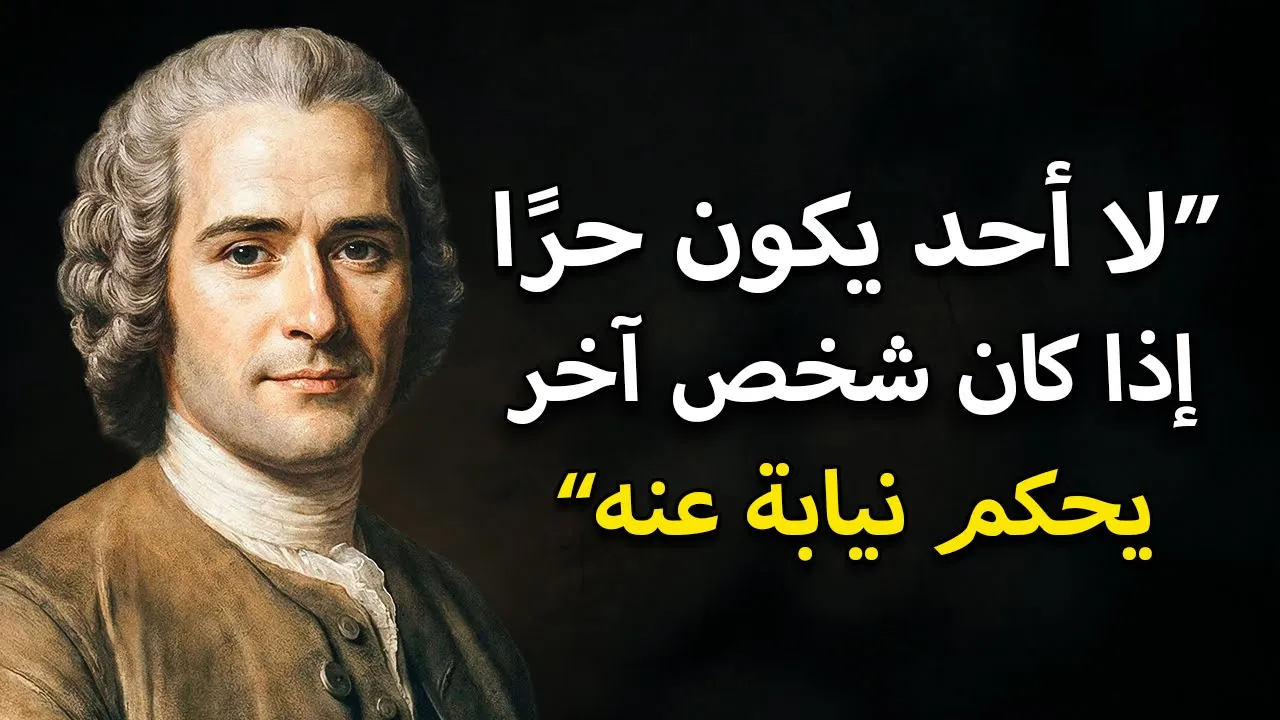







Jean-Jacques Rousseau's The Social Contract proposes that individuals can join a political society while preserving their natural freedom by collectively forming a sovereign body governed by the general will—the collective decision-making of all citizens aimed at the common good—where each member becomes an indivisible part of the whole, exchanging individual private interests for civil and moral freedom through active participation in legislation.
Rousseau's Social Contract: General Will & Political Freedom
Added:The basic concept of the 'State of Nature' as conceptualized by political philosophers like Thomas Hobbes and John Locke, which serves as the starting point for contractarian thought.
The core tenets of early Social Contract Theory, specifically how individuals consent to surrender certain freedoms to a governing authority in exchange for social order.
The distinction between representative democracy and direct democracy, as Rousseau's model relies heavily on active, direct citizen participation.
The historical context of the 18th-century European Enlightenment, particularly the intellectual shift toward questioning absolute monarchy and religious authority.
The distinction between 'Negative Liberty' (freedom from external obstacles) and 'Positive Liberty' (the capacity to act upon one's fundamental desires), especially in the context of Isaiah Berlin's critiques.
Philosophical critiques of the 'General Will', exploring how later thinkers argued that Rousseau's concept could lead to majoritarian tyranny or authoritarianism ('forcing people to be free').
The historical application and influence of Rousseau's political philosophy on the French Revolution, particularly on the ideology of Maximilien Robespierre and the Jacobins.
Modern developments in democratic theory, such as deliberative democracy and civic republicanism, which draw inspiration from Rousseau's emphasis on the common good.
117.8K views2.4Klikes21:02Original Release: 2019-08-14
in the social contract reso takes on what he says is the fundamental question of politics how do you reconcile an individual's freedom with the authority of this state in other words how can people come together to create a government that still preserves the liberty of individuals his real innovation was reimagining how this political society would be organized he put forward the idea of a general will the collective will of society directed towards the common good it's only if laws are made in accordance with this collective will that a sovereign would be considered legitimate citizens would actively participate in making the laws so in following the law each member would simply be obeying themselves as a self legislating citizen there are a number of ambiguities and contradictions in Rousseau's formulation and your opinion of his political theory is going to have a lot to do with how well you think these get resolved there were those who thought that he was an aristocratic Republican who supported an elective aristocracy others saw him as a theorist of revolutionary terror and a forerunner to 20th century totalitarianism thinkers within the British tradition have also tended to seem as a utopian romantic whose attempt to square the circle of freedom and Authority wasn't sufficiently tempered by the realities of modern politics let's follow a soz argument in the text and see for ourselves I'm James Muldoon I'm a lecturer in political science at the University of Exeter and this is an introduction to reso's the social contract [Music] natural Liberty man was born free and here's everywhere in Chains this is the famous opening line of Russo's the social contract like Hobbes and Locke were so denied there was any natural basis of the authority of one person over another reso claimed that individuals have a natural right to self-preservation in a state of nature this meant they can do whatever is necessary to survive but Rizzo didn't imagine the state of nature as a state of war for so our instinct for self-preservation was also moderated by a compassion that gave rise to empathy for others according to the very vivid portrait of a natural condition painted by Rizzo in a discourse on inequality human being is a robust and independent in the state of nature they're solitary creatures who don't care about how many likes their posts are getting or how many followers they have on Instagram because he didn't see a dry for a steam and glorious so fundamental to our human nature his image of a natural condition was far less conflictual than that of Hobbes or even Locke there are so an individual simply slept under a tree hunted when they needed and walked about the world naked and unashamed based on this idea of natural equality between individuals reso started the social contract by criticizing other writers for defending natural hierarchies first he argued against Robert Filner that there was an original right to rule inherited by Adam as the first man of the Bible he was also critical of writers such as Grotius and Hobbes who justified the rights of absolute monarchs by claiming the people agreed to their subjection through an original contract rasuu didn't think it was possible to sign away your freedom because the capacity to make meaningful moral choices was the basis of your humanity to give up your freedom for a so it was to give up your moral nature and hence your status as a human being Hobbes as sovereign may have the power to enforce the law but also thought there was a difference between power and authority this distinction didn't matter much to Hobbes Barroso is adamant that mice did not equal right we're under no duty to obey a sovereign even if it's based on a contract entered into under door no person has any natural authority over another therefore the only legitimate way of establishing Authority was by free consent so although were so employed the same basic model as Hobbes he used it to reach an entirely different conclusion we'll see that the goal of the social contract verso was to enhance the freedom that individuals already possessed in a natural condition the social contract in book 1 chapter 6 we reached the first main statement of Rousseau's fundamental problem how do you join a political society and retain your original natural freedom in Hobbes's social contract the price of entering into political society was giving up most of your rights to a sovereign we so attempted to show how one can enter into a collective Association without making such a fast impact how to find a form of Association which will defend the person and goods of each member with the collective force of all and under which each individual while uniting himself with the others obeys no one but himself and remains as free as before the social contract verso was a way of enhancing our freedom by recognizing the inherent difficulties of solitary living and taking advantage of the benefits of political society for a kind of social contract and political association would allow us to reconcile this problem of natural freedom and political authority each of us puts in common his person and all his power under the supreme direction of the general will and in return each member becomes an indivisible part of the whole resource idea of the social contract also involved a renunciation about individual rights but in return he argued we receive something far more valuable inclusion as a free and equal member of a political community imagine it like starting a really good relationship with someone you have to give up certain things that were good about being single but the idea is then returned you get so much more than what you had by yourself there is an acknowledgement among all social contract theorists that we're altima better off with others in society than on our own while Hobbes's sovereign has the potential to behave like an abusive partner and can just look out for them sells reso thought that a sovereign would only be legitimate if they strive for the common good of all their members he combined an ancient Republican notion of citizenship and active participation with a modern social contract tradition the ultimate goal of the contractors and security but freedom resource critics often point to the difficulties involved in how this would work in practice how do i as an individual ensure that the community's laws are always ones that I agree with what about minority groups who get out of voted how do I participate directly in creating every law these are the questions that Rizzo will have to answer civil society the hypothetical social contract produces a collective body and a unified subject of the political community while haba sought that the sovereign would be an artificial person separate from the state were so considered this a mistake for him it was the people themselves United together who were the true sovereign the greatest threat to this new political community came from individuals who didn't fully commit to the contract and its goals he was concerned that individuals would prefer their own private interests over the common good he thought that if we wanted to enjoy the benefits of living in society we also had to do our fair share in fulfilling our duties as citizens in chapter 8 of book 1 Rizzo argued that we received two main things when we enter into a political community we exchange our natural Liberty for a so called a civil and moral freedom to be free for a so is to be autonomous to live under our own laws coming from the Greek or to us meaning self and normos meaning laws or customs I have to give up the right to do whatever I want but I exchange this for the certainty of civil freedom this guarantees me the lawful title of property rights that are more secure than the mere possession of an object in the state of nature he argued that this would be a superior form of freedom although we can technically do whatever we want in a state of nature we are practically restrained by the power of everyone else to do what they want this defence of property rights might strike you as odd based on what Rousseau wrote in the discourse on inequality what he's trying to do in the social contract is demonstrate the conditions under which property rights and government could be considered illegitimate in comparison to what he sees most often in modern societies which is the rule of force and fraud there is also a second change which is important for a so related to our morals living in a society in which the law is decided by everyone means that the laws of the community are going to be rational and therefore moral I no longer have to rely on my own natural instincts and inclinations to act morally these tend to be good but they can also be misguided what makes us moral beings is our capacity to choose differently from our natural instincts and not to be governed by our nature living in a community helps us to live a properly and moral life because we can be guided by law which is the outcome of a more sustained process of rational reflection sovereignty in the general will for a so the entire citizenry United in a legislative assembly exercises sovereign power for this power to be legitimate it must be directed in accordance with the general will towards the common good result was the first modern theorist of popular sovereignty each citizen enjoys equal responsibility in the legislative assembly this is Russo's great contribution to political theory that the people themselves are the source of sovereignty and legitimate government before or so in authors such as Bowden and Hobbes sovereignty defined the absolute power of the monarch it's Rousseau notion of popular sovereignty that became so important to the French revolutionaries like in Locke the legislature is supreme for so it must be derived from the combination of the Wills of every citizen and it must only direct itself to general and universal laws that apply equally to everyone in terms of executing these laws it's the executive branch which will carry this out the government or the executive is merely an intermediary body set by a sovereign people to maintain and carry out the laws that they decide upon despite his many criticisms of Hobbes on several key points Rousseau and Hobbes agree first sovereignty is inalienable and indivisible reso didn't think that people could elect representatives to act on their behalf sovereignty could only be exercised for a so by all the people united and correcting themselves to the common good one of the key differences between Rousseau and the other social contract theorists is that he was a Republican who thought that politics was a process of collective decision-making by a body of equal citizens in a self-governing political community the keys Russo's account was his idea of the general will which is one of the most notorious aspects of his political thought the simplest explanation is that the general will describes individual citizens turning away from their own private interests to think about what's best for society the general will emerges through a process of collective will formation of all citizens deciding on what is the common good it establishes rules for the good of society but never directs how those rules should be carried out in particular circumstances it can only ever Express laws in the abstract and hence can't be directed at specific people or objects it could decide that music was banned from the city but it couldn't specify that a particular group of citizens couldn't listen to music reso also differentiated the general well from the aggregated Wills of all individuals the general will emerged not by adding up all of our personal preferences but through each individual turning from their own private affairs to the affairs of the community so the general will is going to have a lot to do with a change in perspective from inward looking individuals to publicly minded citizens interpreters of ruisseau have disagreed on whether there's an objective common good that exists independent of any particular decisions or whether it's simply whatever is decided by citizens in a Legislative Assembly in other words does it describe a procedure of collective decision-making or doesn't have some kind of transcendent existence as a political ideal that we're always striving for this tension is based on the fact that I so wants to use the concept of the general will as a normative benchmark for deciding on whether the particular decision should be considered legitimate but he also has to deal with the fact that not all laws made by public assemblies have been particularly rational or wise the recognition that the public often errs on particular cases but ultimately should be the judge of what's in the public interest leads him to state a number of paradoxes in explaining the general will research said a number of things that are particularly worrying for those interested in the protection of the rights of minorities reso tended towards the view that homogeneity is a public good and the differences of opinion reflect defects in the body politic he argued that if I hold an opinion that is different to the general will it proves only that I've made a mistake in my reasoning he also thought that the greater the harmony in public assemblies the healthier the society this is in contrast to a Republican like Machiavelli who valued discord in politics then we get to risos infamous remark that whomsoever refuses to obey the general will shall be constrained to do so by the whole body which means nothing other than that he shall be forced to be free critics of Rousseau points out but in a majoritarian voting system like the one we're so pre post citizens in a minority will be outvoted and constrained to follow law with which they potentially disagree this calls into a question Russo's claimed to have reconciled the problem of individual liberty with state authority and has also led some critics to see potentially authoritarian consequences in his political theory resource theory runs into problems when considering some of the difficulties of political decision making what happens to persistent minorities how can they be said to be ruling themselves these will occur more frequently in plural and diverse societies societies which were so considered to be less suitable to democratic government what happens when society is divided along class religious or identity grounds for a so in a well-ordered society individuals would be able to differentiate their own private wills from the general will but in modern divided commercial societies the accumulation of private wealth was becoming a much more dominant driving force in politics than older notions of civic virtue while it's clear that we so saw these issues as political problems it's less clear what he thought could be done about them his valorisation of social homogeneity and his emphasis on civic virtue and constant participation in legislative politics gives his theory and nostalgic quality which seems based on social conditions that were fast disappearing even in his own time later we so believed that there was a virtuous relationship between good laws and good citizens but it's unlikely that the first citizens to form a political society would be sufficiently moral to be able to make good laws how do corrupted citizens make good laws for themselves we're so introduced the figure of the legislature to solve this problem and to frame the initial collective identity and laws of a community the legislature chooses the form of government based on an assessment of the culture and customs of the people and the geography and climate of the territory after framing the initial laws the legislature would then withdraw from the state and have no right to govern or participate in politics it's an attempt to circumvent the problem of a people lifting themselves up by their own bootstraps while later theorists such as Marx will put forward the idea of the self emancipation of the working class for Machiavellian or so that people are not able to undertake such a task this seems strange to modern democratic readers and appears to undermine a lot of what resew said about political autonomy but it's part of Russell's realist method of taking people as they are and laws as they could be the office of the legislature is extra constitutional it's a special office there's completely outside the normal functioning of the Republic Rousseau also credits the figure of the legislature with almost superhuman wisdom and foresight he also argued that the legislature should credit God with the wisdom they required to make the laws to add to their authority their aim is to found long-term stable institutions that will provide the basis of a long lasting Republic it's a controversial aspect of reso's political philosophy but one that he thought indispensable to creating a durable political system forms of government reso address the ancient distinction between the different forms of government of democracy aristocracy and monarchy as rule of the many the few and the one but he did so within his own distinctive understanding of sovereignty and government for a so that government would just be the executive rather than the legislature which was composed of all citizens guided by the general will although reso proposed a very participate I dia of politics his theory of popular sovereignty isn't synonymous with democracy in fact he rarely used the term democracy throughout his text he thought a democracy was a government in which the people are not only sovereign but also constantly sitting as a permanent council of full-time public servants administering public policy in terms of executing the laws Rousseau actually preferred an elected aristocracy of only a few wise people who would be elected from the people to govern a civil servants but he also insisted that different types of government would be better for people with different traditions and customs he claimed that freedom is not a fruit of every climate and it's not therefore within the capacity of every people Rousseau is most famous for his recommendations for the necessary preconditions of a democracy first he thought a democracy would require a very small state where the people could be readily assembled second a culturally homogeneous society in manners and morals third a large measure of equality in rights and socioeconomic status finally a democracy would work best with little or no luxury which he thought corrupted both the rich and the poor to have a direct democracy where the people actually administer all the laws would only be possible for a so in a very small state with a homogeneous and tight-knit community it might also require slaves to do all the work as in democratic Athens where citizens had more leisure time to engage in politics civil religion in the final chapter of the social contract reso puts forward his doctrine of civil religion this was one of the most scandalous parts of the text and the reason the book was banned in France and in Geneva following Machiavelli recycling that Christianity had been ineffective at fostering civic pride and patriotism and actually had a negative effect on the flourishing of a state reso recommended that the sovereign encourage belief in the existence of a Supreme Being the afterlife and the idea that those who act wickedly would be punished but like Machiavelli civil religion the seems less about a genuine commitment to the beliefs and more an instrumental use of them for political purposes Rousseau is the devout Calvinists who despite his conversion to Catholicism and then back to Calvinism never wavered in his commitment to Christianity he argued the differences in a religious belief should be tolerated within certain bounds so long as their dogmas contain nothing contrary to the duties of a citizen reso thought that a variety of different denominations of Christianity should be tolerated what he thought couldn't be tolerated were atheists because without the fear of divine punishment they could not be trusted to follow the laws were so argue that those who couldn't accept the doctrines of the state should be banished he even says that you could be put to death if you affirm the doctrines but later act as if you don't believe them despite his reputation as a political radical and his association of the Jacobin Club Rousseau was far more moderate when applying his principles in practice when he was invited to work on the constitution of Corsica and the government of Poland later in his life some of his advice was more restrained than his general principles offered in the social contract he was aware of the difficulties of applying abstract principles to concrete situations and always sought to base political judgments on the particularity of each case the social contract would go on to become one of the most popular and well-read political texts of the 18th century and would only be overtaken in the 19th century by a new text with seemingly even more radical implications marx and engels communist manifesto for an analysis of this text and other theorists in the history of political thought please check out my other videos [Music]
Up Next

40:38
Rousseau's Social Contract and the General Will | Political Philosophy
@YaleCourses
106.6K views•2008-09-22

24:30
BRICS Pay and de-dollarization: A New Financial Order Emerges? | 55 chars
@DannyHaiphongYT
164.6K views•2024-10-22

7:33
Government Surveillance Methods: 10 Ways You May Be Watched
@BeAmazed
1.6M views•2017-04-09
10:19
Explaining the Saudi-Iranian Proxy Conflict in the Middle East
@Vox
18.2M views•2017-07-17
Related Study Plans & Knowledge Roadmaps
Structured learning paths in Political Science
political-science
Economic Statecraft: Sanctions & Chokepoints
01Foundations of Geoeconomics and Economic Statecraft
02The Mechanics of Weaponized Interdependence
03International Sanctions: Types, Implementation, and Efficacy
+ 2 more learning modules
12h5 modules
Explore Roadmap
political-science
Central Bank Independence: Politics & Policy
01Foundations of Central Banking and Monetary Policy
02The Time Inconsistency Problem & Inflation Bias
03The Delegation Model and Designing Independence
+ 2 more learning modules
12h5 modules
Explore Roadmap
political-science
Consociationalism: Power-Sharing & Stability
01Democratic Dilemmas in Divided Societies
02Introduction to Consociational Democracy
03The Four Pillars of Consociational Design
+ 2 more learning modules
12h5 modules
Explore Roadmap
political-science
Rebel Governance: Legitimacy, Economy & State
01Foundations of Rebel Governance and Statehood
02Establishing Political Legitimacy and the Rebel Social Contract
03Wartime Economies and Rebel Resource Management
+ 2 more learning modules
14h5 modules
Explore Roadmap