In film scoring, a single musical theme can be expanded into multiple variations by changing instrumentation (such as piano to organ), altering perspective, combining themes, creating lyrical explorations, or modifying the arrangement, allowing composers to maintain thematic unity while providing variety throughout a composition.
Film Scoring: Theme Variations for Effective Scoring (6 Examples)
Added:Deep Dive
Basic Music Theory and Harmony: A solid understanding of major/minor scales, chord progressions, and functional harmony.

10 COMMON MISTAKES Beginner Guitarists Make
236.9K
Beginners should learn basic music theory concepts including knowing notes on the fretboard, major and minor pentatonic scales, and basic chord theory (major/minor triads and seventh chords). A recommended approach is to memorize notes on the first four frets, then the next four, and work on scales progressively. Understanding these fundamentals is essential for becoming a proficient musician.
Click to watch →

The Composer Roadmap I Wish I Had at 18
104.9K
Music theory is our best effort to describe how music works, while harmony is how notes sound together (chords). Harmony involves chord progressions, building emotion, accompanying melodies, and understanding musical grammar. Beginners should learn treble and bass clefs, rhythmic values, key signatures, major and minor scales, basic intervals, and chords (major, minor, diminished seventh). Practice playing or writing simple progressions like I-IV-V-I. Intermediate study includes functional diatonic harmony, common cadences, chord inversions, and modulation (key changes). Practice four-part writing by harmonizing melodies or basslines. Advanced study covers chromatic harmony, extended chords (ninths, elevenths), altered chords, modal interchange, and distant key changes. Throughout, train your ear to identify chord progressions by ear. Harmony and counterpoint merge at advanced levels where chords (vertical) and melodies (horizontal) work inseparably.
Click to watch →
ALİNİN YENİ KALE EVİ Kids build New Playhouse Slide Toy
8M
The video contains musical phrases that demonstrate basic melody construction. The segment shows how combining different musical elements (represented by 'we', 'town', '축제') creates melodic lines. This illustrates the fundamental principle that melodies are formed by arranging musical notes in sequences that create recognizable patterns and emotional expression.
Click to watch →

Material For All Engineering Tools And Instruments | Engineering Tools
445.9K
The video examines the relationship between melody and harmony in musical composition. It explains how melodic lines interact with harmonic progressions to create cohesive musical pieces. The instructor demonstrates how melodies are constructed within harmonic frameworks and how harmonic changes support melodic development throughout a musical work.
Click to watch →

#30 Basic Harmony Rules: Music Theory Harmony 101
178.6K
Harmony involves specific rules for smooth voice leading, including avoiding parallel octaves and fifths, preventing overlap between voices, and ensuring notes move in different directions; the 5-7 chord resolves to the 1 chord with specific rules: the third (leading tone) must rise to the tonic, the fifth falls to the fifth, and the seventh falls to the third of the tonic chord.
Click to watch →
Deep Dive
Concepts of Melody and Motive: Familiarity with musical motifs, theme construction, and basic developmental techniques like transposition and inversion.
Composición de melodías - Parte 1 - El Motivo
32.2K
Melody is a succession of sounds perceived as a single entity with identity and sense, closely related to the human voice and language. It is the most memorable part of music because it can be reproduced without instruments. Melodies develop around scales and pass through moments of tension and resolution. The motive is a small musical unit that functions as a generative element, appearing multiple times but not literally—it varies in rhythm, profile, accentuation, and intervallic content. Rhythm, the order and duration of musical events, is the most basic element defining a motive. Profile refers to the succession of ascents and descents that notes perform. Intervallic content (separation in height between notes) creates coherence and characteristic color. Effective motive development balances repetition and variation, reinforcing the motive with near variations before introducing more distant ones to maintain recognizability while creating richness.
Click to watch →

Leonard Bernstein Young People's Concerts What is Melody
63.8K
Melody is defined as a series of notes moving along in time. People often confuse melody with tune, but melody encompasses many forms: tunes (whistlable, complete songs), themes (melodic seeds for development), motives (short 2-4 note units), bass lines, and inner voices. Tunes are complete with beginning, middle, and end, fitting the human voice range. In symphonic music, themes replace tunes because they invite development rather than being self-contained. This distinction explains why some people find certain music 'non-melodic' - they expect complete tunes but encounter incomplete themes or motives instead.
Click to watch →
How To Approach Melody In An Entirely New Way - #1 Melodic Figures
4K
Music is composed of figures rather than individual notes, similar to how sentences are made of words rather than letters. Our brains naturally group individual notes into recognizable patterns, which is essential for perceiving music as meaningful. A motive is a specific, memorable pattern with unique rhythm and shape that remains recognizable even when varied, exemplified by Beethoven's famous da-da-da-dum motive. In contrast, figures are entirely generic building blocks—fully adaptable components functioning like stem cells or Legos. Figures line up with meter, meaning their first note falls on a beat, making them the fundamental units from which melodies are constructed.
Click to watch →

12 - ¿Qué es la melodía? Por Leonard Bernstein - Conciertos para jóvenes
16.7K
Melody is a series of notes that change and progress over time - the essential substance of music. People confuse different types: tones (catchy, whistlable phrases), themes (melodic ideas within vocal range), motives (small seeds of 2-4 notes), and inner voices. In symphonic music, complete tones are inappropriate because they don't require development. Repetition is the key factor that makes melodies memorable. The 1-2-3 method constructs memorable melodies: (1) present a short phrase, (2) repeat with variation, (3) the theme takes flight. Motives are small melodic seeds that can be joined seamlessly to form phrases, phrases to form sentences, and sentences to form paragraphs. Contrapunto (counterpoint) means multiple melodies sounding simultaneously - it is an abundance of melody, not its absence. Melody is not always on top or bottom but can be in the middle. The most important reason some people find certain music 'not melodic' is what our ear expects - based on cultural and historical context. Musical taste changes over time: melodies pleasing Beethoven's contemporaries would have scandalized Bach's era. Hindemith's 'In the Meat' (1930s) is a non-repetitive melody considered one of the most moving in modern music. Brahms' Fourth Symphony demonstrates that melody can emerge from seemingly simple material through masterful fusion of techniques.
Click to watch →

Don't COMPOSE A MOTIVE Without This
38K
A motive is the smallest grouping of notes forming an identifiable characteristic unit, distinct from a complete musical phrase. Effective motives typically range from four to seven notes and contain both a distinct interval shape and a distinct rhythm. These two components create a recognizable musical fingerprint that can be reused throughout a composition. Variations of motives involve stretching or shrinking intervals, adding or removing notes, or changing duration while maintaining recognizability. This approach allows composers to develop musical ideas cohesively without introducing new concepts.
Click to watch →
Deep Dive
Introductory Instrumentation: Awareness of different instrument timbres and textures, particularly keyboard instruments like piano and organ.
Lecture 1 Introduction to Instrumentation (Part A)
69K
This course introduces instrumentation and measurements, covering two primary aspects: principles of measurements and types of instruments. Instrumentation involves using instruments to measure physical quantities, such as rulers for length or voltmeters for voltage. Measurement is the method of using instruments to obtain readings with proper considerations. The course focuses on principles including accuracy, precision, reliability, and data processing, along with various instruments like temperature sensors, flow sensors, gyroscopes, encoders, rain sensors, and moisture sensors.
Click to watch →

LEC 01 | INTRO OF INSTRUMENTATION& MEASUREMENT | ELECTRONICS ENGINEERING | SIR&ENG OLENJOLAI&NEKI
358
Instrumentation is the science and field of study involving measuring instruments used for indicating, measuring, and recording physical quantities, while an instrument is a device that measures, monitors, or controls physical quantities such as voltage, current, resistance, and power; equipment refers to a collection of tools or machines used to perform specific engineering tasks, and a device is a mechanical, electrical, or electronic tool designed to perform specific engineering functions.
Click to watch →
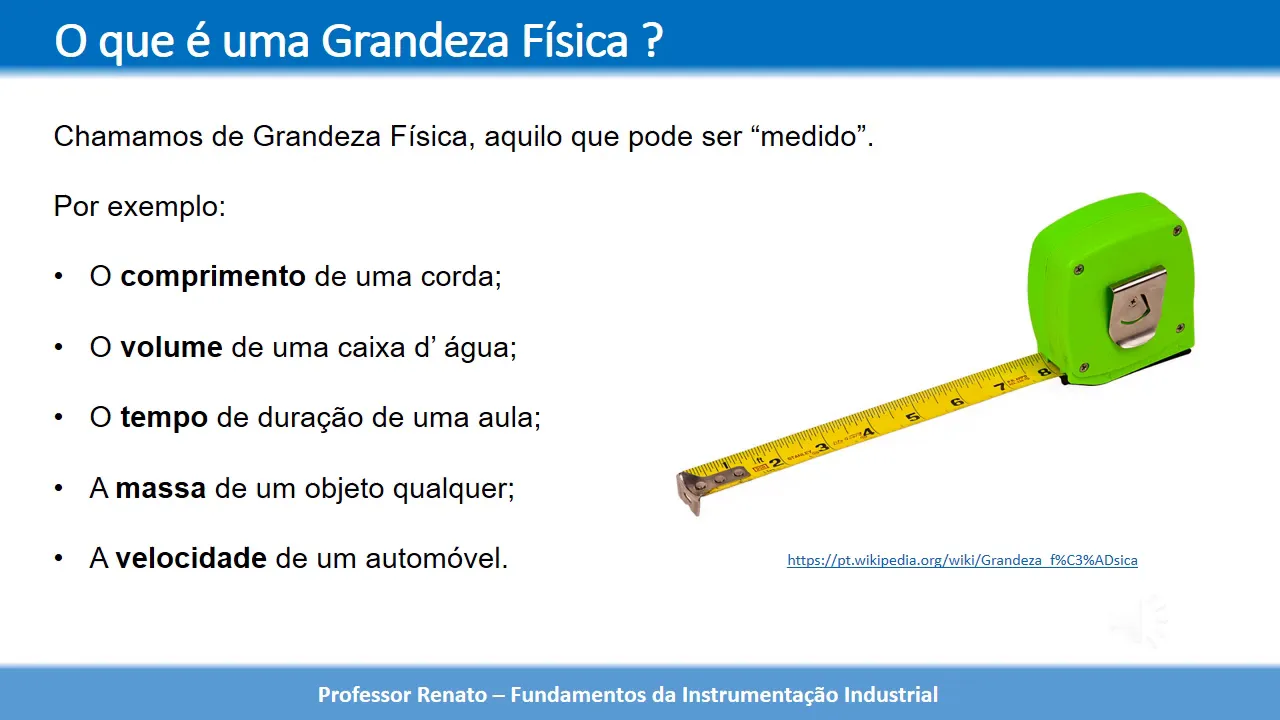
Introdução a Instrumentação Industrial
4.5K
Industrial instrumentation is the field that develops and applies technologies to measure, control, register, and indicate physical and industrial variables; a physical quantity is anything that can be measured with an instrument, and measurement involves comparing a value against a standard unit, with the International System of Units (SI) defining seven fundamental quantities (length, mass, time, electric current, temperature, amount of substance, and luminous intensity) and their derived units.
Click to watch →

Aula 1.1 - Introdução | Instrumentação
743
This comprehensive introduction covers the Instrumentation and Measurement Systems course for Mechanical Engineering students. The instructor, with a Mechanical Engineering degree from USP São Carlos and Master's in Mechanical Engineering, shares their research background in robotics, parallel manipulators, and kinematic redundancy. The course will use materials from a previous optional course on Computer-Assisted Instrumentation, covering all topics from the standard instrumentation syllabus. The course structure includes weekly recorded video lectures (approximately 50 minutes each) with questionnaires for attendance tracking. Assessment methods include weekly questionnaires, four graded activities (Carro Ti, datasheet presentations, discrete control projects, and filter projects), and a final group project requiring students to work in teams of five. The Carro Ti is a dynamic Q&A session where participation earns 5 points and achieving over 60% correct answers earns an additional 10 points. Students also participate in peer evaluation of colleagues' work. The course requires 75% attendance (9 out of 11 questionnaires) for approval, with a minimum final grade of 6.0. Students are encouraged to form study groups and participate in the department's junior company program.
Click to watch →

Conceptos Generales de Instrumentación | Instrumentacion Industrial
54.5K
This video introduces fundamental concepts in instrumentation that will be repeated across all instruments discussed. The instructor emphasizes that understanding these basic concepts is essential before moving on to more advanced topics. The key concepts covered include: field of measure (campo de medida), rangeability (rangeabilidad), span (alcance), error, accuracy (exactitud), precision (precisión), and hysteresis (histéresis). These concepts are fundamental to understanding how instruments work and how to properly select and evaluate them.
Click to watch →
Deep Dive
The Role of Music in Narrative: Understanding how music functions in film to support emotion, subtext, and character development.
The Favourite reviewed by Mark Kermode
253.5K
The film uses contrasting musical styles—from Purcell and Handel to experimental scratchy sounds and Elton John playing harpsichord—to enhance its narrative. The music underscores key moments, such as when Queen Anne burns her hand in lime and suffers from gout, with the build-up of pain relieved by musical release. This demonstrates how music functions as a narrative device to heighten emotional impact and underscore thematic elements like suffering and relief.
Click to watch →

Dream SMP Minecraft - Giải Mã Bí Ẩn Bài Nhạc Của Quackity (Phụ lục Las Nevadas)
60.6K
This video demonstrates how music functions as a sophisticated narrative device that encodes complex philosophical and thematic content. The song 'Will the Circle Be Unbroken' serves multiple purposes: it explores universal human concerns about mortality and the afterlife, while simultaneously functioning as a metaphor for recurring power cycles in storytelling. The song's connection to Bioshock Infinite's narrative structure—where an infinite loop only ends with the main character's death—illustrates how musical works can encode complex narrative structures. The video shows how a single piece of music can simultaneously address existential questions about life, death, and the nature of existence while also serving as a symbolic representation of cyclical patterns in fictional worlds. This demonstrates the multifaceted role of music in narrative art, where artistic expression can convey layered meanings that transcend simple entertainment.
Click to watch →

Hans Zimmer y sus mejores BSO | "El Análisis" de Jordi Maquiavello | Prime Video España
62.6K
Music in films functions as a narrative character rather than mere accompaniment. This video explores how musical elements convey narrative meaning through three key approaches: (1) Expressive accompaniment that creates emotional intensity and psychological tension through rhythmic patterns like ticking sounds; (2) Musical themes that represent character psychology, such as Superman's ascending fourth leap versus the modern version's descending scale reflecting depression; (3) Leitmotifs—recurring musical motifs from Wagner's works that serve as narrative figures. The analysis demonstrates how music can mark how viewers should feel, communicate character limitations through musical scales, and transcend into fictional worlds. Music can convey narrative information that would otherwise require dialogue, potentially surpassing visual imagery in importance.
Click to watch →
Bungie Made me CRY || Destiny 2 FINAL Mission MUSIC Reaction
125.1K
Game music serves as a powerful emotional and narrative tool that reflects both character experiences and player journeys. The main theme of Destiny 2's end reflects 10 years of experiences, including things lost and found. Music incorporates haunting darkness and synthetic quality while featuring momentum and forward propulsion. The opening is honest and reflective, with French horns rooted in the guardian soundscape and a choir creating a repeated melody about life, love, acceptance, and new beginnings. Music elevates experiences by providing a vantage point different from experiencing events without it. In opera, singers uncover character psychology through musical hints, creating three-dimensional characters. Similarly, game music helps players understand circumstances and creates tension and deeper understanding of situations.
Click to watch →

Величайшая Игра, Которая Не Смогла - Metal Gear Rising Revengeance | О чем был MGR Обзор-Аналитика
48.3K
The game's soundtrack is described as not just background music but as a narrative device that explains what is happening on screen. Each track carries its own thoughts, emotions, and story. This approach to music in games represents a sophisticated use of audio to enhance storytelling, where the music itself becomes a form of narrative that reveals character motivations and thematic elements that might not be apparent from the gameplay alone.
Click to watch →
Prerequisite Knowledge
- Concept 01Basic Music Theory and Harmony: A solid understanding of major/minor scales, chord progressions, and functional harmony.
- Concept 02Concepts of Melody and Motive: Familiarity with musical motifs, theme construction, and basic developmental techniques like transposition and inversion.
- Concept 03Introductory Instrumentation: Awareness of different instrument timbres and textures, particularly keyboard instruments like piano and organ.
- Concept 04The Role of Music in Narrative: Understanding how music functions in film to support emotion, subtext, and character development.
Subsequent Learning
- Step 01Full Orchestral Arranging: Translating piano or keyboard-based thematic variations into complex arrangements for a full orchestra.
- Step 02Scoring to Picture and Synchronization: Learning how to align thematic variations with specific visual cues, cuts, and camera movements in a DAW (Digital Audio Workstation).
- Step 03Hybrid and Electronic Texturing: Integrating acoustic variations with synthesis, sound design, and modern electronic production techniques.
- Step 04Leitmotif Mapping: Developing a comprehensive scoring plan that tracks character arcs and narrative shifts across a full-length film using musical variations.
Motif Intro
Themes Merge
Final Organ
Motif Intro
0:00Playing Section
- 1
Presents six variations of a core musical motif.
- 2
Establishes the foundational theme for the scoring session.
Texture-Based Sound Design and Non-Thematic Scoring
While traditional film scoring emphasizes clear thematic development and motif variations, a major contemporary counter-movement favors texture, timbre, and ambient sound design over melody and harmony. Proponents of this approach argue that prominent thematic hooks can distract the audience or manipulate emotions too overtly. Instead, composers like Trent Reznor or Hildur Guðnadóttir utilize drone-based soundscapes, microtonal textures, and integrated sound design to create an immersive, psychological atmosphere. In this paradigm, the line between music and sound effects is blurred, prioritizing raw sensory impact and spatial tension over structured Western harmonic progression and classical theme variation.
Deep Dive
Full Orchestral Arranging: Translating piano or keyboard-based thematic variations into complex arrangements for a full orchestra.

1 Theme - 5 Orchestrations
60.1K
This comprehensive segment demonstrates the complete process of creating a lush orchestral arrangement. The process begins with placing the melody in octaves in high strings, creating a foundation spread across all string octaves. The bass line is doubled in octaves for stability. When strings are fully occupied, brass fills harmonies while woodwinds double strings with arpeggios for movement. Horns play chords around middle C using closed voicing, and trumpets reinforce the melody. Additional elements like choir, sine wave layering, harp, celeste, vibraphone, and timpani are added progressively. The arrangement is balanced, warm, and the melody cuts through clearly. This demonstrates how orchestration is fundamentally problem-solving where each choice creates follow-up decisions.
Click to watch →
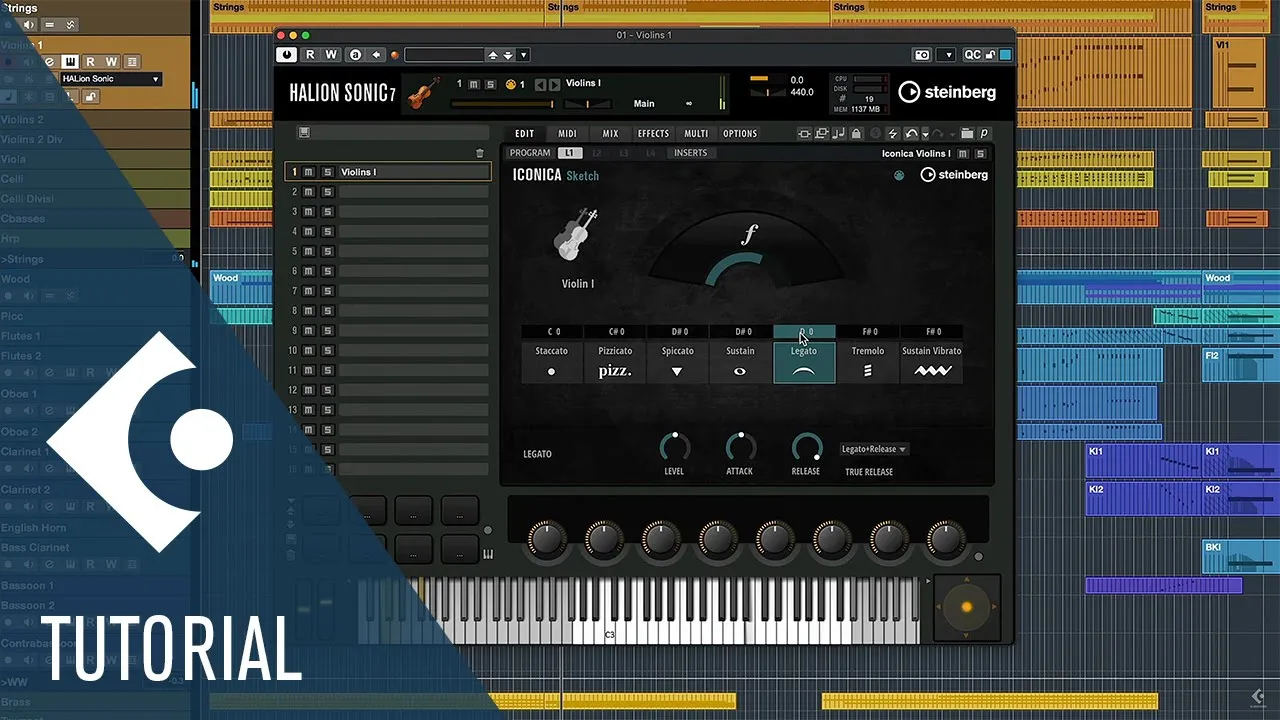
Iconica Sketch – A Full Orchestra at Your Fingertips | New Features in Cubase 13
79.2K
Iconica Sketch is a new orchestral library feature in Cubase 13 that provides a complete orchestra with 34 instruments and 140 articulations in a compact 5GB library, enabling users to create full orchestral arrangements with high-quality sounds while maintaining light computer resource usage.
Click to watch →
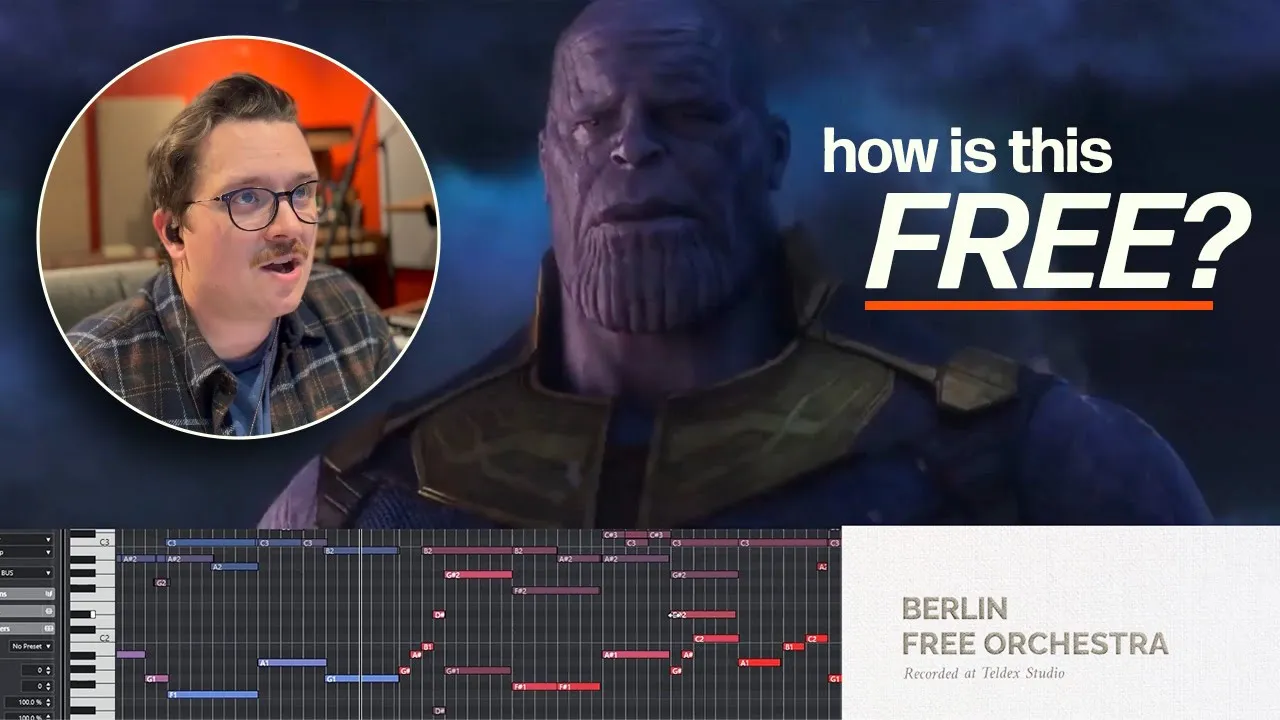
Can Berlin Free Orchestra do.... AVENGERS?!?!?!
178.8K
Creating a complete orchestral arrangement requires integrating multiple sections including woodwinds, brass, strings, and percussion. Woodwind sections reinforce other voices while adding melodic interest. Brass sections add power and grandeur, with trumpets effectively integrated when properly balanced. Percussion sections, including harp, timpani, tubular bells, and glockenspiel, may sound simple in isolation but become powerful in context. The harp glissando effect can be created manually by playing sustained notes and then moving them. The key insight is that individual instrument quality matters less than how well the entire ensemble works together, and free libraries can produce professional results when used thoughtfully in complete arrangements.
Click to watch →
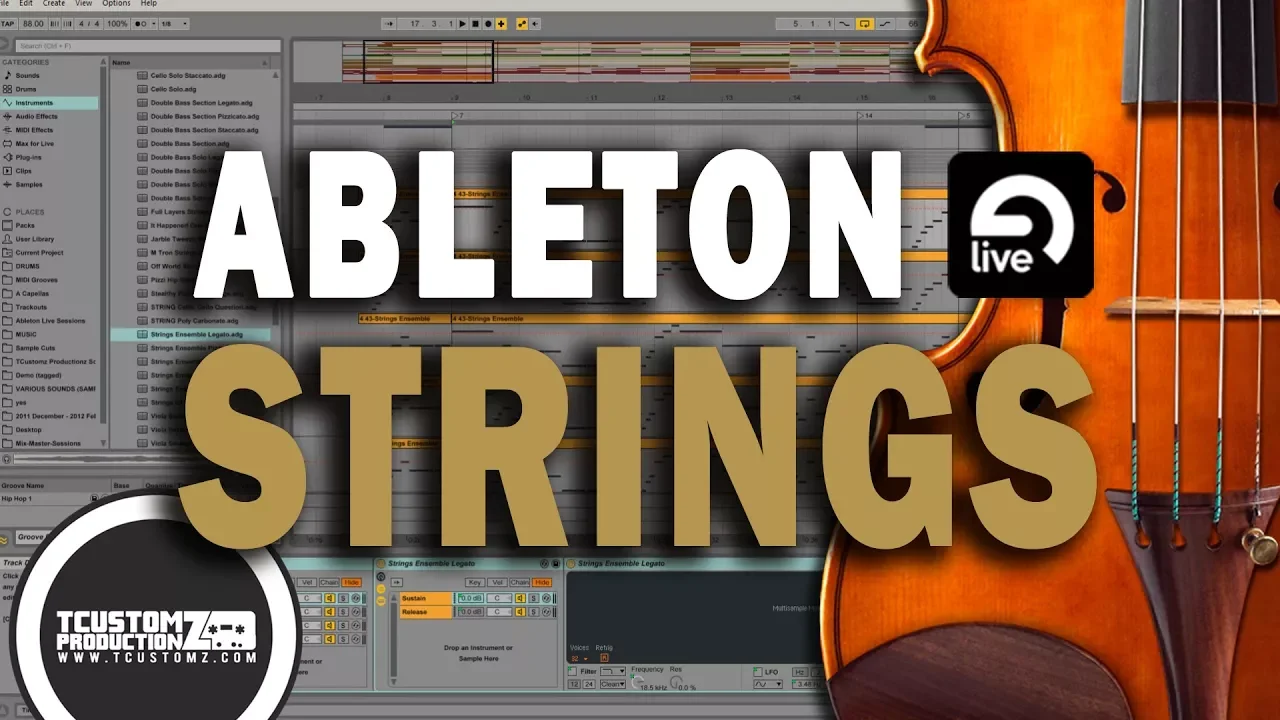
Awesome Orchestra Strings Patches (Stock Sounds) in Ableton Live 9 | Brass, Cello, Horns & Strings
77.3K
This segment covers the complete workflow for building orchestral arrangements using layering techniques. The instructor demonstrates duplicating the same string patch multiple times and pitching each instance down by one octave to create a richer sound. Higher registers are panned to the right channel while lower registers go to the left, creating stereo width. Middle registers are brought down in volume for balance. The instructor then expands the arrangement by adding complementary brass and cello sections, demonstrating how multiple stock patches from a DAW's library can be combined to create professional-quality orchestral textures without requiring expensive comprehensive plugins.
Click to watch →
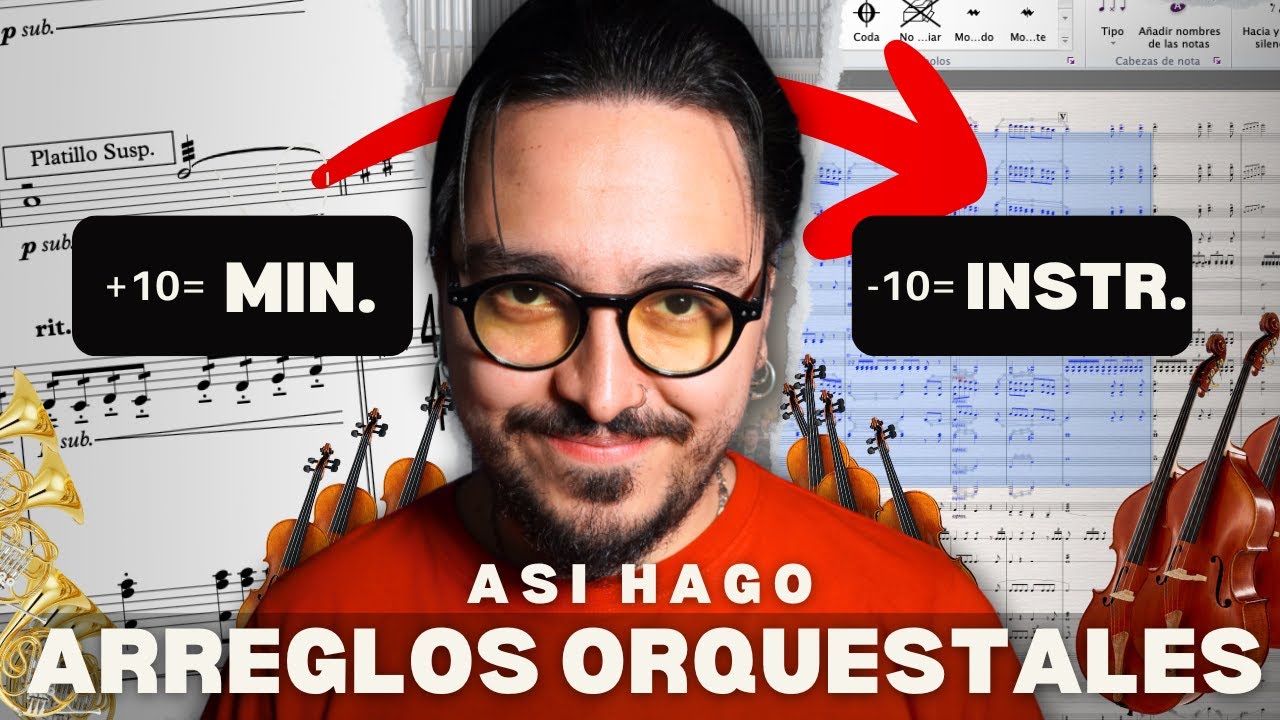
¿Cómo hacer ARREGLOS ORQUESTALES?🎻 (y cobrarlos Bien!💰) l Jesús González
9.3K
Professional arrangers follow a systematic process: first, deeply listen to and analyze the original material before writing any notes. Second, conduct thorough client conversations to understand their vision—whether they want to maintain the original style with enhanced orchestration or seek a completely different version. Third, clarify whether the client needs an arrangement or orchestration, as these terms have distinct meanings. Fourth, establish clear pricing based on ensemble size: for 10+ instruments, charge per minute of music; for fewer than 10 instruments, charge per instrument. Fifth, request 40-50% advance payment to protect against non-payment. Sixth, create proper score formatting with composer and arranger names, treating French horns as an independent section. Before beginning orchestration in notation software, create a reduction to piano on paper as a planning tool. When writing continuous flute passages, alternate between the two flutes to allow each player time to breathe.
Click to watch →
Deep Dive
Scoring to Picture and Synchronization: Learning how to align thematic variations with specific visual cues, cuts, and camera movements in a DAW (Digital Audio Workstation).

Digital Performer 5 Part 2 of 6
5.6K
The Conductor Score View provides precise timing information including bar numbers, time signatures, and frame positions. The click track is synchronized to the picture, allowing the orchestra to follow visual events. During the scoring stage, visual effects like streamers, punches, and flutters are superimposed over the projected picture to communicate tempo changes, meter changes, and sound effect placements to the conductor and orchestra. This system replaces expensive hardware used in traditional Hollywood scoring stages.
Click to watch →

Nick GaS #2
18.7K
In Get the Picture, correct answers earn $20 and reveal dots on the board. The first team to buzz in with the correct answer gets to connect the dots in a square of their choice and has a chance to guess the picture.
Click to watch →
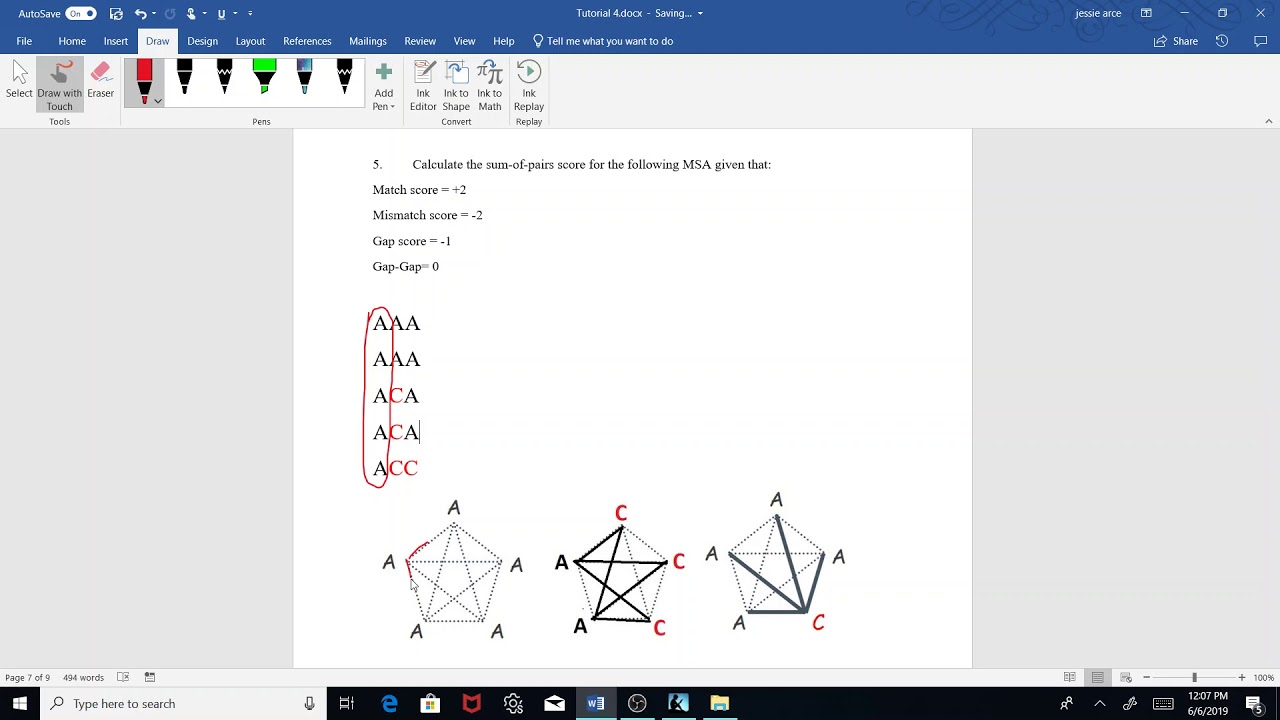
Tutorial4
245
The pictogram method provides a visual approach to calculate sum of pairs scores: (1) Create a geometric shape representing the number of sequences (pentagram for 5, square for 4, triangle for 3), (2) Use dotted lines to indicate matches and solid lines for mismatches, (3) Count all dotted lines for total matches, (4) Count all solid lines for total mismatches, (5) Apply the scoring scheme to calculate the total score. This method provides a visual representation of alignment quality and is particularly useful for larger alignments.
Click to watch →

Synchronica (シンクロニカ) Showcase
394
Synchronica's scoring system awards 10 points for perfect, 8 for great, and 4 for good. Clear rate must be at least 70% to clear. Bonuses include combo bonus (percentage of maximum combo) and release bonus (up to 10% per red/yellow note release), with maximum possible score of 120%. AAA starts at 115%, AA at 110%, A at 100%. Every song has a dynamic background attuned specifically to the song, with particles made specifically for each song. The game features a beautiful, aesthetically pleasing range of songs with few pushing the 200 BPM barrier (most modern music games are much faster). The fastest song is 200 BPM, while others are much slower, with some maxing out at 122 BPM.
Click to watch →
Logic Pro X 303: All Stars Tips 'N Tricks - 14. Time Code and Picture Sync
713
Synchronization (sync) is the process of ensuring that Logic Pro delivers the exact frame of picture corresponding to the playhead's position. When the playhead is at a specific location in the timeline (such as bar one beat one), the software should display the exact frame of picture that should be seen at that moment. This ensures that music and sound effects align perfectly with the visual content.
Click to watch →
Deep Dive
Hybrid and Electronic Texturing: Integrating acoustic variations with synthesis, sound design, and modern electronic production techniques.
Substance Painter Tutorial: Photorealistic Prop Texturing
57.8K
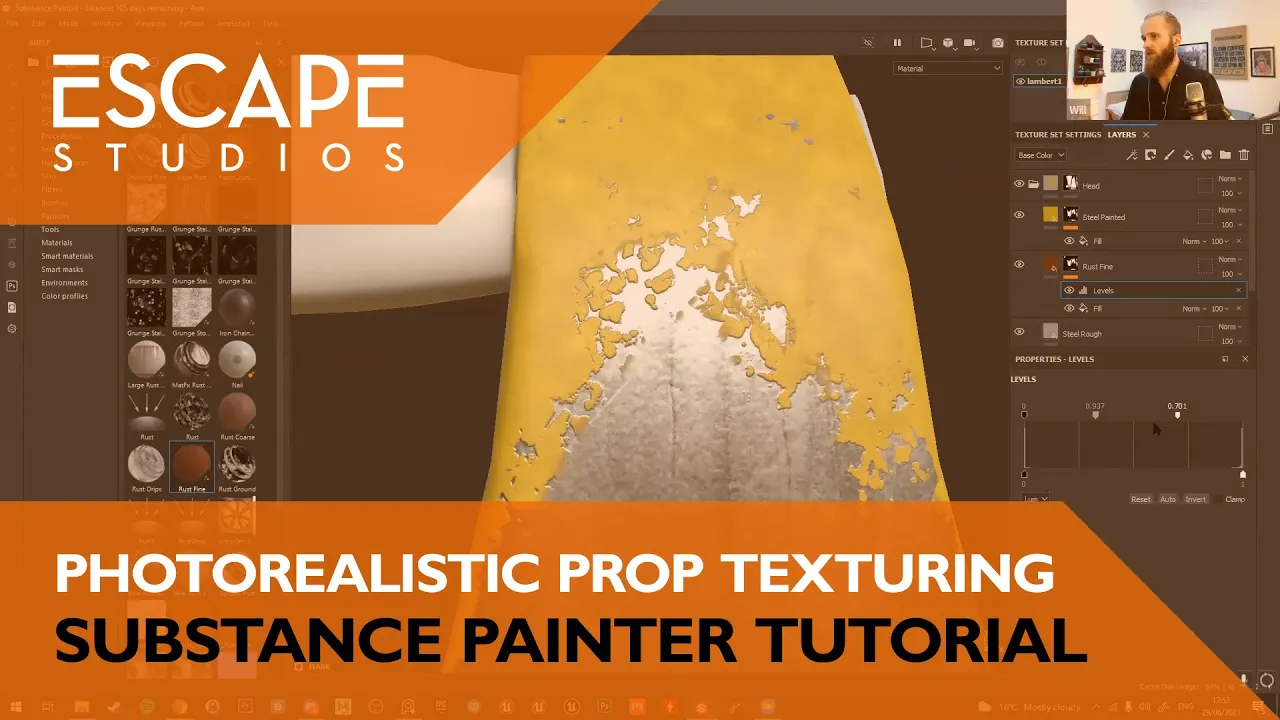
Substance Painter includes procedural grunges (randomizable via seed values) and tileable photo textures for adding roughness variation. Folders with shared masks ensure consistent application across multiple layers. Effective texturing combines procedural effects (smart masks, grunges, edge wear) with hand-painted details using blend modes like multiply. This hybrid approach balances efficiency with realism—procedural elements provide consistent randomness and micro-detail while hand-painted elements maintain creative control. The result is surfaces that feel authentic and lived-in.
Click to watch →
Unite Berlin 2018 - Substance for Unity Plugin: Better Performance, Faster PBR Workflow
3.1K
Effective 3D texturing pipelines must support bidirectional workflow rather than strictly linear progression from modeling to texturing to engine. Creative companies should build pipelines that support failure and enable back-and-forth adjustments between production stages. Hybrid texturing combines photogrammetry/scanning with procedural techniques to leverage strengths of both approaches: scans provide high quality but lack flexibility, while procedural methods offer variability but may lack detail. By applying procedural layers to scanned base materials, artists can easily modify parameters like fiber types, add weathering effects (snow, water, dirt), and create numerous variations from a single source asset. Substance Source provides over 1,000 pre-built materials with exposed parameters, multiplying available variations across industries including automotive, games, and VFX.
Click to watch →
Aaron Covrett @ NAB Show 2019 | Maxon Cinema 4D
103.8K
Effective texturing combines procedural material building with photogrammetry-derived base maps. Artists layer procedural height information, subsurface scattering properties, and Meshroom-generated diffuse maps within Substance Painter. This hybrid approach allows fine control over surface characteristics while leveraging the detailed reference provided by photogrammetry. The result is assets with excellent topology, proper UV unwrapping, and rich surface detail derived from original photographic captures.
Click to watch →
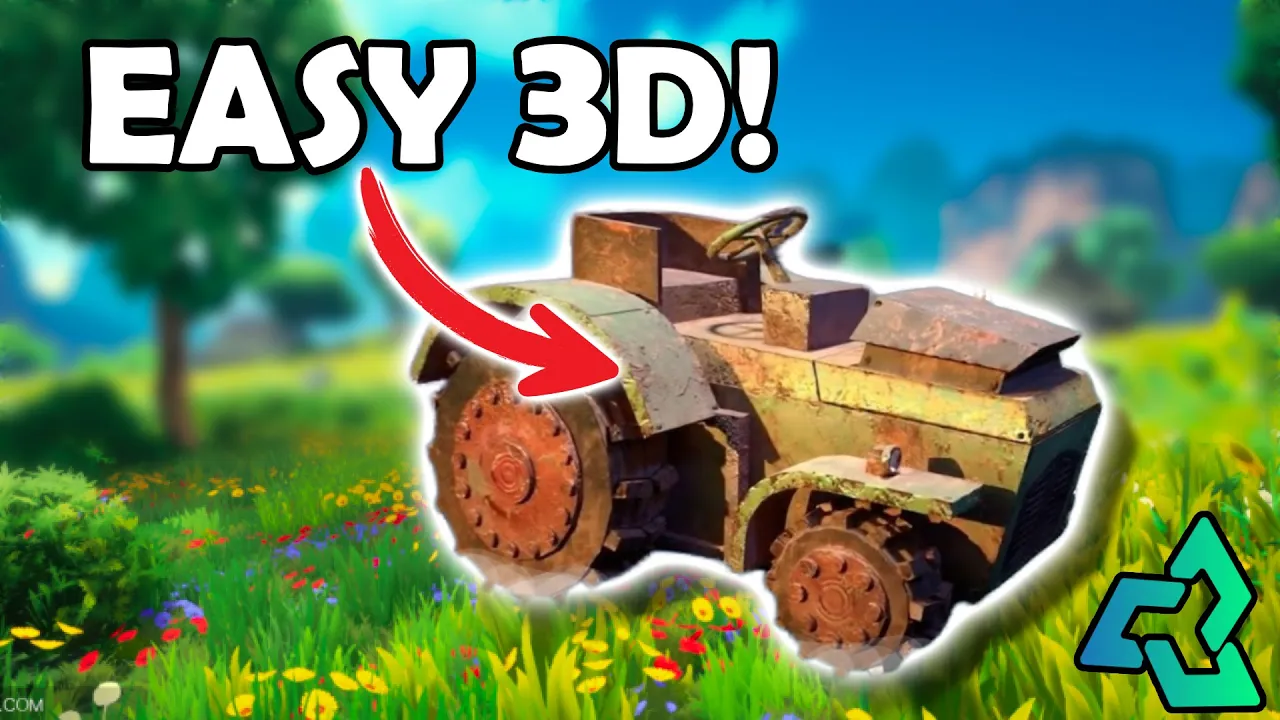
The easiest way to create Game Ready 3D Assets! (Sloyd AI + Substance Painter)
1.3K
This section presents a hybrid workflow combining generator-based efficiency with manual artistic control. Edge wear generators create subtle deterioration effects along model edges, requiring adjustment of wear levels and contrast for natural results. Geometry masking ensures effects only appear on intended surfaces. The workflow transitions to manual brush painting using bright orange paint with dirt brushes to create focal spots of rust. Turning off symmetry allows focused attention on natural-looking placement. Heavy coat applications combined with eraser tools create varied intensity. This hybrid approach leverages generator efficiency for base texturing while manual techniques add unique character and authenticity to final assets.
Click to watch →
Innovative Workflows from Substance Designer to Unreal Engine | Adobe Substance 3D
28.7K
This extensive section explores combining photogrammetry's photorealism with procedural generation's flexibility. Photogrammetry provides high-quality textures but loses procedural information, while procedural textures offer control but lack realism. The hybrid approach involves importing photogrammetry textures, processing them to extract key features, and enhancing with procedural nodes. UV coordinates establish relationships between 2D texture space and 3D mesh geometry, with values ranging from 0 to 1. The directional warp node moves texture content based on intensity inputs, with white moving content by one full unit and gray values proportionally determining movement distance. Random directional warping without control causes visual artifacts, solved by using pixel processors to read pixel values, multiply by tile count, apply ceil function, and divide to get normalized offsets for controlled tile randomization.
Click to watch →
Deep Dive
Leitmotif Mapping: Developing a comprehensive scoring plan that tracks character arcs and narrative shifts across a full-length film using musical variations.
Лейтмотив Гастера: Всеобщая паранойя (feat. Rom1o)
60.7K
A musical motif becomes a leitmotif only when combined with other musical elements to create a specific feeling. Simply repeating a four-note pattern does not automatically make it a leitmotif. Longer motifs (such as 27 notes in the Freedom theme or 12 notes in the Gerson theme) do not require additional elements to be recognized as leitmotifs. Gaster's leitmotif is unique because it is just four notes, requiring both the melody and context to be identified.
Click to watch →

El leitmotiv en la escritura | Se7en, Devil may cry, Chainsaw man, Sonic 06
60.8K
A leitmotiv is a term originally referring to the repetition of elements within compositions to generate specific emotions. It creates connections between works and characters or central ideas. Leitmotivs are not complete themes but extracts or particular melodies that remind audiences of characters. The Darth Vader Imperial March exemplifies this, creating immediate danger when heard. Melody alteration changes context while maintaining connection. Dark Souls uses leitmotivs across its saga, with the Lord of Cinder theme connecting games. Sonic 2006 demonstrates contextual changes, using the same melody with explosive, melancholic, and heroic variations. Leitmotivs extend beyond music to any element expressing central themes. In Seven, the metronome symbolizes Somerset's inability to change. In One Piece, vibre cards express character states through consumption. The Going Mary represents adventure and freedom, becoming damaged to symbolize conflict and loss. In Bloodborne, blood serves as a leitmotiv for power and progression. The line between leitmotiv and symbolism is often blurred.
Click to watch →

The Amazing Digital Circus - All Songs with the "Main Theme" Leitmotif
67.6K
This video demonstrates how leitmotifs (recurring musical themes) are used throughout The Amazing Digital Circus animated series, with the 'Main Theme' leitmotif appearing in various songs including 'Sorry About That,' 'Your New Home,' 'Digital Days,' 'Sacchariferous Sovereignty,' 'Not Alone,' 'Peacefuller Times,' 'Don't You Open That Really Scary Door,' 'Boxed Suggestions,' and 'May I Take Your Order,' all composed by @Gooseworx.
Click to watch →

All songs with the "Freedom" leitmotif in Deltarune (Chapters 1-2)
304.6K
The 'World Revolving' leitmotif in Deltarune (Chapters 1-2) appears in multiple songs including 'The World Revolving,' 'The Circus,' 'Dialtone,' 'BIG SHOT,' 'The Chase,' 'The Door,' and 'Nightmare Knight,' representing a recurring musical theme that some players also refer to as the 'Secret Boss' or 'Freedom' leitmotif.
Click to watch →
Leitmotifs: What Les Miz Taught Lin-Manuel Miranda (Musical Theatre Universe Part 1)
50.6K
A leitmotif is a musical melody, chord progression, or rhythm that represents a specific idea, person, object, or concept. In musicals like Hamilton, certain melodies return repeatedly throughout the show to represent particular elements of the narrative.
Click to watch →
Motif Intro
Themes Merge
Final Organ
Motif Intro
0:00- 1
Presents six variations of a core musical motif.
- 2
Establishes the foundational theme for the scoring session.
Texture-Based Sound Design and Non-Thematic Scoring
While traditional film scoring emphasizes clear thematic development and motif variations, a major contemporary counter-movement favors texture, timbre, and ambient sound design over melody and harmony. Proponents of this approach argue that prominent thematic hooks can distract the audience or manipulate emotions too overtly. Instead, composers like Trent Reznor or Hildur Guðnadóttir utilize drone-based soundscapes, microtonal textures, and integrated sound design to create an immersive, psychological atmosphere. In this paradigm, the line between music and sound effects is blurred, prioritizing raw sensory impact and spatial tension over structured Western harmonic progression and classical theme variation.
Basic Music Theory and Harmony: A solid understanding of major/minor scales, chord progressions, and functional harmony.
Concepts of Melody and Motive: Familiarity with musical motifs, theme construction, and basic developmental techniques like transposition and inversion.
Introductory Instrumentation: Awareness of different instrument timbres and textures, particularly keyboard instruments like piano and organ.
The Role of Music in Narrative: Understanding how music functions in film to support emotion, subtext, and character development.
Full Orchestral Arranging: Translating piano or keyboard-based thematic variations into complex arrangements for a full orchestra.
Scoring to Picture and Synchronization: Learning how to align thematic variations with specific visual cues, cuts, and camera movements in a DAW (Digital Audio Workstation).
Hybrid and Electronic Texturing: Integrating acoustic variations with synthesis, sound design, and modern electronic production techniques.
Leitmotif Mapping: Developing a comprehensive scoring plan that tracks character arcs and narrative shifts across a full-length film using musical variations.
934 views73likes4:59@ImpliedMusicOriginal Release: 2025-09-29
Hi, it's Chris with Implied Music. Every week I do a series of shorts, vertical videos here on YouTube and over on Instagram. I have a halfhour movie, a short movie to score and I'm exploring a couple of simple themes and textures.
Here are six versions of my basic motif.
Here's a little film motif.
We'll hear it again and again in this series.
[Music] The organ underscores a second character. And this chord progression underlies the original motif.
[Music] Heat. Heat.
Here's the first motif again with a slightly different perspective.
[Music] [Laughter] A combination of both themes.
[Music] Heat. Heat.
[Music] A lyrical version of theme one with a little more exploration.
[Music] And finally, an organ version of theme one. Heat. Heat.
[Music] [Music] [Music] Well, I hope that was useful. Like and subscribe. Ding the bell to be notified when I do my videos. I'll see you next time.
[Music]
Up Next

20:50
AI for Language Learning: A Linguist's Guide to LLMs
@languagejones
14.3K views•2026-02-27

12:54
Triumph of Orthodoxy Icon: Byzantine Art & History Explained
@BenCallan
2.1K views•2024-08-06

9:49
FastAPI vs Flask vs Django: Choosing the Right Python Web Framework
@TechWithTim
302.5K views•2024-05-26

1:42
Game of Thrones Opening Credits: A Cinematic Analysis
@gameofthrones
46.3M views•2011-04-18
Related Study Plans & Knowledge Roadmaps
Structured learning paths in General & Interdisciplinary Studies
general-studies
Elevator Engineering: History, Physics & Cities
01From Hoists to Safety Brakes: The Dawn of Vertical Lift
02Hydraulic vs. Traction: The Engineering Physics of Elevators
03Modern Speed, Safety, and Algorithms
+ 2 more learning modules
12h5 modules
Explore Roadmap
general-studies
Rubber: Material Science, History & Geopolitics
01Origins of Natural Rubber & Mesoamerican History
02The Chemistry of Natural Rubber & Vulcanization
03The Geopolitics of the Rubber Boom & Colonization
+ 2 more learning modules
12h5 modules
Explore Roadmap
general-studies
Containerization: Evolution, Logistics & Trade
01Ancient Trade & Bulk Cargo: Amphorae to Barrels
02The Industrial Revolution & Cardboard Packaging
03The Containerization Revolution: Malcom McLean
+ 2 more learning modules
12h5 modules
Explore Roadmap
general-studies
Textile Tech: Evolution, Labor & Global Impact
01Pre-Industrial Textiles: Handloom & Cottage Industry
02Mechanization: The Spinning Jenny to the Power Loom
03The Factory System & Global Labor Transformation
+ 2 more learning modules
10h5 modules
Explore Roadmap