










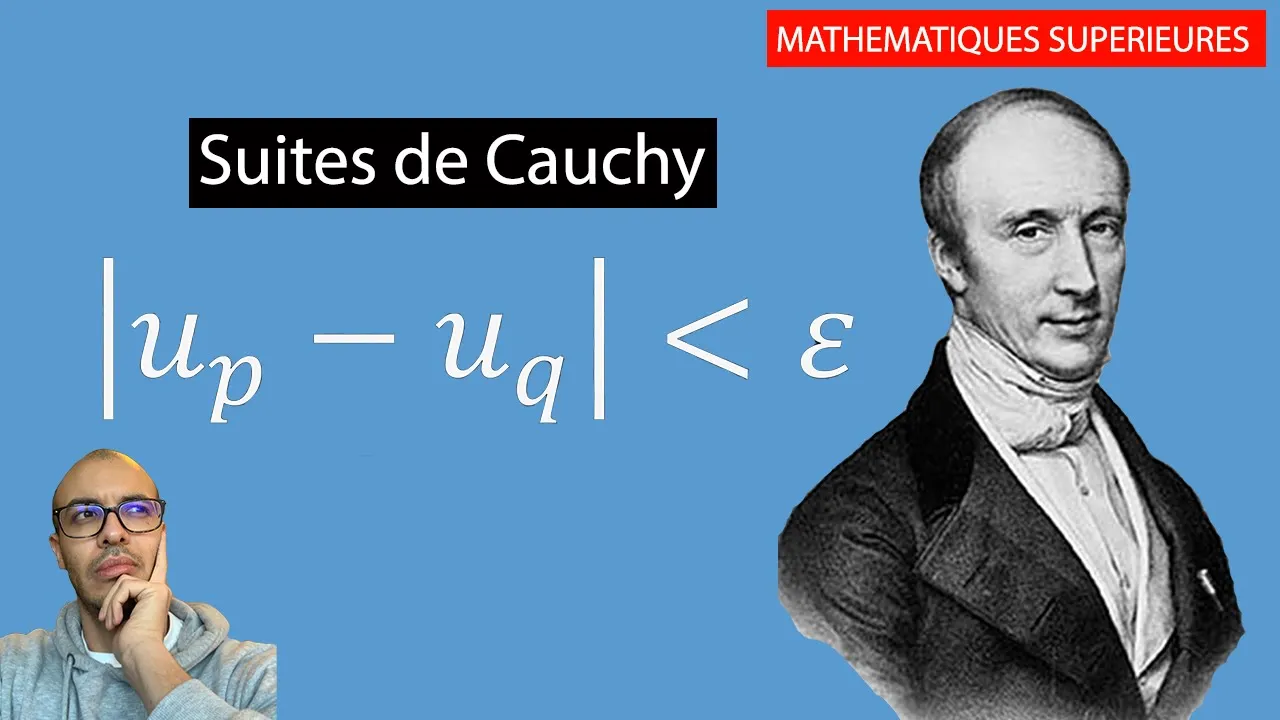





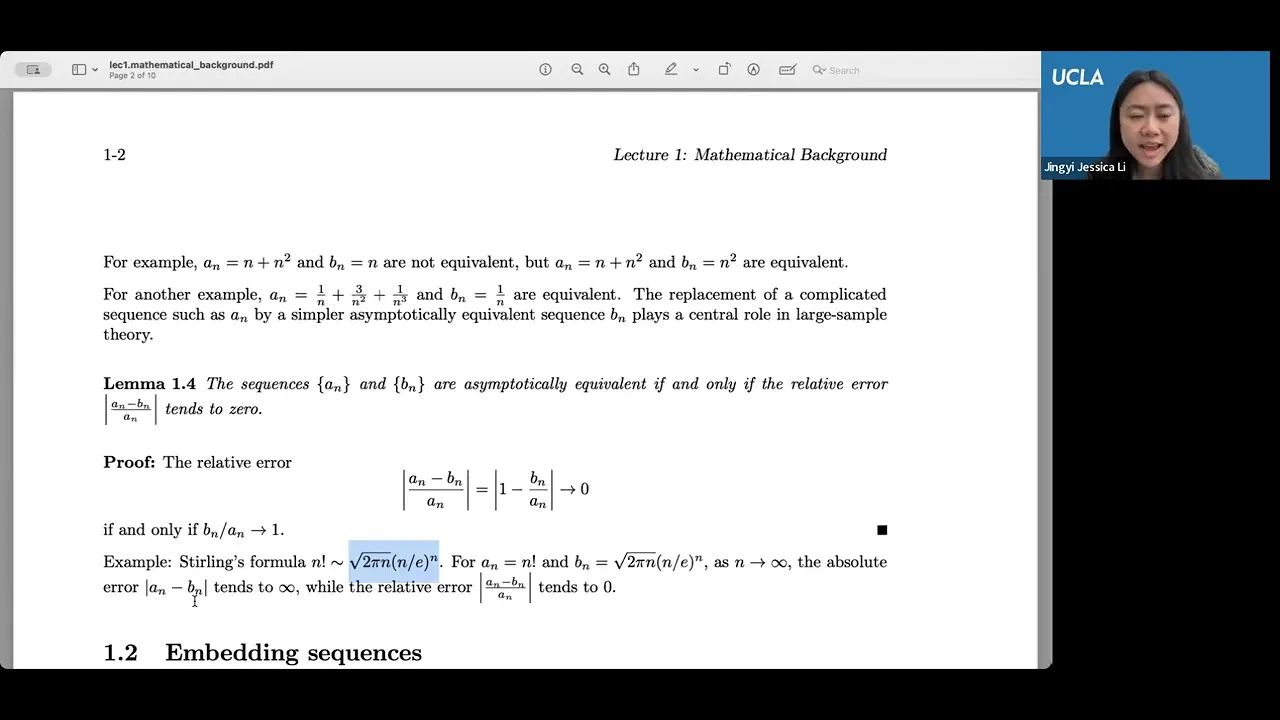



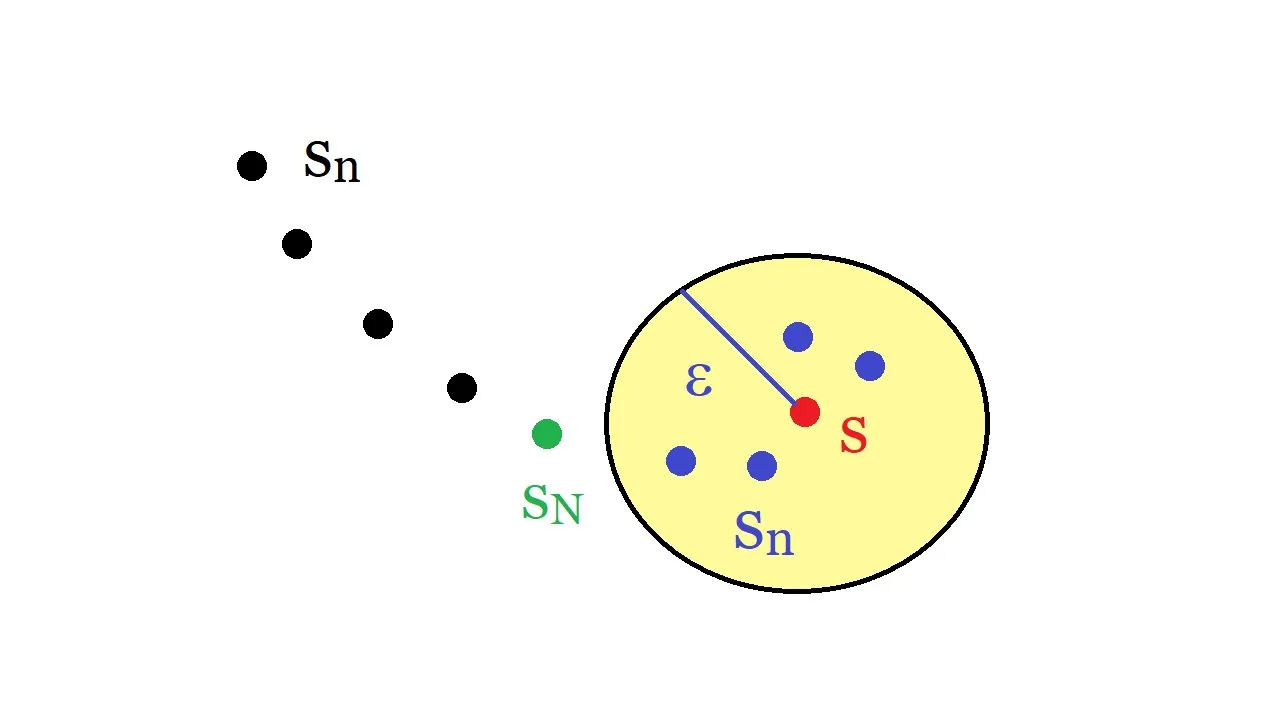
A sequence is a function from natural numbers to real numbers, denoted as (sₙ)ₙ∈ℕ, and a sequence converges to a limit s if for every ε > 0, there exists an N such that for all n > N, |sₙ - s| < ε. Key limit theorems include: if sₙ → s, then K·sₙ → K·s; if sₙ → s and tₙ → t, then sₙ + tₙ → s + t and sₙ·tₙ → s·t; if sₙ → 0 and tₙ is bounded, then sₙ·tₙ → 0; and if sₙ ≠ 0 for all n and sₙ → s ≠ 0, then 1/sₙ → 1/s. Sequences can diverge to +∞ or -∞, meaning terms become arbitrarily large or small respectively.
Sequences and Their Limits: Quantifiers, Convergence, Proofs
Added:Familiarity with mathematical logic, specifically the precise use of existential (∃) and universal (∀) quantifiers in formal statements.
A foundational understanding of the real number system, including the concepts of upper and lower bounds, supremum, and infimum.
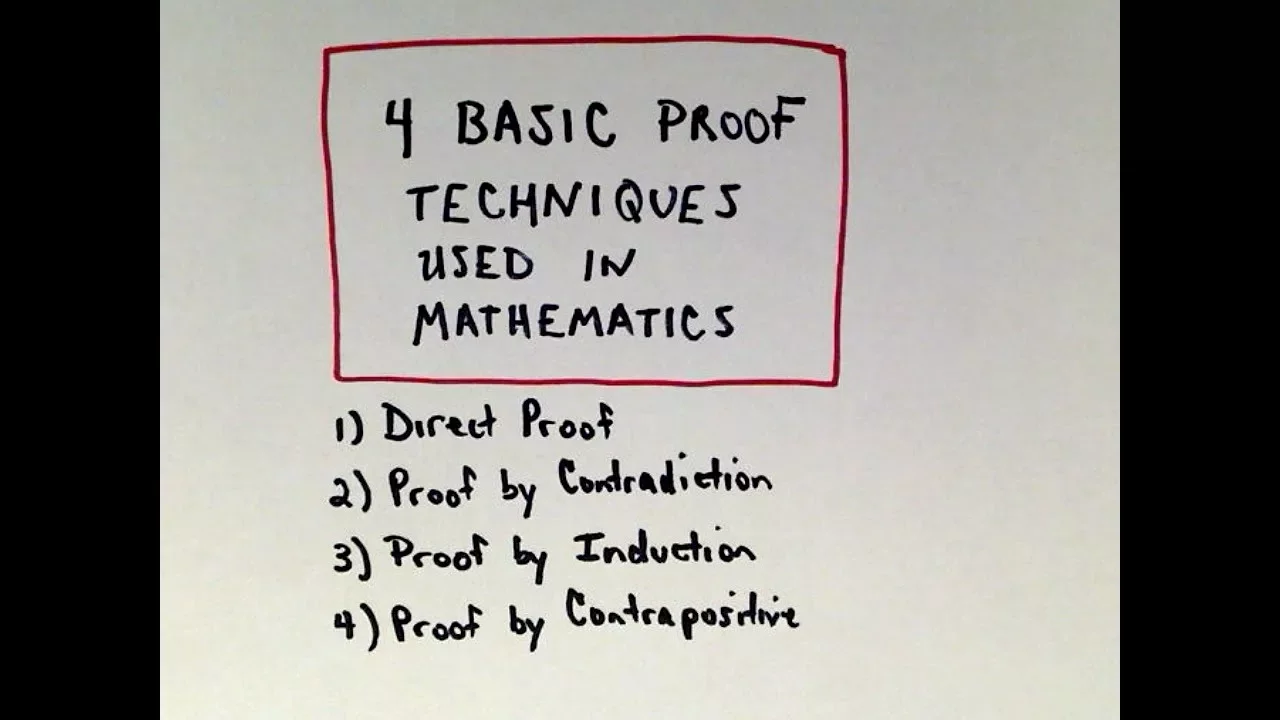
Basic proof techniques in mathematics, such as direct proof, proof by contradiction, and mathematical induction.
An intuitive grasp of what a sequence is, namely a function mapping the set of natural numbers to the real numbers.
The definition and properties of Cauchy sequences, leading to the completeness of the real numbers.
The concept of subsequences, limit superior (lim sup), limit inferior (lim inf), and the Bolzano-Weierstrass Theorem.
Infinite series and convergence tests, which apply sequence limit concepts to infinite sums of real numbers.
Limits of functions and continuity, extending sequential limit definitions to continuous domains.
Introduction to metric spaces, generalizing sequence convergence to more abstract mathematical spaces.
106 views0likes21:36Original Release: 2017-06-30
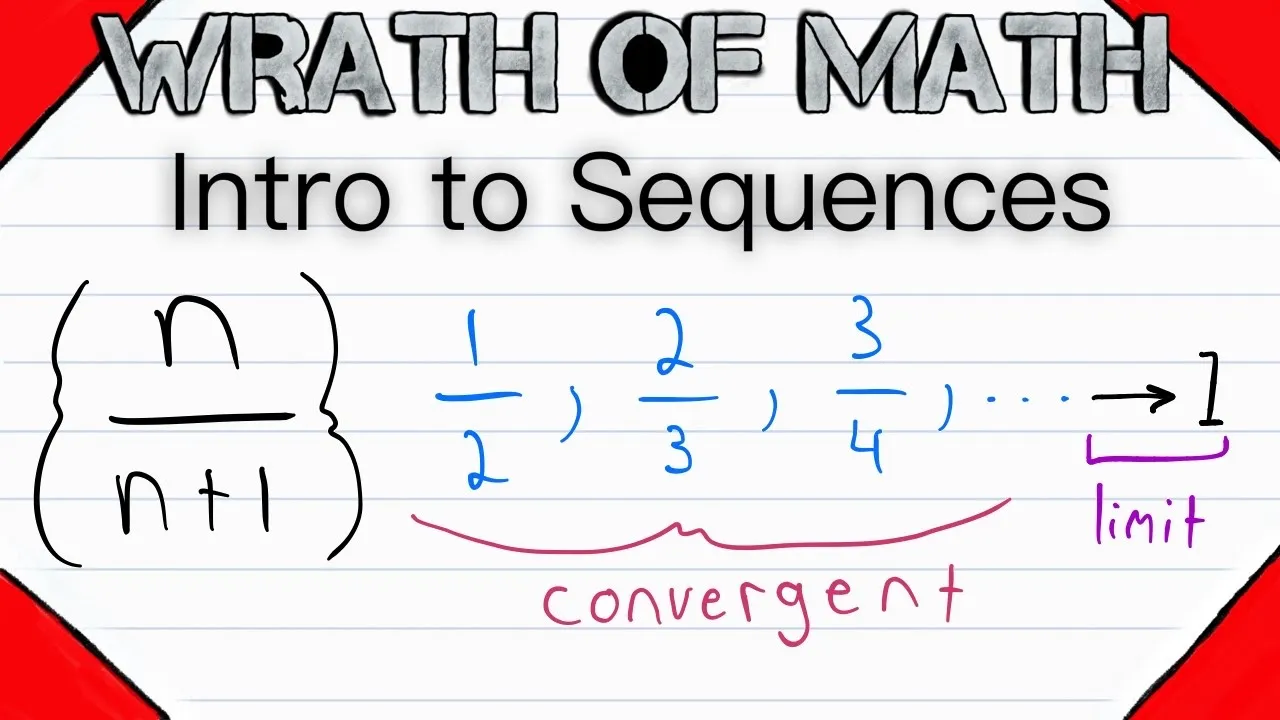
greetings it's Paul Bamberg welcoming you to the preview video for class two in math s322 I'm expecting that everyone will watch this before Tuesday morning so you'll have an idea of what we're going to be doing in class the next day and how the various proofs and examples fit in the subject is sequences and their limits let me start by introducing a bit of notation these quantifiers are absolutely standard in serious mathematics for some strange reason they're not used by Ross in our textbook but they save a lot of space when you're writing on the board and I'm going to encourage you to use them throughout the course the first of these is called by logicians the existential quantifier it's written like a backwards cap e it's red there exists and it's almost always followed by the phrase such that which in that context you can feel free to abbreviate as S period t period here's an example of its use the logical proposition is there exists an X such that x^2 equals 4 that's a true statement why because either xal 2 or xal minus 2 has the property that its square is equal to four the other quantifier is the universal qual quantifier it's an upside down capital A you can read it for all for each or for every and you use it to specify that some proposition is true for every member of some set or sequence in most of the interesting cases this set or sequence will be infinite so here's an example for for all X in the real numbers x^2 is greater than or equal to zero that's a true statement because whether you consider an arbitrary positive number an arbitrary negative number or zero the square is either zero or positive change it slightly to for all X in the real numbers x^2 is greater than zero now that's a false statement it's true for all positive numbers it's true for all negative numbers but it's not true for zero one counter example is enough to kill it which brings us to the next idea how to negate these quantifiers let's start with a statement of the form there exists an X such that P of X is true for example there exists a prime number such that that prime number is even that's a true statement because two is a prime number what would be the negation of that statement the negation of that statement would be all prime numbers are odd for all X the proposition P of X that the prime number is uh even is a false statement so to negate the proposition you do two things you convert P of X is true into P of X is false and you also replace their exists by for all the same rule works if you're trying to negate a for all statement if you start with for all x p of X is true how can you refute that statement well you refute it by showing a counter example and you only need one example there has to exist an X such that P of X is false so if I start with the statement all prime numbers are odd that is a false statement and I want the negation of that statement the negation is there exists a prime number such that P of X is not odd it's even and that's a true statement because two is an even prime number now we can get to sequences a sequence is arguably really a function the domain of the function is the natural numbers you can start with zero or one or even some larger integer M if it strikes your fancy and the domain is all the little ends that are integers greater than or equal to your starting integer M the co-domain of the function in this course is also going always going to be a real number because we're doing a course in real analysis in other branches of mathematics you could have sequences of vectors or sequences of complex numbers or sequences of matrices but we're just going to deal with sequences of real numbers to denote a specific element in the sequence we subscript s the symbol for the sequence with n so S Sub 2 for example would be the second element of the sequence if we wanted to note the entire sequence the long winded way is S1 comma S2 comma dot dot dot which makes it very clear we've got an infinite sequence or s subn in parentheses for n in the natural numbers or or even sub subn enclosed in parentheses it's important to use parentheses and not curly braces if you use curly braces you're denoting the set of values in the sequence and it's possible to dream up a sequence for which although the sequence is infinite the set of values is only finite consider for example the sequence where the nth element in the sequence is the cosine of n * pi cosine of pi is min-1 cosine of 2 pi is 1 cosine of 3 Pi is minus one so the set of values in the sequence is Just the Two element set consisting of minus one and plus one parentheses to specify the sequence curly brackets to specify the set of values in the sequence now I can talk about the limit of the sequence and in most cases in this course where we work with limits we're going to reduce the problem to limit of a sequence for the limit of the sequence the only limit you can consider is the limit as n becomes very large and for that reason it's unambiguous to write limb of s subn instead of the more long- winded limb as n approaches Infinity of sub subn now for the key definition a sequence s subn is said to converge to a limit s if by making n large enough you can get all the remaining values in the sequence to be as close as you like to the Limit s so let's consider how we write this formally you start by specifying how close to the Limit you want it to be you say I challenge you with Epsilon equals 1,000 I have to respond to your challenge with a capital N ACC counting number and I choose that so that for all little n that are greater than that capital N the nth element of the sequence differs from the limit s by less than Epsilon notice this absolute value it has to lie in the open interval from s minus Epsilon to S Plus Epsilon and this is almost always done with these symbols Epsilon specifies how close you want to get capital N specifies how far along in the sequence you have to go and little n specifies an arbitrary element of the sequence beyond the capital lth element it's a bit of a pain to prove that a sequence converges by using this definition because in order to apply the definition we have to know the limit s of a sequence once we can figure out that limit the rest of the proof is purely algebra the algebra turns out to be rather messy and we will come up with better ways of doing this starting in the third class you might worry that a sequence has more than one limit but that can't happen with sequences of real numbers if a sequence converges to S and that sequence converges to T then s equals T that seems so obvious you might think it would be hard to prove it but in fact it turns out to be very easy to prove it and it will be our first example of the use of a tri of the triangle inequality which I introduced last time for doing real analysis proofs Ross devotes several pages to the issue of formal proofs a formal proof is one that includes the minimum number of statements required in order to establish the truth of some mathematical proposition and frequently that involves throwing away a lot of the scratch work you did in order to figure out how to do the proof you'll discover this when you try to construct these formal proofs on your own you say I need to prove that this particular sequence converges to three and you f fure out by playing around that if someone challenges you with an Epsilon and you choose a capital N that is an integer greater than 17 over Epsilon the proof Works in a formal proof you say for any Epsilon greater than zero let N be the smallest integer that's greater than 17 over Epsilon and then you proceed to do the proof leaving your reader wondering how on Earth did she figure that you needed to use 17 over Epsilon that's what I mean by throwing out your scratch work and if your goal is to instruct your audience it might be that something that's a bit longer than a true formal proof is appropriate now let me present some theorems about limits we can prove all of these for the from the definition and most of them will in fact be proved in class first one if s subn converges to S and I multiply everything in the sequence by some real number K the sequence K * s subn converges to K * s next equally obvious but actually great fun to prove if s subn converges to s and t subn converges to T then the sequence whose General element is S subn Plus T subn converges to S Plus and those of you who've been teaching calculus are probably aware that you need these results in order to prove the rules that your students learn about derivatives like the derivative of the sum of two functions is the sum of their derivatives next theorem if a sequence converges it's bounded that is if s subn converges to S there exists some real number m usually one chooses an integer for this but that's not necessary such that every element of the sequence has the property that its absolute value is less than M how can a sequence fail to be bounded it can be fail it can fail to be bounded if there are terms that are positive and arbitrarily large or negative and arbitrarily small but such a sequence doesn't have any chance of converging to anything next if s subn converges to s and t subn converges to T the sequence of products s subn * T subn converges to S * T we'll need this eventually to prove the product rule for differentiation another in the same family and this one's a little bit trickier if s subn is a sequence that converges to zero and you multiply each term by the corresponding element of the sequence T subn then the limit of s subn time T subn is equal to zero but there's a catch T subn has to be bounded why well I can give you a simple example suppose that s subn is the sequence 1 1/2 1/3 1/4 1/ 15 that certainly converges to zero let's pick an unbounded sequence T subn 1 4 9 16 and so on If I multiply the terms together I get 1 2 3 4 and so on which certainly doesn't converge to zero and it's because of that sort of counter example that we need to impose this boundedness restriction on t subn finally what about a sequence of reciprocals well here we have to be very careful not to divide by zero if s subn is different from zero for all n so that we can take the reciprocal of any element and furthermore the limit of the sequence is different from zero it's entirely possible to have a sequence like one a half a third a fourth a fifth that converges to zero even though no element of the sequence is zero then the infimum of the absolute value of the sequence is positive that is there is some nonzero number that's small enough that every element of the sequence is greater in absolute value than that and if all those conditions are satisfied we can prove that 1/ sub subn is a sequence that converges and it converges to 1 / s once we have these limit theorems they will generally provide the best way of figuring out the limit of a sequence and there are numerous examples in the textbook about how you can use these limit theorems to figure out limits in cases we doing a Brute Force formal proof would be tedious and unpleasant let me conclude by saying a bit about Infinity first let's consider a bounded subset of the real numbers and in order to avoid being trivial let's make sure it's a bounded non-empty subset this always has a supremum and an INF both of these are real numbers the supremum is the smallest real number that's greater than anything in the sequence the inum is the largest real number that is smaller than anything in the sequence but what if the subset is unbounded well there are two ways a sequence can be unbounded it can fail to be bounded above or it can fail to be bounded below indeed it can fail in both ways if s has no upper bound then we say the supremum of s is plus infinity if it has no lower bound we say that the infimum is us Infinity that means that every subset of the real numbers has a supremum or an infimum but it's not always a real number plus and minus infinity are not real numbers because they don't satisfy the field axium you get into serious trouble with things like zero times infinity when we're specifying limits the infinity symbol has has a precise meaning when I say the sequence s subn diverges to plus infinity what I mean is that the terms in the sequence become arbitrarily large no matter how large a positive number you choose you might choose 1,000 I can find a capital N such that once you go beyond that point in the sequence I choose n equals 2000 and every element of the sequence beyond the 2000th element would be greater than your 1,000 notice that in order for a sequence to diverge to Infinity the elements of the sequence have to become and remain greater than any positive number and in exactly the same way we say that a sequence diverges to minus infinity if no matter how negative a number you give me I can find a place in the sequence Beyond which all the elements of the sequence are less than your capital A so now you know about limits you know about sequences you know how to use the infinity symbol and we'll get together in class prove most of the results that I've mentioned and do a few interesting examples of calculating limits here are some of the theorems we're going to be proving if you have a sequence that diverges to plus infinity and you have a second sequence t with a positive limit then the product of the two sequences also diverges to plus infinity notice the Restriction that t subn has to have a limit that's greater than zero if the limit is zero the limit of the product could end up being finite if you have a sequence of positive real numbers then it diverges to plus infinity if and only if the limit of the sequence of reciprocals is zero if you have a sequence that diverges to plus infinity limit of SN is plus infinity and you add on another sequence then the limit of the sequence S subn Plus T subn will also be plus infinity except we have to impose some requirements on S subn if s subn becomes extremely negative this may not be true and here are three more or less equivalent properties if tabn approaches a limit other than minus infinity this is true it doesn't actually have to approach a limit all that's really required is that t sub B is bounded and in fact we only have to worry about adding on very negative numbers so it only has to be bounded below so this is the minimum Criterion we have to satisfy the infimum of T subn has to be some number greater than minus infinity there has to be some finite negative number with the property that everything in the sequence is uh greater than that okay we're done for today see you in class tomorrow
Up Next

16:40
Open and Closed Sets | Real Analysis Limits and Topology
@JoelAndersonMath
264 views•2026-02-04
4:43
Elliptic Curve Cryptography Explained: ECC, ECDSA, ECDH
@PracticalNetworking
28.5K views•2024-10-21
10:44
Fourier Series Introduction: The Big Idea Explained
@DrTrefor
387K views•2021-05-03

6:00
The Mathematical Impossibility of Accurate World Maps
@Vox
23.3M views•2016-12-02
Related Study Plans & Knowledge Roadmaps
Structured learning paths in Mathematics
mathematics
Tensor Calculus: Vectors to Riemann Curvature
01Mathematical Foundations: Linear Algebra & Calculus
02Covectors, Dual Spaces, and Tensor Basics
03The Metric Tensor and Index Gymnastics
+ 2 more learning modules
40h5 modules
Explore Roadmap
mathematics
Gödel's Incompleteness: Logic, Proofs & Limits
01Introduction to Formal Systems & Hilbert's Dream
02Set Theory, Cardinality, and Cantor's Diagonal Argument
03Arithmetization and Gödel Numbering
+ 2 more learning modules
14h5 modules
Explore Roadmap
mathematics
Galois Theory: Fields, Groups & Solvability
01Foundations of Abstract Algebra: Groups & Fields
02Polynomials & Field Extensions
03Splitting Fields & Symmetries
+ 2 more learning modules
24h5 modules
Explore Roadmap
mathematics
Non-Euclidean Geometry: Models & Geodesics
01Euclid's Fifth Postulate and the Birth of New Geometries
02Hyperbolic Space and the Poincaré Disk Model
03Geodesics: Defining Straight Lines in Curved Spaces
+ 2 more learning modules
15h5 modules
Explore Roadmap