










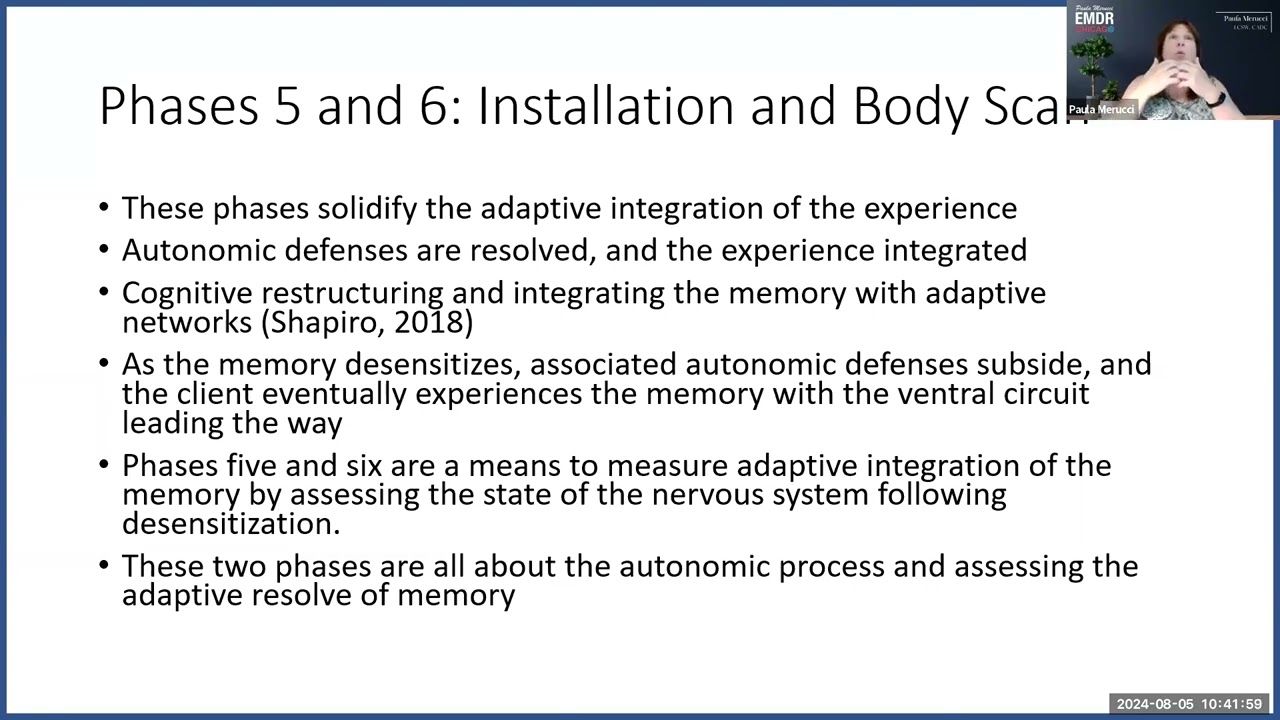







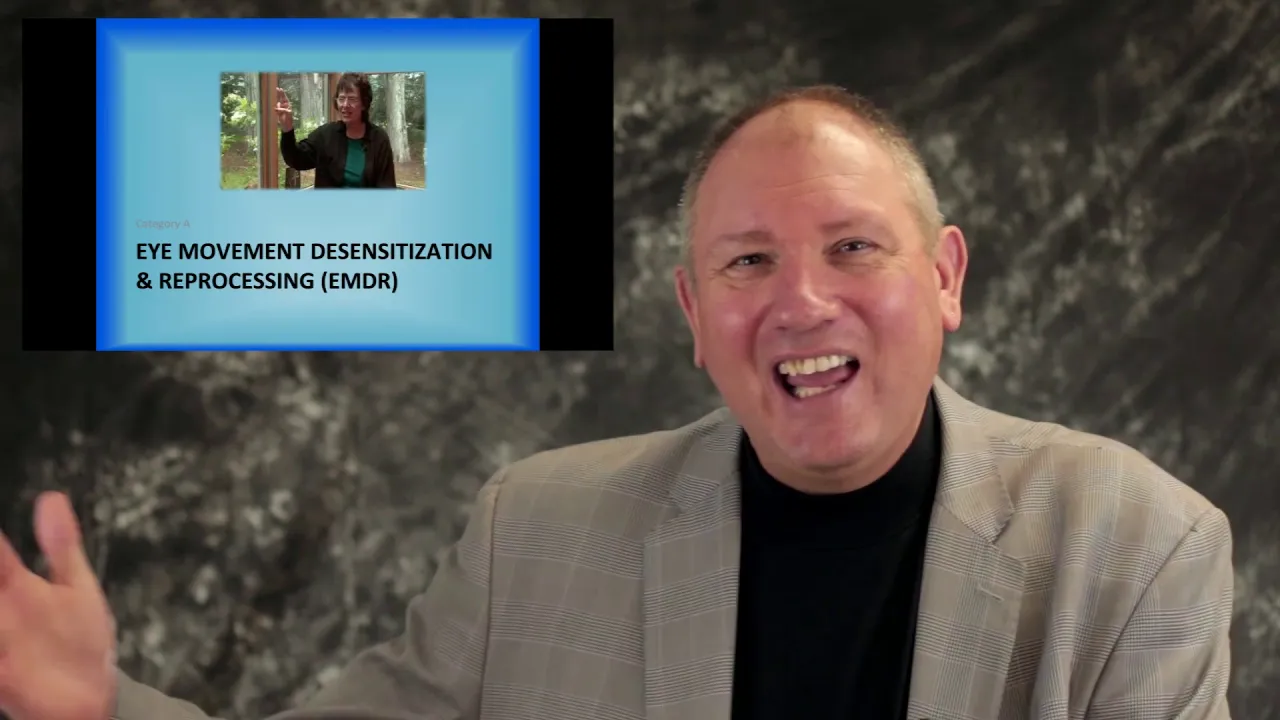

EMDR therapy is an eight-phase protocol for processing traumatic memories, beginning with Phase 1 (history taking and resource identification) and Phase 2 (preparation), followed by Phases 3-6 (actual reprocessing of target memories using bilateral stimulation), and concluding with Phase 7 (closure). The therapy involves identifying target memories, establishing negative and positive beliefs, rating disturbance levels (SUDS scale 0-10) and validity of positive beliefs (1-7), then using bilateral stimulation (such as eye movements) to facilitate the brain's natural processing of traumatic memories until they reach adaptive resolution. Resources like mindfulness practices, breathing techniques, and grounding exercises are established beforehand to help clients manage distress during reprocessing. Not all sessions achieve complete resolution (distress level zero), but the process still provides therapeutic benefits. The demonstration shows how incomplete sessions are acceptable and how clients transition back to the present moment using guided relaxation techniques.
EMDR Therapy Phases 1-7: A Clinical Demonstration of Reprocessing
Added:coming in for this demo a lot of thanks for having yeah and we've known each other a long time we have and now we're colleagues and taking this opportunity to give people a sense of a little bit how not just how EMDR therapy works but a little bit from the perspective of mindfulness based work and also the meta protocol mindfulness and the MDR treatment template for addictions but it's really also for trauma and adverse like a fountain the whole deal being that immunotherapy is a complete psychotherapy and that we place it within another complete psychotherapy mindfulness based work or Buddhist psychology and put that all together and what we have is a way of easing suffering transforming suffering and and so you've been trained that way and a lot of your colleagues have been trained that way and then in the context of this demo you know taking the opportunity to do a modified sort of phase one phase two and then just wait processing so you just go up for that right so it's been a while actually if it's like done my own reprocessing so this is gonna be a nice turn okay so from that phase one phase two perspective just you know do you have any having not done reprocessing or a while do you have any questions or concerns about how many and ER therapy works or you know what it is that we're actually doing when we do reprocessing before asking a few other questions um do I have any concerns yeah well because um I guess because it's been a while and I haven't looked at these traumas really closely there might be some fear that it'll linger with me more than I would like it to or I might not be able to access it so oh one or the other yeah I'll see what we'll see what happens and just knowing that what you already know and that you've done this work before both on both sides of the couch as it were which is that we do all this resourcing beforehand and I know you're a very resource person and that in the last 10 minutes of our session we won't be reprocessing will stop reprocessing wherever we are even if we have an incomplete session because one of the things that a lot of people have a fear of is incomplete sessions meaning it doesn't get the disturbance doesn't get to a zero it doesn't go up to a seven in terms of the positive belief and one of the myths I like to dispel is that that's a problem you know it's not an album right so we'll see we'll see where it goes but in the spirit of the phase one work and the Phase two work what are your strengths and resources and that which you tap into that keep you resilient you know today you brought you through all the work um today I do have a very strong mindfulness meditation practice and so the heart practices in Buddhism loving-kindness and joy and even compassion more than anything are the things I you know sit with there's also I love doing walking meditations and just walking and focusing on something positive because it helps my brain continue to to be stimulated Oh bilaterally in that way you know and then you know also just speaking with people friends you know that can actually help Co regulate my emotions and things anything else and the strengths and resources hmm I think that I have a lot for some reason I can't really think of what they are that's pretty good most of the time most of the time I do have 12-step program you know fellowships stuff that I do and a sponsor right yoga all right and then going back to all of that list so then and I heard a couple of things that certainly could be used in the office what would you say it would be what you would prefer to think of as the resource we might go to number one if at any time you wanted to stop reprocessing because it doesn't happen a lot but it sometimes if it goes outside your effective window of tolerance that you might say you know no more and we go to a resource and or the resource that you might want to go to at the end you know when we have that last 10 minutes so which of those that you listed is most likely or is there one that you didn't list that you enjoy well um any kind of meditation that will focus on regulating the breath and getting in touch with my body a light source guided meditation or light stream yes light source I'm looking at like first light so that kind of thing just so I can get integrated with my body environment all right good I know how to do those you know how to do those and you know in you know in a regular therapeutic relationship there's a good chance that we've done a lot of work together on this kind of things these are the kinds of things you come front-loaded with a lot of things yeah we might have if we were an actual therapist client relationship over time that we would have developed those together if you might have them to begin with so that's great and then I wanted to ask you to contextualize you know the kind of work that people do in phase 1 and phase 2 but particularly phase 1 when they're looking for target memories and they're looking for and all those kinds of things and you know you've been working on your stuff for a very long time so if we had been in a relation of their relationship over time we would have done more than one session identifying themes and building rapport you know that we have built in him and all of that so what would you say are like the major themes or the major things in your own therapy and in your own recovery work that you've been able to work through over over the years kind of like the completed phase one items well a feeling of not being loved feeling of feeling less than like a failure that I was wrong all of those themes were things that that I lived with for a very long time and it was really hard to feel that anyone would appreciate who I was as a person just from a lifetime of traumatic stuff right and so I did a lot of work on you know father leaving father dying mother not paying attention kind of stuff you don't want to attachment but that creates little of self-esteem in it that makes people feel like you're a failure and here I sit here I sit you know with a pretty good education and a pretty good career and I never thought that would happen for me you know so that's that's why working on those core beliefs of not being good enough and they wrong we're so valuable so that speaks so much to thank you for that that speaks so much to the power of of just recovery but also the power of trauma therapy and go through those kinds of experiences that again if it had been over the course of our own therapy together right these are the kinds of the work that we would have been doing that you did elsewhere in it identified the core beliefs the core themes what it was I need to work on where where it is them suffering and then going back and finding those events but also those the ruptured attachment and all the other elements and then having them reprocessed you know regardless of whether it was this way or you know some other way and a lot of people who come into my practice I'm sure it's true for your practice and a lot of the people who get trained the way that we train at our Institute is a lot of people coming in front loaded with a lot of therapy and recovery already you know not got people that come into our rehabs but come into our problem how to practice and they have this experience you know we don't eliminate it we don't you know look at it we don't pooh-pooh it you know it's like oh yeah you worked through that stuff and usually what happens is is that people will come into the office and say there's these one-two-three kind of things that are still stuck right after all that sometimes it's themes there might still be themes left or it might be just their singular events and we'll talk about that in a few minutes and then there's the folks who come in and just to speak to the work that we do with people who are in center right in a treatment center is honoring the fact that not everybody who walks into a treatment center comes not front loaded with resources with an ability to possibly be getting into their reprocessing sooner than later and that's that's the way that we work as well which is to work together with the client and with the whole team to see between all the resources that there are at the center what we forcing opportunities and then all of the opportunities that the person did take on you know outside senator even while being in the midst of their addiction that they may come in and we can't assume that they aren't resourced correct yeah right you're the work that you've done I know today and then you know as we work with all our different clients it's honoring all the work that they've done and not assuming right right right so so like for instance I don't want to assume what you do and don't have we've known each other a long time but casual cup of coffee is different than what we're doing right now yeah section so so let's do again a sort of a brief compared to the way it would be otherwise you know phase one workup of what would you like to work on today is it a theme or is there a memory or two that's on your mind that you think you might want to well well there were a couple of intense memories that I've never really focused on and well I'll describe them okay and then we can talk about maybe how they're affecting me one was when I was a small child I was about six or seven and we had an apartment load of cats running around and different ages and one day I was running to answer the front door and a kid ran right where I was running and I stepped on the key hmm and I stepped on its neck it was I can't even talk and you don't have to know you don't have to get a whole story for us to so today I'm a cat lover you know but um you know I kind of pushed it away and I don't know how it affects me otherwise maybe I'm I cry too much or I or I've become mean I don't know the other one is pretty hardcore as well my stepfather was a very very lovely man and I was about 17 actually and we had lived with him for five years and he took us away from that that cathouse into this lovely life and being a teenager I was on the phone it was pre cellphones I was on the phone kept telling me to get off it's late at night and so one time he just came in and he took the phone out of my hand and slammed it down and told me to go to bed and so I said I hate you I hate you I never want to see you again then I went to bed and he went to that the next day he got up and went to work and I went to school I got home from school the phone rang and he had died from burning so my last words were I hate you so those are two pretty major memories and again like instead of these super resource so Signori it is so you're working you know you're living and working in this life so either one of those you know I'm sure would be something that would be workable what would you what would you like what would you prefer to work on today I'm having kind of visceral reactions from both we're gonna have to do another demo later yeah but what do you want to do you know I think maybe my stepfather only because I think that really affects my relationship with my half-sister okay his daughter you know I kind of walked on eggshells around her my whole life all right so it might change that we'll see all right it might you know I changed that you know we both know your MD artists were really quick and we also know it's not the miracle cure people in this matter of fact that was some bad press it got in as much as it made people have certain expectations okay so one might call this this is an event-based trauma it's not necessarily complex in its own right or part of a complexity but it kind of is at the same time so in any case perhaps it will start the process of moving this material and so that feels okay then we'll we'll do it all right all right and would you prefer tactile or you want to go with eye movements we discussed it before and you just talking about movements okay so what we're going to do next is we're going to spend just a minute checking the eye movements and the distance and all that and then we'll set up the target and we'll go okay so put your gaze that way and then just tell me if you're able to track that yes you are I can see it can you track that speed so you know the drill okay so I'm gonna activate the target by setting it up according to the protocol and once we get to where we've set the whole thing up I'm going to start find movements and then you just notice whatever you notice and with this report yes alright and know that I'm here at all times and let's pick a physical stop sign of some kind in case you do want to stop the reprocessing for any reason knowing that I'm here to help you go through it just that yeah that's fine okay as you think of the your stepfather passing away and those real last words to him what image represents the worst part of that and as you think of that image of answering the phone what negative belief do you have about yourself now in this moment so I'm horrible present and what positive belief about yourself would you rather be able to have even while thinking of that image and when you think of the words I'm a good person while thinking of that image as it is now how true are those words on a scale of one to seven one is completely false sevens compliant and as you think of the words I am a horrible person and the image what emotions are present for you right now so just sadness as you consider the sadness and the words I'm a horrible person and the image all at the same time on a scale of zero to ten where zeros nothing at all ten is the worst you can imagine where are you right now what do you notice in your body my chest is really really tight yeah so notice that tightness in your chest and the sadness and the words I'm horrible person and the image notice whenever you notice his father's deep breath what do you know sit down well I'm picturing myself I fell to the floor I just can't stop coming and my boyfriend is standing next to me he doesn't know what to do and I just hear the person on the phone just saying hello are you there are you there that's that's all I'm never take a deep breath what do you want to know well I'm just thinking about learning that that's lutely stepfather what a nice and and he was between him sitting behind his desk eating cherries because that was its favorite and today and they said and he said that it was right before he collapsed that he was the happiest man on earth and I just was so made just something it was such deception god I just feel a lot time here right now yeah I'm thinking about Poirot is running right now I don't know why it's like okay people uh-huh I just picture it sitting in the back deep breath what do you know see now this could see my mother I keep saying I don't know what I'm gonna do my little sister was too just wandering around I don't know what to do and I can't look at her because I'm just cuz I'm joking about what happened so I'm just sitting a lot I want you not to know just remembering my funny things when he did he used to just hung out - yeah my grandmother came up from what's clearly forgot about that my mom's long and I just see them hugging grind together and my mom just saying learn in the kitchen probably a week later after this hear everything there's just none whole house is just no that's all take a deep breath I'm remembering hearing a noise I was in my bedroom it's dark and there's this weird noise outside my window and I caught up and I walked into the living room there was an image of me out of something sitting by the fireplace and I don't know if it was a dream I end up I was real and he just said I'm okay that's all it said that I never saw see that Sheena's third birthday party it was a couple months after he doesn't call me bunch of people today but it struck him she wasn't having fun because III and my mom just kept saying I'm sorry your dad's dead I'm sorry tonight that's my mother very good man so she's strikeout but my mom keeps pounding intern I'm so sorry I'm sorry they're all party it was very typical I'm just nursing my body really calming down a lot I'm how I saw it in it it's just memories of how money took us away from all the bad life and brought us into good and he was happy he was happy he had Shane was just really happy I'm dancing now I'm just thinking about my little sister now it's been my harder to cultivate a really solid relationship with her even now after all these years just okay well actually oh yeah they found the original image my phone call on a scale of 0 to 10 with zeros nothing at all Tenace the worst you can imagine where is that image now I get it - any thoughts as to what's keeping it from zero or what's left this may be thinking about feeling a little bit of guilt more than sends stumbling because of shame I'm just thinking of Shana now my hands are tingling well I'm just just feeling very calm and I'm just family like I just don't have a conversation I'm just thinking about me it's a 17 year old I just not have any life skills I didn't know what to do I didn't really do anything wrong they're just 17 you know see now I'm actually noticing the burden is that you think of the original image zero it's nothing at all I'm neutral the tenants or she can imagine or hmm it's pretty neutral it's actually manager so those words I am a good person I came up with earlier is that good enough positive belief that was formed or is there something better well what first came to mind was I'm not a bad person well yeah I'm a good person yeah when you think of those words I'm a good person while thinking of the image as it is now on a scale of one to seven where one is completely false seven is completely true what are you I can't say seven okay and what do you think is between those six in the Senate okay put together that positive belief I'm a good person along with the image as it is now so I have a team with you anyone else no it's not tight it's just like this like that the Airways have opened up so ya want one relaxation as you consider it the image at the same time as I'm progressing one two seven one maybe a seven so notice Bobby sensation and or it's not a good person image as it is now well I'm thinking about the image and I really don't have any reaction and I'm a bit person when you get the image as it is now 1 to 7 how true that's true there was no real intent I think yeah it's interesting [Laughter] so one last you close your eyes keep them open whatever and it's not like a big old Buddhist body scan and makes you minutes just check yourself from top your head bottom your feet and see if there's anything residual that you notice can be pleasant or unpleasant you want me to tell you what it is yeah yeah thank you good my shoulders just drop yeah so put that clear body scan together with the image as it is now okay yeah pretty cold all right oh you know that means we've got a complete obsession yeah and we still have yeah almost ten minutes left pretty much ten minutes left - still you know what it's complete we still want to have that time to be able to do resourcing so we have ten minutes less left in the session as we always do so and my question always is you know so what do you need in the last 10 minutes yeah sometimes when we have an incomplete session there's a lot of different kinds of needs and then but even these last 10 minutes making the transition from this beautiful strange process to you know walking out the door so I know what you need I need to just come back into the present moment okay and how do you want to do that do you want to do that by just talking about what just happened or do you want to do it through a dedicated kind of practice a guided meditation or I'm guided or you know what do you need what do you what do you what will help you to bring you into the room why don't you do a bit of guided okay and would you like it to be guidance towards the breath and the core the body or sound or what would you what what guidance would you prefer what grounds you the most good you know try that towards the body towards the body yeah okay so sort of a modified body skin yeah about five minutes sure there's a few minutes at the end for anything else that you mean I did the body's already just like saying okay yeah this all right so go ahead and close your eyes or keep them open whichever is your preference in the clouds land okay so and then choosing a portal for tracking the breath just for a moment before we start to go into the body so just outside the nostrils are just inside the nostrils is good and or or the rise in the falling of the belly or chest and just taking a few really normal breaths from this place and now we're going to notice points of contact to start it with the body so notice your back against the chair and that contact contact in your seat and the backs of your legs contact of the bottom of the feet that's the floor contact of your arms against your sides and contact your hands and just taking a minute to notice if any of those points of contact feel particularly grounded it may be all of them just one of them and just noticing which if any of them feel the most grounded and go ahead and let yourself have that ground lean into it if that feels right you can just continue to notice it I'm just sitting in this place of ground if at any time the grounding doesn't feel as grounded see if you could just notice that with this little judgment as possible and while maintaining whatever sense of physical ground turning some or all of your attention your a preference back to the breath maybe taking three look they're having these super deep breaths but take three breaths a little deeper in that place ground and as we come to the end of this meditation period opening your eyes at your own pace whatever it feels like you want to once your eyes are open any movement you feel you need to make to transition back into all right that workout yeah oh great so anything else that feeling me for going back out to the world for today no no just having a nice a nice memory no like stepfather that I haven't had good I haven't so just a reminder reprocessing we usually say reprocessing may continue I think we should just change it to reprocessing will so you know there's no homework in EMDR therapy but you know notice what you notice if you notice anything that you want or need to bring into a therapeutic context you know notice other memories continue changing body sensations or feeling States or any of that anything that might be helpful to you and again like what you just said is one of the beautiful things of unity oh therapy is that memories that were maladaptive ly processed are brought to an adaptive resolution and then B home resources we just become more resourced with these new positive beliefs and positive memories they get unearthed through this process so feel free to just you know dig into that and enjoy it and even you know whatever you feel like you wanna use butterfly hug or you're just tapping it just think about just positive there makes out of it yeah yeah slow down well thank you very much you're very welcome thank you Anitha that's great
Up Next

Integrating IFS and EMDR Therapy: A Clinical Guide for Complex Trauma
@IFSDownUnder
367 views•2026-02-02

Graphic Medicine: Comics for Collaborative Healthcare Communication
@nationalpatientadvocate
189 views•2023-12-04

Neuroanatomy: Central and Peripheral Nervous System Divisions Explained
@AKLECTURES
136.2K views•2014-09-20
Stages of Labor and Vaginal Birth | Childbirth Animation
@nucleusmedicalmedia
52.1M views•2017-08-18
Related Study Plans & Knowledge Roadmaps
Structured learning paths in Medicine