














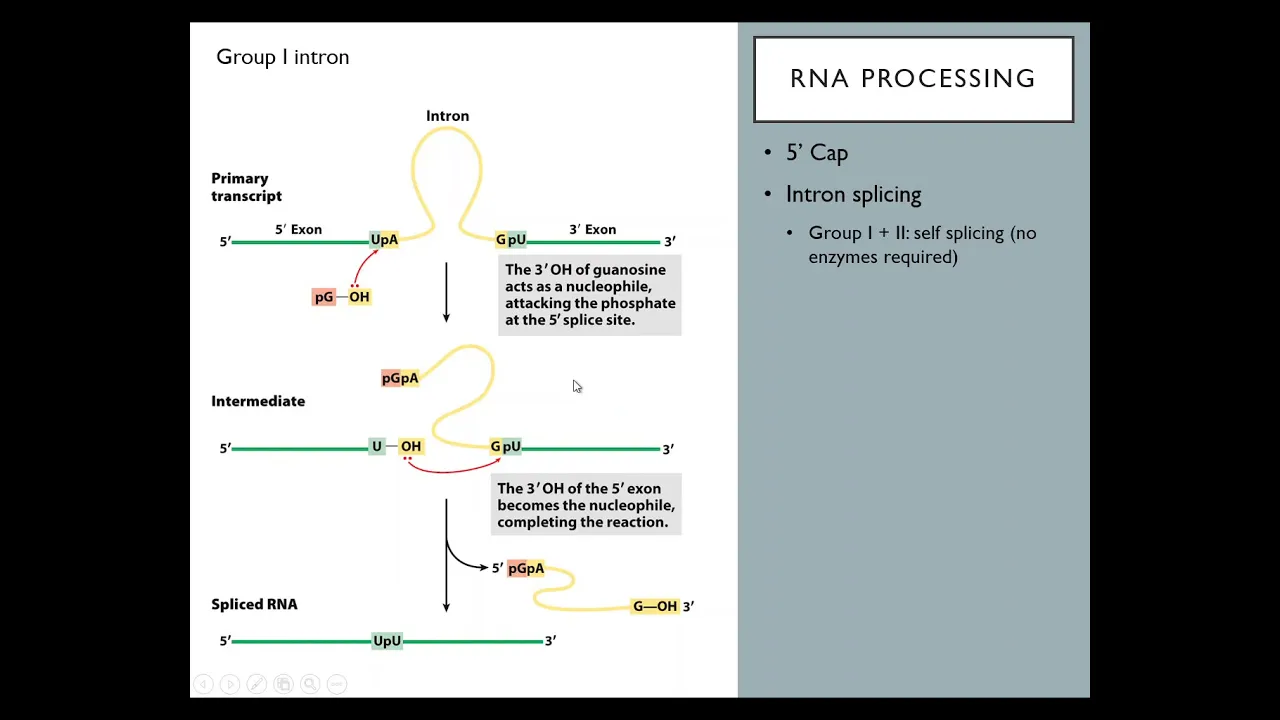



In eukaryotic cells, newly synthesized mRNA contains non-coding introns (discovered by Sharp and Roberts in 1977) that must be removed through splicing by the spliceosome complex before the mRNA can be translated into proteins, unlike prokaryotic cells where mRNA is immediately functional; this process involves capping the 5' end and adding a poly-A tail to the 3' end, resulting in mature mRNA consisting only of exons containing codons for polypeptide synthesis.
Eukaryotic mRNA Processing: Exons, Introns & Splicing
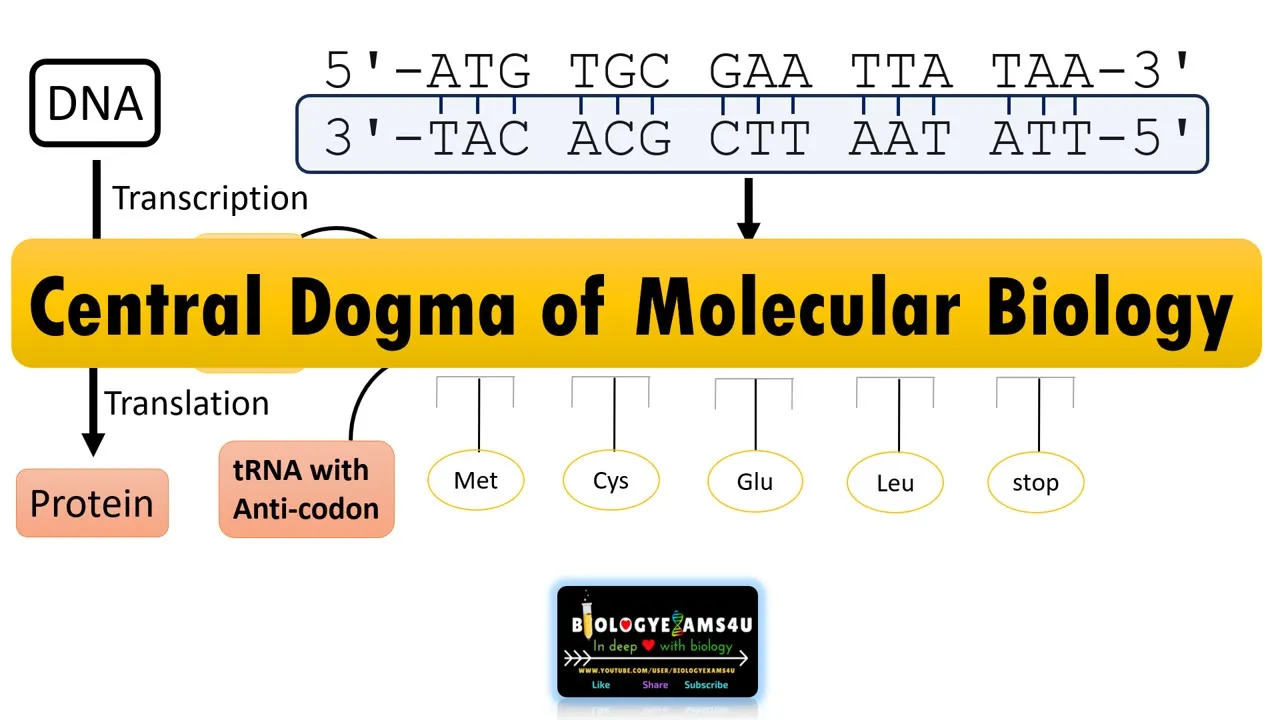
Added:The Central Dogma of Molecular Biology, specifically the pathway from DNA to RNA to protein.
The chemical structure of RNA and how it differs from DNA, including the roles of ribose sugar, uracil, and single-stranded dynamics.
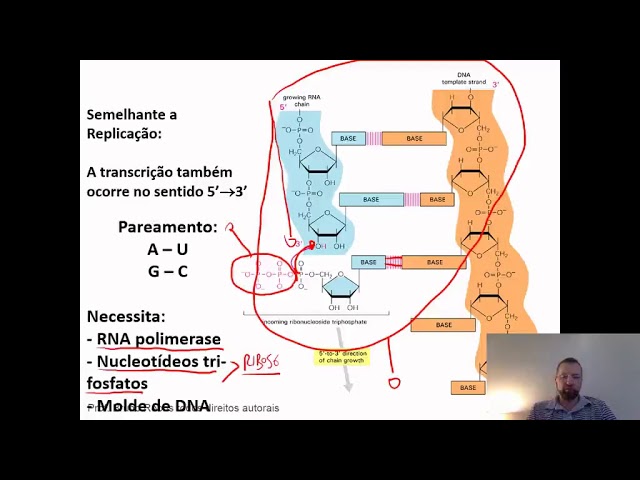
The basic mechanism of eukaryotic transcription, including how RNA polymerase synthesizes a primary RNA transcript (pre-mRNA) from a DNA template.
The fundamental structural differences between prokaryotic and eukaryotic cells, particularly the presence of a membrane-bound nucleus and compartmentalization.
The process of eukaryotic translation, exploring how mature mRNA is exported from the nucleus to the cytoplasm and read by ribosomes to synthesize proteins.
The concept of alternative splicing, detailing how a single pre-mRNA can produce multiple distinct protein isoforms, increasing proteomic diversity.
mRNA degradation and stability control, investigating how the removal of the 5' cap and shortening of the poly-A tail regulate the lifespan of mRNA.
The clinical and medical implications of splicing errors, such as their role in genetic diseases like spinal muscular atrophy (SMA) and various cancers, and modern splicing-targeted therapies.
94.3K views1.1Klikes8:28Original Release: 2015-02-17
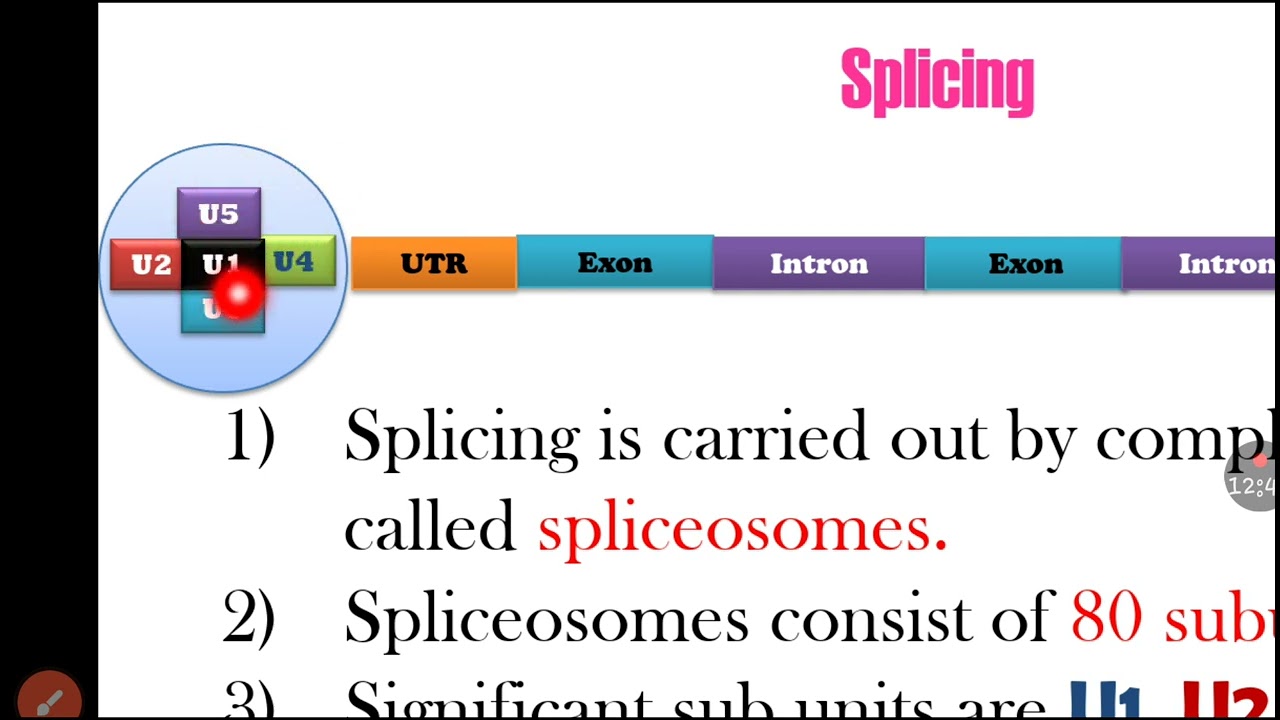
in procaryotic cells such as bacterial cells once we synthesize the MRNA molecule that mRNA molecule will consist of a continuous sequence of codons that can be used by the ribosomes of that bacterial cell to synthesize a given polypeptide chain in fact because of this because the MRNA molecule in procaryotic cells does not have to be modified in any way following the process of transcription translation usually begins on that mRNA molecule before it is actually synthesized and this is in contrast to how it takes place inside our cells inside UK carotic cells so inside bacterial cells and many other procaryotic cells trans translation the process of protein synthesis begins on that mRNA molecule before that Mr molecule is actually completely synthesized and that's because the newly synthesized mRNA molecule in procaryotic cells consists of a continuous sequence of codons so if blue means we have these codons then the entire mRNA molecule in procaryotic cells consist of this blue region because these blue regions are the codons that Express that particular sequence on the polypeptide chain now for quite some time we thought the same exact thing was true in eukariotic cells such as human cells but in 1977 Philip sharp and Richard Roberts basically discovered that this was not true when it came to mRNA in eukaryotic cells in fact in eukariotic cells the newly synthesized mRNA molecule consist of these intron sections these sequences of nucleotides that do not code for any protein and they also contain these exons which were the regions that contained the codons that did code for that particular polypeptide chain so instead of looking like this one instead of having a continuous blue section the MRNA molecule and UK carotic cells such as our own human cells consist of these intervening sections known as introns in fact the in NT means intervening sequence of nucleotid so we have 1 2 3 four green regions the introns in this particular mRNA and we have 1 2 3 four five of these exons that contain the codons that will be used by the ribosomes to basically synthesize our polypeptide so the major difference between these procaryotic cells and eukaryotic cells is that our UC carotic mRNA once it is synthesized it contains these introns and therefore it cannot be used directly to synthesize the proteins it has to be modified and these introns have to be removed while the exons have to be glued spliced together before that ribosome can actually synthesize the protein and this is not true in procaryotic cells because they don't contain the introns and that's exactly why transcription and translation can take place at the same exact time as we'll discuss in more detail in future lectures now on average in humans a human gene contains about 8 introns but for those genes that are very very large for example tens of thousands of nucleotid long we can have as many as hundreds of these introns in a given Gene now the question is once the eukariotic cell actually synthesizes this premrna molecule so this mRNA molecule that is not in its fully functional and modified form is commonly known as the precursor mRNA the premrna or the primary mRNA and so once we form the primary mRNA molecule how exactly do we modify this molecule and at what stage do we actually take out these introns well basically within our cell we have this complex of special proteins and special RNA molecules that Aggregate and combine together to form a complex a structure known as a spliceosome and the spliceosome is responsible for essentially locating these introns removing the introns while at the same time gluing together together splicing together those exons and this can be seen in the following diagram now on top of essentially removing the intron these mRNA molecules in our cells and other eukaryotic cells are modified in two other ways we basically cap the beginning with a special type of nucleotide sequence and that's called the capping process and at the end of that mRNA we add an additional sequence that consist of a polyadenosine nucleotides as shown in the following diagram and we'll discuss what that means and what that is used for in more detail in a future lecture in this lecture we're simply going to introduce the fact that in procaryotic cells we don't have this process taking place but in eukariotic cells we do have the process of mRNA modification so as soon as we synthesize that particular mRNA that mRNA is known as the primary mRNA the precursor mRNA or the premrna molecule and it consists of these introns shown in green and the exons shown in blue so let's call this Exon number one Exon number two and Exon number three now first we basically take we basically create these two modifications we cap our five and and we B basically add the polyat tail on the other end of that particular mRNA molecule and what this basically allows that mRNA molecule to do is it prevents the MRNA molecule from being degra uh from being broken down and it also allows it to basically reach that Final Destination and we'll discuss more about that in a future lecture now once we cap this end and once we add that tail the next process is the splicing process so essentially this sposo moves onto our molecule it removes these introns by essentially noticing specific sequences at the beginning of the introns and by removing the introns it then is it then basically connects these exons by forming the proper phosphodiester linkages and So eventually we form the following mature and fully functional mRNA molecule that now consist of only this Co these coding regions that contain the codons that can be read by that particular ribosome and synthesize that polypeptide chain now notice that a common feature in in this splicing process in the splicing mechanism is that the exons are actually ordered in the same sequential manner that the gene had those coding regions on the DNA molecule so initially we begin with XA number one XA number two XA number three and what we see here is XA number one followed by EXA number two followed by EXA number three so this is usually what we see in the process of splicing and we'll discuss how this actually takes place and why these modifications actually exist in much more detail when we get into the process of transcription and translation
Up Next

14:07
DNA Transcription and Translation: Protein Synthesis Explained
@crashcourse
5.8M views•2012-04-09
50:12
Bacterial Communication: Quorum Sensing and Biofilm Formation Explained
@JHUAAP
12.6K views•2011-06-28

7:47
Post-Translational Modifications Explained: Types & Functions
@AKLECTURES
136.8K views•2014-09-11
7:08
Bacteriophages: Earth's Deadliest Killers and Future Antibiotics
@kurzgesagt
34.6M views•2018-05-13
Related Study Plans & Knowledge Roadmaps
Structured learning paths in Biology
biology
RNAi: Biogenesis, RISC & Gene Silencing
01Molecular Biology Foundations: DNA to Protein
02Introduction to RNA Interference (RNAi)
03Molecular Biogenesis of miRNA and siRNA
+ 2 more learning modules
10h5 modules
Explore Roadmap
biology
Mycorrhizae: Signaling, Biophysics & Ecology
01Foundations of Mycorrhizal Symbiosis
02Molecular Signaling and Root Colonization
03Biophysics and Bioenergetics of Nutrient Exchange
+ 1 more learning modules
11h4 modules
Explore Roadmap
biology
Circadian Clocks: TTFL, SCN & Periphery
01Foundations of Molecular Biology & Gene Expression
02Introduction to Chronobiology and Actograms
03The Core TTFL: Molecular Architecture of the Clock
+ 3 more learning modules
14h6 modules
Explore Roadmap
biology
Population Genetics: Math, Drift & Selection
01Genetic & Probability Foundations
02The Hardy-Weinberg Principle and Baseline Models
03Mathematical Modeling of Natural Selection
+ 3 more learning modules
18h6 modules
Explore Roadmap