The rocker-bogie suspension system used in Mars rovers combines multiple engineering innovations: titanium suspension arms provide strength, thin aluminum wheels (approximately 30,000th of an inch thick) create flexible, springy behavior similar to rubber tires, six-wheel drive with four-corner steering enables precise maneuverability including turning in place, and the entire system functions as both landing gear and mobility platform. This design allows the rover to navigate obstacles up to certain heights while maintaining stability during landing and traversal of rocky Martian terrain.
Curiosity Rover's Rocker-Bogie System Explained by NASA Engineer
Added:Deep Dive
Basic principles of mechanical linkages, pivots, and passive suspension systems.
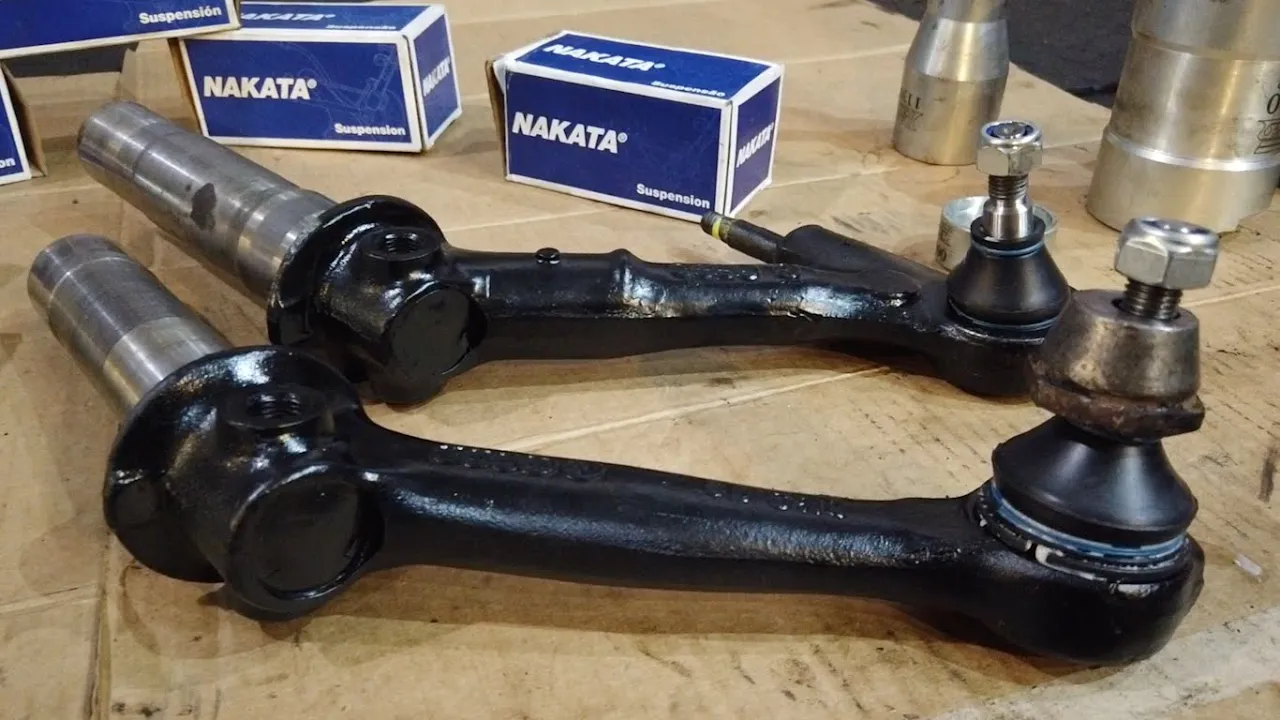
Gurgel - Montagem da suspensão 01
35.4K
The suspension system consists of two upper arms and two lower arms, with the upper arm lacking the shock absorber pin. Pivôs are mounted with threads on the same side, with one rebate facing upward and the other downward. The pivôs feature two raised peaks that facilitate correct installation and an oval-shaped base that accommodates suspension movement at the proper angle. The oval design allows the pivô to work through the suspension's range of motion without restriction.
Click to watch →
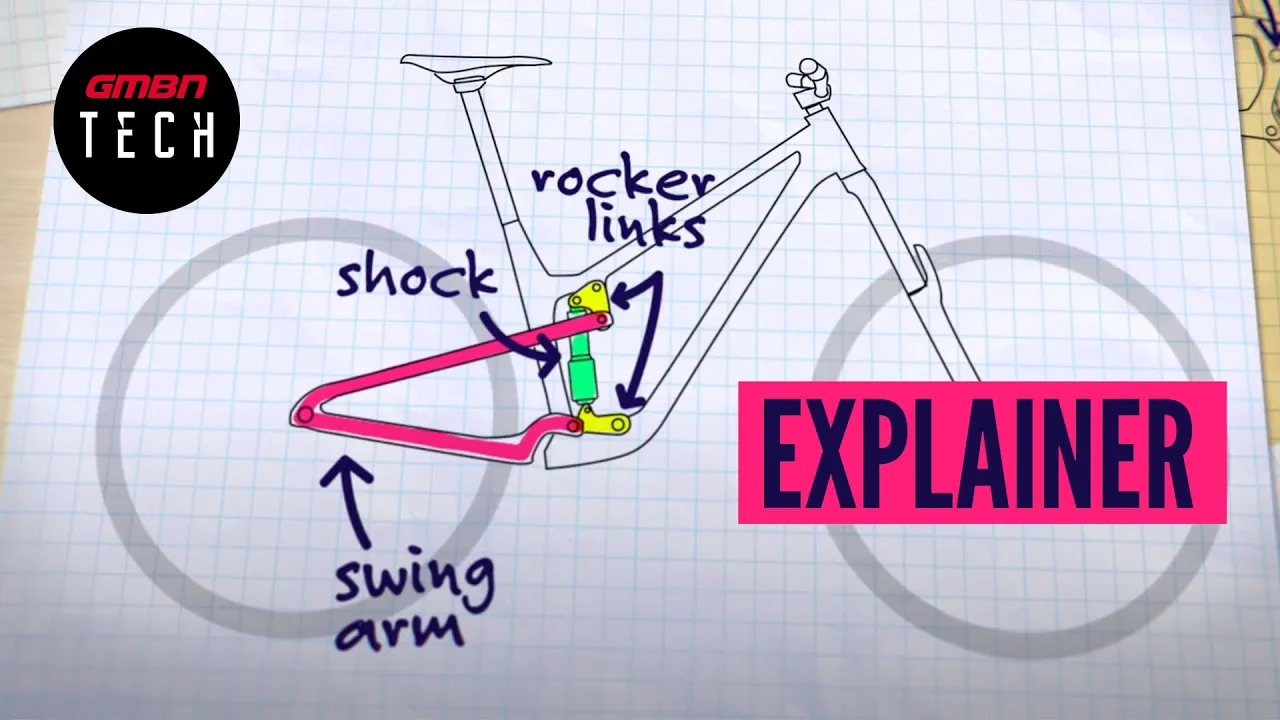
Understanding Suspension Layouts | Single-Pivot, Horst Link, Dual-Link & More Explained!
178.4K
Linkage-driven single pivot adds one or more links to the basic single pivot design while keeping the rear axle rotating around the main pivot point. These additional links change the leverage on the shock at different points in the suspension's travel. Unlike true single pivots, this design is not linear—the bike may require less force to activate initial travel but more force toward the end. The Canyon Lux exemplifies this design using a hanging rocker link to tune suspension compliance. Flex stays (flexible seat stays or chain stays) provide additional bottom-out protection without adding pivot points, reducing weight compared to designs with extra hardware.
Click to watch →

Criando uma bike full suspension do zero! Pedaleria
56K
Links are pieces that actuate the shock absorber, while pivots are the points where the suspension articulates. The distance between holes in the links completely changes how the rear suspension functions. Depending on the hole placement, the rear suspension can open slightly during operation or even close. This design detail is critical for proper suspension function.
Click to watch →

Every Type of Suspension Explained
964K
All suspension systems consist of three fundamental components: (1) Springs - which allow wheels to move independently from the chassis while returning to their original position, (2) Dampers/Shock Absorbers - which control and dampen the oscillations of the springs to prevent excessive bouncing, and (3) Linkage Structures - which guide the motion and angle of the wheels through their travel range. The geometry of these linkages determines how different suspension types are classified.
Click to watch →
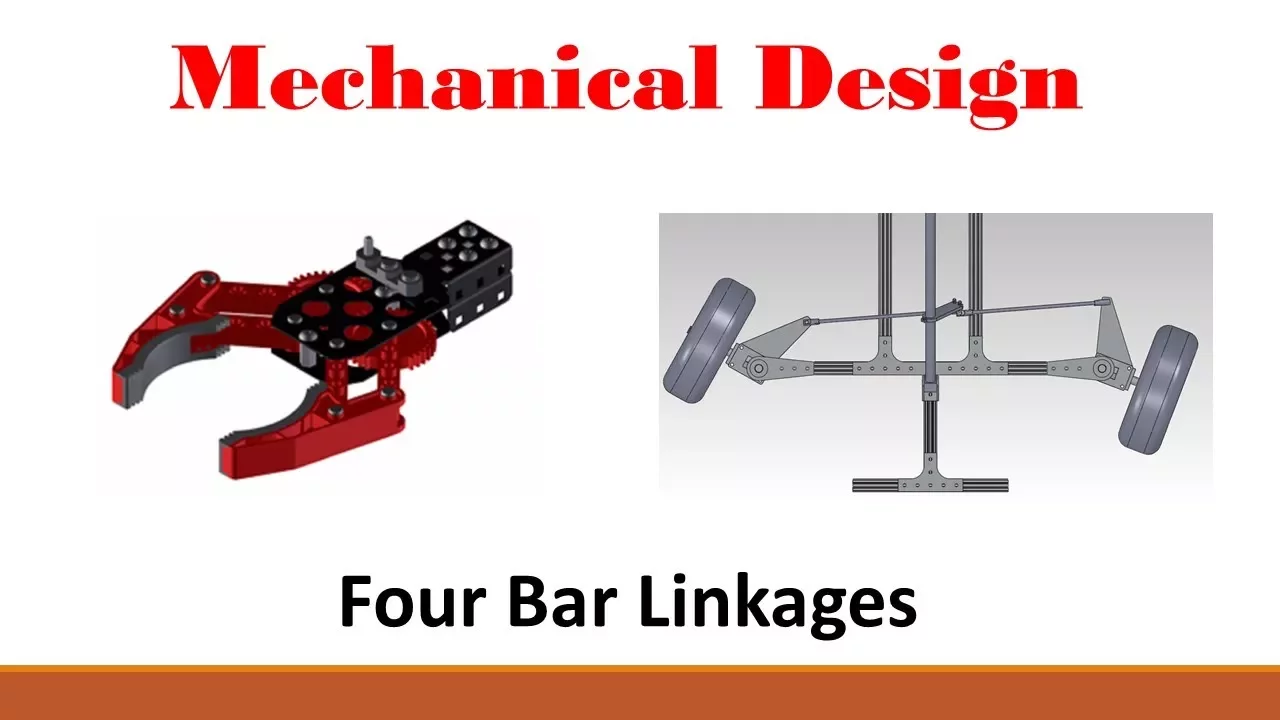
Mechanical Design (Part 5: Four Bar Linkage)
124K
A linkage is a rigid body with attachment points called nodes, classified as binary (2 nodes), ternary (3 nodes), or quaternary (4 nodes). Six joint types constrain motion: revolute (rotational), prismatic (sliding), screw (combined rotation-linear), cylindrical (both rotation and sliding), spherical (3 rotational DOF), and planar (3 DOF in plane). Kinematic pairs impose constraints between bodies. The Kutzbach mobility equation M = 3(L-1) - 2J₁ - J₂ calculates degrees of freedom, though it ignores link lengths and configuration.
Click to watch →
Deep Dive
The physics of center of gravity, torque, and static stability on inclined surfaces.

Complete Physics in 4 Hours 🤯 | ICSE Class 10 One Shot Marathon | ICSE 2026 | Part 1
59K
This section covers torque (turning effect of force) as τ = F × d, with clockwise torque negative and anticlockwise positive. Equilibrium conditions require zero net force and zero net torque, with static equilibrium at rest and dynamic equilibrium at constant velocity. The center of gravity is the point where entire weight appears to act, found at diagonal intersections for rectangles, geometric centers for spheres, and experimentally for irregular bodies. Stability depends on center of gravity position—lower center of gravity increases stability. Practical applications include door handles positioned far from hinges for easier opening, wheelbarrows as second-class levers, and the importance of center of gravity in vehicle and building design.
Click to watch →

สมดุลกล สรุปเนื้อหา | ฟิสิกส์ ม.4 by ideal Physics
144K
Torque (τ = F × d) causes rotational motion, with equilibrium requiring Στ_clockwise = Στ_counterclockwise. A couple (two equal opposite forces) produces torque without requiring a pivot point. In translational equilibrium, force position doesn't matter; in rotational equilibrium, position is crucial. The maximum number of unknowns solvable is three (two from translational, one from rotational equilibrium). Stability depends on center of gravity position: stable equilibrium lowers CG when displaced, unstable raises it, and neutral keeps it constant. On horizontal surfaces, slipping occurs when F = μ_s × N, and tipping when normal force shifts to the edge. On inclined planes, slipping occurs when tan(θ) = μ_s, and tipping when tan(θ) = D/H. The condition requiring the smaller force occurs first.
Click to watch →

2023 IGCSE Physics 0625 Oct./Nov. Paper 4 Variant 1 0625/41/O/N/23
1.8K
This segment covers stability and rotational mechanics: (1) Center of gravity is the point where an object's entire weight is concentrated; (2) Structures are unstable when center of gravity moves outside the base; (3) Support wires provide tension forces that resist tilting; (4) Moment (torque) is calculated as M = F × d, where F is the perpendicular component of force and d is the perpendicular distance from the pivot.
Click to watch →
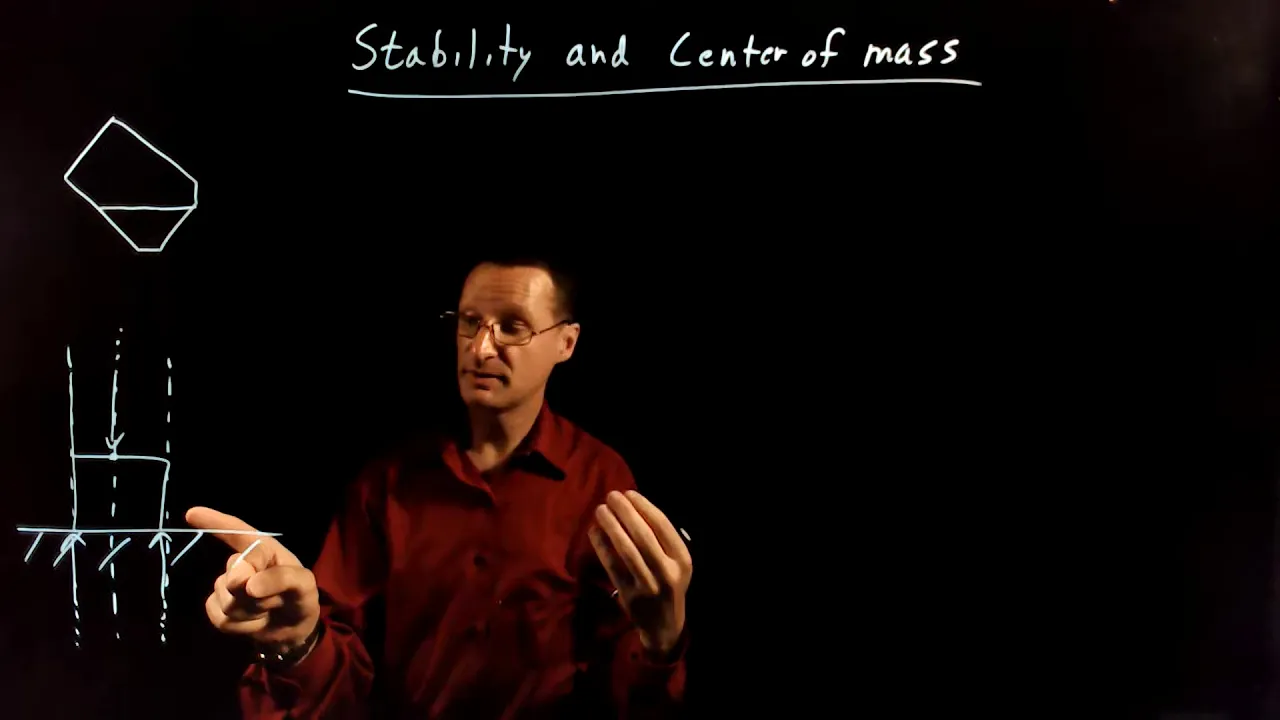
Center of mass, torque, and stability
927
An object is stable when its center of mass lies between its support points, ensuring that the net torque about any axis equals zero; conversely, instability occurs when the center of mass extends beyond the support base, which is intentionally utilized in activities like walking to generate angular acceleration for movement.
Click to watch →

Static Equilibrium, Torque, Stability
972
For an object to be in static equilibrium, two conditions must be satisfied: the net external force must equal zero (ΣF = 0) and the net external torque must equal zero (Στ = 0); torque is calculated as the product of force and lever arm (τ = r × F), where the lever arm is the perpendicular distance from the axis of rotation to the line of action of the force, and stability requires the center of gravity to be positioned above the base of support.
Click to watch →
Deep Dive
Fundamental environmental challenges of Mars, including low gravity, sandy soil, and rocky terrain.
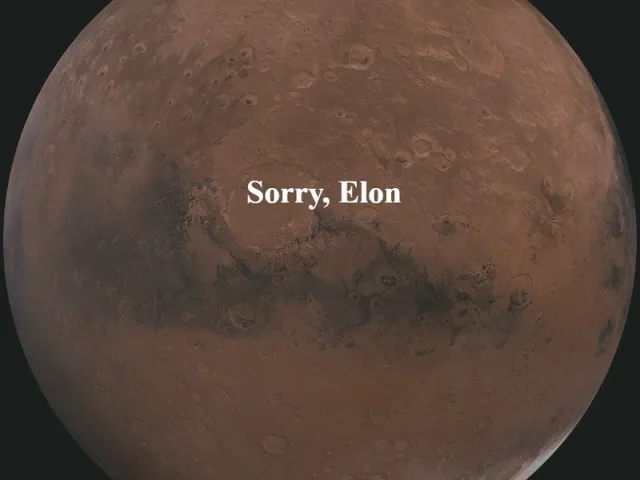
Why I'm Staying on Earth and Not Going to Mars
416
Mars presents multiple fundamental environmental challenges that make human settlement extremely difficult. The planet lacks a global magnetic field due to its inactive core, leaving it vulnerable to intense UV radiation that would cause severe sunburn within seconds. A Martian year lasts 687 Earth days, making each season approximately 171 days long, which would disrupt human activities like sports seasons, shopping cycles, and birthday celebrations. Mars has no oceans, beaches, or forests, eliminating access to seafood, firewood, and recreational spaces. The average temperature ranges from 57°F to -81°F, with some areas reaching -284°F. The atmosphere consists of 95% carbon dioxide, making it unsuitable for human breathing and creating hazardous dust storms.
Click to watch →

¿Por qué es imposible que los humanos lleguen a Marte? | Roger Penrose
142
Mars presents three major environmental challenges: significantly lower gravity than Earth, an extremely thin atmosphere, and soil saturated with toxic chemical compounds called perchlorates. These conditions directly threaten human health, causing bone mass loss, muscle weakening, cardiovascular alterations, and hormonal problems. Any human habitat on Mars would function as a nearly closed system where contaminant accumulation and entropy increase represent constant survival challenges. While engineering offers partial solutions, each solution generates new energy costs and problems requiring management.
Click to watch →

Pourquoi la PREMIÈRE COLONIE sur MARS s’Effondrera en 6 Mois — La Vérité que Personne ne Dit
141
Mars presents fundamental environmental challenges that make human colonization extraordinarily difficult. With only 38% of Earth's gravity, the human body—evolved for millions of years under 9.8 m/s²—faces unknown physiological effects from prolonged intermediate gravity exposure. Radiation exposure reaches 300 millirem annually, 15 times nuclear worker limits, with solar flares potentially delivering lethal doses in hours. Temperature extremes range from 20°C to -100°C, creating massive thermal stresses on all equipment. Water management is particularly challenging: surface water immediately vaporizes due to 1% atmospheric pressure, and subsurface water access at 1.5 km depth in -60°C conditions represents a challenge far beyond first-generation colonists' capabilities.
Click to watch →

DEVEMOS MESMO COLONIZAR MARTE? | TV Cringe #058
27.7K
Mars presents multiple life-threatening environmental challenges for human habitation. Solar energy is only 40% as effective as on Earth due to distance from the Sun, and dust storms frequently obscure sunlight for days. Wind and geothermal energy are impractical due to the thin atmosphere and cold interior. Radiation exposure is 50 times higher than on Earth, exceeding NASA's career limits after just 3 years. Protection requires thick CO2 ice layers and 1 meter of dust, eliminating windows and forcing residents into windowless tunnels. The toxic, alkaline, nitrogen-poor soil cannot support agriculture without extensive detoxification and fertilization. Mars' 38% gravity causes bone and muscle loss, requiring daily exercise. The fine, toxic dust grinds into spacesuits and equipment, making exterior work extremely difficult.
Click to watch →
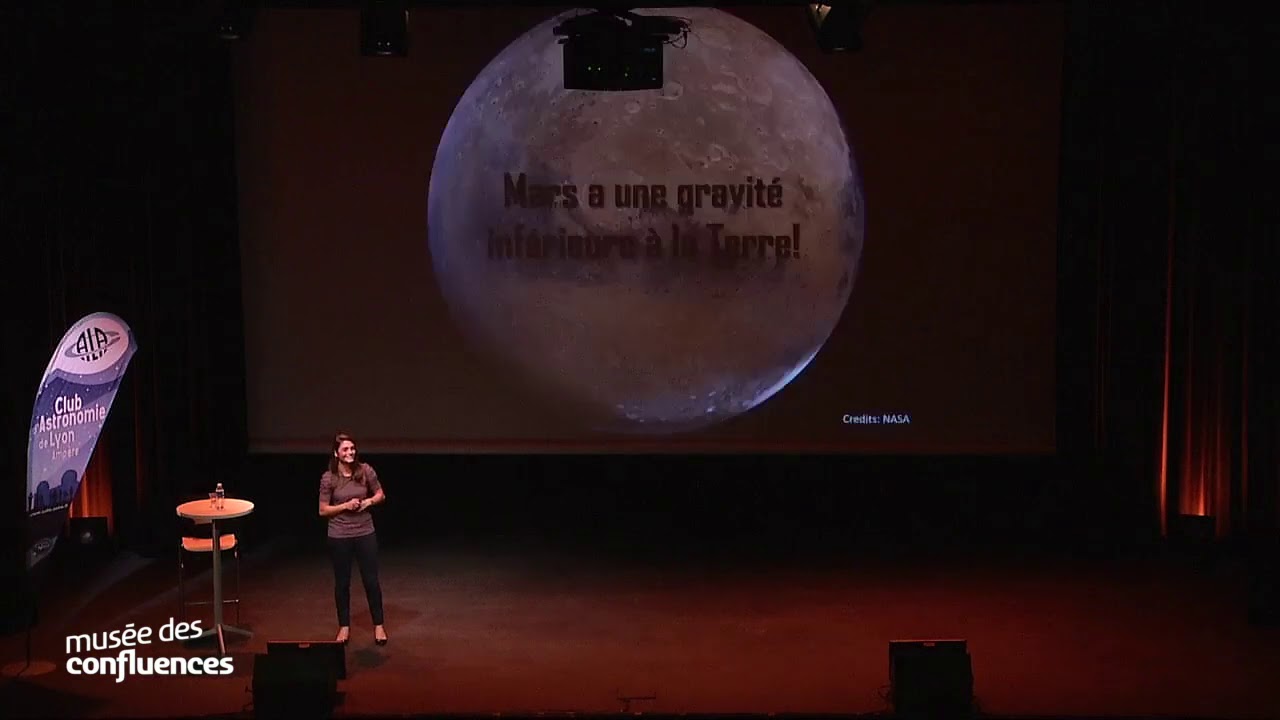
Vivre sur Mars
252
Mars presents three major environmental challenges: reduced gravity (38% of Earth's), low atmospheric pressure (1% of Earth's), and extreme temperature variations. The reduced gravity causes significant bone and muscle loss during long missions, requiring 2 hours of daily exercise. The low pressure creates enormous structural forces that can cause habitats to explode if not reinforced. Space suits are essential for external work, with EVA procedures requiring decompression chamber waits. Plants can grow in low gravity but face challenges with root development and water distribution.
Click to watch →
Deep Dive
Concepts of multi-wheel drive systems, including independent wheel motors and steering actuators.

Chrysler Jeep Dodge Concepts
333.9K
The Jeep Hurricane concept features independent wheel drive and steering, meaning each wheel can be controlled separately. This technology enables three distinct steering modes: tow-in steering (both front and rear wheels turn in the same direction), crab steer (all wheels turn left or right simultaneously for sideways movement), and regular four-wheel steering (front and rear wheels turn in opposite directions for enhanced maneuverability).
Click to watch →

Dr. Peter Dow - VP of Engineering at REE Automotive | Munro Live Podcast
2.7K
Each wheel operates as an independent actuated unit capable of delivering torque vectoring, regenerative braking, and active steering. With four wheels each capable of up to 32 degrees of steering articulation, vehicles achieve dramatically improved maneuverability including significantly reduced turning radii. This distributed actuation architecture enables advanced handling characteristics typically associated with sports cars rather than commercial vehicles.
Click to watch →

제자리 회전·옆으로 이동까지 '360도'로 움직이는 SUV / KNN
32K
The independent wheel motor control system is the underlying technology that enables crab steering and zero-point rotation. Each wheel has its own motor that can be controlled independently, allowing the vehicle to apply different forces to each wheel. This system includes in-wheel motors that provide independent power to each wheel and torque distribution technology that manages how power is allocated across all wheels to achieve complex maneuvers.
Click to watch →

Full Release Of The Challenge Mode! | Scrap Mechanic
420
Independent wheel motor systems allow different wheels to be powered by separate motors, enabling differential speed control. The video demonstrates connecting the front steering wheels to one motor system and the rear drive wheels to another, allowing the front wheels to spin faster than the rear wheels. This configuration can improve vehicle performance by allowing the front wheels to rotate at optimal speeds for steering while the rear wheels provide propulsion. The presenter explains that this setup can help the vehicle move more efficiently and handle different terrain conditions.
Click to watch →

MultiSteeringSystem von Kotte
20.9K
The MultiSteeringSystem (MSS) is a Steer-by-Wire technology that enables independent steering control of each axle through electric proportional valves, allowing agricultural vehicles to follow the tractor's path precisely or operate in different modes like 'Hundegang' (dog walk) for ground protection, with four available steering modes and safety features including redundant systems and mode-specific restrictions.
Click to watch →
Prerequisite Knowledge
- Concept 01Basic principles of mechanical linkages, pivots, and passive suspension systems.
- Concept 02The physics of center of gravity, torque, and static stability on inclined surfaces.
- Concept 03Fundamental environmental challenges of Mars, including low gravity, sandy soil, and rocky terrain.
- Concept 04Concepts of multi-wheel drive systems, including independent wheel motors and steering actuators.
Subsequent Learning
- Step 01Autonomous navigation and hazard detection systems (computer vision and SLAM) used by Martian rovers.
- Step 02Materials science of space exploration, specifically wheel degradation issues on Curiosity and the development of shape-memory alloy tires.
- Step 03Terrestrial applications of the rocker-bogie suspension in military, agricultural, and search-and-rescue robotics.
- Step 04Alternative space mobility technologies, such as legged micro-rovers, Martian helicopters, and bio-inspired crawlers.
Mars Rover Mobility
Mars Rover Mobility
0:04Playing Section
- 1
Explains the rover's rocker-bogie suspension and landing gear role.
- 2
Describes titanium and aluminum construction, including thin tire shells.
- 3
Details six-wheel drive, steering capabilities, and slow speed for safety.
Limitations of the Rocker-Bogie System and Alternative Mobility Designs
While the rocker-bogie suspension system is a proven design for Mars exploration, it has significant limitations, prompting roboticists to advocate for alternative mobility systems. The rocker-bogie design is restricted to extremely slow speeds to prevent dynamic instability, and it struggles in deep, loose regolith, which famously trapped the Spirit rover in 2009. Opponents and alternative designers argue that legged robots (such as quadrupeds or hexapods) or wheeled-legged hybrids offer superior adaptability. These systems can step over obstacles rather than rolling over them, scale steeper slopes, and better navigate soft sandy terrains. Additionally, alternative concepts like screw-propelled vehicles or wind-driven 'tumbleweed' rovers offer vastly different trade-offs in terms of speed, energy efficiency, and mechanical simplicity, challenging the rocker-bogie's status as the default standard for planetary exploration.
Deep Dive
Autonomous navigation and hazard detection systems (computer vision and SLAM) used by Martian rovers.

Crónicas Marcianas - Noticias de Marte / 11 de Julio 2021
77K
The Perseverance rover uses an improved autonomous navigation system called AutoMAP to navigate Mars. This system creates 3D terrain maps ahead of the rover, identifies hazards, and plans routes around obstacles without additional direction from Earth controllers. The system combines perspectives from two mobile cameras during initial vehicle movement. The rover can reach a maximum speed of 120 meters per hour, five times faster than the Curiosity rover. The terrain is created incrementally from stereo images taken by navigation cameras, and the software evaluates the safest driving routes.
Click to watch →
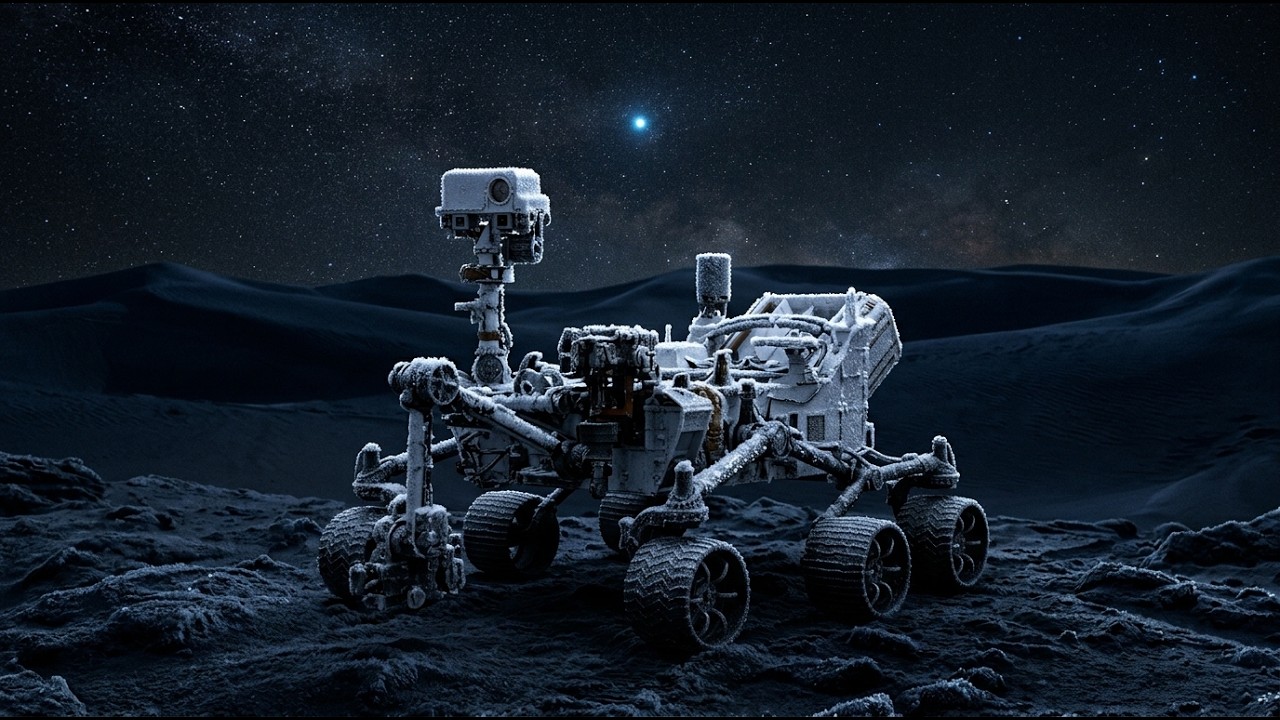
Как управлять машиной, если руль срабатывает только через 20 минут? Как устроены Марсоходы
187
Mars rovers use stereoscopic vision to perceive depth, similar to human binocular vision. Two cameras capture images from slightly different angles, and the computer analyzes displacement to calculate distances to terrain features. This creates three-dimensional maps of the surrounding terrain. The rover then analyzes these maps to identify dangerous obstacles: large rocks that could damage the undercarriage, steep slopes that could cause tipping, and holes or cracks. It independently marks these areas as forbidden and plans safe routes around them. This autonomous navigation allows the rover to avoid obstacles without ground control, though it significantly reduces speed to 15-20 meters per hour.
Click to watch →

Steve Squyres - Roving Mars: Spirit, Opportunity and the Exploration of the Red Planet
3.9K
Due to the 20-minute round-trip signal delay between Earth and Mars, real-time joystick control is impossible. Each rover carries hazard avoidance cameras (HAScams) on front and rear bumpers that take fisheye views. The rover builds 3D terrain renderings in its computer brain and autonomously decides whether to drive over obstacles or around them, with programmable levels of caution.
Click to watch →
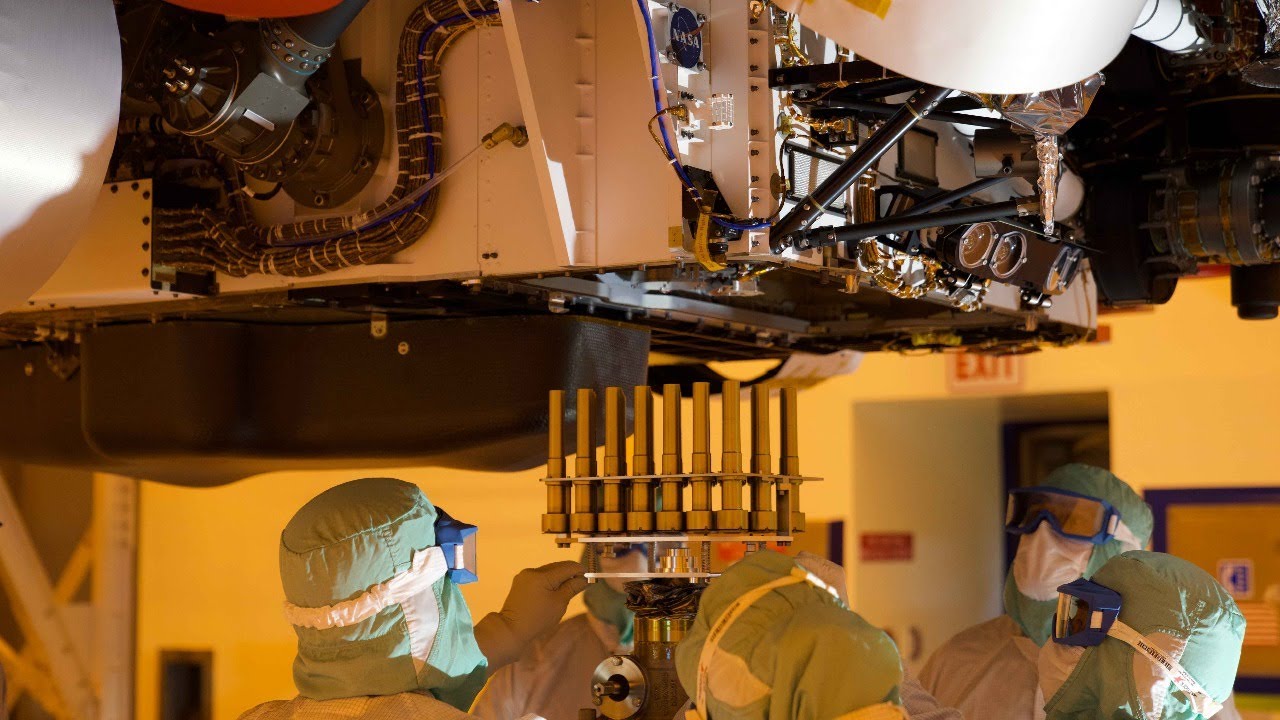
NASA’s Perseverance Mars Rover Team to Discuss Early Science, Sample Collection (News Briefing)
56.1K
Autonomous navigation evolved from Sojourner (1997) through Spirit/Opportunity (2006) to Curiosity (2011), culminating in Perseverance's most advanced system. Unlike previous rovers that stopped frequently to image and plan paths, Perseverance makes real-time decisions, enabling much faster traversal. The AI builds 3D maps using stereo cameras and generates optimized obstacle-avoiding paths. This enables drives three to four times longer than human-directed operations, dramatically increasing scientific productivity.
Click to watch →

Curiosity Rover Report (Sept. 19, 2013): Leave the Driving to Autonav
88.9K
Autonomous navigation is a capability that allows Mars rovers like Curiosity to drive themselves on Mars while still maintaining human oversight. In this system, human planners provide the destination coordinates, but the rover independently determines the safest and most efficient path to reach that location. The rover uses its navigation cameras and hazard cameras to capture images of the terrain ahead, then processes this visual information to identify potential obstacles and plan a collision-free route.
Click to watch →
Deep Dive
Materials science of space exploration, specifically wheel degradation issues on Curiosity and the development of shape-memory alloy tires.

How NASA Built The Future Tire
641.8K
NASA developed specialized space tires because rubber fails in extreme environments: the moon reaches -280°F and has 200x Earth's UV radiation. The Lunar Roving Vehicle used zinc-coated piano wire mesh with titanium chevrons, but Curiosity's aluminum wheels failed after 10 miles on rocky terrain. NASA created the Spring Tire with 800+ load-bearing springs, carrying 10x the load and resisting punctures, though steel deformed. The solution was Nitinol, a nickel-titanium alloy with 1:1 ratio that undergoes reversible phase transformation between Austenite and Martensite forms. This shape memory alloy can withstand 10% strain (20x better than Spring Tire) and returns to original shape when heated. The woven chain mail design provides suspension and puncture resistance. NASA and Goodyear are testing Earth versions on gravel, though challenges remain for pavement, wet conditions, and mud terrain.
Click to watch →

Varda capsule reentry to Earth - is there UFOs sightings on it?
3.2K
NASA has been developing specialized wheels for Mars exploration since the 1960s, trying smooth rubber tires, wire mesh wheels, and coiled steel wire tires. The Curiosity Rover's wheels lasted only over a year before serious damage. Engineers replaced aluminum with nitinol (nickel-titanium shape memory alloy), which reverts to its original shape after bending—unlike other materials that stay deformed. This technology is also used in bicycle tires that develop perfect shape memory when rolled over bumps, and in medical applications like tubes that expand to desired widths under certain temperatures. The memory foam used in mattresses and pillows was originally developed by NASA in 1966 to customize astronaut seats and ease G-force effects during takeoff and landing.
Click to watch →
![МАГІЧНІ КОЛЕСА ВІД NASA 🔥 [VERITASIUM]](https://i.ytimg.com/vi/iQ07lL3Wfi4/maxresdefault.jpg)
МАГІЧНІ КОЛЕСА ВІД NASA 🔥 [VERITASIUM]
752.3K
This comprehensive section traces the evolution of wheel technology from basic materials science to space exploration applications. It begins with shape memory alloys (SMAs) that can regulate atomic positioning to return to predetermined shapes, convert mechanical energy to thermal energy, and stretch 30 times more than ordinary metals. The section explains how solid tires use spring-like structures eliminating air inflation needs, providing 700 kPa pressure and functioning normally after punctures. It then explores the fundamental challenges of space wheel design: extreme temperature variations from 120°C to -156°C make rubber brittle, while the absence of atmospheric pressure causes cracking. Traditional metal wheels are single-piece aluminum constructions without welds to avoid weak points, but remain heavy and cause damage between grilles. The section culminates with the discovery of nitinol—a nickel-titanium alloy that undergoes phase transformations between austenite and martensite structures, enabling remarkable properties like shape memory and superelasticity that allow 6-8% deformation without permanent damage.
Click to watch →
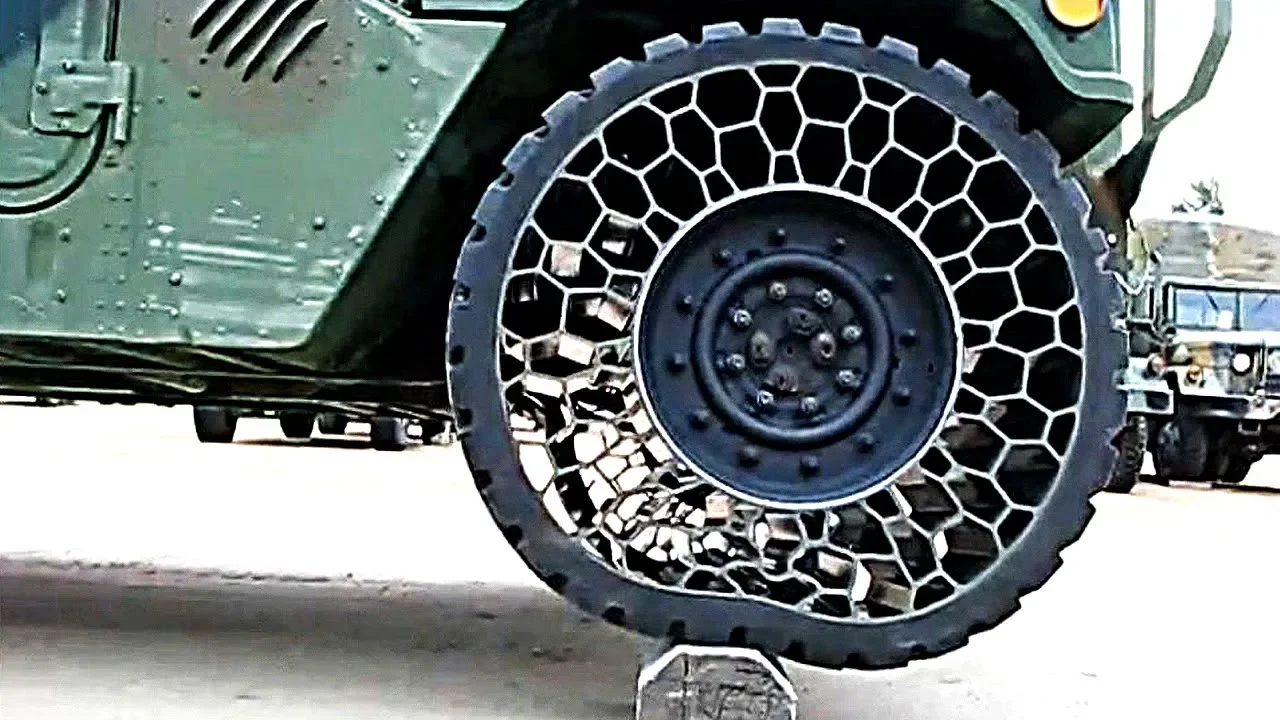
8 RUEDAS MÁS INCREÍBLES QUE JAMÁS HAS VISTO
2.8M
The springs in NASA's Safe Memory tires are made from a special titanium-nickel alloy with shape memory properties. After small deformations up to 10%, the wheels can return to their original shape. For more severe deformations, the material must be heated to restore its original form. This technology was developed after the Curiosity rover's tire was damaged in 2013.
Click to watch →

CiencTecTV Ep.13 - As Rodas Danificadas do Curiosity - O Problema e as Soluções
10.5K
The Curiosity rover's aluminum wheels (50 cm diameter, 0.75 mm thick) face two primary damage mechanisms: material fatigue causing creases from repeated deformation on rocky terrain, and sharp rocks causing structural gouges when the rover climbs over them. The center wheel bears the most stress, combining the rover's weight with the other five wheels. Scientists have calculated remaining wheel life expectancy: 8 km on hard bedrock terrain, 13-14 km on softer rocks, 30-40 km on sparse rock terrain, and indefinite distance on sandy terrain.
Click to watch →
Deep Dive
Terrestrial applications of the rocker-bogie suspension in military, agricultural, and search-and-rescue robotics.

Building a terrestrial rover to explore the ecosystem, part 1
157
This video demonstrates building a modular terrestrial rover using 2020 aluminum V-slot profiles for an affordable, reconfigurable frame, equipped with a rocker-bogie suspension system (invented by NASA engineer Donald B. Bickler in 1988 for the Mars Rover Sojourner) and bus servos with magnetic encoders for precise camera control, enabling the rover to navigate rough terrain effectively.
Click to watch →

The Jet Propulsion Laboratory W/ Doug Ellison - Part 1
60.8K
Mars rovers use a passive rocker-bogie suspension system with six wheels and four-wheel steering. The suspension includes a differential that links both sides of the rover. This design allows the rover to drive over obstacles up to the size of its own wheels. The system is completely passive, meaning it doesn't require active control to function; the mechanical design naturally distributes weight and absorbs shocks from rough terrain.
Click to watch →
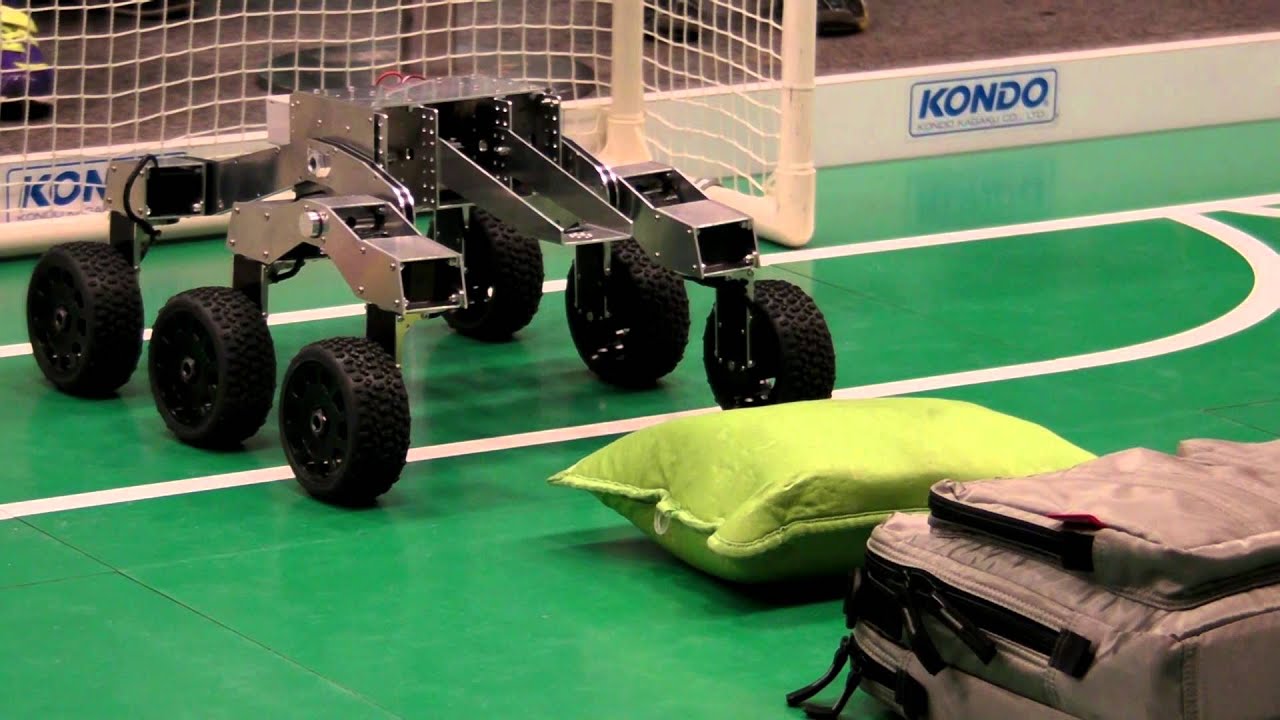
ロッカーボギーローバーデモ
44.2K
A rocker-bogie rover is a six-wheeled mobile robot where each wheel has an independent steering and driving mechanism, allowing the vehicle to traverse rough terrain like rocks and stairs while keeping its body stable; this design enables the robot to overcome obstacles up to 1.5 to 2 times the wheel diameter, making it ideal for disaster response and rescue operations.
Click to watch →

PROGETTARE UN ROVER PER L'ESPLORAZIONE PLANETARIA - Building Continuity #01
175
The rocker-bogie suspension system, used by Perseverance, consists of two main elements (rocker and bogie) connected by a differential. The bogie distributes weight more uniformly across wheels, similar to military truck designs. A key feature is that when one wheel encounters an obstacle and lifts, all other wheels remain in contact with the ground passively without requiring additional motors. This passive system maintains stability and distributes weight uniformly across all wheels.
Click to watch →

مهم ترین ماموریت هایی که روی مریخ انجام شدند!
6K
The rocker-bogie suspension system consists of a long articulated front arm (rocker) and a shorter rear arm (bogie). This purely mechanical structure naturally adapts to uneven terrain, keeping all six wheels in contact with the surface while distributing weight evenly. This design was essential because Viking images revealed Mars' surface was covered with sharp basalt rocks rather than soft sand.
Click to watch →
Deep Dive
Alternative space mobility technologies, such as legged micro-rovers, Martian helicopters, and bio-inspired crawlers.
![[02] C. Semini, 6th Workshop on Legged Robots ICRA'22](https://i.ytimg.com/vi/cIBX9DmphF8/maxresdefault.jpg)
[02] C. Semini, 6th Workshop on Legged Robots ICRA'22
861
Legged robots (hexapod and quadruped) are being developed for space exploration to access hard-to-reach areas that wheeled rovers cannot reach, such as craters and skylights. This project, funded by the European Space Agency, involves collaboration with DFki (Germany) and Airbus (UK). The motivation is that while Mars helicopters (like Ingenuity) can access hard-to-reach areas, they have low payload capacity and cannot exert forces on the environment. Legged rovers can complement the fleet of machines needed for future Moon and Mars missions, including tasks like moon-based habitat construction.
Click to watch →

AMAZING ROBOTIC ANIMALS YOU MUST SEE!
348.7K
SpaceBach represents an alternative to traditional wheeled Mars rovers by eliminating wheels entirely. While less stable than conventional rovers, this legged design can access locations that wheeled vehicles cannot reach, including Martian caves and rough, rocky areas. During tests, SpaceBach demonstrated impressive performance despite its unconventional design. The robot can also jump, and on the moon, it could hop across the surface at speeds comparable to a galloping horse. This approach illustrates how legged locomotion may be essential for exploring extraterrestrial environments with challenging terrain.
Click to watch →

Rock and Roll with NASA Challenge Webinar, Oct. 2, 2025
316
NASA has explored non-wheeled mobility systems including ATHLETE (six-legged robot with wheels) and Viper (crawler with active suspension). Mars rovers Opportunity and Spirit got stuck in soft soil, leading to studies of alternative mobility. Viper's crawling motion demonstrated ability to traverse sticky terrain. Trade-offs include mass, energy, cost, complexity, and risk. For long distances, wheeled vehicles are more efficient, but for short traverses, legged systems may be appropriate.
Click to watch →

The bio-inspired 'transformer' that crawls, rolls and flies
703.8K
The M4 robot demonstrates how bio-inspired design enables a single robotic platform to perform multiple mobility functions—crawling, rolling, flying, and tumbling—by reconfiguring its limb-like rotors, achieving greater energy efficiency and versatility compared to robots designed for only one mode of movement.
Click to watch →

Journal du n°438 - Un hélicoptère sur Mars (et autres infos)
655
NASA's Mars Helicopter Scout (MHS), a lightweight solar-powered drone under 2 kg, will conduct short 30-second flights on Mars in 2021 to capture aerial images, while researchers at the University of Manchester have developed a robot mimicking the jumping technique of Philoponella spiders, which can leap six times their body length and generate force five times their weight, demonstrating how biological adaptations inspire technological innovation.
Click to watch →
Mars Rover Mobility
Mars Rover Mobility
0:04- 1
Explains the rover's rocker-bogie suspension and landing gear role.
- 2
Describes titanium and aluminum construction, including thin tire shells.
- 3
Details six-wheel drive, steering capabilities, and slow speed for safety.
Limitations of the Rocker-Bogie System and Alternative Mobility Designs
While the rocker-bogie suspension system is a proven design for Mars exploration, it has significant limitations, prompting roboticists to advocate for alternative mobility systems. The rocker-bogie design is restricted to extremely slow speeds to prevent dynamic instability, and it struggles in deep, loose regolith, which famously trapped the Spirit rover in 2009. Opponents and alternative designers argue that legged robots (such as quadrupeds or hexapods) or wheeled-legged hybrids offer superior adaptability. These systems can step over obstacles rather than rolling over them, scale steeper slopes, and better navigate soft sandy terrains. Additionally, alternative concepts like screw-propelled vehicles or wind-driven 'tumbleweed' rovers offer vastly different trade-offs in terms of speed, energy efficiency, and mechanical simplicity, challenging the rocker-bogie's status as the default standard for planetary exploration.
Basic principles of mechanical linkages, pivots, and passive suspension systems.
The physics of center of gravity, torque, and static stability on inclined surfaces.
Fundamental environmental challenges of Mars, including low gravity, sandy soil, and rocky terrain.
Concepts of multi-wheel drive systems, including independent wheel motors and steering actuators.
Autonomous navigation and hazard detection systems (computer vision and SLAM) used by Martian rovers.
Materials science of space exploration, specifically wheel degradation issues on Curiosity and the development of shape-memory alloy tires.
Terrestrial applications of the rocker-bogie suspension in military, agricultural, and search-and-rescue robotics.
Alternative space mobility technologies, such as legged micro-rovers, Martian helicopters, and bio-inspired crawlers.
39.1K views438likes2:04@NASAJPLOriginal Release: 2010-09-23
my name is Sean hagert I'm a Mobility engineer on the Mars science laboratory so as you can see down there we just recently completed testing the wheels and suspension system on the flight Rover now the mobility system might look familiar it's a classic rocker bogey suspension system that we've used for the last two generations of Mars rovers and it does a lot of things that actually the mobility system hasn't done in the past so for this Mission Mobility system not only drives the riv around it's also the landing gear the wheels are actually the first thing that make contact with the surface of Mars now just about everything you see on the mobility system looks black but that doesn't mean it's all the same material the tubes the suspension arms coming down to the wheels those are all titanium the tires themselves those are aluminum the shell on those tires is actually a piece of machined aluminum that's about 30,000 of an inch thick that's about the thickness of seven pieces of paper and when they're that thin it makes them actually soft and so they can behave in much the way that a rubber tire would behave and give you that springy load for for landing for driving over rocks this test was sort of an obstacle course for the Rover because we have to drive over obstacles of certain Heights and those correspond to rocks of certain Heights that we expect to see on the surface of Mars so those ramps were're mimicking those rocks to make sure that we can actually drive over them and get to the science now you notice that it's six- wheeel drive and all four corner Wheels steer now those Wheels can steer plus or minus 90° and what that allows you to do is actually position the wheels kind of tow in and turn the Rover in place and that makes it a very maneuverable platform to position itself for science now what what you saw on that test was actually top speed of the Rover about 4 cm/ second or to put another way it takes about 40 minutes to go the length of football field we want to go slow because when you're 50 million miles away from the nearest service station it's okay to go a little slow and be a little careful my name is Sean Hager this has been your building curiosity update
Up Next
15:19
3D Printed RC Car Chassis: Engineering Process and Design Optimization
@CURV-LAB
56.5K views•2026-02-24

30:32
Ultrasonic Transducers: Resonant Frequency Measurement and Horn Design
@imajeenyus42
229.9K views•2017-02-22

54:16
Polymer Environmental Degradation: Mechanisms & Stabilization
@iit
1.8K views•2012-07-10
33:39
How a Student's Question Saved a NYC Skyscraper from Collapse
@veritasium
22.8M views•2025-04-26
Related Study Plans & Knowledge Roadmaps
Structured learning paths in Engineering
engineering
Building Acoustic Levitators: Physics & Arduino
01The Physics of Sound and Standing Waves
02Piezoelectric Transducers and H-Bridge Drivers
03Arduino Programming: Generating 40 kHz Signals
+ 2 more learning modules
14h5 modules
Explore Roadmap
engineering
Building Peltier Cloud Chambers: Particle Tracks
01Cosmic Rays & Cloud Chamber Physics
02Thermoelectric Cooling (TEC) Fundamentals
03Custom Liquid-Cooling Loop Design
+ 2 more learning modules
18h5 modules
Explore Roadmap
engineering
Yagi-Uda Antennas: Modeling, Build & VNA Test
01Introduction to RF and Antenna Fundamentals
02Yagi-Uda Antenna Design Principles
03Antenna Modeling and Simulation in 4NEC2
+ 2 more learning modules
18h5 modules
Explore Roadmap
engineering
ECG Monitor Design: Op-Amps, Filters & Noise
01Electronics & Breadboard Basics
02Op-Amps and Instrumentation Amplifiers
03Bioelectricity and ECG Fundamentals
+ 2 more learning modules
18h5 modules
Explore Roadmap