
















This lecture challenges the conventional paradigm that more outdoor air automatically improves indoor air quality. The speaker argues that while dilution with outdoor air is commonly used, it provides exponentially diminishing returns—cutting exposures to 1/8th normal requires 8 times the outdoor air, which most systems cannot provide. Outdoor air is often not fresh (e.g., wildfire smoke affecting Westford, MA with AQI in the 60s-70s). Instead, the equivalent clean air flow (ECA) concept offers a better framework, representing any air quality control method (not just outdoor air) in terms of an equivalent amount of dilution. This approach allows combining different control methods like filters, UV systems, and air cleaners for performance-based air quality control. The speaker emphasizes that ventilation should be one of several strategies, with source control being the most important according to the NYOSH hierarchy of controls. Research shows that only a small number of contaminants (primarily PM2.5, formaldehyde, radon, and ozone) account for 99% of indoor air harm, suggesting focused control efforts may be more effective than broad prescriptive requirements.
Indoor Air Quality: Ventilation vs. Equivalent Clean Air Flow
Added:[Music] Okay. Uh, welcome back.
What what I' what I'd like to do is I'd like to introduce a a dear personal friend, an ashray legend, past president, U and he runs, I think, the best building science course in university in the United States of America.
>> We're number three.
>> Okay. I I think you're number one. Uh, no. In the United States, >> that was my point.
>> Yeah. The 11th province.
>> Paris. Paris. 11th province.
[Laughter] This is really bad if I'm laughing this hard this early. Okay. U anyway. Uh, Bill runs a spectacular program at at at Penn State and uh, literally it is I I think the best building science program that we have and and and and he's going to talk about something that, you know, everybody agrees on, which is indoor air quality. So, please give a warm welcome, Bill Baffle.
>> Yeah, thank you, Joe. It's really great to to be back to uh to talk to this this group of uh expert uh colleagues and and peers. Um you may note that that my title is different than what's in the program that didn't get updated. And there's also an abstract that I won't read to you. Um I I wanted to talk broadly about ventilation and air quality today. So I I I did switch things up a little bit, but we we will be talking about ventilation and indoor air quality, not about operational carbon or something like that. Um I I I should also say before starting that I knew Eric Bernett as the uh director of our housing research center at Penn State and he was a great guy and uh I can can see how uh people like Joe and and John turned out the way they did under his toutelage. I also wanted to say that that John Stro is always a hard person to to follow. He's probably a hard person to preede, but I will do my best to uh to be at least informative if not entertaining. So, I start with my dad joke titled air is human, but is it the best way to control IQ? And sort of give you my punchline before we we get all of the details. I I think that we're stuck in a paradigm of more and more outdoor air is the way to make indoor air quality better. And I think that's wrong in in many ways. So, I will make my case about that. I do want to thank John for for showing that there may be subjects where we're even more confused than than we are about indoor air quality. Um, I want to start with a quote that I I found in a document I downloaded on the way to the the conference. This is from Jello Lever from uh from Belgium who's a great building scientist over there and and he had at the beginning of a report written by someone else uh a quote from Andy Pley a long time ago who has been very involved in ventilation standards that we design our ventilation for no particular reason. uh which is kind of you know a hard thing to hear coming from someone who's been the chair of Ashray standard 62.1 but if you go on to to read the the details here um what he's saying is that much of our ventilation standards uh uh many of them are shrouded in uh in a veil of consensus fog and and I know from personal experience that a lot of the people who are on these committees aren't really all that keen on saying exactly how they came up with those numbers. They say, "Yeah, we looked at all the data and we we have a method, but they're they're not going to tell you." And of course, that's one thing I'm not in favor of of continuing to do.
I think we need more transparency in our standards and we we need to take the u consequences of of showing what our methods are.
So, so let's u without giving the whole case about why better indoor air quality is good. Joe um down in in in Boston at Harvard, the other Boston Joe has has written two editions of a book on on why that's important and many others have as well over more than 20 years. Um ventilation means dilution with outdoor air to to most in the conventional wisdom. And why why does that seem like a good thing to do? Well, there are lots of contaminants that have indoor sources. Building materials will emit various things. Indoor processes uh have emissions and occupants as we were discussing earlier have emissions as well and the consequences of exposure to these emissions are bad in in a number of ways. Odors are unpleasant. We can have chronic toxicity if we're exposed to really harmful things. Some of them can cause increased incidence of of cancer and then there productivity loss as well to throw in there. So the the theory is the belief is that outdoor air is fresh. So if we bring in a lot of it, we'll make the indoor air fresh too.
It's a great theory.
So I want to uh to point out one important u equation here before we we go on to to talk about whether more outdoor air is a good idea. This is the steadystate concentration equation for a constant contaminant source asper emitting some volutric amount of a of a contaminant. And we have in our ventilation error a concentration C0.
And what we see here is that the increase above the ambient is S over Q where Q is the the ventilation air flow rate. So the more uncontaminated or or lower contamination air we bring in, the lower our steadyst state concentration is going to be. And that sounds great until you start looking at what it means to try to improve indoor air quality. So what the implication of that equation is that we have exponentially diminishing returns for more outdoor air and consequently exponentially increasing cost to condition the outdoor air. So, um, if we start at some reference level, let's just say where it is, it's where we are today. And if we want to, uh, to cut, uh, our indoor exposures down to 1/8 of what they are normally, it takes eight times the outdoor air. And most systems can't even provide that much air, much less condition it. So, it starts to look like maybe not such a great idea. And, of course, the the other thing is that uh, outdoor air isn't fresh a lot of the time. And we used to like to show these pictures of of places like Delhi in India and say, "Oh, isn't it awful that they've got such bad air quality there?" But we're at a moderate level here. And I just came back from vacation in Minnesota.
And we had air quality indexes of of over 150 while we were up at the lake.
You couldn't see across the the two-mile lake on a a bad day. That was because of the way the wind blows. And this is what the US and Canada are are cherished. uh 57th 51st not state looked a few days ago. I'm I'm not I'm not on that uh that program. I I like them just the way they are. But you can see that uh wildfires are creating a huge area of really bad air quality and wind currents are taking that all over the country and that's why we've got a an AQI in the 60s or 70s here in in Westford today. So, if you wake up with uh sand in your eyes, you either you stayed a long time at the clubhouse last night or you're you're sensitive to PM.
And this happens around the world. You look at the uh a map of of Africa and the Middle East and and Asia and there's a lot of really bad air quality and outdoor air. Um so, we really shouldn't be focusing on for that reason. Another important definition to to clarify for everyone if if you haven't thought about this or read about it much is that ventilation does does not mean outdoor air by by definition. That's not actually what standards have meant when they discuss ventilation for a long time. So I' I've given the the definitions of ventilation that you find in ashray standard 62.1 and 62.2 two here and and both of them simply say that it's supplying air or removing air from a space to control air contaminant levels. So this doesn't rule out having recirculated air that's going to uh be cleaned in some way. Um a related concept is ventilation air supply air that's outdoor air plus any recirculated air that's been treated for the purpose of maintaining acceptable IQ. And I think that's really the key to the the future as we'll discuss as we go along here. So here's a typical uh multiple space uh commercial type um VAV air conditioning system and you can see over there on the left hand side that we have outdoor air and we mix it with return air and usually the the return air volume is is a lot larger than the outdoor air volume. So if we can can remove contaminants from that, it it helps us quite a bit.
So recirculating systems um can filter particles. That's the main thing we do is have filters that will remove particles from the air and the outdoor air will perhaps lower particulate levels but also remove some of the contaminants that are of indoor origins.
uh we can add other controls if we want to control gaseous contaminants to the conditioning of that return stream. Um strangely over all the history of minimum standards we have not until very recently had any that tried to figure out what the combined effect of all the controls was. We have some ventilation um which actually we can do calculations to figure out what it's doing but then we have a filter and the filter has to have an efficiency of X or or higher.
Well, that doesn't tell me anything unless I know how much air is going through it and where it came from. So, it it's it's kind of a flaw in the existing standards that uh that's the way we do it. Uh recirculation does have that that good u quality of of making it possible to remove more indoor contaminants um faster um and to to allow us to use air cleaners. and it increases economizer capacity. If we have a doad system, that's usually designed just for the minimum outdoor air. If we have a recirculating system that has has five or six times amount the amount of supply air flow, then we have the ability to do economizer control in climates where it makes sense. But what's not so good is that multiple space circulation takes uh whatever is in one space and eventually spreads it out uniformly to all of the other spaces. So it's it's not really good at containing uh point source emissions and also it it increases the energy use because fan power to move large quantities of air is is more expensive than having part air and part refrigerant or water. So here's a a simple little twozone example from one of my my Penn State lectures. We've got two spaces. they've got the same area and um and volume. And we're going to we have a filter in the system and we're going to assume that we initially have a contaminant released uniformly in the first zone and there's none in the second zone. Then we're going to see what happens when we run a little transient process. And and what we see in this figure is uh how concentration changes over time in zone one and zone two uh without a filter and with a filter that removes 35% of the contaminant on a single pass. So the u no filter release zone concentration is that black line with no symbols that starts out at 100% and drops. And the uh second zone uh no initial contaminant concentration, no filter is the line with the blue circles. And you see that that concentration increases rapidly due to the recirculation that's going into the supply air. And eventually we've got the same concentration. When you put a filter on this system, we get the same kind of behavior qualitatively. But note that both of those concentration profiles come down much more quickly to lower levels. And so if I didn't know that there was a filter in the system, I might infer that someone would have just turned up the outdoor air flow a lot to to dilute it, which again suggests that maybe we ought to be able to combine these things. And um the way we do that is with concepts that uh go under various names, but the one we're we're talking about now is is equivalent clean air flow because that's what we called it when we wrote ashray standard 241 for infectious aerosol. So maybe this is a better way to do it. U you can show that if you you try hard enough, you can represent the effect of any air quality control in terms of an equivalent amount of dilution. So there's some amount of uncontaminated air, not necessarily outdoor air, but uncontaminated air that would have the same effect and and so then we can add these things together when we're looking at the control of specific contaminants and and that makes it a lot easier, maybe not easy, but easier to do uh performance-based air quality control. Now in in standard 241 we were concerned about particles containing active pathogens and so we called the the required ventilation in that case ECAI equivalent clean air for infection control. And we had a lot of arguments in the committee about whether we should put a subscript on it or not. They said, "Well, yes, if we're just looking at this standard, we know that it's for controlling infectious aerosols, but I had this thought that we could generalize it." So, we're going to need at least uh three different categories to be able to to use this across indoor air quality standards. Gases would be one. That's going to be the most difficult. Um particles probably easier because filtration is something we understand how to use pretty well. And then infectious aerosols. um these concepts are actually getting some some air in uh no joke in in our our ventilation committees.
So a really simple uh example of how to determine an equivalent clean air flow and this is really much like the uh clean air delivery rate that is the basis of AAM standard AC1 for portable air cleaners. Got an example here where on the right hand side we have a space that has a source S in it and we want to maintain a concentration C and we're taking off a flow rate of air QF which is the flow through a filter and we put it through a filter with an efficiency of ADA and so some of the contaminant but not all is is removed and it goes back into the space. So we can imagine that there's an equivalent process on the right that's left that's dilution only. And so there's some QV which is going to be our equivalent clean air flow um that um will achieve the same concentration. We'll assume that that uh this is uncontaminated air. If it's going to be equivalent clean air, we've got to set C not to to zero. And so it's really easy to show that the equivalent clean air flow before you try to account for air distribution effects is simply the flow rate through the filter multiplied by the filter efficiency.
Gets harder to do when you're looking at something like a UV system in this space where there's not actually any air flow through a a device. You're you're simply uh putting energy into the air, but it can still be done.
All right. So that's an important concept that uh I I hope we can promote.
Um one of the big questions is always how much ventilation and and we could talk endlessly about u how much and there's different values for different spaces but I'll try to put a a con conceptual framework around this. One of the important things is uh what are we trying to accomplish with with ventilation? ventilation is is really all about controlling air quality for some purpose. And if you went back to the early 19th century, the thinking was, well, people are are using up oxygen and we've got to replace that.
And we initially had you from Tread Gold really low four CFM per person recommendations for ventilation. But then Billings in the the US and uh Fluga in uh in Germany and and um it's a it's a serious emission from this figure from the paper that I got it from. Florence Nightingale um recognized that people had better outcomes in healthc care facilities if they had high levels of of ventilation. And so uh when you got to the the late 19th century, the recommendation went from from 4 CFM per person up to 30, which is a number we've heard again recently um during the COVID pandemic and and after. And this was actually picked up by ASHVE, Ashray's predecessor organization in 1914 in a model uh ventilation code. And by 1922, 22 states had uh 30 CFM per person as their uh ventilation standard. Um but there started to be some push back on that. that's a lot of air and and u maybe it's not accomplishing what we want it to do and and perhaps we're starting to become more concerned about the energy use and so Yagloo at uh Harvard School of Public Health did some research on ventilation and his uh belief was that really if we were ventilating enough to control odors that would would be all it it took and so that brought the ventilation rates back down to 10 CFM per person and they more or less stayed there through the the initial publication of asteroid standard 62.1.
Um we got to the point though when the energy crisis occurred that there was a lot of pressure to reduce outdoor air flows again and for a short while ashray had recommended ventilation rates and minimum acceptable ventilation rates and and guess which ones everybody picked.
Um, so it didn't cause uh sick building syndrome as some have suggested, but it it certainly didn't help. And the reason I say it didn't cause sick building syndrome is that sick building syndrome had been identified as a problem years before the the ventilation rates in the codes dropped down to that level. We were just making sure that it was a problem, I guess, when we we did that.
But it it only lasted for one addition of standard 62.1 and then we got back to to where we are today at about 15 CFM per person after smoking was taken out of the standard. It no longer uh will cover smoking spaces. So the the I think the lesson here is that we've never really been able to decide as an industry or as a society what we're trying to do with ventilation and we need to to come to a consensus on that based on the evidence that we have now.
So let's leave that point for a moment and and go to another one that's important for the development of standards and how much should we ventilate and and that is to note that that ventilation is only one of the ways we have to improve indoor air quality. I think everyone knows these things but it's good to look at them uh once in a while. On the the left hand side we have the uh Swiss cheese analogy of of reason um which wasn't again invented during co it uh was in a paper published in in 2000 human error models and management which is a really interesting read. The more different modes of control we have, the more likely we are to protect ourselves from a given hazard. And then over on the right hand side, also very important is the NYOSH hierarchy of controls, which embodies the important point that getting rid of sources is really the the most important thing we can do or substituting less harmful sources. And then after we've done all of that, then we have to look at what we can do with other controls like like ventilation and filtration and air cleaning and things that are even more significant than than that. Um I I have been amused for for quite a while that that uh both Ashway standard 62.1 and 62.2 two uh published uh agenda to to change one word in the title of the standards but it really I think fits in with this point. Um on the left we have the cover of Ashbury standard 62.1209 uh and the title is ventilation for acceptable indoor air quality and on the right we have the the title of the current version ventilation and acceptable indoor air quality. I I think this is maybe subliminal, but it's important that ventilation uh does some things, but if you actually take the time to read the whole standard, you you'll find that there is a lot of other important good stuff in in standard 62.1 and 62.2 about how you go about maintaining acceptable indoor air quality. Of course, one of the things that that that I think is is really important and neglected is that that there are chapters on operation and maintenance in those standards. And unfortunately, that's where they they have stayed because what goes into the codes is only the design requirements, the prescriptive design requirements for ventilation rates.
So if we look at um what the goal has been in in standards for the most part uh perception and safety have been the uh the things that we focus on for for almost a hundred years in non-healthc care facilities. uh safety and I I'm very particular in in choosing that word because I don't think it's health and we're trying to prevent certain harms with the standards but not to promote what we would consider a current definition of health which is more than simply not uh uh getting cancer due to airborne exposures over your lifetime or or other problems. So the definition of acceptable indoor air quality in Ashray standard 62.1 is shown there and you can see these two aspects of of IAQ that uh are are prominent no known contaminants at harmful concentrations that generally means lifetime exposure limits as determined by authorities and the other part is a substantial majority exposed not expressed dissatisfaction. And um the graph on the right comes from the work of of Fanger uh in Denmark mainly but others as well. And you see that if our goal is is 80% or more not u dissatisfied then we're at about 7 7 12 lers per second per person which is about 15 cfm and apparently that's considered to to cover u the other part of the definition as well because we don't have a lot of spaces for which we have much higher u per person flow rates than that. So if we we look at these current uh standards a little bit starting with with non-residential Ashray standard 62.1 has two procedures in it. One is is called the ventilation rate procedure. It's prescriptive and it's what almost everyone uses and uh it has over a 100 space types for which uh per person uh outdoor air flow and per unit floor area air flow are specified. So, it uh to get started, it's pretty simple process of counting heads and and and measuring the size of a room. And that will give you the the initial uncorrected breathing zone ventilation rate. You can see a little example of of what's in the the main table for that in standard 62.1. You should use actual headcounts, but if you don't know it, there's a default occupancy. Um, another interesting thing here that I'll mention, although I'm not going to say much about it, is that this air class is an important improvement. You know, one of the principles of healthcare ventilation is is clean to less clean.
And so, a while ago, standard 62.1 established classes for air that had been put into spaces. And if it's class one, that's that's good, and you can recirculate it. Two, you can recirculate it with some restrictions, and eventually you get to four, and that must be exhausted. So you this is another one of those examples that there there's a lot in here that goes beyond just how many CFM do I need. Um there's also a performance procedure that's been in the standard for a long time. It was justifiably neglected for uh decades because it used to say that the the user of the standard had to identify the contaminants of concern and what their safe levels were and then do mass flow calculations to figure out how much ventilation uh was needed and then of course they would be on the hook if things didn't work out. So there was a a total redo of this a few years ago and now there are 14 chemicals and three mixtures of so-called design compounds and PM2.5 that uh are for which limits are set. There's a table in the standard that gives those limits. So the designer still has to figure out how much ventilation or other type of control you need. This is a a process or procedure that would allow you to use air cleaners. Um, and then when you're done, you have to do what is called objective verification, which means you go into the building after it's finished and and measure to see that you've met all of those limits. And there's also subjective verification, which means you've still got to satisfy the 80% not dissatisfied criterion. So, it's the same definition of acceptability, but if if you um are are good at doing this, you may be able to come up with a lower energy building by using alternatives to more outdoor air. So, here's the the table on the left of the the designed compounds in PM2.5. You can see that we uh owe California most of the u the design limits. There's a a couple from the three from the EPA Knacks in there and couple of German standards as well.
But so this is what you would have to do post occupancy. And the mixtures below are shown. They're they're just combinations of those. For the mixtures, we use the the um familiar way of of taking the ratio of the concentration to the design limit for each contaminant.
And the sum of all of those has to be less than one in order to comply. So that's there. It's a big improvement, but I I have to say that uh uh 18 things that you have to comply with is a lot, especially if you're going to think about maybe measuring some of them real time. And that's where I think some interesting work has been done that you should know about. U in residential standards, we have pretty much the same definition of uh acceptability that we have in standard 62.1. It's almost word for word except that they don't put the 80% in there. It's a a substantial majority. So, we have a contribution that's based on the the floor area and a contribution that's based on the number of occupants. But the way you determine the number of occupants is by counting bedrooms. So, if you you look at the equation there, the uh the total is.3 times the floor area in in square feet.
So, it's.3 CF 03 CFM per per square foot. and 7.5 times the number of bedrooms plus one.
So that's like mom and dad in one bedroom and one person in each of the others is is how you would would get to that. So the minimum is two and uh obviously it's 7 and a half CFM per person. And when you add all that together you're probably getting close to their uh 15 CFM per person total. And this is this is for the the whole dwelling but it should be distributed uniformly if you can. Uh, interestingly, there's there's a credit for infiltration that you can use to reduce the amount of outdoor that you have to supply through your outdoor system. I I found it uh kind of interesting that that standard 62.2 in in many ways is more technical and complicated than 62.1 and yet it's intended for the the residential market. But so be it. At least they've taken this equation and reduced it to tables so you can look up the floor area of your house and the number and count the number of bedrooms and figure out how many CFM you need. I have pretty small house about 1,400 square ft on a finished basement and we've got three bedrooms. So that that says we we need about 75 CFM for the for the whole dwelling.
So there have been some some recent agenda to 62.2 two that I think are um and 62.1 that are are quite uh valuable.
Um there's a an addendum for 62.2 that's looking at the use of equivalent clean air as a way of of complying. Uh it's a there's a a new indoor air quality procedure for 62.2 two that's under consideration, but it's it's different and in a lot of ways better. And I'm going to talk about the u where that came from in a little bit. And they've also already developed an informative appendix, a non binding that deals with how you would apply ashray standard 241 to a residential building. That's not in the 22 version. I think it'll be in in the 25 publication that comes out this year.
So a few observations on the status quo I suppose in in addition to all the other observations I've already made. I think we know what the rationale is. You know at a high level we we have qualitatively what the standards are are trying to do but the the quantitative details are are hard to uh uh to dig out sometimes if they even exist. And you know, ironically, uh, from my survey of standards and their evidence basis, it turns out that healthcare has the worst standards of all that, but um, they're using mostly empirical air change rates that that came from the mid 20th century. And I'll I'll say more about that a little bit later, too. Um, I think that that we're at a an interesting point in time that uh we've gotten to to where there is quite a bit of of interest among the public, not just uh the expert community, that we should try to raise the bar on what we define as acceptable. I think part of that is more transparency on the basis for standards. We should put uh that basis out to be uh criticized and improved by uh by debate. uh I think we should be moving towards performance or evidence-based prescriptive um uh approaches and we're getting to where that's more feasible. Um expanding requirements to new areas like health and productivity and I could add resilience here uh as well is is a strong interest of many and a bigger role for air cleaning and and disinfection. uh for a long time um it seems that all air cleaners except for mechanical filters were deprecated and I think we're starting to see that maybe there actually is potential for them if we don't just charge blindly into using them when we don't really know enough about what they do.
So let's now move to looking at some interesting research that I think is informing the uh developing approach to standards and a new rationale. Um I want to start with with a historical paper just to make sure I acknowledge all the the sources. A few years ago, Logadol at Lawrence Berkeley National Lab did a really interesting study to develop a new method for identifying the harm caused by contaminants. So, their goal wasn't to set new standards, but to to figure out which contaminants were were causing harm and to quantify how much they were causing and doing it in terms of of disability adjusted life years. um which is a a pretty well accepted practice that that works well if if we have good data on the the consequences of say toxic uh or carcinogenic exposures but it doesn't work so well for for other things but uh for for what they were trying to do I think it was a good approach and so their analysis uh found that there was a really pretty small number of contaminants that in residential buildings were producing most of of the harm Um, this is a figure from that paper and I've made a little box at the upper left hand corner um to show what looked like the the worst uh contaminants of the the many that they looked at. Note that that's a log scale on the the vertical axis. So every time you go up one tick, that's another order of magnitude. So all of those things to the to the right of ozone are orders of magnitude lower than PM. And this was also I think the first paper I was aware of that clearly showed that the main thing we had to be concerned about is exposure to particulate matter. See PM2.5 is is up there. SHS secondhand smoke that's an issue when people smoke indoors. But then we've got other things you would expect to to find being serious concerns. Formaldahhide radon and they have different values for smokers and non-smokers. Yes.
>> Uh Dolly lost per 100,000 persons >> per year. A disability adjusted life year. So, so you start with the life expectancy of some of a person with no um adverse effects and then if you have let's say toxer epidata on something that that causes some kind of disease you can use that data to determine how many years that will take off of life expectancy but it can also be done and I'm not an expert on on doing the nuts and bolts these calculations it can be done for u morbidity as well as mortality It's not just shortened life expectancy. It's reduced quality of life or there's some kind of disability caused by an exposure. Say it. I I always get a little bit worried when we we boil lots of things down to to to tradeoffs. Um so you got to be careful about the bounds you put around. Baron Olsen, my uh colleague from Denmark, former Ashray president, used to say about one of the uh the green building standards, you know, do you do you want better indoor air quality or a bowl of apples in the lobby, you know, there you get get the same same point uh for doing the of course the uh the bicycle rack.
Yeah. Yeah, I you know I know someone who did a um a building in I think it was Montana or Wyoming and they they got a lead point for a hitching post. So you know you got to be creative when you're applying these standards. All right. So um logol um was was done at Lawrence Berkeley National Lab and Max Sherman was involved in that and he eventually through some strange series of events got u connected with Ben Jones a professor at University of Nottingham and so recently we've had some really good work done by a PhD student of of Jones with Sherman German being involved in it. So, um I've I've included the DOIs for these papers in case anyone wants to look them up. You may not want to read all the details, but the the bottom lines are pretty interesting. So, um Morantes at all kind of replicated the uh the log study with some differences in methodology and they started out with over 300 uh indoor air contaminants, known indoor air contaminants.
Um, and they eventually found a small number that had enough data to to do what they wanted to do. And and they started by for each contaminant identifying a u a harm index. And actually, I think that should have been 45, not 25, but who's counting? Um the harm index was the um the the dollies caused per year per um some number of of people for a unit of of of exposure. So if you get this harm index and then you have the the actual concentration then you can can get the the dollies for that contaminant in a a particular application. And so they got results that were pretty similar to um Logadol. And u this is now being used as the basis for the proposed indoor air quality procedure for standard uh 62.2.
And I'm pretty sure that it's uh 45 not 25 because as you can see from this figure there are are six contaminants that are responsible for 99% of the harm using this methodology. and the other 39 that they screened uh collectively only accounted for 1% and again you see that that PM2.5 is the greatest at 67% of the harm and right next to it is coarse particulate matter so particles together for the assumptions that they made are over 80% and the other things nitrogen dioxide if you have indoor combustion for cooking and formaldahhide and radon an ozone are the others. So, um, this makes me happy because it starts to to look like maybe there's a practical way to to do this. Yes.
>> No, I think I think there's data. I I imagine that since they were thinking in terms of what to do with standard 62.2 too and kind of written smoking out of out of the ashray standards at least as being unsafe. Maybe that's why they didn't include it. I would go back to the log paper I think to to look at the risk there.
>> But there's a lot of people smoking things that aren't tobacco.
>> I'm shocked.
Shocked, sir.
hot people don't >> Yeah. Well, you can get it in a can. You know, I was just in Minnesota. Certain beverages are legal there that aren't in in Pennsylvania.
All right. So, so um this is really good stuff and you know one of I think the the few things to come along in recent times that's really created a lot of enthusiasm and and again just within uh days of coming here I got the uh uh pre-roof paper by the same group where they looked at office buildings. So it's really the same uh approach applied to a different type of of building. So they have a different profile of of contaminants that you find there in different concentrations. And they found that there were only four contaminants amongst the the hundreds that they started out with that were responsible for 99% of the harm more more than that. And uh this is is now being considered by the subcommittee of ashray standard 62.1 as a possible way of updating the indoor air quality procedure to to make it more um practical and useful. So again PM2.5 formaldahhide ozone and and coarse PM are the main things. So you got a good particle sensor that's that's getting to be affordable. formaldahhide's not uh not cheap. Um ozone and and maybe you're done maybe. But again, this is one paper by one group and and I'm always reluctant to uh go along with the idea that somebody did a nice piece of research, so we should change all of our standards right now. We we need to to vet these things and and to make sure that these are robust findings.
So u as you can see I think dollies as a metric u perhaps aren't the answer to all of our prayers but but they uh uh certainly have a role to play in our thinking about standards that are more evidence-based and quantitative. I mentioned some of these concerns already that that the trade-offs can be tricky that um uh you can have a very imprecise process for determining dollars.
Somebody asked that at some point for especially for things that aren't backed up by say toxicity data to uh uh make a a guesstimate of of what the impact is.
You know suppose we go off in the direction of we want to use this kind of approach for for for productivity. Um how do you come up with the quality years lost for productivity? It's that probably pretty smudgy.
But uh the good thing is that this work so far has suggested that the list of contaminants that we actually have to to pay attention to for control may be a lot smaller than we thought. And I don't think that there's really this kind of a rigorous basis behind the list of contaminants in the indoor air quality procedure right now that Ashray is is using.
All right. So let's move on from the the minimum air quality standards to um resilience standards. John mentioned resilience this morning as being a concept that's getting a lot of um discussion these days. A lot of people are discussing resiliency which just makes my flesh crawl but uh that why is totally unnecessary. So I'm I'm trying to promote resilience. So um the uh the goal here is to extend our standards to account for uh conditions that aren't normal. Maybe we don't think about it enough, but all of our building codes that are based on the ashray uh 61 2.1 and two standards, that's really ordinary air quality. assuming that you've got outdoor air of sufficient quality and and assuming that we're not really concerned about things like um there's a pandemic going on, you may have someone uh in your space who's infected with a disease that uh um you're not prepared to to ward off with your immune system and so there's a high risk you could have a very serious consequence. So we are mainly concerned about um uh infectious aerosols and also wildfire smoke.
So for infectious aerosols, we developed the standard 241. I I gave a a full talk just on it a couple of of years ago, so I won't go through all the details, but it was developed uh at uh break neck speed and published in in 2023 after four months of development. Uh we're currently in the process of of going through a couple hundred public review comments that we got. We're trying to get an ANCIE uh certification by by next year. So we we are working hard on it.
Um so this standard only applies during what we call infection risk management mode or periods when there's a heightened concern about infection. I I would we haven't established exactly how that's done, but if you look at the the current summer incidence of of diseases that have been in the news about COVID and uh RSV and and others, right now the level is probably pretty low. And if we were actually making a decision about do we need to do all of that here today, maybe we would some would say we don't need to. But there are others who who feel we should just be operating at a much higher level of protection all the time because there's always some risk.
That that's an issue that uh we're we're working on to to try to improve future versions of the standard. So what this standard specifies are equivalent clean air flow quantities for infection control. There's no requirement associated with outdoor air except that you have to meet whatever your uh base uh acceptable indoor air quality standard is. So if you've got a code that's based on standard 62.1 or 62.2 or 170 that defines your minimum outdoor air. We don't uh say anything about that. Um we have worked hard in this standard to allow air cleaners to be considered for use. We don't support them or endorse them. A few types are are named in the standard, but the the only objective here was to create a level playing field. So, put in test requirements for performance so that you have to report what this technology does and some safety requirements uh so that you have to clear in order to be usable. And the basis of this standard is uh population level risk assessment. Uh very rigorous. We went through a a Monte Carlo modeling procedure to come up with the ECAI values. And uh to my point about transparency, we've recently published all of the details of the model in a paper that you can now download. This is an open publication and it has every parameter in it. You know for for example uh probability of infection point um one for uh a a 1 hour exposure and we have the community incidence rates that are assumed 3% in healthcare facilities 1% for all others and so on. So you can you can read all of that. Um, as as Ben Jones likes to say, as he was one of the main developers of this model, all models are wrong, but some models are useful, that's our our theory here, because we use the best available knowledge. This uh flow diagram illustrates how complicated the the process to calculate one equivalent clean air flow value was. Um, the blue items are are assumptions. what's the community infection rate, the exposure time and the probability of infection we want to achieve. Everything in red was based on SARS KV2 because we were in a hurry and that's the data we had. We need to generalize that now. And everything in the green box is a parameter for which there is a distribution that we know of super spreader individuals who emit far more infectious aerosol than than other people. So for all of those variables we did Monte Carlo modeling where you sample the assumed distributions to get cases how many infectors are present what is their emission rate and and so on and and u we did that I think with a 95% confidence interval in a a Monte Carlo model. All right. So, we get these ECA values that depend on the space type and how many people uh are there and what they're doing. And we don't have the coverage of standard 62.1, but there are seven occupancy categories and 25 space types for which values were calculated. These clean air flow rates vary from things that look pretty typical to things that might uh frighten you. uh 20 to 90 CFM per person, but remember these are equivalent clean air flow values. So we're not talking about 90 CFM per person of outdoor air. And also the standard allows you when you're operating in in emergency mode to simply reduce population to match what you're able to provide. So in this space you know today um if if we cut the population back to I calculated yesterday 136 uh we would we would actually still comply with um with 241. So it's it's it's very flexible and uh based on a rigorous and transparent uh risk assessment. Now this is the table that that has all of those values.
I don't think I'll dwell on on that. You can see that um perhaps though that uh a few facility types like um restaurants are are pretty high uh and and others are are quite low.
So one of the things that has really driven me nuts for for years and I'll I'll say more about it is is the um diversity of units and approaches that we have for indoor air quality. And so here's a little comparison of outdoor air in standard 62.1 and the CDC five air changes per hour recommendation and what we would do with standard 241 for an office, a classroom, and a restaurant. So I put the standard 62.1 data up in the the table at the upper right. Uh the bottom is the one to look look at. Um the default occupancy 62.1 CFM per person are in the the first column and they range from 10 to 17 and ashray 241 per person numbers range from 30 to 60. But notice that uh 30 matches up with 17 and 60 matches up with 10. So they they came out quite differently.
Um, and then air change rates using the 241 equivalent clean air flows with an 8ft ceiling. We've got air change rates from 1.1 to 31.5.
And and the point I want to make here is that we did the calculations to show that the risk of infection is the same across all of these different space types. And this demonstrates how how poor a u a single air change rate is at telling us what we need to do. Five is way too much for an office. It's way too much for your home. You calculate what the air flow rate would be for your your house at uh five air changes per hour, but it's not enough for a restaurant. So I think we're showing here that we can do better than we have done with some of these recommendations.
So, now let's look at at wildfire smoke briefly. And uh I I didn't chair the development of this standard, so I don't have as much to say about it. You're you're probably glad to to hear, but guideline 44 was was published recently by Ashray and and this is not a code standard.
It's uh it's advice best practices, but you can use it to design controls for smoke. It's it's for commercial institutional healthcare and multi-unit residential buildings. And there's a prescriptive approach and there's also a uh a performance-based approach that requires you to do calculations and it mainly focuses on pressurization and on filtration of of outdoor air. So just to give you a a glimpse of of what's in it u there's a section on design uh calculations that involves using that ugly equation there number one which um shows you what concentration you get for a combination of parameters that includes the outdoor PM level and your filter efficiency and a lot of other things. So, you can use this as a design equation to determine what filter efficiency you need. Um, but there's an easier way to do it as well. And I I recommend this to you if you're concerned about uh protecting buildings from uh from wildfire smoke.
All right. So, there's another thing I want to talk about just briefly that I could could go on for a long time about this. Um, is air distribution. And we uh uh spend a lot of time thinking about how many CFM do we need to put into a space that's well mixed assuming that all of that air gets to where it wants to go. You know, if I put a a vent on the wall over here and had 10 CFM coming through it, how much of that do you think the folks in the corners of the room or in the royal box over there would uh would get aside from that? Mrs. Lincoln, how did you like the play? Um so so this is really important. Um but we're not doing a great job with it yet.
Now we we assume perfect uh mixing in our uh in our standards and then we try to to tweak it to make it work for the way real buildings are. So you'll find in standard 62.1 a ventilation effectiveness table that you can can use at your your peril. Um there are a lot of problems with it. I don't think even the committee believes what's in it but they they have it there for you to to use. Uh ventilation effectiveness is going to depend a lot on the application and uh the details of air distribution matter.
I didn't include all of my figures from my my COVID talks about how air currents were really clearly responsible responsible for lots of infections, a restaurant with with um VRF cassettes on the ceiling and they were creating at the the point where their air flows came together a really high velocity flow of air and the only people who got infected were the people who were in that Airstream that was kind of originating where the infected person was and we've seen a the church in in Australia where the uh I think was the the choir director or the musician was infected and you can see the the pattern of infections that go from the choir loft to where the air patterns were. So, we've we've got to be concerned about this and we're kind of kidding ourselves if if we think that uh just dumping the right number of of CFM or liters per second into the air is going to get the job done for us. Unfortunately, um we don't believe CFD most of the time and we we can't afford to do this for every space experimentally. So, uh it's an area that needs a lot of work.
So, let's move on u from that to uh a little more about air cleaners. And u I think it's really good to see that they're getting the attention that they deserve, which is unpleasant, I think, for air cleaner manufacturers in some ways. But this is the only way in to standards and to performance-based air quality as as I think we would like to to have it is for them to to show that they uh they work and that they're safe.
COVID had a really overheated air cleaner market and and what we found was first of all at least the beginning of the pandemic most of the claims of performance didn't have much evidence behind them mostly just the manufacturers say so uh their observations their clients who said yeah we've got it their quality is great but they didn't really have have data uh reporting of performance tests was highly misleading we had uh we had data being reported in terms of equivalent u air changes per hour that the air change rate was was uh based on a 100 cubic foot box. So it was actually a pretty low cleaner delivery rate or they would say 99.9% reduction in in 3 hours with the technology on in a chamber. um it would be like 99.5% in 3 hours with the technology off because of natural losses. So there was all sorts of uh shenanigans going on there that were trying to uh uh stop by writing better standards and the only safety testing that was being done was for ozone production because in the codes there was a zero ozone emission requirement but none of the other things that might happen from indoor chemistry.
So there have been some good outcomes.
We've had u a new chamber test method that's been published by Ashray standard 185.3 that is going to really uh improve our ability to characterize air cleaners. U there's research going on in academic institutions and in government agencies in some countries um for for all air cleaner types. And a really u encouraging thing for me is that ASM is working on a test standard for uh chemical emissions that uh will be very useful when it's done. The paper that I've shown there alongside of of this text is is an article written by some of the people involved in developing that standard that describes the methodology.
Basically, they've got a uh a cocktail of gases that are commonly found in indoor environments. And so, you seed a chamber with that and then you turn on the technology and you see what happens.
And they're looking for uh for VOCC's and for secondary organic aerosols and and that sort of thing. So, here's some some figures from that uh article by by Link at all. This is mainly people at uh at NIST and um in this one they are looking at mostly uh UV based products.
So GUV um means um you essentially upper room or whole room radiation systems. um PECO and PCO use catalysts and are really kind of a different technology even though they use UV and there's also an electrostatic precipitator there and uh what you see is that for most of these there was was some at least small increase in VOCC's except for the ESP that was the only one for which they um they decreased and the others show uh details for uh VOCC generation for the different technologies. Those are the the ones in the upper right and then particle generation is shown in the the block in the middle. Um, interestingly, uh, 222 nanometer UVC, which is is being, you know, really promoted hard for whole room radiation, seems to to produce more byproducts than our old friend 254, more particles and and um, more ozone. So, um, you know, I think we probably could have agreed a long time ago that this was going to happen. This is just photosysis that we're seeing but no one had taken the time to look at it.
I think the question is what do we do with that in information? uh we do we say okay we can't use these because they produce byproducts you know my question is should we stop using UV air using outdoor air because it's full of ozone right outdoor ozone levels are higher than indoors and our main source of of ozone is is from outdoor air and and to uh perhaps show some evidence of that here's a study that was done at the University of Colorado and this is modeling again this was u paying at all Jose Gimenez whose name you may know from the pandemic. So they looked at u ventilation only 254 nanometer um UVC and 222 nanometer UVC at three different air change rates. So.3 air changes per hour low that may be actually you getting close to normal ventilation for some spaces. Three air changes per hour is medium and and nine is high. So, in every one of these blocks you see on this figure, we've got low, medium, and high groups that have no um UVC 254 or 222 going from from left to right. And um expectedly, the UV worked really well on on SARS KB2. So, in the upper left hand corner there, you see that that it was effective. Um, the rest of these blocks show what happened with several secondary contaminants. And I've I've marked a couple of them there that I think are are important. Uh, the paper doesn't comment on this so much, but I I think it's quite interesting. If you look at ozone levels at the different ventilation rates, you see that there's a very strong increase in in ozone with increase in in outdoor air. And it's much greater than the difference between no UV and UV. So I'm asking why are we so concerned about 222 producing ozone?
And we're not concerned about this. I'm not saying we shouldn't be concerned about the ozone production from UV. But but we've got to start look looking at everything. Ventilation can't take a pass either. And this goes back to my point that outdoor air isn't uh fresh much of the time. So were I think that Yeah, go ahead.
Uh I'd have to go back to the manuscript. Um sorry I it's modeling and and also I don't think that they were trying to to use extreme outdoor air conditions. I think it was what they would consider to be acceptable outdoor air. But I'll let me follow up on that. I've got time to answer that question later on in the uh the conference here. So, so what I was was going to say was are the question is if there's a significant benefit from a technology and a certain amount of potential harm, do we just say you can't use it or do we try to figure out how to mitigate that that to a to an acceptable level that right now you couldn't use 222 um in in a building that was following Ashray standard 62.1. I want to say I'm not not shilling for for the the UV guys, but that there are technologies that may be useful that are being shut out because of this.
Okay, so now I I get to beat up on um units for a little while. So, do ventilation units matter? Well, if they didn't, why would I put this slide in my my talk? I just want to say a little bit about air change rates versus u what I would call absolute flow rates in in units like cubic feet per minute or or liters per second. It's it's really an important difference because an air change rate is um is relative. It's flow rate measured in in room volumes per unit time. Um it's also not actual replacement of of air. So we got two problems here. one is it's a relative unit and people don't understand that some of the time and it also an air change doesn't mean that you're changing all of the air. If you have mixing going on in a space then you're only actually uh removing about uh 37% uh with with every air change. uh and yet um air change rates are the basis of health care standards, the basis of laboratory ventilation and also animal facilities and and u I was really unhappy that that during the co 19 pandemic uh people started looking at health care standards and saying oh well we should have an air change rate of x because that's what's in the health care standard not knowing that the health care standard really um had was full of numbers that that were at best empirical.
So, uh, air change rates became very common to the point that CDC recommended five air changes per hour of of clean air delivery as their standard back in their recommendation back in 2023.
An interesting thing, if you're doing some math with this, is that you can't directly determine a contaminant concentration simply from an air change rate. Right? you got a source and that has a certain strength until you take the air change rate and turn it into an actual air flow. Um you you don't know what the the maximum is going to be.
What they're useful for is defining the the length of a transient period. So if if you introduced a source into a space, you could use the air change rate to figure out how long it would take to come up to its maximum concentration or how long it would take to clear a contaminated space. But if you're going to do the the concentration calculation, you have to use the actual flow rate. So absolute absolute flow rates are are flow uh in units like CFM and liters per second per unit of something could be per floor area per per person as we've seen and this is the basis of residential and non-residential standards and I think that's why uh because it just makes sense to to focus on dilution in the uh the worst case to maintain an acceptable concentration.
So here is the math. The the equation on the upper left is what you get when you do a transient calculation of concentration. And here CSS stands for the steady state concentration and uh C at time t and c 0 are at the beginning and end of some period. And those are dependent in an exponential way on the actual flow rate of clean air divided by the volume of the space. And that happens to be the air change rate. So I replaced Q over V with air change rate in the uh the second equation. But you need this the steady state concentration to know what the actual concentration is. And we get that from the equation on the right that we've already seen. The uh the figure here shows how air changes work. We've got um initially 100% of the dimensionless concentration. So the left hand side of the upper left equation and if we have one air change per hour, the concentration comes down slowly towards zero. And if we have three air changes, it comes down more quickly. And every time you have an air change, you reduce the concentration by 63%.
So I've I've marked one air change um up to the point where we have the concentration of of the one air change case. That's um then 37% of what we started out with. And if you just go horizontally to where that line intersects the three air change per hour uh curve, you find that we have 37% of what we started with after after a third of an hour. So that's after after one air change. All right. So that's how they they work. And there these are the sorts of things that air change rates are good for. They're not good as a general ventilation specification.
So very interestingly um Ashray sponsored a research project to investigate the evidence for air change rates in in its standards. What's interesting is that they did this in 2023 and the first publication of Ashray standard 170 which is their healthc care standard that's based on air change rates was in in 2008.
So at at some point after more than a decade they said you know maybe we should figure out you know whether there's any evidence for these things and I've got a few piffy quotes from the u the report um they're not encouraging.
The only robust evidence is that ventilation can be used to control thermal comfort and and therefore minimize distraction and fatigue among caregivers. You know not asepsis. Um unfortunately a single optimal air change rate was not identified for any healthc care space. And then finally they they discuss how air change rates are probably going away. But to John's point earlier they say and I love this quote given the observed pace of change for the HVAC industry air change rates days are numbered but it's likely a large number.
So there you go.
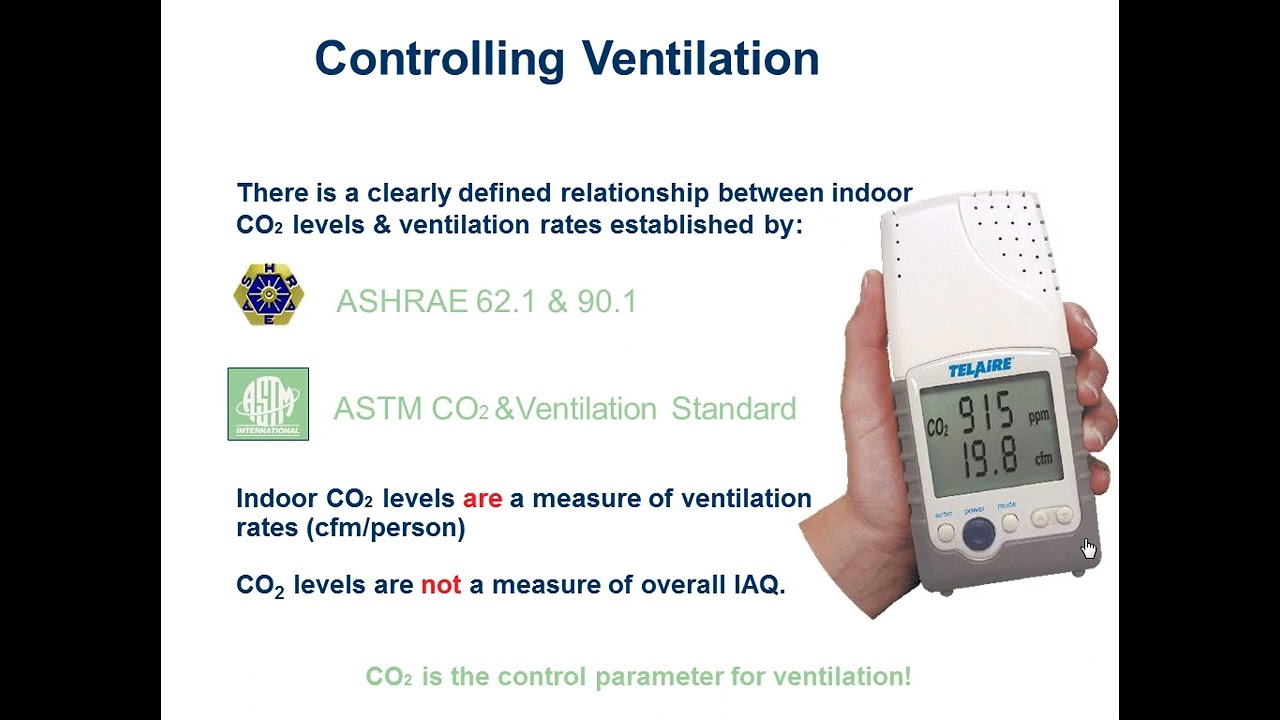
And then no no discussion of ventilation would be complete without getting irritated about the use of uses and misuses of carbon dioxide. So I I'll ask here what about carbon dioxide? Uh for for details I'll refer everyone to the ash position document on indoor carbon dioxide which is a very nice document and it covers all of the the topics that you see there. The point of these is to come up with positions that can be used in advocacy and also recommendations for research and those sorts of things. I've paraphrased a few of the um the uh u positions. Um important one. CO2 is simply not an overall an accurate overall indicator of indoor air quality, but if you know what you're doing, it can be useful. The problem is that there are a lot of people with Aeronet fors who have no idea what they're doing and they're getting concerned about things um or getting misled about what those those data mean. Um for evaluating ventilation rates, indooroutdoor CO2 concentration is essentially using a tracer gas and it's only accurate if you know the parameters of of the measurement. So you wouldn't do a tracer gas test without knowing what your assumptions were and and what the inputs were to it. So you can can use it for for that. But um you can also come up with with misleading results partly because CO2 concentrations are often not steady state in a in a space with populations changing, ventilation is changing. Um there's evidence of the effects of CO2 at typical indoor concentrations on health, well-being, learning, sleep, and work performance, but it's mixed. The conclusion here was that yeah, there's a lot of developing evidence, but not enough to change standards. And this is really, you know, important thing to to keep in mind that some good research will not inevitably lead to better standards. Sometimes good research just tells you we need to do more so that we're certain enough of what we're finding to to improve standards. U in theory there is a connection between CO2 concentration and airborne infection risk the so-called rebreathed air fraction but it's really hard to apply accurately. you know, your your risk depends on a lot of things um besides just the ventilation, right? Like is there a super spreader in the room with you or someone with mild infection or or nobody. So um it's it's an interesting concept, but it's it's more theory than something I think you can use in practice. Um and of course I think everyone would agree sensor characteristics and placement are are critical for control when you're using CO2.
So, Ashray standard 62.1 um has has finally caved in and and now provides u data for supporting the use of CO2-based demand control. You can see my parenthetical there. Um so what you have here is uh the the maximum um increase above the ambient concentration for different types of spaces. And all this is doing is giving you a number that will return the the same ventilation rate that you would have gotten if you had done the prescriptive calculation. There's some spaces for which they didn't think that could be done but for um others they could. Uh if you're using this for a recirculating system, then these numbers don't work. You would have to reference them to what's in the supply air because they're they're increments that represent how much additional dilution there is.
One more thing I don't like about CO2 concentrations um as a way of controlling ventilation is that ever since we split the ventilation into a room component and a personal component, a a constant CO2 concentration will no longer give you the correct ventilation rate because the the room component has to be maintained all of the time and the part you can turn down is the occupant component. And so what you're getting is a smaller and smaller amount of CO2 generation uh as as the occupancy decreases from maximum.
So what should be happening is because of that constant amount for the floor is that the set point should be declining.
So what we see here in this this example is a a lecture classroom and at its full occupancy um it should be at about u700 ppm. I know that's a number that that shocks people too. We see recommendations that indoor CO2 concentration should be under 800 ppm.
If you go through standard 62.1, you'll find almost up to 2,000 like this, but also some that are lower than 800, even down towards 600. It mostly depends on the occupant density. So that black curve um as the occupancy decreases shows you what the CO2 concentration would be if we had the correct ventilation rate. And obviously as we go to nobody in the room, it's going to go to whatever the ambient is. It's moving towards 500 ppm.
So this you can only crudely approximate this in a real space.
Okay, think I'm going to make it, Joe.
Uh so now we're to the the wrap up here um to try to summarize some of the the points from this you pretty diverse u agenda. Um the status quo is still dominated by prescriptive air supply. Um the objectives of ventilation haven't changed a whole lot in 50 years. If you go back further than that we see some some differences. Um there's some evidence behind some outdoor air requirements but not others. And um there's a lot of interest in improving IAQ but more outdoor air is not the way to do it.
But there's more. All right. So some some promising trends um standards and guidelines for extreme events. Not just because I've been involved in one of them, but I think this is a direction we need to go. And I would actually like to see the things that are described in those standards just getting into our general IQ standards. I think uh why shouldn't the minimum uh IQ standard include resilience as well to some extent? The equivalent clean air approach I think is is getting some acceptance and has a lot of of things to to recommend it. um performance approach based on quantified harm or benefit uh is a good thing and given that we have sensors that are now better able to support it. Uh the evidence that that a small number of contaminants need to be controlled with PM being number one is is encouraging.
If we just do a good job on on PM in our buildings, we've we've really improved things a lot. Uh and I think the the growing potential for air cleaners to to do more of our indoor air quality control is is a good thing too. We may actually be able to reduce outdoor air from prescriptive levels in some cases if we uh if we do it appropriately and uh to enable that the improvements in air cleaner testing uh are are very important.
But a little more uh I couldn't get it on one slide. Sorry. Uh needs and concerns. So I gave you the the good the good stuff, the positives. Um potential cost and complexity of performance standards is always going to be an issue. It's a lot easier to just do a little algebraic calculation using numbers from a table than to actually figure out how you could optimize. But I I think we're moving in the direction where we can develop tools to help make that possible. Um there are some important gaps in knowledge or research that need to be filled. Air distribution is is just a mess right now. We mostly ignore it in in applying standards. Um modeling of infection risk. We we've done the best we could with our standards to date, but there are a lot of uh uh fairly uh uncertain parameters in those processes. Maybe well we will never get to total certainty but I I hope we can do better and then need to know a lot more about air cleaner performance and and safety.
Uh harmonization of standards is a hot topic in in Ashray. We're trying to actually get uh people from these different siloed ANIE standards committees to talk to each other. We we've you know been in the same room together. We did a panel discussion on air change rates with somebody from 170, 621, 622 and 241 in um Phoenix at our last meeting. So that's that's an ongoing project and I I think uh that will be beneficial as well. Um and you know and finally um standards without enforcement are are really kind of of useless. So I I think there's a a need to identify what would be an appropriate level of of regulation and enforcement and advocate for it probably focusing in the US on the the state and local level at at the moment. Uh and I think really important is post occupancy evaluation of of air quality. I think there there's an analogy here to what's happened in energy where uh reporting of energy performance data and and putting penalties on buildings that don't uh maintain u an appropriate level of performance is a good thing and we can copy that in the indoor air quality world. So it's not quite lunchtime and that's all I have and so I'll end with the usual pictures of my cats to annoy Stephanie. She's a dog person. Thank you very much.
question here.
To what extent do you guys balance the uh inlet of humidity through ventilation against particulates and other indoor air quality issues when fresh air is the when outside air is the main strategy?
>> Yeah. Well, I think you know standards for ventilation have have not probably done as much as they should, but I don't know if Lou Heramman's here, but you know, there's been a lot of talk about maximum indoor relative humidity or or due point that that's allowable under Ashway standard 62.1. I I think it's something that needs to be considered uh in the operation of of economizers. You know, economizers in in cool humid climates can create really high humidity indoors that's uh bad in many ways and low humidity and economizers can make really uncomfortable conditions and maybe create unhealthy conditions if it if it gets too low. But um we don't do nothing but we could do more. When I when I look at uh recommendations for humidity, I go to the Ashray handbook and the chapter on humidification which has some recommendations which are are pretty good. 30 to 60, you know, 40 is better, but uh at least 30 to 60. And that's that's what I try to do in my home. I have humidifiers that I use to keep keep it above 40 in the winter and I I shoot for around 50 in the summer with dehumidifiers.
So yes, I saw a couple of bullet points where you talked about sensor and sensor placement and sensor types uh in facilities who may be running under a BMS uh and have their HVAC system and dedicated outdoor systems on a DDC.
Would your recommendation be that these sensors be placed downstream of air filtration on the return side and then also downstream of the mixing box so that you know that you're getting a good mix of air? And by sensor types, I mean not only just CO2 sensors, but other sensors that may measure VOCC's or infectious aerosols, uh an x number of things that could also give big uh sick building syndrome, not just CO2.
>> Yeah. Well, you know, if you're if you're using CO2 for for ventilation control, it's that's that's a hard way.
You often measure the return. uh return from a system isn't very good because now you're just getting the average. But return from a space is at least going to give you the average, but the the variation can be very large. I imagine the CO2 concentration is quite a bit lower where I'm standing in the the middle of of the room. So, how many sensors and where do you put them is is going to be an issue. Um, but I'm I'm more concerned about what is the level of the contaminants that that I'm trying to control in the occupied space. Um, you'd want to know what's in the outdoor air because if you're going to use potentially more outdoor air, then you've got to know what's in it, the ozone particles, whatever it might be that that is is a problem in that location.
>> Thank you for that. I've been trying to ask that question for >> colleagues and it's always something that they can't answer always right away. So, thank you for that.
>> There's a lot of good sensors out there on the residential market that read particulate matter, VOCC, CO2, radon, fromaldahhide. Obviously, humidity is a factor. If demand control ventilation has been accepted in the commercial standard, uh why not include it in the residential standard if the technology is there to do the same thing?
>> Yeah. Why why not? But you got to measure more than CO2, right? That you got to look at the at PM and you've got to look at at humidity and you've got to control all of those to to be acceptable. The thing with with VOCC measurements is a t TV t TV t TV t TV t TV t TV t TV t TV t TV t TV t TV t TV t TV t TV t TV t TV t TV t TV t TV t TV tvocc is is a pretty worthless measure.
Um you know you saw in in the the papers that I I I presented that formaldahhide is really the the bad actor. You can have a high TVOC level that's not causing you really any risk because it's something benign or you could have what looks like a fairly low level and then and you've got a real problem. So, I've always been kind of averse to buying an air quality monitor because I hate to spend money on something that has a TVC sensor in it.
See, >> thank you for that great presentation.
Um, I'd noticed a kind of glaring silence on mold and miccotoxins and non um noninfectious uh biologicals. And um I think obviously the common consensus is to not have mold, but um generally we find that most residential homes have some level of mold. It I was wondering if you could just comment on that.
>> Yeah. U well well of course I mean from my point of view controlling humidity is the first thing you need to do and making sure there's not water coming in through the enclosure which isn't really a ventilation problem. Yeah. I mean, Joe is has pioneered showing how, you know, like a bad envelope combined with a poorly installed HBAC system can create a a real mess. So, but you know, I was really just talking about the standards.
And I think controlling the >> in the space humidity levels is one thing, but the interstitial spaces, I don't know what we can do about those if the building's not put together, right?
>> Yeah. And kind of like the happens uh factor, like there's always some plumbing thing or whatever. Yeah, but you know there there's some interesting stuff and I I too many topics to talk about in in 90 minutes. Uh I'm involved in a project uh called ARPA h breathe that u is going to be five-year project and there I think four or five different teams working on on real-time bio sensors that ultimately are supposed to be able to identify um at least I think 25 different bioerosols and and we're not just looking at pathogens it's also allergens on on those teams. So we hope that technology is coming and and that's supposed to be integrated into a risk model and field tested to see whether we can actually control uh using the the input from those sensors.
>> What is that?
>> Uh ARPA h it's kind of like DARPA a RPA-H and and the specific solicitation is is breathe.
>> Uh doctor, thank you for the presentation. I thoroughly enjoyed it.
Um quantitative qualitatively while the battle is not raging right now between particulate particle pleated filters and electronics do you have any sort of just qualitative comments on the electronic you know the 20,000 volt plate and wire filters compared to that of pleat >> um well I I think ESPs can be a good technology you saw that it actually performed quite well in that byproduct test so you know I think they have their uses I'm not sure what the the cost factors are between using mechanical filters and having electrostatic precipitators. Anything though with a corona discharge, you know, potentially going to be a source of ozone that that could be a a problem. So, they um I'm happy to to see them used as long as they're appropriately tested and qualified. But it is good technology and charging particles has been, you know, shown to improve the u the performance of mechanical filters as well. So I think there's some some good potential there not just electrical potential.
>> Hi uh thank you for bringing some clarity to these important topics. I appreciate that very much. Uh my question for you is do you have an opinion on uh building control services such as passive logic, brain box AI and sendle breathe to take the human operational component out of thermal comfort and ventilation control.
Um I don't have any really specific comments but I I think um you I gave a talk on on are we smart enough for smart buildings a few years ago and and you know one of the the things I found by doing the literature search on on that was that you know we've kind of gone full circle to we're going to do everything automatically to putting the human back in the the loop a little bit.
And so that's kind of I I thought that was a persuasive argument. I I really don't want to have something that was designed by somebody I never met who doesn't know me controlling my building.
I'd like to have some ability to to interact with it.
>> So about 25% of my work is resolving problem projects or uh rescue projects.
And I see that the uh lack of maintenance or that building engineer having to do manual adjustments causes more problems than it solves.
>> So that's why I mentioned it. Well, yeah, ma maintenance of course is is an issue in itself and and of course we've talked about that here, right? You know, the the they came in to maintain the the air handling units and then now we're we're set back to where we were.
>> I'm talking about more of the measurement adjustments and >> just because it's antiquated. Thank you.
>> All right. Um this will be the last question, but you can catch them personally. So, um >> you're it.
Thank Thank you, Bill. Uh quick question uh like your thoughts or comments on uh from a on the residential side on the building air leakage uh from the international uh mechanical code or Florida mechanical code. Um they say bring in you need mechanical ventilation if you're at 3 AC or less. And you you spoke of the credit that you can get for infiltration uh you know from on on the ventilation standard. Uh you also mentioned the five 5ac was was good acceptance. If you could speak a little bit more on the 5ac and where that came from and where that that resides and just your thoughts on 3ac and where it came from.
>> Yeah the fiveac came from a a dark place. Um, C CDC got a lot of pressure from the White House to come up with a number before the CO restrictions entered in March of 2023.
They they they couldn't just wait for us to to finish 241. So, like at the same time CDC and one of and one of the guys who who had to to say, "Okay, it's five is the chair of the air cleaner subcommittee of of 241." So um there was that um you know the the method in in 622 you can take credit for whatever leakage you've got and the rest has to be mechanical.
Yeah. So the the three came from Sweden.
Serious was in the Swedish code. And uh what happened was is that in Canada in 1982 under R2000 um we divided it in two because we thought we were twice as good at hockey as the Swedes. So that got us to 1.5.
But I'm serious. We just simply took three. We're better than the Swedes. We divided it by by by by by by two. Now at the same time uh the small homes council in Champagne Orurbana, Bill Banflap built the localal house which was less than >> Bill Rose.
>> Sorry, Bill.
>> Wayne Shik way back. Um and it was at less than one ACH at at at at 50. And then um it was adopt that the technology for the double wall was stolen by a bunch of Canadians in Saskatoon and they built uh eight eight houses that came in at 6 a at at 50 and I was asked to build a thousand houses at that number. you have any freaking idea, you know, if you build a square ugly box with nothing, you'll get there. And so we we we test built 100 houses and was lucky for us to get to, you know, just under under just over two. So we simply then then multiplied that by two to get back to three.
No, I'm serious. And and then what happened was and you know several decades go by and then we we built under the building America program with some of the production builders we built and measured a thousand houses in Chicago and found that you know if you got rid of the big holes you could get below three and so we ended up well no but you and why you should ask why 50 Pascals you you want to We're talking tightness, right?
>> Yeah.
>> That's He's nodding. He's talking tightness.
>> And uh you know, anyway, but so how Okay. Where'd the 50 Pascals come from?
Well, uh I didn't have a fan big enough to get to 75 because my original contract was to get to 75. And >> where did the 75 come from? I'm going to tell you.
So I uh wanted to know so I went up to the National Research Council of Canada was talking to Gus Hanigard, one of our mentors, and I I said, "Uh, professor, I always wanted to know where the 75 came from." He says, "Come with me and go to the corner of the director of the division of building research." And he says, "Joe wants to know where the 75 Pascals comes from." And the head of the department of of of building science said, "I didn't have a fan big enough to get to 100."
So the original plan was 100 Pascals. We couldn't do it. I could only get I couldn't get to 75 and I got to 50. And so couple years go by, like several decades, and I'm go to the committee and I say, "Well, look, we should maybe go back to 100 Pascals because the noise is going to be less, blah, blah, blah, blah." And they say, "Oh, no, there's a lot of research that went into where we got this."
And I said, "That's why it's called BS."
All right. Anyway, uh, thank you.
Up Next
ERV vs HRV: Myths Debunked for Home Ventilation
@buildshow
212K views•2018-03-06
Ultrasonic Transducers: Resonant Frequency Measurement and Horn Design
@imajeenyus42
229.9K views•2017-02-22

Polymer Environmental Degradation: Mechanisms & Stabilization
@iit
1.8K views•2012-07-10

How a Student's Question Saved a NYC Skyscraper from Collapse
@veritasium
22.8M views•2025-04-26
Related Study Plans & Knowledge Roadmaps
Structured learning paths in Engineering