





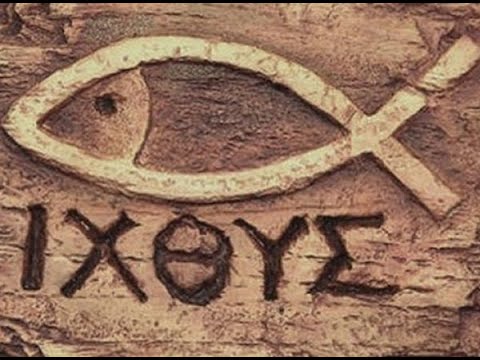








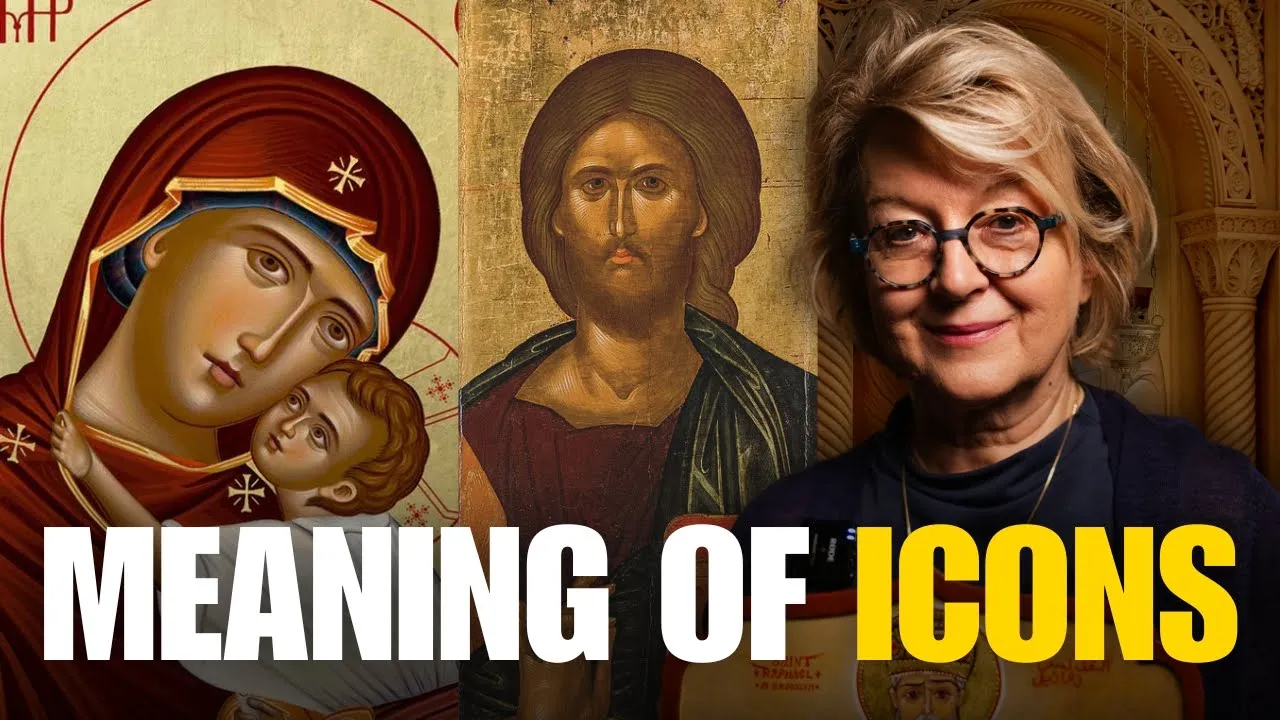


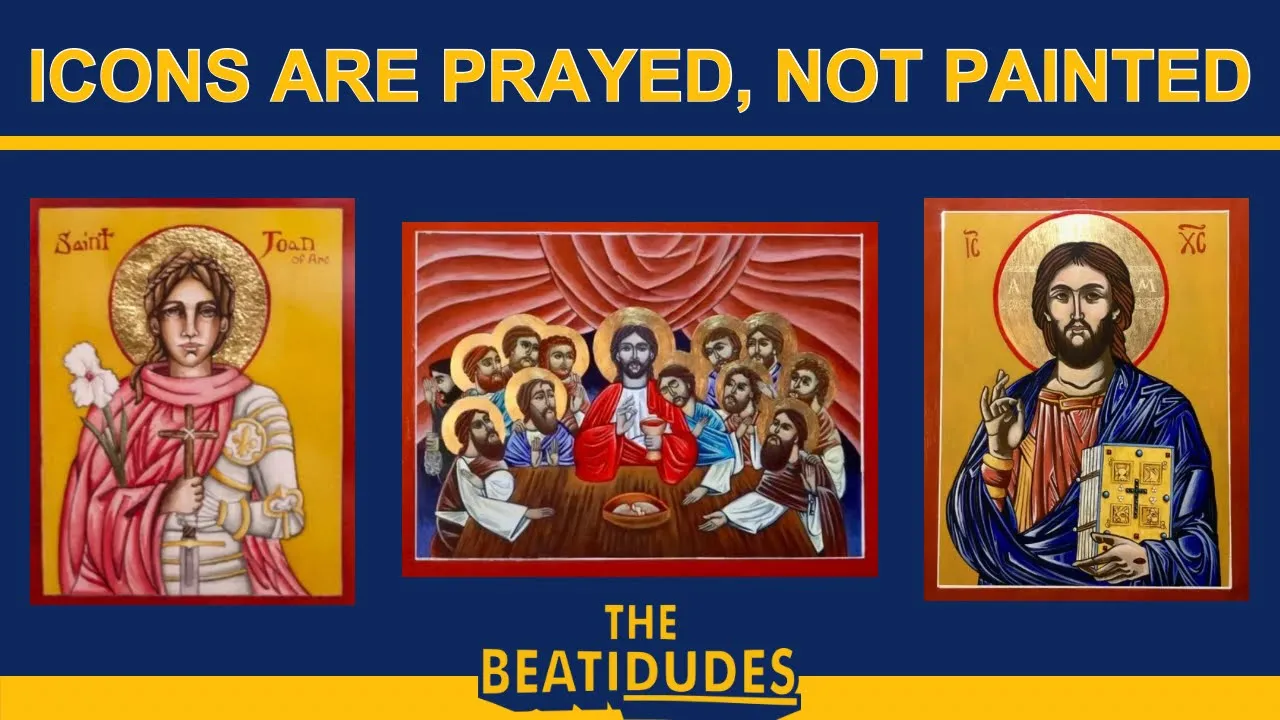




Christian iconography evolved from early Christian symbols (like the Chi-Rho and Ichthys) used during persecution to sophisticated theological art that conveys Christological truth through standardized visual elements—gold and pink undergarments representing Christ's divinity, blue outer garments representing his humanity, and specific facial features (larger eyes, smaller mouths) symbolizing saints' transformed state in heaven. This art form, developed primarily in the Eastern Orthodox Church after Constantine legalized Christianity, uses encaustic, fresco, and mosaic techniques to create theological statements that proclaim faith, sanctify space, and open windows into the heavenly realm, contrasting sharply with the humanistic, sensual realism introduced by Renaissance art that moved away from these mystical traditions.
Christian Iconography: History, Theology, and Meaning | Fr. Panayiotis Papageorgiou
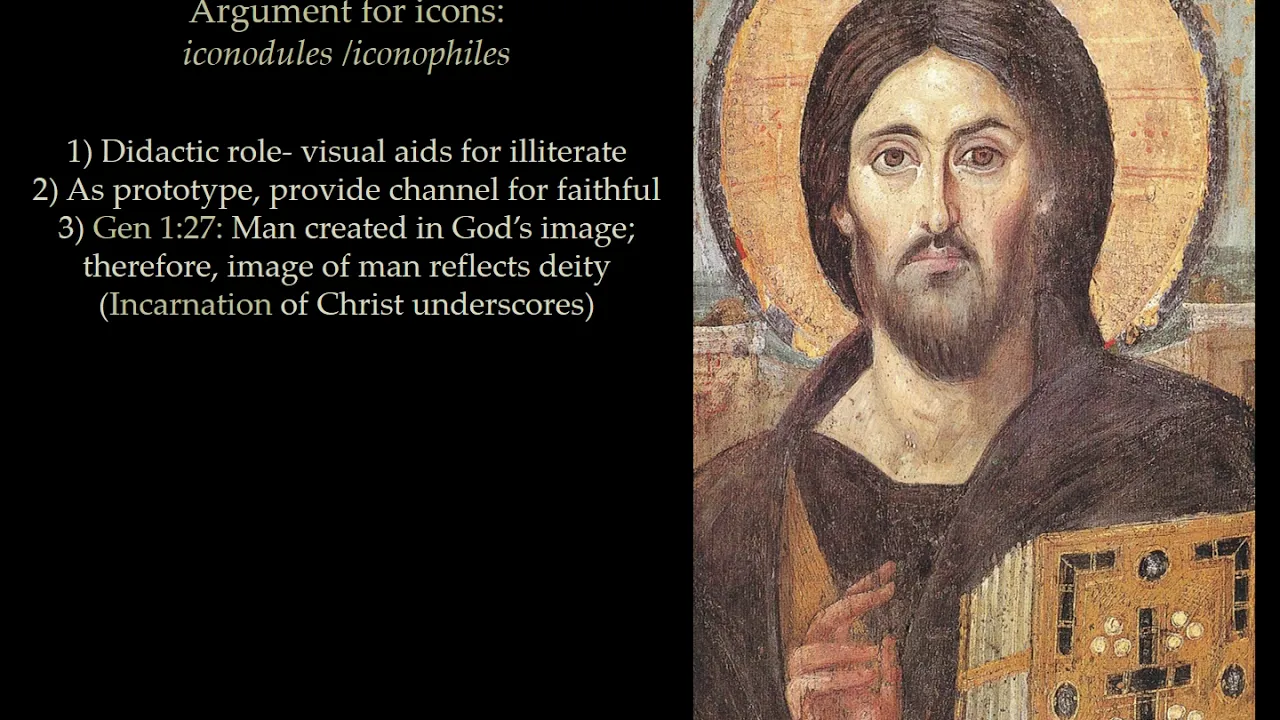
Added:[Music] good evening first of all first of all I want to thank you for being here tonight and I want you to bear with me for the next hour and a half as we go through some important things and if there's anybody from the art department here that would be an interesting journey through through time to see how Christian are developed but even if you're not enjoy whatever I have discovered over the years myself which amazed me and I have completed this presentation over the last few years to present to you and tonight is the night so the story of Christian art as iconography first I want to say that people created art all the time from the beginning of time when people were able to do things in caves and wherever else I have here a couple of things three things here from the ash and Greek and Roman art and I'm not going to go into the details because that's not what is interesting right now it's just to show you that art is always out there and that the art of the Christians followed this other art of the Greeks and the Romans the next slide is about these portraits the fame portraits which were developed in Egypt from the first century BC to the third century AD and we're the closest art to what became the Christian art that we have as iconography so you can go and research all of this and learn more I don't have much time to go deeply into it but I'm going to show you some of these portraits which some of them are found in the Metropolitan Museum in New York if you go go to the Egyptian section it's the first chamber there on the walls and they're also in the caskets these are amazing beautiful and they precede what the art of the Christians became there is another slide here and then let's go to the early Christian symbols so the first 300 years the Christians were basically persecuted and most of the time they hide they were hiding so they use symbols and we find these in the category we find them in on stone we find them everywhere we find the most surco foci and one of them is of course this one here the hero which is the first two letters of the word Christos in Greek now one there and the other one is the cross on the other side which you might you you of course you know we still use it okay then we have the Alpha Omega which means the beginning and the end where is that found Revelation book of Revelation and we have the Lamb which is not used in the east in the Eastern Church since they seek the 500s but he continued to be used in the West and it refers to the Lamb of God which is Christ the sacrificial lamb we still refer to the body blood of Christ in the Eucharist as the lamp and and then the center one what is that shape it's a fish what does the same side fish so what does it have to do with Christians and Christianity good question well the Christians realized that these these word fish in Greek can be the acronym for issues Jesus Christus Christ through God's your son and Sigma Savior so this became a password in a way for Christians as they communicated with each other and revealed that they were Christian okay so exist is a symbol for Jesus Christ the Son of God the Savior which is really Proclamation also of that truth that the Christians of the early church believed that Jesus was the son of God and he was a savior he was the Christ he wasn't just another man but he was a lot more than that okay let's go to the next one here we see the hero again in the Alpha and Omega Christos the beginning and the end and this is from as a core focus which is in the Vatican Museum here is the same thing in a mausoleum in Ravenna in Italy which is a mosaic okay so we have here mosaic Christian art from the 450 from from the fifth century and the Christians begin to use that medium to proclaim the faith at some point as well which is there from the beginning the ancient Greeks had it Romans got it from the Greeks and therefore the Christians continued because they were Romans as well they were Greg the Romans then we go to this is a symbol of the church the Ark of salvation with the hero again and here we see again hero with a fan Omega reversed from a catacomb and here is a the first I would say depiction of a scene from the life of Christ on a slab of stone from a sarcophagus again in the catacombs of Rome and we see the Virgin Mary holding Christ Joseph behind her the star in the Three Magi very simple okay but telling a story and this is from the third century okay the next one this is the earliest depiction of Jesus standing which not very clear but we have him we have at least the miracle when he raises the paralytic he heals the paralytic and you here you see the paralytic here like down on his bed and then he picks up his pallet and he goes this from dura Europos which is in Egypt I'm sorry in Syria which I'm not quite sure if it's still there after all the mayhem over the last couple of years three three or four years so you see that the early Christians begin to put out art to show some of the stories of the life of Christ and they depict Christ in this one this is very common in the early church especially in the catacombs Christ as a good shepherd or maybe not Christ himself represented in as a historical Jesus but a symbol of Christ or a symbol of the good shepherd and you know that in the scriptures in the New Testament of course Christ Himself speaks about himself as the Good Shepherd so the early Christians represented the Good Shepherd as an image of what Christ was and what a shepherd would be the Christian Shephard a bishop a priest but here you see him in a tunic which is all of the more of the great Greek and Roman tradition and and that does not continue very long okay so let's go to the next one here is again the same scene similar scene from the catacomb of Priscilla in Rome the witch Shepard again which is again not necessarily the historical Jesus but these kernels so some people interpret these as the Paris Paradise Isle setting okay with the animals around him of course the sheep on his shoulders again The Good Shepherd early this is again from the third century I believe then in the fourth century we have here a mosaic of Christ as a teacher surrounded by the disciples but you could also see this one as Christ in the temple surrounded by the teachers teaching the teachers you remember the story okay when he was 12 and he they go to the to the temple in Jerusalem and he stays behind and his parents come back after a day's walk to find him and they asked where have you been like he said to his mother I was in my father's house and it's after that we don't have anything in the New Testament about Jesus until he's 30 years old he begins his ministry and here we have this drawing on classical images of philosophers and so there is a progression in how Christian art moves along and how he is depicted here he's not bearded and his younger and the same thing is repeated uniquely repeated in the sixth century in that Basilica of San Vitale in Ravenna during the time of Justinian and after that we don't see this young Jesus beardless young Jesus anywhere at least in my research I may have missed something but I have not found it ok so let's go back to the 4th century here we have in the catacombs of Marcellinus and Peter in Rome the second half of the fourth century a depiction of Jesus flanked by Paul and Peter holding the gospel and underneath there the martyrs that they're presented and the description is here you can find this and I wanted to show you a close-up of his face it's not very clear but he's bearded he has flowing hair long hair he's holding the gospel and he's blessing with his right hand okay what I want to tell you is that this is the beginning of iconography of depiction of Jesus in the same way until today at least in the east he's been depicted like this in the Eastern Church in the Orthodox Church here is another one from the same period bearded Jesus with the Alpha and Omega from the catacomb of Como Dilla one of the first beer that images of Jesus late fourth century okay here in in sin apolinaria in class in Ravenna sixth century from the time of Justinian we have this cross with the face of Christ at the center bearded again long hair similar tradition and then I'm going to show you some mosaic words the work that was done around this time at the same time when churches began to proliferate after Constantine after Christians receiving freedom to worship to build churches to worship freely and to and to build churches freely and the Emperor even underwrites the cost of many churches he builds probably 450 churches around the Empire at this time during the 4th century during his lifetime then we have the beginning of the proliferation of Christian art the Christians are free they develop they take what they have in the traditions of the Romans in the Greeks and they develop it and make it into a Christian tradition and we're going to talk about why they're doing this as well but I think you're gonna see this as I talk and watch this okay this is a vine and this is from a floor of a national church that has been destroyed by an earthquake in powers of Cyprus and the vine of course represents a couple of things what he said I am the vine right and also what do we get from the mind wine right so the Holy Eucharist so this is all the floor of this church a mosaic on the same floor we have the deer and this is a motif I would say or a depiction that is found in many churches and I'll show you a couple of them where the deer are in front of a spring of water and I'll show you the next one which will explain something as a deer longs for flowing streams so my soul longs for you O God so the use of the deer is given a meaning that's deeper and more profound than just an animal as the as the psalm explains that my song my soul searches for you and longs for you just like the deer especially when they sense their time of death or they're sensing that they need water they run to find water so that they can live longer so Christians like the deer they long for Christ they long for the water like he promised the Samaritan woman and the water and the deer together represent that here is a classic example from the mausoleum of Galla Placidia that we saw before in four 50 where the two deer are coming to the source of water across on the floor in the church again of impulse of support the church of support at the location where sin Paul preached in puffles as we learned from the book of Acts in the first journey like he took what took him to Cyprus through Cyprus and on the same floor of that church we have miss which is basically a chalice and underneath says wisdom has mingled her wine in a bowl so what would this represent a chalice wine mixed wine mingled wine okay say it what does it represent the Eucharist communion okay let me switch gears a little bit and I'm I'm gonna tell you what the media you already saw some things but I'm gonna give you a little more about what kind of media are used for creation of Christian iconography Christian icons and to this day what kind of media let's see the first one is in gaff and calf stick paintings and these are made with hot pigmented wax on wooden panel if you search on the internet you'll find this this method and it tells you how to do it don't try it it's difficult don't burn yourself with the wax but this is an ashen practice I'll show you some of those beautiful ones that come to us from 2,000 years ago fresco is a technique of mural painting executed upon freshly laid or wet lime plaster water is used as the vehicle for the pigment to merge with the plaster and with a setting of the plaster the painting becomes an integral part of the wall okay these particular murals can last forever because the plaster dries up and and absorbs the pigment the pigments remained pure and clear for the rest of the life of that plaster and we have some examples from thousands of years and later Christian examples from thousand years ago fifteen hundred years ago that are the colors of vibrant to this day mosaic made from the assemblage of small pieces of colored glass or stone or other materials known as Tesori which are put together in a very special way and all of these methods are still be done today I would say that encap stick and fresco is more difficult to make so you don't find them very often but mosaic is frequently made even in our times if in fact what you need to do is go to the cathedral here the annunciation cathedral the entire Cathedral is covered with mosaics portable icons on would this is the most common kind of icons that we have and you will see them if you go next door afterwards this is the this is just a piece of wood treated in special way and the icon is created on it and and the and these are easy to carry around plus that's why we call them portables and we use them during the services still in the Orthodox Church depending on what the feast is and how we need to use it and then we have plain wall paintings in Greece many times because the churches are made out of stone or made out of plaster they the choreographer comes in and he paints straight on the wall here because we're using this paper kind of walls when you call them drywall they're easy to be damaged and you don't paint directly on them because they won't last very long and of course there's paper on top and you're gonna be painting on paper so what they do with that Konig refers do here in the United States they do painting on canvas and then they take the canvas and they bring it and they stick it to the and they put the pieces together as a puzzle and create an icon if you go into North Luke's Church like has this my church does in Marietta you will see and and I watched the air con Agra Fair when he was doing it he brought these pieces that would you I would not be able to put them together he did and especially the ones on the dome of the church which is a huge space and he had to do it looking up most of the time an amazing process and you need a very smart guy to actually do things like that there's a lot of mathematics there that even though you're not he's not a mathematician he applies a lot of mathematics to put those things together and so most commonly in the United States we have this painting on canvas which lasts for a long time even if there is water in the seeps through the wall the canvas is still safe okay now that I said all that let me show you and in caps tick icon and I couldn't done with the in caps tick method pigment pigments are mixed with wax and they're burnt into the wood this icon is from the monastery of st. Catherine's on Sinai I have actually seen it it's not as big as that it's about this big okay and and it's one of the earliest portable icons probably the most the earliest portable icon of Christ that we have preserved to this day from the sixth century I wanted to show you his face close close-up of his face what do you see here there's a difference yeah between the one eye and the other hmm the tear might be an artifact from the long time that this icon has been around but it could be it here of like he's actually crying because this shows a reaction to something he's peaceful of this time on this side and there's a reaction here he's upset he is disturbed yes can you see it he's disturbed what would Christ be disturbed by our fallen nature our sinfulness he's crying for us ok many other things too but let's let's stay with that so the Econolodge refer was conveying a specific point when he created that difference in the eye in the one side and the other ok this is a beautiful mosaic from the 11th century at the great church of a year Sophia in Constantinople which was covered with plaster for many centuries when the Muslims took over and they turned that church into a mosque and then in 1931 the church they they turned a year Sofia into a museum so they began to open up the iconography that was on the walls and this is what they revealed here it's actually the third Auguste Renoir site the Virgin Mary and and some John on the other it's the the icon of vases the supplication and Christ in the center bearded with long hair he has this blue over him and this red underneath we'll talk about that in a moment he's holding gospel and he's blessing with his right hand standard icons starting from the 4th century down in the 11th century in this great church over here Sophia in Kristen's Noble the colors are important because the icons convey a message so the inner garment underneath you can see it's kind of goldish and it has some pink in it and the other garment is blue well the inner garment the gold and the pink wherever they're depicted on Christ they note guess what his divinity he's God and the other garment he knows the fact that he became man so he's God who took on humanity he's God who became man so you see how the church is proclaiming a truth about Christ Christological truth about who he is because this this elements of faith are at the core of what Christianity is the moment you drop the divinity of Christ or the humanity of Christ you're disturbing what happened the Incarnation you're disturbing what God did through that event and you're not the Christian anymore so anybody who proclaims that Christ is not God he's not a Christian anymore anywho anybody who may say that Christ was never man he's not a Christian anymore so Christ is both God and money remains God man even after his resurrection and he see the trial of God or the father as God and man resurrected deified perfected in his humanity because the divinity does not change and therefore our salvation comes from that what we are hoping for is based on that truth you cannot take that truth away there is no salvation for us there is no hope for us and these are the decisions of the ecumenical councils especially the first four let's move to the next one major iconic Rafik styles there is the Creed and school I'm gonna show you some examples the Macedonian school Cornero school I don't have any examples but there are other forms - I'm not going to go into it but these two the first two are important because most of the iconography that you see is in those two styles this is a an amazing beautiful beautiful icon of Christ seated with a footstool with with a pillow behind him and blessing with his right hand and holding a book the book of the Gospels and this is from the Church of the predominant areas which is the the center of mount athos if you if you don't know what my offices ask me later I explained by one of the most famous iconic refers from the 13th century you can see the colors you can see the pink underneath blue on top and the elements all the same as we described before this is actually from a column ok a column in front of the the altar in the in the middle of the church in the front part of the church it's a column and on it there is Christ on the right side and there is the Theotokos the Virgin Mary holding Christ on the other side I'll show you a picture of that as well here is a detail of this and here is a similar modern icon from a church that I served in Cyprus that was there when he was created and you can see again the same kind of depiction of Christ but there's a little more information here that I wanted to point out to you you can see him blessing again sitting the same way and throned with a book up and this time the book says I am the light of the world whoever follows me will never see darkness ok so this I could be called the light giver okay if the book says I am life the life of the world ok who and it said there are from the Gospel of John that would be the icon of the light giver if it says what's the other end is another one light life and the resurrection I am the resurrection ok these are the typical icons of Christ that the only change might be just the book and what he says and again the golden pink underneath and the blue on top and here what are these letters k very there's a short shortening of the word issues which means Jesus and a shortening of the word Christos which means Christ and then also dear the Savior to Cosmo of the world so it's a proclamation of who this is he is the savior of the world he is Jesus Christ the Christ and he is the light of the world and he's God and man there is one more element this thing this thing and this thing what is that that's actually two words it's the article or in Greek which would be translated the in English okay like you say the man the person write in English of course when you use it for personal pronouns you don't for personal for names you don't put a pronoun in Greek you always do it's the way we distinguish masculine feminine from Luther okay the English you don't do it for names but here or on Omega and knee at the end right this is a proclamation of who he is as he appeared in the Old Testament so in the early church and subsequently at least in the Orthodox Church I'm not sure what the other traditions might have there is an understanding that God the Father never appeared only the logos the word of God appeared through the word this is from the Gospel of John through the word the world was created all creation was created food through the Word of God the Word was with God from the beginning and there was never a time when he was not with the father okay and the Holy Spirit so when Joe when Moses in the Old Testament asks God what is your name what is God answer I am that I am that's the English translation in Hebrew was Yahweh so when the Old Testament was translated into Greek a couple of hundred years before Christ during the Hellenistic period the period of Alexander the Great is subsequently starting probably around the Year 300 the the entire Old Testament was translated from Hebrew to Greek for several reasons including the fact that the Jews did not know Hebrew anymore they were Hellenized so they spoke Greek they understood Greek they read Greek so the their scriptures were translated into their language now that they had so they will be able to read them and so and so we have the translation by the seventy scholars Jewish scholars primarily in Alexandria Egypt which was a major Jewish they had a major Jewish community about a third of the city was juice and when they came to the translation of Yahweh they translated us on horn means being a being something that exists something that has life and if you if you know if you la Sofia or other things that use this word ontology comes from that okay so so when they trusted yahuwah into greek they trusted a whoa a meat on i am the one who is the one who has life the one who exists so the name of god in greek the name of god as he appears as he reveals himself to moses and subsequently is this or on the one who is life has life gives life creates life is life okay and that is the second person of the Trinity the Lord who appears throughout the centuries and participates in the life of people as he presents to them the existence of God and faith in the real through God and reveals the coming of the Messiah who is the law was in the end incarnate and so every icon of Christ when you want to say who he is you can put that on on it and most of the ones being done today they always have it let's see here here we have on the other side of this of this icon in the same church we have this the icon of the Theotokos what the still dog was mean God bear the one who bore God the one who gave birth to God so here we have who she is that's a shortening of meteor which means mother and this is a shortening of say Oh which means of God the mother of God so Theotokos can also be the mother of God and here is all the atria and look at her hand pointing to him she's the one who leads us to him she's always pointing to him okay and of course he is here in in his golden and white as a as a young child holding the scroll of the scriptures because he's the logos the locust comes to us through him and he seated enthroned look at the pillows in the back and footstool at the bottom keep that in mind you're gonna see that throughout the centuries and then Owen again right the one quiz now this is a an icon of what we call the Pantocrator Pantocrator is a word used in the book of Revelation nine times that means the one who rules over all things so look it up if you want you find it nine times but in the Old Testament is used I think 49 times now don't hold me to that because I my memory is not good on this but it's a lot more than nine and it always refers to God so here is the Incarnate God in the Dome of the church this is a top of the chopper at my church here in Marietta with the gospel book blessing with his right hand with the pink radish whatever gold in the body in the the undergarment the blue on top which denotes his divinity his humanity and Jesus Christ o Pantocrator the one who rules over all things surrounded by angels now let me take you to the big dome in my church which is familiar to those of you who are from my church where again you have the same exact depiction a different kind of thing around it which is a code from the Old Testament that God looks from from his throne in heaven and and he and he has he cares for all those who are on earth and he surrounded by the prophets in this particular case the major prophets basically whoever the Econo graphic could fit in that space so the Solomon and David in Isaiah this is David this is Solomon this says there these Elijah etc etc okay let's move on now okay let me back up and say that this is art okay this is the style the Cretan style this is macedonian art the colors are more vibrant and basically the rest of it is the same in this particular case the angels are surrounding Christ and it represents these Pantocrator icons on the domes represent Christ ascending to heaven but also coming again in glory but also the the dome represents heaven and he's in heaven right now but he's coming again in glory so he ascended surrounded by angels he's coming again surrounded by angels now this we call an eschatological icon the domes the dome icons are eschatological from the world s hidden which means the end times okay now last year I went to I went to Italy and I want to show you that the Italian art in the churches before we're up up unto the 14 1400 and early 1400s are not very different from all of this okay and then I would ask the question what happened why did they change there are hardly any icons in Catholic churches Protestants have completely given up on icons and what happened okay let's see this is in Ravenna picture I took myself Christ and throne you see the pillar in the back footstool holding a scroll scriptures and blessing with his right hand sixth century time of Justinian when Justine Ian recaptured Italy from the barbarians who had invaded called Visigoths Ostrogoths and vandals and all these are the guys who came in wave after wave and destroyed Europe Europe was in this in total destruction for 400 years there was no civilization in Europe for 400 years they lost of course their Greek language which they had they lost philosophy they lost astronomy they lost science it took them another thousand years to recover it but in the East that was never lost there's a total continuity a complete continuity that never interrupted until the Muslims came in 1453 when everything was destroyed so much destruction it's it's sad to to talk about history sometimes it makes my heart pains me basically I remember Steven Runciman it's a great piece and team theologian of the Christian period of the Christian Roman Empire up up to the fall of Kazan noble he's walking through the ruins of mistre in Greece and he turns to the camera and he says it is it is sad it is sad for the for the passage of time is sad from all the destruction that has come about by people who could not recognize or appreciate civilization so pop history of Saint John in Florence 11th century there is Christ basically see that there is no throne but here you have some new elements you have the stigmata okay again the colors look at the colors okay underneath is the pinkish reddish whatever it is this looks more I don't know it has gold in it too and the bluish on top so the preservation of the elements of this icon which preserved what who Christ is and that his both God and man are still in the economy in the West even after the the coming back from the 400 years of destruction this comes back as well so they begin to create churches and to create icons like that and let's go to the next one Christ in the Basilica of st. mark in Venice 11th century and thrown the pillow in the back foot stool at the bottom gold underneath and blue on top holding the gospel blessing with his right hand very similar to everything we've seen before and then if you go to Sicily you find some amazing iconography 11th century I'll show you three I believe I have here he says I am the light of the world okay the same one that we saw before actually the for those of you who haven't seen this before and who have been to my church and who are for my church react the icon the mosaic icon of Christ in the extra Gnostics the outside when you come into the church is basically based on this icon okay you can see the colors underneath on top is Christos it doesn't have the Alpha and the Omega I'm not sure why they didn't do it but it's in Italy underneath the icons underneath they're also very very much in the same style as everything else that we've seen in the east so if you go to Montreal in Sicily same period or 12 century actually a century later you can see again something very similar and underneath the field August enthroned with angels around here and the Saints I'm not sure it's Peter Peter I think and Paul if you go to palermo sicily 12 century again you can see this beautiful mosaic of christ uses Christo's the gold or light color underneath and the blue and this is the icon outside my church which is based on all the first one from Sicily that I just showed you which somebody did it's very interesting how how this iconographer did this he brought it rolled up and here he opened it up and it was the back of the icon he created this icon by putting the tesserae the the legal stones and glass for it from the top and creating an icon underneath he never saw the icon after he finished he saw it for the first time with me when we opened it up after he put it on the wall okay it was at this thick canvas okay he put glue on the wall we lifted up the icon hid it there we removed the canvas and voila this is the icon and he was he stood in front of it in amazement himself he made a mistake I don't know if you saw it I did I didn't say anything I didn't wanna embarrass him can you find the mistake huh Yin yep he made a mistake here he did the end reversed I'm not gonna tell him maybe if he comes back we'll talk about he's nothing Cesar an iconography from Athens okay so in the earthwork Church we continue the same tradition using these same media and these same styles to create a cone ography because there is something about iconography which is different from regular art there is a mystical aspect to this this is not a realistic representation of who Jesus was although if we had cameras and photograph photographic cameras at the time and videos we will have plenty of those this is just representing who he is as the Son of God the law was incarnate who walked on earth and did what he did we know from the scriptures who is both God and man and he is the life giver he says Here I am the bread of life who has come from heaven okay this is the chapel in my church and in the cove of the chapel behind the altar there is always most of the time there is the icon of the Theotokos usually with open arms but that differs from church to church as well there's a variation with Jesus always standing in front of her or being helped by her in the Orthodox Church we almost never I say almost because I know of one icon recently that they made the field dog was standing by herself in the Orthodox Church we always depict her with Christ she is who she is because of him she is who she is because she is his mother okay and here is her in the main Church in maryada where she is enthroned and holding Christ and she's called apply doTERRA toner on the one who is wider than the heavens why would he she be wider than the heavens because she gave birth to him who created the heavens was much bigger than the heavens okay so another proclamation of who he is she is their daughters which points to him she is the wider than the heavens which points to him everything about her points to him but look at the colors what do we have here we have blue underneath with red on top why because she's human but she took on the ultimate perfection of humanity which we call it theosis in Greek in English it translates as deification which is the goal for all of us okay God created us in His image with a purpose that we may become perfected in his likeness and the first person who did that was her through that association with him the closeness with him so if we want to be deified if we want to be perfected as God wants us we have to have a relationship with him as she does we can be his mother we can be his brothers and sisters but close ones not just distant ones who left and never came back okay here is another one okay the previous ones go from the credence style here is one which is from the what we call Macedonian style okay and here is one critter style from another Church this is from Cyprus from the church has served in Cyprus I just wanted to give you several of these to show you that is very consistent the way that these icons are made they're very standardized although there is variation there is also a standardization when it comes to the symbols of the faith okay and immediately I found similar things 6th century remember if the dog was seeded and Thrones pillow footstool Christ she's blessing here - that's interesting I don't see his heart the way society should be holding is the scroll this ok look again Italy again Baptist ribs in John in Florence 11th century very similar Christ holding the scroll blessing if your dog was enthroned footstool underneath and the colors again reversed there is the the human side might have greenish blue sometimes and that's here you can see the green so there's a little variation that but on top is purple gold that kind of thing and then the apse of the basilica of santa maria maggiore in rome from the beginning of the 13th century okay these are some of the most beautiful mosaics in the same tradition as the ones we have seen before is a very refined mosaics now this is also I believe the papal cathedral outside of the walls of Rome somebody told me recently and I think that's what they told us when we were there and it has the elements well it has a lot of the elements that we talked about but it's also a little different and this particular icon is specific to something that developed in the Roman Catholic Church never developed in the Eastern Churches the crowning of the Theotokos by Christ as Queen of Heaven he became a dog mind the Roman Church never exists so there's one of the differences that in in the development of what happened in the West which didn't happen in the East but the iconographic style the way it's done and I'm going to show you this later again this is the tour mission of the Theotokos the falling asleep of the Theotokos which the Roman Church they call it the Assumption because they go to the next level which is the what happened three days later but the in the east we call it our mission we also call it Assumption but that's kind of secondary to the Dormition and all the acog rafi in this church was amazing the 11th century con Agra fee was beautiful amazing and very close to everything else there was more modern stuff also which I'm not going to talk about because it doesn't fit here but back to the baptistry of Saint John in Florence 11th century and love of the second ography very similar to everything that I showed you before I took lots of pictures this is just one of them let me switch gears now we're going to the Holy Land and we're back to the fourth century sorry sixth century in the Church of said George in Madaba Jordan they were doing restoration work a few years ago maybe 20 years ago and they were removing the floor which was damaged and this is what they found underneath a mosaic map of the whole island an amazing find and it has the names of the cities and all kinds of things Bethany and Jericho and beef miss Tyler anyway let me show you the next one the map of Jerusalem if you ever go to the Holy Land you cannot go to Jordan and see this okay it's beautiful and amazing sixth century it's it's an aside it's kind of but I want to show you how they used this particular medium of mosaic creation okay let's talk about holy icons what are holy icons what do we understand about holy icons how how they work how they're made let me I can see the time yes I do holy icons are I say windows into heaven what are they windows into heaven will I hope that you'll be able to understand this by the time I finish this talk but holy icons are theological statements there are theology in color and the church started this so early from the moment he was free to proclaim the faith the church started proclaiming the faith through colourful mediums medium and this the icons are a means of proclaiming the faith and the church has used wolly icons stitching to throughout the centuries so when you take an icon that depicts a story from the life of Christ let's say the Christ the the the entrance of Christ Jerusalem before the before he was arrested and crucified he's gonna donkey and entering the process of following and you ever seen that beautiful depiction of that event the icon of we're gonna see some of them here the icon of let's say in the birth of Christ we icon of the Transfiguration of Christ and all these other icons what are they doing okay at the time when books were not available for everybody they were very difficult to create because they were they were usually there was no printing press and they were usually done on leather material and by hand okay first of all it was it would take years to do one Bible and it would take a lot of money to buy that Bible because somebody would have to work for such a long time so only wealthy people could buy Bibles and probably ninety two percent of the population maybe 95 and in some places 98 percent of the population were not able to read so the church used icons as a medium of teaching proclaiming the faith and teaching the stories the biblical stories but holy icons are a lot more so let's see what else holy icons have a sanctified sanctifying effect on the beholder so when you put an icon in the space where you are you're up in the window you're opening a window into another Aeon the realm of heaven the realm of God I'll talk about it in a little bit of how that works but they're also pulling in or rather they're pulling you into that into the realm but they're also projecting into Yuri on what is happening in that icon so they project the saint or christ or they event into the space and time of the beholder the sanctifying our space and time but they open also window into the time and space of the biblical event which they depict inviting the behold to transcend time and space and enter and experience that event entered experience the Christ event so holy icons open a window for the beholder into the heavily dimension in which the saint currently exists as well so when you walk into a space and I have watched people walk into my church which is because it's not completely covered with icons but it has a lot of icons on the walls on the dome and during the Greek Festival in in May the week after Mother's Day okay we have the Greek Festival every every year and we do two Church tours so we open the church and we do tours and I have watched people walk into the church and as soon as they walk in they go they are in a different space and we have this tradition in the Orthodox Church once the church is consecrated as a sacred space we don't use it for anything else except worship so we don't do secular events we don't do secular recitals of music or anything else is only for worship and the icons provide that element of the sanctified space so let's see how the icons are made and what they mean and how they are different from regular art and here is an icon of the third dog was holding Christ where I say here sensuality has been removed okay look at her face is she really attractive physically attractive I don't think so that's on purpose she's not made ugly she's made the elements the human elements which provide sexual attraction have been removed on purpose her nose has been reduced and I'll tell you why your mouth has been reduced they suddenly any flesh to see and but this particular icon is very special because it has movement okay how is the movement look at Christ's face he's looking well into this direction and he sees the cross and he's scared and he basically grabs on his mother for protection look at his hands holding onto her he kicks his foot and his sandal comes off unique icon okay not very often I conserve movement this one does and again you can see the colors which denote his divinity his face is a lot older than he might be being held by the mother two years old or three years old whatever he looks older there's a purpose for that what's the purpose he is from eternity okay he's timeless he's from eternity the eyes of the Theotokos are a little bigger than normal we'll talk about that in a moment let's go to the next one here is st. Catherine both of these icons are from the monastery of st. Catherine's in Mount Sinai they are big icons on wood and here's the Catherine she was a very beautiful woman according to the story of her life one of the most beautiful women of her time she was also very wealthy because she was from a royal family that is what denotes that she was also the one of the most educated women of her time all these books and instruments of mathematics and things do you know that their royal colors of the clothing as you can see and the feather in her hand denotes that she was educated she was able to write know many women and most men could not write in those days and then there is also the torture instruments because she was a martyr and she called a cross which denotes her martyrdom that she's a martyr as she died for Christ again this beautiful woman is represented here with a very seen nose small mouth no flesh showing eyes probably bigger than normal in the face reduced to not very attractive physically attractive or essentially attractive person so now I want to tell you a little bit about the Econo graphic process okay as much as we can fit into this short time iconography has to be done a prayerful way as a glorification to God and proclamation of the faith in Christ through a colorful medium personally I always check with this iconography job before I buy an iPod from them I want them to do the icons in a perfect way I just don't want to buy an icon from somebody or cover just anyone their life is important if they're prayerful person is important and then the iconographic techniques how icons are made why are they made the way they are let's see any of you artists here do you I'll be able to draw or paint yes yes okay very good if you want to create a portrait I didn't do this I I can't draw anything so forgive me but if you wanted to draw a portrait you would do something like this right half the face right only one side if you wanted to do a caricature you would take the elements from the face of the person and accentuate them and make them ridiculous right well the iconographic style takes the elements of the faith smooth them out and makes them beautiful in that way that's the opposite of what the caricature would do and the iconography always shows both sides of the face there is a reason for that according to our theology Christian theology of early early church and subsequently we are persons a person in Greek piroso born has to do with the face okay in the ash in Greek times when they did the theater they used what they call Pro Shop BIA with masks to cover the face because the person changed they change who they are they changed the role that they were doing they were never showing their own faith it's not like today in movies and theater in in in our times where you know you see the movie actor in one movie as this guy and the other movie is another guy another movie is another guy the Asian Greeks will never show their face of the actor only the face of the person that was being depicted so prou show beyond is the word which is the word depicts that particular face of that particular act okay so pro Saban is unique do you know that your face is so unique our faces are all unique that's why now these technological gurus are trying to scan our faces and do face recognition because we're all unique in theology it's the same thing we're all unique so our face is important and we become fully persons and restored human persons as we face God face to face in the sense that we appear in front of him in the end even for the final judgement but we appear in front of him and we present ourselves every time we pray every time we do something that has to do with worship it's me in this unique person that is presented not somebody else no masks no hypocrisy always me always who you are who you are so this is what the iconography does it emphasizes on the unique person personhood of each one of us which is what is saved by God that's why Christianity doesn't accept reincarnation doesn't accept that we disappear in some sort of infinite thing and never exist again we're unique persons that exist forever God made us unique to remain forever in that way okay and I'm going to bring you back to this the five young portraits which precede iconography and my suspicion I have not really studied this very deeply and I just took this idea from a paper that was published in Greece that there is a connection because this is the development of art formation Greek art - Hellenistic art which is represented here and finally - iconography all of these are in cap stick pictures the method of molten wax with pigment burned into wood okay okay another element of icons which is different from let's say a realistic art and modern some of the modern things that we do is that iconic iconography is two-dimensional what does that mean well if it's three-dimensional and things are in the distance would be small right just simply this is a simple kind of thing you will see that later when I show you some other things and you know when children would draw a house let's say they would draw the front and the back the same size I still draw this way I can't do otherwise but when the economy fir draws this he does the same in a different way the front and the back are the same size no three-dimensional everything is flat when let's say in modern art or in three-dimensional art or realistic art do you you have a tree it would I mean this is very simple it doesn't show everything but you know you see the tree you see the distance thing so they're smaller you see the the shade falling if you go to a child's tree it would look like this shall I tell you I still do the same and if you go to an iconographic representation of a tree it's a symbol of a tree that looks more like a leaf and the mountains will look like these lines that are symbolic of mountains okay so I cut the symbols everything is symbolic so when you when it comes to taking like today we have modern Saints we have Santa Clara who died in 1920 he was declared the saint in the Orthodox Church in 1960 that's a photograph of him when he was in Athens so if you want to create the nikon from him what do you do oh you go from this to this okay he was a bishop so he holds a gospel he blesses with his right hand he was a monastic so he has the black cover on his head and if you go to some the two most modern Saints that we have in the Orthodox Church that I have the blessing that I met the man and I knew them that's how they looked and when you turn that into an icon that's what you get this one sample videos was a monk and a priest so his blessing he's not a bishop he's the monastic therefore he has this he's blessing because he's a priest he's not holding a gospel because he's not the bishop okay this one was just a monk no the priest so there's no blessing there is no there's no gospel and in this particular case he's actually looking more like what he used to be with a little screw for the little hat on his head okay this is sebaceous from Mount Athos and this is sin porphyrios who lived in athens most of his life but he started from our authors and ended up on martha's okay I want to point I want to show you this to these two women saints and martyrs of the church from the third century sin MV Ania and cynically see look at their faces what do they say somebody said they're similar yeah they're very similar they're almost the same because we don't know how they looked first of all okay we don't have pictures so the iconography has a standardized way of showing martyrs in a standardized way of showing women martyrs and here are two women mothers their cover the heads are covered you don't see much flesh except for their hands in their face and they're holding the cross which means that they were martyrs and and they have these thin noses which don't look very pretty mouths and disappeared the ears have something to do we don't see it here we're gonna see it in the next slide but their eyes are bigger than normal I'll tell you in a moment what the other elements are okay so all sensuality has been removed from them because I look at them and I say they're beautiful but in a spiritual way rather than in a material way or a sensual way here we have two great Saints you may know them Athanasius and basil greatness was decreed and bears of the great there were both bishops so they're wearing the vestments of the bishops from that time they're blessing with the right hands and they're holding the gospel their beards are very specific and the rest standardized as I said iconography actually will open a book and say how did some basil look and they would take the elements and put them in the icon the icon is the the style of the choreographer but the elements are the same in every single icon so if I look at the Nikon of some basil it doesn't matter who made it I will recognize him okay the same for San Nicolas the same for a sense unless use their faces look at their faces now look at their eyes there you bigger than normal their ears are bigger than normal their mouths of disappeared their noses are smaller okay here is when I'm gonna explain this a little further where are the saints where are the saints right now the kingdom of God in the presence of God they are surrounded by light the light of the kingdom of God okay the gold represents the light of the kingdom that's why we put gold in the back of the icons in the surrounding of the saints then look at their faces the eyes are bigger thee because they have they are seeing amazing things their mouths are small because they're speechless and their mouths are no useful anymore their noses shrink because they are not useful anymore their ears are bigger because they're beholding their hearing amazing things in the kingdom of God maybe the singing of the angels one more thing look at their foreheads kind of bigger protruded why not has a meaning to divine wisdom they were both great theologians but their wisdom has been perfected as they enter into the presence of God so this is all about the presence of the kingdom both where they come from and opening the window for us to enter into it but also bringing that to us and making it real in our own space and time okay icon of Christ I kind of leaked the birth of Christ now this is a beautiful icon from the 11th century it's kind of damaged almost a thousand years right or maybe a thousand years but this icon has a lot of elements it has a lot of events that did not happen at the same time so let's see what they are what do you see in the center well the Theotokos the Virgin Mary she's actually the biggest figure in the in the picture because she's the center of this because she's a walk via birthright the Theotokos and next to her I'm gonna leave that last okay let's leave that last what do you see here the angel speaking to one of the Shepherd's announcing the good news of the Shepherd up here the angels are singing Hosanna in the highest peace on earth here is the glory of God shining down through the star on to the spot where Christ is let's see here what's happening here Joseph being tempted some people say the devil I say been tempted the devil didn't come himself but he's been tempted right and he's thinking what on earth is happening here I had nothing to do with this right here we have something that comes from the early apocryphal writings from the second century one of the books called the protoevangelium of james which tells the story of the life of the Theotokos the virgin mary and in this there is a story of the birth and the women that took care of her that helped her to give birth the midwives you know in those days they had midwives everywhere every every village had midwives I was given birth by a midwife because there was a midwife in my village and we'd even know her name he was my moon they won who did all the birth things okay so we have two midwives and they're washing baby Jesus who looks like a 15 year old why did I say before because he's eternal he's from eternity okay and these are the women who witnessed that the Theotokos was a virgin before birth a virgin during birth and a virgin after birth so all the icon of the Theotokos if we go back you will see a star on her the head up here and a star on the right shoulder and a star on the the left shoulder pointing to the fact that this was a miraculous birth in some way because she never knew man okay here are guess what these are who these are the Magi the Three Magi now this is very interesting because the iconography went out of his way to distinguish them between each other okay there are three horses which have three different colors which signify all nations okay there are three men which were different clothing different style clothing different clothing which signify all traditions and customs and cultures and the three men are one is a young man beardless the other is a middle-aged man and the other is an older man which signifies all ages all time so we are in that picture okay our times are in that I couldn't because Christ came to get bring salvation to all nations to all cultures and to all time to all people of all time and then let's go to little Jesus if you actually look at this closely you will see that he is not little he looks like his 15 because he is from eternity and if you look at what he's wrapped in that's not straddling clothes it's very a clothes which proclaims what's gonna happen in the future as he will die and be buried and this manger or creep or whatever it is is not a major but it's a tomb which signifies his death and resurrection or his death an internment rather okay he's definitely men so this icon is an icon that transcends time okay that's an important thing to remember some icons transcend time I'm going to show you another one in a minute we have here a similar scene but in Italy from the 13th century 13th century that icon was from the 11th century this one is from the 13th century so whatever was happening in the least was also done in the West similar not exactly the same but similar there is Christ looks older wrapped up in burial clothes in a tomb so dog was the biggest figure the center the thoughtful Joseph and the angel announced in the good news to the shepherds the angel singing the glory of God and the star shining down to where Jesus is so the Roman Catholic Church even after the split or what we consider the great season which was basically the recognition of the differences that they had among them that we're the basically the product of many centuries of alienation and many centuries have been apart and other events which I'm not gonna go into right now but I can answer any questions later if you want they were doing iconography okay very similar to what's happening in the east it is even possible that they send people to waste and kind of brought back things that they didn't have anymore and they restored this process of holy icons in the West now this is an icon of what I call before the Dormition of the Virgin Mary the falling asleep of the Virgin Mary the death of the Virgin Mary and here is the story from the apocryphal book of the gospel of the James the proteome and Gallienus and James which says that at the time when the third dog was new at the time when her time came to die she knew that she was going to die and so she called the opposes to come to meet her and and so that she can have them with her she surrendered her soul to her son and the Apostles came except except for Thomas who was in India and the Holy Spirit brought him through the intercessions of the Theotokos now here she's asleep she's fallen asleep she's she died we say fallen asleep in in the Orthodox Church especially I'm not quite sure if they do it in any of the other traditions but we say fallen asleep because we understand that this is a temporary condition okay and we say falling asleep and then when we talk about the places where we put the people who fall asleep we call them cemeteries right so what a cemetery mean in Greek key material it means where the people are sleeping you learn something else next time you see a cemetery don't think of all the horror movies that you see think of key material a place where people are asleep waiting for the resurrection okay so what I love about this icon what I love the most about this icon is that in all the icons that we see where Christ and the feeldog's are in the same picture all right she's holding him well here he's holding her her soul as she surrendered to her son okay let's go to Italy Dormition of the third daughter she's santa maria maggiore in Rome from 296 well it's the same icon this is mosaic the other one was painting this is mosaic and Christ is holding her in her in his arms he's a little bigger here but still the same concept okay I made my point right here we see the baptism of Christ here I want you to see what is happening I say this icon is two-dimensional why I tell me what things show that it's two-dimensional and not three-dimensional just yes correct and look at the waters look at the fish you can see the fish of the that's right the water is elevated as if it's behind him but if it was a realistic picture it would be like flood right and here you have a personification of the river Jordan who in the psalms in the sounds father John I found it I assure you it says that the river B holds this and turns back to look at it okay and who is this Leviathan even Leviathan is amazed and he looks at the miracle this is a revelation of God as Trinity it's one the biggest miracles in the history of people who believed in yahuwah okay the biggest figure is Christ who is in the center second figure is of course John who is baptizing him the glory of God and the voice of the Father saying that he is my beloved son and then the the Dove are the the Spirit does add of the Spirit in the form of a dove now the spirit was not incarnate okay it was just that that was a symbol of the Spirit in a way spirit did not become a dove only Christ was incarnate the father was never incarnate the Spirit was incarnate only the son and then you have these angels on this side have you read the story is are there angels in the story no oh just come from this is iconographic freedom now where there cannot refer needs has an empty space so what he does is that he pulls from another story what happens after the baptism Christ goes up to the mountain where he's tempted for 40 days he fasts and he is tempted and then at the end after the devil leaves him alone the angels come to minister to him okay the iconography brought them here - they have towers in their hands to receive him as he comes out of the water okay next Italy baptism this is actually early for the fifth century in Ravenna and then I'm gonna go to this one what icon is this their Pentecost Pentecost how can you tell oh it says it up there somebody can read Greek okay I showed it to a class I do at Holy Spirit College and I said they didn't know Greek so I said what I can easily said ghost say how do you know he said the flames over their heads okay okay something is happening here I want to focus on it I want to kind of stop for a moment let me just give you some of the elements this is in a building how do we know all of this and the cloths over that bill the the drawing of the walls denote this is his side the building if it was outside the building there will be mountains and trees and things like that okay so there in the upper room through to the story here however there is a depiction a representation of the cosmos the world okay the creation and he's holding the cosmos is crowned okay and he's holding the what Scrolls to off Scrolls for the 12 tribes of Israel okay and these are the Apostles how many are there 12 but by this time Judas is out hmm it's 11 no it's tough stuff you're right so what happened Paul Wow Bravo Paul is here well this is Peter and this is Paul I can tell from a mile away because they're standardized okay so what is pot doing here Paul didn't even become a Christian until 15 years from now okay well this icon transcends time just like the Christmas one and I say I usually say take Paul out and put yourself in it if you receive the Holy Spirit you are in the place OCO because the event of Pentecost is it transcends time it doesn't stop with that event that night Pentecost is for each one of us every one who has been baptized and received chrismation or confirmation when we receive the Holy Spirit that's our Pentecost and that's what we see here okay let's go to the next one crucifixion this is one of those icons that contain emotion which you don't see in many many icons say unique icon the show's emotion you look at the face of John the young disciple and his sad you look at the face of the Theotokos and the women are with her the in front of the cross Christ is dead on the cross and the situation that pierce his side and he said this was indeed the Son of God who actually in the Orthodox Church at least we have him as a saint you see the halo around him because the tradition has it that he accepted Cristina he accepted Christ as as the Messiah and as God he became a Christian I want to show you the face of Christ which is very peaceful okay at this point he's dead there is the water and the water in the blood that comes from his side which also signify what hmm the Eucharist the Eucharist okay and that's why we put water in the Eucharist I think the Roman Catholics do the same right yeah yeah and we put in the Orthodox Church we put water twice we put it when we prepare the gifts of the preparation table we put cold water right before we commune we put hot water to raise the temperature to symbolize our faith which is warm and fiery okay it also takes tastes much better okay and Allah alright this is Santa Maria Antigua in Rome I was never able to get into that church but I found pictures I want to show you that the crucifix there which let me show it more vibrant colors right here perfect somebody did the job so I didn't need to do it santa maria maggiore maria Antigua in Rome this is the crucifix there is a difference here which I didn't see I never found in the eastern depictions of Christ on the cross in the East he's always with the eyes closed peaceful he's dead here he's peaceful but his eyes are open okay that's a difference in the aeronaut Rafi from what happened in these two what's happening here you see the elements again this is John the Evangelist the third dago's this is long he knows the Centurion this is one of the people who were there who crucified Him and I'm gonna stay right there I'll show you the next one now this is from the 11th 12th century the San Damiano crucifix have you ever seen this one it's a beautiful beautiful cross I saw it took a picture of it actually it didn't come out very very well because it was darker but again you have the same elements that you saw before John and the Theotokos lankiness perhaps and the women open eyes other things too this is of course most of you who know the story of Sir Francis of Assisi you know that he was praying in front of this particular crucifix when he felt the need to repair the church or he heard God's voice ask him to repair the church which led him into his sainthood and this is found in the in the the Church of st. Clare of Assisi in one of the chapel's that's there all right steel iconography though it's flood it's two dimensional it has all the elements of iconography let's go next to this one now this is modern so I want to show you the contrast to modern things that depict the crucifix these are three dimensional different kind of this one is really strange I think but never mind let's go to the next one I have an empty slide there's a reason for that wait for the next the Renaissance that's when everything changes if you didn't know that's when everything changes in the Western Church the Renaissance brings humanism realism rationalism which prevail in the culture of Europe and of course the church there is a rediscovery of the azure Greek mythology the ash and philosophers the ashen right there is the mythological stories of the gods and all the other mythological stories and they begin to retell those stories through different ways like the busi but art becomes a medium to retell the stories as well all right let's see what we have here and this is the Primavera it's a completely made up with the logical story of the Renaissance right before they're in sons of fifteen late 15 and 16th century the Renaissance has began this is one of those Renaissance huge beautiful art that cannot say it's no good art beautiful art but there is a change in the styles of art from what we have seen in Asia Greece and Rome and the Econo graphic styles of the Christian period before the Renaissance both in East and West this is different from everything now that's not a problem but it becomes a problem I think when you see are things like this that's another mythological story ok I come back to to the icon of the resurrection I want to give you a contrast again I'm going back and forth a contrast the icon of the Resurrection in the east the Orthodox icon of the resurrection has Christ descending into Hades breaking the doors of this place whatever it is where souls are asleep the Jews called it Cheryl the Greeks called it Hades and what does he do what does he do he designs into Hades to retrieve those who have died before he came and the first ones is Adam and Eve he pulls them by the hand you see how he grabs them by the wrist from here not by the hands but to make sure he's gonna get them out ok and then surrounded by Adam and Eve is on this side the just men and women of the of the Old Testament with first one a young man who died early the first one who died was his name Abel and of course Cain is the one who killed his brother he's not here on the other side we see the prophets who was the last prophet John the Baptist right there then you have Solomon and David behind him or whoever so this is the earth hooks understanding of the resurrection that he said descending to Hades is a vation event that brings people back and opens up the kingdom of God where the thief enters first and others are resurrected at the moment of the death of Christ when the earth is shaken and the tombs are opened and many of the old people of the Old Testament are reason who enter heaven with their bought his resurrected bodies so you go to the Vatican Museum Renaissance I don't remember what year this is but I took this picture myself so the heads of the people here are I can't get them out I didn't want to go into too much trouble so I left them I took this with my iPhone I said this is a contrast to the other one so let me show it so here you see a triumphant Jesus coming out of a very realistic scene of coming out of the the tomb and the the guards are dispersing the scared the running and what does he hold in his right hand his left hand actually what is he holding hmm the flag of we the Crusaders the Crusaders okay crusade the flag okay it's an embroidery by the way it's a beautiful beautiful embroidery then we went to the Museum of the Fiji Museum in Florence and here is a painting which is very similar at least in in the understanding okay we're triumphant Jesus rising with the Crusader flag these guards are sleeping and all they're scared and they're running away as he comes out of that triumphantly now this is Renaissance okay before that the icon was similar to taste what do I have here reintroduction of statutes the first time because statues were forbidden by the early church through the councils because they were they were a danger for especially the illiterate people who came into the church who might think that who were coming from paganism the worship being statues of the gods and they thought of the God dwelt in the statue they didn't want them to do things like that so they abolished such a they forbade them both east and west statutes disappear until this point so some of these notches are amazing and beautiful but I'm saying they were reintroduced by Michael Angelo the first one to do statues for the three-dimensional things in this way beautiful Vatican the Church of San Peter's beautiful and I was I was moved by it when I saw it but at the same time I knew that this was the beginning of something different okay so the Pieta by Michelangelo 1498 to 1499 and then this amazing thing here David completely make it like what we see here Jesus not completely this guy is completely naked and his eyes if you look at them closely they're like hearts hearts Michelangelo was in love with him beautiful statue amazing statue imitating the ash and Greek statues okay very realistic of course is huge an amazing piece of art but this was designed to be either outside the church or inside the church I'm not quite sure in the beginning I think was outside today is in a museum of course but statues were introduced into the churches we went to the place where let me let me go back we went to the place where the chains of sin Peter are and there are two more statues Oh several more stages actually made by Michelangelo of prophet Moses some of the women from the Old Testament was it Moses it was more Sofia and then other statues from Michelangelo's hands and there is a host of even in the museum in Fiji you find the hosts of unfinished rocks that will become statues beautiful work I cannot complain about the quality and the beauty I have to say it's a new thing in Christianity okay and then let's go to the next one Michelangelo again he is the one of the the only painting from his hands that we have he has again realistic painting the colors are reversed actually the Virgin Mary okay this is of course Joseph maybe Jesus completely naked with his genitals showing and this is John the Baptist if you haven't seen this and what's going on behind them all these naked people where they come from again imitation of ancient Greek art introduced in religious art okay naked people now this is beautiful I took this with my own with my iPhone took this picture I took server and I got the best one but something else is happy he opens the door Michelangelo opens the door so this is what happens right after we have the Sistine Madonna Raphael it's it's a it's a painting it's a small painting not too big I think I haven't seen it I have never seen it so if you've seen it correct me we have here naked Jesus again the third daughters make it feed said Barbara again shoulders showing beautiful woman right not not like st. Catherine realistic and then the only always covered this since Sixtus who actually paid for this painting and then the angels are naked not too naked but starting to and I'm putting this as a comparison with again the more traditional art which is present in the West of course in museums are filled with this more traditional way of depicting Christ and the Theotokos let's go to the next one these are revolution revolution this is the Madonna of the long neck Piper Yano 15 32 33 we're in the depth of the Renaissance and we're at the beginning of what what else has happened since 1517 the Reformation okay their formation is going on where these things are developing so there's an opening which is bringing freedom to do things that they never did before the Reformation must have had an effect on this not on this particular picture but only on the movement okay of the Renaissance moving into new things that are unusual until now now this is the Madonna the long neck by parmigiano these are the first painting where the Virgin Mary's breasts is distinctly shown or baby Jesus completely naked with his genitalia showing after these dances art becomes more and more humanistic realistic sensual and loses completely the spiritual and mystical aspects of the original Cana graphic art of the previous centuries depicted on the right side you have columns in the back you have this other thing here which some guy half naked again in the distance the angels look at these angels almost showing everything and the revolution is moving on this is teen Chapel I think this is the ultimate of all things you might have gone for the Sistine Chapel but you didn't see things close up I'm going to show you some things to give you a reality of what it's there let's see the first thing is a naked man and God who creates him this is very classy I mean do you have seen this everywhere is the creation of man by God I am NOT here to interpret or to tell you exactly what happens I'm just showing you I'm moving to the next one now this is the first time that Jesus is depicted naked like this and he looks and the Virgin Mary the next to him and he looks his beardless and compounded from antique conceptions of Hercules Apollo and Jupiter fulminate ur probably in particular the Belvedere Apollo brought to the Vatican by pope julius ii so these artists are influenced by the greek art that was done in the past and they bring it into what they consider now christian art this is from the Last Judgement in the Sistine Chapel which is on the west wall I believe and let's see what's next empty screen again alright this is the original depiction of Santa Barbara I believe okay said Catherine Sistine Chapel the Last Judgement Michelangelo this is a early copy before these things were changed because some of these they were so embarrassed about it people tried to change them and fix them and they did all kinds of things that this is one of those things that was completely changed send Catherine fully naked with breasts hanging with this Saint Blaise went right over her as if something's happening and this is what it became after today's version after Danielle tell the Volterra painted clothes over San Catherine and painted someplace with a different upper body position after Michelangelo died they didn't dare touch it until after he died as if this wasn't enough let me show you one more okay this is the the flood everybody's naked and this is this is the one I wanted to show you the Last Judgement by Michelangelo mixing of Christianity with pagan myths heron and Minos the two mythological figures heron was the guy that led people to Hades on the boat they had to give him a coin so the ancient Greeks used to put a coin in the mouth of the dead so that when they get to Harlan they the heart would take the coin so he can bring them to the other side otherwise they were left behind okay I know some of you know these stories Minos who was another story I'm not gonna go into it but this is a mixing of these mythological stories as the as Michelangelo brings some elements from the Divine Comedy of count to three in Dante's Inferno which was written two centuries before and let me finish with this I wanted to show you what advertisers do today in order to get your money to get our money so I look for this picture for a long time before I found it I found it in Cyprus actually when I was I brought to Libya to the pediatrician and I was flipping through the magazines and there she was I said Cindy Crawford you coming with me I went today I went to the to the doctor and I said to him I have a magazine here it is I want this page can I tear it out just go for it he didn't even ask me why but I wanted to show you what the advertiser has done with the woman's body and his face to get you to buy that Omega not the Alpha Omega just the Ameri domakr watch they made her they increased her lips made them very attractive ready to kiss you your nose is beautiful her eyes have been made beautiful you see a lot of skin you have you hardly see any clothing his own skin and of course the omega watches right in your face all the contrary the iconographer does exactly the opposite here is a princess self annoys your name a mother with a cross wearing even jewelry okay but her features are reduced like every other Saint because sexuality has been removed here sexuality was accentuated here sensuality was removed because this is trying to take advantage and prey on your emotions and passions and sexual attractions and this is trying to remove all of those things so that you can get into the kingdom of God okay that's what iconographies about years later I said where on earth is Cindy Crawford today well he's as pretty as she used to be and she's doing exactly the same thing showing her skin her lips her face your beautiful eyes trying to sell you now the secret to eternal life a secret to youth her creams well so far no stands showing you that the sacred is different thank you
Up Next

Earliest Depictions of Jesus in Art: 10 Ancient Images Explained
@UsefulCharts
5.9M views•2022-06-03

Icons and Iconoclasm in Byzantine Art History | Explained
@EastTennesseeState
15.5K views•2014-01-14
Ukiyo-e Art: History, Woodblock Printing & Influence
@japanathand
6.3K views•2023-06-08
Caravaggio's Life & Artistic Evolution: A National Gallery Guide
@nationalgallery
2.5M views•2016-03-03
Related Study Plans & Knowledge Roadmaps
Structured learning paths in Art History