![🛑REFORMA PROTESTANTE //Características Principales // MARTIN LUTERO [Monje Que Cambio El Mundo]](https://i.ytimg.com/vi/mKZqrSUmSTM/maxresdefault.jpg)














![1648 – The Thirty Years War – Sabaton History 040 [Official]](https://i.ytimg.com/vi_webp/tEBmUBtuXYo/maxresdefault.webp)






The Protestant Reformation, initiated by Martin Luther's 1517 posting of the 95 Theses, fundamentally transformed Western Christianity by challenging the Roman Catholic Church's authority and practices, particularly its sale of indulgences and emphasis on works over faith. This grassroots movement, fueled by the Renaissance humanist emphasis on individual faith and the printing press's ability to spread ideas, split Western Europe into Catholic and Protestant camps, ultimately contributing to the birth of modern secular society through increased literacy, religious freedom, and the separation of church and state.
The Reformation: Martin Luther's 95 Theses and Legacy - Rick Steves' Europe
Added:The religious and political hegemony of the Roman Catholic Church in late-medieval Europe.
The medieval theological concepts of sin, penance, purgatory, and the practice of selling indulgences.
The invention of the Gutenberg printing press (c. 1440) and its role in accelerating the spread of information.
The decentralized political structure of the Holy Roman Empire and the power dynamics between the Emperor and local German princes.
The Catholic Counter-Reformation, including the Council of Trent and the rise of the Jesuit Order.
The fragmentation of Protestantism into distinct theological movements, such as Calvinism, Anglicanism, and Anabaptism.
The European Wars of Religion, particularly the Thirty Years' War, and how they concluded with the Peace of Westphalia in 1648.
The long-term socio-economic impacts of the Reformation, including the rise of vernacular literacy, individualism, and the early foundations of secularism.
4.5M views37.1Klikes55:37Original Release: 2017-08-24
In a castle, in the heart of Germany, in 1521, a monk on the run took refuge.
He was in disguise and using an alias.
A few days earlier, the holy Roman emperor had branded him an outlaw, and now he could be killed at will.
For nearly a year, that monk hid out in this castle while shock waves from his supposed crimes reverberated throughout Europe.
His name? Martin Luther.
This is the story of Luther and the Reformation.
And it's more.
It's the story of progress, from medieval darkness to Renaissance humanism, and how it's with great struggle that societies earn freedom as they evolve.
Hi, I'm Rick Steves.
500 years ago, Martin Luther kicked off the Reformation.
In the next hour, we'll trace the dramatic events of this grassroots movement that changed the course of history.
With this upheaval, Christianity in Western Europe was split in two -- between Protestants and Catholics.
This split happened to a medieval world permeated and stabilized by one all-encompassing religion.
But that world was colliding with the new ideas of the Renaissance.
It was rocked by fearless explorers and adventurous thinkers.
And one of these great minds belonged to a humble German monk named Martin Luther, who could no longer stay silent about the wealth and corruption of his Church.
His controversial teaching and preaching brought him into conflict with the pope and the holy Roman emperor, leading to a bold showdown watched by all of Europe.
This courageous stand by one man sparked a century of conflict.
It started as a war of words, but eventually spiraled into actual war, changing Europe and Christianity forever and contributing to the birth of our modern world.
The story of Martin Luther -- the man who would become the most notorious, celebrated, and provocative figure of his age -- begins here, in the bucolic German countryside south of Berlin.
When Luther was born in this house in Eisleben in 1483, he entered a world that was still medieval.
Most people lived in humble villages.
They tilled the fields.
They lived their entire lives in a single place, poor and illiterate.
They bowed down to the local duke, who protected them from rampaging bandits.
And in every town, overseeing it all was the biggest and richest structure in town -- the church.
Though most people were poor, Luther's father owned a copper mining business, and his son got the best education this remote land could offer.
Luther's story was set here in rural Germany at the end of the Middle Ages.
But to understand the Reformation, we need to go back 1,000 years to far-off Rome.
When the ancient Roman Empire fell around the year 500, it created a power vacuum that left Europe in relative poverty and stagnation for 10 centuries -- the Middle Ages.
During that difficult time, the Roman Catholic Church held Europe together.
It provided more than religion.
It provided stability.
It was the one thing that united a fractured Europe, offering continuity and comfort in a troubled age.
Echoes of ancient Rome lived on in the Church: Roman senators became bishops, the design of their law courts -- called "basilicas" -- became the design of their churches, and the Roman emperor (called the "pontifex maximus") became the Christian pope (also called the "pontifex maximus").
The Church was "Roman" because it was ruled from Rome, and "catholic" -- a word that means "universal."
Through the Middle Ages, the Church condoned a kind of institutionalized slavery -- that was feudalism.
Feudal European society was made of three parts -- The nobility had the secular power and owned most of the land.
The Church -- which was the educated elite -- controlled the Word of God, and provided spiritual blessings.
And the downtrodden peasantry -- they did all the hard labor.
For commoners -- that was 90% of the population -- life was pretty miserable.
Most children died before adulthood.
Punishments for the poor were harsh.
[ Bell ringing ] The plague, which routinely devastated towns, killing a third of the population, was thought to be the wrath of God.
It was a frightful time.
People worked the land, hoping only to survive the winter.
Life for the vast majority was a dreary existence, tolerable only as a preparation for heaven.
The Church offered a glimmer of hope with the promise of eternal happiness in paradise.
Art was considered worthwhile and legitimate only as long as it glorified God.
Entire communities dedicated generations of their resources to constructing the biggest buildings of the age: awe-inspiring cathedrals lit by splendid stained glass.
The Church commissioned society's greatest art -- statues, pulpits, and altar pieces, all done anonymously.
And Europe's faithful masses paid the price, and carried the stone.
To this day, all over Europe, you can see the legacy of this great medieval "Age of Faith" -- soaring naves topped with elaborate Gothic arches and flooded with a heavenly light.
Art was a tool of the Church -- both to teach, and to terrify.
Imagine, once a week, illiterate peasants would walk into a church and be wonder-struck by stained glass, towering columns, and glittering glories.
Church art gave them a glimpse of the amazing heaven that would reward only the faithful and the terrible hell awaiting those who disobeyed.
Martin Luther lived at the end of this period, but on the cusp of dramatic change, the dawn of the modern age.
In 1501, 18-year-old Martin moved to the city of Erfurt, where he attended law school.
Even today, this half-timbered medieval town -- with a shallow river gurgling through its center -- remains an inviting destination.
Erfurt's venerable university produced many illustrious alumni.
But a good education didn't come easy.
Medieval students had a rough life.
They got up at 4:00 in the morning to attend mass, ate two simple meals a day, and only took one bath a month.
On the upside, students were given a liter of beer per meal.
Martin enjoyed his college days here in Erfurt.
Like any normal kid, he studied hard, and he partied hard.
As a schoolboy, young Martin developed his appetite for learning, music, and the Bible.
A deep thinker and a big personality even at a young age, his friends nicknamed him "the philosopher."
And his love of good German beer earned him the title "king of hops."
Luther's father had planned that his son would become a lawyer, but that safe career path was suddenly sidetracked by an event that seemed to him like destiny.
In July of 1505, as he was traveling to school, Martin was caught in a violent storm and nearly struck by a bolt of lightning.
Terrified, he promised that if he survived the storm, he'd dedicate his life to God.
Soon after, 21-year-old Martin checked into Erfurt's Augustinian monastery, famous for its discipline and scholarship.
The former party boy took a vow of chastity, poverty, and obedience and became a monk.
Luther set out to become an A-plus monk.
He did everything he could to please God.
He studied ancient Greek and Hebrew in order to read the earliest manuscripts of the Bible.
He'd spend hours at a time in confession and lie overnight on this tomb, arms outstretched, to meditate on his faith.
He was ordained a priest and said his first mass in this church.
By age 23, Martin Luther was a dedicated priest in the Roman Catholic Church, and on the fast track to a brilliant career as a professor of theology.
And yet, in spite of all this, he remained tormented by feelings of unworthiness.
He was consumed by a spiritual obsession -- coming to terms with his relationship as a sinner with a demanding and judgmental God.
In 1505 -- the same year that Luther entered the monastery in Germany -- hundreds of miles to the south, in Italy, Florence was celebrating the unveiling of a brand-new symbol of the city -- Michelangelo's "David."
David also symbolized a new age, known as the Renaissance.
Looking into the confidence in David's face as he sizes up the giant he's about to kill, the Florentines saw optimism, the goodness of creation, and the power of the individual to affect change -- in a word, humanism.
That's why the Renaissance was about more than just pretty art.
It was a revolution of ideas.
The Renaissance, which means "rebirth," sought to rediscover Western civilization's ancient Greek and Roman roots.
And with humanism, the importance of the individual skyrocketed.
This "rebirth" opened up a whole new world of possibility -- in science, politics, and economics.
Religion was also seen in a new light.
Life was suddenly about more than preparing for the hereafter.
Artists saw themselves as an extension of God's creative powers.
Both in subject matter -- like beautiful nude bodies -- and in theme, humanists embraced the full human experience.
Rather than just bowing down in church, Renaissance artists and thinkers sought to express the glory of humanity -- and in doing so, to glorify God.
Other big changes were also percolating.
Imagine Europe's class of 1500.
Great thinkers like Leonardo da Vinci embraced science and studied nature.
Gutenberg's printing press made books affordable, allowing knowledge to spread rapidly.
Michelangelo was chipping away at his early masterpieces, Machiavelli was shaping modern politics, Columbus stumbled upon the Americas, Copernicus was putting the earth in its place, and Martin Luther, among other courageous reformers, would soon be questioning 1500 years of Church tradition.
With all this progress, two important movements in European history were about to intersect: the Renaissance and the coming Protestant Reformation.
But first, Luther had to address his inner turmoil, and a life-changing trip helped make that happen.
In 1510, seeking a way to help the troubled young monk overcome his demons, Brother Martin's superiors at the monastery sent him on a pilgrimage.
He walked 700 miles through a harsh winter, over the Alps, down the spine of Italy on a pilgrim's trail just like this.
His destination -- the hometown of his Christian faith, the city of Rome.
Imagine Luther, the weary yet wide-eyed young pilgrim, trekking for weeks and finally cresting this hill and seeing Rome.
Passing through the gates of the city, he dropped to his knees and said, "Hail, holy city of Rome!"
He would have seen many of the same sights that tourists and pilgrims enjoy today, places like the fabled Colosseum, the glorious Pantheon -- where pilgrims remembered early Christian martyrs sent to their deaths, and churches approached by long stairways, busy with worshippers climbing on their knees.
He marveled at exquisite basilicas, and gazed at Castel Sant'Angelo -- the fortress where the pope would take refuge when the city was under siege in that rough-and-tumble age.
Luther crossed this bridge, the venerable Ponte Sant'Angelo, to reach the highlight of his pilgrimage -- St. Peter's Basilica.
Today's basilica stands on the tomb of St. Peter -- the spot where, nearly 2,000 years ago, Christianity became solidly established in Europe.
It's believed that Peter, Jesus' right-hand man, was crucified for his beliefs right here at a chariot racecourse, which was decorated by this obelisk.
His followers buried his body in a humble graveyard on the Vatican Hill -- just over there.
For three centuries, Christians worshipped quietly at his grave.
In the fourth century, after Christianity was legalized, a huge church was built directly upon Peter's tomb.
While today's basilica was built shortly after Luther's visit, stepping into the grand church, Luther would have had an experience much like pilgrims do now.
He'd have seen Peter everywhere -- in artwork, his tomb, and in the words that Christ spoke to his disciple, which gave the popes in Rome their holy authority -- "You are Peter, and upon this rock I will build my church."
And, like today's pilgrims, Martin Luther lined up to kiss the foot -- worn shiny by over 1,000 years of veneration -- of this very statue of Peter, the first pope.
Despite all the history and grandeur, Luther was struck by the contradiction between the enormous wealth of the Church and the Bible's emphasis on simplicity and caring for the poor.
During Luther's visit, the bombastic Pope Julius II was in the midst of spending a fortune for an extravagant remodel of his church.
In addition, the pope had hired Raphael to decorate his personal living quarters with elaborate frescoes and Michelangelo to paint his sanctuary, the Sistine Chapel.
All this was to be financed by money extracted from faithful parishioners across Europe.
Over the centuries, the Church, ruled from Rome, had grown increasingly corrupt and worldly.
Popes, bishops, and priests lived in luxury while others struggled, tarnishing the Church's reputation.
The Church hierarchy had become materialistic and entangled with politics.
Sins were crimes, and tithes were collected like taxes.
Popes waged war, and bishops were treated like royalty -- when one entered the room, you knelt and made a show of humility.
The Church -- tasked with protecting 1500 years of tradition -- had grown conservative, even as times were changing quickly.
While scientists and progressive thinkers were introducing new ideas, the Church, which defended the notion that the world was the center of the universe, fought against these new ideas.
And the Church was the keeper of knowledge.
Knowledge is power, and in Europe, until modern times, church abbey libraries held most of the books.
And locked away in these libraries were any books with threatening ideas -- the "libri prohibiti," or prohibited books.
Church leaders were the gate-keepers to this knowledge, and they alone had the key.
Back then, access to the Bible was also controlled.
It was only available in Latin, which only the educated elites of medieval Europe, which was the clergy, could read.
For over 1,000 years, mass had been said in Latin.
Priests would interpret the Word of God to the parishioner, who had little choice but to simply nod in agreement.
In Rome, Luther came face-to-face with this worldly corruption at its worst.
And one thing he found particularly troubling -- the veneration of holy relics.
Relics were the physical remains of something holy -- a saint's bone, a piece of the cross, or a drop of holy blood.
Rome was the richest place in Christendom for relics, which helped make it the ultimate destination for pilgrims.
And the pilgrimage trade was a big money-maker for the Church.
Medieval Christians believed they'd go to heaven only if they did more good than evil.
And most figured they'd fall short.
So when they died, God would need to purge them of their excess sin.
The Church called this purging process "purgatory" and the people thought of it as years of misery.
To reduce waiting time in purgatory, the devout accumulated good works in this lifetime by doing penance, and by venerating holy relics.
Like any devout pilgrim, Luther immersed himself in the holy sights of Rome and visited a long list of relics.
But he became increasingly disenchanted.
He wondered if these objects really were that important.
He observed lots of greed and hedonism, and very little spirituality.
It seemed that each spiritual favor came with a price.
Corrupt monks and clergy were abusing both their powers and the trust of their parishioners.
And Luther bristled at the pope's lavish lifestyle and vanity projects funded by the sale of indulgences.
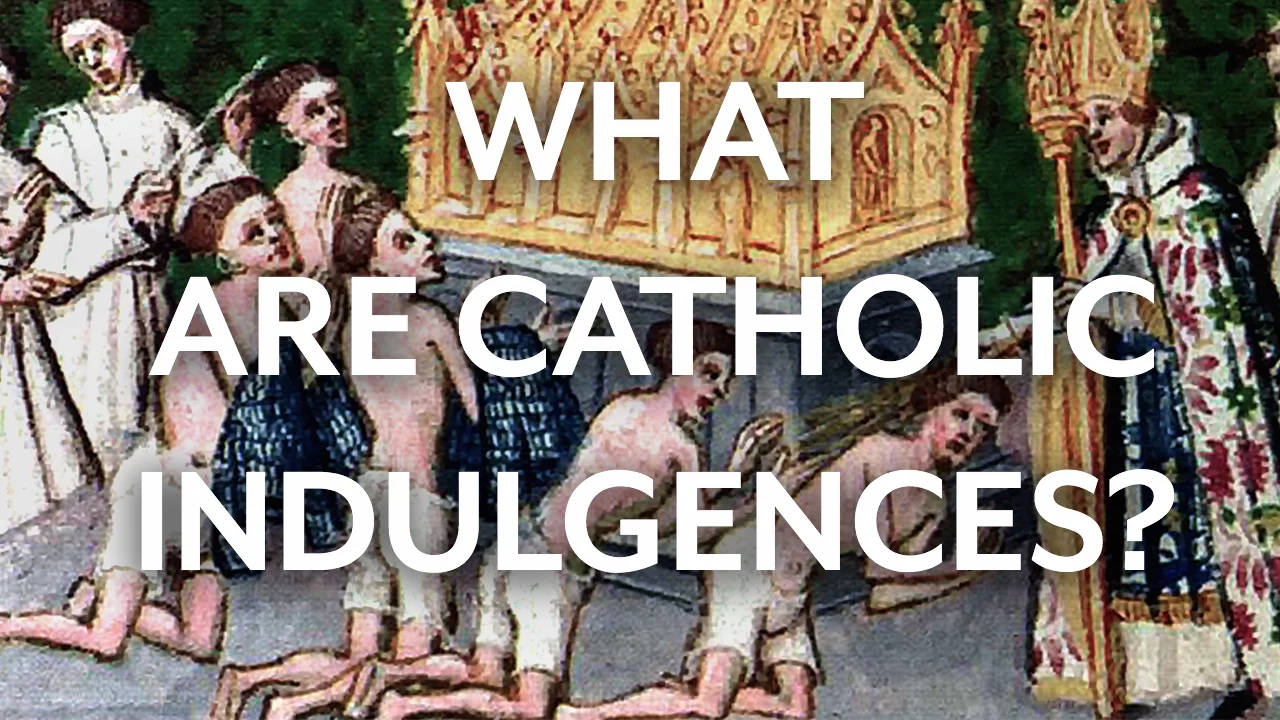
Indulgences worked like this: The saints lived such holy lives that they accumulated a surplus of "heavenly merits."
These merits could be earned or purchased by sinners and then used as a kind of currency to buy down the consequences of their sins.
An indulgence came as a letter from the pope, a kind of coupon good for less time in purgatory.
And they were transferable.
An earnest Christian could actually buy credit for his dead loved ones, as well.
One day while in Rome, Luther visited the Scala Santa (or "Holy Steps") brought back from the Holy Land and believed to be the very steps from Pontius Pilate's palace that Jesus climbed on the day he was convicted.
As Roman Catholic pilgrims still do today, Luther joined the crowd and made his way up, saying the Lord's Prayer on each step.
The pilgrim's reward for this climb: fewer years in purgatory for each of those steps.
Reaching the top, Luther stood up and thought, "Who knows if this is actually true?"
Luther had a lot to think about as he hiked home.
Back in Germany, he moved to the university town of Wittenberg, where he became a professor of theology.
At the time, Wittenberg was on the rise.
The local ruler, Prince Frederick the Wise, was working to make his capital an intellectual and cultural center.
He invited the region's best and brightest, from Luther to the painter Lucas Cranach to Luther's fellow professor and theologian, Philip Melanchthon.
The old center of Wittenberg looks much like it did in Martin Luther's day.
Stately mansions stand shoulder to shoulder, and the main square is dominated by its Town Hall.
Wittenberg's Church of St. Mary is where young Luther preached hundreds of sermons.
As if sorting out the spiritual confusion caused by his time in Rome, Luther struggled publicly through his preaching.
It was a dilemma.
He wanted to be true both to his Church and to his new understanding of God.
Things were revving up as it was becoming clear to everyone that there were discrepancies between what the Bible taught and what the Church was doing.
Luther attracted larger and larger crowds as, eventually, both his teaching and his writings directly attacked the corrupt practices he'd seen in Rome.
At the altar today, a painting shows a charismatic Luther preaching with his hand on the Bible, recalling how he supported his points not by relying on Church tradition but by quoting directly from the gospel.
Luther was not the first to question Church practices, nor was this discontent limited to Germany.
But going up against the medieval Church had a history of deadly consequences.
Two centuries before Luther, these evocative and remote castles in the south of France were destroyed by the medieval Church to silence heretical voices and keep the Church united.
They were the desperate last refuge of the Cathars, a break-away group of Christians who disobeyed Church dictates.
After a terrible period of torture and mass burnings, the Cathars were wiped out.
A century after the Cathars, Jan Hus of Prague also confronted the Church and met a similar fate.
He demanded that ordinary Christians be allowed to take communion with both the bread and the wine, which at the time was reserved exclusively for the priest.
Like Luther, Hus was a professor who gave controversial sermons and challenged Church authority by translating parts of the Bible into the local language.
And, also like Luther, Hus was prepared to die for his convictions.
But Hus was ahead of his time.
Lacking Luther's advantages -- such as the printing press, to help spread his ideas -- Jan Hus was declared a heretic and burned at the stake in 1415.
Back in Wittenberg, just as Luther was struggling with these contradictions and becoming more and more skeptical, the pope kicked off a capital campaign to build a glorious new St. Peter's Church in Rome.
It would be very expensive, and the German states, more fragmented and therefore easier to take advantage of than other parts of Europe, would foot much of the bill.
Papal fundraisers came out in full force.
With a fanfare of drummers and trumpeters, the fundraising campaign of the zealous priest John Tetzel came to Luther's neighborhood.
They offered letters of indulgence promising "full forgiveness for all sins, no matter how great, and absolution from all punishments."
As these were fully transferable, indulgences were ideal for bailing loved ones out of purgatory.
Caring and frightened peasants lined up to buy as Tetzel's men sang, "As soon as the coin in the coffer rings, another soul from purgatory springs."
[ Coin jingles ] Luther, with fresh memories of the corruption he saw in Rome, was outraged.
The Bible said nothing about buying forgiveness.
And it said nothing about purgatory, either.
Luther, now brazenly defying both the pope and over a thousand years of Church tradition, had become hugely popular.
But internally, he was still struggling with feelings of his own unworthiness.
He searched the Bible, hungry for an answer.
He was desperate to know, how could anyone deserve or earn salvation?
He found his answer in Paul's letter to the Romans.
It read, "The just shall live by faith."
With that key phrase, Luther discovered what he considered the "good news": that salvation is not earned by doing good works or giving money to the Church -- it's a free gift to anyone who believes.
Realizing this, Luther actually wrote, "All at once, I felt that I had been born again."
Re-energized, Luther began shaping a new theology that emphasized a personal relationship with God.
It was each person's faith that mattered, rather than Church rituals.
By the fall of 1517, Luther was ready to go public.
He wrote a treatise, known as his "95 Theses," or points for discussion.
As any good professor should, he raised some hard questions.
For example, point #82 boldly asked, "If the pope redeems some souls for the sake of miserable money to buy a church, why doesn't he empty purgatory for the sake of holy love?"
It was here, at Wittenberg's Castle Church, where, on October 31, 1517, Martin Luther came with his 95 points.
According to legend, he nailed the list to the door.
It was a kind of community bulletin board back then.
It was written in Latin, and intended only for scholarly debate.
But its impact turned out to be far greater.
Luther's supporters spread his ideas.
They were printed up in German and spread across the land.
The issues he called attention to angered the public.
This was a turning point, and now, change was unstoppable.
The sale of indulgences dropped dramatically, and the pope's salesmen were run out of town as German mobs now chanted slogans like, "When the coin rings in the pitcher, the pope becomes even richer."
[ Coin jingles ] Luther's posting of the 95 Theses kicked off the Reformation.
Many consider this the most important religious event of the last 1,000 years.
And today, 500 years later, Reformation Sunday is still celebrated in Protestant churches each October.
Luther was expert at PR, and his timing was ideal.
While he was a great writer, he also had the best political cartoonist in the land as a friend and took full advantage of the new-fangled printing press.
Thanks to the printing press, his many sermons and essays could be quickly and cheaply mass-produced as booklets.
His writing was witty, concise, and often in the local dialect.
His pamphlets were instant bestsellers -- nicknamed "Flugschriften," or "writings that fly," because they spread like a flock of birds to every corner of Europe.
In today's terms, his ideas went viral.
And that political cartoonist?
That was Lucas Cranach.
Cranach painted many portraits of Luther and his family, and illustrated Luther's books.
Knowing many of his followers were illiterate, Luther used Cranach to illustrate his points.
And Cranach did so vividly.
Book covers showed priests as bumbling animals, even the pope as a donkey.
Luther's bold ideas resonated with the masses: "Christ is found not in the bones of saints but in your love for each other, in the sacraments, and in the holy words."
"God's forgiveness cannot be purchased like a sack of potatoes.
The pope needs more prayer than money."
Meanwhile, the news of Luther's theology, attacks on the Church, and growing popularity reached Rome.
The new pope, Leo X, called Luther a heretic and sent him a papal bull threatening excommunication.
This formal document gave Luther 60 days to recant or be kicked out of the Church.
Luther, not cowed by the pope's bull, responded with a flurry of new pamphlets, further challenging Church practices.
Things escalated.
In a legendary tit-for-tat, the pope ordered the burning of Luther's books, and Luther burned the papal bull.
The more the Church opposed Luther, the bolder Luther became.
The two most powerful leaders in Europe back then were the pope, based in Rome, and the holy Roman emperor, whose empire spanned much of Europe.
The pope was furious.
And the emperor, Charles V, being a devout Catholic, wanted to support his pope.
The emperor could have crushed Luther easily.
But Charles had a bigger problem.
The Turks were threatening Europe from the east, closing in on Vienna.
Much of Charles' empire was made of German states, so to defend Europe, he needed German support.
Knowing Martin Luther had powerful German friends, the emperor had to deal with Luther cautiously.
He agreed to give Luther a hearing and summoned him to the imperial diet -- that's like a congressional hearing -- in the city of Worms on the Rhine River.
The Holy Roman Emperor himself traveled to Worms to arbitrate.
Luther's challenge to Rome's authority was cheered by Germans.
Traveling to Worms, Luther was greeted with a hero's welcome at each stop.
Pamphlets showed him with a halo accompanied by a dove, symbol of the Holy Spirit.
It's said that in one town, 60 horsemen escorted Luther to a church so packed with people eager to hear him preach that the balcony groaned and nearly collapsed.
Imagine the showdown at Worms -- papal representatives, princes, imperial troops, all power-dressing.
The emperor himself, sitting high on his throne.
The crowds craning to see the action.
In the center of the room, Martin Luther stood alone beside a table stacked with his rabble-rousing books and pamphlets.
The prosecutor insisted Luther was a heretic.
Summing up his case, he asked, "Who are you to go against 1500 years of Church doctrine?"
He demanded that Luther renounce his writings.
Luther would not budge.
Perhaps as never before in European history, one ordinary person stood up to authority for what he believed.
He said: "Unless you can convince me by scripture or by clear reasoning, I am bound by my beliefs.
I cannot and I will not recant.
May God help me. Amen."
Luther was declared a heretic and left Worms essentially an outlaw.
Now "outside" the protection of the law, Luther could be captured and killed by anyone.
On his way home to Wittenberg, he was kidnapped and dropped out of sight.
Many thought Luther had been killed.
In fact, Luther had been kidnapped but by friends for his own safety.
He was given refuge in the Wartburg Castle by his benefactor, Prince Frederick the Wise.
Luther grew a beard and passed himself off as a simple knight -- Junker George.
He spent the next year in hiding -- waiting, planning, and wondering what would come next.
This was Luther's room.
Restless and lonely in the castle, he fell into depression.
Throughout his life, he had struggled with what he saw as his personal war with Satan.
Luther would say, "Whenever the devil harasses you, seek out the company of friends, drink more, joke, and make merry."
Alone at Wartburg, he fought his depression by studying and writing.
And it was here that he employed his favorite weapon -- the printed word.
Believing that everyone should be able to read the Word of God, Luther began the daunting -- and dangerous -- task of translating the New Testament from the original ancient Greek into German.
He used simplified language, as he said, like a mother talking to her children.
Just as the King James version of the Bible did for English, Luther's translation helped to establish a standard German language that's used to this day.
Luther's translation brought the Bible to the masses.
The printing press made it more readily available and affordable to the public.
And German literacy rates skyrocketed.
As Germans read the Bible for the first time, they found -- as Luther had -- no mention of indulgences, purgatory, or even a pope.
This further fanned the fires of reform.
Luther was becoming the hero and figurehead of a growing revolution.
The epic showdown at the Diet of Worms inspired others to action.
Before long, across the land, monks and nuns left their monasteries, priests got married, and peasants were actually challenging the feudal system.
Things went beyond Luther's intentions of reforming the Church.
The Reformation was unleashing a grassroots social and political rebellion, and it spread like fire.
The changes spilled beyond religion.
In 1524, Germany's peasants, emboldened by Luther's brave challenge to the status quo, rose up, attacking their feudal masters with hoes and pitchforks.
They misinterpreted Luther's calls for freedom of religion to mean freedom from their feudal lords, as well.
Luther, who was only concerned with issues of faith and the Church, was horrified that his ideas could be misused to spark such a social revolt.
He actually condoned the nobles' brutal crackdown as they killed thousands of peasants to restore order.
But it was clear, the wheels of Revolution he'd set in motion could not be stopped.
Martin Luther's reforms unleashed turmoil far beyond his intent.
Eventually Luther left his Wartburg Castle refuge and returned home, here to Wittenberg.
He surrounded himself with a theological think tank and worked to rein in the extremism now rampaging through the land and to give direction to the Reformation and to what was becoming the "Lutheran" Church.
The Reformation movement spread far beyond Germany in the early 1500s.
Luther, while pivotal, was only one of many Christian leaders struggling to reform the Church.
In Switzerland, a land with deep roots in democracy and free thinking, Ulrich Zwingli also challenged the authority of Rome.
From his pulpit in Zürich, he railed against Church corruption and any practices that weren't specifically mentioned in the Bible.
His mission -- to place a Bible, written in everyday German -- into the hands of every person.
Zwingli's ideas reached each of Switzerland's remote cantons, and his theology gave the famously independent and yet-to-be-united Swiss something in common.
In nearby Geneva, in this church, a Frenchman named John Calvin also preached reform.
Like Luther, Calvin was convinced that salvation was by God's grace.
But Calvin emphasized predestination, the notion that God had already decided who was saved.
Calvinism, which evolved into Presbyterianism, spread to France, the Netherlands, and beyond.
Protestant ideas spread quickly through Scandinavia, thanks to its rulers.
King Christian III of Denmark had actually been present at the Diet of Worms and was inspired by Luther's brave stand.
He returned home to Copenhagen to establish Lutheranism as Denmark's state religion.
The Swedish king, Gustav Vasa, took a shrewd political approach.
He used the Reformation to make a clean break with Roman Catholic rule, nationalize Church holdings, and consolidate power for himself, thus becoming the "father" of the modern state of Sweden.
In England, King Henry VIII also broke with the pope in Rome but for selfish as well as political reasons.
He created the Church of England, with himself at its head.
He dissolved the monastic orders, destroyed their abbeys, and appropriated the Catholic Church's vast land holdings.
When Catholics rose up against him, Henry had the ringleaders hung, drawn, and quartered.
And his actions left Henry not only much richer and more powerful but free to divorce his barren wife and marry his fertile young mistress.
In Scotland, John Knox preached at the main church in Edinburgh, where he founded a separate Protestant denomination, austere Scottish Presbyterianism.
Knox insisted that every person be able to read the Word of God for themselves, which resulted in Scotland developing an education system centuries ahead of its time.
Not all reformers broke from the Church.
The priest and philosopher Erasmus of Rotterdam admired Luther's ideas on the importance of faith over good deeds.
Like Luther, he openly questioned the Church.
But he proposed sweeping reforms from within.
Erasmus remained a priest and never left the Catholic Church.
A Spanish soldier named Ignatius of Loyola had a spiritual conversion and spent a decade wandering Europe on a pilgrimage.
He eventually formed the Jesuits, a religious order whose mission was to be the intellectual warriors of the Church, battling both corruption within the Church and heresy outside the Church.
During the early 1500s, new ideas were cross-pollinating throughout Europe.
Protestant reformers, Catholic reformers, humanists, and scientists were all reading each other's words.
It was an exciting and confusing time.
Two powerful cultural movements -- the Reformation and the Renaissance -- were rushing together in a swirl of currents as history flowed on.
All across Europe, the momentum seemed in favor of reformers.
But the spread of the Reformation didn't happen without chaos and conflict.
In many areas, there were violent uprisings.
From Holland to Switzerland, Protestant extremists vandalized Catholic churches.
They attacked what they considered symbols of idol worship, forbidden by their interpretation of the Bible.
These iconoclasts, as they were called, shattered stained-glass windows, they lopped off the stone heads of saints, and stripped gold-leaf angels from the walls.
When Catholic cathedrals became Protestant churches, interiors were made simple, with dazzling images replaced by plain walls, pipe organs, and pulpits.
[ Organ plays ] For example, the biggest church in Switzerland, the Lausanne Cathedral, was originally Catholic and dedicated to Mary.
But when the Reformation hit, Swiss reformers purged it, whitewashing colorfully frescoed walls, trashing stained-glass windows, and smashing statues of Mary and the saints.
Today, the church remains clean of images and dominated by its extravagant pipe organ.
[ Organ plays ] Another example is the once Catholic, now Protestant main church of Haarlem, in Holland.
While now whitewashed in the Protestant fashion, the pillars reveal the decorative original frescoes that were covered up.
The many gilded chapels dedicated to various saints were removed.
The towering pipe organ is a reminder that, for Protestants, music became more important than the visual arts.
[ Organ plays ] And pulpits became a prominent feature because of the Protestant emphasis of bringing the Word of God directly to the people in their own language.
In territories where Protestants dominated, Catholics survived but went underground, forced to practice their faith in hidden churches.
In generally Protestant Amsterdam, for example, this Catholic church kept a low profile, disguised as a townhouse.
Persecution of Catholics, along with the rise of Protestantism, was turning Catholics into a minority in northern Europe.
By the mid 1500s, the Roman Church employed a strategy for stemming the tide of reformation.
The Vatican fought back with the Counter-Reformation, an attempt to put what was the universal Catholic Church back together.
On one hand, the Church worked to reform its internal corruption and reach out to alienated members -- and on the other hand, the Church resorted to propaganda, intimidation, and outright force.
Art became a propaganda tool.
Extravagant Counter-Reformation art and architecture was designed to inspire the masses.
Catholic churches dazzled with gold leaf and ornate decorations, offering a glimpse of the heaven that awaited those who remained faithful.
Counter-Reformation artists painted radiant, soft-focus Marys, sentimentally wrapping everything in warm colors and gentle light.
This bubbly Baroque style of art featured large canvases... bright colors... rippling motion... wild emotions... grand themes... and holy saints.
It appealed to the senses.
and was popular with both peasants and nobles alike.
It made heavenly visions real, and stirred the emotions.
This Baroque style remained popular in Catholic parts of Europe for generations.
The Church's propaganda art could intimidate as well as inspire.
Worshippers saw images of God-fearing Catholics burning Protestant pamphlets, of defenders of the Church stepping on snakes representing heretics, and angry angel babies tearing out pages of Lutheran teaching.
And the Counter-Reformation relied on an institution dating back to earlier times: the Inquisition.
It emanated from Spain at the imposing palace of El Escorial.
This full-scale, Church-run legal system brought Protestants, Jews, and nonconforming Catholics before its courts on the slightest evidence of "heresy."
Those convicted would be punished, tortured, and, in many cases, executed.
The Protestants responded with anti-Catholic propaganda of their own.
In this painting, hanging in Luther's hometown church in Wittenberg, the reformers tend to the "Garden of the Lord."
Luther rakes, and his intellectual sidekick, Melanchthon, pulls water from the well, symbolizing how the reformers went back to the original source to translate the Bible.
Meanwhile, the pope and his people trash all their careful spiritual gardening.
Even though Jesus has given the pope a reward, the pope keeps his hand outstretched, asking for more.
Looking on, the reformers pray reverently.
Other art was shockingly direct.
In this etching, Protestants portray the pope as Satan himself.
The whole era was intolerant to the extreme.
Everyone was convinced their vision of God was the one and only way.
And Luther was as conflicted and intolerant as his age.
He came down hard on the Roman Church, on Protestants who disagreed, and particularly hard on Jews.
Luther was intolerant of Jews.
He was angered that they wouldn't convert, which drove him, in his later years, to write hateful anti-Jewish essays.
This prejudice was consistent with his general intolerance, as when he supported the killing of so many rampaging peasants who were threatening the social order.
And it was only a matter of time before this kind of bitter war of ideas would flare up into actual war.
The Reformation and Counter-Reformation unleashed pent-up frustrations that transformed Europe into a battlefield for the next 100 years.
The wars may have been called "religious wars," but for the princes who ruled the many little German states, breaking with Rome -- as with most religious wars -- was also about power, money, and land.
Many German princes -- like Luther's supporter Frederick the Wise at Wittenberg -- saw the Roman Church as an obstacle to greater power.
And, at great peril, many opted to split from the Roman Church to support Luther, even if that meant war.
For a German prince, there were three big reasons to break from Rome: First, by opposing the pope, princes could rule without meddling bishops, who were above secular laws.
Second, princes could hold onto tithes formerly sent to Rome -- and a huge drain on their economies.
And third, the biggest landowner in their realm was the Church, and by joining forces with the Protestants, princes could confiscate Church lands.
The strife Martin Luther had unwittingly unleashed led to a chaotic series of wars that would last more than a century.
Throughout the 1500s, Europe's princes and kings jockeyed for power, using religion as their excuse.
It culminated in a bloody free-for-all, called the "Thirty Years' War," that raged from 1618 to 1648.
While the war involved many countries, it was fought mainly on German soil.
Much of the battle gear, ramparts, and folkloric reenactments tourists see today in Germany dates from this war.
Casualties were devastating, as a third of all Germans were killed.
On the Catholic side, the pope was supported by the powerful holy Roman emperor.
The emperor had Europe's leading army, and was more than willing to march into Germany and put down Protestants.
As these wars, with a mix of political and religious agendas, raged across Europe, princes grabbed for power while the people violently sorted out their deep-seated religious frustrations.
After literally millions of deaths, the devastation of entire regions, and widespread economic ruin, all involved were exhausted.
In 1648, a treaty was finally signed.
The result? Not religious freedom.
But now the leaders of each country were free to decide if their subjects would be Roman Catholic Christian or Protestant Christian.
Western Europe was effectively divided between a Catholic south and a Protestant north, a line that roughly survives to this day.
Europe had split into two camps.
On one side was the Roman Catholic Church -- those Christians who still recognized the pope.
On the other side were the Protestants, or protesting Christians.
Of course, both Catholics and Protestants are Christians.
But they have different styles and take different approaches.
For Catholics, church rituals and an ordained clergy are essential intermediaries between a worshipper and God.
They venerate saints and the Virgin Mary, and confess their sins to a priest.
Catholics accept precedents established through the centuries by the Church, and follow the spiritual leadership of the pope in Rome.
And they maintain a time-honored element of elaborate ritual and mysticism that enriches their religious experience.
For Protestants, worship style became different.
They purged their churches of holy relics, dispensed with many of the rituals, and reduced the formal role of ordained clergy.
Rather than appealing to saints and Mary, Protestants emphasize their direct relationship with God through Bible study and personal prayer.
Luther rejected five of the Catholic Church's seven sacraments.
He kept only Holy Communion and baptism.
The Lutheran movement introduced two essential changes -- They believe, first, salvation is a gift from God.
It's a matter of faith. You can't earn it.
And second, the Bible is the only source of religious authority.
After sparking such sweeping changes, Luther, in his later years, settled into a quiet life as a respected professor.
But his life was never without surprises.
One of the first things he did shocked everybody -- he got married!
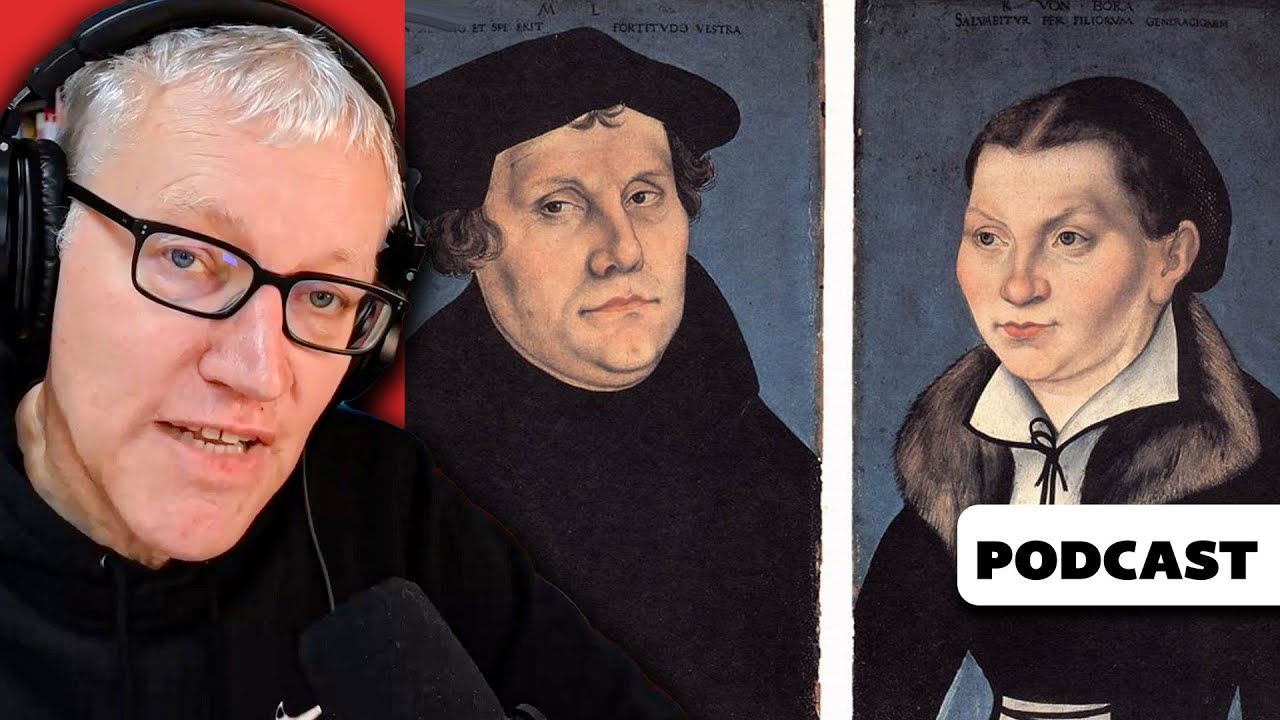
42-year-old Martin Luther, a former monk, married 26-year-old Katherine von Bora, a former nun.
Martin and Katie went on to have six children and raise four orphans.
Katie, who ran the huge and busy Luther household, was a welcome partner in Luther's circle.
Luther wrote, "Marriage is a better school for the character than any monastery, for it's here that your sharp corners are rubbed off."
Luther used his dining room table to host an ongoing social and intellectual jam session.
It was where his students, houseguests, and fellow reformers gathered, drinking Katie's homebrewed beer and eating the Luthers almost out of house and home.
They'd spend long hours discussing and debating religious issues and applying their ideas concretely to everyday life.
Luther's followers hung on his every word.
His students took notes.
And this anthology, which was printed in 1567, is called "Table Talk."
It collects over 6,000 entries, from profound to vulgar and offensive to silly.
"He who does not love wine, women, and song remains a fool his whole life long."
"What lies they tell about relics!
How is it that 18 apostles are buried in Germany when Christ had only 12?"
"God writes the gospel not in the Bible alone but on the trees and flowers and clouds and stars."
Luther remained a complex man.
He continued to struggle with depression.
He could be crude, bombastic, and even bigoted -- riddled with contradictions.
And he certainly enjoyed his beer.
Although he did warn, "It's better to think of church in the ale house than to think of the ale house in church."
Luther's earthy lifestyle reflects some of the spirit of what became the Lutheran Church, ideas which, back then, were quite radical.
He affirmed dimensions of everyday life, such as marriage and the joy of sex, as good and important, provided they were carried out in faith.
And pastors were free to marry.
There was nothing in the Bible that said they couldn't.
Luther believed in what he called the "priesthood of all believers."
Whether a schoolteacher, farmer, or a gardener, he believed all are equally capable of understanding God's word and can receive salvation without the help of intermediaries.
Because literacy was crucial to reading the Bible, Luther lobbied Germany's nobles to provide schools for all boys and girls.
And Luther loved music, which he figured the devil hated.
In perhaps his deepest depression, Luther wrote one of Christendom's greatest hymns, "A Mighty Fortress."
He composed many other hymns that put the basic elements of Christian worship into song.
To this day, Protestant churches are particularly alive with great organs and choral music.
Luther, who believed, "He who sings prays double," would have enjoyed the singing of the visiting Dresden boys' choir as they performed in his hometown church in Wittenberg.
Luther died in 1546 at age 62.
A massive funeral procession accompanied his body to the Castle Church in Wittenberg, where he's buried.
To this day, pilgrims bring flowers.
[ Choir singing ] After Luther's death, until the dawn of the 20th century, the Reformation helped open the way for fundamental changes in Western society.
With a less controlling role of the Church in everyday life, secular forces were free to flourish.
Secular thinking, including science, would thrive.
Literacy increased across Europe as people had the freedom to read the Bible.
Free-market capitalism thrived in northern Europe, fueled by the Protestant work ethic.
Nonreligious, secular arts were able to flourish.
And, eventually, a democratic spirit was kindled as people were emboldened to stand up to power, and there was a greater separation between church and state.
For most of the 500 years since the Reformation, relations between Catholics and Protestants have been troubled.
But there was one lesson Europe learned the hard way: tolerance.
And in our lifetime, huge strides have been made.
More than ever, Protestants and Catholics are coming together, and see themselves merely as different expressions of the same faith.
The Reformation was more than a religious event.
It was part of the societal weave we call progress.
And progress comes out of struggle -- religious freedom grew out of the Protestant Reformation, political freedom came out of the French Revolution, and personal freedom is the cry of the civil rights movement in our age.
It's all hard-earned. It's not always pretty.
But it is worth the trouble.
Martin Luther was a pivotal character in history who stood up for what he believed.
The Reformation he unleashed helped create a more tolerant society that eventually allowed diversity in how people strive to better understand God.
I'm Rick Steves. Thanks for joining us.
Up Next

25:50
Banned Philosophy Books: A Guide to the Index Librorum Prohibitorum
@CosmicSkeptic
455.8K views•2025-08-30

33:02
The Great Schism of 1054: Causes and Consequences
@SacredCathedrals
113.5K views•2026-02-19
91:57
The Geopolitics of the Ukraine War and the Rise of Global Autocracy
@JordanHarbingerShow
468K views•2025-04-19
17:05
Understanding the Cold War: Superpower Conflicts and the Road to Détente
@OverSimplified
46.1M views•2019-01-24
Related Study Plans & Knowledge Roadmaps
Structured learning paths in History
history
Byzantine Iconoclasm: Theology, Art & Politics
01Foundations of Byzantium and Early Christian Images
02The First Iconoclasm: Leo III and the Crisis of Images
03Empress Irene, Nicaea II, and the Second Iconoclasm
+ 2 more learning modules
9h5 modules
Explore Roadmap
history
Iranian Revolution (Causes, Events & Legacy)
01The Pahlavi Dynasty and the Roots of Discontent
02The Spark of Rebellion and the Rise of Khomeini
031979: The Fall of the Shah and the Climax of the Revolution
+ 2 more learning modules
8h5 modules
Explore Roadmap
history
Mali Empire: Mansa Musa, Trade & Timbuktu
01Foundations of the Mali Empire
02The Trans-Saharan Gold and Salt Trade
03The Reign and Pilgrimage of Mansa Musa
+ 1 more learning modules
6h4 modules
Explore Roadmap
history
1947 Partition: Politics, Borders & Legacies
01Foundations of British India and the Divide
02The Political Negotiations and the Mountbatten Plan
03Drawing the Boundary: The Radcliffe Line
+ 2 more learning modules
8h5 modules
Explore Roadmap