Carbon Fee and Dividend is a market-based climate policy that reduces carbon emissions by collecting fees on carbon-based fuels and returning most of the revenue to citizens as dividends, which incentivizes consumers to shift spending toward lower-carbon alternatives while maintaining household budgets.
Carbon Fee and Dividend: A Market-Based Climate Solution Explained
Added:Deep Dive
Understanding negative externalities, specifically how carbon emissions represent an unpriced cost to society and the environment.

This asset performs better than BITCOIN and GOLD - Carbon Credits with Trey Lockerbie
43.8K
Approximately 80% of global emissions currently represent unpriced externalities—negative environmental effects not reflected in market prices or taxed appropriately. Carbon pricing mechanisms like carbon credits create market-based incentives to reduce emissions by putting a monetary value on environmental damage. As governments implement mandatory carbon pricing (like Canada's $170/ton by 2030), demand for verified carbon credits will grow substantially. Unlike other commodities, carbon credits have no substitutes, making them unique in economic terms.
Click to watch →
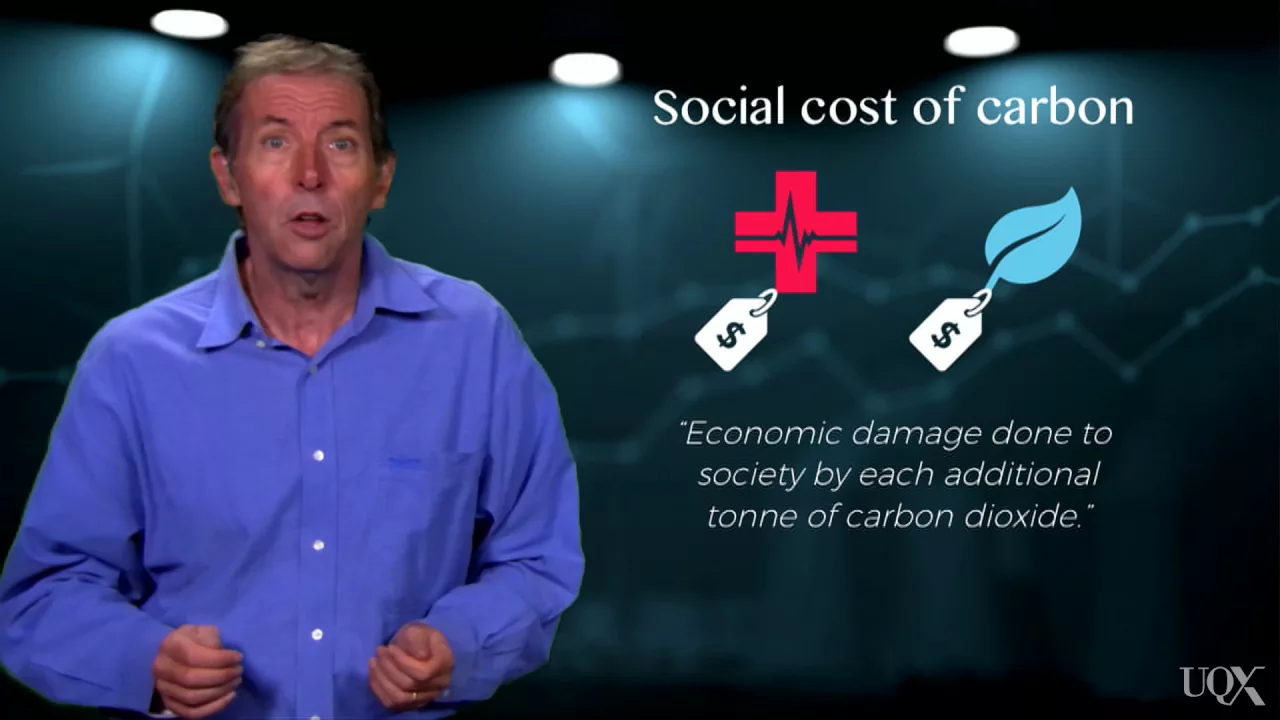
UQx Carbon101x 1.2.1.1 Externalities and the 'Social Cost of Carbon'
3.1K
Externalities are indirect, un-costed impacts on third parties when individuals or organizations make decisions about production, consumption, and investment; negative externalities occur when firms do not bear the full social costs of their activities (such as pollution), creating market failures where private costs differ from social costs; the social cost of carbon estimates the economic damage to society from each additional tonne of CO2 emissions, and governments can address these externalities by implementing policies that internalize these costs, such as pricing mechanisms or tradable permits.
Click to watch →
2.8(Micro)Market failure:Negative externality production:Market electricity coal-fired power station
2.4K
This section defines negative externalities as costs externalized onto society that firms do not bear. Using coal-fired power plants as the example, it explains how carbon emissions create climate change impacts, local air pollution (sulfur dioxide, nitrogen oxide), and human health problems (lung diseases). The marginal social cost (MSC) represents the total cost to society including both private production costs and externalized social damages. This concept is essential for understanding why free market prices understate true production costs.
Click to watch →
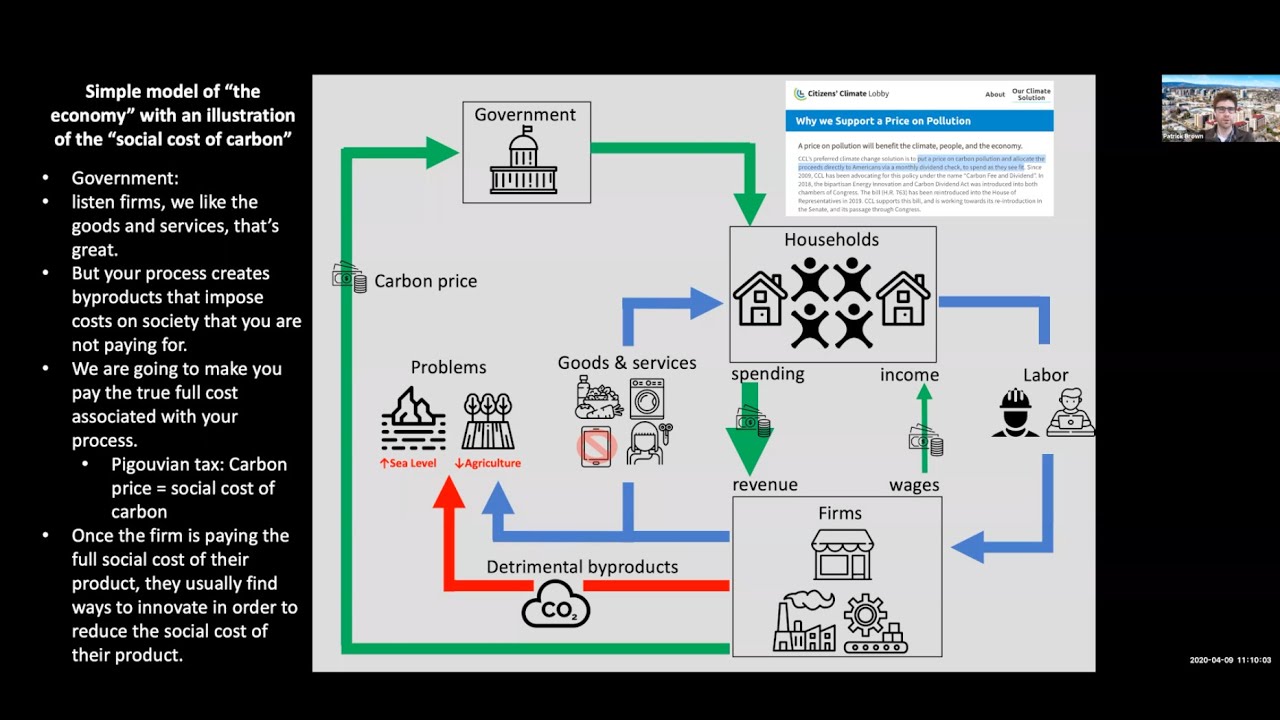
Carbon Price Is there One Weird Trick to Solve Climate Change?
148
Negative externalities occur when the production or consumption of goods and services imposes costs on third parties who did not choose to incur those costs. In the case of carbon emissions, firms producing goods and services generate CO2 as a byproduct that affects the entire atmosphere and climate system. These costs are 'socialized'—spread across society rather than borne by the polluter—because the problems (like sea level rise, reduced agricultural yields, and extreme weather events) affect everyone regardless of whether they contributed to the emissions. This creates a market failure where private costs (to the firm) differ from social costs (to society).
Click to watch →

САММИТ В ГЛАЗГО, ТОРГОВЛЯ КВОТАМИ И ЭКОЛОГИЯ, МЕСТЬ ПРЕДЛОЖЕНИЯ | НАСТОЯЩАЯ ЭКОНОМИКА №2
23.4K
Carbon pricing is essential because emissions have no market price, creating no economic incentive to reduce them. The Coase Theorem states that with clearly defined property rights and zero transaction costs, markets would efficiently allocate resources. However, in reality, externalities (unpriced costs affecting third parties) cause market failure. When factories pollute without paying for environmental damage, they overproduce harmful goods. The goal of carbon pricing is to internalize these external costs, making polluters pay for environmental damage and creating market incentives for cleaner production.
Click to watch →
Deep Dive
Basic economic principles of supply and demand, including how price increases typically lead to reduced consumption of a good (price elasticity).

Supply and Demand
29.2K
The law of supply and demand states that when demand for a product is high, prices go up, and when demand is low, sellers lower prices. Supply refers to how much sellers have, while demand refers to how much buyers want. When Maya and Tomas raised their lemonade price from 20 to 35 cents, they sold only half a pitcher by noon, demonstrating that higher prices reduce demand. Conversely, when they lowered the price to 15 cents, sales increased significantly. This shows the fundamental relationship between price and consumer purchasing behavior.
Click to watch →

종호쌤이 알려주는 경제론, 시장론 쉽게 정리하는 법! | 메가랜드 막판정리 | 부동산학개론 이종호
4.1K
Equilibrium price increases when demand increases or supply decreases. Demand increases with population growth, preference increases, substitute goods price increases, income increases, and price increase expectations. Supply decreases when construction material prices rise. Elasticity measures responsiveness: price elasticity of demand shows quantity response to price changes (elastic: small price change, large quantity change; inelastic: large price change, small quantity change). Income elasticity determines normal vs. inferior goods (positive vs. negative). Cross-price elasticity identifies substitutes (positive) vs. complements (negative). Supply elasticity affects price change magnitude: elastic supply causes smaller price changes, inelastic supply causes larger price changes. Luxury goods have more elastic demand than necessities.
Click to watch →

Why Audi Q3 didn't sell at a cheaper price ? | Veblen vs Giffen Goods | Price Elasticity of Demand
701
The basic law of demand in economics states that when the price of a good increases, fewer people will buy it (or people will buy less of it), and when the price decreases, more people will buy it (or people will buy more of it). This makes intuitive sense - if something becomes cheaper, consumers tend to purchase more, while higher prices typically result in reduced consumption.
Click to watch →

Basic Economics - 2.3 - The Role of Prices - Supply and Demand
2.8K
The basic principles of economics state that people buy more at lower prices and less at higher prices (demand), while producers supply more at higher prices and less at lower prices (supply). There is no fixed or objective need for products or services, as demonstrated by the Israeli kibbutz example where charging prices for electricity and food sharply reduced consumption. Similarly, there is no fixed supply of natural resources like oil, as the economically feasible amount varies directly with price. Oil sands in Venezuela and Canada were not counted in reserves until prices rose sufficiently to make extraction profitable.
Click to watch →

Economy - LPG crisis & Essential Commodities Act- Key Facts for UPSC Prelims & Mains by Mrunal Patel
95.8K
Price elasticity of demand measures how responsive the quantity demanded of a good is to changes in its price. It is calculated as the percentage change in quantity demanded divided by the percentage change in price. Goods with high price elasticity (elastic demand) see significant changes in quantity demanded when prices change—for example, luxury items like ice cream have elastic demand because consumers can easily reduce consumption if prices double. Conversely, goods with low price elasticity (inelastic demand) maintain relatively stable consumption levels despite price changes—for example, addictive substances like gutkha have inelastic demand because consumers continue purchasing even when prices increase substantially. The elasticity varies based on whether a good is considered essential for survival or discretionary spending.
Click to watch →
Deep Dive
The concept of Pigouvian taxes, which are taxes levied on market activities that generate negative externalities.
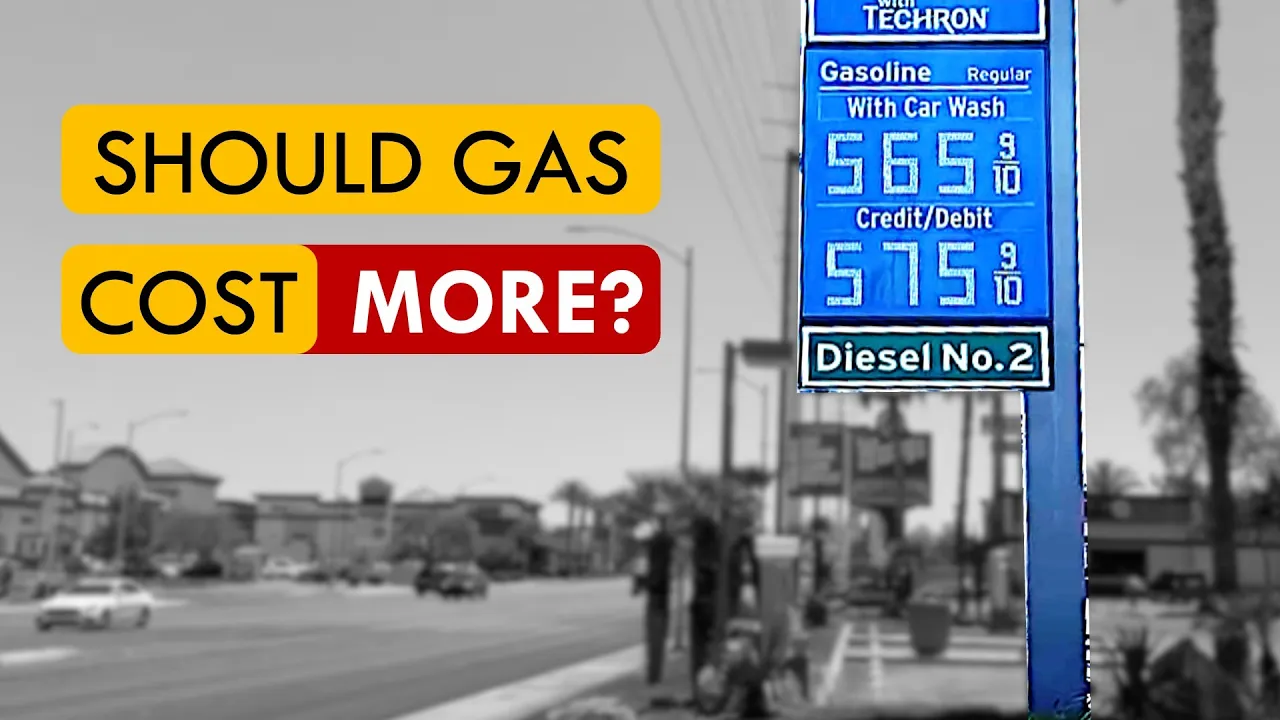
How the Pathetically Cheap Cost of Driving Makes Our Cities Worse
111K
A Pigouvian tax is a type of taxation named after economist Arthur Pigou, designed to account for negative externalities—costs imposed on society by economic activities that are not reflected in market prices. The concept applies when individual actions create costs borne by others, such as pollution or traffic accidents. By imposing taxes on activities that generate these external costs, governments can encourage more socially optimal behavior. Examples include cigarette taxes (to address health costs from secondhand smoke) and gas taxes (to compensate for air pollution and climate change impacts).
Click to watch →

Indian Economy | CLASS 31 - राजकोषीय नीति / Fiscal Policy | Part 3 | UPSC 2025/26 | Madhukar Kotawe
50.9K
A Pigouvian Tax is a tax imposed on activities that create negative externalities (harm to society). Named after economist Arthur Pigou, this tax is designed to internalize external costs. For example, taxes on pollution, carbon emissions, or other harmful activities are Pigouvian taxes. The goal is to reduce harmful activities by making them more expensive, thereby aligning private costs with social costs.
Click to watch →

Pigouvian Tax | KYC Series: Know Your Concept | By Nirmesh Sir | StudyIQ PCS
1K
Pigouvian Tax is a tax levied by the government on economic activities that generate negative externalities, such as pollution or environmental damage, to internalize the external costs and incentivize producers to reduce harmful activities; it was first defined by British economist Arthur Pigou in the 1920s and is commonly applied to industries that pollute the environment or products like tobacco and alcohol that negatively impact society.
Click to watch →

pigouvian tax
3.2K
A Pigouvian tax is a government-imposed tax on economic activities that generate negative externalities (such as pollution or environmental damage), designed to internalize these external costs by making producers and consumers pay for the full social cost of their actions, thereby reducing harmful activities to a socially optimal level.
Click to watch →

UGC NET Economics | Money & Banking PYQ 2022–2025 | Most Expected Questions
1.9K
A Pigouvian tax is a tax levied to correct negative externalities (negative externalities are costs imposed on third parties by economic transactions). The correct statements about Pigouvian tax are: (1) It provides a solution to internalize the total cost of an activity in the market; (2) It helps reduce the production of pollutants through public policy; (3) It acts as a corrective tax. However, it does NOT directly increase factor productivity in the real sector. This concept is from environmental economics and welfare economics.
Click to watch →
Deep Dive
Fundamental knowledge of climate change, greenhouse gases, and the primary sources of carbon dioxide emissions.

Climate Change Expenditure Tagging: Climate Change 101
306
Climate change is driven by the greenhouse effect, where greenhouse gases act as a shield in Earth's atmosphere containing solar heat. Major greenhouse gases include carbon dioxide (82% of effects), methane, nitrous oxide, and fluorinated gases. Primary emission sources are electricity generation (fossil fuels), transportation (gasoline/diesel), industries, agriculture (cattle methane production), and commercial/residential sectors. This foundational understanding explains why human activities are altering Earth's climate systems.
Click to watch →

Environment (पर्यावरण) | Most Important Questions | For All Exams | HSSC TGT Screening | CET Mains
56.2K
Greenhouse gases are the primary source of carbon dioxide emissions. These gases trap heat in the atmosphere, causing global warming and climate change. The increase in greenhouse gases is the main driver of current climate change phenomena.
Click to watch →

تغير المناخ / العلوم البيئية / صف ثاني عشر / مناهج سلطنة عمان / كامبريدج / استاذ / محمد صالح
1K
Climate change refers to continuous natural variations in Earth's climate through warming and cooling cycles. Greenhouse gases are atmospheric gases that absorb infrared radiation from Earth's surface, including CO2, water vapor, methane, nitrous oxide, ozone, and industrial chemicals like CFCs. The natural greenhouse effect maintains Earth's surface temperature at approximately 15°C instead of -18°C without these gases. Human activities have significantly increased greenhouse gas concentrations, amplifying this natural effect. Four main human sources contribute: fossil fuel combustion (coal, oil, natural gas) releases CO2 and water vapor, with coal responsible for 33% of global warming; rice paddy agriculture accounts for 19% of emissions through methane release during anaerobic decomposition; livestock farming releases methane through digestion and reduces carbon absorption by clearing forests; and landfill gas, composed of equal parts methane and CO2, is the third largest human methane source in the US. Methane has a 12-year atmospheric lifespan but is 28 times more effective at trapping heat than CO2, which persists for over 100 years.
Click to watch →

Energy & Climate Change -- understanding the global drivers
438
Climate change is driven by rising greenhouse gas concentrations, particularly CO2. The greenhouse effect naturally warms Earth by 30°C, making it habitable at 15°C average. CO2 levels have risen from 220 ppm (60,000 years ago) to 390 ppm today. The global carbon cycle involves exchanges between atmosphere (760 gigatons), vegetation (600 gigatons), soil (1,600 gigatons), and oceans (1,000 gigatons). Human activities disrupt this balance through ecosystem loss, ocean acidification, and fossil fuel emissions. CO2 accounts for 85% of UK emissions, with primary sources including fossil fuels, biomass burning, and land use change. Methane (8% of UK emissions) is 20 times more powerful than CO2, arising from landfills, cattle, and rice paddies. Nitrous oxide (5% of UK emissions) is 300 times more powerful, from fertilizers and catalytic converters.
Click to watch →

Infoveranstaltung: Fortsetzung Klimaneutrale Landwirtschaft Graubünden
352
This section explains the scientific basis of climate change. Over the past 800 years, atmospheric CO2 remained between 150-300 ppm, but industrialization caused a 50% increase. Unlike historical climate variations over 40,000-100,000 years, current changes are unprecedented in speed. Greenhouse gases (CO2, methane, nitrous oxide, FCKW) trap heat, with warming potentials ranging from 28 to over 12,000 times CO2. Without greenhouse gases, Earth would be -18°C, but excess causes dangerous warming. The four major emission sources are transportation, industry, agriculture, and households.
Click to watch →
Prerequisite Knowledge
- Concept 01Understanding negative externalities, specifically how carbon emissions represent an unpriced cost to society and the environment.
- Concept 02Basic economic principles of supply and demand, including how price increases typically lead to reduced consumption of a good (price elasticity).
- Concept 03The concept of Pigouvian taxes, which are taxes levied on market activities that generate negative externalities.
- Concept 04Fundamental knowledge of climate change, greenhouse gases, and the primary sources of carbon dioxide emissions.
Subsequent Learning
- Step 01Evaluating the economic and social impacts of progressive vs. regressive taxation, and how carbon dividends can offset costs for low-income households.
- Step 02Comparative analysis of alternative carbon pricing mechanisms, such as Cap-and-Trade (emissions trading systems) vs. Carbon Fees.
- Step 03The concept of Border Carbon Adjustments (BCAs) to prevent 'carbon leakage' and maintain international trade competitiveness.
- Step 04Real-world case studies of carbon pricing implementation, such as the Canadian federal pricing system or the British Columbia carbon tax.
碳费红利
结束
碳费红利
0:02Playing Section
- 1
碳费与红利是减少碳排放的市场机制。
- 2
对化石燃料收费,并将大部分收入返还给公众。
- 3
通过改变价格推动低碳消费选择。
Direct Regulation and State-Led Investment (Command-and-Control)
While the Carbon Fee and Dividend relies on market-based price signals to gradually shift consumer and corporate behavior, critics argue this approach is too slow, indirect, and inequitable to address the urgency of the climate crisis. Proponents of alternative approaches advocate for direct 'command-and-control' regulations—such as banning internal combustion engines, mandating renewable energy standards, and directly phasing out fossil fuels. Additionally, environmental justice advocates point out that market-based mechanisms allow localized pollution 'hotspots' to persist in low-income and marginalized communities, as wealthy industries can choose to pay the fee rather than reduce emissions. Instead of relying on market forces, this counterpoint favors massive public investments in green infrastructure, public transit, and direct community-led transition programs to guarantee swift and equitable decarbonization.
Deep Dive
Evaluating the economic and social impacts of progressive vs. regressive taxation, and how carbon dividends can offset costs for low-income households.
Carbon "Price is Right": Harnessing the Market to Drive Down Carbon Emissions
207
Carbon pricing is often considered regressive because low-income families devote a higher percentage of their income to energy consumption. However, this view is incomplete: (1) The dividend can make a regressive tax progressive by returning revenues to households; (2) Health impacts from local air pollution (ozone, particulate matter) disproportionately affect poor communities and can offset costs; (3) Benefits of avoided climate damages may accumulate more to poor communities who are less able to adapt; (4) An MIT study found that air quality improvements from transitioning to low-carbon economies could offset implementation costs by up to 10 times. Comprehensive analysis must consider all distributional impacts, not just energy costs.
Click to watch →
Can the UK meet its energy needs from renewables?
1.8K
The carbon dividend represents the most widely endorsed policy solution among economists, backed by over 3,500 economists including 27 Nobel laureates. Under this mechanism, a carbon tax generates revenue returned to households equally, transforming a regressive tax into a progressive one. Poorer households use less energy absolutely, so they pay less in total taxes while receiving the same dividend as wealthier households. This approach provides price signals encouraging efficiency and low-carbon choices while maintaining social equity. The carbon dividend addresses the fundamental problem that direct carbon taxes disproportionately burden low-income consumers, making comprehensive decarbonization politically and economically viable.
Click to watch →

Carbon Pricing Costs for Households and Revenue Recycling Options in Canada
127
Carbon taxes in Canada are found to be quite regressive, imposing substantial burdens on lowest-income quintiles. Analysis of four revenue recycling options shows: means-tested sales tax rebates and lump sum dividends are progressive (providing greater rebates to lower-income households), sales tax cuts are somewhat ambiguous, and increases in basic income tax exemptions are regressive. Without the Output-Based Pricing System, indirect costs substantially increase (particularly in Alberta, Saskatchewan, New Brunswick, and Nova Scotia), causing carbon tax costs to nearly double for high-income households in these provinces.
Click to watch →

Prospects for Economic Growth in the United States
234
Distributional analysis revealed: (1) Household rebates are the most progressive policy, benefiting low-income households most; (2) Payroll tax reduction redistributes from old to young in the short run, becoming moderately regressive in the long run; (3) Labor income tax reduction is progressive for retired generations but regressive for young and future generations; (4) Dividend/capital gains elimination plus rebates proves generally progressive because indexed transfers offset lower capital income taxes; (5) Debt reduction plus rebates shows similar patterns with smaller long-run gains.
Click to watch →

Gilets jaunes: « Ces types de mouvements vont se multiplier dans les mois à venir »
55.2K
Carbon taxes are regressive because they disproportionately affect low-income households. This occurs because carbon taxes are consumption-based taxes that impact budgets more heavily on those with lower incomes who spend a larger proportion of their earnings on basic necessities. Wealthier individuals can absorb these costs more easily and often have savings to draw upon. In France, the 2018 carbon tax represents approximately 1% of the budget for the 10% most modest households, compared to only 0.2% for the wealthiest. This creates a perception of unfairness, especially when combined with broader fiscal policies that provide substantial tax benefits to the wealthy while working-class citizens bear the burden of funding public services.
Click to watch →
Deep Dive
Comparative analysis of alternative carbon pricing mechanisms, such as Cap-and-Trade (emissions trading systems) vs. Carbon Fees.

Carbon Pricing in the Ontario Industrial Market
100
Two primary carbon pricing mechanisms exist: carbon taxes establish fixed prices per ton of emissions providing price certainty but uncertain reduction outcomes, while emission trading systems set caps on total emissions creating price volatility through market auctions but guaranteeing specific reduction targets. Subtypes include cap-and-trade (fixed emission caps with tradable allowances) and baseline-and-credit systems (activity-based intensity limits that ratchet down over time). Globally, approximately 39 carbon pricing regimes exist, with roughly equal numbers of carbon tax and emission trading systems. Europe leads with comprehensive coverage, while the US lacks federal mechanisms despite state-level initiatives in California, Washington, and RGGI states.
Click to watch →

BEYOND CARBON FEES: NEXT STEPS IN CARBON PRICING Forum
121
Carbon pricing mechanisms, including carbon fees and emission trading schemes (ETS), are essential policy tools for reducing greenhouse gas emissions, with carbon fees providing stable price signals and predictable costs for businesses, while ETS systems offer emission caps but face challenges with price volatility and market liquidity; successful implementation requires careful design, stakeholder engagement, and gradual rate increases to achieve meaningful emission reductions while maintaining economic competitiveness.
Click to watch →

Canada's Political Affairs Update with the Toronto Sun's Brian Lilley
39.4K
Quebec operates a cap-and-trade system rather than a direct consumer carbon tax, which functions as an alternative mechanism for carbon pricing. Under this system, Quebec pays approximately $57 per ton of carbon, compared to $80 per ton paid by other Canadian provinces. This creates a de facto lower carbon price for Quebec residents while still participating in carbon market mechanisms. Ontario previously joined Quebec and California in a carbon market, though it drove up costs without significantly reducing emissions.
Click to watch →

アナライズ・プラス(2021年7月17日放送「マーケット・アナライズ plus+」)
1.5K
Carbon pricing is a market-based approach to reduce greenhouse gas emissions by assigning economic value to CO2 emissions. There are two main mechanisms: carbon tax (government-imposed tax on emissions) and cap-and-trade (government sets emission limits and allows trading of emission permits). Cap-and-trade is more effective for controlling total emissions because it establishes a hard cap on total pollution, whereas carbon tax only makes emissions more expensive without guaranteeing reductions. The EU Emissions Trading System (EU ETS), launched in 2005, is the world's first and largest cap-and-trade system, covering over 11,000 facilities across 31 countries and reducing power sector emissions by 35% through fuel switching from coal to natural gas and renewables.
Click to watch →

Systems Thinking for Climate Change
2.5K
Two main approaches to carbon pricing exist: cap and trade (setting emission limits that decrease annually, creating tradable credits auctioned to companies) and fee and dividend (implementing a steadily increasing carbon tax, starting at $40/ton and rising $10 annually). From a systems perspective, cap and trade creates price volatility that makes future planning difficult for businesses and citizens, reducing effectiveness. Fee and dividend provides stable, predictable pricing that enables long-term investment decisions in renewable energy infrastructure.
Click to watch →
Deep Dive
The concept of Border Carbon Adjustments (BCAs) to prevent 'carbon leakage' and maintain international trade competitiveness.

IMF Summer School: Macroeconomics of Climate Change
1.6K
Border carbon adjustments (BCAs) address competitiveness concerns through charges on imported embodied carbon. Three rationales exist: preserving EITI industry competitiveness, preventing emissions leakage, and encouraging global carbon pricing adoption. However, limitations include modest incentives (China's exports contain only 1% embodied carbon for EU), potential WTO legal challenges, and violation of differentiated responsibilities principles. Effective BCA design requires focusing on EITI industries rather than broader sectors, using country-specific benchmarks initially to avoid burdening emerging economies, and basing exporter rebates on exogenous industry benchmarks rather than firm-level emissions to maintain mitigation incentives.
Click to watch →

Understanding Border Carbon Adjustments (BCAs)
5.7K
Border Carbon Adjustments (BCAs) are trade mechanisms that charge imports at the border as if they were produced under the domestic carbon pricing regime, designed to prevent carbon leakage when countries implement ambitious climate policies; however, their effectiveness depends critically on design choices including trade scope, exemptions, emissions coverage, carbon accounting methods, credit for foreign climate actions, and revenue use, which can lead to outcomes ranging from genuine environmental protection to unfair domestic producer protection, making international cooperation essential to avoid a fragmented regulatory landscape that disproportionately burdens developing country exporters.
Click to watch →
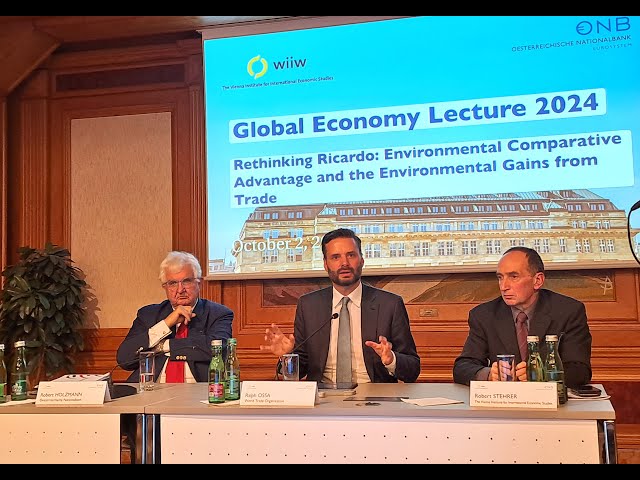
Ralph Ossa: Environmental Comparative Advantage and the Environmental Gains from Trade
271
Border carbon adjustments (BCAs) aim to prevent carbon leakage but face significant challenges: compliance costs are very high for small and medium enterprises, particularly in developing countries; many WTO members perceive BCAs as environmental protectionism and unfairness; and political costs are large, risking trade tensions. A better alternative is global carbon pricing arrangements that make BCAs unnecessary. The WTO provides a clear framework for orderly conduct of industrial policy through existing agreements on subsidies, tariffs, and technical barriers to trade. Despite challenges, the WTO continues delivering through negotiations, dispute settlement, and oversight, with more than 75% of world trade still conducted under WTO rules. The organization faces reform needs but remains the cornerstone of the global economy.
Click to watch →

Building bridges: Border carbon adjustment and the multilateral trading system
148
International consensus on border carbon adjustment could include several key principles: (1) Primacy of leakage protection - BCA should only prevent leakage, not preserve competitiveness or leverage others; (2) Revenue sharing - significant portions should be rebated to affected developing countries; (3) No double protection - BCA charges should be adjusted downward for domestic carbon pricing in exporting countries; (4) Credit for equivalence - BCA should credit for carbon prices paid in exporting countries; (5) Openness - meaningful consultation and full transparency on draft regulations; (6) Best practices - BCA should only cover goods subject to domestic carbon pricing, with challengeable default assumptions on greenhouse gas intensity; (7) No national exemptions - no country should unilaterally judge other countries' climate ambition adequacy; (8) Independent appeal mechanisms for foreign producers. The EU's CBAM is designed to ensure equal carbon pricing, prevent double carbon pricing, and apply progressively. For Least Developed Countries (LDCs), the EU has built a transitional period of three years with no adjustment, only information collection.
Click to watch →

Global Economy Lecture 2024
893
Border carbon adjustments (BCAs) are mechanisms designed to prevent carbon leakage by imposing additional tariffs on imports from countries without equivalent carbon pricing. With approximately 75 carbon pricing schemes now in place globally covering 24% of emissions, countries increasingly combine domestic carbon prices with BCAs to protect competitiveness. However, BCAs face significant challenges: high compliance costs particularly burden small and medium enterprises and developing countries; perceptions of unfairness as wealthy nations impose costs on developing economies; and substantial political risks of trade tensions. A better alternative would be global arrangements making BCAs unnecessary, which is why the WTO, IMF, World Bank, and UNFCCC are collaborating on measurement standards and common carbon pricing metrics.
Click to watch →
Deep Dive
Real-world case studies of carbon pricing implementation, such as the Canadian federal pricing system or the British Columbia carbon tax.

Cathy Orlando - Canada's Carbon Fee & Dividend
105
Canada implemented a comprehensive federal backstop carbon pricing policy consisting of two components: a price on fossil fuels for consumers and an Output Based Pricing System (OBPS) for emissions-intensive industries. The OBPS functions as cap-and-trade without a cap, sending market signals while helping industries remain competitive. The policy applies to provinces without equivalent systems, including Ontario, Saskatchewan, and Alberta. Approximately 80% of Canadians benefit financially, with rebates varying by province based on local electricity grid carbon intensity. The carbon price increases from $20/ton in 2018 to $50/ton by 2022, with economic studies indicating it must reach $220/ton by 2030 to meet even current Paris Agreement targets. British Columbia's experience demonstrated job growth in clean energy sectors following carbon pricing implementation.
Click to watch →

Canada's Carbon Tax Explained and why it keeps going up (2024)
6.4K
Canada's Federal Carbon Pricing System, introduced in 2019, applies nationwide unless provinces have their own carbon pricing meeting minimum standards. The system has two components: a carbon tax on fuels and the Canada Carbon Rebate. The carbon tax increases annually by $15 per ton, starting at $20 in 2019 and reaching $65 by April 2024, with plans to reach $170 by 2030. Different fuels have different prices per unit based on their emission levels. The rebate system is revenue-neutral, returning 90% of collected funds to households and 10% to decarbonization projects. Alberta was the first North American jurisdiction to price carbon in 2007.
Click to watch →
Trudeau SNAPS After HECKLED He Spent Time in a BATHTUB with Tom Clark
48.8K
Canada's carbon pricing system operates through two parallel mechanisms: provincial/territorial systems and federal systems. Provincial systems (British Columbia, Quebec, New Brunswick, and Northwest Territories) have their own carbon tax systems and do not receive federal rebates. The federal system applies in Manitoba, Nunavut, and Yukon. Some provinces (Ontario, Newfoundland and Labrador, Prince Edward Island, Nova Scotia, Alberta, Saskatchewan) have hybrid systems where both federal and provincial components apply. This creates a complex landscape where different regions face different carbon pricing realities, with approximately 15 million Canadians in Quebec and British Columbia alone not receiving rebates despite the federal rebate program.
Click to watch →

The Politics of Taxes in Canada — Trudeau, Harper, Poilievre & Carney Explained
10K
In 2008, British Columbia became the first jurisdiction in North America to implement a broad-based carbon tax, designed to be revenue-neutral with cuts to personal and corporate income taxes. Starting at $10 per ton of CO2 (about 2 cents per liter on gasoline), it rose gradually each year. Campbell called it a market-based solution to environmental problems. Between 2008-2012, BC's per capita fuel use dropped by roughly 16% even as the economy grew faster than the Canadian average. The OECD and World Bank praised the policy as a model for balancing growth with sustainability. However, politically it was a minefield—rural and working-class communities saw it as a direct hit to wallets. By 2011, public backlash was so intense that Campbell resigned, and his successor froze the rate and dropped the revenue-neutral promise.
Click to watch →
Carbon "Price is Right": Harnessing the Market to Drive Down Carbon Emissions
207
Many governments have adopted carbon pricing in recent years, including South Africa, Chile, South Korea, and China (which launched cap and trade in January 2017). British Columbia, Canada provides a notable example: a center-right government implemented a carbon tax starting at $10/ton and increasing to $30/ton, based its reelection campaign on it, and now has no opposition among any political party. The province has raised the tax to $50/ton. British Columbia's success demonstrates that carbon pricing can build broad political support over time, even across the political spectrum. The Canadian federal government is proposing a pan-Canadian carbon price where provinces set their own terms but must implement pricing.
Click to watch →
碳费红利
结束
碳费红利
0:02- 1
碳费与红利是减少碳排放的市场机制。
- 2
对化石燃料收费,并将大部分收入返还给公众。
- 3
通过改变价格推动低碳消费选择。
Direct Regulation and State-Led Investment (Command-and-Control)
While the Carbon Fee and Dividend relies on market-based price signals to gradually shift consumer and corporate behavior, critics argue this approach is too slow, indirect, and inequitable to address the urgency of the climate crisis. Proponents of alternative approaches advocate for direct 'command-and-control' regulations—such as banning internal combustion engines, mandating renewable energy standards, and directly phasing out fossil fuels. Additionally, environmental justice advocates point out that market-based mechanisms allow localized pollution 'hotspots' to persist in low-income and marginalized communities, as wealthy industries can choose to pay the fee rather than reduce emissions. Instead of relying on market forces, this counterpoint favors massive public investments in green infrastructure, public transit, and direct community-led transition programs to guarantee swift and equitable decarbonization.
Understanding negative externalities, specifically how carbon emissions represent an unpriced cost to society and the environment.
Basic economic principles of supply and demand, including how price increases typically lead to reduced consumption of a good (price elasticity).
The concept of Pigouvian taxes, which are taxes levied on market activities that generate negative externalities.
Fundamental knowledge of climate change, greenhouse gases, and the primary sources of carbon dioxide emissions.
Evaluating the economic and social impacts of progressive vs. regressive taxation, and how carbon dividends can offset costs for low-income households.
Comparative analysis of alternative carbon pricing mechanisms, such as Cap-and-Trade (emissions trading systems) vs. Carbon Fees.
The concept of Border Carbon Adjustments (BCAs) to prevent 'carbon leakage' and maintain international trade competitiveness.
Real-world case studies of carbon pricing implementation, such as the Canadian federal pricing system or the British Columbia carbon tax.
2.4K views27likes2:53@stevenlevymathOriginal Release: 2016-08-09
this is Step Levy and this is Steven Levy math this presentation is about carbon fee and dividend carbon fee and dividend is a market-based way to reduce carbon emissions that cause climate change there are only two elements collecting a fee on carbon-based fuels and returning most of the money most of the fees to the General Public minus a few Administration percentage points to the government here we see an oil well and there is carbon fees associated with the oil that they pull out of the ground which are then given to the general public in the form of a dividend we'll see more about that in a second before carbon fee and dividend this is what you see there's a family they're going to go out for a long lunch or dinner whatever they have $4 so they're going to spend a dollar on each one of these fast food items they're going to add two hamburgers and two salads but with carbon fee and dividend I start off with $4 but the salads are still a dollar however the hamburger is now $2 so all they can afford is one hamburger and two salads but they're going to get a dividend check for a dollar so they get a dollar and with that dollar they buy another salad so what we see here is that their SP expenditures have now moved more towards things that don't require as much carbon to be produced well thanks for watching my Facebook page is Steven leevy math. info I'm also on teacher Tu is Steven Ley math.com and here are the credits rolling by if I can be of help let me know leave a message on my Facebook [Music] page [Music] [Applause] [Music] [Applause] [Music] a
Up Next

8:20
EU Emissions Trading System: Market Insights and Investment Guide
@CarbonMarketNews
12.6K views•2022-01-14

5:07
Impact of Yuan in Indo-Russian Trade Amid Sanctions
@WION
261.9K views•2022-07-01
10:33
Behavioral Economics Explained: Rationality, Nudges, and Risk
@crashcourse
1.1M views•2016-03-12

113:18
The Age of Easy Money: Fed & Inflation | Full Documentary
@frontline
21.2M views•2023-03-15
Related Study Plans & Knowledge Roadmaps
Structured learning paths in Economics
economics
Sovereign Debt: Defaults, IMF & Restructuring
01Introduction to Sovereign Debt & Government Bonds
02Debt Sustainability & Credit Ratings
03Anatomy and History of Debt Crises
+ 2 more learning modules
12h5 modules
Explore Roadmap
economics
Market Design: Matching Theory & Gale-Shapley
01Introduction to Market Design and Price-Free Markets
02Two-Sided Matching & The Gale-Shapley Algorithm
03School Choice Systems and Mechanism Design
+ 2 more learning modules
10h5 modules
Explore Roadmap
economics
Impossible Trinity: Forex, Capital & Policy
01Introduction to Monetary Policy and Central Banking
02Exchange Rates and International Capital Flows
03The Mundell-Fleming Model
+ 2 more learning modules
8h5 modules
Explore Roadmap
economics
Healthcare Economics: Market Failures & Systems
01Introduction to Healthcare Markets and Market Failure
02Asymmetric Information and Adverse Selection
03Moral Hazard and Insurance Design
+ 2 more learning modules
12h5 modules
Explore Roadmap