















![[핵융합과 플라즈마] 3.3. 6차원 위상공간 유체 (플라즈마의 키네틱 이론)](https://i.ytimg.com/vi/72tUSomExks/maxresdefault.jpg)




This lecture introduces the fundamental fluid equations governing plasma response to external and self-generated electromagnetic fields. The equation of motion for plasma species (electrons, ions, neutrals) incorporates electromagnetic forces (Lorentz force), collisional drag forces proportional to momentum loss per collision, and pressure gradient forces arising from non-uniform density and temperature distributions. The equation of continuity describes particle conservation through the divergence of particle flux. Together with Maxwell's equations, these form a complete set for plasma dynamics. A key distinction exists between total time derivative (following fluid elements) and partial time derivative, essential for understanding nonlinear plasma phenomena. Collision frequency depends critically on electron temperature, with electron-ion collisions showing ν ∝ T_e^(-3/2) due to velocity-dependent Coulomb interactions, unlike electron-neutral collisions with constant cross-section.
Plasma Physics: Fluid Equations for Plasma Response to Fields
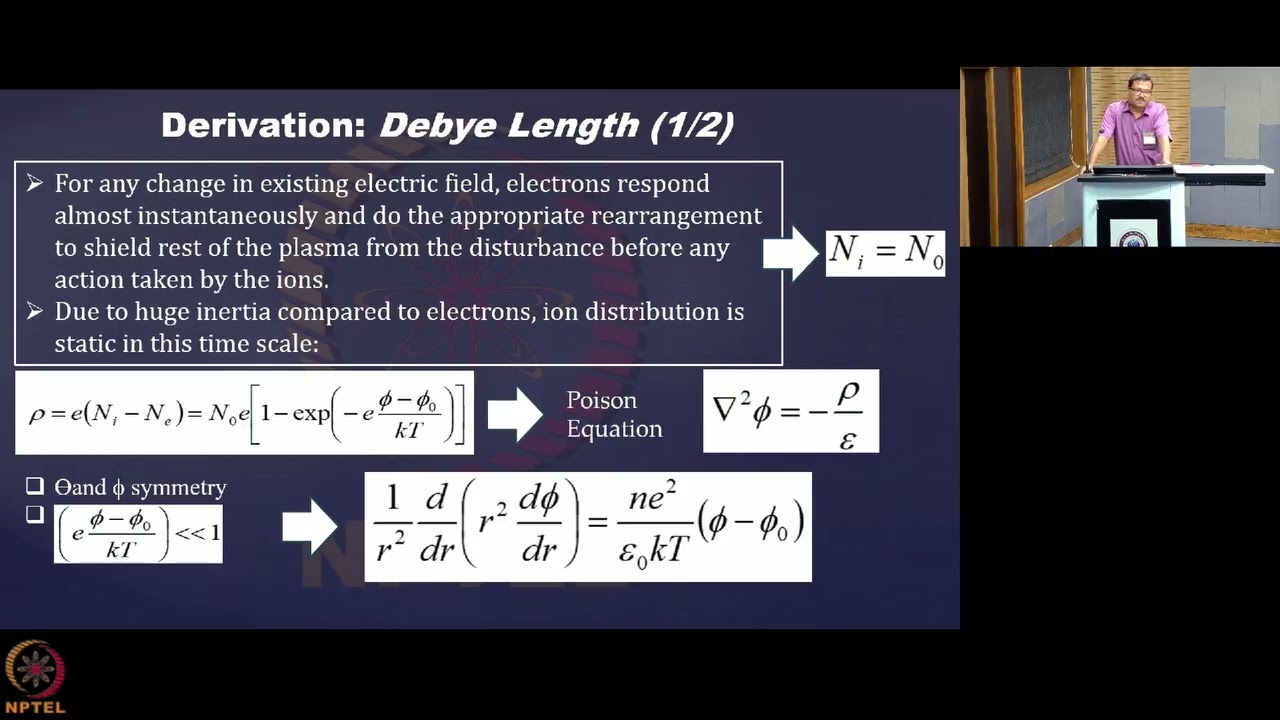
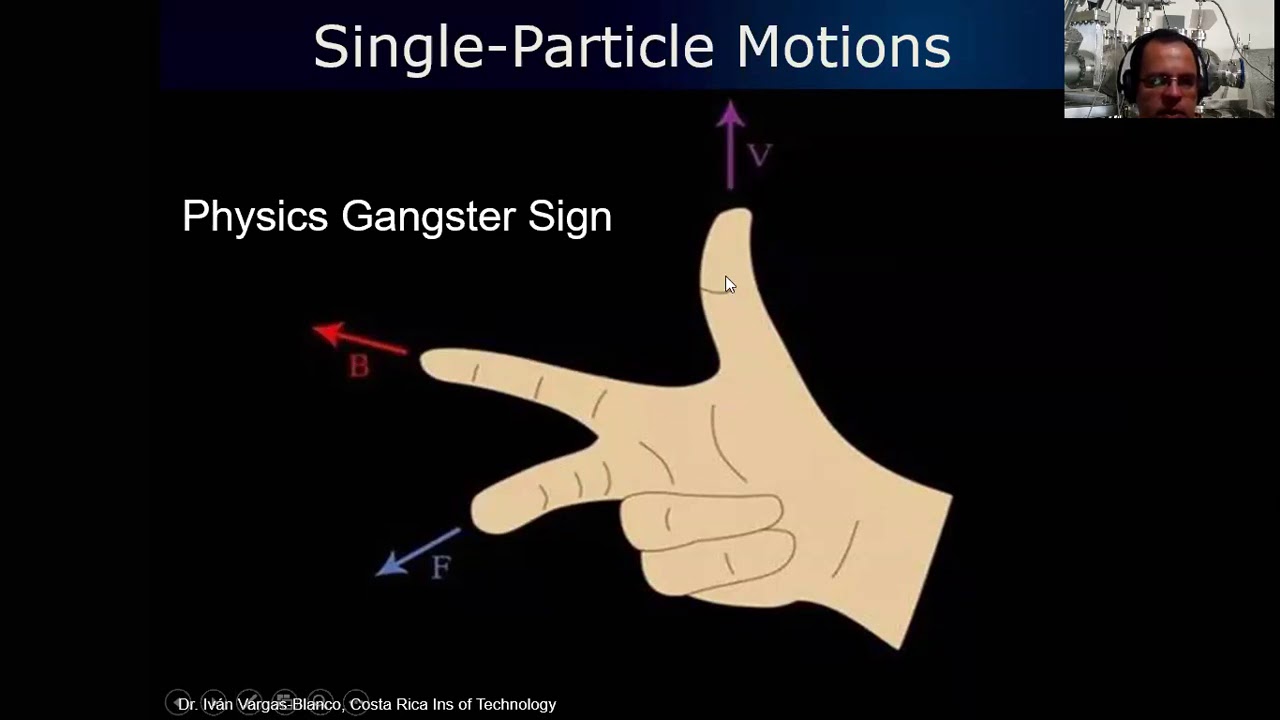
Added:[Music] well friends today I'm going to talk about plasma response to fields these could be external fields or self Fields produced inside the plasma and the basic formalism would be involving the flid equations so today I will give you a brief derivation of equation of motion equation of continuity and these will involve the concept of momentum loss bya collisions and force experienced by particles due to pressure gradient well these are the references three books one by FF Chen the other one by VL Ginsburg and the third one is by Thomas EST well the plasma response as you know plasma comprises three kinds of spes namely the electrons ions and neutral neutrals are largely atoms sometimes in some cases they may be ions molecules also but we'll consider primarily the atoms now the these species are characterized by some microscopic quantities like density then mass of a carrier of particle then charge of the particle then we talk about the drift velocity and temperature for electrons we characterize write these quantities as density as n mass as M char charge as minus E drift velocity as V Vector which is the average velocity of particles and temperature is T sometimes we will write as te for ion's density will be denoted as ni mass as Mi charge as z i into e where z i is called the charge number for single L ionized ions z i is Unity drift velocity is VI and temperature s TI for neutrals the density will be designated as n subscript n mass as M subscript n which will be nearly equal to Mi I mass of the iron charge of the neutrals is zero drift velocity often will be zero sometimes this way finites we refer that later and temperature of the neutrals will be TN so these are the macroscopic parameters that characterize a spaces the iso is that when we apply an electric field for instance what is the equation that will govern the drift velocity of particles what is the equation that will govern the evolution of density of particles these two quantities n and V are characterized or governed by two equations they are known as the equation of continuity and equation of motion let me begin with the equation of motion equation of motion for instance I will write the equation of motion for electrons which says that rate of change of moment M DV by DT is equal to the applied force or Force experienced by the particle now the force can be of many kinds if there is an electric field in the system then and magnetic field in the system then the F would be equal to charge of the electron into the electric field e and if there is a magntic field the force will be minus E the charge into V cross B so this is known as the electromagnetic force on the particle on the electron besides this there is another force on the electron that could be due to collisional drag the collisional drag let's understand what is this when the electrons move they acquire drift velocity then this on their way they encounter a heavy particle means an ion or a neutral atom for instance this is a particle here ion electron is coming from here as it comes close by it experiences the attractive force and it path gets deviated like this so the electron which was coming like this after passing through the vicinity of the ion has changes Direction of momentum so there is a loss of momentum or momentum change in each Collision what we do we say that on an average in a collision momentum is randomized means in some Collision the change of momentum is negligible in some the change of momentum is to MV if electron is coming with a momentum MV then the change in momentum per Collision is approximately equal to MV change in momentum per Collision is equal to MV and if there are new collisions per second then the momentum lost in Collision per second will be new * MV so momentum lost in New collisions per second this would be equal to m v into new but this is a loss of momentum not gain of momentum so equivalent collisional drag force on the electron would be F due to collisional drag would be equal to minus M new V this I have written in the assuming that the scatter the ion or neutral is not moving in case there is a drift of the scattering a scatter particle then this is modified by for collisions with particles moving with drift velocity we I for instance the F due to collisional drag would be minus M new into V minus VI so this is a important loss mechanism for momentum so electrons gain momentum from Electric and magnetic fields but they lose momentum via cigance to ions and neutral particles usually VI is a smallest compared to V and we can ignore this VI here but in some cases this is required so unless we are considering a case where iron velocity is significant we will be essentially using this expression M newv for momentum loss per Collision per second then there's another force on the electrons because they have finite temperature and hence they possess finite partial pressure partial pressure of electrons is written as product of electron density into temperature of the electrons here Bulman constant is hidden in Te so basically you are familiar with pressure of a maxan gas as product of density into Bulman constant and temperature for electrons density is n and KT we call KBT we call a simply te this is T temperature and energy units now the problem is that when you apply certain fields on the particles especially the fields of waves the particles acquire drift velocity and the velocity is not uniform everywhere it may vary from point to point as a result density may change so pressure will change the issue is if there is a non-uniformity in pressure I will call this pressure as PE for instance is scalar quantity now consider a simple case suppose I consider a region of space of unit area of crosssection this is unit area and the distance between this is say Delta X so consider a volume of plasma of unit area of crosssection and length Delta X and suppose the pressure varies with X so pressure on the left is p and pressure on the right is p plus Delta P because the pressure is changing so it will be different here than there now what the pressure does pressure means the force exerted by the gas on the left on this so This force will be in this direction whereas the gas or the electron gas on the right hand side will exert a force in the leftward direction so the rightward force is p leftward force is p plus Delta p and hence the net force on the volume element volume element is equal to minus Delta p in the X Direction but how many particles are feeling this Force the number of particles that are contained in this volume if n is the density of electrons in unit volume then the volume of this small space is this region the volume is 1 into DX so the total number of particles here would be density times Delta X so the force per particle per electron would be then minus Delta P divided by the number of particles in this volume element which is n * Delta X and that is in the X Direction This is written as minus 1 upon n Delta Delta X of p and p is NT so it's n * te so this is an expression for the pressure gradient Force experienced by each electron so now we have found typically four forces that an electron will experience and I can summarize them f is the electric force the magnetic force V cross B then there is a force due to Collision drag which is M V new and then there is a force due to pressure gradient which is min - 1 upon n gradient of NT e here I have generalized the pressure gradient force in my derivation I had presumed that the pressure varies only with X but if pressure varies in general with XY Z then the force will be expressed as a gradient of pressure now the issue is on the left hand side of the equation of motion we had M dvy DT what is dvy DT let's understand this please we are dealing here with millions and trillions of electrons in a system in a plasma there are a lot of particles and we are talking about average velocities but the system may not have the average velocity if you take average velocity of particles in this region in a small volume around this point it could be different somewhere here it's different then if you consider a volume element here so number of particles here if you count and measure their velocities and take their average the value of V will be different here than there so rather than specifying the velocity of individual particle we define v as a quantity called velocity field this means that I can divide my system my plasma into a large number of small volume elements and in each volume there may be large number of particles so find their average velocities but this average will depend on time as well as position so this velocity field is the average velocity of particles located at position r at time T if you have a function which depends on one variable then you can Define the differential coefficient of that function simply Suppose there is a function say G some function of X then we Define DG by DX as limit X going to zero g at x + Delta X Delta X going to zero rather minus G at X upon Delta X this is the definition of of differential coefficient of a function of one variable here we are dealing with velocity field which is a function of R and T R means X Y and Z so three variables and T so there are four variable function so here we have to be careful about defining the differential coefficient now total time derivative implies that if you are obtaining DB by DT then what should you do measure the velocity of an electron at R position at time T suppose this is my volume element RT located at RT so consider the number of particles here find their average velocity at time T after a while these particles because they are moving with a finite drift velocity so they have moved out somewhere here so this position would be moved by distance delt R which will be equal to V velocity time delta T so rather than obtaining the velocity at time t plus DT here you measure the velocity at this time at this position so find the velocity at position r plus v DT because this is the new position this particles have moved and at time t plus delta T and take the difference of this velocity here from the velocity that was here so your ey is fixed on the same particles which were here then they moved to the here and divide this by delta T and then take the limit delta T going to zero tending to zero so this is the definition of total time derivative in contrast if I had kept my eye fixed at this point measured the velocity of particle at position r at time T and then later at same point at time t plus delta T I will get a quantity called Delta V by delta T which is the limit delta T tending to zero I'm keeping my I fixed on the volume element so V at r at time t+ delta T minus V at time at position r at time T upon delta T please understand one thing that my ey is fixed on the volume element not on the particles when I calculate the partial time derivative of V so these two derivatives are different this is called total time derivative with respect to time this is called partial time derivative of velocity they are not equal they're not same now we can understand that this V is a function of four variables and we can employ tailor expansion to simplify this expression I will do that so I can write simply v as a function of X Plus VX Delta t y + VY Delta t z + v z delta T comma t + delta T this is my V at position r + V delta T and T plus delta T I'm using the tailor expansion this gives me because this is a function of four variables so I will differentiate V with respect to each variable 1 by one Delta V by delta T into change in variable T which is by delta T this is the first thing then I differentiate V with respect to this variable so Delta V upon Delta X into increase in this variable by amount VX delta T plus the next variable is y so Delta V upon Delta y v y delta T the last one is variation to zed so Delta V upon Delta Zed into v z delta T now delta T is common in all of these so I can take it common and I can write this as Delta V by delta T plus VX Delta V by Delta X Plus V y Delta V upon Delta y plus VZ Delta V upon Delta Z Now Delta Delta X Delta Delta Y and Delta Delta Zed are three components of D operator so I can write this in a simpler way as gradient delta T multiplied by Delta V by delta T t plus v dot d and V and if I use this in my definition of DV by DT I obtain DB by DT is equal to Delta V by delta T because I have to divide this sorry I forgot one thing very important this is the change in V but I should write this a term here I should have added a term here which is V at R and T the initial value I forgot to write that I'm sorry with that so just add this term here plus V at R and T So plus V at R and T plus V at R and T so when you substitute this in the definition of DV by DT it turns out to be Delta V by delta T plus V Dot DV so there is a connection between total time derivative and partial time derivative this is the additional term that comes over here it's called convective derivative this term is finite only when velocity or it average velocity depends on position if you apply a uniform field in to all the electrons in the plasma and if we does not depend on position then obviously this term is zero so whenever your force that is producing average velocity is space dependence then this term may be important and one has to be careful one cannot ignore it so well this is the total time derivative of velocity and now I will use this in the equation of motion and write the equation of motion like this so equation of motion can be written as M Delta V by delta T plus v dot d v is equal to minus E E minus E V cross B the magnetic force minus n M new V collisional drag force and minus one upon n gradient of n te the pressure gradient Force this is our complete equation of motion well in some cases like if you are talking of plasmas in stars and like sun then there is a gravitational force also so to the right hand side one must add a term If gravity is there say gravity is G then plus mg a force due to gravity should also be added there but in most laboratory plasmas of Interest mg is not significant you can ignore this and hence we will be dealing largely with the these terms remaining terms in this equation but in some cases of Interest we will be adding this mg term also now this is one equation which has been very widely used you may note one thing to be simple suppose the plasma has only electric field forget this magnetic force term forget the gravity term forget the pressure gradient term and suppose the collisions are not there then forget this term also then the response of electrons to an electric field is given by this equation V is called the response and E is called the source that acts on the particles the thing is that the response has a single term V here but it's a product of response terms this product of V's is called nonlinear term and this is a typical characteristic of plasmas that in many applications this no terms become important and this is largely the source of nonlinear phenomena like harmonic generation parametric instabilities and many other phenomena similarly if there is a magnetic field of the wave for instance then this V crossb term you cannot ignore and this also is called nonar term because the force involves the response itself so whenever this is a product of response to the source the then the term is called nonlinear term and this also is responsible for a large number of phenomena nonlinear phenomena sometimes the product of density and temperature is may cause in nonlinearity or Collision frequency with velocity product because Collision frequency also depends on velocity of the particles not only average velocity but on thermal velocity also so they are also very so sources of nonlinearity in plasmas so basically thing is that plasma response in general to any field is nonlinear however if the fields are weak you can ignore the nonlinear terms and the pro the process of neglecting these nonlinear terms is called linearization so we will solve these equations in a little while however let me go over to another important equation and that is called the equation of continuity equation of continuity can be written as rate of change or partial rate of change of density with time Delta n by delta T plus Divergence of NV is equal to zero I think uh I need to explain a few things in here what is NV and why this Divergence of NV is related to density let me explain this this product of NV is usually called the flux of particles and let me denote this by Fe a vector which is equal to NV let's understand what is this quantity suppose electrons have average velocity a certain direction suppose this is direction of average velocity of electrons consider a unit area perpendicular to v a question would arise how many particles will cross this area in 1 second B is the average velocity with which the electrons move means the distance they travel in 1 second so all those electrons which are at a distance equal or less than we will be able to cross this because in one second they will travel a distance V so what you are expecting is that in one second all those particles that are filled in a volume of length Unity of area of crosssection unity and length V they will be able to cross this and how many particles are there in this volume the volume of this isace this is this region is length in length V into crosssection one so volume is 1 into V and the number of particles in this would be number of electrons in this volume would be electron density n into volume of this region which is V so this is the flux so flux essentially implies the number of particles Crossing unit area per unit time if they are moving with d velocity V because this is vector quantity so we call this Fe as NV as I had so this is called the particle flux Crossing unit area per unit time the issue is in a system if this quantity is not uniform it varies to be simple consider a region let me go to the next page consider a small volume of unit area of crosssection and separation of width like Delta X and suppose the velocity is in the X Direction so this is my velocity VX if particles are flowing here with the flux Fe the flux with which they're moving out could be Fe plus change in Fe suppose the change in Fe is Delta Fe so the number of electrons entering per second this volume element is Fe the number of electrons leaving this unit area per second is Fe plus Delta Fe so if this is quantity is positive more particles are leaving less are coming in and hence there is a net reduction in density particle number here so net reduction in electron number in the element is equal to Delta Fe per second is Delta F and the total volume is how much unit area unit area I am considering so area of this element is Delta X so this is the number of electrons reduced in volume Delta X so net reduction in electron density or electron number in an electron number per unit volume per second would be Delta Fe upon volume which is Delta X I can write this quantity as Delta Delta X of Fe but Fe is a product of NV n v as I'm taking the X Direction be nvx you can generalize this to three dimensions rather than considering a volume element perpendicular to x-axis it in a general direction then particles are entering there the volume elements could be a box like this so particle can enter and leave so in three dimensions when particles are moving then the net number of particles reduced per un volume is gradient of NV please understand this quantity is the reduction so if I have to write the increase then I should write a minus quantity whenever this quantity is negative then there is a increase then more particles enter less leave then there's a increase so in that case negative so then just put this equal to rate of change of density and this is precisely the equation of continuity so the equation of continuity let me rewrite as Delta n by delta T plus Divergence of sorry there is a DOT product required here n v is equal to Z so I think I have given you a simple derivation of two important equations in plasma dynamics that controls the plasma Dynamics the Dynamics of electrons and similarly you can write the equations for ions also so we treat ions as a mixture of two fluids electron fluid and ion fluid and you write separate equations for electron density and and electron velocity and similarly ion density and ion velocity but whenever the electrons move they constitute a current so when there is a current then the current will produce from X equations magnetic field and electric field or whenever charges move they also produce electric electric field even if the density is there so when there's a the accumulation of charges somewhere or infection of charges that will produce electric field so one should combine these equations the equation of motion and continuity with the Maxs equations and then they form a complete set to describe a system so let me write down the Maxwells equations also to complete our description so I am going to just briefly mention Maxwell's equations the first equation is known as Divergence of D is equal to row now D is relative to the electric field through this relation by definition D is equal to epsilon0 e plus polarization capital P in gaseous plasmas the polarization of atoms is very small and you can ignore this capital P term so for gaseous plasmas this is typically of the order of Epsilon 0 into e where epsilon0 is called free space permittivity this is free space permittivity in MK units so this is this displacement Vector is related to electric field by this quantity epsilon0 e another equation is the Divergence equation for magnetic field B which says Divergence of B is equal to zero B is the magnetic field third is the equation equivalent of Fades of electromagnetic induction which is curl of e is equal to minus Delta B by delta T in integral form this equation sometimes is written and this is written as e do DL this quantity over a close path is called EMF this line integral of the electric field is equal to rate of change of flux linked with the circuit so this is B do DS is the flux linked with the circuit and rate of change of flux with time and the fourth Max equation is generalization of ampers slw which says that curl of H is equal to J plus Delta d by delta T J is known as the current density and H is related to the physical quantity B the magnetic field by this relation B is equal to mu0 H + m where H well mu0 is the magnetic permability of free space and M is the magnetization or dipole moment per unit volume for plasmas this m is negligible and this is equal to Mu H so this is called free space per permeability so these four Maxell equations coupled with the equation of motion continuity form a complete set of equations governing the Dynamics of plasmas well I would like to caution that these equations though they describe the plasma Dynamics in most situations but is still they are missing some important effects called kinetic effects because when we are dealing with the propagation of waves in particular some electrons may be moving with the velocity of the wave phase velocity of the wave and they can interact very resonantly with the waves and can exchange momentum and energy with the waves very effectively so we have to deal with different electrons moving different velocities differently and for that one requires a kinetic description or the description based on veloc equation when we come to that stage we'll discuss that equation also well so I have given you four Maxell equations that in conjunction with the equation of motion and continuity complete the description of a plasma many phenomenon plasmas however before I close I would like to say a word about collisions so a word on cious will be proper at this stage well what happens that when an electron moves in the vicinity of a scatterer if the electron moves quite far away from the scatter it doesn't suffer a collision it goes like this but when it falls within certain a distance the distance of closest approach is called impact parameter for instance if I have a typical radius of an atom like a then you can characterize the effective area of crosssection of the atom to be Q is equal to Pi squ so whenever the electron falls on this area it will suffer collision and after Collision will go like this if it moves away from this area then It suffers no Collision so for electron neutral Collision you can always assign a effective area with the atom now I would like to see the problem in a different way rather than assigning a area to the scatterer I am assigning an effective area of crosssection to the electron suppose the electron has a hello around it of crosssection Q and when the electron travels a distance in 1 second is like thermal velocity V thermal so in 1 second it will move like this but before it covers one second it may collide with an atom and it may change its path it may go like this so the electron comes here and suffers a collision and goes in this direction then suffers another collision and goes in this direction now the mass of the electron is very tiny as compared to the mass of the scatterer so primarily the energy transfer is very little the moment transfer is the significant quantity so these are called momentum randomizing collisions so what they can say that the electron is moving a distance of the order of V thermal thermal velocity or thermal speed in 1 second so it will covers a zigzag kind of cylinder of crosssection Q and length V thermal and the number of collisions it will suffer in one second is the same as the number of scatterers it will encounter way because the scatters which are outside will not collide with this so only those scatters which are lying inside this cylinder they will be colliding with this electron so what is the total volume of this electron cylinder volume of the El of the cylinder which is a fictious cylinder of crosssection q that I am assigning to an electron the length is V thermal crosssectional area is Q so Q into V thermal is the volume and in this volume how many scattering particles will be there scatter will be there if the neutral particles have a density NN then the number of scatterers in this cylinder would be equal to their density into volume and this quantity is then called the Collision frequency because with each particle electron is going to suffer a collision so the number of coll so the Collision frequency new is equal to n n q into V thermal this is the Collision frequency is a product of density of scatterers into Collision crosssection of the scatterer into thermal velocity of the electron for neutral particles Q is simply equal to Pi a squ where a is the radius of the atom which is of the order of an angstrom a few angstroms so Q is typically 10 the power -9 M squ but the case of collisions of electrons with ions is very different let's understand that also in the case of ions ions exert a force on the electron even if it is quite far away from here obviously if the distance of closest approach suppose the electron is going like this then the distance of closest approach is called impact parameter P if this is electron is coming closer here this will not go on this path it will go like something like this it will feel attracted and go like this this is the actual path the electron will Traverse and you expect effect that larger the value of P weaker the effect of this electr attractive Force Orum force of the Ion on the electrod so the change in momentum or change in direction of the electron motion will be less effective when p is large but P could be quite large not angstrom it could be several angstroms tens of angstroms or hundreds of angstroms because this is a slowly varying the potential or the electric force due to the Ion on the electron is a long range Force so but how to define a effective Collision frequency we Define an effective Collision frequency by saying that find out the impact parameter P for which the electron suffers a 90° Collision it means it goes like and comes like this so that the angle of his cattering is 90° and what has been found is a simple calculation that impact parameter P for which the kinetic energy of the electron which is half MV s equals the potential energy due to the ion if the ion charge is z i into e electron charge is Small E then this quantity divid by P 4 Pi epsilon0 into p is the potential energy so if I equate the kinetic energy of the electron to potential energy of the electron at the impact parameter P then the P that you get from here turns out to be the one that if an electron arrives with impact parameter P given by this equation It suffers 90° Collision so we Define an effective area of crosssection Q is equal to Pi p² and if you put the value of P from this equation it turns out to be p is equal to so Pi is there and two will cancel out so you will get z i e s upon 2 pi Epsilon 0 m whole squ into 1 upon V4 this is a very be thermal rather this is thermal velocity I'm presuming here that my electron is moving with a velocity actual velocity is this V really is the actual velocity here I'm presuming that the actual velocity is like thermal velocity typically some electrons may move faster some may move slowly so we are typically taking this like thermal velocity so Collision crosssection Q is inversely proportional to fourth power of velocity how about the Collision frequency Collision frequency is a product of ion density collision crosssection and thermal velocity so when you put these numbers in here this is scale says thermal velocity of electron to the power minus 3 or temperature of the electron to Theus 3 by 2 this is a very important dependence means the electron temp temperature larger the electron temperature weaker the Collision frequency and later on we will learn that all majure quantities like electrical conductivity thermal conductivity diffusion coefficient Etc these microscopic quantities depend on collision frequency and hence they depend on electron temperature very sensitively this is a very important dependence so whereas for the case of Elon neutral collisions Collision crosssection Q was a constant if Q is a constant then the Collision frequency will increase with thermal velocity like temperature to the power half whereas in a electron ion Collision because Q decreases with velocity of the electron so Collision frequency scal says minus 3x2 this is something very significant and uh we will see it's effect on response of a plasma to electric field later thank you very much [Music]
Up Next

Magnetohydrodynamics Lecture: Beta, Pressure, & Instabilities
@usyd-seniorplasmaphysicsle6653
20.8K views•2017-05-30

21cm Hyperfine Transition in Neutral Hydrogen: Radio Astronomy Basics
@AaronRobertParsons
12.4K views•2011-10-13

Lagrangian Equation for 2D Systems & Electrical Circuits | NPTEL
@iit
23.2K views•2010-01-15

Entropy and the Second Law of Thermodynamics Explained
@veritasium
27.5M views•2023-07-01
Related Study Plans & Knowledge Roadmaps
Structured learning paths in Physics