This video illustrates the development of moral reasoning through a discussion of the Heinz dilemma, showing how individuals progress from viewing morality as absolute rule-following to recognizing that moral principles may require breaking unjust laws when protecting human life, demonstrating the evolution from pre-conventional to post-conventional levels of moral development.
Heinz Dilemma: Moral Reasoning Development Explained
Added:Deep Dive
Basic principles of developmental psychology, particularly how cognitive structures change as individuals age.

MPC001 B 1 U1 - Cognitive Psychology - Part 1
170
Developmental psychology studies how cognitive structures and abilities change from infancy through adulthood. It examines how children develop thinking skills, how cognitive abilities mature over time, and how different developmental stages (childhood, adolescence, adulthood) influence cognitive processes. This field helps us understand how thinking and learning evolve throughout life.
Click to watch →

Psychology 30 important questions/ मनोविज्ञान के 30 अति महत्वपूर्ण प्रश्न/ reet /2nd ग्रेड/3rd ग्रेड
8K
Development proceeds from head to toe (cephalocaudal principle). Basic motor skills include crawling, grasping, and reaching. Schemas are organizational structures that help individuals perceive and interpret information. Prenatal development is called gestation period, prenatal period, or intrauterine period. Adolescents develop egocentrism including imaginary audience and personal fable.
Click to watch →
2026- MEB- AGS I Soru Çözümü - Gelişim Psikolojisi I
2.1K
This section examines how cognitive structures (schemas) change across developmental stages. Bilişsel yapı refers to mental structures that individuals use to perceive, understand, and organize information. These structures vary significantly across ages—a 6-month-old, 3-year-old, and 12-year-old will have fundamentally different ways of understanding the same object. A 6-month-old may put a pen in their mouth due to reflexes, a 3-year-old might scribble with it, and a 12-year-old would draw meaningful pictures. This demonstrates that cognitive structures develop and change, reflecting increasing complexity in understanding and interaction with the environment.
Click to watch →

2) Soru Çözümü - Gelişim Psikolojisi - Bilişsel Gelişim
52.5K
Cognitive structures determine how individuals respond to situations based on their developmental stage. Different age groups respond differently to the same situation because their cognitive structures differ. For example, a 2-month-old might put a phone in their mouth, a 2-year-old might pretend it's a car or airplane, and a 12-year-old might try to use it as a weapon. These structures develop as schemas multiply and experience increases.
Click to watch →
Piaget, Psicología del Desarrollo, los 4 Estadios
76.6K
Jean Piaget, an epistemologist, developed a theory comparing individual cognitive development (genesis) to species evolution (phylogenesis). His fundamental thesis holds that cognitive structures increase in complexity through development. Children and adults understand reality differently due to varying cognitive structures. Development occurs through interaction with the environment, where children experience discrepancies between existing knowledge and new discoveries, prompting adjustment of cognitive structures. Biological maturation of physical structures like the brain is essential for cognitive development, as not all children at any age can understand all concepts.
Click to watch →
Deep Dive
The conceptual distinction between law (legal rules) and morality (ethical principles).

Morality, Law, Difference between Morality and Law, #Ethics
22.2K
A critical distinction exists between law and morality: an act can be legally permissible yet morally questionable (such as layoffs during organizational losses), while an action can be legally prohibited yet morally commendable (like helping persecuted minorities). Law focuses exclusively on external observable acts and is enforced through formal penalties by state authorities, making it objective and expedient. In contrast, morality addresses both external actions and internal intentions, relies on personal conscience rather than institutional sanctions, and maintains absolute ethical standards independent of legal frameworks. This systematic difference explains why legal compliance does not guarantee moral integrity, and why moral guidance often transcends legal requirements.
Click to watch →

Le droit et la morale
4.5K
This section establishes the core distinction between law and morality through three key criteria. First, source: moral rules originate from individual conscience (internal), while legal rules are established by public authorities (external). Second, purpose: morality seeks individual moral improvement, while law maintains social peace and order. Third, sanction: moral violations trigger internal remorse, while legal violations result in state-enforced penalties. These distinctions form the theoretical foundation for understanding how these two systems operate differently within society.
Click to watch →

مراجعة لمادة المدخل لدراسة العلوم القانونية / الجزء الأول/ صالح النشاط
12.2K
To distinguish legal rules from moral rules, consider four criteria: (1) Source - legal rules come from the legislature (parliament), while moral rules come from religion, society, or cultural values, (2) Scope of application - legal rules apply only to public space, while moral rules apply to both private and public spheres, (3) Purpose - legal rules aim at public interest and social order, while moral rules aim at ethical behavior based on community values, (4) Consequences - legal violations result in formal penalties (civil, criminal, administrative), while moral violations result in social disapproval without formal punishment. For example, adultery may be morally condemned but not legally punished in some societies.
Click to watch →

Dame LO SUJET DROIT ET MORALE
24.8K
This section details the three main points of distinction between law and morality. First, sources: legal rules emanate from state authority (Parliament, Assembly) through constitutional procedures, while moral rules come from individual conscience, social groups, or religion. Second, finality: law aims to create social order, while morality aims to improve and perfect the individual. Third, sanctions: legal sanctions are external (criminal or civil penalties), while moral sanctions are internal (remorse, self-reproach). The section also addresses conflicts between law and morality, such as Article 262 of the Civil Code allowing acquisition of another's property through possession, which contradicts moral principles.
Click to watch →
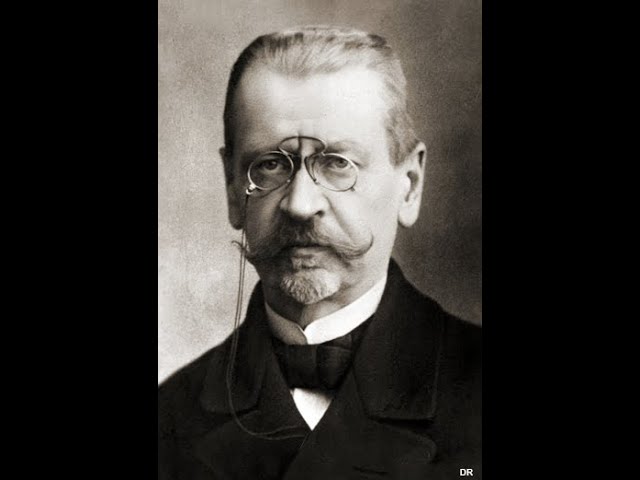
Séminaire général du CERCRID "Penser le droit avec Leon Petrażycki" - 17 janvier 2025
103
The key distinction between law and morality lies in the attributive dimension. Both involve feelings of obligation, but only law involves an attributive component where one person feels obligated toward another who has a corresponding claim or entitlement. In moral situations, one may feel obligated to act without there being any corresponding claimant who could demand compliance. For example, giving charity to a beggar may feel morally obligatory but does not create a legal claim against the giver. Conversely, paying wages to an employee creates a legal obligation because the employee has a claim against the employer.
Click to watch →
Deep Dive
Jean Piaget's theory of cognitive development, which laid the foundation for developmental stage theories.

Jean Piaget's Theory of Cognitive Development Explained!
249.5K
Jean Piaget's Theory of Cognitive Development proposes that children progress through four distinct, sequential stages of cognitive growth: the sensorimotor stage (birth-2 years) where infants learn through sensory experiences and reflexes, developing object permanence; the pre-operational stage (2-7 years) characterized by egocentric thinking, animism, and inability to conserve quantities; the concrete operational stage (7-11 years) where children develop logical thinking, reversibility, and classification skills; and the formal operational stage (11+ years) where adolescents gain the ability to think abstractly, reason deductively, and engage in metacognition. Piaget emphasized that cognitive development occurs through the processes of assimilation (incorporating new experiences into existing schemas) and accommodation (modifying schemas to fit new experiences).
Click to watch →

UPTET | CTET 🔥 CDP 10 महानायक 🔥 एकसाथ 15 नंबर पक्के BY DHEERAJ SIR 🔥🔥
95.5K
This section covers Jean Piaget's Cognitive Development Theory, which describes how children's thinking changes qualitatively as they develop. Piaget proposed four stages: (1) Sensorimotor Stage (birth to 2 years) - learning through sensory experiences and motor actions; (2) Preoperational Stage (2 to 7 years) - symbolic thinking but lack of logical reasoning; (3) Concrete Operational Stage (7 to 11 years) - logical thinking about concrete events; (4) Formal Operational Stage (11 years and above) - abstract and hypothetical thinking. Each stage represents a qualitative change in how children think and process information.
Click to watch →

जीन पियाजे कोहलबर्ग वाइगोत्सकी चाॅम्स्की पर महत्वपूर्ण प्रश्न ।। CDP।। CTET2026
157.9K
Jean Piaget is a developmental psychologist who studied the development of intelligence. His theory consists of four stages: Sensorimotor (0-2 years), Preoperational (2-7 years), Concrete Operational (7-11 years), and Formal Operational (11+ years). Key concepts include object permanence, egocentrism, conservation, assimilation, and accommodation. Piaget viewed children as active constructors of knowledge who acquire understanding through active interaction with their environment. His theory is based on cognitive development and emphasizes that intelligence develops through assimilation.
Click to watch →

पियाजे कोहलबर्ग एवं वैगोत्सकि परीक्षा में आए हुए प्रश्न #Piaget Kohlberg and Vygotsky mnovigyan ques
783.6K
Jean Piaget, a Swiss psychologist, established cognitive development theory as the foundation of developmental psychology. His theory identifies four distinct stages: Sensorimotor (0-2 years), Preoperational (2-7 years), Concrete Operational (7-11 years), and Formal Operational (11-15 years). Each stage represents a qualitative shift in how children think and process information. The theory emphasizes that children actively construct knowledge through interaction with their environment, rather than passively receiving information. Understanding these stages is essential for educators and psychologists to support appropriate learning and development.
Click to watch →

TEORIAS DA APRENDIZAGEM: JEAN PIAGET
18.9K
Jean Piaget's theory of cognitive development, known as Epistemologia Genética or Constructivism, proposes that children actively construct knowledge through four distinct developmental stages: the Sensório-Motor stage (0-2 years, learning through senses and motor actions), the Pré-Operatório stage (2-7 years, characterized by symbolic thinking and egocentrism), the Operatório Concreto stage (7-12 years, featuring logical thinking about concrete objects and reversibility), and the Operatório Formal stage (12+ years, involving abstract and hypothetical reasoning). According to Piaget, cognitive development occurs through a process called Equilibração Majorante, which involves four interconnected processes: desequilíbrio (disequilibrium when new knowledge exceeds existing schemas), assimilação (assimilation where new information is integrated into existing cognitive structures without modification), acomodação (accommodation where cognitive structures are modified or transformed to accommodate new information), and equilíbrio (equilibrium where assimilation and accommodation balance each other). Additionally, Piaget proposed three phases of moral judgment development: anomia (absence of rules in children under 5-6 years who don't follow collective rules due to egocentrism), heteronomia (rule-following with external imposition up to 9-10 years), and autonomia (self-governance where children create and accept new rules).
Click to watch →
Deep Dive
The definition and structure of an ethical dilemma, where two or more moral imperatives conflict.

Lost on the Lady Elgin: The Ethics of Shipwrecks
217
An ethical dilemma, also called a moral dilemma, is defined as a situation in which two or more conflicting moral imperatives confront a person, none of which overrides the other. A closely related definition characterizes an ethical dilemma as a situation in which every choice is wrong. This concept is fundamental to understanding the moral challenges faced by individuals when no clear right or wrong answer exists, and all available options involve some form of moral compromise or violation.
Click to watch →
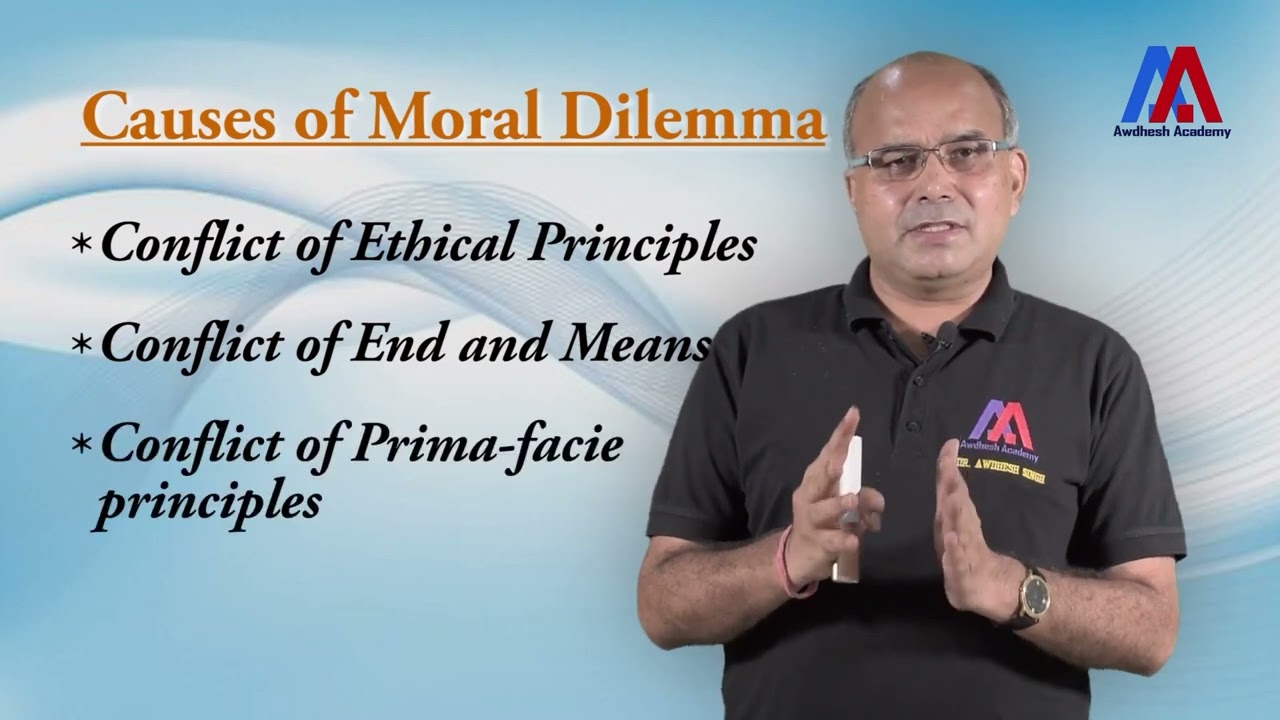
Ethical Dilemmas (Hindi )
806
An ethical dilemma (also called ethical paradox) is a decision-making problem where two or more moral principles conflict with each other, and it is unclear which principle should be followed or which is preferable. Unlike simple choices between right and wrong, ethical dilemmas require choosing between competing moral values where following one principle may violate another.
Click to watch →

Ethical concepts (Business Ethics @NAISHAACADEMY )
2.9K
An ethical dilemma is a decision-making problem between two possible moral imperatives where neither option is acceptable nor preferable. In an ethical dilemma, choosing one option will require violating your personal standards, while choosing the other will require compromising your values. This creates a situation where you must choose between two undesirable alternatives, neither of which aligns with your moral beliefs.
Click to watch →

ASCENSO 2021 DPCC: Dilema moral y reflexión ética
16.1K
A moral dilemma (or ethical dilemma) is a decision-making problem between two ethical, moral, or civil imperatives, where neither option is unequivocally acceptable or preferable. It involves a third person who has witnessed a situation and does not know what to do, feeling caught between two options (like being between a sword and a wall). The key characteristic is that any decision taken will affect or benefit someone while also potentially harming someone else.
Click to watch →

Ethics UPSC Mains 2021 Discussion | Resolving Ethical Dilemmas | Tirthankar Roychowdhary Sir | EDEN
399
An ethical dilemma is a situation where two values, two imperatives (moral standards), two principles, two rights, two duties, or two options come in conflict with each other. The decision maker finds it very difficult to choose one and reject the other because both options appear attractive. Even when one option is chosen and the other rejected, the decision maker is not at 100% satisfaction level because there is some sort of regret about giving up something worth holding to.
Click to watch →
Prerequisite Knowledge
- Concept 01Basic principles of developmental psychology, particularly how cognitive structures change as individuals age.
- Concept 02The conceptual distinction between law (legal rules) and morality (ethical principles).
- Concept 03Jean Piaget's theory of cognitive development, which laid the foundation for developmental stage theories.
- Concept 04The definition and structure of an ethical dilemma, where two or more moral imperatives conflict.
Subsequent Learning
- Step 01Lawrence Kohlberg's six stages of moral development across three levels: pre-conventional, conventional, and post-conventional.
- Step 02Carol Gilligan's critique of Kohlberg's theory, introducing the 'Ethics of Care' as an alternative to the 'Ethics of Justice'.
- Step 03Cross-cultural studies on moral reasoning to understand how different societies evaluate ethical priorities.
- Step 04Real-world applications in bioethics and medical ethics, such as drug pricing, resource allocation, and the right to try experimental treatments.
Moral Dilemma
Value of Life
Moral Dilemma
0:09Playing Section
- 1
Stealing medicine debated for saving a life.
- 2
Law obedience varies with moral corruption.
- 3
High prices seen as immoral extreme.
Carol Gilligan's Ethics of Care
Carol Gilligan challenged Lawrence Kohlberg’s stages of moral development—which rely heavily on the Heinz Dilemma—by arguing they contain a distinct gender bias. Kohlberg’s original research was conducted exclusively on male subjects, leading to a theory that prioritizes an "ethics of justice" based on abstract rules, rights, and laws. Gilligan proposed that women often approach moral dilemmas through an "ethics of care," which prioritizes interpersonal relationships, empathy, and the prevention of harm. Under Kohlberg's scale, this relationship-oriented reasoning often placed women at lower stages of moral development. Gilligan's counterpoint argues that moral development is not a single linear path toward abstract justice, but rather includes a separate, equally valid path centered on connection and responsibility to others. This broadened the psychological understanding of morality to include care, compassion, and relational contexts.
Deep Dive
Lawrence Kohlberg's six stages of moral development across three levels: pre-conventional, conventional, and post-conventional.

Kohlberg moral development theory|HTET CDP classes for PRT TGT PGT|level & stages of morality theory
12.8K
Kohlberg's theory identifies three levels of moral development, each containing two stages. The Pre-conventional Level (ages 4-10) includes Stage 1 (Obedience and Punishment Orientation) where children follow rules to avoid punishment, and Stage 2 (Individualism and Exchange) where children follow rules based on self-interest. The Conventional Level (ages 10-13) includes Stage 3 (Good Interpersonal Relationships) where individuals follow rules to be seen as 'good' by others, and Stage 4 (Law and Order Orientation) where individuals follow rules strictly to maintain social order. The Post-conventional Level (ages 13+) includes Stage 5 (Social Contract Orientation) where individuals recognize rules as changeable agreements, and Stage 6 (Universal Ethical Principles) where individuals follow abstract ethical principles even when conflicting with societal rules. Very few people reach Stage 6.
Click to watch →

REET L-1/L-2 (बाल विकास part-12 ) psychology by vivek pareek sir kalam academy
4.2K
Lawrence Kohlberg developed his theory through interviews with boys aged 10-16, using moral dilemmas like the Heinz Dilemma. He proposed three levels: (1) Pre-conventional Level (ages 4-10) - Stage 1: Obedience and Punishment Orientation (avoiding punishment); Stage 2: Instrumental Relativist Orientation (personal gain and exchange); (2) Conventional Level (ages 10-13) - Stage 3: Good Boy/Nice Girl Orientation (seeking approval); Stage 4: Law and Order Orientation (maintaining social order); (3) Post-conventional Level (ages 12+) - Stage 5: Social Contract Orientation (rules as changeable agreements); Stage 6: Universal Ethical Principles Orientation (following self-chosen universal principles).
Click to watch →
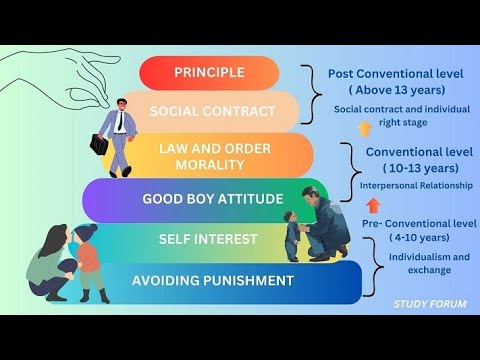
Kohlberg’s Stages of Moral Development | Psychology | B.Ed | Moral Education Explained in Hindi
339
Lawrence Kohlberg's theory explains how humans develop moral reasoning through three levels and six stages. Level 1 (Pre-Conventional) focuses on self-interest: Stage 1 (Obedience and Punishment) avoids punishment, Stage 2 (Individualism and Exchange) seeks personal gain. Level 2 (Conventional) emphasizes societal rules: Stage 3 (Good Boy-Nice Girl) seeks approval, Stage 4 (Law and Order) follows duty. Level 3 (Post-Conventional) relies on personal principles: Stage 5 (Social Contract) recognizes unjust laws can be changed, Stage 6 (Universal Ethical Principles) follows conscience and universal values like justice and truth.
Click to watch →

CTET CDP Complete PYQ Test 2026 | Full Syllabus | Class 8 | Paper 1 | Ppaer 2 | Learn With Sweety
11K
Lawrence Kohlberg proposed six stages of moral development organized into three levels: (1) Pre-conventional level: Stage 1 - Obedience and punishment orientation, Stage 2 - Instrumental relativist orientation, (2) Conventional level: Stage 3 - Good interpersonal relationships, Stage 4 - Maintaining social order, (3) Post-conventional level: Stage 5 - Social contract orientation, Stage 6 - Universal ethical principles.
Click to watch →

Piaget Kohlberg and Vygotsky constructs and critical perspectives CTET CDP 05 English
9.9K
Lawrence Kohlberg, an American psychologist, developed a theory of moral development with six stages organized into three levels: (1) Preconventional Level: Stage 1 (Punishment-Obedience Orientation) - avoiding punishment; Stage 2 (Instrumental Relativist Orientation) - expecting rewards; (2) Conventional Level: Stage 3 (Good Boy-Good Girl Orientation) - seeking approval; Stage 4 (Law and Order Orientation) - obeying rules and laws; (3) Postconventional Level: Stage 5 (Social Contract Orientation) - following social contracts and mutual expectations; Stage 6 (Universal Ethical Principles Orientation) - adhering to universal ethical principles regardless of others' actions.
Click to watch →
Deep Dive
Carol Gilligan's critique of Kohlberg's theory, introducing the 'Ethics of Care' as an alternative to the 'Ethics of Justice'.

UPTET 2026 CDP संपूर्ण महा मैराथन | मनोवैज्ञानिक बार-बार आने वाले प्रश्न | CDP by Rohit Vaidwan Sir
22.4K
Carol Gilligan proposed the ethics of care as an alternative to Kohlberg's ethics of justice. While Kohlberg's theory focuses on abstract principles of justice, Gilligan's approach emphasizes relationships, care, and responsibility to others.
Click to watch →

Encuentros Grupo 40+. Diálogo sobre la ética del Cuidado
182
This segment introduces Carol Gilligan, the first author to develop the ethics of care. Her work 'In a Different Voice' (1982) and 'A Voice in a Human Voice' (2000) challenged the dominant liberal and rationalist approaches to ethics. Gilligan critiqued Lawrence Kohlberg's moral development theory, which was based on studies of male subjects and reflected patriarchal assumptions. Kohlberg concluded that women were less capable of moral reasoning because they could not separate normative reasoning from lived experience. Gilligan argued that this was not a deficiency but a different approach to morality that emphasized relationships and care rather than abstract principles. She identified two moral modes for resolving dilemmas: one based on impartiality and abstract rules (the 'justice' mode), and another based on relationships and care (the 'care' mode).
Click to watch →

Rosemarie Tong, Carol Gilligan's Ethics of Care | Gilligan's Criticism of Kohlberg | Core Concepts
3.8K
Carol Gilligan criticized Lawrence Kohlberg's six-stage moral development theory for being biased toward male perspectives, as it emphasizes justice, rules, and abstract principles over care and relationships; she proposed an alternative three-level ethics of care framework that progresses from self-focus to other-focus to a balanced integration of both, arguing that women's moral reasoning—centered on maintaining relationships and caring for others—was systematically undervalued by Kohlberg's justice-oriented scale.
Click to watch →

mako mermaids: ecofeminist utopian nightmare
145.6K
Carol Gilligan's 1982 masterpiece In a Different Voice follows up on research by Nancy Chodorow into the distinct moral developments of men and women. Research found that a sense of individuality was more common in those raised as men while a sense of interconnectedness was more common in those raised as women. This distinction became the basis for two different ethical theories: the feminine sense of interconnectedness led to an ethics of care, while the masculine sense of individuality led to a rights or justice-based ethics.
Click to watch →
BIOETICA - TEO 3: Anticonceptivos y la interrupción del embarazo
224
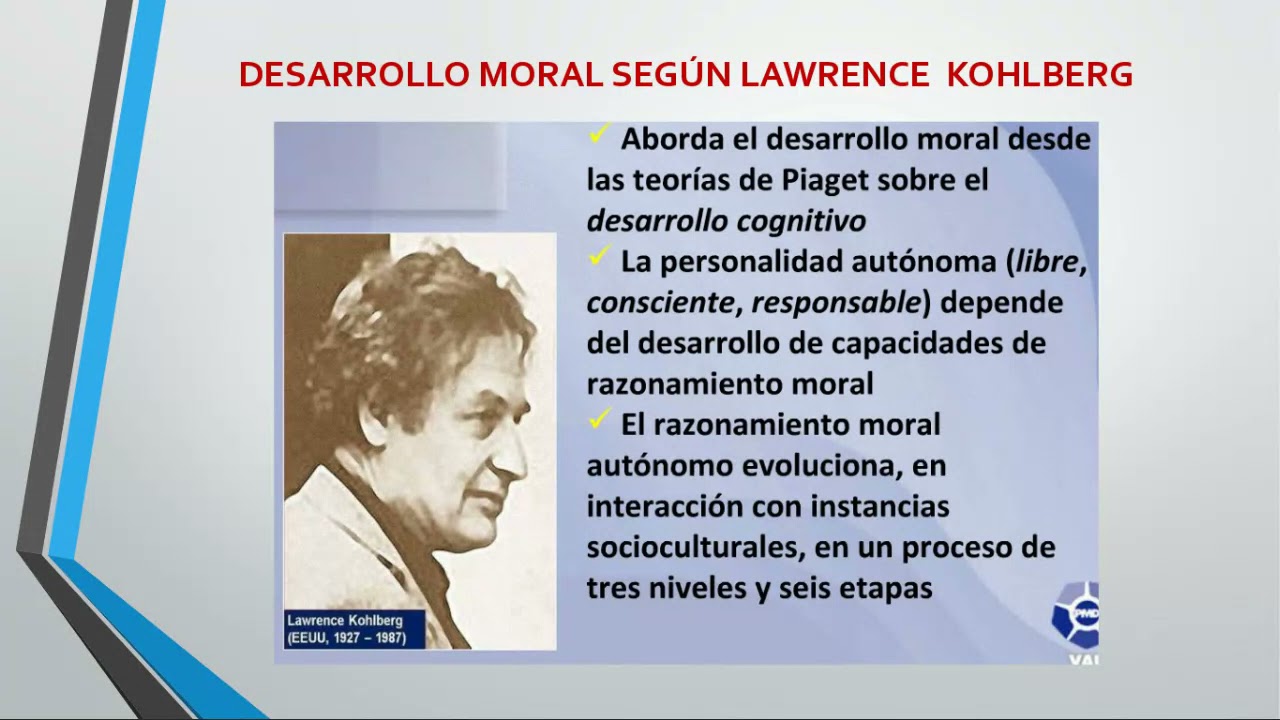
Carol Gilligan, a student of Kohlberg, criticized his research for only studying men and assuming women develop moral reasoning the same way. Her study of women revealed that while women also develop autonomy and justice, they additionally develop compassion and responsibility for others. Gilligan proposed that women use narrative, contextual reasoning while men use abstract, formal reasoning. She argued that both the ethics of justice and ethics of care are valid moral frameworks, and that moral maturity cannot be reduced to passive acceptance of societal codes.
Click to watch →
Deep Dive
Cross-cultural studies on moral reasoning to understand how different societies evaluate ethical priorities.

Культурные различия и мораль. Моральные нормы в США, Индии, Китае и Исландии
1K
Cross-cultural research reveals that moral reasoning varies significantly across cultures: Miller & Bersoff (1992) found that Indians prioritize interpersonal relationships over justice, while Americans prioritize justice, with Indians demonstrating post-conventional moral development where interpersonal obligations take precedence over personal justice; Keller et al. (1998) showed Chinese children value altruism and relationship preservation, while Icelandic children prioritize keeping promises and personal interests, reflecting collectivist versus individualist cultural values.
Click to watch →

15. A Person in the World of People: Morality
243K
Moral reasoning has both universal and cultural dimensions. Universal moral intuitions include anger at cheaters, gratitude toward sharers, and feelings that some things are right and wrong—these appear across all human cultures and even in young children and nonhuman primates. However, there are significant cultural differences in what people find morally objectionable, such as views on masturbation, homosexuality, abortion, and other practices. Richard Shweder identified three ethics frameworks: autonomy (rights, equality, freedom), community (duty, status, hierarchy), and divinity (purity, sanctity, pollution). Western cultures are highly invested in autonomy ethics, while other cultures may prioritize community or divinity ethics. Jonathan Haidt's research reveals that even people who believe they hold to an ethics of autonomy show moral judgments that contradict this belief, demonstrating that moral judgments are not always based on conscious reasoning about harm and rights.
Click to watch →

Георгий Васильев: «Это кончится. Победой добра»//«Скажи Гордеевой»
1.5M
Different cultures give different weights to the same moral foundations. Western cultures tend to emphasize empathy, freedom, and justice more heavily, while Eastern cultures place greater importance on loyalty to one's group, respect for authority, and respect for something big and pure (such as God or the state). This explains why moralities can be different even among people from the same country.
Click to watch →

Can We Be Moral Without God?
215
This section examines how different cultures approach morality. Early 20th century psychologists concluded character traits are not consistent but depend on circumstances. However, recent research revived interest in character traits. Anthropologist Richard Schroeder compared American and Indian moral reasoning, finding that Indian society foregrounds community and divinity while American society emphasizes autonomy and individualism. Despite cultural differences, both systems contain a sense of the other. The section uses the example of sati practice to demonstrate that even seemingly barbaric practices operate within coherent moral frameworks, showing that moral reasoning operates differently across cultures.
Click to watch →
The seven moral rules found all around the world...
954
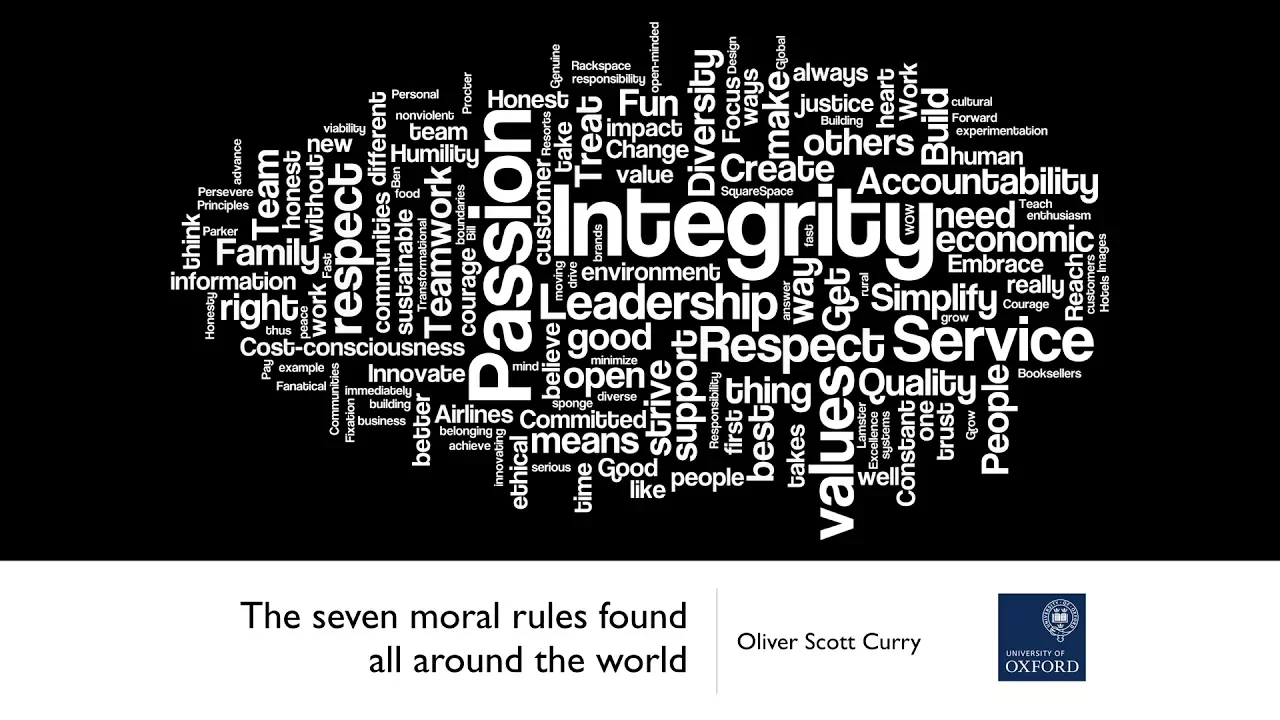
While all cultures share the same basic moral impulses, they vary significantly in how they prioritize these values. Environmental factors shape which moral principles become most important in specific contexts—for example, larger families may elevate kin loyalty while strong central authorities may reduce the importance of vengeance. Additional universal moral candidates include working hard, telling the truth, and generosity with surplus resources.
Click to watch →
Deep Dive
Real-world applications in bioethics and medical ethics, such as drug pricing, resource allocation, and the right to try experimental treatments.

Bioética e Biodireito
476
Applying bioethical principles presents significant practical challenges. In cases of patient autonomy, courts have sometimes condemned physicians even when patients signed informed consent, particularly when patients did not fully understand medical consequences. This creates uncertainty for healthcare professionals. The principle of justice faces particularly difficult challenges in resource allocation, as treatments for rare diseases can cost 7,000 to 300,000 reais monthly, while common diseases require less. Countries must decide whether to prioritize treatments for the majority with common but less severe diseases or allocate resources to the small percentage with incurable conditions. Some countries only pay for medium-cost treatments, leaving expensive treatments to families and cheaper treatments to those who can afford them.
Click to watch →

Cutting Through the Matrix w Alan Watt -Ring a Ring o' Roses PSYOP Experts Guide the Stories 3-14-20
159
Bioethicists have decided on practical things to do and give situations in schools to bring up youngsters in a new way of living. They focus on using resources on the planet and getting people bumped off at one end or the other. They convince the public that this is a good thing for the world and the planet. This is part of the larger agenda of population control. The testing kits are not treatments, but they are used to divert attention from the real issue. The focus is on testing rather than stopping the spread. This is part of the plan to keep people in la-la land till the very end.
Click to watch →

مراجعة الفلسفه كامله للصف الاول الثانوي | الترم التاني
43.7K
Bioethics is a branch of applied philosophy studying problems from medical and biological progress. Van Rensselaer Potter first used the term in 1970, defining it as the 'science of survival.' Three main fields include medical ethics (doctor-patient relationships), research ethics (experiments on humans), and health policy ethics (community protection strategies). Key medical ethics issues include organ transplantation (requiring healthy living donors or recently deceased donors), euthanasia (rejected by most societies due to human life's intrinsic value), and informed consent requiring disclosure, understanding, competence, voluntariness, and active patient participation.
Click to watch →

اقوى مراجعة شهر فبراير ومارس - فلسفة ومنطق - ترم تاني 2026 - #اولى_ثانوي
86K
Bioethics addresses moral issues in medicine and biology. Key principles include: Beneficence (doing good for patients), Non-maleficence (avoiding harm), Autonomy (patient freedom), and Justice (equal treatment). Bioethics differs from applied ethics by focusing only on medicine and biology. Key areas include clinical ethics (treatment decisions, confidentiality), research ethics (experiments, studies), and health policy ethics (state's role in healthcare).
Click to watch →

تريكات ومقتطفات لم منهج الفلسفه والمنطق كامل في ٣٥ دقيقه 🔥#اكسبلور #الفلسفة #أولي_ثانوي #مراجعات
836
Bioethics, first used in 1970 by Van Booter, is applied ethics dealing with practical ethical rules. It encompasses three areas: (1) Medical ethics - doctor-patient interactions, treatment decisions, and hospital cleanliness; (2) Research ethics - balancing innovation with protecting research subjects; (3) Health policy ethics - government health decisions and resource allocation. Key principles include: (1) Value of life - life is sacred for all beings regardless of condition; (2) Non-maleficence - no harm to patients, whether intentional or negligent; (3) Autonomy - respecting patients' right to make decisions; (4) Informed consent - patients must be fully informed; (5) Competence - decisions by those capable; (6) Voluntary consent - free from coercion.
Click to watch →
Moral Dilemma
Value of Life
Moral Dilemma
0:09- 1
Stealing medicine debated for saving a life.
- 2
Law obedience varies with moral corruption.
- 3
High prices seen as immoral extreme.
Carol Gilligan's Ethics of Care
Carol Gilligan challenged Lawrence Kohlberg’s stages of moral development—which rely heavily on the Heinz Dilemma—by arguing they contain a distinct gender bias. Kohlberg’s original research was conducted exclusively on male subjects, leading to a theory that prioritizes an "ethics of justice" based on abstract rules, rights, and laws. Gilligan proposed that women often approach moral dilemmas through an "ethics of care," which prioritizes interpersonal relationships, empathy, and the prevention of harm. Under Kohlberg's scale, this relationship-oriented reasoning often placed women at lower stages of moral development. Gilligan's counterpoint argues that moral development is not a single linear path toward abstract justice, but rather includes a separate, equally valid path centered on connection and responsibility to others. This broadened the psychological understanding of morality to include care, compassion, and relational contexts.
Basic principles of developmental psychology, particularly how cognitive structures change as individuals age.
The conceptual distinction between law (legal rules) and morality (ethical principles).
Jean Piaget's theory of cognitive development, which laid the foundation for developmental stage theories.
The definition and structure of an ethical dilemma, where two or more moral imperatives conflict.
Lawrence Kohlberg's six stages of moral development across three levels: pre-conventional, conventional, and post-conventional.
Carol Gilligan's critique of Kohlberg's theory, introducing the 'Ethics of Care' as an alternative to the 'Ethics of Justice'.
Cross-cultural studies on moral reasoning to understand how different societies evaluate ethical priorities.
Real-world applications in bioethics and medical ethics, such as drug pricing, resource allocation, and the right to try experimental treatments.
93.2K views335likes3:14@prof.mariecoppola608Original Release: 2013-04-24
do you think this guy should steal the medicine no you don't think he should steal it and why don't you think he should steal it uh a police would catch him a police would catch him should hin steal the drug uh yes you think he should and why do you think he should uh so he can save his wife okay and if he can make save enough money he should give the extra $2,000 to the drug fist or whatever okay and in general should people try to do everything they can to obey the law yes you think they should and why well sometimes they should okay so sometimes they shouldn't okay so I'll ask you again so do you think everybody um should do everything they can to obey the law no way no okay and why do you think they shouldn't always do everything they can to obey the law because the law might be corrupt do you think Hine should steal the drug drug I I guess so yeah you think so and why why do you think you should steal the drug well based upon the fact that it's immoral that the first guy is charging so much I mean if there's absolutely no other way around it I'm sure he could well I guess you said he couldn't think of another way so yeah I guess I mean I guess that's the only I mean that's what I do it's the only option okay okay I me because of the the guy was IM moral in the first place yeah I guess so and do you think it's important for people to do everything they can to save another's life I guess so yeah I mean yeah and why do why do you think that cuz life is valuable I guess a lot more important than money or yeah it's a lot more important than money okay and in general should people try to do everything they can to obey the law um in general yeah mhm so times when they shouldn't obey the law like why why in general why do you think that well if there's several I mean if if it's a matter of right and wrong the law is clearly wrong or what the guy is doing is clearly wrong then I guess there's a point where too much is too much okay what do you mean by two medicine like I don't know like that guy withholding medicine that isn't you know if he makes $2,000 that's a lot of money so I mean if he's you know pushing making $4,000 that's just it's just ridiculous and I guess I mean enough is enough in that case
Up Next
9:52
Kohlberg's Moral Development Theory | MCAT Psychology
@khanacademymedicine
967.6K views•2014-02-25

164:01
John of Damascus on Holy Images: A Theological Defense
@BannedBooks
139 views•2026-04-25

68:32
Should We Destroy the Machines? Big Tech Surveillance Critique
@TheStoriesWeTell303
167.9K views•2025-11-30
4:57
The Myth of Sisyphus: A Greek Legend of Eternal Punishment
@TEDEd
8.6M views•2018-11-13
Related Study Plans & Knowledge Roadmaps
Structured learning paths in Philosophy
philosophy
Frankfurt School: Critical Theory & Culture
01Foundations of the Frankfurt School and Critical Theory
02Horkheimer & Adorno: The Critique of Instrumental Reason
03The Culture Industry and Mass Deception
+ 2 more learning modules
12h5 modules
Explore Roadmap
philosophy
Philosophy of Language: From Frege to Austin
01The Linguistic Turn: An Introduction to Language in Philosophy
02Gottlob Frege: Sense and Reference
03Early Wittgenstein: The Picture Theory of Meaning
+ 3 more learning modules
15h6 modules
Explore Roadmap
philosophy
Feminist Epistemology: Standpoint & Injustice
01Introduction to Epistemology and Feminist Critiques
02Sandra Harding and Standpoint Theory
03Donna Haraway and Situated Knowledges
+ 2 more learning modules
12h5 modules
Explore Roadmap
philosophy
Environmental Philosophy: Ethics & Deep Ecology
01Foundations of Environmental Ethics & Anthropocentrism
02Biocentric Individualism and Animal Liberation
03Ecocentric Holism and Deep Ecology
+ 1 more learning modules
10h4 modules
Explore Roadmap