




![[Comment ça marche ?] Comment explose une étoile en supernova ?](https://i.ytimg.com/vi_webp/-IjAwszbiO8/maxresdefault.webp)




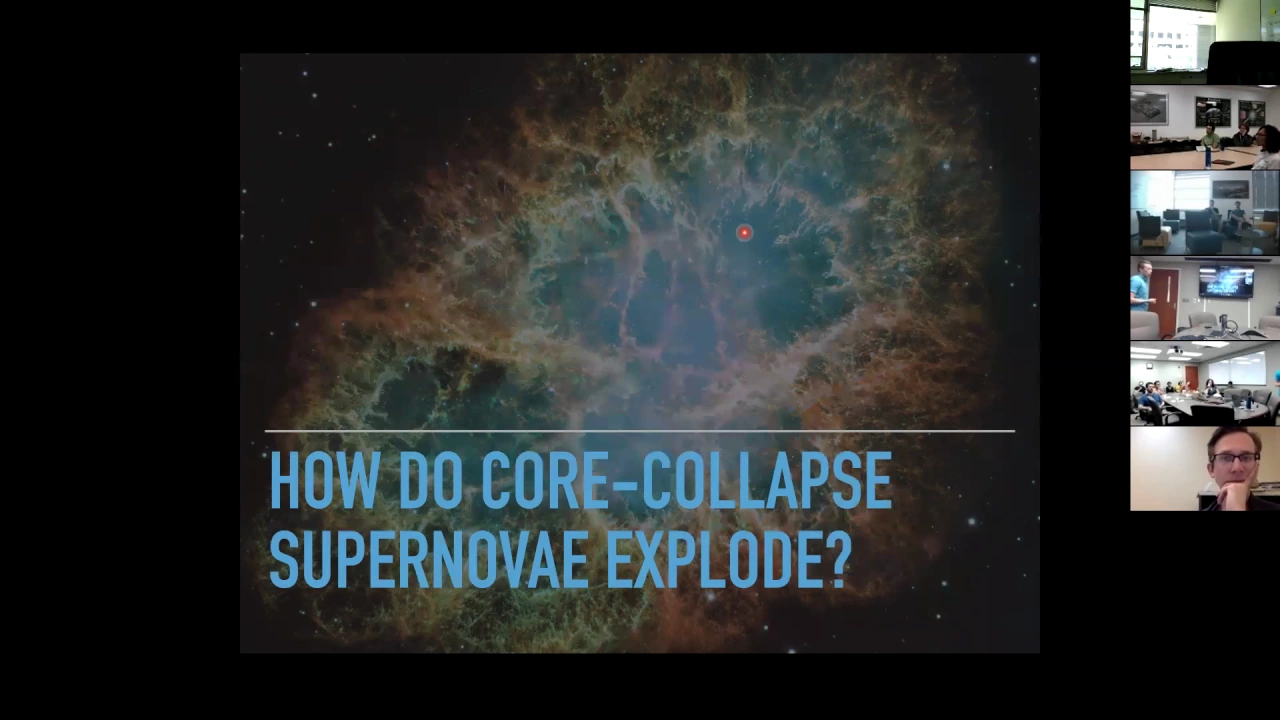

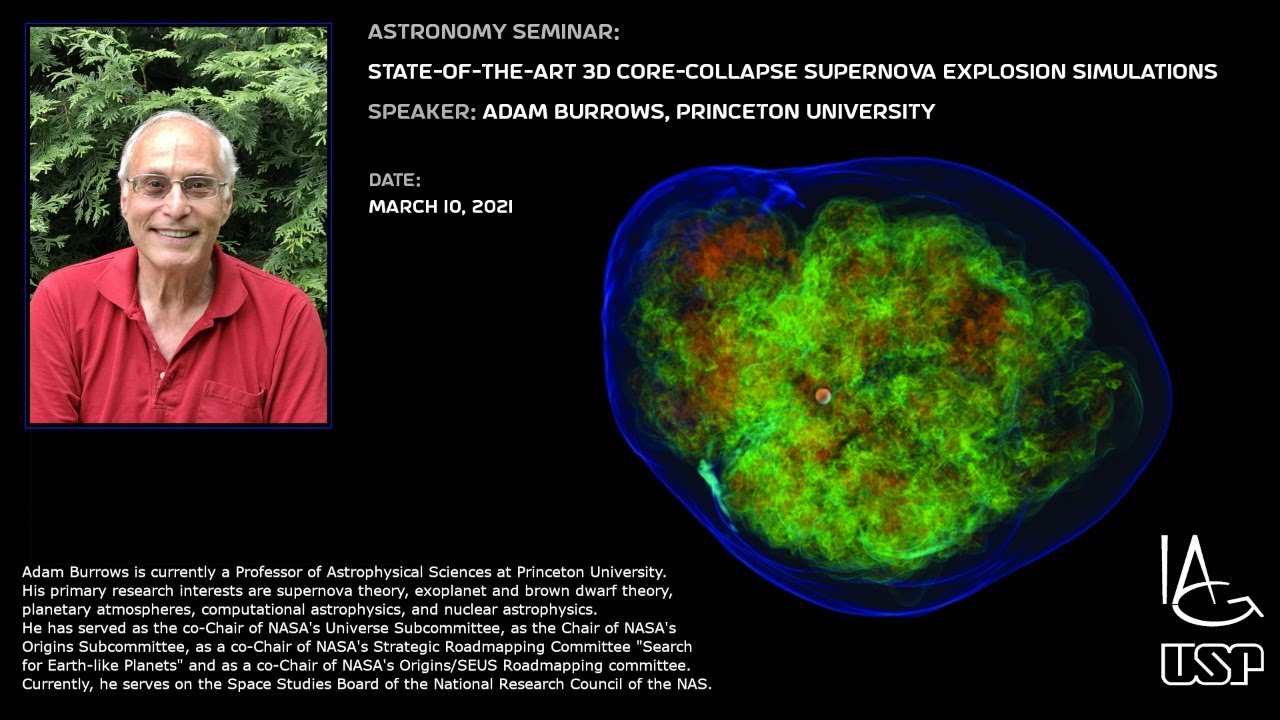


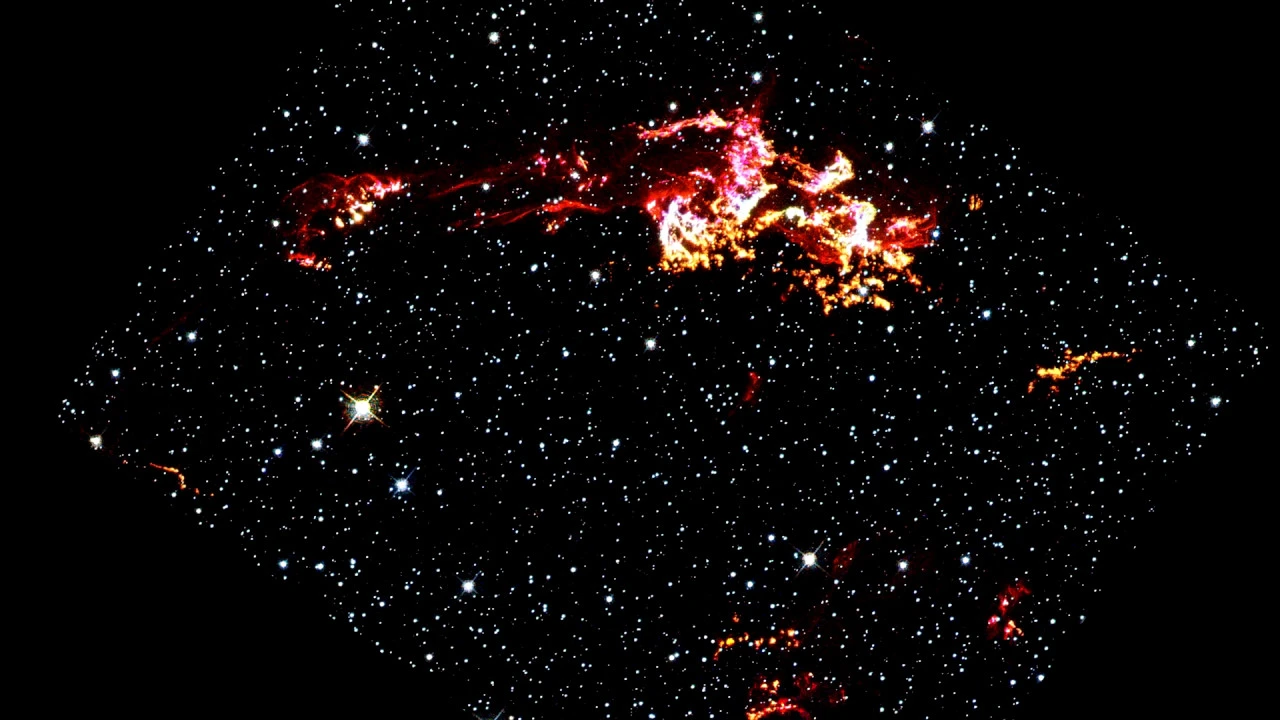



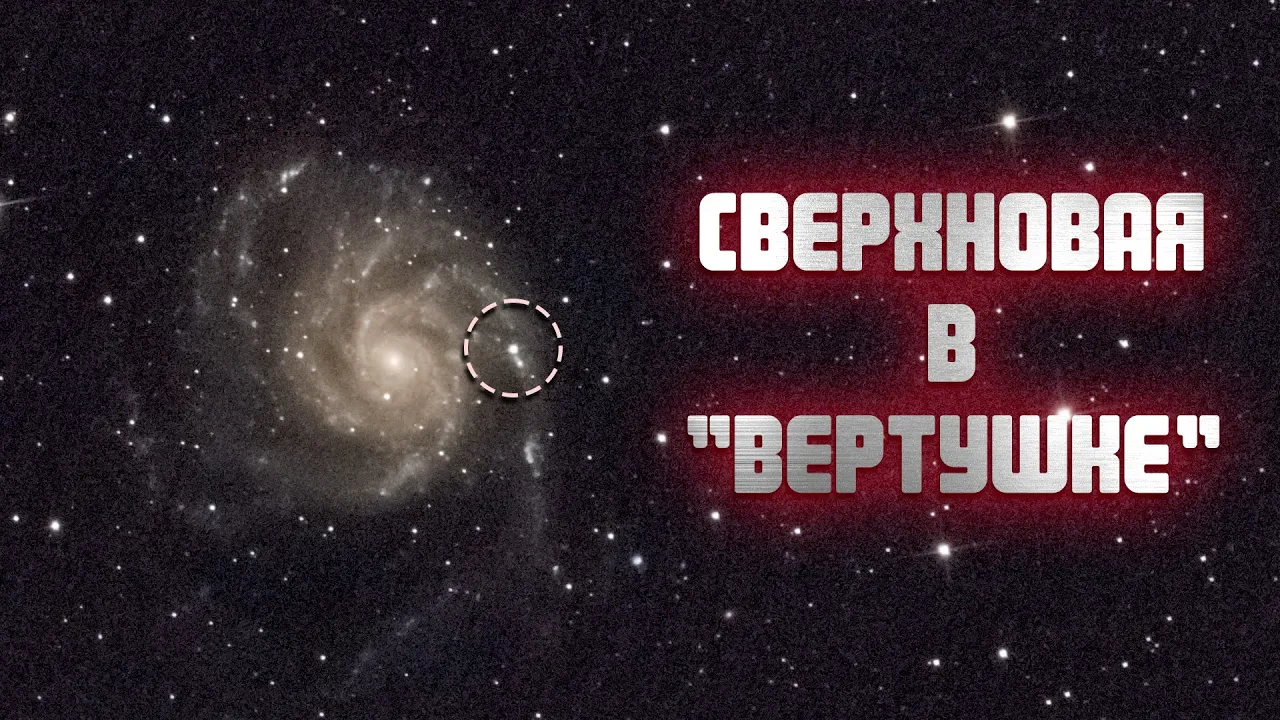
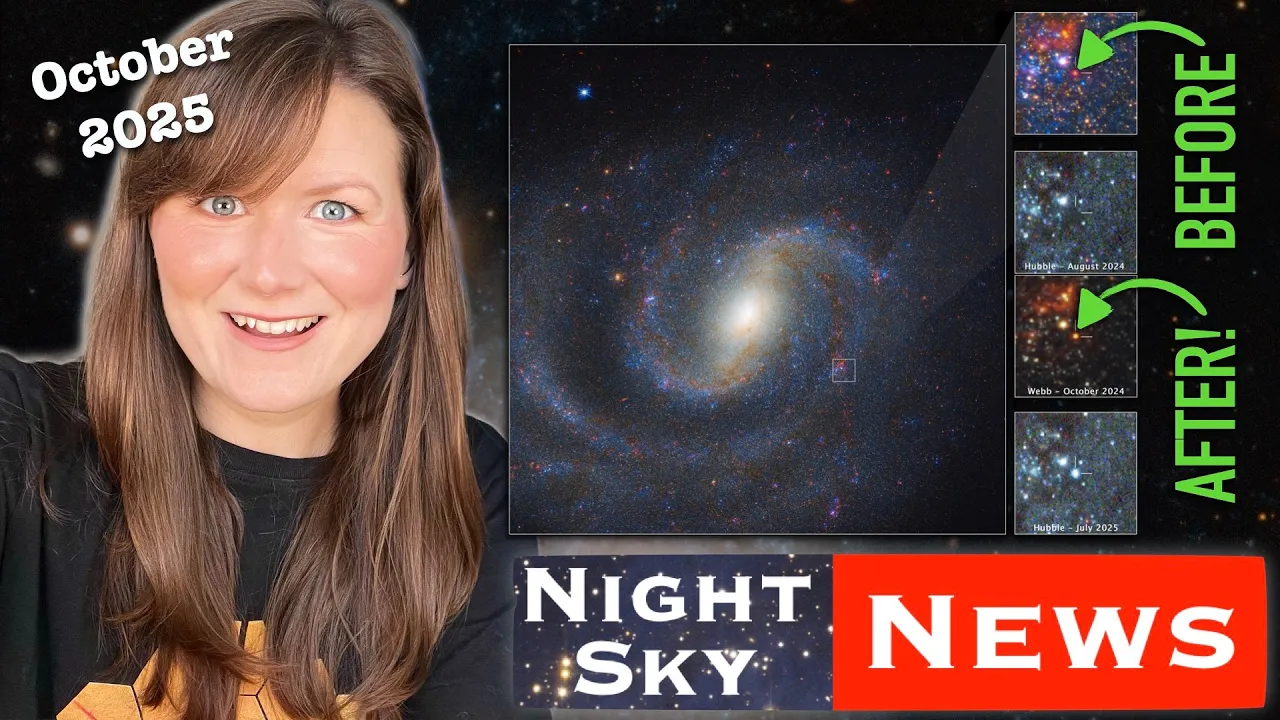

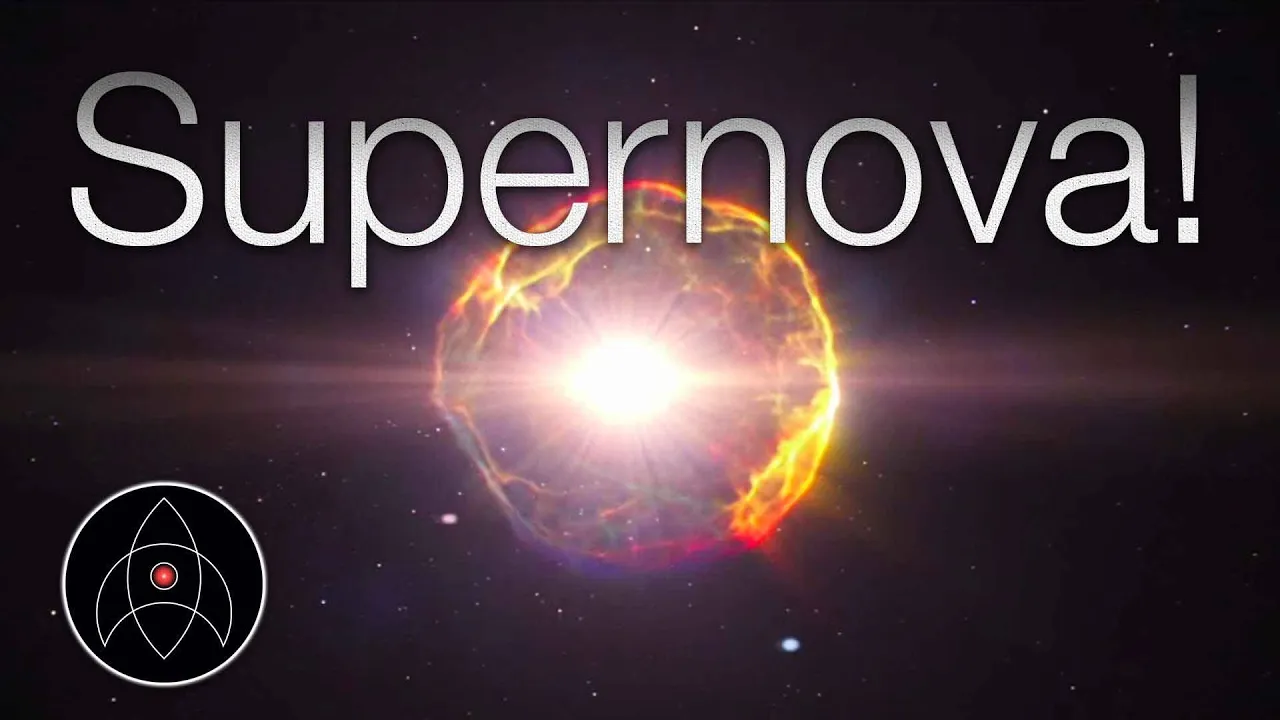
For the first time, astronomers captured a Type II supernova (SN 2024ggi) during its initial breakout phase using the ATLAS survey and ESO's VLT telescope, revealing that the explosion has a prolate (football/olive-shaped) geometry rather than being perfectly spherical. This observation challenges existing theoretical models of supernova explosions, as both neutrino-driven and jet-driven mechanisms have limitations when tested against this new data. The discovery demonstrates that supernovae can exhibit organized axial symmetry, suggesting that either magnetic field-driven jets or some other mechanism is responsible for channeling the explosion energy along a preferred axis, though the exact physical process remains an open question in astrophysics.
Supernova SN 2024ggi: Observing a Star's Explosion in Real Time
Added:Supernova are full of mystery. We still don't fully understand what makes them explode. That's partly because they're impossible to predict. We know what type of star is said to detonate, but have no way of knowing exactly when. In fact, most of the data we have about these spectacular events comes from studying their remnants. in many cases hundreds if not thousands of years after they began. That or a stroke of dumb luck where we just happened to be looking in the right direction at the right time.
But earlier last year, this changed. We finally captured a supernova as it was exploding and on purpose.
Finding it just hours after it began.
This is one of the earliest detections we've ever made, and it's shown us something we've never seen before. The shape of the explosion. It might sound like an unusual thing to get excited about, but this discovery has the power to unlock the inner workings of exploding stars and answer centuries old conundrums. What are the mysterious mechanisms that drive a supernova? How does a core collapse inward then suddenly explode outward? And why do some supernova fail? Thanks to new data from the Atlas survey, we're edging closer to answers. I'm Alex Mccoan and you're watching Astro. Join me today as we watch a star explode in real time, decode the shape of its blast, and find out what really happens in those critical seconds before a star rips itself apart.
On the night of the 10th of April 2024, the Atlas survey was conducting a routine sweep of the cosmos. It consists of four wide field telescopes positioned around the globe in South Africa, Chile, and two in Hawaii. Together, they systematically scan the entire night sky every 48 hours, imaging each region four times in that window. This rapid revisit time helps catch fastmoving events as they happen. And at 3:21 a.m. on the 11th of April, that's exactly what happened. Atlas detected something unusual. A single point in the sky brightening dramatically over the previous 5.8 hours. Immediately, this reading triggered the telescope's automated alert system. The news of the unknown transient spread to the astronomical community across the world, who quickly got to work deciphering what it could mean. 23.8 8 million lighty years away in the spiral galaxy NGC 3621 a star had just died. What Atlas caught was a type 2 supernova right as it happened. Yiang from the Chinua University in Beijing and his colleagues knew what this meant. It was their chance to see for the first time the true shape of a supernova explosion in real time. But they had no time to waste. In addition to being impossible to predict, the initial breakout period of a supernova explosion is incredibly short-lived. Once they go off, their original geometry remains intact for just hours. After that, the ejected material crashes into surrounding gas and dust, warping and obscuring the blast's original shape. The pristine fingerprint of the core collapse, the very thing needed to understand how massive stars die, would be gone forever. So to get a true reading, the researchers had to act fast. While most of the world slept, Yang and his team worked through the night, drafting an emergency proposal to the European Southern Observatory. They urgently needed time on one of the most powerful instruments on Earth, the Very Large Telescope in Chile. If they were going to measure the shape of the explosion, they had to start gathering data right away.
Luckily, ESO immediately approved the request, and the VLT swung towards Galaxy NGC 3621.
Yang and his team waited with their hearts in their throats and their eyes locked on their screens. This was the moment of truth. Had they taken too long, would they get a pure reading back or a scrambled mess of inputs from an already warped explosion?
By the slimmest of margins, they'd pulled it off. Precious data started streaming in, painting a picture of true undistorted supernova geometry. Yang and his team were witnessing the birth cry of supernova 2024 GGI and learning at last how the universe makes its most violent fireworks.
Supernova come in two main types, but we'll focus on type two here, the kind Yang and his team observed. Through a mix of physical theories, astronomical observations, and computer simulations, we've managed to build a pretty respectable model of how we think stars die.
Models are really important in science, helping us test hypotheses and granting new insights. But having programmers skilled enough to develop those models is just as important as having the scientists who work with them. And thanks to Brilliant, the sponsor of today's video, those programming skills are readily available to anyone, including me. That's what I really love about Brilliant. I don't consider myself to be much of a programmer, but it's something that I'm interested in. And through Brilliant's intuitive, easy to grasp interactive courses, like their thinking in Python course, I've been able to brush up on my skills, helping me gain that foundation to start making programs of my own. Brilliant helps you excel at maths and coding with it step-by-step lessons and personalized practice designed for anyone age 10 to 110. Their wide catalog of courses are expertly crafted by the finest minds at MIT, Harvard, and Stanford who know a thing or two about effective learning.
You don't watch videos, but learn by solving problems, which I like as I'm something of a hands-on learner. See for yourself. To learn for free on Brilliant for a full 30 days, go to brilliant.org/astramm in the description below or scan this QR code right here. Astramm viewers also get 20% off an annual premium subscription, which gives you unlimited daily access to everything Brilliant has to offer. Stars spend their lives fusing lighter elements into heavier ones by combining nuclei into more tightly bound configurations.
This fusion process releases excess energy, creating an outward pressure that pushes back against the stars own gravity. This keeps the star in a stable spherical shape. Over billions of years, the stars core works its way up the periodic table, fusing hydrogen into helium, helium into carbon, carbon into oxygen, neon, magnesium, silicon, and finally iron. But this is where the chain stops. If you want to fuse iron into something heavier, that reaction won't release energy. It will require an energy input instead. Iron 56 has the lowest mass per nucleon out of every possible nuclear configuration. So, every chain of nuclear reactions will ultimately turn every other type of nucleus into iron 56. Eventually, the star's entire core becomes iron. It's a dead end. With no more energy releasing fusion reactions available, the star has run out of fuel. It stops burning. The outward pressure that has been holding it up against its own gravity disappears. Without that support, the core collapses on itself at breakneck speeds. The outer part of the core can reach velocities of 70,000 km/s. That's 23% the speed of light. The collapse is so violent that it crushes protons and electrons in the inner core into neutrons. It also releases a flood of nutrinos, nearly massless particles that carry away enormous amounts of energy.
The collapsing material slams into the newly formed neutron core and rebounds, creating a shock wave that propagates outward at thousands of kilome/s, a process known as core bounce.
But the shock wave doesn't make it far.
Within milliseconds, it stalls nearly 100 to 200 km from the center as it plows through the dense outer iron core.
The extreme temperatures and pressures tear apart the heavy iron nuclei back into lighter elements like helium, a process that absorbs enormous amounts of energy from the shock. This is the moment where one of two things can happen. If the shock stays stalled for more than about a second, the star will keep accreting mass until it collapses into a black hole. There's no bang, no brilliant burst. Everything slips into the void. A failed supernova.
The more common and mysterious alternative is that the shock doesn't stall, it gets revived. something, nutrinos, jets, magnetic fields, or some combination we don't yet understand, transfers enough energy to allow the shock wave to continue and turn the implosion into an explosion. Exactly how this happens remains one of the biggest unsolved mysteries in astrophysics and is why events like SN 2024 GGI are so tantalizing to the scientific community.
The shock wave travels up through thousands of kilometers of stellar material. The journey takes several hours until finally it breaks through the outermost layer of the dying star.
This is the breakout phase. As it emerges, the shock wave creates a brilliant flash of ultraviolet and optical light, releasing huge amounts of energy and heating the stars outer layers to tens of thousands of degrees.
It's only at this point that the supernova becomes visible for the first time, reaching peak brightness over the next week or two. And the beginning of this rising brightness is exactly what Atlas saw in the early morning hours of the 11th of April, 2024.
Atlas catching SN204 GGI as early as it did was a triumph. But detection was only the opening move. The real work began after the alert went out. A race against the clock to put the right instruments on target before the explosion's original geometry vanished forever. That urgency was exactly why Yang and his team had fought for time on the VT. They weren't just trying to see the supernova. They were after a very specific signature hidden in its light.
Something only one instrument could reveal.
Mounted on the VLT is an instrument called Fors 2, the only one of its kind in the southern hemisphere. It measures spectropolarimemetry, how light is polarized across different wavelengths of the visible spectrum.
Normally, light waves vibrate in all directions perpendicular to their direction of travel. This is unpolarized light. But polarized light has waves that only vibrate in one direction. For example, when sunlight reflects off a flat surface like water or glass, it becomes partially polarized. It's also why when you put on polarized sunglasses, this glare disappears.
They're designed to filter out that kind of polarized light. In the context of SN204 GGI, Yang was interested in polarized light because of what it could reveal about the shape of the explosion.
A perfectly spherical explosion scatters light equally in all directions, producing no polarization at all. An asymmetric explosion, on the other hand, one that is symmetrical along one axis, like a football or a peanut-shaped explosion, would polarize light in a specific pattern. Fors 2 can help scientists decode this pattern. When light enters the instrument, it first passes through a rotating crystal plate that can shift the orientation of the polarized light by a precise amount. By moving this plate to different angles, the instrument effectively rotates any polarized light, allowing it to measure polarization in all directions.
Next, the light hits a Wallist prism, a unique optical component which physically separates the incoming beam of light based on the polarization direction. Light waves vibrating in one plane go one way. Waves vibrating perpendicular to that go the other way.
Each beam is then split into its component colors, creating two sidebyside spectra on the detector, one for each polarization orientation.
By comparing how bright each wavelength is across the two spectra, astronomers can determine how strongly the light is polarized and in which direction.
Knowing how the light from SN2024 GGI is polarized tells us the shape of its explosion. From there, we can predict the mechanism that caused it.
For over 50 years, scientists have tried to explain the physical processes that revive a stalled shock wave and trigger a supernova explosion. From the creative rubble emerged two leading ideas. The first says that nutrinos must have something to do with it. We know the core collapse sends huge amounts of nutrinos shooting into space. But in the incredibly dense region just above the neutron star, even nutrinos have trouble getting through. It's thought a tiny fraction of them deposit their energy into the material above the core, heating it from below. This creates a violent convection. If enough energy accumulates, the shock surges back to life and the star literally blows its top, exploding furiously.
But here's the thing, the convection doesn't heat the nutrinos evenly.
State-of-the-art 3D simulations led by Bernard Müller at Mon University show these explosions are highly asymmetric, and we've observed real supernova that fit this model well. The Cassiopia a supernova remnant, for example, shows an asymmetric distribution of radioactive chemicals like titanium 44 and nickel 56, which trace back to asymmetries present from the onset of the explosion.
The second theory says jets are behind the boom. Instead, the collapsing core forms a rapidly rotating neutron star surrounded by a disc of infalling material. Magnetic fields threading through this disc get wound up and amplified by the rotation. Twisted tighter and tighter like a rubber band.
These amplified magnetic fields channel material into two powerful jets shooting out along the stars rotation axis like cosmic blowtorrches. They punch through the stars envelope with tremendous force, driving a fundamentally different explosion. In this scenario, the blast would produce axial symmetry along the stars spin. The explosion then expands along this axis, leading to a football-shaped or olive shaped geometry. We've seen this kind of structure in other supernova like SN203XF, whose explosion was also organized and elongated.
So, what do you think Yang's VT observations show for SN 2024 GGI? Pause the video and comment below. An explosion if you think it's highly irregular and asymmetric like the nutrinodriven model predicts or an American football if you think it's symmetrical along an axis like the jet model predicts.
So moment of truth. This is what SN 2024 GGI look like. The spectro polar imagery data collected by the VLT's force 2 revealed a clear well-defined axis of symmetry and an olive or football-shaped explosion. Technically a prolate ellypoid.
At first, it seemed like a clear win for the jet driven theory. If the explosion were driven by nutrinos, it would have been completely asymmetrical.
Finally, we had the conclusive observational data we'd always been missing. Case closed, right?
If only it were that simple. These models are based on simulations, theoretical physics, and extrapolated information from supernova we caught much later after the critical breakout phase window shut. The nutrinobased model certainly has its shortcomings. A 2015 article from the Royal Astronomical Society showed that 3D nutrinodriven simulations produce explosions an entire order of magnitude less than what we've seen observationally even in the most favorable of conditions. This suggests nutrino heating alone simply isn't enough to explain the blast. But the jet driven theories aren't flawless either.
2D models seemingly work well. But when astrophysicists simulate jet driven explosions in 3D, something strange happens. A team at Caltech introduced a 1% wobble around the axis of symmetry of a rapidly rotating magnetized stella core. That tiny change made the jets unstable. They twisted and kinkedked, winding around the rotation axis like water streaming out from a garden hose left lying on the ground. Instead of punching cleanly through the star and driving an explosion, the jets produced two misshapen lobes of twisted, highly magnetized material that slowly pushed outward. The explosion never happened.
There simply wasn't enough energy to trigger an explosion. Yet SN 2024 GGI clearly exploded. So, there must be something else going on. Either our models are incomplete or we've missed something else entirely.
The solution might lie in flipping the old theory on its head. What if the fatal wobbling and kinking is actually an essential part of the explosion? If jets rapidly jitter rather than maintain a stable axis, they can't drill a clean channel through the star like in the classic jet driven model. Instead, they're forced to deposit their energy close to the core, roughly a thousand km from the center through shock waves.
These shock waves create hot pressurized bubbles that merge and expand, pushing the stellar material outward and driving the explosion. The jets themselves are chaotic and unstable, but the overall explosion geometry remains actually symmetric, just like SN204 GGI.
So where does this leave us? Well, SN2024 GGI definitely showed us that explosions can have organized axial symmetry. and how it arises, whether through narrow jittering jets or a magneetto rotational mechanism or something else, remains a mystery. We're still unsure what role nutrinos play in explosions like this, if any. It also raises questions about alternative mechanisms that could cause asymmetrical supernova, like Cassiopia A and others which don't follow axial symmetry. Are they in fact caused by nutrinos or something else? Which factors determine what kind of explosion occurs? This might come as a shock, but we can't know without more data. SN204 GGI is the only breakout phase we've observed in such detail and measured in real time. If we could somehow know when and where supernova were going to explode, we could make a point to track them all and look for the patterns. And that's exactly what researchers plan to do thanks to new fall sky surveys like Atlas becoming increasingly popular.
2025 alone saw the inauguration of the Very Rubin Observatory Legacy Survey of Space and Time, NASA's Sphere X, and the latest data release of the Sloan Digital Sky Survey. Astronomers are optimistic that with these new tools, they'll be able to regularly catch supernova within 24 hours of explosion. If they notice an object is absent from previous night's images, but then appears within a galaxy, they'll follow up immediately with spectroscopy to determine the object's characteristics as fast as possible. As more automated survey systems come online worldwide, our ability to catch transient events in their earliest moments will only continue to improve. SN 2024 GGI showed us our models aren't quite there yet.
The next generation of observations should help us find the missing piece and solidify our understanding of how stars all over the universe draw their final breath. And I mean, who wouldn't want to see more supernova getting caught in their explosive moments?
Thanks for watching. If you've been enjoying Astramm's videos and want to help keep this channel thriving, I want to ask you to take less than a minute to check out the Astramm Patreon. It's not just ad free videos, but it's a way to make Astramm's videos less reliant on sponsors and algorithms. The link is below. Your membership directly helps ensure that future videos can stay independent, highquality, and consistent, created for curiosity, not clicks. Thanks so much for considering it. I'll see you next time.
And again, a big thanks to Brilliant for sponsoring this video. Go check them out by clicking their link in the description below.
Up Next
Pulsars and Neutron Stars: Formation, Structure, and Magnetism
@ScienceClicEN
759.9K views•2021-04-05
First Billion Years of the Universe with the Square Kilometre Array
@iaaudc
121 views•2022-05-26

The Paradox of Polaris: Why the North Star Defies Stellar Models
@astrumspace
801.6K views•2025-08-25
Gamma-Ray Bursts: Cosmic Snipers Explained | Astronomy
@kurzgesagt
15M views•2016-07-31
Related Study Plans & Knowledge Roadmaps
Structured learning paths in Astronomy