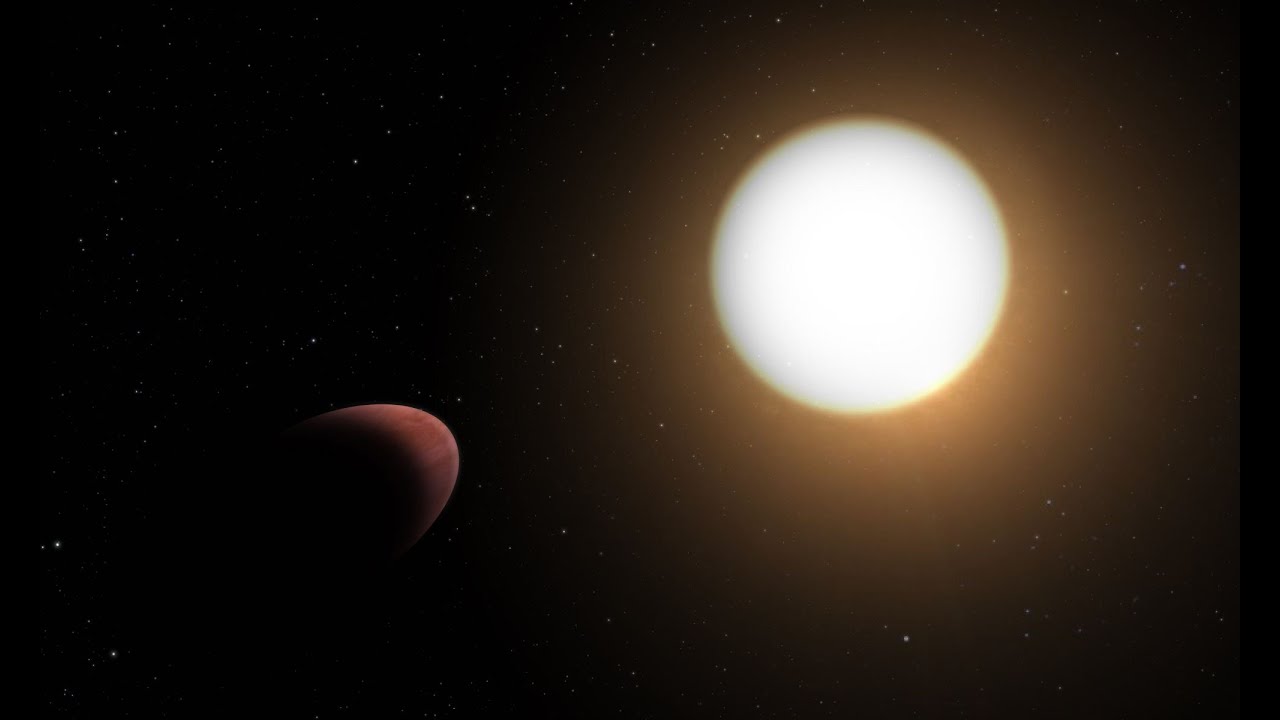





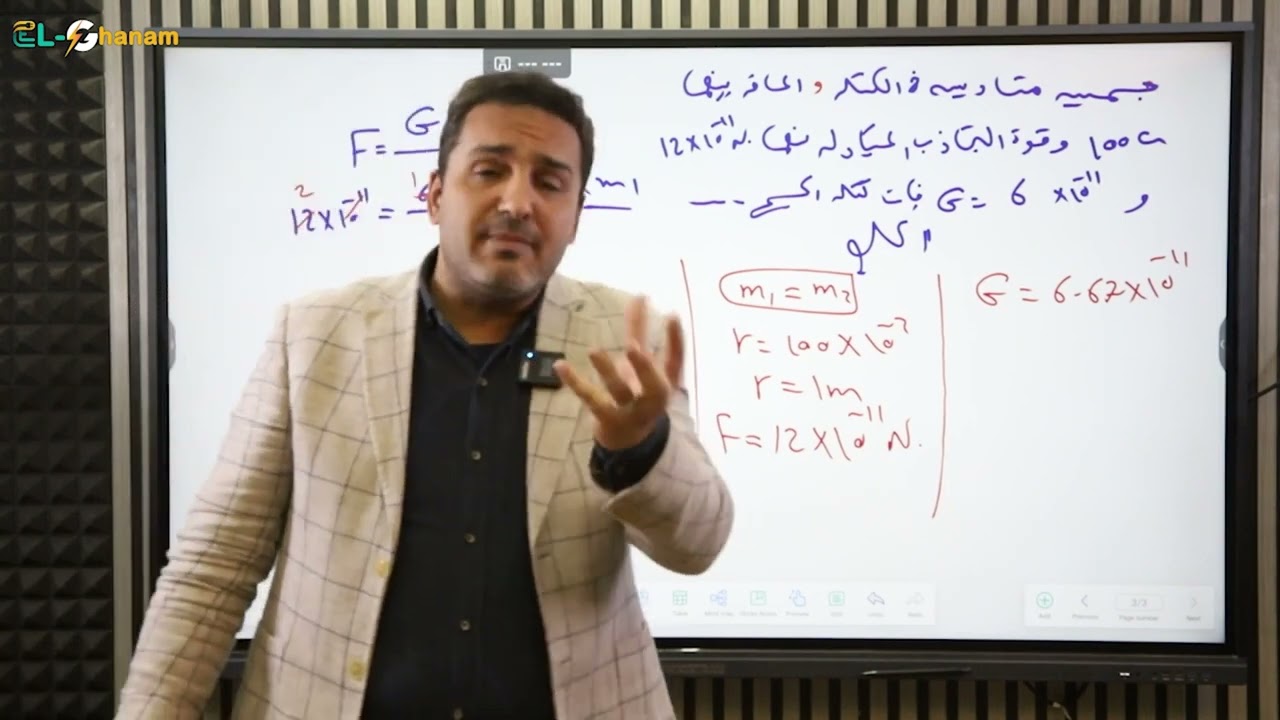






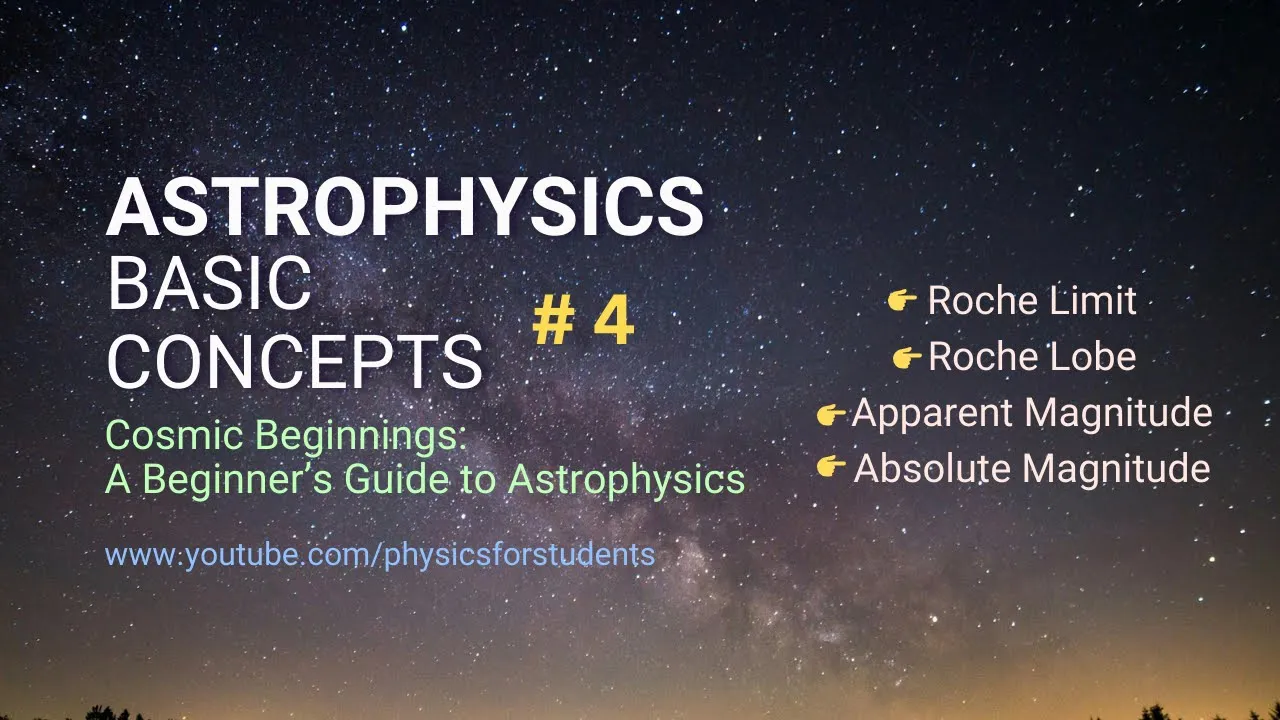









The Roche limit is the distance from a planet where objects begin to be shredded apart by tidal forces, calculated using the formula: Roche Limit = 2.4 × (Planet Radius) × (Planet Density / Object Density)^(1/3). To calculate this in Google Calculator, enter the planet's radius (e.g., Saturn's 5.8 × 10^4 km), multiply by 2.4, divide by the object's density (e.g., 1.2 g/cm³ for icy moons), and raise the result to the power of 1/3 (approximately 0.33). For Saturn, this yields a Roche limit of approximately 116,500 kilometers.
Calculate the Roche Limit with Google Calculator | Astronomy Tutorial
Added:Newton's Law of Universal Gravitation and the fundamental concept of tidal forces.
The physical definition of density (mass divided by volume) and how it differs between celestial bodies.
Basic mathematical operations, specifically ratios, exponents, and calculating cube roots.
Understanding planetary physical properties, such as radius, mass, and how they are measured in astronomy.
Analyzing real-world astronomical phenomena, such as the structure of Saturn's rings and the breakup of Comet Shoemaker-Levy 9.
The mathematical and physical differences between the rigid Roche limit and the fluid (deformable) Roche limit.
The concept of Roche Lobe Overflow and mass transfer mechanisms in close binary star systems.
The role of tidal dissipation, orbital decay, and tidal heating in moons orbiting close to their host planets.
320 views4likes4:33Original Release: 2020-10-07
now if you don't feel comfortable using a scientific calculator to calculate the roche limit i'm going to show you how you can do it here in google calculator okay so there's no excuses for not being able to do this calculation so to calculate the roche limit of a planet the distance where if you get too close things start to get shredded apart um we have to take 2.4 so you type in 2.4 times the radius of the planet so if i'm using the radius of saturn the radius of saturn is 5.8 times 10 to the 4 kilometers so i'll type in 5.8 and then you click this button that says exp that gives me the e big letter e which represents times 10 to the and then i say four okay so i put it in parentheses here so the radius of of saturn 5.8 times 10 to the 4 kilometers to put that into scientific notation into a calculator you would type 5.8 use this exp button to give you this big e and then say 4 and this means 5.8 times 10 to the 4 okay and then you don't really need to put parentheses around it but i did here and then we have to multiply it by the ratio of the density of the planet to the density of this um moon or object or planetesimal that's trying to get a little bit too close to the planet so you have to multiply this by the ratio of let's say the density of saturn which was 0.7 grams per cubic centimeter and then we're going to divide it by so i click the division sign the um click it here or i just typed it on my computer keyboard and divide it by the density of the moon so um saturn's moons are mostly icy rocky bodies and so that density is of of those materials is about 1.2 grams per cubic centimeter on average okay so this is 0.7 divided by 1.2 we have to take that ratio and we have to raise it to the power of one-third how do i do that well if you come over here and you see this button that says x to the power of y if i click that it's going to take whatever i put in this parentheses right here and raise it to whatever power i input so raise it to the power of 1 divided by 3 one-third i'm just going to say that that's equal to 0.33 okay um one-third is 0.333 repeating right or 0.3 repeating but i'm just going to approximate that as one-third so this is our equation for a roche limit of a moon around saturn we've got to take 2.4 times the radius of the planet times the ratio of the density of the planet to the density of that moon or asteroid that's getting a little bit too close to the planet and then you raise that to the power of one-third so i here i raised it to 0.33 okay remember you put the parentheses around that ratio click this x to the power of y button here to give me the little exponent and then i can type in the 0.33 okay so i'm going to ask you to find the um roche limit around the earth or some other planet okay if i ask if i asked you to find the roche limit around some other planet you would change the radius here to the radius of that planet change this first density here to the density of that planet change the second density here to the density of whatever object is going to get a little bit too close to that planet and get ripped apart and then you raise that all to the power of one-third okay so once we've got it typed in like this you hit enter and then that tells us that the roche limit of saturn is 116 500 kilometers so if you get too close and to saturn you get closer n than that value then saturn's gravity will start ripping you apart
Up Next

46:03
Nuclear Physics L1: Nucleus Structure & Mass Defect | IIT/NEET Prep
@DIGITALPHYSICSACADEMY-kb5on
529 views•2026-01-07

12:53
21cm Hyperfine Transition in Neutral Hydrogen: Radio Astronomy Basics
@AaronRobertParsons
12.4K views•2011-10-13

32:32
NMR Spin Physics I: Zeeman Effect, Resonance Condition & Larmor Frequency
@nptel-indianinstituteofsci8064
2.3K views•2024-01-17

27:14
Entropy and the Second Law of Thermodynamics Explained
@veritasium
27.5M views•2023-07-01
Related Study Plans & Knowledge Roadmaps
Structured learning paths in Physics
physics
Nuclear Physics (Decay, Fission & Reactors)
01Atomic Structure and the Binding Force
02Radioactive Decay and Half-Life
03Nuclear Fission Mechanics and Chain Reactions
+ 2 more learning modules
12h5 modules
Explore Roadmap
physics
Soft Matter (Polymers, Colloids & Rheology)
01Foundations of Soft Matter & Thermal Forces
02Polymer Physics and Macromolecules
03Colloids, Surfactants, and Self-Assembly
+ 2 more learning modules
38h5 modules
Explore Roadmap
physics
Analytical Mechanics: Lagrangian & Hamiltonian
01Mathematical Foundations: Calculus of Variations
02From Newtonian Mechanics to Constraint Dynamics
03The Principle of Least Action & Lagrangian Mechanics
+ 3 more learning modules
28h6 modules
Explore Roadmap
physics
General Relativity (Spacetime & Cosmology)
01Foundations of Relativity: Special Relativity
02The Geometry of Spacetime: Equivalence Principle & Curvature
03Einstein's Field Equations: The Mathematics of Gravity
+ 2 more learning modules
55h5 modules
Explore Roadmap