










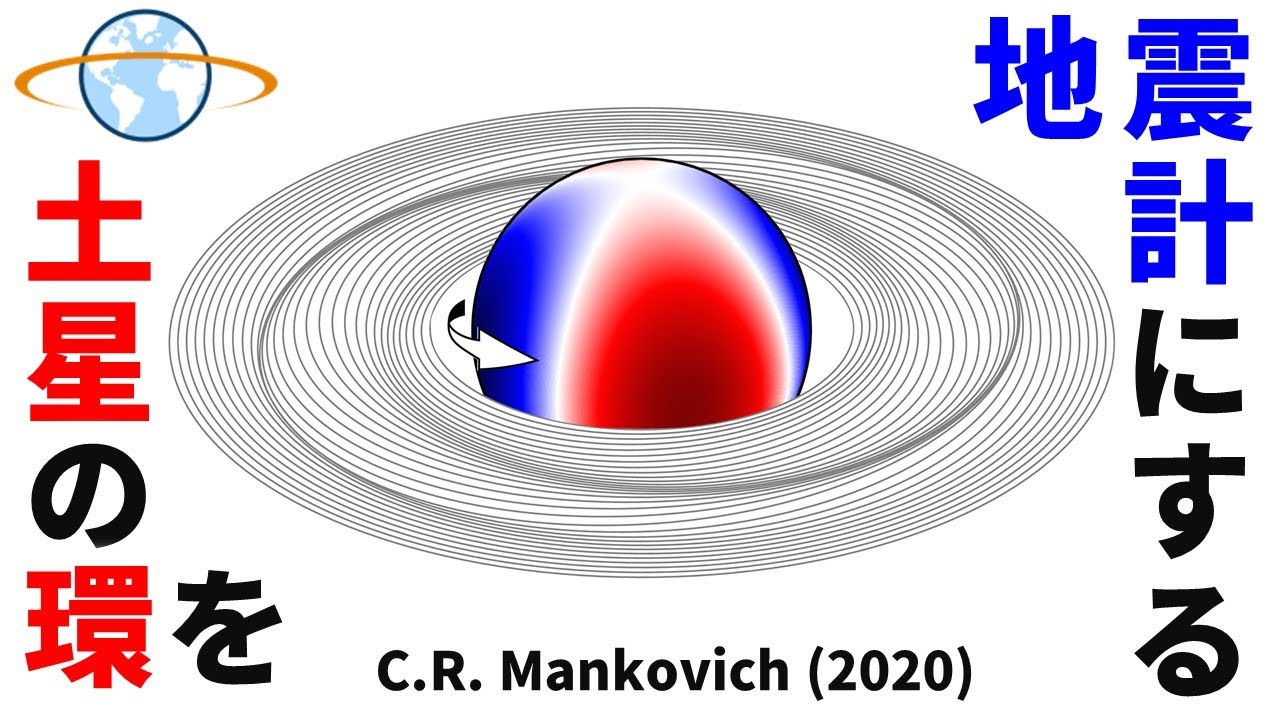






Saturn's rings act as a natural seismograph, detecting oscillation modes caused by the planet's internal structure; analysis of ring wave patterns reveals that Saturn possesses a diffuse, extended core spanning over half the planet's radius, rather than a compact solid core, demonstrating that gas giant interiors are characterized by stable stratification from composition gradients rather than sharp boundaries.
Planetary Seismology: Unlocking Saturn's Interior via Its Rings
Added:Basic principles of seismology, specifically how normal modes (free oscillations) and acoustic waves propagate through fluid and solid bodies.
Fundamental orbital mechanics, including gravitational perturbations, tidal forces, and orbital resonance phenomena (such as Lindblad resonances).
The general composition of gas giant planets, including the concepts of hydrostatic equilibrium, differential rotation, and core-mantle boundaries.
The basic structure of planetary ring systems, particularly Saturn's rings, and how they respond to external gravitational forces.
The theory of 'diffuse' or 'fuzzy' cores in gas giants and how these findings challenge traditional core-accretion models of planet formation.
Advanced Kronoseismology: The mathematical modeling used to map specific ring wave patterns back to gravity-mode (g-mode) and pressure-mode (p-mode) oscillations within Saturn.
Planetary dynamo theory, exploring how Saturn's diffuse core and internal rotation profile influence its unique, highly axisymmetric magnetic field.
Comparative planetology applications, specifically assessing whether ring seismology can be used to probe the interiors of Uranus and Neptune.
140 views11likes1:08:35Original Release: 2021-09-02
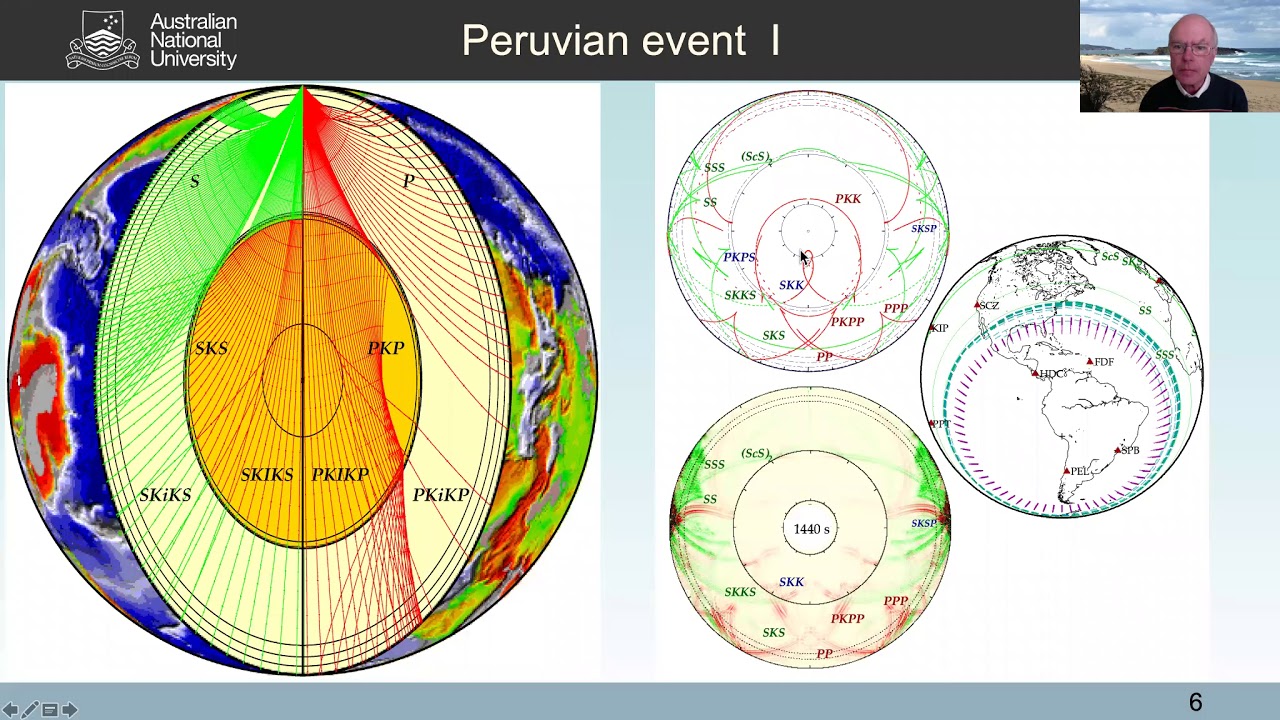
mission okay perfect yeah then welcome everyone to or to the weekly colloquium of the physics institute of the unam in connerva in mexico our guest today is dr christopher menkovic from the caltech in the night united states so let me say some some few words on the detail of dr menkovic so he did his phd in astronomy and astrophysics at the university of california in santa cruz and yeah since 2019 he is a postdoctoral research associate it's a division of geological and planetary science it's a california institute of technology in the united states his research focuses on the formation of stars and planets in particular he is interested in the role played by fluid stability versus instability in these objects and the related question of how these objects naturally pulsate chris thank you very much for joining us today at least virtually it would have been a pleasure to have been here in person to host you here in person and yeah we're looking forward to your talk great thank you so much thomas buenos diaz everyone uh it's really my pleasure to be visiting um at virtually anyway um and i'm excited to tell you about some of these cool results that we've been finding at saturn lately um so i think i'll just i'll just dive right into the main event um gas giant planets are really fascinating things to study in astronomy in part because they dominate the mass budgets of planetary systems they contain kind of primordial building blocks we think of the solar systems that they formed in and so learning about their structure and their composition the way that they're put together can really tell us a lot about the full story of our solar system and from and for the planetary systems in general in which there are many many many study-able systems in the galaxy um so a big question we want to answer for giant planets is what's what's the nature of their formation process and the related question of what's the nature of their course and the prevailing theory for how giant planets get assembled is the theory of core nucleated accretion and the related kind of theory of pebble accretion this is a picture from kind of a classical style core accretion simulation that can build a giant planet like say a jupiter and the basic story is that there are distinct phases there's an initial phase in which planetesimals are accreting into kind of a solid core at some point that growing solid core is able to begin to trap gas from the nebula and when a planet has roughly an equal part of gas mass and heavy element mass it can trigger a runaway accretion some say a dynamical accretion of gas from the nebula and then it creates most of its mass in the form of a gaseous envelope and so this is sort of the standard picture for the accretion of say jupiter and this indeed is a simulation over time that shows a planet recruiting first its core then begins to equate some gas before a runaway accretion event in which the planet gains most of its mass and ends up at 315 or so earth masses this idea has been around for a long time and it has a a major testable prediction which is that gas giants have dense cores so the existence and the mass of cores in our local gas giants jupiter and saturn was kind of a main mission objective for the juno mission to jupiter and the cassini mission to saturn and so you might have heard about this being sort of one of the main points of these missions um juno and jupiter is a is a huge one um and the way that they're supposed to answer these questions for us is with gravity field experiments and that might not mean anything to you or it might so i'll talk a little bit about what does that really mean when we say that juno and cassini can tell us about the cores of these planets well we have these spacecraft that can conveniently be sent to these gas giants which is part of the reason why the solar system is an incredibly convenient place to be answering these questions because we can actually build spacecraft and send them to the planets and it's often said that the gravity field measurements that the spacecraft do is a free measurement in the sense that it doesn't require a dedicated instrument what it actually is is just making use of the radio downlink that these spacecrafts have to earth anyway for navigation purposes in order to track radial velocities as a function of time and so um the way that these spacecrafts orbit is a function of the gravity fields of the planets themselves and so it's really just determining the orbits of the spacecraft that can tell us the gravity fields of the planets the reason that's useful for understanding the interior physics is because the potential outside of the planet can be kind of thought of as a multi-pole expansion these planets are not point sources of mass because they are distorted by their rotation and as a result there is actually a long series of non-spherical terms in the potential this is leaving out influence from satellites and other bodies in the solar system for the moment but the field of just one of these oblate planets can be written as this multiple expansion and you'll notice that there are some familiar items in here it depends on the mass of the planet it depends on your distance from the planet and the planet's radius as well as these legendre polynomials that's that's the kind of nature of the expansion and inside this expansion are these coefficients these j2n and these are really the prizes when it comes to trying to understand the interior of the planet these gravity coefficients j2n i might also call them gravity harmonics are essentially just integrals of the mass distribution over the oblique planet so j2n is ultimately measured because the gravitational potential is measured and inside of this integral that's over the volume of the planet is the density and so when you measure the j2n you are encoding um the full mass distribution over the non-spherical planet and this is a function of course of the composition the temperature the shape and the rotation um and more specifically the spatial distribution of all those things um the kind of unfortunate part about using these types of measurements to back out the density distribution in the planet is that you are integrating over the volume of a planet so these are integral quantities um and as a result they they are only sort of each one is a scalar that tells you some integral it doesn't necessarily uniquely tell you the distribution of of those quantities this is a plot that summarizes the contribution functions to these j2n starting from 0 2 4 6 8. so j2 the contribution function over say saturn's radius to j2 is given by this blue curve where the maximum value sort of tells you the the key region to which that quantity is sensitive and you can see that in general all of these gravity harmonics are weighted heavily toward the planetary surface and so they intrinsically carry kind of weak information about the deepest interior parts of the planet c0 in this case is just the contribution function to the total mass which we know anyway so it's not helpful um so there's kind of an inherent disadvantage in using these quantities to study the deepest parts of the interior um with that in mind i'll give you kind of a picture of theorists sort of best guess for the structure of jupiter before juno gravity started coming down around the time that i was a phd student so this is just one particular model for jupiter's interior structure from hubbard and militzer and this plot is showing density as a function of radius in the planet normalized to the total radius and this is a model that features a classical kind of compact core so you'll notice they're pretty distinct densities describing the the envelope which is dominated by hydrogen and the the core which is just assumed to be a core pure heavy elements like silicates and water ice the cartoon here shows you kind of a general summary of the compositional structure that's assumed in a classical model like this there's an envelope of molecular hydrogen there's an inner envelope of metallic hydrogen and the reason for this is really that for the temperatures typical of the giant planets as a function of increasing pressure as you move into the planet you eventually start to sort of pressure ionize the hydrogen and it takes the form of a metallic fluid and so there's a major difference in electrical conductivity between these two layers which is why they're thought of as sort of distinct there's also something else going on which is indicated sort of here in this layer and also in the fact the outer envelope is said to be helium depleted while the inner region is healing rich and what this is is a helium rain layer so something related to the fact that hydrogen becomes a metallic fluid as you increase the pressure um is the fact that the helium which remains neutral tends to come out of solution and so helium and fluid metallic hydrogen are not perfectly miscible and it turns out that jupiter is is so cold that this this this phase separation between hydrogen helium is happening um and there's a lot of evidence for that both from kind of first principles physics also from an institute measurement of the helium abundance in jupiter's atmosphere that was given by the galileo entry probe and recently maybe some have seen a nature paper reporting an actual laboratory detection of this hydrogen helium immiscibility for the first time which is a major step forward because it's a piece of concrete evidence for this idea that has been around for many decades and applied to jupiter so anyway this was sort of published as the best guess for jupiter's interior structure prior to juno now with the benefit of juno data our ideas for jupiter's interior structure are starting to move a little bit because of what the data requiring this is a plot from sean wall's 2017 paper that is basically fitting similar data although now with the benefit of very precise gravity harmonics for jupiter that extend for several degrees and so there's j2 all the way up to j10 in terms of these even coefficients that are most valuable for constraining the deep interior so there are models with classical compact cores but what it looks like is that diffuse cores as opposed to these really compact pure heavy element cores tend to be helpful for fitting the gravity spectrum especially jupiter's j4 which is rather hard to fit with the models that i was showing in the previous slide and this can take the form of say um just a model where the same amount of heavy element mass that was previously in a contact for is just blurred out to say 40 or 50 percent of the planet's radius or it could be a gradual distribution of that same amount of composition um it's really not clear from the gravity field because again it's intrinsically an integral quantity that does not tell you about the distribution specifically so now we're starting to have a picture for jupiter's interior maybe where there is this there is not such a neat division between a compact heavy element core and the envelope that's dominated by hydrogen and there might be a few reasons for that metalicity gradients might just be naturally built up during core and pebble accretion um in part that's just because there are not really these clean um episodes of heavy element accretion followed by an episode of gas accretion in reality there are there's kind of a continuum of accretion rates that vary between pure rock and pure gas so given that gas can really accrete at the same time as heavy elements you can naturally build up bottom heavy composition gradients whether or not those gradients that are built up in accretion simulations can actually survive for billions of years of evolution is really up for debate because the cooling of these planets tends to drive convection that convection can sort of erase or erode these composition gradients and so it's not clear whether those primordial cores can kind of survive intact at the solar age although it's likely that at least the deepest parts of them do there's there's a separate issue at play here which is just the fundamental solubility of rocky and icy material in liquid metallic hydrogen so there's been a a kind of series of works in high pressure first principles physics that show that water ice and even silicates are just can just be dissolved by liquid by fluid metallic hydrogen and so even if you formed with a kind of discrete pore like in the classical core efficient picture that can still probably mix with the overlying fluid over time and potentially be mixed into a diffuse structure and the final possibility that i'll mention is the possibility of giant impacts so after a core accretion kind of formation of the planet it's still possible that that planet experiences a huge impact which can tend to give you a diffuse core if the conditions are kind of just right and that was in this really cool work by lewitt all in nature um i will say that seems a little bit more remote than other possibilities in my mind just because the particular simulation that showed you can get a very diffuse core like this kind of structure for jupiter happens to be a very massive and a very kind of fortuitous impact in the sense that it has to be dead-on and it's not clear whether given kind of a realistic distribution of of impact distances whether this can actually take place so anyway juno is sort of hinting at this kind of diffuse core structure in jupiter but it's really not clear yet whether one is strictly required it kind of depends on who you ask and one of the major uncertainties in giant planet interiors is still the equation of state even the equation of state for hydrogen unlike stars it's really not well known in the conditions of these giant planet interiors and it's intrinsically really hard to study experimentally and so as a result if you kind of use different equations of state assumptions building your model you might get different answers and i think i think it's too soon to say uh definitively whether this diffuse core is necessary in jupiter um but more gravity data might help to answer that question and the juno mission is ongoing so stay tuned so how how does all this kind of play out for saturn um like like juno there is a phase of cassini's mission that was spent in really close orbits around saturn to measure its gravity field and so what have we learned um and the answer is a lot harder to answer this question for saturn and the main reason for that is because the interpretation of saturn's gravity field is kind of confounded by this this issue of very deep zonal winds um one of the huge results from the genome mission at juno and then also from the grand finale of the cassini mission at saturn was the the result that the zonal wind patterns that you can see on the surface of the planet they're plotted here in these diagrams actually just extend quite deep into these planets interiors which is not something that was at all clear before the spacecraft actually started delivering these data this is a plot that shows the spectrum of even gravitational harmonics for jupiter and green and then saturn in red and the expectation was more or less the expectation for uniformly rotating models which are shown in kind of the smaller markers here and what was found instead is that the higher degree gravity coefficients were really enhanced compared to the rigid model and this is not something you can really explain with an alternative structure for the planet it's really only something you can explain by by appealing to the fact that um velocities in the actual fluid extend quite deep into the planet relative to the rigidly rotating model and as a result these gravity coefficients can kind of be enhanced if you think about it it's it's sort of an effect where the additional rotation from say an eastward an eastward jet near the equator kind of amounts to a little bit of centrifugal lift and so effectively the kind of mass that the spacecraft is feeling is a bit different because of the velocity so you'll notice that the effect on this diagram for jupiter is kind of tiny compared to the effect for saturn where these higher coefficients are really really strongly affected by the differential rotation um you can you can sort of back out a family of profiles that are allowable for the for the wind amplitude as a function of depth and that's what's shown here for saturn above and jupiter below and it's not uniquely determined but but scientists like joha caspian elegante are able to make really informed guesses um and show that the gravity actually constrains the allowable profiles quite well and they penetrate to similar depths it seems the sort of differential rotating part of these planets exteriors penetrates to similar depths in terms of pressure but because these planets have different masses that really corresponds to sort of different depths in the planet um so in jupiter this extents it's something like 3 500 kilometers say very roughly and in saturn these winds penetrate to maybe 9 000 kilometers when you account for the fact that saturn is only one-third the mass of jupiter you you realize that these differential flows are actually influencing a significant fraction of saturn's mass and this is part of the reason that these gravity harmonics are really influenced largely by that differential rotation and so an outcome of this is that we're really not able to say anything quite as definitive about saturn's interior mass distribution because the js certainly j12 j10 j8 even j6 and even j4 when you look at it are pretty significantly affected by the differential rotation and so it's a lot harder to say anything about the contribution the separate contribution from the interior density distribution so it's a bit muddier and unfortunately this really leaves saturn's core as an unsolved problem from the perspective of cassini gravity so is there another way we can study this and you've probably already guessed that i'm here to tell you yes and how um so that brings us to the promise of seismology seismology would be an independent way to study this planet we know that seismology is tremendously powerful in a number of different objects terrestrial seismology is obviously the the birthplace of seismology um and you can study the earth using its normal modes but a lot of the information has come from not using normal modes but studying instead just body waves that propagate following an earthquake so this is this is kind of a cartoon that shows how the two main families of body waves pressure waves and sheer waves can travel in the earth's interior following an earthquake and so there are a number of things you can learn about the earth just one example among the greatest hits is ingaleman's determination that the earth's inner core is actually solid um so in the in the kind of previous picture where the entire earth's core were liquid you have this massive p wave sorry shear wave um shadow zone because a fluid core cannot support shear waves and so they evan s in this liquid core and most of the planet on the far side of the epicenter of the earthquake would have no detectable shear waves likewise p waves um are kind of diffracted differently in the liquid part of the core and the solid part of the core um and what became clear is that some some of these p waves were observable on the exact opposite end of the earth then the epicenter which kind of indicated that part of this inner core needed to be solid and that's just one of many kind of stories that terrestrial seismology had to tell about the interior structure of the earth helioseismology was um kind of a total game changer for our understanding of solar physics the sun turns out to oscillate with what are mostly p modes which are trapped sound waves that are excited by convection in the outer regions of the sun if you've heard of the solar 5-minute oscillation that's an example of solar p-mode oscillations and this has told us a number of things about the sun and its external structure including the finding that rotation varies as a function of latitude on this um in the solar convection zone and that this differential rotation kind of disappears once you reach around 70 of the sun's radius which is thought to be the lower part of the solar convection zone that's referred to as the tachycline and it's kind of thought to be the the seat of the sun's dynamo that generates its magnetic field and then below that is a radiative zone that appears to be rotating kind of rigidly so this was all information that was only possible because of helioseismology astroseimology is is a similar method that applies normal modes to understand the interiors of other stars beyond our sun and just to give just one example there are many classes of pulsating stars but red giant oscillations have been studied using photometry for missions like caro and kepler now tess and red giants are really fascinating because they exhibit not just p modes like the sun but mixtures of p modes and g modes that live in the core g modes are trapped internal gravity waves that are restored by buoyancy and there have been a couple of huge results that came out of this kind of field uh one of them is this is this nature result gravity modes as a way to distinguish between hydrogen and helium burning red giant stars this is kind of fascinating because on the red giant branch in terms of the location on the hertzburn russell diagram there's no way to tell which red giants are ascending the red giant branch versus those that are sitting on the red clump burning helium in their cores but this mixed mode seismology made it possible to kind of disentangle those two families because they have different signatures in their pulsations because one of them has a convective core in part of this healing core that's burning helium another huge result is just the measurement of core rotation these same gravity modes were able to deliver the rotation rate of the interior tiny helium core at the center of these red giants that are pulsating and it revealed the fact that the core is is rotating faster than the envelope of these stars by at least a factor of 10 which was not known at all results like this make me say it's arguable that we understand the interiors of red giant stars better than we understand the interior of jupiter or saturn because the seismology is so readily available now there are hundreds of thousands of oscillating red giants in in tests and it's going to be really fascinating to see what we can learn especially because these are now distributed over the full sky as opposed to the small field that kepler was staring at and i'd be remiss if i didn't mention uh martian seismology which is there's there's an incredible trio of papers that came out just about a month ago um delivering seismic results from the mars insight seismometer um this is a cartoon from just one of those papers that has results about about the martian core and these this finding was kind of driven by mars quakes that were that were picked up these sheer waves that were picked up after having reflected off of the core boundary and so the detection of these mars quakes made it possible um in part through an analysis of their polarization made it possible to determine the radius of mars core and so this is an incredible new detection that's happened in planetary seismology and it's really exciting to see mars insight kind of delivering this kind of stuff um so where does that leave us with giant planets can we do giant planet seismology um and so far the answer is not in a way that's useful this is a result from a nice observatory this is goal medal 2011 showing a power spectrum for jupiter that was obtained from radial velocity maps of jupiter's surface so an oscillating planet should show regular velocities on its surface and measuring their frequencies could tell us about the interior structure this power spectrum shows a bunch of excess power that it seems like is in a plausible place for for jupiter's p modes with amplitudes at the surface of 10 to 50 centimeters per second um there's a secondary bump over here that it's um it's unclear what the origin of that is um but this might be a detection of jupiter p modes unfortunately it's certainly not the level yet where individual modes can actually be picked out which is going to have to happen before these can be useful for constraining the interior structure of jupiter so i think this is a really promising field that we should all be keeping our eyes on in the coming years so at saturn we really have a unique probe in the form of ring seismology or chronoseismology first i want to just say that ring waves throughout saturn's rings are really quite common and they've been known to exist for a long time as a result of satellite orbits so if you look at a photograph like this these look like almost radial patterns they look almost actually symmetric but what these actually are are spiral waves that are wrapping all the way around saturn inside the rings these waves can take one of two flavors these are all waves that are that are sort of propagating away from saturn these are spiral density waves which are just created at what are known as linblad resonances with eccentric moon orbits and all that means is that there is some perturbing frequency from an orbiting moon that is giving gravitational pushes and poles to ring orbits on time scales that are commensurate with like the local uh response frequency of the ring orbit and so there's some resonance condition and satellites can create a huge family of resonances each satellite can and so the rings are just full of these things there's also a separate flavor which are not density waves but bending waves those are actual vertical excursions and out of the ring plane an inclined moon orbit can force that kind of wave in the rings too and just just to kind of paint a picture those spiral density waves physically are really analogous to spiral arms and galaxies that are driven by central bars that are rotating those bars have resonances inside the galaxy that can give you spiral arms of stars likewise bending waves can be seen in in warped galaxies although these might be more like chance encounters with a single gravitational perturber than any resonant forcing from inside the galaxy so around the voyager era 80s into the 90s the there was a question that arose from my now colleague at caltech dave stevenson are saturn's rings a seismograph for planetary oscillations so like i mentioned the rings are full of satellite resonances this is one example of a density wave that is out in the a ring this signature of decreasing wavelength is kind of the direction of propagation as you move away from the resonance so this is a satellite resonance with a with some satellite propagating outward in the rings um this is the signature of a forcing frequency that's slower than the ring orbital frequency in the c-ring um there are a bunch of waves that actually didn't have any clear interpretation when they were initially observed in voyager radio occultations so this is a radio downlink that is going through the rings toward the earth to measure density variations in the rings these density waves are propagating the opposite direction from this density wave which is the signature of a forcing frequency that is greater than the ring orbital frequency which is sort of a telltale sign that the origin for these rings is the origin for these ring waves is within the rings and indeed from saturn itself and mark marley and carolyn porco are two people who took this idea quite seriously and really worked out the mechanism by which saturn can drive potentially observable ring waves they are the first to put their finger on the importance of f modes inside saturn and f modes are fundamental modes of oscillation they're essentially sort of gravity waves that are trapped on the surface of the planet and the key thing about f modes is that they have no nodes as a function of radius inside saturn so if you look at the eigen function of one of these normal nodes of oscillation as a function of radius in the planet the the perturbation is coherent as a function of radius at any given phase so you should imagine this as an oscillation mode so as a function of time this thing will be swinging about zero but at any single phase the the perturbation is coherent across the whole radius and what that means is that it can have a strong influence on external gravity because from outside the planet you actually see a density and gravity perturbation as a function of time these oscillations are understood in terms of spherical harmonics which is why i put a couple of pictures on you on here to show you the types of modes that that we're talking about but i'll talk about that in more detail in just a minute these f modes and saturn have periods of two hours or faster marley and porco showed that around one meter surface displacement on saturn is sufficient to give you an observable density wave and most of these resonances with saturn f modes were predicted to land here in the sea ring um including specific locations where those rows and at all waves those shown on the previous slide showed kind of mystery waves in voyager data just to give you kind of a zoomed out view of various modes that could be at play inside saturn and what those f modes mean here is frequency in units of saturn's dynamical frequency which is really just a function of its of its mean density in those units f modes have frequencies of about one and they can increase from there as you look at different angular degrees but they start at around between one and two times saturn's dynamical frequency up here are p modes so i mentioned p-modes in the context of the sun and red giant stars p-modes have higher frequencies they have overtones so they are overtones and so they have nodes as a function of radius in the planet so they generally give you weaker gravity perturbations and in any case their frequencies are too high to be resonating in the rings and so p modes we are not sensitive to by studying the rings down here is saturn's rotation frequency it's about 0.4 of break up so saturn is actually quite a rapid rotator it's part of white so that is the reason that it's so oblique um and associated with the rotation are modes whose restoring force is the coriolis force and those those go up to about twice the rotation frequency and so below this point you should expect lots of inertial nodes um these are likely weak for perturbing the external gravity field and have low frequencies so f modes are kind of um lucky and that they're both strong and they in terms of frequency have fall in the sweet spot where they're observable using the rings and if if you have an interior model that has the positive buoyancy frequency n in the planet you're also going to admit g-modes and this is really unknown at least before we have ring seismology and i'm trying to foreshadow a bit of where we're going with this um so anyway we have a huge family of modes that are possible their angular structures can be understood in terms of spherical harmonics um which you might know from say quantum mechanics and here l is running down that's angular degree and m is running left to right um a large number of these can be discarded for the purposes of ring seismology for instance these are zonal modes they're totally axi-symmetric and so they cannot give you a response in the rings because there is no non-axis symmetry to them these modes are retrograde um and that turns out to not be able to give you any resonances with pro grade ring orbits um that leaves only prograde modes and these are the modes that are interesting from the perspective of ring seismology among these pro-grade modes there are sort of two flavors of geometries as a function of their symmetry about the equator and modes that are symmetric about the equator can drive density waves at lin-glad resonances those are most of the detections that we turn out to make for saturn and bending waves are modes that are anti-symmetric about the equator and those can drive those vertical oscillations and give us spending waves and this is just to remind me to say that these these cartoons show two armed spirals and there's a really straightforward mapping between the structure of the wave that you get and the structure of the perturbing planet mode so these are both two armed spirals and so these would be caused by m equals two perturbations inside the planet that is two-fold as immutably symmetric patterns so with that out of the way i can talk about kind of the main observational results that came out of some really talented people analyzing stellar occultations using cassini data this is an example of just one spiral density wave that turns out to be because of a saturn normal node and this is work initially by matt hedman and phil nicholson as well as richard french so several papers have come out over the years right up until just now they're continuing to turn out these waves and the ability to observe these waves at multiple phases because the the orbits around saturn was such a long such a long project over more than a decade really lets these waves be characterized really well in terms of their frequencies and also their azimuthal wave numbers and and so that that leads us to our new window into saturn and this is kind of a summary of all of those data that tell us about saturn's interior here we're plotting all of those detections in these field symbols and we're showing them on a diagram of azimuthal pattern number m so how how azimuthally symmetric the pattern is as a function of radius from saturn's center which is really just a proxy for frequency since the orbital frequency decreases away from saturn the sort of grayed out region here on the left is the d-ring which is a really faint ring where these resonances would not be observable because there's kind of not a large response from the ring orbits the rest of these are the c-ring and this is where we have all these excellent detections and here we're comparing them with a simple saturn model that just assumes a conventional layered structure so it has a solid core and there therefore predicts only f modes now you can immediately see well so this there's a lot of detail in these angular kind of labels that i've attached but you don't have to worry about that for right now but just to to orient you a little bit i'll point out a couple of the modes um this main sequence over here are the sectoral modes there are these modes where l equals m and they give you this kind of beach ball structure so this is the 4 4 sectoral mode as you move up this sequence the modes look more like this and if you start to vary the value of l plus m then you can get more latitudinal structure so over here is a mode where m is equal to l plus eight and it has this insane amount of structure on its surface and that is that is a mode that has been detected uh just to give you an idea of kind of the diversity of angular structures that we're sensitive to in saturn now there are kind of two overall classes in this diagram you can see there are predictions where the model does a good job sorry there are detections where the model does a good job and these are evidently just just f modes inside saturn just like i've described so far and these are really useful for constraining interior rotation inside saturn but they're mostly located near the surface and so they don't tell us a lot about the deep interior the other family is down here where this simple model clearly does a terrible job of explaining all these detections and so what is going on there it's the main thing that i want to talk about today and the kind of answer is that saturn hosts g-modes these these detections we think are possible because part of saturn's interior is stably stratified by a composition gradient and that's an idea that was first laid out by my now collaborator jim fuller now professor at caltech back in 2014 and he argued when when only a subset of isaiah were available that saturn featured some stable stratification in its interior probably associated with the boundary of the solid core that could support g-modes and so saturn's interior hosts not just an f-mode cavity but also a g-mode cavity deeper down and again in saturn this can only be provided by a composition gradient because these interiors are so opaque that by default they're fully convective unless there's something else going on and in reality it's an oversimplification to say these are all g modes in reality they're all mixtures of f and g modes they're not so easily organized into distinct flavors in all cases there are also two kinds of things going on in these detections at n equals two and n equals three here you have examples of fine multiplicity that we think we can understand as being induced by saturn's rapid rotation um this is this is a main result from my collaborator janos dubery's work on understanding this fine multiplicity and this is just an example of three modes that are produced in in a model that has a stable stratification in the interior where the deep structure of the normal mode actually is that of a g mode or in this case what's called a rosette mode which has a more complicated structure these are all nodes that are only possible because of the buoyancy of the interior but they're all mixed with um saturn f modes and so near saturn's surface they look more like f modes they have these strong gravitational perturbations um near the surface in these azimuthal in these meridianal slices and so for instance this m equals three triplet of very closely spaced detections can probably be explained just by appealing to mixed modes induced by saturn's rapid rotation and the rotation really helps these modes mix together in a way that would not be possible at all in a non-rotating planet the other thing that's going on here is this course multiplicity that's observed at n equals two and that is really what's driving the main results that i'm here to talk about today and we think that just results from consecutive g-mode orders inside the planet so to to make a long story short we think that this course multiplicity observed n equals 2 is just the result of the fact that we are seeing not just the f mode but also g modes of consecutive order so we just labeled f g1 g2 g3 note that even the f mode is g mode like deep down it has oscillatory character so it's not even a pure f mode in the sense that i told you that earlier it's really sort of f mode like sort of g mode like because of the stably stratified nature of the interior um likewise all of these g modes are kind of f mode like at this surface whereas a pure gmo would really just be entirely confined in the core and have no amplitude at the surface so it happens to be that for saturn these f modes and g modes are really overlapping in a way that they are all observable which is really valuable for for making use of these frequencies to understand the deepest interior and here we're moving on to the main results uh our finding of the diffuse core in saturn when we actually build saturn models with realistic equations of state and consider different composition profiles we can ask ourselves what's necessary to reproduce these m equals two ring seismology constraints and so here what we're doing is looking at a family of interior models with a bunch of different candidate heavy element distributions this is just one family that you can consider so this is mass fraction of heavy elements as a function of radius in the planet and this is the buoyancy frequency and units of the dynamical frequency as a function of radius in the planet that follows directly from this composition profile and the kind of model in this family that you choose really has important observational effects in the rings so here we're showing the predicted mode frequencies for m equals two in the ring plane where here in this diagram we have increasing mode frequency to the right um increasing distance from saturn going to the left and there are four m equals two detections i mentioned that this fine splitting is the result of this um rotation effect that we're not exploring here with these interior models so we think that's understood by some other mechanism so the task here is really to reproduce this overall trio of frequencies um and you can see that there's this one frequency at extremely high there's this one mode detection extremely high frequency this wave that's labeled 7644 and this is kind of the smoking gun that really points to a diffuse core in saturn because it's a very high frequency that can only really be explained by another l equals m equals two g mode and its frequency is simply too high for any model that does not have a diffuse core so models that have a very steep transition between between a core and envelope and therefore have a really peaky profile of the buoyancy frequency um predict an extremely large value for the frequency of this genome that is way off the plot and so simply can't explain the observation um and try as you might there's kind of no way to massage the interior model even when you consider more complicated interior models to produce a frequency at this radius and so this is what drove our main kind of pursuit of the extended core inside saturn we pursue this in more detail and kind of systematically by using joint fits to the seismology and gravity field and that's done with an interior model that has a few free parameters and then we fit that to the set of gravity harmonics and m equals two seismology constraints using markov chain monte carlo and our main findings are this extended stable stratification where the interior stable is stratified and the exteriors is convective notice the details depend a little bit on your parametrization the kind of shape of the composition profiles that you assume here we're comparing our main models to models that have a composition profile that's forced to be smooth you can see they have slightly different predictions for the extent of this stable stratification only a few parameters really matter here there's that extent of the stable stratification the metalicities outside and inside this gradient region and also the deep helium fraction um i'm not talking a great deal about helium rain today but our models do also include a helium gradient that coincides with the heavy element gradient we find that white species hydrogen and helium are probably mixed all the way down inside saturn and that gives you really modest central densities that are actually extremely well constrained as a function of radius just by the joint application of gravity and ring seismology and those profiles are well constrained but this kind of leads to a bit of an ambiguity in how to talk about them just because we're really taught that the key question about these planets is what is the mass of their core but the core is actually kind of an ill-defined concept now that we have a diffuse core um this diagram says that half of saturn's heavy elements are within a third of saturn's total radius the total heavy element content is just similar to existing models because that's actually mostly dictated by the mean radius by the total radius of the planet anyway um if instead we equate the core with the stably stratified region that includes a gradient of composition that might have been built by the formation process and we're finding whopping core masses of 72 sorry 62 to say 78 earth masses radii of 0.6 to 0.75 rs um saturn radii um so it really just depends on on how you define your terms when it comes to what we found for saturn's core the important part is that it's it's very extended um i'm going to skip this for time um uh one thing that would be really nice is to learn about heat transport inside saturn there's this decades-old problem in understanding saturn's interior structure which is that fully convective and so nearly adiabatic interior models if you make an evolutionary model like that then you seriously underestimate saturn's present-day luminosity so this black curve is one of those models um it doesn't look that bad on this plot which is a lot of temperature but in terms of luminosity you would be underestimating saturn's current day luminosity by something like 50 if you have an adiabatic model and really cool work from the content chabris showed that if the model were not fully convective but had a fraction of its interior undergoing layered convection as a result of composition gradients then you could actually find a large family of solutions that can explain saturn's present-day luminosity and these are just a natural result of composition gradients in principle although the efficiency is not really well understood a priori and so can we probe the temperature profile directly to learn about whether this is operating in saturn definitively it certainly aligns well with our finding of the diffuse core and a massive composition gradient but uh can we can we say so for sure and the answer unfortunately is no we pursued a bunch of super adiabatic models models that allow this composition gradient to be undergoing some other form of mixing uh like double diffusive convection that would give you super adiabatic temperature profiles but the answer is that it really doesn't influence the buoyancy very much and therefore doesn't really show up in the g-mode frequencies very much and the reason for that is simply that in the buoyancy frequency the composition term from a gradient like this just far outweighs the thermal term from from any for any plausible temperature profile so we're not able to put our finger on the temperature profile inside saturn based on these measurements and that's going to be a fundamental limitation of the ring seismology the other important thing that we've been able to learn about saturn is a result of these these modes these modes that are at higher end values and tell us more about the rotation of saturn and in 2019 we were able to use rigidly rotating models for saturn to put a new constraint on saturn's deep rotation rate and this is something that's kind of been notoriously hard to measure because saturn is has a quirky magnetic field that does not easily give away the planet's rotation rate this rotation rate for the interior is significantly faster than any of the magnetospheric rotation rates which kind of added to the body of evidence that saturn's magnetic field rotation is not really tracking the interior rotation very well now there are many more measurements that were available in 2019 um roughly double actually and there's this additional new evidence from gravity science that saturn's winds go deep and so together with yanosh dewberry i've been looking into how these differential flows play out for saturn here again are those results that janush found when he was studying a differential rotation in this fine splitting these same modes that i was showing can be used to show that deep winds can really enhance the mixing between the f and g or rosette modes and this is a really cool paper that you know short that i suggest you check out we're finding in ongoing work that the the f mode frequencies uh with this nice tool that yanosh do very develop to calculate these mode frequencies more accurately than was possible before because it accounts for rotation in a complete way um are really confirming the finding from gravity science that the zonal winds inside saturn are quite deep so if now we're plotting mode frequency residuals not just for one m value but for a large swath of m values and the residuals don't look great for a rigid body model and if you increase the depth of zonal winds inside saturn just by extending them inward on cylinders which is um which is a theoretical prediction for how these winds play out um inside of a convective fluid we find that you definitely need a deep differential flow in order to explain the vf mode frequencies it kind of just continues to get better as we increase the wind depth and part of that it's just because at some point the depth of the winds gets below where these modes have most of their amplitude and so they're actually pretty unable to set an upper limit by themselves on the wind depth but when you pair that with the fact that they're also sensitive to the bulk rotation you you can actually kind of constrain both at the same time so these f modes are sensitive to background spin mostly because there's a doppler shift that takes you from the planet frame into the ring frame where the resonance is actually are detected and that's what made our 2019 detection of this this constraint on the rotation rate possible now we're finding that the our optimal rotation rate for this particular interior model might be one minute slower than that and if we do everything sort of all at once and fit the seismology and gravity field using interior models that actually include a differential rotation profile we're starting to get joint information on the wind depth and saturn rotation period so the ring seismology through these f mode frequencies is a really new and powerful tool to study the rotation profile because it's not just sensitive to the depth but also very sensitive to the the background rigidly rotating deep interior of the planet and this is this is preliminary but we're looking forward to to getting these results out there soon um i'll wrap up by presenting a lot of open questions our model for saturn's deep interior doesn't perfectly fit the f mode frequencies or sorry these mixed mode frequencies at low m which you might have noticed on a previous plot these these red lines here are really under predicted by the model which puts a cloud of kind of resonances down here and so this imperfect fit points to the fact that our model is probably incomplete it might have a slightly different shape to the composition distribution and it's important to remember that we are studying saturn using some of the longest radial wavelength modes that the planet has and because of these long wavelengths these modes can't inherently can't feel um much shorter length scale changes to the buoyancy and so what that means is that these results really leave room for somewhat different shapes of the heavy element distribution the helium distribution including potentially decoupled heavy element and helium gradients in the planet that remains a very real possibility although this diffuse core probably cannot go away the gmod cavity can also take the form of layered double diffusive convection which is actually many convective layers separated by diffusive stable interfaces but it's a large number of them and so these f these g and f modes really don't care about the fact that those layers that those uh the stable region might be layered because they're only sampling it over long length scales so a layer double diffusive structure remains a very real possibility for saturn and so that might be the way that the defuse core is transmitting most of its heat outward in the planet one major thing is that we also have no satisfying answer for saturn's peculiar magnetic field you might know that siren's magnetic field externally appears almost perfectly oxy-symmetric which is kind of a surprise given that it's thought to be generated by a dynamo action somewhere inside the electrically conductive part of saturn um an axisymmetric dynamo can't uh exist from kind of fundamental arguments and so it's usually thought that there's a dynamo somewhere in the planet that has a stable layer on top of it that filters out non-axis symmetric components of the magnetic field because of differential flows and the result is that at the surface you can observe a totally azimuthally symmetric magnetic field which is what's observed so the model that we put forward it sort of doesn't have an explanation for that we have a stable stratified dilute core um if you go too far out in the planet you're no longer electrically conductive and so no dynamo action is possible so this model that we put forward might only leave kind of a thin region where it's no longer convectively stable so it's undergoing convection but the electrical conductivity is still high enough that some dynamic action is possible this kind of shell dynamo might not be able to explain an external magnetic field that is axis symmetric or dominated by the dipole component which saturn's magnetic field is or is constant in time which which saturn magnetic field appears to be there's a recent paper from jan and stanley that has nice dynamo simulations that appeal to a pretty broad um stable region that they ascribe to helium rain as the sort of filtering region between the dynamo and the surface and this can nicely explain those properties of the magnetic field principally its axis symmetry but it has this model cannot provide explanations for the data in the ring seismology or the gravity field and so reality might need to be a hybrid of the both of the of the two where we have a dilute core and some dynamo generation region deep in the planet but then a second stable region because of the human gradient and so pursuit of a model like this is a really important avenue for the work that we are doing now so a big question is is the z gradient primordial i'll wrap up in just a minute um and it's still unclear um this is kind of what the heavy element distribution looks like as a function of mass in one family of our models these are simulations of accretion and and evolution for jupiter and this is a paper that argues that it might be hard to get as diffusive core for jupiter as seems to be necessary based on jupiter's gravity field um it's unclear whether for saturn you could produce a structure like this just based on the accretion process and the cooling that follows and like i mentioned earlier part of the problem is that the cooling of the planet drives convection that can kind of erase parts of that gradient and so it's not clear whether or not the profile that we're seeing is primordial that is just a product of the formation process but it might be um and the final thing i'll say is that the excitation mechanism for these modes that i've been talking about and have shown all these incredible results for saturn's interior is still totally unknown we don't know why these modes are excited we don't know what the most important source of dissipation for these modes is and so the field is really in need of good theoretical ideas for why this might be happening some possibilities are forcing by convection um that's what forces mo chemos in the sun but it appears to just be too weak for saturn because of its low luminosity and poor coupling between convective motions and these modes giant impacts are one possibility um most convective storms are another possibility and we can talk about those in more detail if anybody likes after the talk um so just to conclude now because we're about it at time or a little fast saturn's rings have proved to be a sensitive seismograph for planetary oscillations and they're directly probing composition gradients in a planet for the first time certainly in a giant planet for the first time saturn's core is really a stably stratified gradient extending over more than half the planet's radius which is a really striking finding that that simply simply is required by these these gmod frequencies that we found in the rings um is this common in gas giants we're not totally sure final word from juno because those gravity orbits are ongoing might give an indication if it's true in jupiter and it's true in saturn then it might be true in these gas giants in general which complicates all of the commonly told stories about their evolution or interior structure based on what we can observe that's roughly consistent with what's produced by accretion and evolution models but qualitatively those models might have trouble producing a core this diffuse so maybe there's some um mixing or other things influencing composition profile after formation while the planet cooled um ring waves are also providing really important constraints on saturn's rotation which is kind of elusive to study by other means and the process responsible for mode excitation remains totally unknown which is kind of incredible um the future will really rely on other means of planetary seismology just because cassini is finite because the mission is already over um wave detections are still being made in the data that is available but that won't go forever and so to learn more about the interiors of giant planets i'm excited about studies of jupiter from the ground i think a detection might be kind of imminent from data like that and also uranus and neptune will be really fascinating to study using seismology if that's possible whether that's using uranus's rings or orbiters with instrumentation that's dedicated to finding their oscillation modes i think that could be a game changer for these ice giant planets so uh without without delaying further i'll i'll finish and say thank you so much for your attention thank you chris thank you very much for this wonderful wonderful talk very very interesting work and um yeah are there questions comments from the audience um gloria you have a question you like you can start yes thank you thank you for this very comprehensive overview and uh detailed description of the notes i have um i guess i should have asked this earlier but i did want to interrupt i'm a stellar astronomer so for me measuring uh p modes and g modes implies that i get a sequence of photometric observations or spectroscopic observations i understand that in the sun you have the spatially resolved ability to do spectral and photometric uh observations and from there you were able to deduce the oscillation modes so so my question here is what is the observable when you are looking at planets such as jupiter and saturn oh that's an excellent question um it depends a little bit about whether we're talking about ring seismology um ring seismology is pretty i when i say that saturn's rings are a seismograph um i mean that quite literally it really is like a seismograph it's kind of like a a physical realization of the spectrum of oscillations just because frequency is the variable that takes you through the rings because the resonance condition involves the orbital frequency the observable in this case the observable is the frequency directly so you're not taking a photometric time series and then finding a power spectrum from that the rings are showing you the spectrum because the frequency of the mode dictates where it lands spatially in the rings so you're just measuring i mean you you go and you observe the ring and you measure how many wiggles it has or something like that precisely that's that's pretty much it and so so each one of the detections on this diagram is one of those little plots if you zoom in by a factor of thousand a thousand to ten thousand each one of these detections is a little wiggle that is a wave and its location um is a resonance and that resonance gives you a frequency directly and i should mention that i am not the observer um i am the theorist but observers like matt hedman phil nicholson and dick french um really did the incredible work that it took to pull out all these in many cases extremely subtle waves um out of just stellar occultation data so those are data that are just probing the ring density as a function of space and they they can extract frequencies and m numbers those are the observable spring seismology okay for for ground-based uh jupiter seismology it would be akin to what you mentioned for the sun which is spatially resolved maps of the surface where you can pull out components in different spherical harmonics and in that case there's a there's a time series analysis that will that you need to extract frequencies time series analysis of the brightness or of the spectral features of the profiles of the spectrometers yeah you can think of it as kind of a hybrid between the two um have you ever heard of like for one example one kind of instrument you could use to do this is a magneto optical filter which is an old technique for making these these spatial resolved doppler maps of the solar surface and that what that is is photometry it's photon counting but it's in an extremely tiny bandpass um near one of the solar absorption lines and the radial velocities on the surface because of the pulsations modulate the light that's coming through that tiny band pass and so from that time series um you can back out a radial velocity map for the surface of the planet um as a function of time and then it's the time series analysis of those radial velocity maps that can give you uh the power in different angular structures as a function of frequency okay that's very nice thank you so much thank you okay i think there is another question from antigona yes hi i i understand that uh when when when these giant planets are formed they start like falling falling into themselves like and and this following does not stop for billions of years and i don't know how important is that for for um for these modes of vibrations uh and and that that's that's one question and how all this uh relates to the energy source because basically i understand that the ions emit more energy than the energy that they received from the sun and i don't know if this excitation of these uh vibration modes like it's related to this uh or maybe related to to the energy source the internal linear users of these giants right yeah that's an excellent question and i think the answer is that it might be it's not totally clear but yeah you're right that these these planets are are constantly undergoing a contraction because they are they are gradually losing some of their support because they are cooling off and that cooling drives convection which is pervasive over whatever parts of the planet are not stabilized by composition gradients and so cooling translates contraction and cooling translate to convection and it's that convection that maybe is the most important source of energy for these modes but like i mentioned it's still it's still kind of a challenge if you if you just want to explain the amplitudes that these modes appear to have in saturn by excitation stochastically by just convective motions turbulence um the coupling is not really very strong in part because the dominant time scales of the convection are a lot longer than the fast time scales of these oscillation modes so it's not easy for the convection and the modes to talk to each other and so that's that's kind of the main challenge and just just assuming and just trying to understand the amplitudes in terms of stochastic excitation by convection driven by cooling as you say so that doesn't appear to work perfectly maybe there's some other kind of instability related to the the fluid dynamics that is really more effective in pumping energy into these modes and beyond that i just i just don't know we don't know yet okay uh thank you very much there is another question from miguel miguel chavez yeah thank you thank you chris it was a great talk very comprehensive and i have to digest part of the material you just presented my experience with seismology is only a little incursion to seismology of white dwarf stars and uh but this this is very interesting and the overall question i have is whether the the the processes and the analysis you have just presented for saturn uh if they can be applied not only to planets but also to the moons of the giant planets to under to better understand their interiors that's thank you that's a great question and uh given your interest i have to apologize for referencing uh solar oscillations and red giant oscillations but no white dwarf populations because obviously white dwarf pulsations are incredibly interesting kind of phenomenon to themselves um i do i do like love white dwarfs i think the answer in short is that these specific methods are are very very unique very unique is a silly phrase to use but but i meant it when i said that ring seismology is a unique probe to saturn because it has this ring system that is is not only substantial but also has a region that sort of has very intermediate optical depth and so you can you can get filtered starlight that is light is neither totally blocked nor totally transmitted and so that lets you back out these measurements of waves and also have that region be commensurate with the frequency of some of the strong oscillations in the planet um it's it's very lucky and the the moons of saturn generally do not have rings there are a couple tiny bodies in the solar system that that do have ring systems um and i think it would be really interesting to pursue seismology of those using their ring systems but the short answer is that again rings are sort of a singularly useful tool and unfortunately they don't they don't come easy and saturn is kind of rare in its ability to have this this really clean ring system that can be used for this kind of science in general seismology of course can be a useful tool for understanding things interiors but when you talk about small bodies there is a question of there's a kind of different question of how these modes are probably excited the power spectrum might just be kind of dominated by the modes that are able to be forced well by title forcing which puts you in a very different frequency range and can still tell you things about the interior like like love numbers um but it might not get more sophisticated than that i'm not sure i hope that that it sort of answers your question rings needed no thank you thank you and thanks again for the talk okay okay i think there is another question by gloria yeah sorry i just realized um so is this is are the oscillations in the rings connected to the oscillations of the planet i thought they were very separate but somehow no no no yeah i'm sorry i didn't make that more clear but um the oscillations in the ring so some of them i mentioned are because of satellite orbits but all the ones that are useful for understanding the interior are are directly caused by the saturn oscillations so yeah so the waves so we're talking about non-radial modes of oscillation inside saturn and so since they're non-radial modes they have angular structure um there's also saturn's rotation on top of that which carries those structures around the planet in addition to their own intrinsic propagation and so there there are non-axis symmetric gravity perturbations felt outside the planet because of these oscillations so it's it's really like effectively there is there are masses inside the rings moving around they're actually saturn oscillations and it's gravitational influence of those oscillations that give us the waves in the ring so they're they're really one in the same it's the rings picking up this kind of this churning in the gravitational field because of the planet's oscillation so it gives us the planet frequencies directly that is amazing thank you that is really nice to this day when i sit back and i think about that i realize just that is an astonishing fact yes thank you okay yeah thank you very much as uh further questions comments from the audience yeah if this is not the case chris thank you very much thank you very much for this very nice very interesting talk and yeah hope to have you here the next time in person in konawaka and yeah and to all of you see you next week bye bye
Up Next

7:19
Density Wave Theory Explained | Lin-Shu Model for Spiral Galaxies
@wikipediatts1146
130 views•2018-12-31
61:17
First Billion Years of the Universe with the Square Kilometre Array
@iaaudc
121 views•2022-05-26

6:25
Kepler's Laws of Planetary Motion Explained (Educational Astronomy Video)
@Peekaboo_Kidz
404.9K views•2023-02-17

6:10
Gamma-Ray Bursts: Cosmic Snipers Explained | Astronomy
@kurzgesagt
15M views•2016-07-31
Related Study Plans & Knowledge Roadmaps
Structured learning paths in Astronomy
astronomy
Reionization: Pop III Stars, IGM & 21cm Line
01Foundations of Cosmology & the Early Universe
02Population III Stars & Cosmic Dawn
03Physical Mechanisms of Reionization
+ 2 more learning modules
17h5 modules
Explore Roadmap
astronomy
Planetary Rings: Dynamics, Roche & Resonances
01Foundations of Gravity and Orbital Mechanics
02Tidal Forces and the Roche Limit
03Structure, Composition, and Collisions
+ 2 more learning modules
10h5 modules
Explore Roadmap
astronomy
Asteroseismology: Stellar Waves, Ages & Cores
01Foundations of Stellar Astrophysics & Wave Mechanics
02Stellar Oscillation Modes: P-modes and G-modes
03Mathematical Framework of Asteroseismology
+ 2 more learning modules
35h5 modules
Explore Roadmap
astronomy
Adaptive Optics: Physics, Engineering & Control
01Foundations of Wave Optics and Wavefronts
02Atmospheric Turbulence & Optical Distortion
03Wavefront Sensing Technologies
+ 3 more learning modules
35h6 modules
Explore Roadmap