















Polycyclic aromatic hydrocarbons (PAHs), which constitute 10-25% of all carbon in the universe, have been definitively detected as individual species in cold molecular clouds for the first time using radioastronomy and rotational spectroscopy, revealing that both top-down formation in hot circumstellar environments and bottom-up synthesis in cold dark clouds contribute to their cosmic abundance, with some PAHs surviving the transition from molecular clouds to solar system formation and being preserved in asteroids like Ryugu.
Interstellar PAH Discovery: Cold Clouds to the Solar System - Brett McGuire
Added:Basic organic chemistry concepts, specifically the structure, stability, and aromaticity of Polycyclic Aromatic Hydrocarbons (PAHs).
The physical conditions of the Interstellar Medium (ISM), particularly the low temperatures, low densities, and radiation environments of cold molecular clouds.
Fundamentals of astronomical spectroscopy (specifically rotational and vibrational spectroscopy) used by radio and infrared telescopes to identify chemical species in space.
The general stages of solar system formation, including how interstellar dust and gas coalesce into protoplanetary disks, comets, and meteorites.
The chemical pathways of prebiotic chemistry, exploring how interstellar PAHs might react to form complex biological molecules like amino acids and nucleobases.
Advanced observational astrochemistry, focusing on how current observatories like the James Webb Space Telescope (JWST) and ALMA search for complex organic molecules.
Laboratory astrophysics methodologies used to simulate deep-space conditions and test the survival of organic molecules under simulated cosmic radiation.
The broader cosmic carbon cycle and the investigation into whether PAHs are responsible for the unidentified 'Diffuse Interstellar Bands' (DIBs) observed in astronomical spectra.
105 views3likes1:19:58Original Release: 2025-10-30
How's it going?
It was great. Everything went fine.
Yeah, I found everybody. I got lunch.
Talked to everybody. Hard to argue.
>> They absolutely did. Yeah. I I got to go to the red door, which is a was it's Wild.
in space. This is a plot of the total number of molecules known outside our solar system going all the way back to the first detections of CH and CH+ in 1937. Uh this on-ramp here is the invention of radioastronomy. As we'll see, um you can trace basically all of astrochemistry back to radioastronomy.
95% of the molecules that we detect outside the solar system are detected with radioastronomy. And in fact, this plot is now out of date. This was accurate as of January of this year.
We're now up to around 335 molecules known outside our solar system. This is an incredibly large inventory. And while I would like to talk to you about all of these molecules because they're all special and precious in their own right, we don't have time for that. So, I'm going to focus on a subsection of them.
All right? And they're all going to be carbon bearing molecules. And that's because carbon is very important to life. We want to understand how the carbon, the reactive organic carbon was delivered to our planet is delivered to forming planets and other solar systems, right? How does that cycle from the dark cloud all the way to places where life might eventually arise? So, where is the carbon? Well, most of the carbon is in CO, right? But CO is boring chemically speaking, right? So, we're not going to talk about CO. You never hear it from my mouth again. Um, what we're going to talk about is polyclic aromatic hydrocarbons, PAH's, right? So, most folks know in astronomy PAHs from their infrared signatures, right? The unidentified infrared bands seen in basically any region of the galaxy where there is material and UV photons, right?
What happens is that these PA's absorb UV photons and then have to shed that energy. And they shed that energy by vibrating. They're vibrating through their CH and CC stretching and bending motions. Right now, one of the one of the uh tricks here though is that you can't actually label on this plot which molecules are giving rise to those stretching and bending vibrations. And that's because while the infrared vibrational spectra of each pH is unique, right? They're separable. here in the laboratory on Earth with a high resolution instrument, they have fingerprints, right? The CH and CC stretching of one PH looks an awful lot like the CH and CC stretch of many, many other PHAHs. So, because we're working in space and we can't separate our sample and all of the PHEs give relatively similar spectra, we can't identify which individual species are present and giving rise to these emission features. we can just classify them in general and maybe break them down into broadstrokes categories. Now, despite that, if you assume that these actually are coming from PHEs, and there's no reason not to. They absolutely are coming from PAH's, right?
Uh you can then make an estimate about how many PAHs have to be there to give rise to bands of this intensity. And it turns out, depending on who you ask, something like 10 to 25% of all carbon in the universe is in a pH, right? It's an absolutely massive reservoir of these materials.
Now, I want to just take a a a small side step here back in history um because I think it's really interesting uh some of the evidence that was used to suggest that phes were these carriers initially, right? So the these observations, these are very high resolution modern observations here, right? But the original observations looked a lot shadier, right? And uh folks like Lou Alamandola and Xander Tins were trying to figure out what they were actually made of. And there were some suggestions that PH's might be a logical uh a logical carrier. So they collected soot from the tailpipe of a car, right? because as we'll hear about phahes are a primary byproduct of bad fossil fuel combustion, right? And they put it in their spectrometer and they measured the spectrum of autosoot and they measured the spectrum of Orion and they matched, right? I think that's just really fun. It also shows the same problem though, right? They didn't know what phes were actually in that autosuit. It just sums up to give this general spectrum, but it is distinct and characteristic. It even has the little shoulder feature here, right? which I think is really cool. But from a chemistry standpoint, it's embarrassing that we can't actually identify individual phahs because if I don't know which ones are there, I can't think about how they're reacting with one another. I can't think about the detail bond breaking and bond forming that went into making them and then project how they're going to move forward throughout the process. And that's sad because, as I said, here on Earth, phes are really important. We actually understand their chemistry pretty well. They're the primary byproducts of bad fossil fuel combustion, right? So, if you burn something poorly, you make black soot.
That black soot is composed of a lot of phahes. So, a birthday candle, a flame, right? Things coming off of these bad oil well sites, right? And it's not just that they make phahes, but those phahes go into our atmosphere and become the seeds of pollutant atmospheric organic aerosols, right? They're also one of the primary constituents of the char marks on grilled meats. Uh turns out this is not true for grilled vegetables. You make very few phes if you grill vegetables, but for um uh meat, this is a this is a primary component of those black marks. They're delicious. They actually give that meat its grilled flavor profile. They're also highly carcinogenic. So, they're giving you cancer, right? And so the the the takeaway message here is that up until nine months ago, uh we put a lot of money into understanding the chemistry of PHEs because they were polluting our environment and ruining our health.
Right? So all of the environments that we care about pH chemistry here on Earth are high temperature, high density environments, flames, grills, right? So we understand that chemistry well. So what the mimicking environment in space where we might be able to make pH is in a similar way, right? And the answer at least in in uh theory here is in the immediate surroundings of evolved stars.
Right? So in the circumstellar envelopes of AGB stars you have very hot temperatures high amounts of carbon that are being put out by these suing stars and the densities are actually relatively high. Right? And so the idea here is that you use what's called the top down method which is very poorly named but it wasn't my choice uh to build from the bottom up very large phahes in the surroundings of these carbon stars. And then when they exit the hot region where that chemistry is no longer operable they get broken back down by chemical reactions and UV radiation into the distribution of phahes we see today. Right? Right? So build them up very large to the top and then break them back down into the distributions the top down route. And this chemistry there are a lot of different pathways but a lot of them look like something called this the hydrogen abstraction acetylene addition haka chemistry pathway. And the idea here is that you assume which is an assumption uh that you can start with a single benzene ring here and you just bring in acetylene an acetylinic subunit a two carbon atoms here. you pop off a hydrogen, right? And you add that uh carbon there and add a bond. And then you bring in another acetylene and you pop off a hydrogen and you complete that bonding network there to add a new ring.
And you can keep doing this over and over and over and over and over. You can build up very large phahes this way. In fact, a combination of haka and a few other high temperature routes can make basically any pH you want. Any configuration of rings put together in any different uh configuration you're interested in.
But the key is high temperature, right?
And the reason for that is that each one of these steps requires energy. It has an activation barrier, right? In a flame or in the surroundings of a star, this is not a problem. Anywhere else in space, none of these reactions work because there's not enough ambient energy to get over those activation energy barriers.
[clears throat] But that's not to say that there aren't potentially other ways to make these molecules in space, right?
You can go to the opposite extreme from an AGB star. Go to a cold dark molecular cloud 10 Kelvin right and ask can we make molecules from the bottom up the bottom up pathway using cold temperature chemistry. So start with very small simple things like acetylene and methane and build our way up through uh carbon species to the distribution of phahes that we see today. Right? So this is called the bottomup route. uh and there are measured uh pathways in the laboratory that we understand that can make these phahes at cold temperatures.
One of them is called the Hava mechanism. Hydrogen abstraction vinyl acetylene addition. You start with a benzene ring. I think it's still a big assumption. Uh and you bring in vinyl acetylene. That's four carbons and four hydrogens. You lose two hydrogens from your benzene ring and you just form new bonds there and you put a new ring on.
Right?
This works well for a few species and there are other pathways than hava that work at low temperatures but thus far we don't have experimental evidence that the low temperature chemistry is nearly as universal as the high temperature chemistry. There are a limited number of species you can make with low temperature chemistry. It's much more selective, much more discriminatory, but it does work. Right?
So then the question is are the phes that we see today the results of top down chemistry or bottom up chemistry right did they form in hot environments or do they form in cold environments or is it a a mixture of the two because of course the molecules that were made in this top down route they exit and they transit through the interstellar medium they can just show up in these cold dark clouds and maybe we detect them there right totally reasonable for that to happen there is one other to that though is that something happens between this stage and this stage and that transit through the interstellar medium and that is that these molecules are exposed to the harsh background UV radiation of the galaxy right and through computations and through theoretical uh experimental work it's been shown that for most phah's of a size below say 20 or 30 carbon atoms in the lifetime of that transit from one place to another the UV radiation will completely destroy them all of the small pH ahs that were made in that top down route should be obliterated before they show up in these cold dark clouds. Right? So that gives us a few different handles here to think about when we go hunting for phes and trying to understand what the the chemical pathways might be operative and what the observable indicators might be of which pathway is operating. Right? So we can go through a few of these different things here. Right? Remember we can make basically any pH we want in a hot environment. Right? you can make the full distribution there with very few exceptions. Um, after they leave those environments, anything that's small should be destroyed, right? Which means that if we see small phes in a cold environment, they probably were formed there, right? Because they could not have survived the transit through the interstellar medium. However, the chemistry that's operative in those environments is more selective, right?
At least from what we understand in the laboratory right now, there aren't as many pathways to make those phes. can't just choose anything willy-nilly. Now, the problem is again we can't actually probe this unless we can detect individual pH molecules. Looking at distributions isn't going to do it. So, uh what we did is we turned away from infrared astronomy because I'm not a real astronomer and I infrared astronomy is scary. Um and we turned to radio astronomy and rotational spectroscopy.
I'm going to tell you why this is really useful here. Um this is going to be the only slide with an equation on it. There is no quiz. The equations will go away soon. Um so to zero order approximation if you're looking at a simple diatomic molecule and its rotational spectrum right the frequencies the signals in the radio domain that arise from that uh spectrum are given by this equation 2 uh times uh b * j + one j here is a quantum number just an integer or half integer and b is the rotational constant of the molecule right the rotational constant is given by some more constants we have plank's constant and the speed of light the number eight and the moment of inertia, right? And if we remember our freshman physics, the moment of inertia for two things is the reduced mass separation of those masses. Of course, the reduced mass is m1 m2 over m1 plus m2. So why did I put this up here? I put this up here because if you look at all of these different factors that go into the rotational spectrum of a molecule, there are only two things on here that aren't fundamental constants. It's the atomic masses and their arrangement in 3D space. Right? And this holds for, you know, I put up the simple diatomic case here. This holds if you go to very complex three-dimensional molecules, right? The rotational spectrum, those frequencies are determined by the masses and how they're arranged in 3D space.
And that makes the rotational spectrum of each different molecule unique and highly separable. If you change a single neutron in a molecule, if you go from carbon 12 to carbon 13, the entire spectrum of that molecule shifts and changes in a way that is separable, right? So the there's none of this uh problem we have in the infrared of the signatures of two different molecules looking the same, right? This is not the case for rotational spectroscopy. So what does this look like in practice?
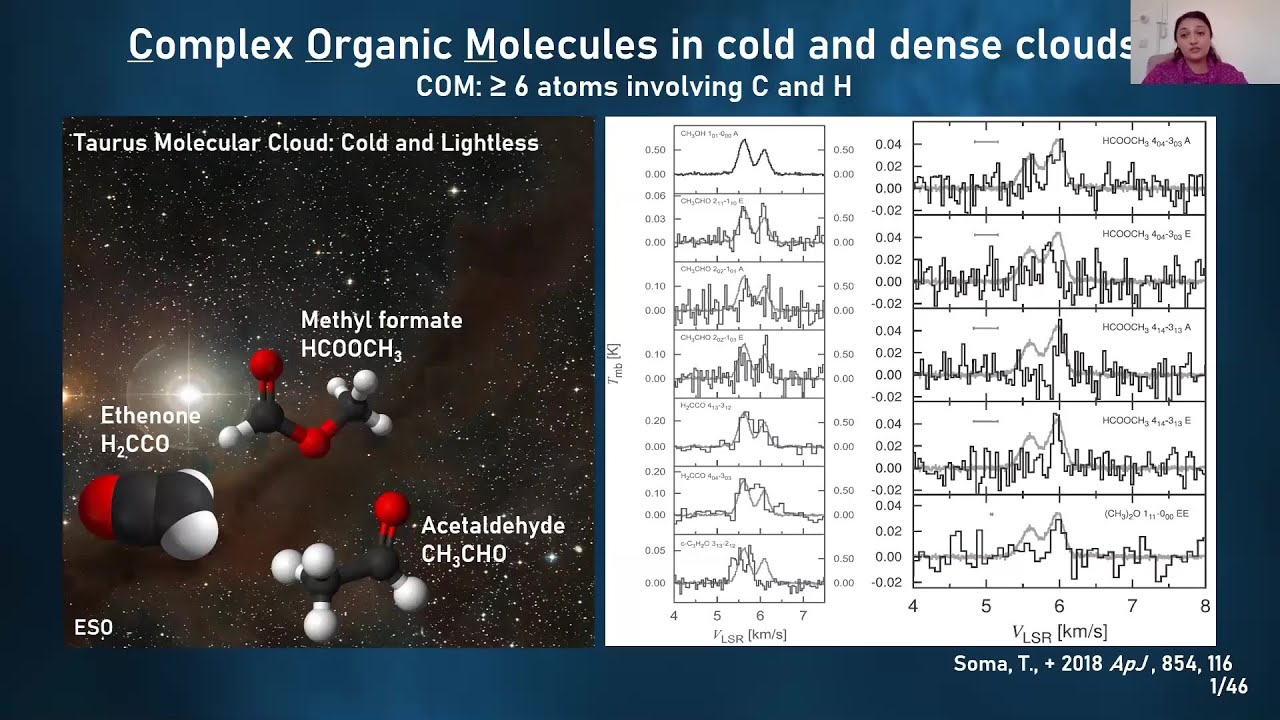
Well, we can observe a source like TMC1 that we're going to talk about using a telescope like the GBT that I'll talk about in a second, right? And we can look at the emission of molecules that are rotating in that source because rotational energy levels are really low energy. Right? So even at 10 Kelvin of kinetic energy, you can thermally populate rotational energy levels which means we can look at emission. We do not need a background star. The entire sky is glowing in a molecular emission and we just have to collect it right with our telescope. And then if we want to identify what molecule this belongs to, well, we just look in our database of rotational spectra that we measured in the laboratory for a perfect match. In this case, the cyanomethyl radical, right? There is no other arrangement of atoms in the universe that can give this exact set of frequencies. This is a unique pattern which belongs only to CH2CN. It's the frequency match that matters. The intensities give us uh the absolute intensities tell us how much is there and the relative intensities tell us the the temperature the exitation conditions but it's the frequency match that is the exact uh uh signature of this molecule. So this is actually how we this is how we identify new molecules in space. Fortunately it's not always this easy or I wouldn't have a job. Um so the tricky part for us is determining where to look, how deep to look and then where in the laboratory uh what molecules to study in the laboratory and actually performing those experiments.
So how do we actually get the spectra in the laboratory? Well, we use a technique called fora transform microwave spectroscopy. So we take a a high vacuum chamber here. It's got two resonant mirrors that uh amplify the molecular emission that's in there. And what we're going to do is we're going to pulse in a sample of molecules. In this case, a benzo nitrial is our our fake molecule here. Um, our fake sample here into the chamber. And this adabatically expands the the gas and cools it from room temperature to 2 Kelvin, right? Which is great. We have our own little miniature molecular cloud in here at 2 Kelvin. And the 2 Kelvin is not important that it matches interstellar temperatures. It's important because it puts these molecules in just a few rotational energy levels so that they're all concentrated in a few transitions to make them really bright and easy for us to see. And in fact, what they'll do, this is a fake energy diagram here. It is not to scale. Is that they'll populate through some Boltzman distribution into the energy levels corresponding to the the temperature of the gas about 2 Kelvin.
Then what we can do is using a a radio antenna, a horn in here with microwave radiation, we can blast in radiation corresponding to one of these energy differences, corresponding to a rotational transition. And what that will do is it will move that population.
It will excite molecules from E2 into E3. Then we can turn off that radiation.
And what are the molecules going to do?
They're going to relax, right? They're going to relax through uh emitting their rotational emission, right? emitting at that exact same frequency back out at us. We can capture that frequency in the time domain and then for transform it to get to the frequency domain. There we go.
I skipped ahead in one animation. Um, okay. So, why is this important? This looks like a a weird trivial experiment because I put in light at one frequency and I got out light at that exact same frequency. Well, that's a detection experiment. If I know the spectrum of the molecule, I can use this to figure out whether or not it's in my sample.
But if we don't know the spectrum, if it's a new molecule and we're interested in measuring the fingerprint, well, what we do is we just sweep through frequencies until we hit a resonance, until we get light back out, right? This allows us to piece together the spectrum to figure out exactly which frequencies belong to that molecule. So, I use benzo nitral here as an example because this is a molecule with a benzene ring, right? that simplest six-membered aromatic subunit that make up a lot of those PAH's. Um, one of the tricks about rotational spectroscopy is the molecule has to be asymmetric. It has to have a permanent electric dipole moment. So, benzene has no rotational spectrum.
Can't look for it directly.
Cyanobenzene, benzon nitrial has a booming electric dipole moment, right?
And actually, chemically speaking, it's trivially easy to make benzonitrial from benzene and CN. So, if we see benzon nitrial in space, it has to be benzene there, right? That's how you make it.
So I this is what I did uh during my posttock is I measured the spectrum of this at very in one of these instruments and we went and looked for it in space and the ch the space the the source that we chose was TMC1 this is a cold dark cloud in the in the constellation of Taurus here right 10 Kelvin and the reason that we chose to look here is that a colleague of ours Sergey Kolinsky had looked in data from Noyama that had been taken by Norio Kyifu over 10 or 15 years detecting numerous new molecules in this source and saw a tiny hint of bzzon nitrial. He stacked all the transitions together. There's a little tiny signal there. Now, this wasn't enough for a detection, but Noama was a relatively small telescope compared to the Greenbank telescope, right? It's a Greenbank telescope, the most powerful radio telescope operating at the the frequencies where these molecules live, 100 meters in diameter, located in the Appalachin. It's in West Virginia in the national radio quiet zone. Right? So we're able to use this entire this incredibly huge photon bucket uh to just point at TMC1 and collect the spectrum.
So we initially did this looking just for benzo nitrifile and we found dozens of lines, right? All of the pieces of the spectra that we had measured in the laboratory were showing up here and get different signal to noise based on, you know, the receiver performance in different locations, but all of the chunks that we were looking for, all of the pieces actually showed up. And this was really exciting, right? Because now we have uh the first detection using radio of a six-membered ring, the simplest aromatic subunit in space.
There had been a detection of benzene in the infrared one previously in a carbon star by Pepe Trernacharo back in 2005 or something, right? This was exciting because we see it in a cold dark cloud with radioastronomy much easier to detect.
So got excited about this decided that we want to see what else is in TMC1, right? Can we go further than benzo nitral? Are there other aromatic molecules? Now, as I said, I am a trained chemist and so I very quickly learned from my colleagues that when you start a new large program in astronomy, there are some important things you have to do and it's not have an idea. It's not write a proposal and it's not get funding. It's come up with an acronym.
So, we are GBT observations of TMC1 hunting aromatic molecules or the Gotham Collaboration. Um, this is our legally dissimilar logo. um using actual benzonit trial data. So the you know the bats ears here are real benzonit trial transition from TMC1 which I think is really cool. Um but over time the the collaboration has grown and expanded. It started as just me and my my postoc friends uh and and today has a very large team dozens of members. Um this is us from our our team meeting about a month ago in Greenbank. um mostly comprising of graduate students at this point with postocs and a lot of the folks uh that were postocs me to begin with and have gotten permanent faculty positions which is great. Um so G is really driven by uh the the young folks the early career folks um on the team and we have folks uh that are uh peer astronomers that are computational chemists that are laboratory chemists um uh and everything in between there as well as a full suite of observational astronomers. Um, there's also some uh, you know, old people on here like Tony to to give us some some wisdom and advice occasionally. Um, so what is Oh, by the way, for scale here, um, the telescope here is a mile away from where we took this picture. That's how big this thing is. If you haven't been to GBO, you should go to Greenbank. It's incredible. Um, and if you go as part of a science conference, sometimes they'll take you up on the telescope, which is even more incredible. All right. So, the primary product of this is a deep broadband spectral line survey of TMC1, right? So, we wanted to capture all of the frequencies that we could of this source all at once, as deep as we could go so that when we measured a new molecule in the laboratory, we didn't have to then go propose for new observations and hunt for the molecules one by one in TMC1. We'll just collect everything. Um, and at this point, we have more than 1,400 hours of GBT observations on just this one source.
And I I'm really happy that uh postoc seu um who just got a a a cosmic AI fellowship at NAO uh built a pipeline uh to do automatic RFI excision calibration all these sorts of wonderful stuff has reduced the full survey and it's all now publicly available. So if you want to detect molecules with our data you can go do it. Um there's a link in in her paper up here. You can download the whole data set uh and publish new things.
But when we wanted to look for new molecules we were first faced with a challenge. You have to get rid of all the known lines, right? You got to figure out what lines are coming from molecules you already know about that you don't care about, right? And this is actually a somewhat timeconsuming process. We initially did this by hand.
Um, and it takes weeks because you have to painstakingly go through databases, look at molecules, check them, make decisions, go back, do a fit, remove them from, and this was a problem, especially if we wanted to do this on more sources or if we wanted to do experiments like this in the laboratory where we make chemical mixtures and take line surveys to try to identify molecules. So, one of my students decided that he'd try to bring machine learning to bear on the problem. So, this is a wells suited AI problem. Can we assign the lines using machine learning and get rid of all the known lines that way? And it turns out to work pretty well. And there's a few steps in the process. And I'll show you why the machine learning is so important. So if we go line by line through the spectra, we can pick up a molecular line, we can measure its frequency, fit a gausian to it, and then look in the database, look in Splatalog or CDMS or JPL and say what other transitions match that, right?
What's nearby, right? And maybe there's only two molecules and one of those transitions matches really well and say fine, this belongs to molecule A. Well, you can also go a little bit further than that. You can say, well, molecules have more than one rotational line, right? So maybe we could look for another few transitions of these molecules. So maybe we're choosing between molecule C and D, both candidates for this line here. And molecule C, you look in the database and you say, well, there should be a line here and here, and that matches pretty well. But molecule D should be a line here, and it's missing, right? So you can discriminate here based on intensity as well. This is also something that you know uh traditional computing can do relatively easily.
But the trick comes in when you have decisions to make because in reality what happens is you look at a spectral line and then you compare it to the lines in the database and the lines in the database have errors in them experimental uncertainties right all of these molecules have a transition that could reasonably be assigned to this line right within the errors. So the question is how do you choose? You could very simply just choose the one that's closest in frequency match. That's fine.
But this should really not sit well with you because phosphine is not a very likely interstellar molecule in a cold cold dark molecular cloud. And we know this because we have some chemical intuition. There aren't other known phosphorous species like this in that source. Phosphorus is very low abundant.
This is a very bright line. it doesn't look like the other molecules in the inventory. And so we would say something wrong here. A computer has a hard time doing that, right? To put it, you know, a little more concretely here, if you have a mixture of molecules that looks like this, I don't even need to tell any of you what these molecules are or what the colors stand for. If I give you two options down here at the bottom, either thophene or vinyl alcohol, and I tell you which one of these belongs to this mixture, you'll tell me it's vinyl alcohol. Right? Because nothing up here has a yellow in it or a ring. Right?
Now, chemically, I can tell you that nothing up here has sulfur in it and nothing up here is a heterosyclic species. And nothing about this chemistry is anything like thophene. But this alcohol down here is a very logical reactant for these up here. Right?
That's chemical intuition. So, can we train a molecule to a model, a computer to do that, right? The key is this context, right? What is the chemical context that we're working with? Right?
And context is important, right? You can ask, is four a lot? And that depends on the context. Four dollars is not a lot, but four murders is a lot, right? So, we got to think very carefully about the chemical context. So for the example I showed you before, I can tell you that this line actually came from a laboratory experiment where we reacted these two molecules together, benzene and methylcyanide. And from that context, it becomes pretty clear which one of these is the correct choice. It's a benzo nitral line, right? Because this is a very clear chemical product of this sort of reaction. But that is not a problem that traditional computing can handle very easily. So we asked ourselves how do you teach a computer to have chemical intuition and that what that really means is how do you teach a computer to have context right and it turns out this is not a problem we had to solve we are not machine learning experts I definitely am not but we can borrow from advances in machine learning even in things outside of chemistry and what we're actually borrowing from is uh an algorithm that does natural language processing so we can look at some sentences here I wish I could have a picnic on the bank of the river sen and I wish I had more money in my bank account and I once made a wish that I was a fish. Right? And we can look at some words in here. Bank has a very different meaning here and here. And it's because of the context. Similarly, wish has a different meaning here and here. Right up here, bank and river tells you it's a river bank. Bank near account and money tells you it's a bank account. Similarly, the I and the A tells you I have a verb or a noun.
Right? So, how do you learn context?
Well, this is a solved problem. It's an algorithm called word tovec, uh, which put together by some folks in Google back in the day. I'm going to show you how this works. The idea is we want to be able to turn words into vectors and have those vectors be very close to each other if the words are similar to one another in context. So, what you do is you take a corpus of sentences here. So, you know, kale is bitter, arugula tastes bitter, cucumbers are delicious, and matcha is delicious, right? And we try to train a model that puts vectors for each one of these words nearby each other in vector space. So for example here you could say kale and arugula should be very close to each other because these are both green leafy vegetable foods. Right? And cucumbers should be nearby because this is a green vegetable food but it's not leafy. All right? And you could say matcha is nearby but a little bit further away because this is a green food but it is neither uh leafy nor vegetable. Right?
The other words in the sentences would be someplace else. Right? Oh, and these are all foods together. Is and are and tastes are all verbs. Right? Whereas is and are close to each other because they're being verbs and tastes is uh something different, right? Uh you also have uh plural uh singular being verbs and and uh uh so forth. And then you can uh have the extra one put in down there.
Oh yeah, sense verbs for tastes, right?
And then further away we have the things they describe, bitter and delicious, right? Food adjectives. Uh one of which is a positive food adjective and one is a negative food adjective, right? And you know these are nearby each other because they're both sense words. So what's the whole point of this? The whole point of this is that if you then introduce something new, a new word, and encode its vector, you can learn something about its context, even if you haven't taught it the context. So, here's the example. I'm going to ask you the question, do you want some mazuna, right? And I'm going to say I'm going to give you the information. Mazuna's vector puts its dot right here. Right?
So, you can tell me now the most likely outcome for what Mizuna is. it's probably a green leafy vegetable food because it's very near the other green leafy vegetable foods and in fact it is Japanese mustard right so we wanted to do the same thing from molecules and you can do that building off of word tuve other people than us uh built an algorithm that takes molecules and encodes their chemical context with respect to one another so what is the uh context of the atoms and the groups of atoms within this molecule as represented by asky text so things like smile strings and selfies These tokens tell you the composition of the molecule and how they're bonded together. And this produces vectors. And if you train a molecu a model to give it a bunch of molecules and you say put the vectors nearby each other for similar molecules, you can then do the same thing. You build up a chemical vector space that has many different dimensions.
And you can then add weight to that vector space if you know a molecule is in a mixture. So if you know your molecule is in TMC1, you just put a Gaussian over the top of that point in vector space. The idea being that other molecules that are likely to be in the source should be nearby in vector space.
They should then be heavily weighted.
Right? So what we can do is we can start our algorithm again. We go through our line survey. We find the peaks. We query the database. We get the line frequencies that we have to choose between. But now we go and we ask the computer, the machine learned algorithm, which one of these is most likely to be in the mixture given everything else we know. What's nearby in chemical vector space? So we give it a score based on that. Then we do the frequency match.
Then we do the intensity match and we come up with a molecule that we think is likely assigned to that line. Right?
This updates the surface. We add more weight to it. And then we repeat the process over and over and over. And every time we go through, we recheck every single prior assignment. And it turns out that this assigns all of the lines in the spectrum with about 98% accuracy in about 15 minutes rather than taking several weeks to actually do by hand. So it really speeds up the time to analyze these surveys. So that lets us ask the final question. What is new in our surveys? Well, what was left was new phahes. We started detecting multi-ring species starting with cyanonapathylines here in 2021 and going up to five and six membered ring species indine and cyanoind. This was based on laboratory work we did in Mike McCarthy's laboratory. Um our colleagues in Spain started looking at the the source and detected these three- ring PHA species.
Um cyano uh a snapline and phenolene. Uh and we didn't want to be outdone by people detecting three rings. So we thought we'd go bigger. Um so at my uh lab at MI oh and and also smaller. We want to look at other derivatives of these. Um, so at my lab at MIT, we've built a microwave spectrometer here using um some some heated sources that allow us to put a bunch of uh aromatic molecules into the gas phase. Um, unfortunately, by the time we wanted to do this, we didn't yet have the source working to make things bigger than three rings. So, we went back to to Mike's lab to do the spectroscopy on a four-ring species, pyrene. And this is work that was led by a scientist in my group, Gabby Venzel, and our collaborator Elsa Cook at University of British Columbia. This is a symmetric molecule. So we had to add CN groups to it in order to study it in the laboratory. It's three different places you can put a CN group to make one, two, and four cyanopyrene. Can't buy it commercially. We're not a synthetic chemist, but I have wonderful synthetic colleagues like Allison Wland at MIT who sacrificed a posttock here to make this for us. And we went to measure it in the laboratory. So, I was on a plane coming back from France and I got a message from Gabby on Slack that started with don't flip, which is never a good thing to hear out of the person running your lab while you're gone. Um, but she had measured a few lines uh and had started to already see signal from this molecule in our TMC1 data. And over the course of the next few weeks, she measured more than a thousand lines of these three different molecules and managed to detect all of three of them in our data just sitting there waiting to be discovered. And I said I wasn't going to mention CO again, but I I have one more thing here. Um, if you look at the abundance of this molecule and ignore CO, about one in every 220 carbon atoms in this source is in a pyrene.
It's that much of this molecule there.
It's absolutely insane how abundant it is. But we didn't want to stop there. If you look at the chain of stable phahes, we detected one ring, two ring. Uh, our colleagues have detected a three- ring that's not quite like this, but close.
We detected pyrene. So, where do we want to go next?
We're going to skip ahead and just go down to corine. Um you can't buy you can buy coronine but you can't buy cyanoorine in a bottle. Um and Allison's postto Shuo said no I'm not doing that again. Uh so she sacrificed a first year graduate student Gary Gong uh who worked over Christmas and New Year's to synthesize a gram of this uh molecule which was fantastic. Uh and then Gabby very quickly measured those lines in the laboratory as well and was able to get a very high signal uh high significance detection when you stack up all the lines in our spectra in space too. And so what that brings us to is that you know we had a detection of benzinite trial in 2018 and since then we've detected all of these individual phahs in space for the first time. right between us and our Spanish colleagues there's a huge number that has exploded after waiting 20 30 almost 40 years from when the the UIs were first identified right to actually identifying individual ones and what's really weird about these is that the amount of them out there doesn't make sense because there's some pretty basic trends in astrochemistry that hold for molecular families and that is as molecules get larger their abundance drops Right? So if you look at a family of molecules like the HC3N, 5N, 7, 9, and 11N, the abundance drops off. This makes sense, right? Making more and more things, there's going to be fewer and fewer of the products, right? The pH abundances don't decrease. There is essentially as much chlorinine out there as there is benzo nitrial, which is wild, right? This does not follow bottomup synthesis roots. uh right? If you're going from the bottom up, your abundance should drop off as you get larger. It also doesn't make sense for top down synthesis. If you're breaking things down from very large molecules, those should be the most abundant and you should have fewer of the small ones as you go down. Right? So, the trend should either be down to the right or down to the left. And it's neither of these, right? And I think what that's telling us is that there is clearly a contribution from both pathways here. We can't explain it purely bottom up and we can't explain it purely top down. And because what we know from the laboratory is that the bottom up routes are very selective. There's probably a difference on a molecule by molecule basis about what the relative contribution is. Some molecules are probably all top down, predominantly top down and some are probably all bottom up and some are a mix between. And we can get a few clues about this actually by looking again at our own solar system. So moving from uh the dark cloud to our solar system. This is work that was done here in GPS at Caltech and John Eer's group among other places. Um the Japanese space agency launched a probe to asteroid Ryugu Hayabusa 2 in 2014 and it sent back samples of this asteroid to Earth which means we can then measure it with mass spectrometers the most sensitive instruments that we have basically and do much more detailed analysis than we can do with remote sensing in in astronomy. And what John's group did, this is work led by Sarah Zikner here, is they looked at the isotopic signatures of all of these phahes that they detected in the in the asteroid.
And um I'm not going to go into the details of it, but it turns out looking at the isotopic signatures of these molecules, you can infer at what temperature they formed. And it turns out that these three ring species here, none of which we see in TMC1, all show formation in circumstellar environments, temperatures above a th00and Kelvin, top down chemistry. But these three napylene, pyrene, and florenthane. And we see both napylene and pyrene in TMC1 show isotopic signatures consistent with dark cloud formation, bottomup formation. Uh florenthane here we're going to look for, but we have to synthesize uh sacrifice another graduate student here to synthesize this and we haven't gotten to it yet. All right. Um but I think this is really cool, right?
Because this is all of these things together are giving us some interesting hints, right? It's telling us that not all phahes are created equal, right?
There's some environments that make some types of phes. There's some environments that make other types of phahes. And it's going to vary on a a molecule by molecule basis. But I think what's really intriguing is that we clearly are making some of them here at 10 Kelvin in the cold dark clouds. And the fact that we see PAH's with that same isotopic signature of 10 Kelvin formation in asteroids in our solar system, right?
Where did those come from? They probably came from our natal molecular cloud.
Right? That means that there's material in our solar system that is the chemical composition of which was set before we had a star, before we had a protoar. It survived the creation of the solar system. A very violent event to make its way to us. Now one other interesting thing here uh that that sort of throws a wrench in some of these uh ideas is that in that asteroid there were two phahes that showed formation at a thousand Kelvin greater than 1,000 Kelvin top down route. They were very small phahes they should have been destroyed between when they were made and when they showed up in our solar system they weren't made here. There's not a thousand Kelvin pyrolysis environment and solar system it to make these that we know of. And so what that probably means is there's also a gap in our understanding of the survivability of phes from the top down to the cold dark clouds. And in fact, there's some laboratory work by Mark Stockett and colleagues showing that yes, certain phahes can survive radiation uh more robustly than we had originally thought. Um, but I I just I'm I'm incredibly excited now that we're able to make this at least tentative connection between the chemistry happening in natal molecular clouds and the chemical archaeological record of our own solar system. So that's where I want to leave you. Um, I'll acknowledge all of my my colleagues and collaborators here. They did all of the work that I talked about here. I haven't done any actual science since I was a postoc. Um, this is my group at a conference over the summer. Uh, sources of funding, uh, a podcast if you want to fall asleep. uh and how you can get in touch with me online. Happy to take any questions you might have.
So the there are a number of variables here and I'm not an expert in these particular experiments. Um one you have to isolate these molecules in the gas phase. You can't just take a powdered sample of phes and expose it to UV because if you have the phes in contact with something else that provides a thermal uh uh think thank you for the right that allows that energy to spread out in a way that is not accessible in space right so you have to isolate them in the gas phase that's actually experimentally quite hard to do right then you have to radiate them under conditions that mimic interstellar radiation happening over tens of thousands of years that's also hard to do right so you can adjust the fluence of this and play some other tricks to try to mimic it. But that's not a one to one either. And then you have to try to extrapolate well how many things actually were destroyed over the course of that and actually measuring how how many were destroyed. That can be a challenging spectroscopic or massspec experiment right and then for the ones that survived question is how did they survive and why did they survive because we can do this experiment maybe in uh you know for a few phahes but there's many many different ones and we want to understand the mechanism of action for it. Um so the the mechanism that Mark is proposing is something called recurrent fluoresence. Um that allows the energy to keep uh being distributed around through these vibrational energy levels longer before the molecule shakes itself apart.
Uhhuh.
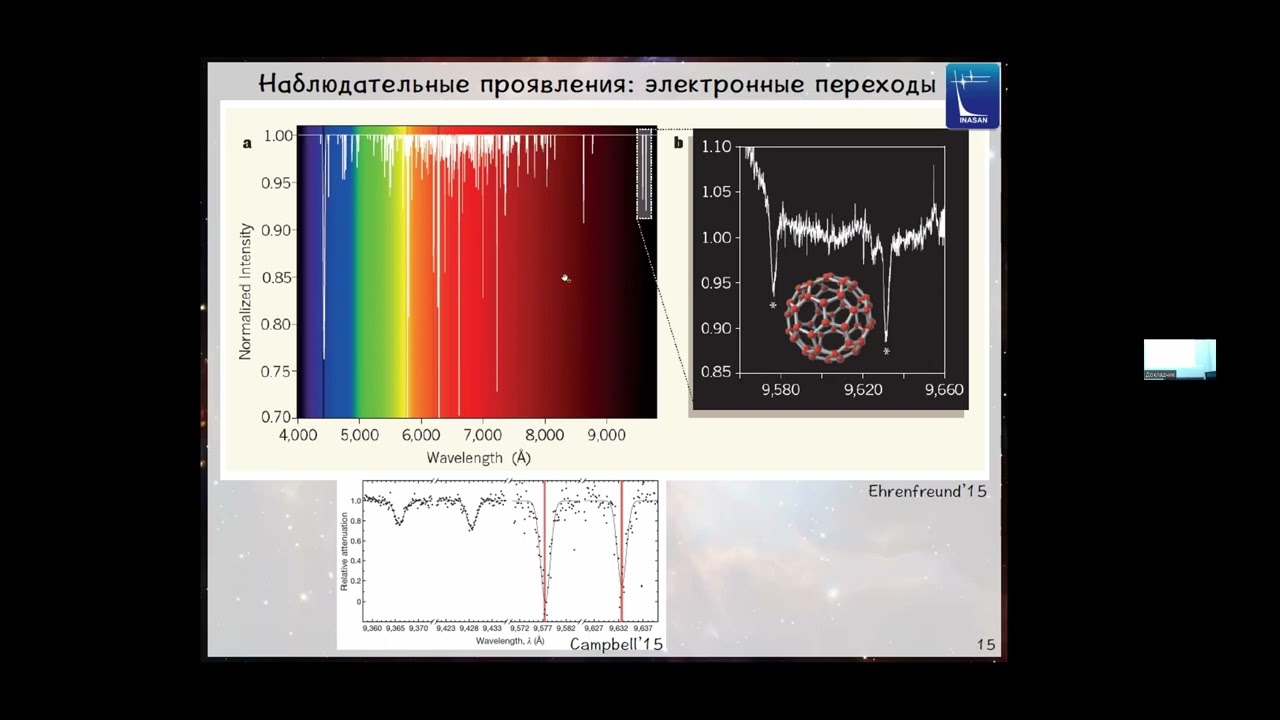
Um I like my reputation so I'm not going to speculate on the carriers of the diffuse bands. Uh I would so my group is not touching that. Uh there are folks that have suggested after the detection and assignment of C60 plus to the diffuse bands that positively charged PHS uh warrant reinvestigation. um they were suggested early on in the early 90s and late 80s as potential carriers. Um and the experiments to measure those are even harder than the recurrent fluorescent experiments in some ways. Um but now that C60 plus has been assigned uh folks are are digging back into that possibility um with with modern instrumentation. Yeah. But they're they're very very hard experiments to do.
Mhm.
>> Uh so so the answer to that is no on a couple of levels. one, I don't understand anything about star formation or infrared astronomy or how to tie that to the phes. Um, simply because it's I haven't learned that area of astronomy.
But second, um, I I think I would eventually like to be able to connect what we're learning here to answer some of these questions, right? So, if we can figure out chemistry that's operative here, we can use that to interpret the changes that are happening in the infrared bands uh, visav the environment that they're in, right? And back out something astrophysical like that. The trick is that what we're going to have to do is find hopefully a way to observe the radio emission of phes in the same location that you see the infrared emission so that you're sure you're looking at the exact same sample. And thus far, all of our attempts to do that have failed spectacularly. We see no radio emission in any of the places we've looked that have very bright infrared pH signatures. Um, and I think there's a couple of reasons for that.
One is that if there's bright infrared signatures, that's there's a lot of UV radiation there, right? So, Some of the small phages certainly are just going to be destroyed in those environments, right? Maybe not all of them, but some of them. The other problem is that those environments that have the UV radiation are typically quite warm relative to these dark clouds. And these large molecules have a huge number of rotational energy states available to to populate. And if you go from 10 Kelvin to even as warm as 20 or 30 Kelvin, the population spreads over so many different rotational energy states that the any individual transition you might want to look at is so underpopulated that the transitions are undetectably weak. Even using our stacking techniques, we haven't seen anything yet. So, we're hoping that there will be a Goldilock zone. We're trying a bunch of different regions here to try to find the exact place where these things match up. Um, I think more likely what's going to happen is that as we flesh out the inventory that we see here and the lab folks that are working on the mechanisms figure out exactly how to make these that we'll come up with models that say all right given this distribution what should the infrared band distribution look like right and start comparing to those under different environments. I think that's more likely uh to be the avenue that that we go down in the future but hopefully we'll get some some joint observations here at some point.
So they have >> uh the modeling that goes into benzene formation in astrochemistry wildly un underpredicts the amount of benzene that we know is there. So we we don't understand benzene formation chemistry and it's a real problem because that means that we can't accurately model any of the pH chemistry because all goes through benzene in combustion they get better agreement but my understanding is that there is still a very big problem with small phahes and benzene in combustion where their current understanding even using haka and all of these other mechanisms that they have access to does not actually produce the correct amount of small pahes. The interesting thing though, and I think this is really encouraging, is that historically speaking, that community has uh not spent a lot of time looking at low temperature pH and benzene formation. Um, which is something that we're very interested in, right? And so folks like Ralph Kaiser in Hawaii have been doing wonderful work on low temperature pH formation pathways.
And my understanding is that uh some of the models that are now incorporating these low temperature pathways are seeing better agreement for the small PHAH's. Um, and so it could be that these two models are just going to have to come uh come to a a consensus here at some point and unify both the high temperature and the low temperature.
It's much easier for the high temperature, the combustion environments because anything that works at low temperature works at high temperature, right? The vast majority of the reactions that work at high temperature will not operate in our low temperature environments. Right? So it's much easier for them to take the the stuff that Ralph is doing to try to explain what's what's happening in space and incorporate it into those models.
Can you compare the >> certainly the ones that we detect?
Absolutely. Yes.
>> Uh in you mean that like the absolute abundances they're they're like uh oh sure they're they're almost identical to each other.
>> There is no abundance difference that we no meaningful one. So a factor of you know two or three but within the errors right between benzene napylene uh indine the three membered rings pyrene and chanine right they all once you account for the fact that there's can groups on some of them have essentially identical abundances >> which is very weird >> yes yep What are the mass constraints in the phes?
Yep. our so take this with a very large grain of salt because there's a lot of assumptions that go into this but something like 0.1% of the total carbon is locked up in pyrene and so include the incl the the total carbon budget yeah based on what we think the the starting elemental carbon was for the for the cloud at the beginning yeah which is both a very small number but also a surprisingly large number right um now there's order of magnitude at least uncertainty on that number because you have to make a lot of assumptions about that. Um and the the detailed calculation is in the back of the pyne paper if you actually want to see the the assumptions that we made.
>> Mhm.
>> Mhm.
Sure.
uh I don't know for the infrared. Yeah, I don't have the I don't have the answer for that for for the infrared. Yeah, we don't see we we have actually gone to a PDR to to the edge of one of these regions and looked for for radio emission from our molecules and seen nothing nothing at all. So, we don't see any radio emission from from PH is in in the PDR regions we've looked at so far.
Um, even though there's bright infrared emission.
Yep. Yep.
In the infrared. Yes. Um, but I I don't have a number in my head for for uh the the mass fraction in in the from the infrared observations, I'm afraid.
I mean the bulk is between 10 and 20% of of the carbon is is in phahes but that's spread over you know on a galaxywide scale.
So we see many many duterrated molecules. We do not see duterrated phahes.
Yep.
it will. So we do not detect them here.
We don't have the sensitivity. The the the dutarium ratio, the DAH ratio would have to be one essentially for us to be have the sensitivity to see it.
Yeah, it it will be preferentially selected.
It's still not going to be a high enough ratio for us to see it most likely and we don't have the laboratory spectra for it either. Um now all that said there was a paper a few months ago from JWST showing um uh a large amount of duteration in pH is inferred from the infrared bands. Um that might have been yeah it might have been Bruce's paper there. Um so there is work on this in the infrared. We would certainly like to do it but we can't we don't have the sensitivity to see the dutarium in the lab. Um so we can't even measure the spectra there. And it the DTH ratio in each position substitution position would have to be about one in order for us to see it in space. So yep. Uh the answer is presently no but we hope soon yes. Um so uh and again this is you know my lab is a spectroscopy lab. we are not equipped to do the the reaction kinetics and the reaction modeling. That is Ralph's expertise and others. I'm just picking on Ralph. Um but I actually have some pretty pretty high hopes that in the next five or 10 years we're going to be able to do that. And and the reason for that is that there are a huge number of PAHs, even small PHAHs. And so it makes it really hard to choose which ones to study in the laboratory. By virtue of the fact that we are now limiting that, right, by saying these are the ones that are out there and that are important. um Ralph and others are able to then concentrate their efforts on how do we make those right um and I think the fact that the low temperature ones are selective is indeed going to tell us which one of these pathways are the most important there and help us disambiguate what's what's happening yeah >> thanks
Up Next

65:00
Chemistry of Protoplanetary Disks & Nascent Planets | Karin Öberg
@videosfromIAS
2.4K views•2016-11-01
83:56
Biocatalysis and Catalysis in Islatravir Synthesis | Merck Webinar
@SCIwheresciencemeetsbusiness
675 views•2020-10-08
10:06
1H NMR: Determining Number of Peaks from Structure
@MSJChem
59.2K views•2017-04-06

17:31
Edible Water Bottles: A DIY Guide to Sodium Alginate Spherification
@ryan
10.5M views•2019-06-21
Related Study Plans & Knowledge Roadmaps
Structured learning paths in Chemistry
chemistry
Nuclear Chemistry: Decay, Meds & Fuel Cycle
01Introduction to Nuclear Structure and Radioactivity
02Decay Dynamics and Kinetics
03Radiation Interaction and Detection
+ 2 more learning modules
24h5 modules
Explore Roadmap
chemistry
Supramolecular Chemistry: Forces & Machines
01Foundations of Chemical Bonding and Intermolecular Forces
02Introduction to Host-Guest Chemistry
03Thermodynamics and Dynamics of Self-Assembly
+ 2 more learning modules
16h5 modules
Explore Roadmap
chemistry
Photochemistry: Excited States & Reactions
01Foundations of Light-Matter Interactions
02Molecular Orbitals and Electronic States
03Photophysical Processes and Jablonski Diagrams
+ 2 more learning modules
18h5 modules
Explore Roadmap
chemistry
Coordination Chemistry: Bonding & Properties
01Introduction to Transition Metals and Ligands
02Crystal Field Theory (CFT) and Geometry
03Magnetic Behavior and Spin States
+ 2 more learning modules
14h5 modules
Explore Roadmap