The power loom revolutionized textile manufacturing by using water power instead of human muscle to weave thread into cloth, incorporating a mechanized flying shuttle that rapidly wove cross threads through thread webs at unprecedented speeds; this efficiency so dramatically outperformed traditional hand weaving that it destroyed the cottage weaving industry, leading to the 1811 Luddite riots in England as displaced workers protested against the new machines.
The Power Loom: A Revolution in Textile Manufacturing
Added:Deep Dive
The basics of the domestic system (cottage industry) and traditional hand-weaving methods.

AP EURO Unit 3 Review (Everything you NEED to Know!)
334K
Before factories dominated manufacturing, goods were produced mainly in people's homes through the cottage industry (also called the putting out system). Merchants bought raw materials and paid wages to various workers (spinners, weavers, dyers) to transform materials into finished goods. This system laid the foundation for industrialization by increasing the number of workers, especially in rural villages, who could earn wages and sustain their families.
Click to watch →
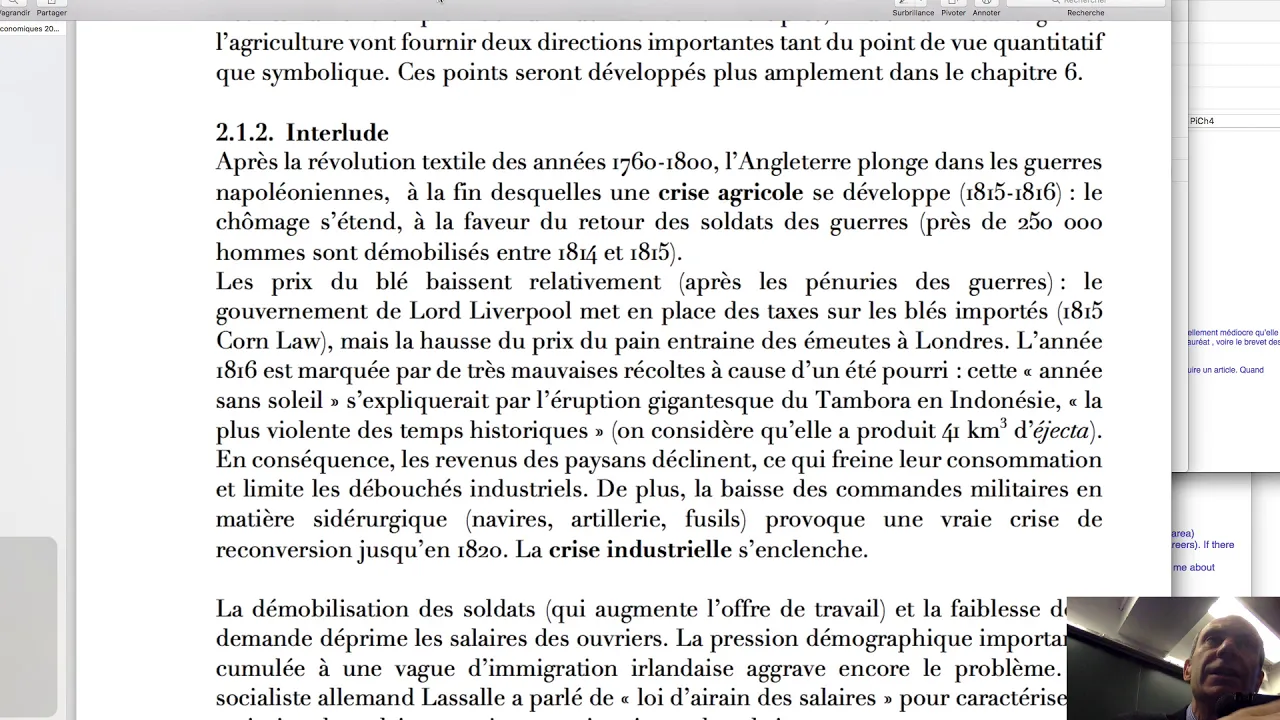
Histoire économique L1 économie - cours du 4 octobre 2019
2.6K
The domestic system (cottage industry) was the pre-industrial mode of production where merchants distributed raw materials to families who worked at home, transforming goods in their residences. This system persisted until the Industrial Revolution. Workers were dispersed, had no collective bargaining power, and faced extreme poverty. The system was characterized by merchants who organized production without manufacturing anything themselves, relying on family labor to produce goods like textiles, buttons, and clothing.
Click to watch →

संपूर्ण भूगोल | Bihar Board Class 12 | 5 फरवरी Exam Complete Revision | Objective + Subjective
24.3K
Cottage industry is a small-scale industry operated in homes with minimal capital, using traditional methods and family labor. Examples include pottery, handicrafts, and candle making. Small industry operates in small factories with more capital, machines, and hired workers. Examples include electric fans and radios.
Click to watch →

class 12 geography sample paper 2025-26 | class 12 geography question paper 2025-26 | 12th cbse
2.6K
Cottage industry involves family members working together using local raw materials with minimal capital and transportation requirements. Handloom industry requires many workers, provides semi-skilled employment, and includes yarn spinning and weaving activities. Sustainable development meets present needs without compromising future generations' ability to meet their own needs.
Click to watch →

द्वितीयक क्रियाएँ Important Question I Class12 geography Chapter6 Term2 Secondary Activities Imp Que
98.9K
Cottage industry refers to small-scale industries started from home using family members. Key characteristics include: (1) Started from home with minimal capital investment, (2) Family members work together, (3) Uses local raw materials available in the area, (4) Produces daily use items, (5) Does not require heavy machinery, (6) Transportation and capital requirements are minimal. Examples include making candles, pickles, paper bags, and bamboo baskets.
Click to watch →
Deep Dive
Early textile innovations of the Industrial Revolution, such as John Kay's Flying Shuttle and James Hargreaves' Spinning Jenny.
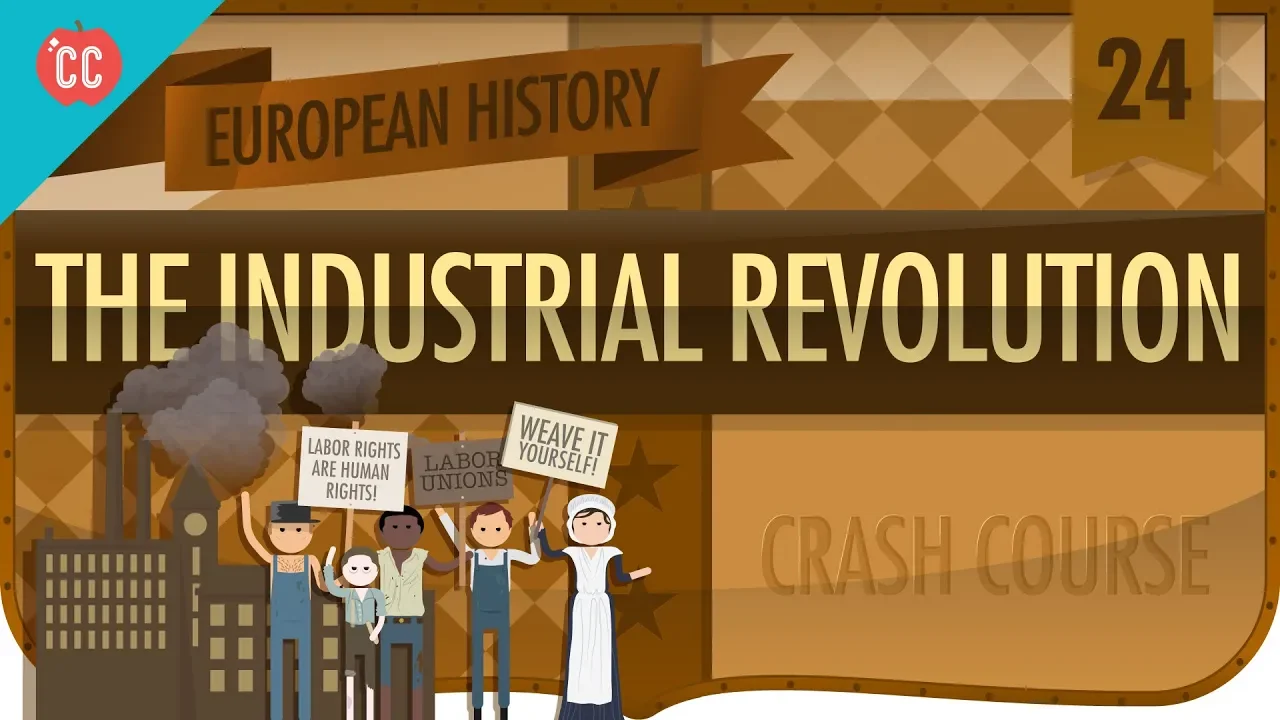
The Industrial Revolution: Crash Course European History #24
2.6M
The Industrial Revolution emerged from population growth following centuries of wars, plagues, and climate challenges, combined with improved nutrition from global trade goods like coffee, tea, chocolate, corn, and potatoes. This created more time for learning and experimentation. Key innovations included John Kay's flying shuttle, James Hargreaves' spinning jenny (allowing one person to spin 120 threads), and Richard Arkwright's water frame using water power. These incremental improvements by many artisans, rather than solitary geniuses, led to the first factories. Industrial spies facilitated knowledge transfer, as Europe learned from more advanced manufacturing regions in Asia and elsewhere.
Click to watch →

REVOLUCIÓN INDUSTRIAL - TELARES
45.9K
The Industrial Revolution transformed textile manufacturing through key inventions: John Kay's flying shuttle (1733) mechanized weaving by using a hammer to propel the shuttle through threads, while James Hargreaves' Spinning Jenny (1764) enabled one person to spin multiple threads simultaneously, dramatically increasing production efficiency and marking the transition from cottage industry to mass manufacturing.
Click to watch →

History class 10 chapter 5 bihar board | Class 10 history chapter 5 | 10th history bihar board
95.8K
The Industrial Revolution began in the textile industry because cotton was a basic necessity with high demand. Key inventions include: Flying Shuttle (1733, John Kay) for faster weaving, Spinning Jenny (1765, James Hargreaves) for multiple yarn threads, Water Frame (Richard Arkwright) for water-powered spinning, and improved Steam Engine (1769, James Watt). The iron and steel industry developed rapidly, enabling construction of ships, roads, and railways. The Safety Lamp (1815, Henry Davy) improved mining safety.
Click to watch →
History of Industrial Revolution Documentary
299.1K
The textile industry drove the Industrial Revolution through continuous innovation. John Kay's flying shuttle (1733) doubled weaving efficiency. James Hargreaves' spinning jenny (1765) spun eight threads simultaneously. Richard Arkwright's water frame (1769) produced strong thread, while Samuel Crompton's spinning mule combined both technologies. Edmund Cartwright's power loom (1785) automated weaving. Eli Whitney's cotton gin (1793) revolutionized cotton processing. These innovations transformed Manchester into 'Cottonopolis,' establishing the factory system that centralized production under one roof.
Click to watch →
LA REVOLUCIÓN INDUSTRIAL: ¿QUÉ FUE? ¿QUÉ CONSECUENCIAS TUVO? (EN 10 MINUTOS)🚂⚙️
228K
British inventors developed crucial machines that transformed production: John Kay's flying shuttle (1733) enabled faster weaving of wider fabrics; James Hargreaves' Spinning Jenny (1764) could spin 8 threads simultaneously; Richard Arkwright's water frame (1768) produced thicker threads using hydraulic power; and Samuel Crompton's Spinning Mule (1779) combined previous innovations to create superior thread quality. These inventions dramatically increased textile production capacity.
Click to watch →
Deep Dive
The fundamental concept of mechanization—transitioning from human or animal labor to machine power.

Automation in workplace | CLASS 11 ISC | BUSINESS STUDIES ONESHOT BY NIHARIKA MA'AM | 8112601234
3.3K
Mechanization is defined as using machines to reduce human effort without replacing humans entirely. According to CR Memoria, it mainly consists of replacing and assisting both animal and human labor by mechanical power wherever possible. The key purpose is reducing physical strain on workers while they remain involved in operating and supervising machines. Examples include using mixer grinders instead of manual grinding, tractors replacing bullocks for plowing, and typewriters assisting manual writing. In mechanization, humans still need to operate, control, and monitor machines, but with reduced physical effort. The three stages of production evolution are: (1) Traditional stage - before machines existed, humans relied entirely on physical effort or animal power; (2) Mechanization stage - machines reduce human effort but humans remain essential for operation; (3) Automation stage - machines operate independently after programming.
Click to watch →

Grados de mecanización
2.7K
Mechanization is the employment of machines to perform activities across sectors, aiming to save time and reduce physical effort by replacing human or animal labor. It represents a fundamental shift from craft and manual work to machine-based operations. Mechanization offers advantages including increased operational speed, reduced production time, decreased worker fatigue, improved safety, better material flow control, lower production costs, and enhanced inventory management. However, it presents disadvantages such as high initial investment costs, requirements for operator training, specialized maintenance personnel, and reduced operational flexibility. Industries employ five levels of mechanization: Level 1 (manual, dependent on physical effort), Level 2 (mechanized, machines provide motive force), Level 3 (computer-controlled, robots and mechanical arms), Level 4 (automated, minimal human intervention), and Level 5 (fully automated, complete computer control of manufacturing processes).
Click to watch →

O Capital - Livro I (Karl Marx) - Seção IV - Cap. 13.4
152
Mechanization fundamentally transforms the relationship between workers and production. It increases the material human subject to exploitation by capital through expanded working hours. The progress of machinery allows producing larger quantities in shorter times, paradoxically serving as a systematic means to liberate and exploit labor more intensively. Mechanization transfers the virtuosity of tools from workers to machines, emancipating tools from human limitations. This supersedes the technical basis of manufacturing's division of labor, replacing specialized worker hierarchies with equalization tendencies. Workers become mere organs of the machine system, subordinate to central driving forces.
Click to watch →

Paul JORION, Les robots avec ou sans nous ?
4.3K
Mechanization is not a recent phenomenon but part of a long evolutionary process that began when humans first used tools. Even Neanderthals created tools, and some birds use objects as tools. The Neolithic Revolution marked a shift from relatively easy subsistence to intensive agriculture requiring significant labor. This agricultural transformation was followed by gradual mechanization including windmills and animal-powered machinery to reduce dangerous and repetitive work. The invention of the computer represents the latest stage in this long-term process of replacing human labor with machines.
Click to watch →
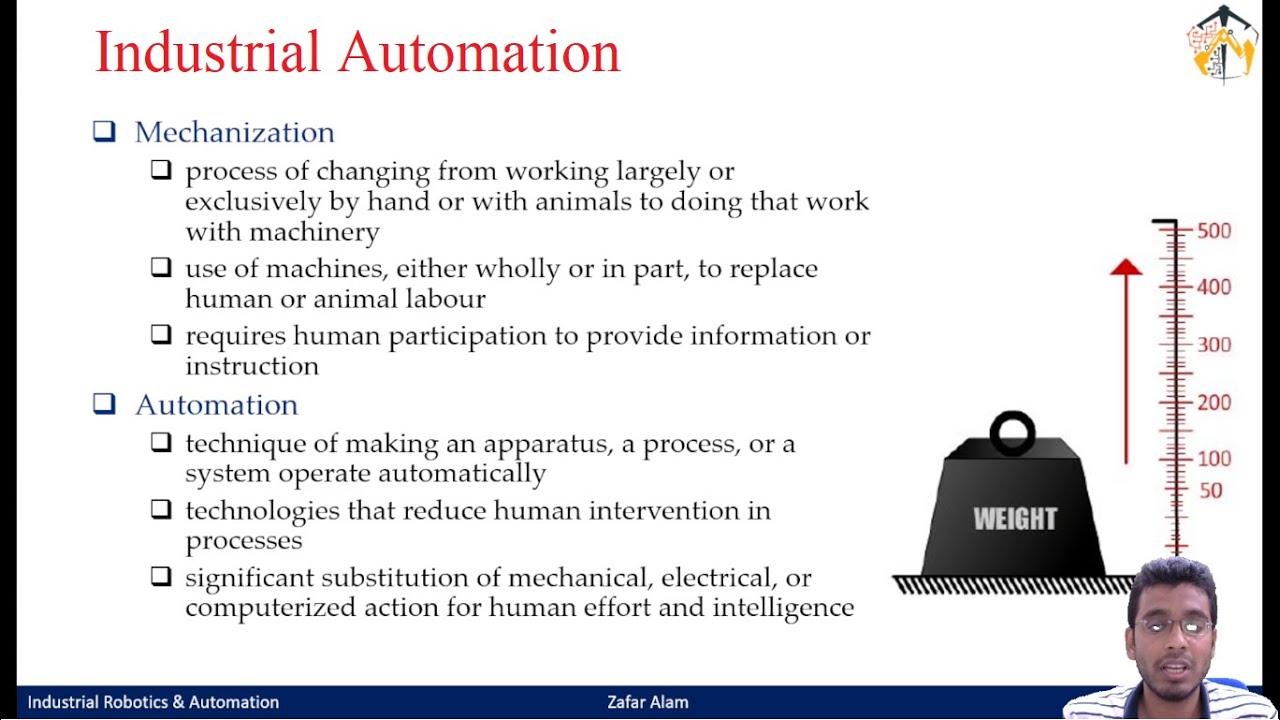
Introduction to Industrial Automation
2.2K
This section establishes the foundational distinction between mechanization and automation. Mechanization replaces human/animal labor with machines but still requires human input for instructions (e.g., pressing buttons to lift and lower weights). Automation goes further by using sensors and counters to operate completely automatically, reducing human intervention to a minimum. The key difference lies in the level of human involvement: mechanization requires continuous human oversight while automation enables autonomous operation through programmed logic and feedback systems.
Click to watch →
Deep Dive
An understanding of early industrial power sources, specifically water wheels and early steam engines.

ПОЧЕМУ ВОДЫ ТАК МНОГО? КАК ВОДА ПОПАЛА НА ЗЕМЛЮ? / Редакция.Наука
795.4K
The water wheel is one of humanity's earliest mechanical engines, dating back to the 5th century BC in China. Depending on design, water wheels can achieve up to 90% efficiency. They powered numerous industrial processes including grain milling, paper production, iron forging, log sawing, fishing, mine drainage, and elevator operation. The power output could reach up to 40 horsepower, comparable to early automobiles. Water wheels represent a fundamental technology that enabled early industrialization before steam power.
Click to watch →

Time Team S10-E06 Merton,.London
330.6K
Early industrial buildings utilized water wheels connected to drive shafts that powered machinery. A narrow water wheel would turn a drum that sat in recesses within walls, providing mechanical power for processes like washing. This system was common in textile finishing operations before steam power became widespread, demonstrating how natural water sources were harnessed for industrial manufacturing near rivers.
Click to watch →

Fred Dibnah's Age Of Steam S01 E03 Driving The Wheels Of Industry
475
Steam power did not cause the Industrial Revolution but played a very important part in it. The factory system was developed from the textile industry, which began before steam engines became fully developed. Quarry Bank Mill, built in the latter half of the 18th century, used water power to drive revolutionary spinning machinery. The original waterwheel was designed by Sir William Barber, featuring suspension water wheels. Early steam engines were unreliable but formidable sources of power. The transmission system involved great vertical shafts that came up through three floors to the weaving shed level, where bevel gears converted vertical motion to horizontal shafts. The great weight of vertical shafts in four and five-story spinning mills created significant problems. Wine shops were long shafts that transmitted power from water wheels up through vertical shafts, twisting when torque started at one end. Water wheels were economical but stopped working during droughts, forcing mill owners to adopt steam power. In 1810, some installed beam engines to help water wheels during droughts. By the end of the 18th century, Bolton led in steam engine technology. All early engines including Watt's could only pump water. In the 1790s, textile industry machines required new engine types. Early engines were built using primitive methods, but Boulton and Watt worked everything out in advance with measured architectural drawings, marking the beginning of the engineering industry. An agreement was made between James Watt and Matthew Boulton with customer Peter Drinkwater, a Manchester cotton mill owner. Originally asking for a six horsepower engine, Drinkwater changed his mind and wanted more power, so the specification was changed to eight horsepower. James Watt introduced the term 'horsepower' into engineering usage to define exactly what their engines could do. The arrival of steam engines had a massive impact on manufacturing, completely altering the skyline. Steam engines could be used not just for pumping water but for driving machinery quickly and bringing up end products. Early steam winding engines were common in northern England, raising millions of tons of coal from the earth with cages having two decks and two subs. By the middle of the 19th century, steam engines had been adopted by nearly every industry. They were cheap to run and made manufacturing much easier, marking the arrival of the Industrial Revolution. This had a massive effect on ordinary working people, who began moving from the countryside to new industrial cities that sprang up close to coal fields and transport routes. The Etruria bone china mill in Stoke-on-Trent used a beam engine to drive machines through a hole in the wall to the gear room, where big cog wheels spread out rotary motion into horizontal shafts, then through bevel gears to vertical shafts driving mixing pumps. The Cornish boiler, reputedly invented by Richard Trevithick in Cornwall, consists of an iron tube with two end plates and a smaller diameter fire tube going from one end to the other. The fire is lit on the grate at the front, with combustion products going along the back, up the sides, and finally up the chimney. The water gauge shows water level, while the pressure gauge uses a steel spiral tube with a quadrant and rack to register pounds per square inch. The steam issuing is not a leak but the safety valve releasing pressure. Despite looking peaceful, a boiler at 75 pounds per square inch contains tremendous potential energy. There were many boiler explosions in olden days, with one incident claiming workers' lives and bits of the engine flying 500 yards away. By the middle of the 19th century, the Bolton and Watt rotated beam engine began to give way to the horizontal steam engine. Richard Trevithick and Matthew Murray in Leeds developed the horizontal type by connecting cylinders to the crankshaft. There were literally thousands of engines made, from tiny ones three feet long to the biggest with cylinders ten feet long. The horizontal steam engine was much easier to manufacture in all sizes and didn't require a great big tall engine room. Steam began to replace water power, but two things were needed: plenty of coal and a good transport system. Places like Wigan, where coal stuck out of the floor at five feet thick, became ideal locations and boomtowns. The earliest factories only employed 20 or 30 people, but by the middle of the 19th century, great factories could employ hundreds of people. The 20 Field Mill at Wigan Pier, built in 1907, was a state-of-the-art spinning mill with fireproof floors, five stories, and room for a thousand employees. The great engine was built by John and Edward Woods of Bolton around 1907. It was a tandem cross compound triple expansion engine with four cylinders - steam entered the small cylinders first, was exhausted into a receiver, then went into the larger low-pressure cylinders. The engine was 2,500 horsepower. The connecting rod alone weighed about three tons. The building had a 'wrong place' where rocks were all rested, with as many as four or five to each floor. The 55 grooves on the drum weighed 70 tons. The noise levels were terrific - imagine a room with 1,500 of these things all going at the same time for 16 hours a day. The industrialization of great cities put terrible strain on antiquated water and sewage systems, requiring new reservoirs and pumping stations. A pumping station built in 1884 pumped water to Nottingham until 1969. Six Lancashire boilers made steam to drive pumping engines, consuming five tons of coal a day on three of them, with the other three on standby. The Lancashire boiler improved by W&J Galloway inserted vertical water tubes at the end of fire tubes, greatly increasing steaming capabilities. Two double-acting beam engines were the last made by James Watt and company, pumping 1.5 million gallons of water a day from a well 100 feet deep. The engine minder would listen for strange changes in sound indicating something was going wrong. When engines were finished, they were well on the budget, with money left over for embellishments like stained glass windows, showing how proud the Victorians were of their engineering achievements.
Click to watch →

Along the Blackstone, Episode 35 - Water Power
744
In the early years of the Industrial Revolution, steam engines were used as supplemental power sources to assist water wheels during periods of drought or ice when river flow was reduced. However, steam power was very expensive to operate due to high coal costs and the need for maintenance on poorly constructed machines. It wasn't until after the Civil War that steam engines became more important than water wheels in America.
Click to watch →

12 Appropriation of Energy Resource
106
The early water wheels first used to drive mills for grinding grain were subsequently adopted to drive mills and pumps to provide the bellows action for furnaces and forces to drive tilt hammers, trip hammers for forging iron, and to provide direct mechanical power for industrial mills. Until the development of steam power during the Industrial Revolution, water wheels were the primary means of mechanical power production, rivaled only occasionally by windmills.
Click to watch →
Prerequisite Knowledge
- Concept 01The basics of the domestic system (cottage industry) and traditional hand-weaving methods.
- Concept 02Early textile innovations of the Industrial Revolution, such as John Kay's Flying Shuttle and James Hargreaves' Spinning Jenny.
- Concept 03The fundamental concept of mechanization—transitioning from human or animal labor to machine power.
- Concept 04An understanding of early industrial power sources, specifically water wheels and early steam engines.
Subsequent Learning
- Step 01The social and economic consequences of the power loom, including the rise of the factory system and the Luddite protests.
- Step 02The development of the Jacquard Loom and how its punch-card system laid the groundwork for early computer programming.
- Step 03The global impact of increased textile production on trade, colonization, and the expansion of the cotton economy.
- Step 04Modern textile manufacturing technologies and the transition to fully automated, computer-controlled looms.
Mechanized Looms
Efficiency Gains
Luddite Riots
Mechanized Looms
0:01Playing Section
- 1
Power looms replaced human muscle with water energy.
- 2
Flying shuttle mechanization enabled ultra-fast weaving.
- 3
Process speed far surpassed manual handloom methods.
The Social Cost of Mechanization: The Luddite Perspective
While the power loom revolutionized efficiency and boosted industrial output, this technological leap came at a devastating human cost. Before its widespread adoption, handloom weaving was a highly skilled, respected, and relatively well-paid cottage industry. The rapid introduction of the power loom de-skilled the labor force, drastically lowered wages, and forced workers—including young children—into dangerous, highly regimented factory environments. This sudden displacement sparked the Luddite movement (1811–1816), during which marginalized weavers and artisans violently destroyed machines in protest of their ruined livelihoods and the loss of their autonomy. Introducing this perspective helps students understand that technological progress is not universally beneficial; it often creates severe economic inequality, labor exploitation, and social upheaval for the working class.
Deep Dive
The social and economic consequences of the power loom, including the rise of the factory system and the Luddite protests.
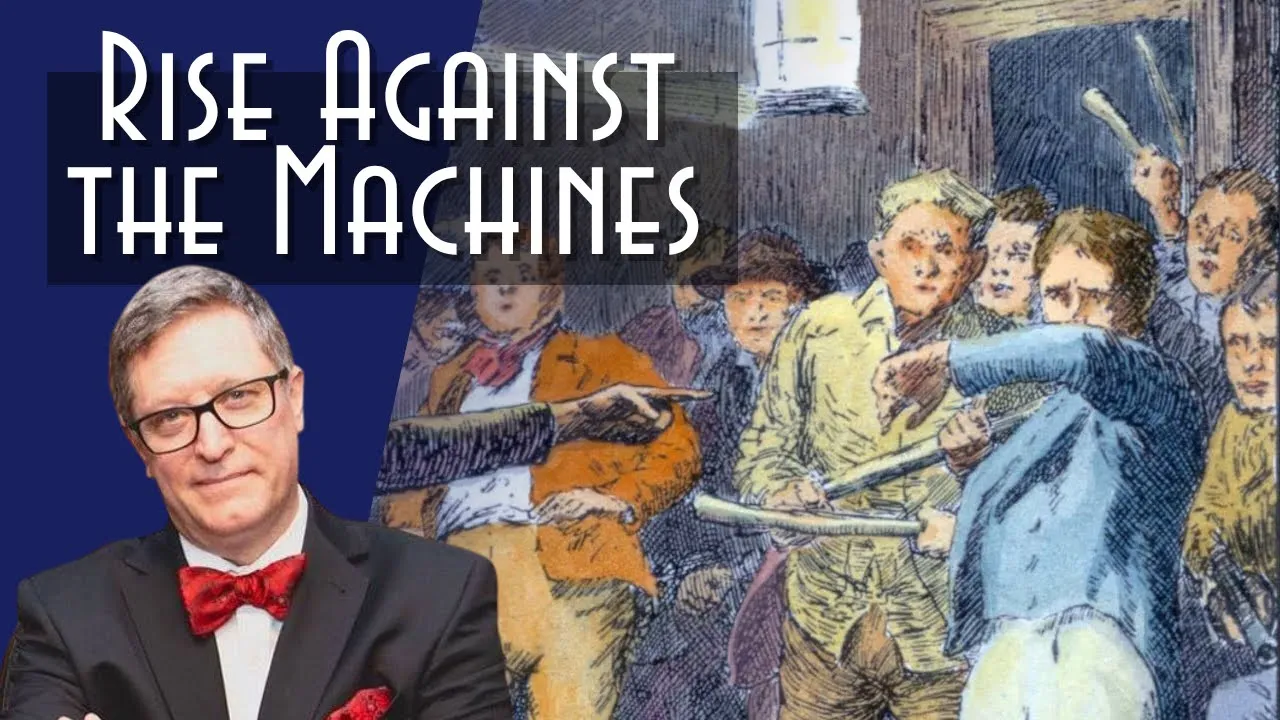
Rise against the Machines: The Luddites
156
The Luddite Rebellion emerged from the transition from cottage industry to factory system. Knitted goods had been a cottage industry carried on by women and children, but by the late 18th century, workers lost ownership of their frames and had to pay for seamers and oil. Middlemen squeezed profits, and workers labored 14-hour days for pittance wages. Children were enslaved to long hours. The destruction of machines as protest had precedents: weavers burned looms in 1675, and mobs destroyed machines at Arkwright's factory in 1776. By early 1811, thousands were unemployed and in poverty. While often presented as anti-technology, the Luddites' real grievance was the use of wide frames for cheap merchandise and the undermining of skilled workers' livelihoods.
Click to watch →

The Heavy Machine That Bankrupted an Entire Industry
142
Automated power looms transformed textile production from skilled household work into centralized factory output controlled by capital owners. Before mechanization, textile production depended on decentralized labor where families spun yarn and wove cloth in their homes, selling through local merchants and guild networks. This system supported entire regions in Britain, India, and Southeast Asia. Skilled weavers controlled pacing, pricing, and quality, with production limits preserving steady demand for human labor. That balance collapsed after 1785 when Edmund Cartwright patented a practical power loom. By the early 19th century, steam-powered factories produced cloth faster and cheaper than any hand weaver. Factory owners benefited immediately as one loom replaced multiple skilled workers requiring minimal training. Wages fell as labor became interchangeable and abundant. Household economies disintegrated within a generation. Social backlash followed with Luddites attacking mills between 1811-1816, but the government responded with troops and executions. By the 1820s, hand weaving in Britain was effectively destroyed. Former craftsmen flooded industrial towns, overwhelming labor markets. Poverty increased, working conditions deteriorated, and child labor expanded. The damage spread to colonial markets where British manufacturers exported cheap machine-made textiles to India, destroying centuries-old handloom weaver economies.
Click to watch →
The Fabric of Civilization & How Textiles Made the World | Virginia Postrel
2K
The Luddites were not anti-technology ideologues but hand loom weavers who had enjoyed a generation of prosperity during the spinning machine era. When power looms mechanized weaving, these workers lost their livelihoods. They protested because increasing productivity meant losing jobs, a tension that remains relevant today with technological change.
Click to watch →

Will AI Kill Investment Banking Analyst Jobs?
381
The power loom invention in 1780s England tripled textile production but initially displaced weavers who physically attacked machines (Luddites). Their three beliefs—technology hurts, will continue hurting, and can be fought—were partially correct. While many workers suffered initially, over decades they adapted by becoming factory workers, machine operators, or benefiting from cheaper goods. The key insight: productivity gains ultimately win, but adaptation takes time and creates new opportunities.
Click to watch →

The Luddites in Yorkshire
4.7K
Edmund Cartwright's power loom (1785) allowed an unskilled boy to produce 3.5 pieces of material in the time it took a trained skilled weaver to produce one piece using traditional methods. This technological advancement made skilled weavers obsolete, leading to the first proper insurrection in 1811 in Nottingham, led by the mythical Ned Ludd figure, which gave the movement its name.
Click to watch →
Deep Dive
The development of the Jacquard Loom and how its punch-card system laid the groundwork for early computer programming.

Early Programming: Crash Course Computer Science #10
853.5K
Joseph Marie Jacquard developed a programmable textile loom in 1801 that used punched cards to define patterns. Each card contained holes that determined whether specific threads were held high or low, allowing the weft thread to pass above or below. These punch cards were arranged in long chains to form sequences of commands for the loom. This invention is considered one of the earliest forms of programming, as it demonstrated how instructions could be stored on physical media and executed mechanically.
Click to watch →

🤖 Pourquoi les ROBOTS HUMANOÏDES sont une IDÉE DE M****
34.4K
The Jacquard loom, invented by Joseph Marie Jacquard, used punched cards to control the weaving pattern. This binary system (hole present or absent) was the precursor to modern computer programming. Charles Babbage and Ada Lovelace later built upon this concept to develop the Analytical Engine, which is considered the conceptual ancestor of modern computers. This demonstrates how a practical industrial invention could lead to revolutionary technological developments.
Click to watch →

ÇALIŞAN HARİKA MAKİNELER SANAYİ DEVRİMİ TARİH (Belgesel BG)
5.9K
Joseph Marie Jacquard's 1801 loom used punched cards to automatically control weaving patterns, enabling complex designs without skilled operators. This punched card system directly influenced early computer programming, as the same binary principle of using holes to encode instructions was later applied to programming computers. The loom demonstrated that machines could be programmed to perform complex tasks, establishing foundational concepts for modern computing technology.
Click to watch →

Paris' Incredible Temple To Science
258K
In 1802, Joseph Marie Jacquard combined the punch card system from earlier looms with Vaucanson's automation to create the Jacquard loom, which could produce complex patterns automatically. This invention transformed the textile industry by making intricate designs cheap and easy to manufacture. The punch card concept later inspired Herman Hollerith, who applied it to electromechanical counting machines for the 1880 U.S. census, forming the core of what would become IBM. Thus, the Jacquard loom represents a direct ancestor of modern computer programming and automated manufacturing.
Click to watch →
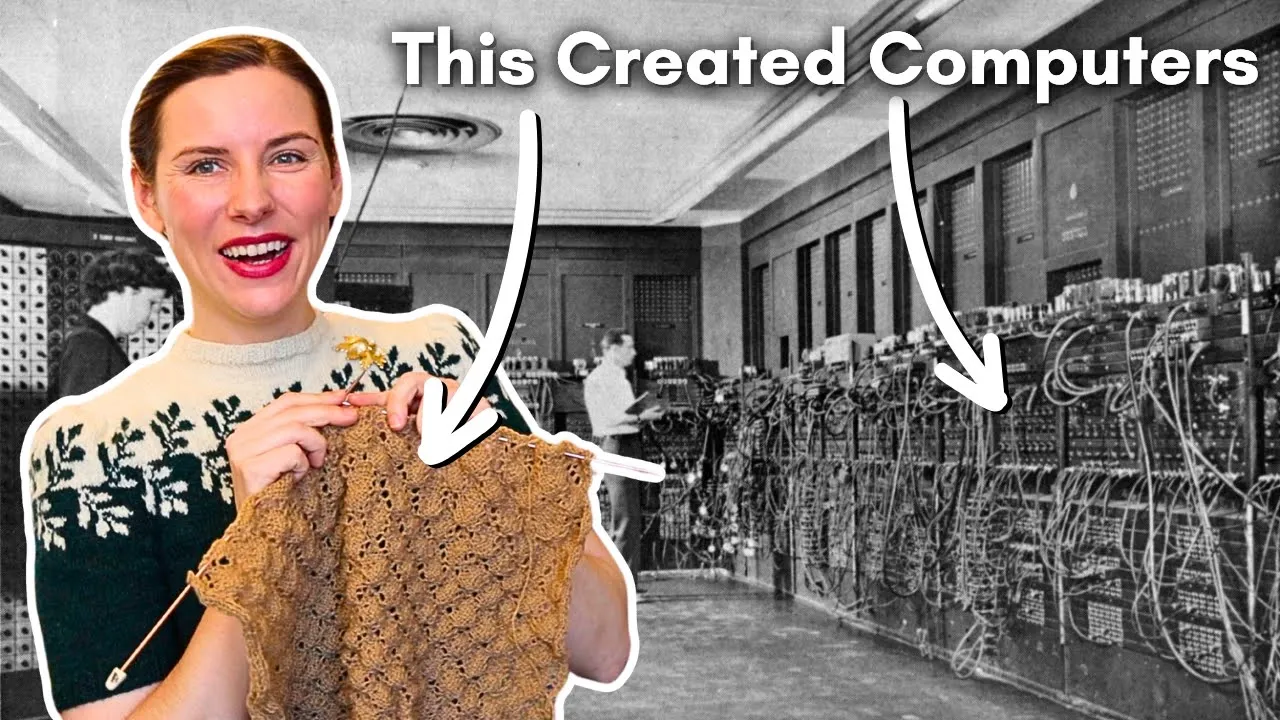
Computers would not exist without fabric
21.8K
Punch cards used in early computers were directly based on the punch cards from the Jacquard loom. Charles Babbage used these punch cards to feed data into his Analytical Engine, which was the earliest theorized computer. Ada Lovelace wrote the first programs for this machine, drawing direct inspiration from how the Jacquard loom used punch cards to create intricate fabric patterns.
Click to watch →
Deep Dive
The global impact of increased textile production on trade, colonization, and the expansion of the cotton economy.

‼️Обережно, БАВОВНА! Невідома історія бавовни: Як вона змінила світ, рабство та економіку! 👀
1.3K
Europe's shift from wool to cotton resulted from cotton's softness, breathability, dyeability, and lower production costs. Eli Whitney's 1793 cotton gin revolutionized production, making cotton cultivation vastly more profitable. European colonial expansion into India, the American South, and Egypt provided access to raw cotton at low prices. The transatlantic slave trade enabled massive cotton production. Empires fought wars and blockades to control cotton flows, with the American Civil War causing a European cotton famine. Colonial powers exploited economies, forcing Indian farmers to produce raw cotton for British factories while limiting India's textile industry. Cotton's profitability drove the expansion of slavery in the American South, where by mid-19th century, the South produced 75% of world cotton, creating a global economic system based on enslaved labor.
Click to watch →

Revolução Industrial Mundo Material 60
621
Cotton became the biggest cash crop of the Industrial Revolution, grown on colonial plantations using slave labor. This exotic luxury became an everyday essential, transported from America and the West Indies to Liverpool, then by canal to mills. The British desire for exotic goods like tea, cotton, and China drove exploration, colonization, and trade networks that created the modern global economy.
Click to watch →

Cotton: The Fabric That Made the Modern World by Giorgio Riello (Audio Summary)
120
The British cotton industry's rise required understanding slavery, colonialism, and ecological extraction beyond mere technology. Slave-based plantations in the Caribbean and US South generated raw cotton output growing 90-fold between 1791-1821, with enslaved Africans working under brutal conditions. Slave-grown cotton offered advantages because it expanded without Europe's ecological limits, serving as 'ghost acres' supplying European economies. Under free trade policies, Britain forced open global markets, eliminating tariffs on British imports while imposing taxes on Indian weavers and converting vast Indian areas into cotton plantations. An estimated 1.5 million Indian weavers lost work by the 1830s, though some adapted to luxury markets or adopted European technologies. By 1900, Western Europe and the US had leapt far ahead of the rest of the world in wealth and productivity, while India's weaving communities languished in poverty. Cotton textiles enabled ecologically constrained European economies to escape Malthusian constraints and launch fossil-fuel-based mass production. A vast international division of labor emerged where millions of enslaved Africans, indentured Indians, and Indigenous Americans produced raw materials for metropolitan capital. The story continued transforming through 20th-century shifts to Japan, then Hong Kong, Taiwan, South Korea, and coastal China, before recent relocation to Bangladesh, Vietnam, and Ethiopia.
Click to watch →

Empire of Cotton by Sven Beckert: 18 Minute Summary
1K
Cotton captivated humanity for thousands of years across Africa, Asia, and America before Europeans interconnected cotton growers worldwide. Samuel Greg opened the first mechanized cotton mill in 1784, revolutionizing productivity—British workers needed only 135 hours to spin 100 lb of cotton compared to 50,000 hours by Indian spinners. British cotton prices fell 50%, and exports surged 16-fold to £58.5 million by 1800. Countries like France, Germany, and Belgium implemented protectionist measures and strong state infrastructure, enabling faster industrialization than nations like India weakened by British colonization. This created lasting divides between developed and developing nations.
Click to watch →

Storia 12 Economia e società del '700 seconda parte
144
Indian cotton was a global commodity that transformed the textile industry. In the 17th century, only 300,000 pieces of Indian cotton were imported, but by the beginning of the 18th century, this had quadrupled. This explosion in imports changed the face of the textile industry. Britain implemented protectionist policies, banning European imports of Indian cotton. This forced Europe to turn to American cotton from the continent, increasing demand for American cotton and accelerating the expansion of slavery in the American colonies to meet this growing demand.
Click to watch →
Deep Dive
Modern textile manufacturing technologies and the transition to fully automated, computer-controlled looms.

The Insane Geometry Of Your Clothes
653.7K
The textile industry drove the Industrial Revolution, with steam engines powering looms—the largest sector by manpower and profit. Early automation used punch cards for pattern control, pioneering machine programming concepts later adopted by computers. Modern looms control over 6,000 warp yarns individually using weight-based tension sensors that detect breaks by completing electrical circuits. The revolutionary advancement eliminated shuttles and bobbins entirely, replacing them with air jets or mechanical grabbers operating at 10+ cycles per second. Metal pins mounted on stationary frames open/close grabbers without adding arm weight. This evolution from manual looms to electronically controlled, high-speed machines represents centuries of engineering progress in textile manufacturing.
Click to watch →

James Burke Connections, Ep. 4 "Faith in Numbers"
213.2K
The evolution of automated textile production progressed through several key innovations. Around 1740, Jean Falcon improved upon Bouchon's system by replacing fragile paper with durable cards containing pattern holes. Around 1750, Jacques de Vaucanson automated the entire process by mounting perforated paper rolls on cylinders that moved automatically using water power, advancing one row of holes with each cycle. For nearly 50 years, Vaucanson's loom remained largely unused in Paris museums until Joseph Marie Jacquard combined Vaucanson's automatic cylinder movement with Falcon's punch card system around 1800, creating a fully automated loom that could produce increasingly complex patterns by adding more cards.
Click to watch →

పవర్ లూమ్ Industry హిస్టరీ | how power loom industry works in telugu | facts | ETech reddaiah
6.7K
Textile manufacturing evolved from traditional hand weaving to mechanized production through key innovations. The flying shuttle (1733) enabled faster weaving, while Edmund Cartwright's power loom (1785) revolutionized cotton production. Joseph Marie Jacquard's 1801 automatic loom introduced punched card systems for pattern control. Modern power looms use electric motors (1/4-1 HP) connected through belt systems to crankshafts, with sensors enabling computer-based operation for precise textile manufacturing.
Click to watch →

Mass Production Processes and Modern Manufacturing Machines ▶4
1.1M
The video features advanced manufacturing technologies including CNC machines, robotic arms, and automated guided vehicles. These technologies enable complex operations such as precision cutting, welding, and material handling. The integration of these technologies represents the evolution of manufacturing from manual labor to highly automated, computer-controlled production systems.
Click to watch →
Paris' Incredible Temple To Science
258K
The development of automated textile looms represents a pivotal chapter in industrial history. Jean-Baptiste Bouchon pioneered the concept in 1725 by applying paper tape control mechanisms from music boxes to weaving looms. His student Jacques Vaucanson improved this by replacing fragile paper with durable cards in 1750, though workers resisted automation with violence. Joseph Marie Jacquard synthesized these innovations in 1802, creating the Jacquard loom that could produce complex patterns automatically. This invention transformed the textile industry and directly inspired Herman Hollerith's punch card tabulating machines for the 1880 U.S. census, forming the foundation of modern computing.
Click to watch →
Mechanized Looms
Efficiency Gains
Luddite Riots
Mechanized Looms
0:01- 1
Power looms replaced human muscle with water energy.
- 2
Flying shuttle mechanization enabled ultra-fast weaving.
- 3
Process speed far surpassed manual handloom methods.
The Social Cost of Mechanization: The Luddite Perspective
While the power loom revolutionized efficiency and boosted industrial output, this technological leap came at a devastating human cost. Before its widespread adoption, handloom weaving was a highly skilled, respected, and relatively well-paid cottage industry. The rapid introduction of the power loom de-skilled the labor force, drastically lowered wages, and forced workers—including young children—into dangerous, highly regimented factory environments. This sudden displacement sparked the Luddite movement (1811–1816), during which marginalized weavers and artisans violently destroyed machines in protest of their ruined livelihoods and the loss of their autonomy. Introducing this perspective helps students understand that technological progress is not universally beneficial; it often creates severe economic inequality, labor exploitation, and social upheaval for the working class.
The basics of the domestic system (cottage industry) and traditional hand-weaving methods.
Early textile innovations of the Industrial Revolution, such as John Kay's Flying Shuttle and James Hargreaves' Spinning Jenny.
The fundamental concept of mechanization—transitioning from human or animal labor to machine power.
An understanding of early industrial power sources, specifically water wheels and early steam engines.
The social and economic consequences of the power loom, including the rise of the factory system and the Luddite protests.
The development of the Jacquard Loom and how its punch-card system laid the groundwork for early computer programming.
The global impact of increased textile production on trade, colonization, and the expansion of the cotton economy.
Modern textile manufacturing technologies and the transition to fully automated, computer-controlled looms.
21.5K views74likes0:57@patrickreed1967Original Release: 2016-12-17
Mechanized power looms used water power instead of human muscle power to weave thread into cloth. One important invention adapted to power weaving from hand looms was mechanized version of the flying shuttle, seen here. This was special device used to rapidly weave a cross thread through the webs of thread on the loom. And with power looms, this process took place at an incredible speed when compared to doing it by hand. It's not surprising that the much more efficient power looms rapidly ended the cottage weaving industry. In England, in 1811, unemployed home textile workers called the Luddites, got so angry about losing their jobs that they rioted and tried to destroy the new textile machines.
Up Next

3:07
Air Jet Loom Working Principle and Weft Insertion Mechanism
@TextileVlog
63.7K views•2023-08-02

30:32
Ultrasonic Transducers: Resonant Frequency Measurement and Horn Design
@imajeenyus42
229.9K views•2017-02-22

54:16
Polymer Environmental Degradation: Mechanisms & Stabilization
@iit
1.8K views•2012-07-10

33:39
How a Student's Question Saved a NYC Skyscraper from Collapse
@veritasium
22.8M views•2025-04-26
Related Study Plans & Knowledge Roadmaps
Structured learning paths in Engineering
engineering
Building Acoustic Levitators: Physics & Arduino
01The Physics of Sound and Standing Waves
02Piezoelectric Transducers and H-Bridge Drivers
03Arduino Programming: Generating 40 kHz Signals
+ 2 more learning modules
14h5 modules
Explore Roadmap
engineering
Building Peltier Cloud Chambers: Particle Tracks
01Cosmic Rays & Cloud Chamber Physics
02Thermoelectric Cooling (TEC) Fundamentals
03Custom Liquid-Cooling Loop Design
+ 2 more learning modules
18h5 modules
Explore Roadmap
engineering
Yagi-Uda Antennas: Modeling, Build & VNA Test
01Introduction to RF and Antenna Fundamentals
02Yagi-Uda Antenna Design Principles
03Antenna Modeling and Simulation in 4NEC2
+ 2 more learning modules
18h5 modules
Explore Roadmap
engineering
ECG Monitor Design: Op-Amps, Filters & Noise
01Electronics & Breadboard Basics
02Op-Amps and Instrumentation Amplifiers
03Bioelectricity and ECG Fundamentals
+ 2 more learning modules
18h5 modules
Explore Roadmap