















![CH 11[micro]: Goods that are not excludable](https://i.ytimg.com/vi/JOfJYolBQdM/maxresdefault.jpg)



Externalities occur when one party's actions affect another party without compensation, causing market inefficiency; negative externalities (like pollution or smoking) lead to overproduction/overconsumption, while positive externalities (like R&D) lead to underproduction/underconsumption, and governments can address these failures through corrective taxation, regulation, or cap-and-trade systems rather than relying solely on private negotiations.
Externalities: Market Failures & Policy | MIT 14.01 Economics Lecture
Added:Fundamental supply and demand analysis, including how competitive markets reach equilibrium price and quantity.
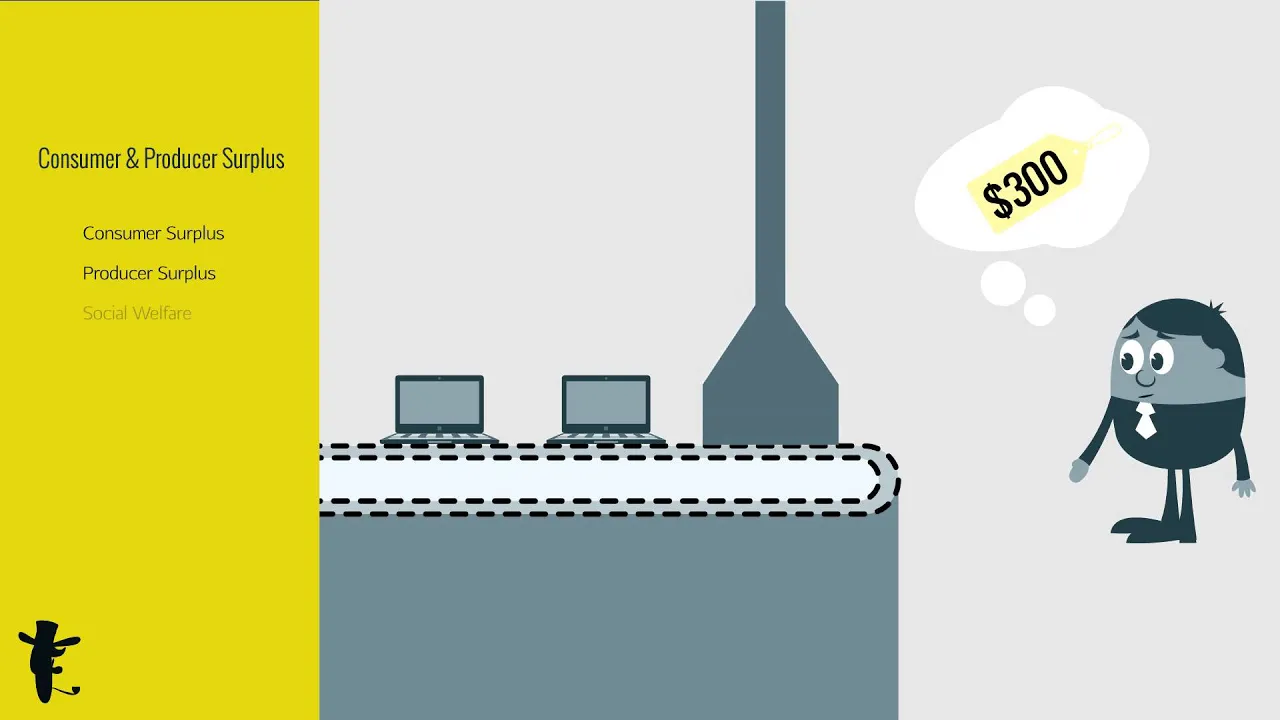
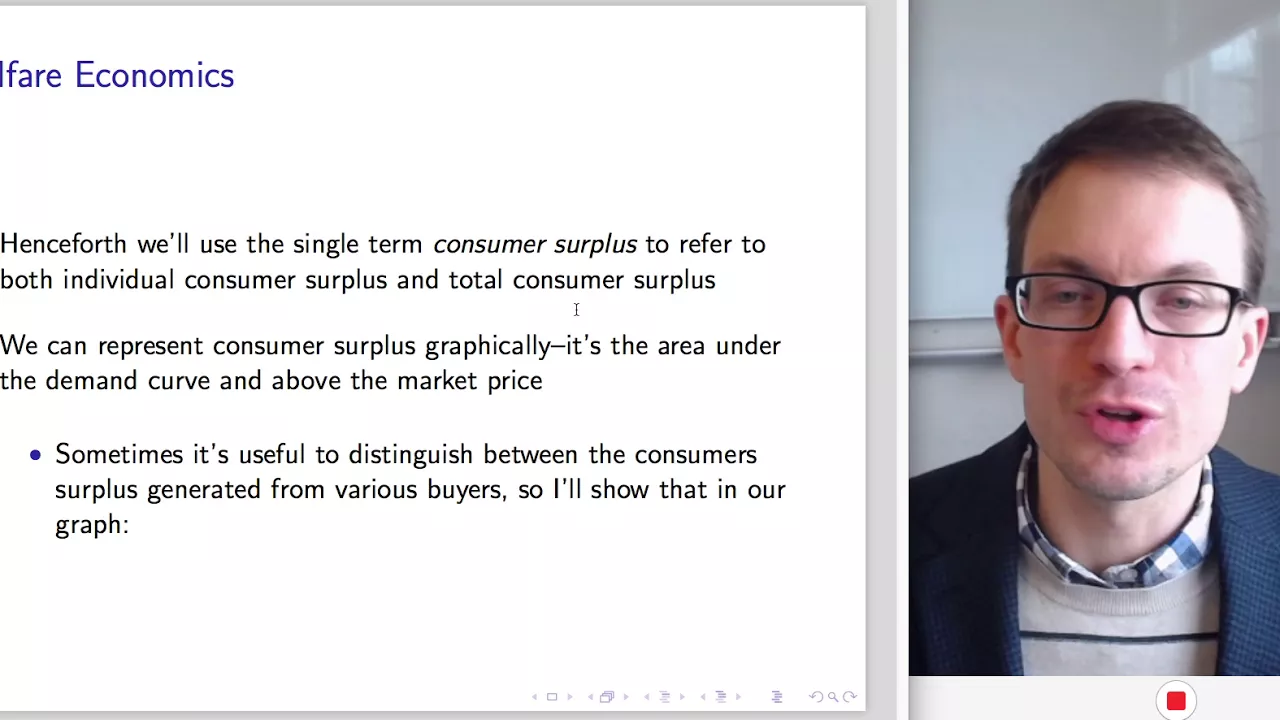
The concepts of consumer surplus, producer surplus, and allocative efficiency in welfare economics.
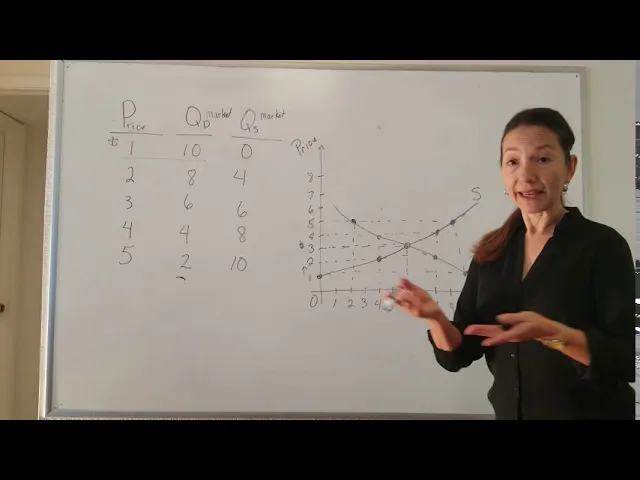
Marginal analysis, specifically the distinction between marginal private benefit (demand) and marginal private cost (supply).
The economic definition of market failure and why competitive markets sometimes fail to maximize social welfare.
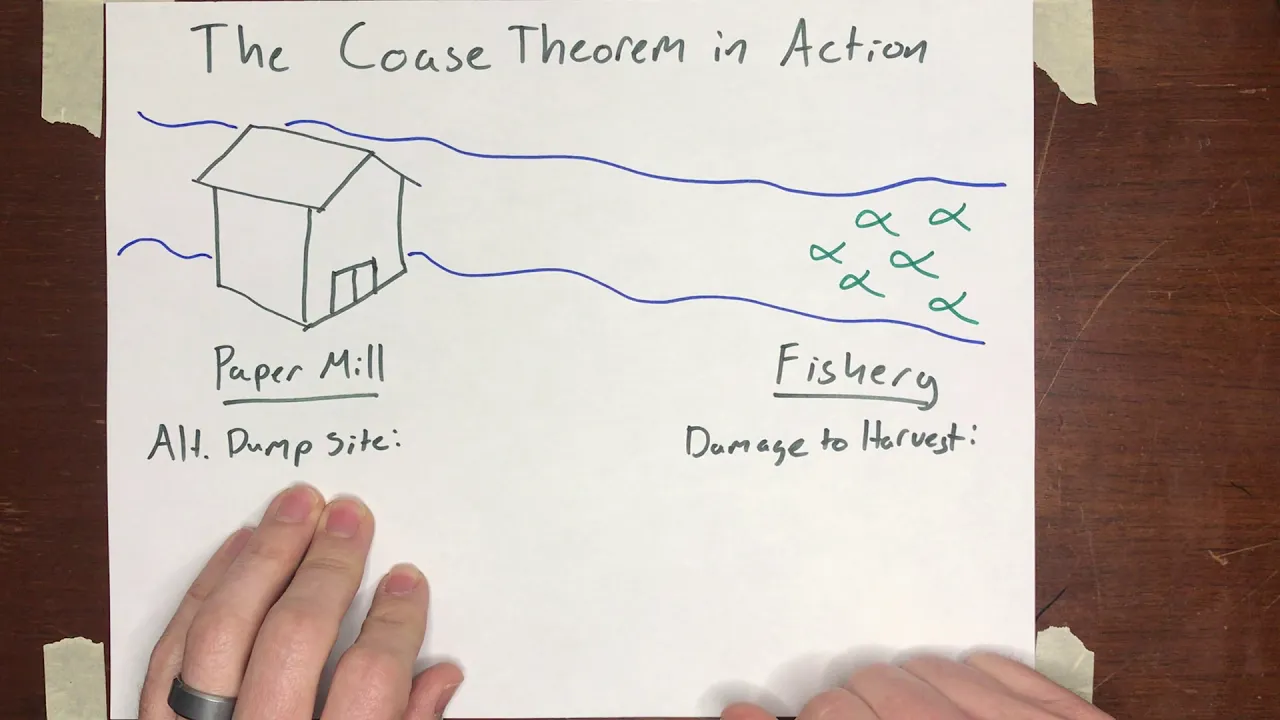
The Coase Theorem and how well-defined property rights and low transaction costs can resolve externalities without government intervention.
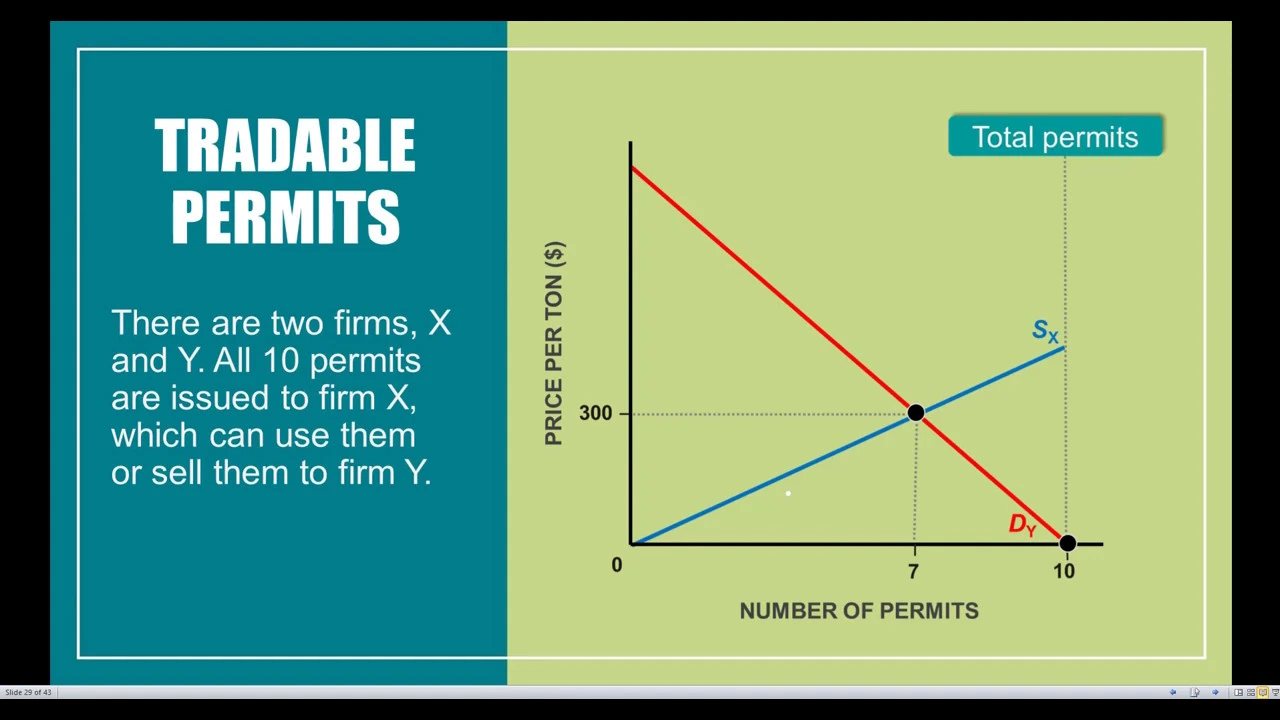
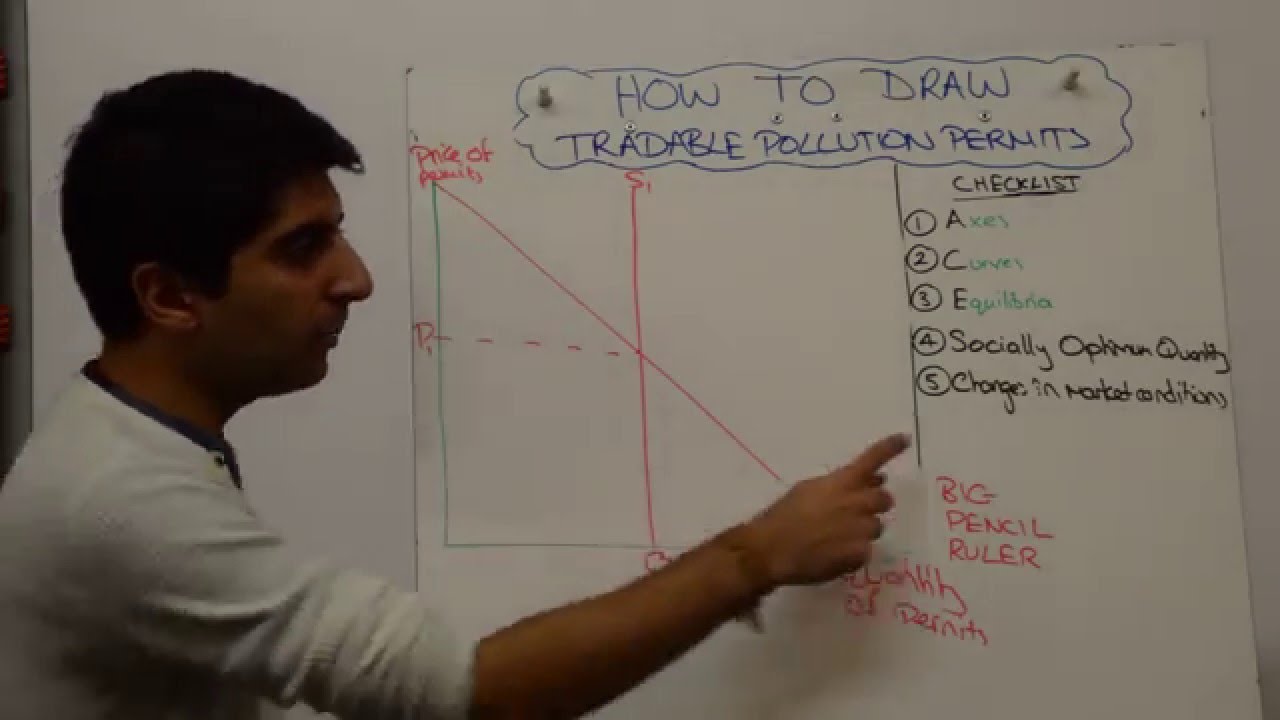
Cap-and-trade systems (tradable pollution permits) as a market-based alternative to Pigouvian taxes and command-and-control regulations.
The economics of public goods and common resources, including the Free-Rider Problem and the Tragedy of the Commons.
Cost-benefit analysis in environmental economics, specifically how economists estimate the monetary value of non-market damages like air pollution.
5.7K views144likes46:54Original Release: 2025-04-02
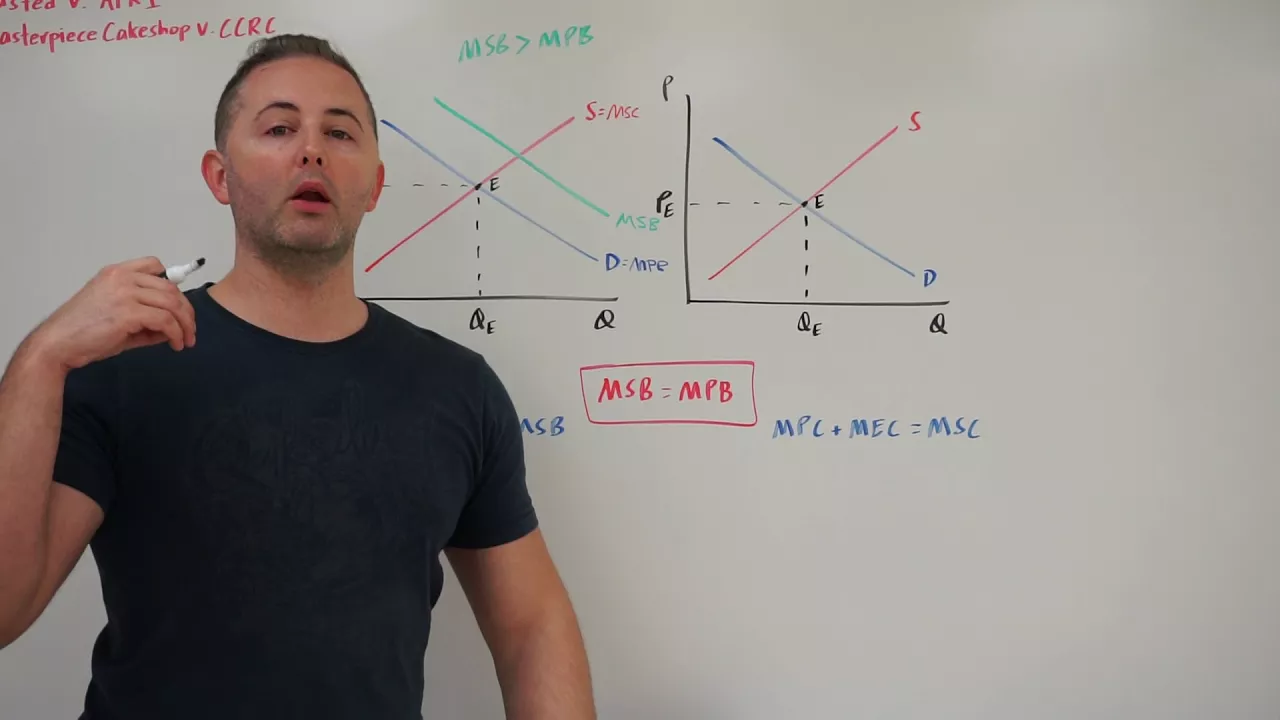
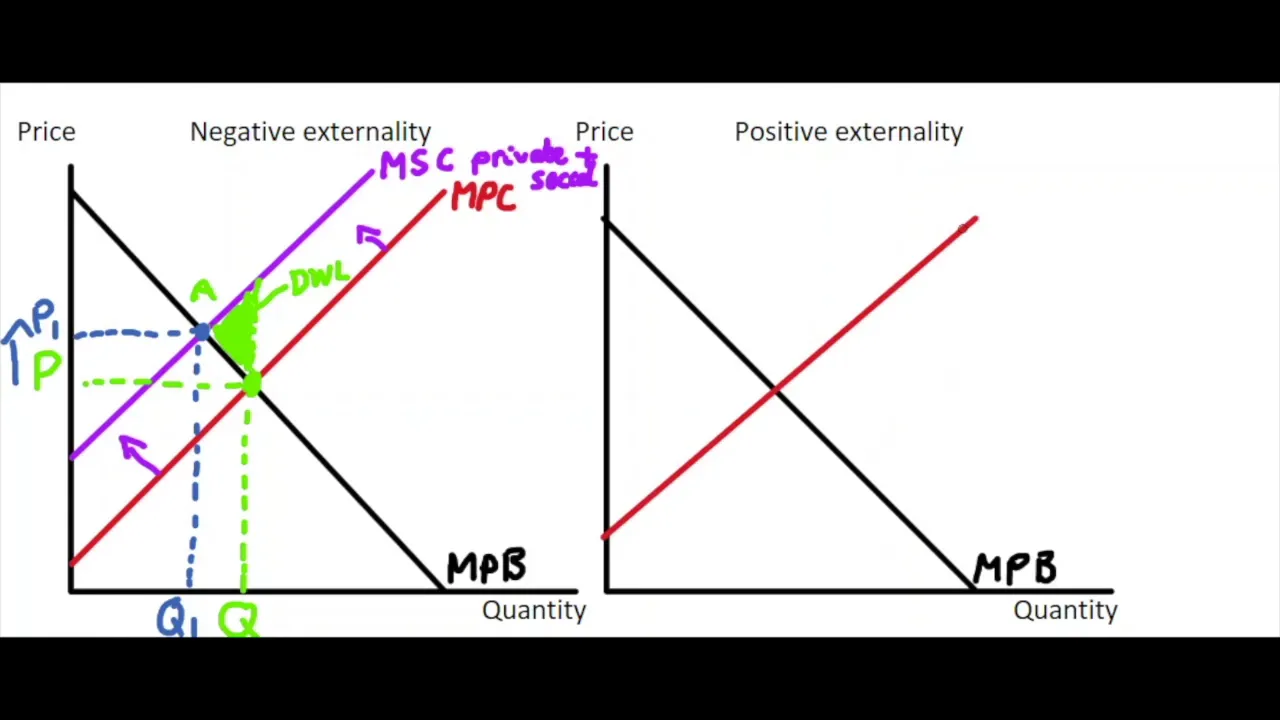
um today we're g to continue our sort of application we learned so far and today we are going to really dive in and sort of in some sense what we could sort of consider consider the mother of all market failures which is externalities the classic the single most classic example that economists use when they talk about market failure is externalities and today we're going to talk about externalities uh what they are why they represent market failures and what governments can do about them so an externality exists whenever the actions of one party make another party better or worse off but the first party doesn't get the benefits or consequence of doing so soever my actions make you better or worse but none of the benefits of making you better or the cost of making you worse accre to me individually in that context that's an externality okay and we will talk about why this C is a fundamental source of market failure and we're going to talk about four different types of externalities so we're going to start with the most classic case which is a negative production externality this is the most classic example of externalities okay so suppose that there's a a steel plant located on a river how many guys read The Lorax guys go excellent good job Dr Seuss greatest second greatest author of history behind Shakespeare is Dr Seuss okay so the lorax tells the story of this plant sort of dumping crap into the river well think about The Lorax think about a plant on a river a steel plant in a river dumping sludge into the river it's a natural byproduct of the steel they's not making sedes he's making steel natural bipart byproduct of the steel plant is uh this sludge and every unit of Steel that's made produces one unit of sludge that gets dumped by a pipe out the back into the river just like in The Lorax okay however the steel plant is not the only user of this River farther Downstream from the steel plant is a set of fishermen and they fish in this River and they make their living uh fishing in this River and it turns out that the sludge that the steel plant's dumping in is killing the fish and hurting the livelihood of the fisherman down the river now this is a classic negative production externality it's negative because my action as a steel plant affects another party which is the fisherman it's production because it's a byproduct of the production process we'll talk later about consumption externals you'll see the difference um and so this is a classic negative production externality and the way we Analyze That is shown in figure 241 once again from my textbook okay we think about the market for steel the market Standard Market diagram you got the quantity of Steel on the xaxis you've got the price of steel on the Y AIS you've got um uh a demand for steel which is the blue downward sloping line and supply of Steel now the key distinction we're going to make here that we haven't drawn before is when we've talked about what demand and Supply represent we've talked about them as private Concepts the domain curve is individual's willingness to pay the supply curve is an individual's firm's willingness to supply but implicit in that and implicit in the welfare analysis would be way back in lecture 12 is the notion they also represent social curves implicit in all the analysis we've done is the assumption that the aggregation of individuals represents society and therefore what's best for individuals is best for society so implicit what we've done is that private benefits equal social benefits so the domain curve for example the slope of the domain curve is the private marginal benefit of another unit of Steel it's also the social marginal benefit now we haven't raised this before because it didn't matter before but today it will likewise the supply curve is the private marginal cost a producing number unit of Steel we just called it marginal cost we didn't call it private but that's what it is and we also represent that as a social marginal cost of producing steel it's what it cost Society to produce steel is what it cost the producer the difference with an externality is social costs now deviate from private costs so if you think about what is the cost of producing unit of Steel well there's the marginal cost of that steel all the stuff that goes into it plus there's the fact that every unit of Steel creates unit of sludge and that kills fish now that is not a private cost the steel planter couldn't give a it's a social cost because but Society is worse off because the fish are dying societ is comprised of everyone in society so the cost of producing steel the social cost is now the manufacturer's private marginal cost plus the marginal damage so the social marginal cost is the manufacturer private marginal cost plus the marginal damage that that production does to society in this case society's represented just by the fisherman the other rest of society we are going to assume to make life easy that marginal damage is constant you could imagine upward or downward sloping marginal demand curves let's leave that alone that which makes it harder all the math and all the intuition goes through assume a constant assume that every single unit of sludge dump causes a constant marginal demand marginal damage MD in terms of killing fish okay what does that imply for both private and social welfare so for private welfare for what the market delivers what the this is otherwise a perfectly competitive market it delivers the outcome at Point a the perfectly competitive market delivers outcome at Point a with no externalities that is also the socially optimal outcome we covered that that's the first fundamental theorem but now we say no the social cost is not the blue line it's the red line it's the private marginal cost plus the marginal damage which is a shift upwards it's a constant shift upwards because we're assuming marginal damage is constant so the social Optimum is not at a it's at C in other words from society's perspective the steel company overproduces steel why does it overproduce steel because a steel compan is saying I'm going to produce steel until the cost to me equals the benefits to Consumers but from society's perspective you should produce D the cost to society equals the benefits to society the benefit to society is the demand curve but the cost Society supply curve plus the marginal damage as a result the steel plant is overproducing steel because it's not accounting for the externality it's not accounting for the Damage Done to the other party and as a result we get overproduction of Steel and a dead weight loss the dead weight loss is a New Concept because we haven't had private and social cost deviating before we've seen deadweight losses before but this is a new kind of dead weight loss that arises because the fact that the steel kills fish creates an externality which causes the steel producer to overproduce steel and as a result of that excess production of Steel we get a dead weight loss dead weight losses here's the trick are done relevant to social marginal costs the ultimate goals to have is to have social welfare maximization that's at C not at a so you've created a dead weight loss okay questions a little mind-blowing different concept question about how this works yeah no so see the thing is societ well it depends defined Society the market can only operate as the market the Market's the market for steel that's what I've drawn here Society being the government could decide to address this and we'll talk about later but the market itself leads to point a so the Market's leading us to overproduced Steel okay so this is not a this is not a positive analysis the positive analysis we already know how to do posi you get to point a this a normative analysis which is point a is over production producing too much course are not accounting for the Damage Done to the fisherman okay let's drill this intuition home by talking about another case let's talk about a negative consumption externality let's talk about a negative consumption externality the classic example of which is smoking when I smoke I exert a negative effect on society partly because um I raised the cost of medical care for dealing with with me when I'm old partly because I create secondhand smoke but for lots of reasons my smoking creates extra cost for society so my smoking decision is represented in figure 242 the cost of producing cigarettes we're assuming no production externality here so the supply curve is both the private marginal cost and the social marginal cost there's no production externality but I choose to smoke it point a or the market chooses smoking at Point a which is where the so the private marginal cost equals the private marginal benefit however the social marginal benefit is lower than the private marginal benefit the social marginal benefit is equal to the private marginal benefit minus the marginal damage which once again I assume is constant done by my smoking in other words I over smoke because when I decide to smoke I just compare my benefits to the cost of cigarettes I don't consider the fact that I'm making you sick and making your tax dollars go up by my smoking as a result I smoke too much from society's perspective think of society as the bubble that includes everyone whereas my decision is a bubble that just includes me so I'm only deciding based on me I'm ignoring the rest of that bubble if my smoking decisions affect the rest of that bubble then I'm over consuming okay and therefore we get too many cigarettes consumed and a parallel dead weight loss okay this time it comes from a shift in the demand curve okay so that is another example uh you note here we used a number we Ed 40 cents that's the best estimate 40 40 or 50 cents is the best estimate of what the negative externality is from smoking about 40 to 50 cents a pack if you add up all the costs smokers impose on society it's 40 to 50 cents a pack and that's why we use that as a constant marginal damage here so given this there's over consumption um of uh of cigarettes externals can also be positive we could have a positive production externality the classic example of that so let's think about what we what we're now you sort of are in the concept think about what I'm going to talk about here I'm going talk about something something that firms do that has benefits on others that the firms don't realize what's the classical example of that research and development when a firm does R&D it creates new science which benefits consumers but consumers pay for that but other firms learn and go further up the development curve based on what the first firm did so if you think about if you go go to figure 234 think about the market for R&D when a firm's deciding how much R&D to do it considers what's the cost of R&D R&D is a cost you got to hire scientists and build labs and so that's the uh private marginal cost and there's a benefit for R&D which is how many patents does it deliver for the firm that's going to drive the demand okay what the firm is ignoring is that by doing R&D they are actually producing knowled that cannot be held totally privately eventually when the patent runs out it's public even before that firms May learn and that's going to benefit other firms that's going to lower the cost of development for other firms so there's a social marginal benefit which effectively lowers the marginal cost of R&D from society's perspective when firms do R&D it's more valuable than the firm at self sees indeed the best estimates are that the private rate of return to firms is on the order of about 15 to 20% pretty high rate of return because a risky investment the social rate of return which is accounting for the benefits other firms get from that R&D are something like two to three times as large because of all the benefits of society and one firm does it spills over and other firms benefit as well okay so that is a positive production externality as a result firms do too little R&D just like a negative production externality causes the steel plants to produce too much steel a positive production externality causes firms to do too little R&D okay that's one reason why in the US we have a tax credit to promote R&D finally we have the last example which is a positive consumption externality and here let me move away from the graphs and talk about an example okay um I have a neighbor who I'm not fond of I may have mentioned this before uh I do not like my neighbor uh part of the reason I do not like my neighbor is my neighbor has a tendency to do big projects about halfway and then stop because he gets bored one such project he started about 20 years ago he decided do a massive landscaping job on his yard and as part of that I produced a giant mound of dirt that was directly out the window of our kitchen and then he stopped and that Dirt has sat there for 20 years at one point my wife snuck out and planted wild flowers on it so it wouldn't look so bad but the bottom line is we got this pile of dirt this guy created so let's think about his decision about whether to get rid of that pile of dirt imagine that it would cost him $1,000 to get rid of that pile of dirt and imagine because he doesn't mind looking at dirt it's only worth 800 bucks to him so the marginal cost is a th000 the marginal benefit privately is 800 you won't get rid of it but what if it's also worth another 500 bucks to me well in that case the social marginal benefit is $1,300 which is above the cost so he should remove the dirt but he won't because he's a jerk Okay and like he doesn't care what I think he's just his own and he's look he's not it he won't not do it not just because he's jerk but because he's considering his own private marginal cost of medits it's not worth it because it's an ex because removing it would have a positive effect on me and he's not accounting for that so he's under he is underusing Landscaping okay questions about any of this yeah uh they're just twoo totally different market failures uh I think you know we could discuss that more another time but they're just they're really not related in in fundamental ways I mean in subsense you could think of information Imes creating things that look like externalities but they're just two different ways the market can fail um okay so now but my neighbor example raises a really interesting question okay I now hopefully have convinced you extra NS exist they're real they cause inefficiencies but do we need the government to fix them I mean after all I could go to my neighbor and offer him 500 bucks to the Landscaping right we don't need government indeed there's a very famous economist lawyer and Economist named Ronald Co who POS what we call the Coan solution externalities which is just negotiate okay basically this fisherman could say hey you're doing this damage to our fishing let's negotiate and have you produce less steel okay so basically theide idea is we don't really necessarily need a government was K's argument because we could solve some negotiation in practice he's wrong and he's wrong for a number of reasons the first reason he's wrong is that the most important externalities are not things like me and my neighbor things like global warming global war is the ultimate externality okay when you drove your car last you were ever so incrementally putting Bangladesh underwater even if it's an EV Le as an EV but even still okay did you think about that did you think well I'm going to drive you thought about my drive is it worth it did you think oh but also I'm putting Bangladesh underwater no you didn't okay because that's an externality you're not accounting for that the problem is externality that's created every day by billions of people and affects billions of people how would they negotiate how would the billions of people who create carbon get to the billions of people who are affected by carbon negotiate they can't it's implausible so one problem with Coast is it's simply plausible for the most important externalities which involve many parties on both sides that's the first problem with saying we can have a private solution to this okay the second problem is that it's kind of socially awkward I mean you notice I haven't in 20 years gone to my neighbor and offered him $500 to get rid of the Dirt Pile it's kind of socially awkward it'd be kind of a super bizarre thing to do right uh there's a famous story of an economist who was on a plane back before he had phones we used to talk people on planes and is on a plane trying to get some reading done and the guy next to him wouldn't stop talking so we offered him 10 bucks to shut up now we laugh CU like in reality like that can't be right no one would do that it's just because it's not how we really interact in society so there's both sort of negotiating barriers and Norms that get in the way think about a classic classic negative production external negative consumption externality is when your neighbor in the door room next to you plays their music too loud okay that they consumtion they are choosing the the volume which optimizes the Music Experience for them the benefits and costs they're weighing off they're not accounting for the fact it's making it harder for you to study now do you ever go to your neighbor and say look I've calculated that this ladder music will cause me to do five points worse on my tests which will affect my lifetime earnings by this amount pay me this or turn down the music no you either ignore it or tell them to stop it you don't tell them to shut it off okay we don't do coing negotiations in reality okay and as a result this is why we need to bring in Government Solutions the government needs to step in and solve the problem of externalities now how can the government solve this problem well one easy example is they can just regulate they can just regulate they could say if the government knows what the social opal production is it can just impose it so for example let's go back to our steel plants example okay let's go back to figure 241 what if the government just came in and said you know what steel plants you're producing Q2 that's a socially optimal amount then boom problem solved we've produced a socially optimal amount the government through regulation has enforced the social Optimum so that would be the the theoretically sort of easiest case the problem in practice is to determine what Q2 is you need to know a lot you need to know what the demand curve looks like you need to know what the supply curve looks like and you need to know the size of the marginal damage those are three hard things to learn and in particular we've talked before in the concept of Regulation about why it's very hard to measure these Curves in practice the firms will lie to you about what the marginal cost is it's hard to measure it it's hard to consumers to actually reveal what stuff's Worth to them for all the reasons we talked about it's very hard to actually in practice measure these curves so there's a lot of information need to gather to get that right but what if there was a simpler solution what if the government said look I do know the marginal damage but I don't know what demand and Supply curves look like in fact you don't need to know that because what the government can do like I said it can regulate which is sort of easy in theory hard in practice the other thing it can do corrective taxation which is imagine if the government went to the steel plant and said I am going to Levy a tax of the amount MD on every unit you produce all I know is MD I don't know anything else and it's only works MD is constant but let's assume I know MD it's constant then I can go to the steel plant and say I'm going to Levy a taxing of MD what would that do to the steel producer decision well let's go to figure 24 44 the steel producer the former e was at a now the government is coming along and saying I'm going to Levy a tax on every unit you produce a marginal tax of MD will that raises their marginal cost by the amount MD therefore shifting their private marginal cost curve up to the point where it equals the social marginal cost curve what the government does through corrective taxation is caused the firm to internalize the externality by basically pricing the externality it causes the firm to incorporate that into their decisions thereby thereby doing so getting to the socially optimal outcome so the government can essentially solve this problem with fairly limited information knows what MD is it can solve this so for example one of my former colleagues Michael greenstone served in the Obama Administration and his main goal there was to measure what he called the social cost of carbon which was what is the marginal cost of what each unit of carbon does in terms of damage through global warming obviously incredibly hard calculation but we have lots of engineering models about how carbon affects the environment he computed the social cost of carbon this is incredibly important because this became a basis for thinking about how we can tax the use of carbon if greenstone's calculations were right he came up at the point time was about $50 per ton of carbon $50 per ton of carbon is something like I forget it's something like 25 cents a gallon of gas maybe it's closer to 50 cents I don't remember exactly we could just say look that's the tax every time you use carbon you're going to pay this tax at a social cost and we would cause people to internalize the externality we could address global warming with one calculation that one calculation is simply what is the damage the margin of carbon doses does to the world to the US or the world we have to decide what we're optimizing and then we're done incredibly powerful if you think about it okay and this is the beauty of corrective taxation okay note that um what you have here is a let's go back to last lecture last lecture we talked about the dead weight loss of Taxation we talked about how taxes create dead weight loss because they reduce the quantity produced trades that are productive are not made here we're saying a tax gets rid of a dead weight loss it's exactly the opposite why because the trades it's getting rid of are not socially valuable when you have a negative externality there are socially invaluable trades being made all the units consumed between q1 and Q2 are losers for society so if you go back to figure 241 everything to the right of Q2 has a social marginal cost above its private marginal benefit its social marginal benefit those units which are hurting Society so by taxing the firm we are bringing them to the social margin to the socially optimal outcome so taxes can create dead weight loss taxes can also get rid of dead weight loss it depends on your starting point if your starting point is already the socially optimal outcome then taxes create dead weight loss but if you're starting from a point of maybe too much production taxes can reduce dead weight loss okay and that's kind of how we uh how we think about it okay questions about that okay now let's talk about government policy in practice let's talk about what the government does in practice because this is one of the most important things the government does is regulate and address externalities and let's talk about the two biggest sources of negative externalities that we have the first is environmental externalities and of course as I said the mother of all externalities which is global warming this is it this is the most important external that exists it's it's an existential threat to life on Earth okay and it is a classic externality because our use of carbon our little use of carbon is creating damage to the entire future of the world okay so it's a classicality when I drive my car I don't acknowledge the damage that's being done okay so basically uh and we all know how terrible global warming is I don't have to give you the scary facts uh carbon dioxide in the atmosphere is now its highest level in 400,000 years um temperatures have risen by more than one degree Fahrenheit in the last 70 years which is the most rapid increase in the last 10,000 years um what you might not know is how bad it's going to be uh basically scientists predict that by the end of the century uh 20 to 40% of Bangladesh will be underwater Cape cot will be gone much of Florida will be gone um and the economic D the economic damage to Society on the order of10 trillion uh uh in terms of uh in terms of economic damage indeed the the world as a whole will be about 10% poor by 2100 uh if uh through the physical damage done by global warming okay so what could the government do well I just described an easy answer corrective taxation we use engineering models to compute the social cost of carbon like greenstone had us do and we say okay we're going to put that into a tax we'll basically compute for every carbon producing activity how much carbon it produces and we'll tax it accordingly indeed Europe does this a lot if you've ever driven in Europe gas even at today's high prices is about twice as expensive in Europe about twice as much per gallon of gas in Europe it's hard to mislead if you see the signs because it's done by leader it's all you got to convert but it's basically about twice as expensive why because of taxes because European nations significantly tax gasoline we tax gasoline but at a much much lower level okay they have much higher taxes now so the easy answer is let's just tax gas here the problem is political Bill Clinton who was president had a lot of controversies during his presidency one that them talked about a lot is he osed a 3 Cent per gallon tax on gasoline and that was one of the most consequentially negative things he ever did for his electoral prospects a lot of the reason that Republicans took Congress in 1994 was because Bill Clinton's 3 Cent a gallon tax proposal gas tax proposal so basically we know the right answer the answer economists have pushed for for 50 plus years which is a carbon tax but politically it's been challenging there therefore the framework that's been adopted since 1992 is instead Quan regulation and in particular a cap and trade system for regulating carbon what that means is we're going to we're going to limit each company is going to limit how much carbon it produces okay that's the cap part it's a regulatory Target okay but we're going to allow countries to trade to take advantage of efficient opportunities let me explain what this means so basically um in the US we do not it is very expensive to convert to clean energy and the reason is because we built an entire economy around dirty energy think of a simple example if I want a natural gas plant I got to First tear down the coal plant or retrofit the coal plant to get the natural gas plant if you take China they're building new plants rapidly well it's not that much more expensive to build a natural gas plant than a coal plant so for them it's cheap to convert from gold to natural gas because they're going to build a plant anyway they don't have to tear something down it's a very crude description of why it's cheaper but roughly speaking it's cheaper for developing countries to grow to grow in a more environmentally sensitive way than us for us for us to retrofit our economy now that's great but if you go to these countries say that they're like you you guys got to party you put all this carbon in the air now you want us to fix it no way we get to have air conditioning we get to have refrigerators all the stuff you guys benefited from for all these years now we're going to get it so the challenge is the quantity idea makes sense but the problem is how do you get the world to buy in and the way you get the world to buy in is but through trading the idea here is let's have permits of how much carbon can be polluted and let's make those permits tradable so the US can say to China look it's very expensive for us to reduce carbon it's less expensive for you so what I'm going to do is I'm going to buy from you your clean production I'm going to essentially pay you off to the reduction that I would otherwise have to do so in other words instead of inefficiently the US reducing pollution a lot and China not much we're going to more efficiently have the US send China a bunch of money and have China do the pollution reduction and you know it's the same outcome because it's global warming a unit of carbon in the air doesn't matter where it came from we are totally IND different worldwide where carbon comes from so if we have someone who can produce it more efficiently and some produce it less efficiently it makes sense for the less efficient guy to bribe the more efficient guy and that's how we get this system to work okay okay now this is a brilliant Insight that economists once again dude Economist pioneered for many years environmentalists were were against this they've adopted it um and this is how we try to regulate carbon now the problem is it's still politically enormously challenging because ultimately the costs of using carbon have to one way or another go up we will never really solve the problem of global warming until we make the cost of carbon feature the damage they're doing okay now the Biden Administration took a somewhat different T to this they said look economists for years have been saying tax carbon regulate carbon politically we're getting nowhere here's a different idea let's subsidize green energy remember the opposite of a tax is a subsidy so instead of trying to tax the bad stuff let's subsidize the good stuff and the inflation reduction act which was passed last year has hundreds of billions of dollars for subsidies things like a $7,500 tax credit if you buy a us-made electric vehicle subsidies for discovering new uh new sources of green energy for carbon capture for hydrogen development Etc basically saying look politically it's a lot easier to spend money than tax money so let's spend money to try to jump start a green economy that can move forward politically it was brilliant okay practically it's still not enough ultim Ely if we're going to truly as a world address global war we're going to have to make people face the true price for what they're doing which is to make carbon more expensive okay questions about that all right let's talk about the other big topic the other big source of negative externalities which is Health ex negative Health externalities negative Health externalities so much of there's a there's a class of goods that are sometimes called sin Goods smoking drinking driving because it causes uh because it causes global warming other drugs and much of the consumption that we do of these sin Goods imposes negative externalities on others so for smoking I already mentioned there's higher medical costs we spend about 80 billion dollar a year in medical costs due to smoking related illness um there's secondhand smoke there's fires thousands of people die every year in fire started by smoke ERS etc for drinking this drunk driving we have 13,000 deaths a year and 400,000 injuries a year due to drunk driving classic externality if I drive when I decide to get behind the wheel okay I'm weighing the benefits and cost of driving drunk I'm not accounting for the fact that I might ruin your life or ruin your family's life okay we have gasoline we talked about that and Other Drugs indeed drug overdose deaths are now the largest cause of accidental death in the US about 100,000 people year here's the tricky thing when are things externalities is not obvious because remember the definition it's when my actions affect you but I don't bear the consequence think about drunk driving I do bear the consequences of getting caught so is that really an externality because I bear the consequences or let's take the case the interesting case of smoking imagine that someone Sat by themselves on a rock in a nonflammable part of the world and smoked themselves to death would there be externalities from that no okay or imagine that I um smoke and uh and it does ultimately raise my medical costs but my insurers charge me more indeed for the first time in history the Affordable Care Act which I talked about in the last lecture allow insurers to charge smokers more for their health insurance well if the amount I pay in extra premiums is equal to the damage I'm doing by smoking then there's no more externality I've internalized it so externalities only arise when they're not internalized that's a very important thing feature to think about okay so the key is that people don't bear the cost okay let's talk about secondhand smoke let's imagine the way secondhand smoke works smoke you all cough let's imagine way secondhand smoke worked was I took my cigarette and stabbed you in the arm with it let's imagine second smoke work by taking my cigarettes that that's the only way second Head smoke could affect you would that be an externality maybe not because you could punch me you could sue me you could make me bear the cost of that secondhand smoke why is secondhand smoke an next because no one owns the air so you can't sue me for smoking in the in in the air unless there's a law that says I can't so external arise when there's not an individual remediation that can make the person bear the cost okay an important distinction now when we think about Sin consumption of sin Goods the government has a wide variety of tools it can try to use to address the externalities okay the first is so what are the government tools one tool is information the government can tell people hey what you're doing uh is um is really bad okay uh indeed um for smoking information's played a huge role in the US in the 1950s half of all Americans smoked half of all Americans smoked and of all education groups smoking rate was pretty equal across the entire distribution of income then we started realizing smoking was bad for you and about 1980 smoking started to fall but here's what's fascinating it fell differently by education group smoking when the Highly Educated has virtually disappeared smoking on the less educated continues to be lower but still consequential still about 18% of American smoke the limitation information is only works if people process it and use it and account for it in their decisions okay so the limit information it's really created the in the information solution has created just sort of more inqu quity in who smokes in America so that's one solution the other solution is taxes we can basically try to get smokers to internalize the externality by taxing them okay and now that only works of course if people respond to taxes by smoking less and it turns out they do it turns out people are somewhat price sensitive just think price estimated elasticity aboutus point4 that for every 10% you raise cigarette prices people smoke about 4% less so one way to address those your tax indeed smoking's declined enormously it declined slowly starting 19 due information it picked up rapidly after 2000 due to massive increase in taxes on cigarettes is a lot of what drove the decline in smoking in the US from 50% to 18% okay and that's great but while that's an easy answer for cigarettes it's much harder for other externalities take drinking the first couple drinks might actually be good for you we don't know but certainly you know many many people thing is every cigarette you smoke is bad for you there's no such thing a cigarette's good for a harmless cigarette every cigarette's bad whereas drinks much of drinking is not harmful to you indeed if you look at the big source of externalities of drinking the biggest source of externality is drunk driving well most of us will drink successfully in our lives without driving drunk so if I deal with alcohol by tax it it's a little bit harder because what I'm doing is I'm collecting a lot of the revenues people who won't cause the damage so that's a harder issue to deal with politically that's a little more challenging think about the number one Health externality facing our society in The Next Century obesity okay one in every three babies born in America today will love diabetes before they die one and three because of the Obesity crisis more than 30 35 % of Americans are obese once again huge inequality I don't think I've taught an obese student at MIT in 10 years okay but 35% of people your age or 30% of people your age are obese so there's a huge amount of inequality okay in that the trick is address not through taxation is hard because we all know eating is actually pretty good for you you got to eat so addressing obesity through taxation is really hard okay we can't just tax food that's going to really hurt poor people so that becomes a place where it's even harder to addess through taxation okay a third solution we can do is penalties for example losing your license if you drive drunk that's great because that targets people who are causing the externality if you guys drink a little and you're fine you're not causing externality so this T targets the person causing the externality the problem is it doesn't really help penalties change in Behavior remind relies on me making a rational decision to say wow I better not drunk drive because I'll get caught when you're drunk you're not exactly making rational decisions problem with penalties is they sort of don't work if the sin good itself is causing irrationality ATT Tax Works because you just don't buy it in the first place say wow I can't afford that a penalty doesn't work because it involves Forward Thinking of the Tye that might not be done why consuming these Goods okay well then finally we have illegality illegality we could just say look it's illegal and that's in fact what we do with hard drugs in this country and in Most states still with marijuana we make it illegal we say look there's these externalities so not people consume it the problem with that is that is is almost certainly not optimal because remember even if there's externalities unless those externalities are enormous or infinite some people still derive benefits above the social cost okay some people still right now say cigarette taxs are close to Optimal but people still choose to smoke does that mean we should ban smoking not necessarily it might mean that they just enjoy smoking so much they're willing to pay eight bucks a pack for cigarettes so basically the question is whether you should ban an activity is depend very much on whether you think the externality is so large that overcomes any possible benefit of consuming the good that's exactly the way we're having now oh and there's one other thing there's another wrinkle which is if you think about it what is the largest source of externalities for illegal drugs the crime associated with obtaining and distributing those drugs which would not happen if they were legal so not only might the extern not be infinite actually making the goods illegal creates externalities in a way that taxing them would not and this is the argument for why many people supported legalization of marijuana because basically argument was look there's externalities of marijuana people driving High still kill people it's less bad than drunk driving there's still some externalities but they are not large enough to rule out the benefits some people get from consuming marijuana and we're creating new extra Nows by making it illegal all the money we're spending on police all the money we spent on jails all the damage that's done by enforcing those laws and that was the argument for making marijuana legal and that's an argument that's one in some states and not one in others you have to ask yourself why does AR going to apply to marijuana and not cocaine or heroin okay well if you really want to have a co coherent argument you've got to argue that the externalities from cocaine or heroin are so much larger than marijuana that we should allow marijuana to be legal and cocaine and heroin to not be legal and in fact you'd be wrong in fact the externalities from these Goods largely arrive from the illegality and that is why most economists think all drugs should be legal not most economists many economists think all drugs should be legal taxed that we should follow the model that we showed in figure 244 we should have corrective taxation account for the externality not B the good now I hope that discussion made you a little uncomfortable as it does me and the reason it made you uncomfortable is because the framework we're using Embraces key assumptions that have been unstayed this whole semester assumptions like rationality okay what we're going to do next time is ask how everything changes when we question those assumptions and we're talking about behavioral economics but I wanted you to leave you with this to remember absent behavioral economics which talk about next time it's really hard to justify making something illegal okay on something like externality grounds alone all right let's stop there we'll come back next time talk about behavioral economics
Up Next
66:43
Externalities & Public Goods: Pollution Economics & Coase Theorem
@DrAzevedoEcon
67.4K views•2022-09-29

5:07
Impact of Yuan in Indo-Russian Trade Amid Sanctions
@WION
261.9K views•2022-07-01
48:22
Market Failures II: Informational Asymmetry | MIT 14.01
@mitocw
59.2K views•2020-07-16

113:18
The Age of Easy Money: Fed & Inflation | Full Documentary
@frontline
21.2M views•2023-03-15
Related Study Plans & Knowledge Roadmaps
Structured learning paths in Economics
economics
Sovereign Debt: Defaults, IMF & Restructuring
01Introduction to Sovereign Debt & Government Bonds
02Debt Sustainability & Credit Ratings
03Anatomy and History of Debt Crises
+ 2 more learning modules
12h5 modules
Explore Roadmap
economics
Market Design: Matching Theory & Gale-Shapley
01Introduction to Market Design and Price-Free Markets
02Two-Sided Matching & The Gale-Shapley Algorithm
03School Choice Systems and Mechanism Design
+ 2 more learning modules
10h5 modules
Explore Roadmap
economics
Impossible Trinity: Forex, Capital & Policy
01Introduction to Monetary Policy and Central Banking
02Exchange Rates and International Capital Flows
03The Mundell-Fleming Model
+ 2 more learning modules
8h5 modules
Explore Roadmap
economics
Healthcare Economics: Market Failures & Systems
01Introduction to Healthcare Markets and Market Failure
02Asymmetric Information and Adverse Selection
03Moral Hazard and Insurance Design
+ 2 more learning modules
12h5 modules
Explore Roadmap