




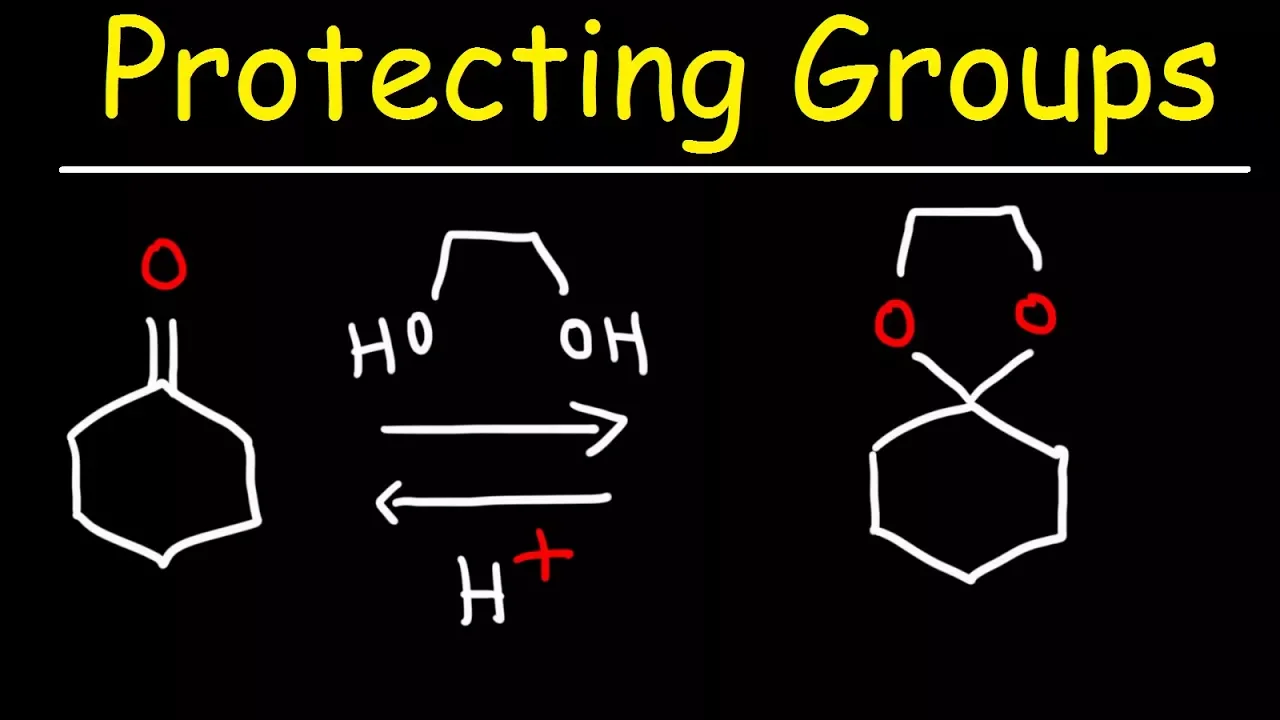












Cyclic acetals/ketals form when aldehydes/ketones react with 1,2-diols (producing five-membered rings) or 1,3-diols (producing six-membered rings) under catalytic acid conditions through a mechanism involving carbonyl protonation, nucleophilic attack, hemiacetal formation, water elimination, intramolecular cyclization, and final deprotonation; this reaction is reversible via hydrolysis with water and acid.
Cyclic Acetal/Ketal Formation: Protecting Groups Mechanism
Added:Mechanisms of nucleophilic addition to carbonyl groups (aldehydes and ketones).
The role of acid catalysis in organic mechanisms, including protonation to increase electrophilicity and activation of leaving groups.
The formation of acyclic hemiacetals and acetals from aldehydes/ketones and simple mono-alcohols.
Basic principles of ring strain and thermodynamic stability of five- and six-membered rings (conformational analysis).
The mechanism of acetal hydrolysis (deprotection) under aqueous acidic conditions to regenerate the original carbonyl compound.
Application of cyclic acetals as protecting groups in multi-step organic synthesis (e.g., protecting a ketone during Grignard reactions or lithium aluminum hydride reductions).
Carbohydrate chemistry, specifically the cyclic hemiacetal and glycoside (acetal) structures of monosaccharides like glucose.
Alternative carbonyl protecting groups, such as cyclic thioacetals, and their use in organic synthesis (e.g., Mozingo reduction).
108 views0likes6:55Original Release: 2024-05-28
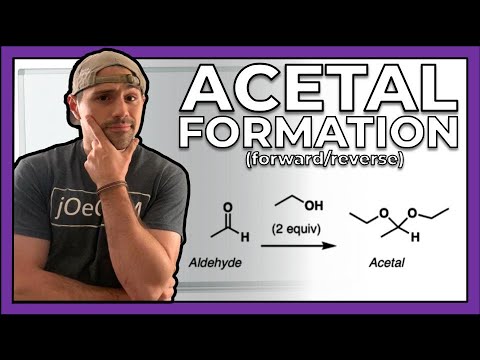
in this video we are going to discuss the formation of cyclic acetals specifically we can react an aldhy or Ketone with a one two dial and catalytic acid and we can generate a five membered ring cyclic acetal or we can use a 13 dial and generate a six membered rink cylic acetal Now tracking with you if we were to just have to predict the product of this reaction here what you could do is draw your structure without the cble bond O then imagine that each of the oxy atoms of your one two dial will connect to the former carbonal carbon and if it's one two dial there's two carbons connecting the two oxygen atoms if we instead were to react with our 13 dial you could draw your structure without the c bond o Bond the carbon to your oxygen atoms of your 13 dial and then connect those via a three carbon chain one two dial makes a five membered ring the one three dial makes the six membered ring and they would be generated via the exact same mechanism okay so what we're going to do here is look at the mechanism for forming that cyclic acetal we're specifically going to form the five membered ring cyclic acetal by reacting with our one two dial and catalytic acid mechanistically we are going to protonate the carbonal oxygen first got a protonate to make it more reactive then your one two dial will attack and bond okay we then need to deprotonate the oxygen atom that just attacked and added in that would then form the Hemi acetal intermediate we now have an O group and an O group bond to the same carbon and ultimately to form the acetyl into cycli we need to kick out a water leaving group so in this step here let's protonate the O component to create our water leaving group from there we are going to collapse our lone pair from our neutral o component and form a pie Bond and that will then expel a water leaving group now as we form that carbonal instead of another alcohol intermolecularly attacking what's going to happen in this step is an intr molecular attack the alcohol within the chain here will attack intr molecularly and that's going to generate a 1 2 3 4 five membered ring tracking with you that's one 2 3 4 and five so we see an intr molecular attack here alcohol within the chain attacks and bonds and we have enough reactivity because the carbonal is charge positive and finally we are going to deprotonate the oxygen atom making that into our neutral acetal structure okay now this mechanism is identical to the one that we just covered on the other page where we formed a normal acetal it's just that if you use regular old alcohol then we had an inter molecular attack when the second alcohol Incorporated but if you're using a one two dial or a 13 dial after we kick out the water leaving group it will be that other alcohol within the chain that will attack intr molecularly to generate a ring and if we started off with our one two dial we're going to form our five membered ring cylic acetal if we instead used a 13 dial we'd form a six-membered ring cylic acetal all right let's recap that mechanism one more time we need to pronate first to increase the reactivity of the Carbono carbon our one two dial will then attack and bond we need to deonate the oxygen atom to stabilize its linkage in the structure and former Hemi acetal intermediate from the Hemi acetal intermediate we need to conceptualize a protonating the O component to create a water leaving group and then we'll expel that water leaving group by collapsing a lone pair from the neutral o portion that creates a charge carbonal intermediate and the alcohol within the chain will then attack intr molecularly forming a five membered ring the oxygen that just attacked at that point is charge positive postively we are then going to deprotonate that oxygen atom to form our cyclic acetal group okay wherein we said both of the oxygens that result attached to what was the carbonio carbon and those oxygens are connected via that two carbon chain so let's imagine we just show another example perhaps we have this structure here if I were to react with my one to dial and catalytic acid I'm going to imagine drawing my structure without the cble bond o I'll then connect each of my oxygens from my one two dial to that carbon and connect them via two carbon chain now watch this let's say that we instead have this example here let's say we have this structure and we react possibly with acetone and we do so with an acid catalyst what feels different about this and is different is in our reaction expression the carbonal is over the arrow and our one two dial is before the arrow whereas appear the one to dial was over the arrow and the carbonal was to the left of the arrow I'm going to use the same strategy essentially to predict my product here what I'm going to do is Imagine connecting each of those oxygen atoms to the former carbonal carbon which is that carbon there I connect each of my oxygen atoms to that carbon former carbonio carbon and that former carbonio carbon had two methyl groups so off that carbon I will have two methyl groups I think that's the easiest way to visualize this in both strategies coming back to the first one here I imagined getting rid of the carbonal and I connected each of my oxygen atoms to that carbonal carbon and then there was a two carbon chain separating them here because that's the larger portion visually I might start by drawing that and then I'm going to imagine each of those oxygen atoms are going to connect to the former carbonio carbon and that for carbonio carbon has two methyl groups attached to it and that would be the structure of the acetyl that I generate okay now ultimately acetal formation can be reversible and we'll talk about this in the next video but just as a little bit of a teaser you could have an acetal and you could then react with water and acid and rea acting with water and acid would reform the carbonal from which that was derived and you would then sever the connections that each of those oxygen atoms have to the carbon and we would regenerate the one to dial and a carbonal okay acetal can form but then we can hydrolize that acetal with water and acid and that will be the topic of our next video
Up Next

6:16
Retrosynthesis Summary: Aldol, Claisen, Michael, & Robinson Annulation
@ChemistryConnected
1.7K views•2020-03-11
83:56
Biocatalysis and Catalysis in Islatravir Synthesis | Merck Webinar
@SCIwheresciencemeetsbusiness
675 views•2020-10-08
10:06
1H NMR: Determining Number of Peaks from Structure
@MSJChem
59.2K views•2017-04-06
17:31
Edible Water Bottles: A DIY Guide to Sodium Alginate Spherification
@ryan
10.5M views•2019-06-21
Related Study Plans & Knowledge Roadmaps
Structured learning paths in Chemistry
chemistry
Nuclear Chemistry: Decay, Meds & Fuel Cycle
01Introduction to Nuclear Structure and Radioactivity
02Decay Dynamics and Kinetics
03Radiation Interaction and Detection
+ 2 more learning modules
24h5 modules
Explore Roadmap
chemistry
Supramolecular Chemistry: Forces & Machines
01Foundations of Chemical Bonding and Intermolecular Forces
02Introduction to Host-Guest Chemistry
03Thermodynamics and Dynamics of Self-Assembly
+ 2 more learning modules
16h5 modules
Explore Roadmap
chemistry
Photochemistry: Excited States & Reactions
01Foundations of Light-Matter Interactions
02Molecular Orbitals and Electronic States
03Photophysical Processes and Jablonski Diagrams
+ 2 more learning modules
18h5 modules
Explore Roadmap
chemistry
Coordination Chemistry: Bonding & Properties
01Introduction to Transition Metals and Ligands
02Crystal Field Theory (CFT) and Geometry
03Magnetic Behavior and Spin States
+ 2 more learning modules
14h5 modules
Explore Roadmap