Two primary methods exist for deflecting asteroids: the nuclear approach, which involves detonating bombs to destroy the asteroid but risks fragmenting it into multiple dangerous pieces that could still hit Earth; and the gravitational tractor beam approach, which uses a space probe to match the asteroid's orbit, apply gentle gravitational forces through retro rockets, and slowly redirect the asteroid's path away from Earth without breaking it apart.
Deflecting an Asteroid: Planetary Defense Science Explained
Added:Deep Dive
Basic orbital mechanics, including Kepler's laws of planetary motion and how celestial bodies orbit the Sun.

Небесная механика для ВсОШ по физике
976
Kepler's three laws form the foundation of celestial mechanics, describing how celestial bodies move under gravitational influence. The two-body problem involves two bodies interacting through a central force following the inverse-square law, resulting in conic section trajectories. Kepler's First Law states planets orbit in ellipses with the Sun at one focus. An ellipse is defined as the set of points where the sum of distances to two foci is constant, with eccentricity (e = c/a) characterizing shape: e = 0 gives a circle, 0 < e < 1 gives an ellipse, e = 1 gives a parabola, and e > 1 gives a hyperbola. Kepler's Second Law states that a line joining a planet to the Sun sweeps out equal areas in equal times, following from conservation of angular momentum L = r × mv. Kepler's Third Law states that the square of the orbital period is proportional to the cube of the semi-major axis: T² ∝ a³, with the general form T² = (4π²/GM)a³ for systems where one body dominates the mass.
Click to watch →

Planetare Geologie (4) • Himmelsmechanik • Meteorströme • Transits | Christian Köberl
52K
Johannes Kepler formulated three fundamental laws describing planetary motion: (1) Planets orbit the Sun in ellipses with the Sun at one focus; (2) Planets sweep out equal areas in equal times, meaning they move faster when closer to the Sun and slower when farther away; (3) The square of a planet's orbital period is proportional to the cube of its semi-major axis (distance from the Sun). These laws describe the basic mechanics of orbital motion. To describe any orbit mathematically, six orbital elements are needed: orbital inclination (angle between orbital plane and ecliptic), length of ascending node (orientation of intersection line relative to vernal equinox), argument of perihelion (orientation of closest approach point), eccentricity (shape of orbit: 0=circular, 0-1=elliptical, 1=parabolic, >1=hyperbolic), semi-major axis (size of orbit), and mean anomaly (position in orbit at a specific time).
Click to watch →

Eugene Bagashov: ‘Elec-centricities’ of Cometary Orbits | EU2016
13.8K
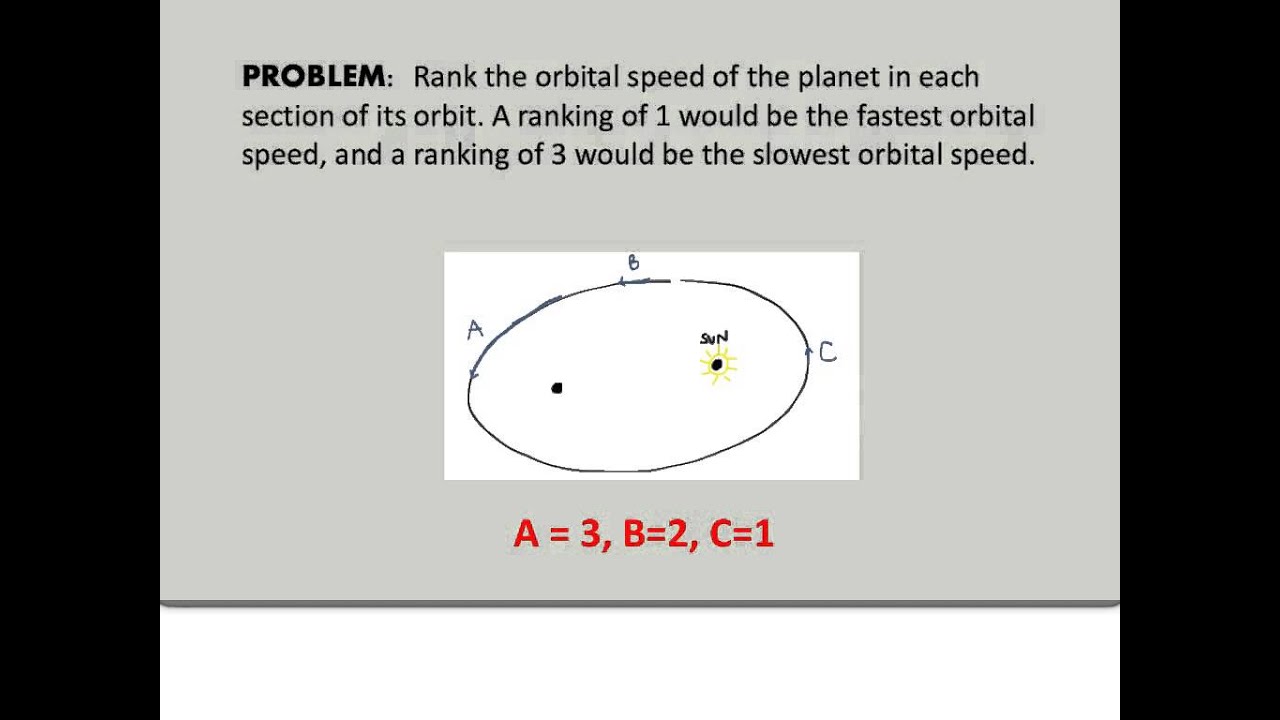
Kepler's three laws describe the motion of celestial bodies in orbit around the Sun. The first law states that all planets move in elliptical orbits with the Sun at one focus. The second law states that a line connecting a planet to the Sun sweeps out equal areas in equal times, meaning planets move faster when closer to the Sun (perihelion) and slower when farther away (aphelion). The third law states that the square of the orbital period is proportional to the cube of the semi-major axis of the orbit, relating the size of an orbit directly to its period.
Click to watch →
ezLecture: Intro to Orbital Motion
448
Kepler's three laws describe planetary motion around the Sun. First Law: Planets orbit in ellipses with the Sun at one focus. Second Law: A line from the Sun to a planet sweeps equal areas in equal times, meaning orbital speed increases when closer to the Sun. Third Law: The square of the orbital period is proportional to the cube of the semi-major axis (T² ∝ a³). These laws were discovered by Kepler in the early 1600s from Tycho Brahe's observations, but the physical explanation (gravity) was not found until Newton in 1686.
Click to watch →

Kepler's Laws of Planetary Motion Explained (Educational Astronomy Video)
404.9K
Johannes Kepler formulated three fundamental laws describing planetary motion. First Law: Planets orbit the Sun in elliptical paths with the Sun at one focus. Second Law: A line connecting the Sun to a planet sweeps equal areas in equal time intervals, meaning planets move faster when closer to the Sun. Third Law: The square of a planet's orbital period equals the cube of its semi-major axis, establishing a mathematical relationship between orbital distance and time.
Click to watch →
Deep Dive
Newton's laws of motion and gravity, specifically the principles of momentum transfer, kinetic energy, and gravitational attraction.
DraftScience vs The Band Wagoners
317
Gravity is just about momentum - it gives things momentum. It functions just like heat or other mechanical things. Bigger things can be understood by hitting something and transferring energy. Gravity is giving something momentum through the same process as an electron hitting inside an atom.
Click to watch →

Documental | Isaac NEWTON y la Gravedad
322.2K
Newton formulated three fundamental laws of motion that form the basis of classical mechanics. The First Law states that a body remains at rest or in uniform rectilinear motion unless acted upon by another body. The Second Law states that the net force applied to a body is proportional to the acceleration it acquires, with the constant of proportionality being the body's mass. The Third Law states that when one body exerts a force on another, the second body exerts an equal and opposite force on the first. Newton applied these principles to celestial mechanics, proposing that the force keeping the Moon in orbit around Earth is the same force keeping Earth in orbit around the Sun. This led to the Law of Universal Gravitation, which states that gravitational force between two bodies depends on their masses and the distance between them. This law enables calculation of gravitational attraction between any two bodies and prediction of celestial movements.
Click to watch →

RADS.201 Fundamentals and Mechanics
3.8K
This section covers Newton's laws of motion and gravitational principles. Newton's First Law states that a body remains at rest or moves with constant velocity unless acted on by an external force. Newton's Second Law states that force equals mass times acceleration (F = ma), with force measured in newtons. Newton's Third Law states that for every action, there is an equal and opposite reaction. Weight equals mass times gravitational acceleration (W = mg). The acceleration of gravity on Earth is 9.8 m/s², representing gravitational field strength. All objects free fall at the same rate regardless of mass because gravitational force per unit mass is constant. Momentum (p) is the product of mass and velocity (p = mv). The Law of Conservation of Momentum states that total momentum before any interaction equals total momentum after the interaction.
Click to watch →

Isaac Newton - History’s Greatest Scientist Documentary
626.2K
Building on Galileo and Descartes, Newton developed new theories about gravity. He discovered that objects exert force over one another when they collide, sending them in different directions along a straight line of center of gravity. He concluded that particles or atoms attract each other with gravitational force correlating to mass and distance between them. His third law states that every action has an equal and opposite reaction—for example, when jumping, gravity pulls you back downward by the same distance. These laws represented a fundamental expansion of human understanding of how gravity and motion work.
Click to watch →

DFCCIL GS- DFCCIL Previous Year Paper 2021 || DFCCIL Previous Paper (SOLVED) || DFCCIL 2023 ||
2.2K
Newton's First Law states objects remain at rest or in uniform motion unless acted upon by an external force. Newton's Second Law states acceleration depends on mass and applied force (F=ma). Newton's Third Law states every action has an equal and opposite reaction. Gravitational attraction is mutual between all objects in the universe—the Earth and Moon attract each other, not just one attracting the other.
Click to watch →
Deep Dive
The definition and classification of Near-Earth Objects (NEOs) and the general composition of asteroids.

Apophis - O Asteroide do Apocalipse Está de Volta
558.7K
Near-Earth Objects (NEOs) are asteroids and comets that orbit the Sun very close to Earth's orbit. Some NEOs orbit at the same distance as Earth, making them co-orbital objects. These objects are classified into three categories based on their orbital characteristics: Apollo asteroids (cross Earth's orbit with larger orbits), Aten asteroids (cross Earth's orbit with smaller orbits), and Atira asteroids (completely inside Earth's orbit). Scientists have identified approximately 14,000 NEOs, which represent potential threats to Earth due to their proximity.
Click to watch →

Apophis, The Asteroid That Could Hit Earth In 2029
659.1K
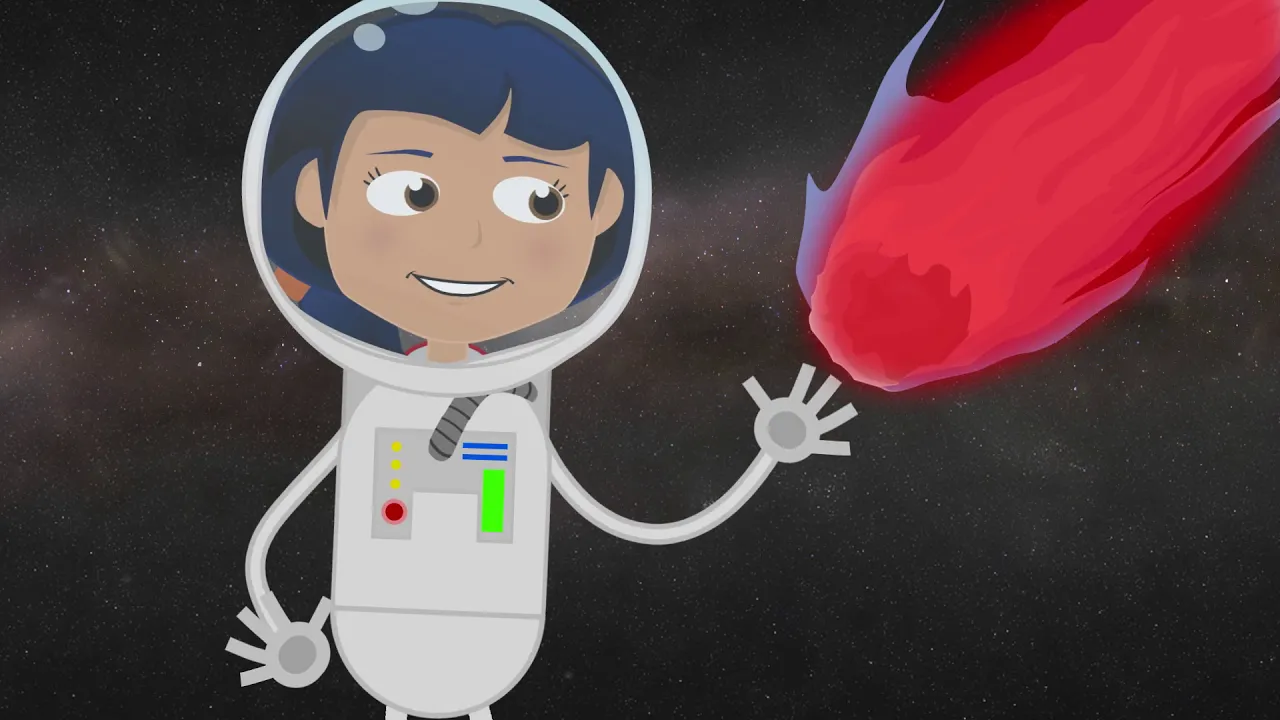
Near Earth Objects (NEOs) are space objects such as asteroids or comets whose orbits around the Sun place them close to Earth. The term 'close' in astronomical terms means being less than 1.3 astronomical units from Earth, where one astronomical unit equals 93 million miles (150 million km). This distance is approximately equal to the distance from Earth to the Sun. An object classified as a NEO does not necessarily mean it will collide with Earth; it simply means scientists must monitor it carefully.
Click to watch →
Let's Launch! Maya Investigates Near Earth Objects
1K
Near-earth objects (NEOs) are celestial bodies in our solar system, including comets and asteroids, whose orbits bring them within 1.3 astronomical units (AU) of the Sun—where 1 AU equals Earth's distance from the Sun. These objects are remnants from solar system formation, with NASA cataloging approximately 18,500 asteroids and 107 comets. Asteroids form between Mars and Jupiter in the asteroid belt, consisting of rocky and metallic material with impact craters. Comets originate from the outer solar system in the Kuiper belt and Oort cloud, composed of ice, dust, and rock, earning them the nickname 'dirty snowballs.' Both types lack sufficient mass for spherical shapes and have impacted Earth throughout history, including events potentially linked to dinosaur extinction.
Click to watch →

Solar System: Asteroids, 1 of 2
1K
Asteroids are classified into three broad composition types based on spectral analysis: C-type (carbonaceous, over 75% of known asteroids, dark, clay/silicate rocks, oldest solar system objects, found in outer belt); S-type (silicaceous, ~17%, bright, iron-magnesium silicates, dominate inner belt); and M-type (metallic, bright, mostly iron, inhabit middle belt). Near-Earth asteroids (NEAs) within 1.3 AU of the Sun represent fragments ejected from the main belt by collisions and Jupiter's gravity, potentially including dead comet nuclei. NEAs are categorized into three groups: Amor asteroids crossing Mars' orbit but not reaching Earth; Apollo asteroids crossing Earth's orbit with orbital periods over one year; and Aten asteroids crossing Earth's orbit with periods under one year. NASA monitors NEAs due to potential impact risks.
Click to watch →

NEOs: Relato para dormir y descubrir los objetos cercanos a la Tierra. Sonido HOGUERA (Astronomía)
12.4K
The solar system contains billions of objects beyond the commonly known planets, including asteroids, meteoroids, and comets orbiting in stable regions like the asteroid belt, Kuiper belt, and Oort cloud. Near Earth Objects (NEOs) are asteroids or comets whose closest approach to the Sun is 1.3 astronomical units or less, and whose closest approach to Earth is 0.3 astronomical units or less. NEOs are classified into three types: Amor asteroids (orbits cross Mars and Jupiter but never Earth), Apollo asteroids (orbits extend beyond Earth's orbit), and Aten asteroids (most dangerous, remain in proximity to Earth's orbit). Potentially Hazardous Asteroids (PHAs) are objects with a minimum diameter of 140-150 meters and a closest approach to Earth of no more than 7.5 million kilometers. Currently, approximately 1,800 PHAs have been cataloged, though none are expected to impact Earth in the near future.
Click to watch →
Prerequisite Knowledge
- Concept 01Basic orbital mechanics, including Kepler's laws of planetary motion and how celestial bodies orbit the Sun.
- Concept 02Newton's laws of motion and gravity, specifically the principles of momentum transfer, kinetic energy, and gravitational attraction.
- Concept 03The definition and classification of Near-Earth Objects (NEOs) and the general composition of asteroids.
Subsequent Learning
- Step 01Case studies of real-world planetary defense missions, such as NASA's Double Asteroid Redirection Test (DART).
- Step 02Advanced deflection technologies, including gravity tractors, laser ablation, solar sails, and nuclear mitigation strategies.
- Step 03The physical properties of asteroids, such as the difference between solid monoliths and 'rubble piles', and how this affects deflection dynamics.
- Step 04The geopolitical and legal frameworks of planetary defense, including international space law and global coordination groups like the Asteroid Warning Network (IAWN).
Two Deflection Ways
Macho Nuclear Option
Fragmentation Risk
Gentle Tractor Pull
Gravity Assist Mechanism
Temporary Deflection
Two Deflection Ways
0:00Playing Section
- 1
Asks for top two asteroid deflection methods.
- 2
First method is explosive nuclear destruction.
- 3
Second is a gentle gravitational tractor approach.
The Deflection Dilemma and Dual-Use Risks
While asteroid deflection methods like kinetic impactors are scientifically feasible, they introduce a profound geopolitical risk known as the 'Deflection Dilemma,' first popularized by Carl Sagan and Steven J. Ostro. This perspective argues that any technology capable of deflecting an asteroid away from Earth could also be weaponized to steer a benign asteroid toward a target on Earth, creating an existential dual-use hazard. Additionally, technical critics emphasize the risk of 'disruption' over deflection: attempts to nudge a rubble-pile asteroid could accidentally shatter it, creating a swarm of smaller, unpredictable fragments that could still devastate Earth. Consequently, some experts argue that developing these technologies before establishing foolproof international governance poses a greater threat to humanity than the natural impact hazard itself.
Deep Dive
Case studies of real-world planetary defense missions, such as NASA's Double Asteroid Redirection Test (DART).

NASA’s DART Mission Tests Earth’s Defenses Against Asteroids | WSJ
190.8K
NASA's Double Asteroid Redirection Test (DART) was a $325 million mission that intentionally crashed a spacecraft into asteroid Dimorphos on September 26th, marking humanity's first planetary defense test. The mission tested kinetic impactor technology, which uses spacecraft to deflect near-Earth objects by changing their orbits. DART targeted the binary asteroid system Didymos, colliding at 14,000 miles per hour. The mission employed SMART Nav for autonomous navigation and LICIACube for imaging. Scientists will measure orbital changes using light curves and the European Space Agency's Hera mission will conduct follow-up surveys in 2026. This real-world test demonstrates humanity's capability to handle asteroid deflections and informs future planetary defense strategies.
Click to watch →

Enceladus passes habitability test | New Scientist Weekly podcast, episode 137
2.2K
NASA's DART (Double Asteroid Redirection Test) mission represents humanity's first real-world planetary defense test. The 500-kilogram satellite will impact Dimorphos, a 160-meter asteroid orbiting Didymos, to test whether spacecraft can successfully alter asteroid trajectories. The satellite will travel at 6.6 km/s in the opposite direction to Dimorphos's motion, slowing it slightly to reduce its orbit. The mission demonstrates that even small initial impacts can produce massive trajectory changes over millions of miles. NASA's Sentry program tracks near-Earth asteroids and maintains risk tables, with current highest-risk objects having only a 2.5% chance of impact by 2082.
Click to watch →

Double Asteroid Redirection Test (DART) Mission
1.1M
NASA's Double Asteroid Redirection Test (DART) mission demonstrates humanity's first planetary defense test to see if intentionally crashing a spacecraft into an asteroid can change its course, using the binary asteroid system Didymos and Dimorphos as a safe testbed; the spacecraft will autonomously navigate to impact Dimorphos at approximately 15,000 miles per hour to alter its orbital period around Didimos, with scientists measuring the deflection effects through telescopic observations, onboard cameras, and future missions like the Italian cubesat LICIACube and ESA's Hera spacecraft.
Click to watch →

The Double Asteroid Redirection Test: Results from NASA’s First Planetary Defense Test Mission
1.8K
NASA's Double Asteroid Redirection Test (DART) was the first planetary defense mission to successfully demonstrate the kinetic impactor technique by intentionally crashing a spacecraft into the asteroid Dimorphos, thereby altering its orbital period around its parent asteroid Didymos by 33 minutes—far exceeding the mission's minimum requirement of 73 seconds—and proving that human intervention can change an object's trajectory in space.
Click to watch →

Dart Mission | First Planetary Defense Test Mission of NASA | Secrets of Space | DART Mission Launch
229
The Double Asteroid Redirection Test (DART) is NASA's first demonstration of the kinetic impactor technique to change an asteroid's motion in space. The mission intentionally crashes a spacecraft into the binary asteroid Dimorphos (160m diameter) to deflect its trajectory, testing whether this approach could protect Earth from hazardous asteroids. The spacecraft uses electric propulsion (NEXT-C system) and autonomous navigation with DRACO camera. The mission targets the Didymos system because Dimorphos's size represents typical Earth-threatening asteroids. Despite no known large asteroids threatening Earth for 100 years, only 40% of such asteroids have been discovered. The mission will be monitored by Earth-based telescopes and planetary radar to measure the orbital period change caused by the impact.
Click to watch →
Deep Dive
Advanced deflection technologies, including gravity tractors, laser ablation, solar sails, and nuclear mitigation strategies.
The Universe S03E08 STOPPING ARMAGEDDON - BluRay 1080p
102
Several deflection strategies exist: kinetic impactors (colliding spacecraft with asteroids), asteroid-versus-asteroid (using non-threatening asteroids to knock Earthbound objects off course), and nuclear explosions (standoff detonations that heat and blow off surface material). Solar sails concentrate sunlight to vaporize surface rock, creating propulsion jets. Lasers cause material to fly off asteroids, pushing them away. Each method has trade-offs - nuclear options are most efficient but banned from space by treaty, while lasers and solar sails face implementation challenges with long-term positioning and dust management. The gravity tractor, developed by the B612 Foundation, uses ion engines to hover near an asteroid, using gravitational pull to slowly change its trajectory. It's about the size of a golf cart and can make precise adjustments over weeks, months, or years. The B612 Foundation aims to perform a test deflection on a non-threatening asteroid by 2015.
Click to watch →

En el 2015 intentarán desviar un asteroide al estilo 'Armagedón' - www.tispain.com
7.1M
Advanced deflection technologies include solar sails and laser systems. Solar sails use concentrated sunlight to heat asteroid surfaces, creating vapor jets that push the asteroid away from its trajectory. A 1980s experiment accidentally discovered that laser pulses can cause material to vaporize and be ejected from surfaces, demonstrating the principle behind these deflection methods. A proposed super-laser system, powered by rockets and solar panels, could be positioned 5 kilometers from an asteroid and use short pulses to vaporize surface material, creating thrust. The laser can be directed precisely and gradually, potentially over several years. However, maintaining the laser or solar sail in the correct position for extended periods is challenging, and the expelled dust could affect the system's effectiveness. Nuclear deflection, while potentially most effective for large asteroids, is complicated by international treaties prohibiting nuclear weapons in space.
Click to watch →

Asteroid Defense
109.2K
Alternative asteroid deflection methods include using solar sails and lasers. One innovative concept involves spraying paint on an asteroid to make it highly reflective, so sunlight exerts radiation pressure to push it off course—similar to how solar sails work. More practical is using powerful lasers to ablate (heat and vaporize) the asteroid's surface, creating a rocket-like effect where the vaporized material provides thrust. Lasers offer advantages over nuclear weapons: they deliver energy continuously rather than in single bursts, can be precisely controlled, and the light travels near-instantaneously across interplanetary distances, allowing real-time adjustments to deflection efforts.
Click to watch →

The Universe S03E08 Stopping Armageddon
117
Advanced deflection technologies include laser systems and solar sails. Laser deflection uses powerful light beams to vaporize surface material on asteroids, creating jets that push the object off course. This method is economical and can be performed by a robotic spacecraft over a 3-month period. The technology was discovered accidentally in the 1980s when researchers observed material being ejected from silicon wafers during laser experiments. A super laser 5,000 times more powerful than everyday lasers could be used, positioned up to 5 km away from the asteroid. Solar sails use orbiting reflectors to concentrate sunlight on asteroids, vaporizing surface rock and creating propulsion. Both methods eject only dust, posing no threat to Earth, but require precise positioning over extended periods. The gravity tractor, developed by the B612 Foundation, uses gravitational attraction to slowly pull asteroids off course without physical contact. It hovers near asteroids using ion engines to counteract gravitational pull, making precise adjustments after primary deflection.
Click to watch →

Hemos encontrado el asteroide más grande de la historia.
1.9M
Advanced planetary defense methods include using solar sails to change asteroid trajectories. By reflecting sunlight off a reflective surface, the radiation pressure can gradually push an asteroid off course. Alternatively, a gravity tractor spacecraft could use gravitational attraction to slowly pull an asteroid away from a collision course without physically touching it.
Click to watch →
Deep Dive
The physical properties of asteroids, such as the difference between solid monoliths and 'rubble piles', and how this affects deflection dynamics.

Астероидная угроза Апофис, Бенну и защита Земли | Документальный фильм
1.7K
When OSIRIS-REx's manipulator touched Bennu's surface, instead of bouncing off like a concrete wall, it sank 50 centimeters into the asteroid with almost no resistance. The spacecraft could have completely sunk into Bennu's interior if emergency thrusters hadn't fired. This was not landing on rock but jumping into a pool of plastic balls. Laboratory analysis confirmed density is only 1.2 grams per cubic centimeter—slightly denser than water and much less dense than any Earth rock. This means up to 40% of the asteroid's volume is empty space. These asteroids are essentially giant cosmic sponges made of stone. For laypeople, this sounds like good news (easier to destroy), but for ballistics specialists, it's a nightmare scenario. Impact physics differs dramatically between solid and rubble-pile asteroids. A strike on a monolith transfers energy throughout the body, changing its trajectory. A strike on a rubble pile is absorbed internally, dissipated through friction between rocks and compression of voids. Like trying to push a heavy oak cabinet versus a bag filled with feathers and down, the same force produces vastly different results. Rubble piles can absorb enormous kinetic energy while maintaining their trajectory. Explosive deflection methods also fail against rubble piles. Shock waves that would crack or push a solid monolith dissipate almost instantly in porous material. The explosive energy is absorbed as heat, leaving only a small crater on the surface while the asteroid continues its deadly path. The Yarkovsky effect, predicted by Russian engineer Ivan Yarkovsky in 1900, describes how solar heating creates tiny but persistent forces on rotating asteroids. One side of an asteroid heats up during the day, then cools and radiates heat into space during the night. By Newton's third law, this creates a constant sideways thrust. This force is tiny—equivalent to the weight of a sheet of paper on a palm—but in the frictionless vacuum of space, it accumulates over years, potentially shifting a 40-million-ton asteroid by tens or hundreds of kilometers. For Apophis, flying toward a 600-meter keyhole, even a 0.5 km shift is the difference between life and death. The Yarkovsky effect makes precise orbit prediction impossible because we don't know Apophis's exact shape, thermal properties, or rotation axis.
Click to watch →

É POSSÍVEL EVITAR A QUEDA DE UM ASTEROIDE / COMETA NA TERRA / COMO FAZER ? OLHE PARA CIMA.
434.9K
Many asteroids are 'rubble piles' - loose aggregations of rocks held together by gravity rather than solid bodies. This structure affects deflection strategies because impactors may not penetrate deeply, and fragments may re-aggregate. The OSIRIS-REx mission to asteroid Bennu demonstrated that rubble pile asteroids have complex surface dynamics that complicate sample collection and deflection attempts.
Click to watch →

DART Asteroid Impact LIVE with Mission Team
455K
Scientists do not know the internal structure of the target asteroid Dimorphos until after the DART impact. The asteroid could be either a solid rock or a 'rubble pile' - a loosely bound collection of rocks and dust held together by gravity. This uncertainty is significant because the impact effectiveness depends heavily on the asteroid's structure. If Dimorphos is a rubble pile, much of the impact energy will be absorbed in crushing the spaces between particles, resulting in less effective deflection. If it is a solid rock, the impact will transfer momentum more efficiently, similar to hitting a solid bowling ball.
Click to watch →

1 MINUTE AGO: Vera Rubin's First Images Just Exposed Something TERRIFYING in Space!
215
Models describing how asteroids form, how they evolve after collisions, and how they might be approached, redirected, or mined for resources all depend heavily on assumptions about internal structure. A rubble pile responds to an impact, a gravitational tug, or an attempted deflection maneuver completely differently than something closer to a single solid mass. If a meaningful fraction of large asteroids turn out to be built more like solid rock than loose gravel, held together by cohesive strength rather than gravity alone, every calculation involving how to nudge a dangerous asteroid off a collision course would need to be re-examined against a completely different set of physical assumptions. A deflection technique calculated to work against a loosely bound pile of rubble, gently redirecting its overall trajectory without disturbing its fragile internal structure, could behave in an entirely unpredictable way if aimed instead at something closer to a single cohesive mass.
Click to watch →

Rolls-Royce Space Reactor // Close Call in Orbit // James Webb's Back
102.7K
Most smaller asteroids are rubble pile asteroids—collections of rock and debris held together loosely by mutual gravity rather than being solid monolithic bodies. These form when asteroid collisions break up larger bodies into debris clouds that gravity pulls back together into loose aggregates. They are less dense and more porous than solid asteroids. This structure means destroying them with nuclear weapons is ineffective, as the explosion simply disperses debris that gravity will reassemble. Defense strategies must instead focus on deflecting these asteroids entirely rather than attempting to destroy them.
Click to watch →
Deep Dive
The geopolitical and legal frameworks of planetary defense, including international space law and global coordination groups like the Asteroid Warning Network (IAWN).

INFORMAÇÕES SECRETAS! A COISA TA FEIA?
114.3K
The International Asteroid Warning Network (IAWN) is a global coordination system operated by NASA that tracks asteroids and comets worldwide. It serves as the primary mechanism for planetary defense, coordinating international efforts to monitor potentially hazardous objects and assess potential threats to Earth.
Click to watch →
¿La NASA ACTIVÓ el PROTOCOLO de DEFENSA PLANETARIA por 3I/ATLAS? Va ser que no
187.3K
The International Asteroid Warning Network (IAWN), an independent international collaboration under the United Nations Office for Outer Space Affairs and the International Astronomical Union, has launched a public campaign to monitor the interstellar comet 3I/ATLAS, which is older than Earth and the Sun (estimated 7,000-11,000 million years old) and has a nucleus of approximately 5-11 km diameter; this campaign is not a military defense operation but a scientific initiative to improve astrometric measurements of comets, open to public participation through a virtual workshop and observation coordination, with the goal of contributing to future planetary defense systems.
Click to watch →
NASA Acil Durum mu İlan Etti? Gezegen Savunma Sistemi Nedir?
12.3K
This segment details the international planetary defense framework. The International Asteroid Warning Network (IAWN) serves as the 'eyes,' detecting and tracking hazardous objects. The Space Situational Awareness program acts as the 'brain,' developing response plans. NASA's Planetary Defense Coordination Office serves as the 'hands,' implementing actions. Alert thresholds exist: objects over 10 meters with greater than 1% collision probability trigger formal warnings. This system requires coordination between scientific assessment and political will, with exercises conducted in 2019 and 2024 to test response capabilities.
Click to watch →

ESA's Hera mission launch (Official broadcast)
128.5K
Planetary defense requires international cooperation because asteroid impacts transcend national boundaries. The United Nations Office for Outer Space Affairs coordinates global efforts through the International Asteroid Warning Network (IAWN) and Space Mission Planning Advisory Group (SMPAG). ESA maintains comprehensive planetary defense capabilities including observation, orbit prediction, and mitigation planning. The FlyEye network addresses observational gaps. Astronaut perspectives highlight that while robotic missions like Hera are preferable for dangerous destinations, human missions to asteroids may become feasible in the future. This framework enables coordinated response planning among space agencies, representing a model for addressing global challenges through international scientific cooperation.
Click to watch →
¡APARECE EN EL CIELO! ¿VIENEN DEL 3I ATLAS? • MILAGRO EN EL HURACÁN • REPORTE SISMICO GLOBAL
14.5K
Since September, NASA and the European Space Agency activated a planetary defense observation campaign under the International Asteroid Warning Network (IAWN). This is not because there is danger, but as a real exercise in tracking a real interstellar visitor. The campaign continues as the comet moves away from the solar system.
Click to watch →
Two Deflection Ways
Macho Nuclear Option
Fragmentation Risk
Gentle Tractor Pull
Gravity Assist Mechanism
Temporary Deflection
Two Deflection Ways
0:00- 1
Asks for top two asteroid deflection methods.
- 2
First method is explosive nuclear destruction.
- 3
Second is a gentle gravitational tractor approach.
The Deflection Dilemma and Dual-Use Risks
While asteroid deflection methods like kinetic impactors are scientifically feasible, they introduce a profound geopolitical risk known as the 'Deflection Dilemma,' first popularized by Carl Sagan and Steven J. Ostro. This perspective argues that any technology capable of deflecting an asteroid away from Earth could also be weaponized to steer a benign asteroid toward a target on Earth, creating an existential dual-use hazard. Additionally, technical critics emphasize the risk of 'disruption' over deflection: attempts to nudge a rubble-pile asteroid could accidentally shatter it, creating a swarm of smaller, unpredictable fragments that could still devastate Earth. Consequently, some experts argue that developing these technologies before establishing foolproof international governance poses a greater threat to humanity than the natural impact hazard itself.
Basic orbital mechanics, including Kepler's laws of planetary motion and how celestial bodies orbit the Sun.
Newton's laws of motion and gravity, specifically the principles of momentum transfer, kinetic energy, and gravitational attraction.
The definition and classification of Near-Earth Objects (NEOs) and the general composition of asteroids.
Case studies of real-world planetary defense missions, such as NASA's Double Asteroid Redirection Test (DART).
Advanced deflection technologies, including gravity tractors, laser ablation, solar sails, and nuclear mitigation strategies.
The physical properties of asteroids, such as the difference between solid monoliths and 'rubble piles', and how this affects deflection dynamics.
The geopolitical and legal frameworks of planetary defense, including international space law and global coordination groups like the Asteroid Warning Network (IAWN).
174.9K views1.9Klikes0:55@QuantumFeverOriginal Release: 2025-08-12
Give me your top two ways to deflect an asteroid.
>> Uh, well, there's the macho way. You're imagining the the war general. You know, let's blow the sucker out of the sky.
You know, we got nukes. Let's So, you send out nukes and you destroy it and then it becomes harmless little bits that then burn up in an atmosphere. But the problem is we're really good at blowing stuff up and we're less good at knowing where the pieces go afterwards.
Suppose you blow up and then now it's two pieces. Now, you have to evacuate two parts of Earth instead of just one.
A kindler, gentler solution would be they've worked on a gravitational tractor beam where you send a space probe and you match orbits and you put it adjacent to the asteroid and watch what happens and you park it there and there they are moving. Well, they'll feel each other's gravity and they'll want to move towards one another, but you have little retro rockets on your space probe and you don't let that happen. You have actually attracted it out of the path of harm's way. It'll still be there to harm you in another day.
Up Next
35:51
Faraday's Law & Lenz's Law | General Physics
@ChadsPrep
34.2K views•2024-02-26

12:53
21cm Hyperfine Transition in Neutral Hydrogen: Radio Astronomy Basics
@AaronRobertParsons
12.4K views•2011-10-13

32:32
NMR Spin Physics I: Zeeman Effect, Resonance Condition & Larmor Frequency
@nptel-indianinstituteofsci8064
2.3K views•2024-01-17

27:14
Entropy and the Second Law of Thermodynamics Explained
@veritasium
27.5M views•2023-07-01
Related Study Plans & Knowledge Roadmaps
Structured learning paths in Physics
physics
Nuclear Physics (Decay, Fission & Reactors)
01Atomic Structure and the Binding Force
02Radioactive Decay and Half-Life
03Nuclear Fission Mechanics and Chain Reactions
+ 2 more learning modules
12h5 modules
Explore Roadmap
physics
Soft Matter (Polymers, Colloids & Rheology)
01Foundations of Soft Matter & Thermal Forces
02Polymer Physics and Macromolecules
03Colloids, Surfactants, and Self-Assembly
+ 2 more learning modules
38h5 modules
Explore Roadmap
physics
Analytical Mechanics: Lagrangian & Hamiltonian
01Mathematical Foundations: Calculus of Variations
02From Newtonian Mechanics to Constraint Dynamics
03The Principle of Least Action & Lagrangian Mechanics
+ 3 more learning modules
28h6 modules
Explore Roadmap
physics
General Relativity (Spacetime & Cosmology)
01Foundations of Relativity: Special Relativity
02The Geometry of Spacetime: Equivalence Principle & Curvature
03Einstein's Field Equations: The Mathematics of Gravity
+ 2 more learning modules
55h5 modules
Explore Roadmap